
Published on 2 Jun 2017
From nipple censorship to breast milk regulation, the government is making it hard to have breasts. The FCC maintains oversight of how much and what kind of breasts can grace public airwaves. Its decisions have ripple effects, since cable broadcasters often voluntarily comply with FCC guidelines.
A more dire issue than strategic anatomical censorship is the issue of breast milk. Between one and five percent of American women aren’t able to produce breast milk, and some babies can’t drink formula. When the two overlap the demand for breast milk is life or death. But acquiring breast milk from donation-based milk banks can be difficult and prohibitively expensive. So some women buy their breast milk on an online “gray market” that stifles suppliers.
In this week’s Mostly Weekly Andrew Heaton explains why the government should get its hands off our boobs.
Performed by Andrew Heaton
Written by Sarah Rose Siskind with writing assistance from Andrew Heaton and David Fried.
Edited by Austin Bragg and Sarah Rose Siskind.
Produced by Meredith and Austin Bragg.
June 3, 2017
The Government Hates Boobs
Secondary boycotting
Ace describes the way political groups can exercise economic pressure on third parties to influence or even to eliminate media voices with which they disagree:
The tactic being objected to — and I didn’t make this clear yesterday — is the tactic created by the left called a “secondary boycott.”
None of you can “boycott” Rachel Maddow — you’re already not watching her, and you enjoy not watching her, and you recommend not watching her to all of your friends.
Well, leftists realized that about Rush Limbaugh — you can’t boycott that which you already don’t use — and so invented the tactic of telling advertisers: Stop advertising on his show or we will boycott you.
That’s the “secondary” part of the boycott: You’re not boycotting the primary target. Which is obviously your right. You’re now conducting political campaigns against businesses to make them stop advertising, and get the show taken off the air entirely.
This is why Cars Dot Com and USAA boycotted Hannity — because the losers of this movement decided to start pressuring the advertisers to stop advertising there.
This is what I mean by “constant political campaigns being run against people not actually running for any office.” These are actual political campaign style efforts — with websites, donor buttons, etc. — being run not just during campaign season, and not just against an office-seeker, but 24 hours a day, seven days a week, fifty two weeks a year, against just about anybody.
Note that the fringe actors who do this shit do so to raise money. They’re fringe, and they’re not going to be hired by actual political campaigns, for the most part.
But they have to make money, don’t they?
So they just decided to invent their own political campaign which is not time-limited as ordinary campaigns are, and just buckrake endlessly to get this or that person silenced.
And they’ve had some success.
Even where they don’t succeed outright, they make themselves permanent residents of your mind: Because they’ve taught you to fear them.
This is what I’m objecting to — I understand that there will be politics in politics, but I don’t want fundraising political campaigns constantly running against anyone the left doesn’t like making all of lives, every single day, every single hour, part of and endless and ugly War of All Against All just so some energetic obsessives can make a dime and feel powerful.
June 1, 2017
Terence Corcoran – It was the fake Tories that did in Maxime Bernier
In the Financial Post, Terence Corcoran blames the supply management fans and other anti-free market types for Maxime Bernier’s loss in the federal Conservative leadership race:
On Monday, during a noon-hour Ontario CBC Radio show, the host opined that Maxime Bernier lost the Conservative leadership because of his “wild ideas,” as if the libertarian politician from Quebec had been offering conservatives options too crazy to contemplate.
Wild ideas? In the recent history of Canadian politics, no politician has been more grounded or sane.
[…] if accounts from the frontline are accurate, Bernier would have won the leadership were it not for vote-rigging infiltrators from the farmers’ unions and associated backers of supply management.
One source says that as many as 3,000 points went to Scheer, mostly in Quebec and Ontario, as a result of an organized campaign in which farmers temporarily joined the Conservative party and then cast votes against Bernier.
Bernier didn’t lose the leadership vote; it was stolen from him by a concerted campaign organized by members of Union des producteurs agricoles (UPA) and farmers in Ontario. Via Facebook, Quebec farmers and others were urged to join the Conservative party and vote for Andrew Scheer.
Three Quebec ridings tell the story. One is Beauce, Bernier’s home riding. Right off the bat, in the opening round of the ranked ballot, Scheer collected 46.63 per cent of the points against 47.5 per cent for Bernier. By the end of the final round, Scheer was at 51 per cent versus 48 for Bernier — in a riding where Bernier is a local hero among Conservatives and hardly anyone would even know Scheer’s name.
May 31, 2017
Stormtrooper gear
In The Register, Gavin Clarke talks about “inexpensive” replicas of the original Star Wars stormtrooper helmets and other gear:

Original Stormtrooper Hero Helmet from Shepperton Design Studios + originalstormtrooper.com
Two years ago, the helmet of an Empire Strikes Back stormtrooper fetched $120,000 (£92,736) at US auction.
An Imperial TIE fighter pilot’s helmet, said to be one of just 12 made for A New Hope, went the following year for £180,000 ($233,244) – something the BBC’s Antiques Roadshow presenter Fiona Bruce dismissed as a “piece of plastic”.
Big money indeed, but the record to date for stormtroopers, the most widely recognised symbol of the Empire, is held by A New Hope sandtrooper helmet, named the Stop That Ship Helmet for the scene it briefly appeared in – the Millennium Falcon blasting out of Mos Eisley under fire. That helmet sold at auction in April for $190,000 (£145,675) in the US.
Yes, four decades after A New Hope debuted in the US – 25 May, 1977 – props built for just £20 a pop are fetching the price of a three-bed semi in the West Midlands.
What’s helping drive up the price is scarcity: just 50 stormtrooper uniforms were made for A New Hope. Those that survived the shoot now reside in private collections.
[…]
So, where does a 30-something who wants a piece of the legend go? Not the mass market of sub-£1,000 suits that targets the fancy dresser.
No, they tap a cottage industry of British specialists – Ainsworth’s Shepperton Design Studios, Edwards’ CfO, and RS Prop Masters in the UK.
This trio is busy vacuum forming sheets of white ABS plastic using curved moulds to a 1.5mm thickness, cutting out and assembling around 30 pieces per suit, making straps, body suits, eyepieces, mics, boots and blasters. Prices run from £1,200 – around $1,550.
And in case you were wondering, there are few concessions on size or girth. The original stormtrooper was 5ft 10in and 110lbs. He remains so. The most you can expect is a little extra plastic around the overlapping at the edges if you’re a little large for a stormtrooper.
May 30, 2017
The Disgusting Contents of Worcestershire Sauce (and Why It s Called That)
Published on 27 Mar 2017
In this video:
Worcestershire sauce, sometimes known as “Worcester sauce” is a savoury sauce that is often added to meat and fish dishes or, if you like your alcoholic beverages, the Bloody Mary cocktail. It may (or may not depending on how much you research your sauce choices) surprise you to learn that it’s literally made from fermented fish and spices.
Want the text version?: http://www.todayifoundout.com/index.php/2013/10/worcestershire-sauce-called/
May 25, 2017
Words & Numbers: Government Can’t Stop Creative Destruction
Published on 24 May 2017
Technology doesn’t just change things, it utterly destroys things. And that’s just fine. It happens so often that people barely even notice when it does. Think about all the new services that have come to market just over the past few years: Uber, Airbnb, Redbox … the list goes on and on.
But that’s only half the story. In turn, the list of services replaced by these new ones is similarly long: taxis, hotels, Blockbuster, etc. And workers in these industries often lose their jobs in the line of creative destruction. We generally accept this as the price of innovation, but many people try to use the government to stop this by blocking the new services.
Today we’re seeing this with more politically well-connected industries like taxis and hotels. Pressure is put on Uber and Airbnb, respectively, to “protect” the established industries they are upending.
This week, Ant and James talk about why this is always a mistake.
Learn More:
https://fee.org/articles/government-cant-stop-creative-destruction/
May 23, 2017
QotD: The dangers of career “dualization”
This concept [of dualization] applies much more broadly than just drugs and colleges. I sometimes compare my own career path, medicine, to that of my friends in computer programming. Medicine is very clearly dual – of the millions of pre-med students, some become doctors and at that moment have an almost-guaranteed good career, others can’t make it to that MD and have no relevant whatsoever in the industry. Computer science is very clearly non-dual; if you’re a crappy programmer, you’ll get a crappy job at a crappy company; if you’re a slightly better programmer, you’ll get a slightly better job at a slightly better company; if you’re a great programmer, you’ll get a great job at a great company (ideally). There’s no single bottleneck in computer programming where if you pass you’re set for life but if you fail you might as well find some other career path.
My first instinct is to think of non-dualized fields as healthy and dualized fields as messed up, for a couple of reasons.
First, in the dualized fields, you’re putting in a lot more risk. Sometimes this risk is handled well. For example, in medicine, most pre-med students don’t make it to doctor, but the bottleneck is early – acceptance to medical school. That means they fail fast and can start making alternate career plans. All they’ve lost is whatever time they put into taking pre-med classes in college. In Britain and Ireland, the system’s even better – you apply to med school right out of high school, so if you don’t get in you’ve got your whole college career to pivot to a focus on English or Engineering or whatever. But other fields handle this risk less well. For example, as I understand Law, you go to law school, and if all goes well a big firm offers to hire you around the time you graduate. If no big firm offers to hire you, your options are more limited. Problem is, you’ve sunk three years of your life and a lot of debt into learning that you’re not wanted. So the cost of dualization is littering the streets with the corpses of people who invested a lot of their resources into trying for the higher tier but never made it.
Second, dualized fields offer an inherent opportunity for oppression. We all know the stories of the adjunct professors shuttling between two or three colleges and barely making it on food stamps despite being very intelligent people who ought to be making it into high-paying industries. Likewise, medical residents can be worked 80 hour weeks, and I’ve heard that beginning lawyers have it little better. Because your entire career is concentrated on the hope of making it into the higher-tier, and the idea of not making it into the higher tier is too horrible to contemplate, and your superiors control whether you will make it into the higher tier or not, you will do whatever the heck your superiors say. A computer programmer who was asked to work 80 hour weeks could just say “thanks but no thanks” and find another company with saner policies.
(except in startups, but those bear a lot of the hallmarks of a dualized field with binary outcomes, including the promise of massive wealth for success)
Third, dualized fields are a lot more likely to become politicized. The limited high-tier positions are seen as spoils to be distributed, in contrast to the non-dual fields where good jobs are seen as opportunities to attract the most useful and skilled people.
Scott Alexander, “Non-Dual Awareness”, Slate Star Codex, 2015-07-28.
May 17, 2017
Sid Meier interview
Last week, Chris Suellentrop talked to the legendary Sid Meier about the Civilization series and other games:
The first Civilization was released more than a quarter-century ago in 1991, after being developed by a team of two – Meier and Bruce Shelley – that grew to 10 at its largest. Meier estimated recently that the budget for the game was around $170,000. He did the programming, the design, and the artwork. “It was kind of an audacious game for us to make,” Meier said during a talk about the game’s development at this year’s Game Development Conference in San Francisco. “6,000 years of history in 640k.”
The Civilization series has now sold almost 40 million copies, according to Take Two, which owns Firaxis. Sid Meier’s Civilization VI, the most recent entry in the series, was released last year. (Even though Meier’s name is on it, the lead designer was Ed Beach.)
At GDC, Meier talked to Glixel for almost an hour with boyish enthusiasm about what makes Civilization work, why Firaxis turns to a new lead designer with almost every sequel, and that whole thing with having his name on the box.
How did it feel to deliver a postmortem on Civilization at the Game Developers Conference to mark the 25th anniversary of the game’s release?
In between the time Civ 1 came out and now, the Internet appeared, modding appeared, Reddit appeared, mobile appeared. So many things have happened in that time. But it’s all within a lifetime.At Firaxis, Civ has been the pillar of what we do. We’re able to find a freshness in it by bringing in different designers. It’s one of the unique things about Civilization. Each iteration is led by a different person. There’s almost a Civ burnout. Once you’ve done a Civ, you’re kind of burned out and somebody else comes in with some fresh ideas.
[…]
What makes a good Civ game?
What happens in the player’s imagination. What we discovered afterwards, just by luck, kind of, was what fueled this “one more turn” phenomenon was the idea that, in your mind, you were always projecting what was going to happen next and what was going to happen three turns from now, what was going to happen eight turns from now. You had multiple irons in the fire. You were exploring this continent. You were dealing with troublesome neighbors. And you had this wonder that was always about to be built. So you were always anticipating what comes next.A good Civ game has that quality, and it’s based in part on the turn-based nature of it. You have the time to imagine what’s going to happen next. You have the time to project your strategy, your ideas into the future. There’s also the anticipation not only of what you’re about to do but what the game’s about to do to you. Genghis Khan is going to show up. Or they’re going to finish the wonder before you. So there’s all those things that you are looking forward to and anticipating.

QotD: Britain’s post-Brexit access to the single market
You see, they think they are granting us a privilege by allowing us to sell them things. This is ludicrous of course, it is imports which make us richer, not exports. But let us humour their delusion for a little. The standard EU position is that if the companies and people of a country are to gain access to the Single Market then they must pay for that privilege. This cannot be about the imports that those people gain from the Single Market of course because that is always under their own domestic control. No, the EU’s insistence really is that if Switzerland gets to sell cuckoo clocks into the EU, Norway can ship fermented sharks heads and the like, then this is a privilege. And that access to the Single Market means that Switzerland and Norway must pay the EU for that privilege. And they do.
[…]
If you get to sell things in Europe then you’ve got to pay the tithe to the EU itself. Reminds me rather of Fat Tony and friends running a nice little protection racket but then much of the EU reminds me of that.
OK. But who should be paying that tithe?
Well, actually, the first question is whether that tithe is worth paying. As up above, it’s imports that make us all generally richer and that’s all under our control anyway. Exports do make some people richer – the people who profit from making exports of course. And that’s not us in general, that’s not Britain, nor the British, and it’s most certainly not the taxpayers who are made richer by exports. So, obviously, it should not be the taxpayers paying the tithe in order to gain access to that market for those exports which don’t profit them.
The people who should be paying the tithe are the people who profit from the tithe having been paid. Those very exporters. Which gives us the solution to who should be paying the tithe. And an interesting side effect of this will be that we will find out whether it’s worth paying at all.
The people who should be paying the tithe are the people who profit from the tithe having been paid. Those very exporters. Which gives us the solution to who should be paying the tithe. And an interesting side effect of this will be that we will find out whether it’s worth paying at all.
Actually, we could in fact argue that a payment into the EU budget in return for Single Market access is illegal state aid. And thus not allowed under the usual rules of trade with the EU. Because it is state aid. Exporters will face tariffs if the payment is not made. The payment thus benefits exporters. But the payment is made by taxpayers, this is thus aid from taxpayers to exporters. It’s a subsidy for exports – something that isn’t allowed.
[…]
The crucial point is that the benefits, as far as the UK is concerned, of Single Market access lie with those making the exports. Thus those making the exports should be those paying the cost of Single Market access. If those who benefit think it not worth the cost then no one should be paying such
bribesillegal state aidaccess fees. And simply by applying the costs, correctly, to those who benefit we find out which is the truth.It’s very difficult indeed, nay impossible, to see the down side of this suggestion. If exporters want Single Market access then exporters can pay for it, not taxpayers. If they won’t pay it then it’s not worth it, is it?
Tim Worstall, “Absurd But It Works – Ensure EU Single Market Access Post-Brexit With Export Taxes”, Forbes, 2016-06-27.
May 16, 2017
How service companies might respond to a mandated increase in the minimum wage
At Coyote Blog, Warren Meyer discusses how real world service companies that employ a lot of minimum wage workers are likely to respond when the minimum wage is raised:
When I discuss this with folks, they will say that the increase could still come out of profitability — a 5% margin could be reduced to 3% say. When I get comments like this, it makes me realize that people don’t understand the basic economics of a service firm, so a concrete example should help. Imagine a service business that relies mainly on minimum wage employees in which wages and other labor related costs (payroll taxes, workers compensation, etc) constitute about 50% of the company’s revenues. Imagine another 45% of company revenues going towards covering fixed costs, leaving 5% of revenues as profit. This is a very typical cost breakdown, and in fact is close to that of my own business. The 5% profit margin is likely the minimum required to support capital spending and to keep the owners of the company interested in retaining their investment in this business.
Now, imagine that the required minimum wage rises from $10 to $15 (exactly the increase we are in the middle of in California). This will, all things equal, increase our example company’s total wage bill by 50%. With the higher minimum wage, the company will be paying not 50% but 75% of its revenues to wages. Fixed costs will still be 45% of revenues, so now profits have shifted from 5% of revenues to a loss of 20% of revenues. This is why I tell folks the math of absorbing the wage increase in profits is often not even close. Even if the company were to choose to become a non-profit charity outfit and work for no profit, barely a fifth of this minimum wage increase in this case could be absorbed. Something else has to give — it is simply math.
The absolute best case scenario for the business is that it can raise its prices 25% without any loss in volume. With this price increase, it will return to the same, minimum acceptable profit it was making before the regulation changed (profit in this case in absolute dollars — the actual profit margin will be lowered to 4%). But note that this is a huge price increase. It is likely that some customers will stop buying, or buy less, at the new higher prices. If we assume the company loses 1% of unit volume for every 2% price increase, we find that the company now will have to raise prices 36% to stay even both of the minimum wage increase and lost volume. Under this scenario, the company would lose 18% of its unit sales and is assumed to reduce employee hours by the same amount. In the short term, just for the company to survive, this minimum wage increase leads to a substantial price increase and a layoff of nearly 20% of the workers. Of course, in real life there are other choices. For example, rather than raise prices this much, companies may execute stealth price increases by laying off workers and reducing service levels for the same price (e.g. cleaning the bathroom less frequently in a restaurant). In the long-term, a 50% increase in wage rates will suddenly make a lot of labor-saving capital investments more viable, and companies will likely substitute capital for labor, reducing employment even further but keeping prices more stable for consumers.
As you can see, in our example we don’t need to know anything about bargaining power and the fairness of wages. Simple math tells us that the typical low-margin service business that employs low-skill workers is going to have to respond with a combination of price increases and job reductions.
May 14, 2017
QotD: Big business, crony capitalism and regulatory capture
Now, Pope Francis has the beginnings of a point about large “private corporations” (note the oxymoron), which in their wealth may grow (though only temporarily) to a size rivalling the smaller national governments. And I would add, they become nearly as centralized and monopolistic (through “regulatory capture”), and faceless and bureaucratic as the agencies of State. Whenupon, unlike the self-perpetuating agencies of the State, they begin to disintegrate from their own lack of enterprise.
It is not enough, as the libertarians suppose, to leave them to their fate, in the knowledge that if they are inefficient they’ll be gone tomorrow. For new large corporations rise to take their place, and at every moment the great majority of people are reduced to wage-slaves of one large corporation or another. Indeed, part of the power of large corporations comes from their scale as employers. A democratic government which tries to stand up to them will quickly relent, and switch to subsidies instead, when they threaten to create mass unemployment.
The question must be asked: What makes vast, morally obtuse, centralized corporations possible? And the answer should be easy to see. It is vast, morally obtuse, centralized governments, which command regulatory regimes that are consistent over huge areas. That has actually become our model for global “free trade”: making regulations and taxation consistent not only across nations, but across continents. This creates an order which large corporations, and only large corporations, are well-equipped to exploit.
Imagine instead they were to face different regulatory regimes, parish by parish. They could still operate, but would have to adapt each franchise to local conditions, as defined by the sovereign local authority. This immediately flips the onus, and gives the local merchant or producer the advantage over his multinational competitor, in being on the spot. It reduces that competitor’s economy of scale, while also imposing upon him a new model of corporate governance, as network, that must of necessity become decentralized and responsive (just as creatures in nature) to every single environmental niche.
The re-focusing on what is local, and what is doable locally, would have tremendous ramifications on “the environment” at large — overwhelmingly positive, given some time. Yet it would also have the happy effect of disempowering the ecological whack cases.
David Warren, “Five thousand max”, Essays in Idleness, 2015-06-19.
May 12, 2017
“Maybe this is creeping privatization after all. It’s certainly worth a shot”
Chris Selley on the neither one thing nor the other state of alcohol retailing in Ontario:
On Tuesday the government enumerated 76 new Ontario supermarkets where, by Canada Day, you will be able to buy beer. That will make a total of 206 Ontario supermarkets where you can buy beer — an artificially limited selection of beer, only in six packs and singles and only during the same bankers’ hours as the LCBO and Beer Store. But still. That’s about one-third as many supermarkets selling beer as there are LCBO outlets selling beer; add in the 212 rural agency stores that sell wine, liquor and beer, and you’ve got almost two-thirds as many private enterprises selling beer as you have government bottle shops.
This could help prove several useful concepts that deserve much wider acceptance in Ontario. One is that it’s very easy for the government to make money off liquor sales without retailing liquor itself. Indeed, it’s easier; that’s why so many governments do it. The supermarkets buy the beer wholesale from the LCBO; the LCBO doesn’t have to worry about paying civil servants to sell that beer or running the stores.
Another is that the private sector can be counted on to keep liquor out of children’s hands. Indeed, with inspections and draconian fines in place, it can probably be trusted more. My observations suggest LCBO employees certainly card everyone who should be carded, but it’s nothing like it is in the U.S. I’m almost 41, not in especially good nick, and I still get asked about half the time.
Might Ontarians develop a taste for all this convenience? The hard cap on beer-in-supermarket licences is 450; having doled them all out, including agency stores, that would mean about half the liquor outlets in Ontario were privately run. And people might start to notice the bizarre inconsistencies: why can the Walmart on Bayfield Street in Barrie sell only beer, and only in six packs, while the Walmart on Hays Boulevard in Oakville can sell beer and wine, and meanwhile Hope’s Foodland in Novar, Mac’s Milk in Craigleith, Redden’s campground in Longbow Lake and Lac des Mille Lacs Bait and Tackle in Upsala can sell beer, wine and hard liquor — and smokes and fireworks and beef jerky and bread and eggs? Why can scores of convenience stores sell everything alcoholic as agency stores, but other convenience stores aren’t even eligible to apply for the new wine and beer licences?
May 11, 2017
Words & Numbers: The Minimum Wage Conspiracy
Published on 10 May 2017
This week, James & Antony tackle minimum wage laws and present some hard facts that might surprise a lot of people.
See the YouTube description for a long list of links related to this discussion.
Empowering undies
A recent email from Sears Canada promises that your lace underwear should not only provide comfort, but also empowerment:
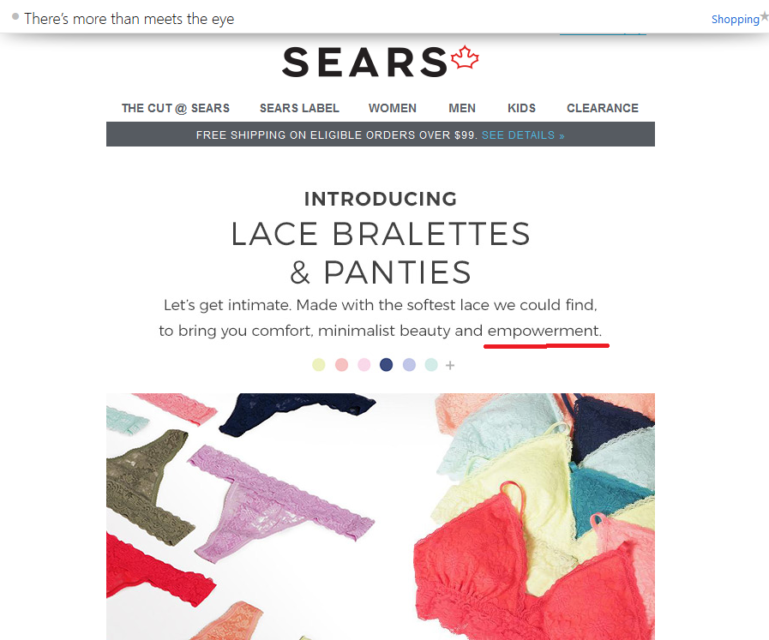
How will you go back to your ordinary non-empowering bras and panties after wearing those?
May 10, 2017
Raging Bitch, Good Shit, and Flying Dog Beer’s Fight for Free Speech
Published on 10 May 2017
“I’ve lived my life as a pro free enterprise person,” explains Flying Dog Brewery CEO Jim Caruso. “Not pro business. Pro free enterprise, pro consumer choice, artisanal manufacturing.”
—
A central player in America’s craft beer revolution, Caruso is dedicated to creating something special both inside and outside the bottle. Famed artist Ralph Steadman, best known for his iconic illustrations for work by Hunter S. Thompson, creates all of Flying Dog’s labels. It was Steadman who spontaneously wrote on his first commissioned label “good beer, no shit.” And it was this label that kicked of Flying Dog’s first — but not last — fight with government censors.Caruso sat down with Reason’s Nick Gillespie to talk about his run-ins with the state, why he is a libertarian, and the how his values keep him happy.
“I’m a happy person. And I attribute that to living as an individual, taking self responsibility, self reliance, but connected to society. It’s not a lone ranger sort of thing.”
Cameras by Meredith Bragg, Todd Krainin, and Mark McDaniel. Edited by Bragg.


