Quotulatiousness

September 27, 2025

Canada’s supply management cartels benefit “an affluent few, burdening the poorest, and creating needless friction with allies and trading partners”

In Reason, J.D. Tuccille explains to an American audience why Donald Trump has been playing hardball with Canada on trade issues:

President Donald Trump justifies his enthusiasm for prohibitively high tariffs by insisting the U.S. is being “ripped off” by other countries. It’s a strange argument, since people only trade with one another if they see benefit in the deal. But the president is right to complain that other governments impose trade barriers of their own that are often every bit as burdensome as the high taxes Americans pay on imports. If foreign officials honestly wish to restore something like free trade, they should emphasize dropping their own barriers in return for lower U.S. levies. Case in point: Canada, which sends three-quarters of its exports across its southern border but imposes damaging restrictions on imports.

In a February proclamation of trade war on the world, Trump announced, “the United States will no longer tolerate being ripped off” and complained that “our trading partners keep their markets closed to U.S. exports”. The first part of that claim is silly. But the second part has a kernel of truth.

A glimpse at that truth came in June when Trump angrily posted that Canada “has just announced that they are putting a Digital Services Tax on our American Technology Companies” and, as a result, “we are hereby terminating ALL discussions on Trade with Canada”.

The threat had the desired impact. Canada rescinded the tax immediately before it was supposed to take effect. While nominally targeted at all large tech companies, in practice that meant American companies and everybody knew it, since U.S. firms dominate the industry.

But that was only the tip of the iceberg when it comes to Canada’s trade barriers. Also in June, international trade attorney Lawrence Herman, a senior fellow at Canada’s C.D. Howe Institute, bemoaned proposed legislation in the Canadian parliament that he characterized as “yet another regrettable effort to enshrine Canada’s Soviet-style supply management system in the statute books.”

He added, “the bill would prohibit any increase in imports of supply-managed goods – dairy products, eggs and poultry – under current or future trade agreements”.

The legislation about which Herman complained has since become law.

[…]

More skeptically, Fraser Institute senior fellow Fred McMahon notes, “supply management is uniquely Canadian. No other country has such a system. And for good reason. It’s odious policy, favouring an affluent few, burdening the poorest, and creating needless friction with allies and trading partners.”

McMahon elaborates that the supply management process is controlled by agricultural management boards which “employ a variety of tools, including quotas and tariffs, and a large bureaucracy to block international and interprovincial trade and deprive Canadians of choice in dairy, eggs and poultry”.

But as we’ve seen so many times over the years, it disproportionally benefits Quebec, and the Liberals desperately need those Quebec votes to stay in power, so the government would rather destroy the national economy rather than give up on our Stalinist supply management cartels.

September 20, 2025

QotD: Why modern dishwashers suck

    The current standards for dishwashers took effect in 2013. The standards, which were based on a consensus agreement between manufacturers and efficiency advocates, specify minimum energy and water efficiency levels. The standards require that standard-size dishwashers use no more than 307 kWh per year and 5.0 gallons of water per cycle.

    In 2024, DOE finalized amended standards for dishwashers based on a joint recommendation from manufacturers and efficiency advocates. The new standards for dishwashers will cost-effectively reduce energy consumption by 15% relative to the current standards while also cutting water waste. Dishwashers

It is a general problem, but what started me thinking about it was being told by my dishwasher that it would take three and a half hours to wash the dishes. That seems, judging by a quick search online, to be longer than average but still within the normal range. I have not been able to find figures online for how long dishwashers took twenty or thirty years ago but, by what I remember, it was substantially less — and the dishes ended up dry, which ours don’t.

The explanation is in the final word of the quote above, “waste”. The owners of dishwashers pay for water and power, so if making them more efficient in those dimensions was costless, did not require giving up something else, there would be no need for the Department of Energy to make the manufacturers do it. I conclude that it was not costless, that it either made dishwashers cost more or do their job less well — take longer, not dry the dishes as well, not clean them as well. Using more power or water to do a better job is not waste.

David Friedman, “Optimizing On A Single Variable”, David Friedman’s Substack, 2025-06-02.

September 19, 2025

Edmund Burke, lawfare, and the East India Company

In The Coolidge Review, Amity Shlaes discusses “the most outrageous campaign of lawfare in the history of the Anglosphere”, as Edmund Burke assailed Warren Hastings, the first governor general of India:

Why do even principled statesmen — and there are some in this administration, too — not dig in their heels and try to arrest the chain of revenge? Why do even cautious, logical men and women succumb to the passion of lawfare?

The most outrageous campaign of lawfare in the history of the Anglosphere, the impeachment and trial of the first governor general of India, Warren Hastings, was mounted by Mr. Incrementalism himself, Edmund Burke. The father of modern conservatism spent nearly a decade of his time in Parliament—from 1787 to 1795—crusading against Hastings, antagonizing allies all around.

Impeaching the “Wicked Wretch”

There were reasons to investigate what was going on in India: Hastings exploited the fact that the East India Company was, at that time, an adjunct of the Crown. That connection between a powerful company and a government — a far more powerful company than, say, Intel — was the trouble, for as Burke would put it, it created “a state in disguise of a merchant“.

Burke chose to prosecute Hastings — and failed. The “wicked wretch”, one of Burke’s slime phrases for Hastings, emerged from the ordeal with a pension, not a conviction. Burke biographer Russell Kirk has argued that the public flaying of Hastings served posterity — in England at least. After Burke’s death, at “every grammar and public school”, the story of Burke and Hastings “impressed upon the boys who would become colonial officers or members of Parliament some part of Burke’s sense of duty and consecration in the civil social order”. That slowed another chain, the chain of abuse by Britons of Indians. After Burke, England recognized that, as Kirk puts it, she had a “duty to her subject peoples in the East”.

Still, even Kirk’s excellent biography leaves readers wondering: Was Hastings truly the archest of the arch villains, as Burke maintained? And is this the right way to go about it all? A book that Burke penned in the same years that he waged his Hastings war, Reflections on the Revolution in France, influenced a far greater number, and in a greater number of lands, than the Hastings story. Burke might have had the same reach with a Reflections on the Abuses of the East India Company.

All the more welcome then is James Grant’s Friends Until the End, which gives the best-yet account of the chain reaction in Burke’s soul that drove him to weaponize government, what his crusade cost him, and what such crusades may cost all of us.

[…]

Next, however, came a challenge that deeply frustrated Burke. Scanning the empire’s horizon for a place to commence a model reform, Fox and Burke settled on the East India Company, which abused the some thirty million Indians it oversaw with the same admixture of plunder, condescension, and cruelty familiar to Catholics of Ireland. The pair put their hearts into the Indian reform: Fox promised a “great and glorious” reform to save “many, many millions of souls”. They also put their minds into the project. To track the East India Company, Burke personally purchased sufficient shares to win him rights to attend and vote at quarterly meetings. He steeped himself in knowledge of a land he’d never seen, learning names of “numerous Indian nawabs, rajas, nizams, subahs, sultans, viziers, and begums“.

Such prep work, as Grant points out, enabled the Whigs to identify the correct solution: de-mercantilization. “Separate the company’s two incompatible missions: sovereign rule and moneymaking”, Grant writes. The compromised statute that emerged from the House of Commons was not as neat: A seven-man commission would rule India, while a board would govern East India’s commercial operations. But the commercial board would be a subsidiary to the commission. And in marshaling their votes for the measure, the pair still confronted the formidable obstacle of East India shareholders in Britain, furious at the threat to their fortunes that such reform represented. Fox might emancipate Hindus, their opponent William Pitt warned, but he must also “take care that he did not destroy the liberties of Englishmen”.

The king and his allies in any case defeated Fox’s India Bill, as it was known, in the House of Lords. The king, who had that prerogative, booted Fox and Burke from paid posts. In the 1784 general election, Burke held on to his seat in Parliament, as did Fox (by a hair), but so many Whigs, now labeled “Fox’s martyrs”, were ousted by voters from Parliament that the Whigs’ opponent, Pitt, became prime minister. Burke’s disillusionment ran deep: “I consider the House of Commons as something worse than extinguishd”, he wrote.

It was thus, at the age of fifty-nine and merely an opposition parliamentarian, that Burke risked his high-stakes lawfare. He commenced impeachment proceedings with a four-day anti-Hastings polemic. Of course, Burke universalized his point: The Hastings trial was “not solely whether the prisoner at the bar be found innocent or guilty, but whether millions of mankind shall be made miserable or happy”. And of course he raised the stakes for fellow lawmakers by appealing to their honor: “Faults this nation may have; but God forbid we should pass judgment upon people who framed their laws and institutions prior to our insect origin of yesterday!” The House must join him in impeachment, the Lords convict Hastings.

The House did join him, handing to the Lords charges that Hastings had “desolated the most flourishing provinces”, “pressed, ruined, and destroyed the natives of those provinces”, and violated “the most solemn treaties”. In thousands of hours of speeches before a jury from the House of Lords, the eager prosecutor, Burke, dwelt on Hastings’s cruelty to the Rohillas, an Afghan tribe from land bordering Nepal. He also charged that Hastings had taken revenge on a crooked tax collector, Nandakumar, for alleging that he — Hastings — had taken a bribe, seeing to it that Nandakumar was convicted and hanged for forgery. Not all of this was proven. And, as the jury of Lords slowly considered the charges, as the months and years passed, Burke found himself more and more isolated. Fox, Burke’s initial ally in the undertaking, faded. By the time the Lords’ jury voted not to convict, eight years on, a full third of their original number had already passed away.

September 18, 2025

NYC smokers get most of their cigarettes from the black market

Filed under: Bureaucracy, Business, Government, Health, USA — Tags: , , , , — Nicholas @ 03:00

Smokers in New York City pay very high taxes for their nicotine delivery systems, so it shouldn’t have surprised public health officials that many would turn to the black market … but the state and local taxes add so much to the price of a pack of cigarettes that most of the supply now comes from the black market:

“Enjoyin’ a cigarette at busy Time Square, NYC” by Mel Schmidt is licensed under CC BY 2.0 .

In 2023, New York raised its cigarette excise tax by $1.00 to $5.35 per pack. New York City imposes its own tax of $1.50 per pack, and that’s before you include federal and sales taxes, making for the most expensive smokes in the country. That is, cigarettes are expensive in New York for those who pay those taxes. But state officials were warned that such a high rate would drive consumers to the black market, and that’s exactly what happened. According to recent research, more New Yorkers than ever are turning to tax-evading illicit sources for their nicotine needs.

Taxes Into Good Health — or Not

When the New York excise tax was hiked, the Albany Times-Union noted, “it’s the nation’s highest and brings a pack of cigarettes at many retailers to about $12 … Health advocates hailed the increase, saying it will lead to fewer smokers and cancer deaths. Anti-tax groups, though, predicted it will increase trafficking in illicit untaxed cigarettes in the state.”

Health advocates like taxing vices on the theory that raising taxes simultaneously generates government revenue while escalating prices for allegedly bad things — like cigarettes — out of reach of many consumers. What they rarely consider is that there are other options, such as buying cigarettes smuggled from jurisdictions with lower levies.

“New York has created a cigarette-smuggling empire, and the worst is yet to come,” Todd Nesbit, an economics professor at Ball State University, and Michael LaFaive, of the Mackinac Center for Public Policy, warned even before the 2023 tax increase. “It’s the unavoidable consequence of the state’s decades long history of raising the cigarette tax.”

“If enacted, consumers will go across borders to do their shopping or rely on black-market suppliers,” agreed the Tax Foundation’s Adam Hoffer. “Tax revenues will fall, illicit activities will thrive, and law enforcement spending will need to increase.”

In fact, as Nesbit, LaFaive, and Hoffer emphasized, even before the dollar-per-pack tax hike, more than half of cigarettes sold in the state of New York lacked local tax stamps and were smuggled from elsewhere. Since 2023, illicit dealers appear to have claimed even more market share.

September 15, 2025

When folks built their houses from Sears, Roebuck & Co. kits

Filed under: Business, History, Railways, USA — Tags: , , — Nicholas @ 03:00

I thought I’d discussed the Sears kit homes about a decade back, but perhaps it wasn’t for the blog. Anyway, there’s a nice summary by Katrina Gulliver of how Sears and other companies made home-building great a century ago:

A hundred years ago, kit homes were more common in the US. Sold by Sears, Montgomery Ward, and other local firms, buyers received the plans and the pieces for a house and put it together themselves. Economies of scale made these a viable option for someone looking to build a house in the expanding suburbs.

The 1914 Sears Modern Homes catalog shows three homes that could each be bought for $656 (in the small print, they admit your outlay would be more like $1,250 all-in, including brick, cement, plaster — which they don’t supply — and labor). Your kit house would be delivered by rail; it was generally assumed householders would be handy enough (or know whom to hire) to put it all together from the supplied plans.

According to a 1930 report by the National Bureau of Economic Research, National Income and Its Purchasing Power, in 1914, the average clerk could be making $1,000, and a factory manager earning $2,300. That means these houses were within reach of lots of people — especially bearing in mind that land costs in many cities were also relatively low. In Chicago, lots within 5 miles of downtown were available for less than 50¢/square foot in 1914.

Those kit homes included wood, metal, and glass, and reflected both the tastes of consumers and the economies of bulk production. The various styles in the catalog over the years included craftsman, Dutch colonial, Federal, and cottage — styles that have continued to be popular in residential architecture of the US.

The Sears catalog of 1936 states: “This is the age of modern efficiency. No longer can human hands compete with machine precision and production. ‘Speed with accuracy’ is the watchword in any department of our great factories.”

(For those curious about such houses, fans of Sears kit homes put together lists of examples still standing.)

September 9, 2025

Employers insist that there are lots of high-paying “entry level” jobs that Canadians won’t do

Filed under: Bureaucracy, Business, Cancon, Government — Tags: , , , — Nicholas @ 03:00

Canada’s insanely out-of-control temporary foreign worker program hinges on employers being honest about the jobs on offer being impossible to fill with Canadian citizens or legal immigrants. The huge numbers of these jobs — often listed at much higher than minimum wage in areas with very high unemployment — strongly implies that employers are systematically gaming the system:

A selection of jobs subject to active Labour Market Impact Assessments (LMIA), meaning that an employer has applied for a temporary foreign worker on the grounds that no Canadian is available to fill the position.
Photo by Government of Canada Job Bank.

If public sentiment is turning against the TFW system, it’s partially because of a greater awareness of the conditions under which employers are claiming they cannot find Canadians for their jobs.

Any hiring of a temporary foreign worker has to first be preceded by a “Labour Market Impact Assessment”. It’s effectively a job posting laying out the basic details of the position, and carrying the disclaimer “the employer could not find a Canadian worker for this job and applied for a Labour Market Impact Assessment (LMIA) to hire a temporary foreign worker”.

What’s made many of these LMIAs so controversial is that they often describe quite desirable jobs with minimal qualifications. There are also noticeably high numbers of them being submitted in cities with high unemployment.

Last year, a viral Reddit post featured a heat map of all the Toronto-area employers who had been approved for temporary foreign workers after claiming to find no Canadian applicants. More recently, the website JobWatchCanada has launched a searchable database of active LMIAs, complete with interactive maps and guides to which employers are the heaviest users.

What really bothers a lot of Canadians about the program is the high number of jobs posted with few or no qualifications at well-above market rates at the same time that young Canadians are finding it impossible to get hired no matter how many positions they apply for:

In June, a Calgary auto shop submitted an LMIA for a “motor vehicle mechanic helper”. The job is to essentially act as a “gofer”. The starting wage for the helper job is $36.50 per hour, the employer promises to cover relocation costs, and the “experience” category contains only the words “will train”.

A Langley, B.C., drywall contractor said it can’t find any Canadian drywall installers at $36.75 per hour. A vape shop in Lloydminster, Sask., has filed an LMIA to fill a $36.05 per hour shift supervisor job in which the educational requirement is a high school diploma.

In Woodbridge, Ont., a homeowner filed an LMIA for a $38 per hour housekeeper in which the only qualification is that the applicant has to speak English. “No degree, certificate or diploma”, is listed in the space for educational requirements, and the requirement for work experience is just “will train”.

The useful site fakejobs.ca currently shows three LMIA positions in my small town each paying at least $35 per hour that supposedly can’t be filled by local applicants. The jobs — two food service supervisors and a marketing co-ordinator — can’t possibly have such exotic required qualifications that nobody in the area can match, which is why I strongly suspect they’re fakes.

September 6, 2025

The federal government’s foreign worker program is set up for abuse

Filed under: Bureaucracy, Business, Cancon, Government, Politics — Tags: , , , , — Nicholas @ 03:00

Dan Knight discusses Canada’s deliberately two-track job system, which severely disadvantages unemployed Canadians and favours temporary foreign workers instead:

Canada now has a two-track employment system. On one track, you’ve got over 1.6 million Canadians unemployed the official rate just jumped to 7.1%, the worst since 2016 outside the COVID crash. Youth joblessness? 14.5%. Alberta, supposedly an economic engine, bleeding at 8.4% unemployment. And those folks are drawing EI, funded by your tax dollars.

On the other track? The Temporary Foreign Worker pipeline. In 2024 alone, Ottawa issued over 162,000 TFW permits by October. And they’ve already budgeted another 82,000 entries in 2025. Think about that: while Canadians are struggling to find work, Ottawa is busy handing out golden tickets to foreign workers.

And let’s be honest about how this program actually works. It’s sold as a way to “fill labor shortages”. In practice, it often looks like a backdoor family reunification scheme. Business owner Abdul suddenly needs a “specialized” worker conveniently, his cousin in India just happens to fit the bill. So instead of waiting in line under the normal visa system, he comes in the side door through the TFW program. Legal? Sure. Exploitative? Absolutely. It undercuts the immigration rules that everyone else has to follow, and it keeps wages low for Canadians who should be first in line.

Here’s the part that makes you wonder if Ottawa is even trying: we’ve got two federal departments, Employment and Social Development Canada (who runs EI) and Immigration, Refugees and Citizenship Canada (who runs TFW permits). Wouldn’t a functioning government have these two agencies talk to each other? One department says, “Hey, we’ve got 1.6 million people sitting on EI“. The other says, “We’ve got 162,000 employers asking for TFWs“. The obvious solution? Connect the dots. Fill Canadian jobs with Canadian workers first.

But that would require coordination and “coordination” is a foreign concept in Ottawa. These are the same geniuses who can’t keep escalators running in Parliament Hill without a three-year feasibility study. You expect them to line up two departments, EI and Immigration … and have a five-minute conversation? Forget it. Imagine the radical idea: one arm of government saying, “Hey, we’ve got 1.6 million Canadians unemployed and drawing EI …” and the other saying, “Oh great, we’ve got 162,000 employers begging for workers. Maybe, just maybe, we could match those two groups up“. That’s not rocket science. That’s not even science. That’s called basic competence. And Ottawa can’t even spell it.

Using the fakejobs.ca website, I found three LMIA postings in my small town on the edge of the GTA … all paying well over median for pretty ordinary retail management jobs.

September 5, 2025

End the “temporary” foreign worker scam!

Filed under: Bureaucracy, Business, Cancon, Government — Tags: , , , , — Nicholas @ 05:00

In the National Post, Chris Selley explains why Pierre Poilievre and the federal Conservatives should be hammering their demand to eliminate the much-abused temporary foreign worker program:

Youth unemployment stands at 14.6 per cent, according to Statistics Canada’s latest release. That’s the highest non-pandemic July figure since 2009 (15.9 per cent), at the nadir of the Great Recession. It makes nothing but good sense that Conservative Leader Pierre Poilievre would position himself, as he did on Wednesday, foursquare athwart bringing in any more temporary foreign workers to fill positions that certain employers swear blind they cannot fill with younger Canadians at any conceivable price.

“Why is (the government) shutting our own youth out of jobs and replacing them with low-wage temporary foreign workers from poor countries who are ultimately being exploited?” Poilievre asked, rhetorically, on Wednesday. By rights it ought to be a solid populist pitch to Canadians, and no-brainer policy besides.

Companies who use TFWs will insist it’s not about finding “cheaper” help, but about finding any help. Tim Hortons defended itself Wednesday noting that less than five per cent of its national workforce were TFWs — which seems like a very high number, right? It’s not just me? — and those hires tended to be clustered “in small towns and communities where local candidates are not available”.

But an odd sort of small town or community, surely, that can’t live without a Timmy’s, but that doesn’t have enough people to work at it. And it’s an odd sort of remedial program, surely, to bring in employees not from other parts of Canada but rather from halfway around the world. Especially since groups like the Canadian Federation of Independent Business (CFIB) swear blind they’re not after an hourly wage discount, just anyone who’s willing and able to fill the position. It was certainly a very odd kind of fishing resort, it struck me, that claimed this summer it couldn’t find any Canadian employees and needed the TFW program instead.

Didn’t kids used to flock en masse cross-country to take outdoorsy jobs every summer? Have I not read 150 tiresome baby-boomer op-eds on the topic?

The special pleading sometimes beggars belief. And unemployed young Canadians aren’t free to you and me, after all — whoever’s fault it is, if anyone’s, they’re an anchor on the economy. A Deloitte study commissioned by the King’s Trust Canada, published in November, estimated “that under the right conditions, overall real GDP could increase by $18.5 billion by 2034 — more than Canada’s entire arts, entertainment and recreation sector — and (Canada could) add an additional 228,000 jobs in the process” if “youth engagement in the workforce” significantly increased.

September 4, 2025

Net Zero targets and Britain’s ever-declining car industry

Filed under: Britain, Business, China, Environment, Government, USA — Tags: , , , , , — Nicholas @ 03:00

At the Foundation for Economic Education, Jake Scott charts the decline of the British auto manufacturing centres and the government’s allegiance to its Net Zero programs:

Custom image by FEE

Britain was once a giant of car manufacturing. In the 1950s, we were the second-largest producer in the world and the biggest exporter. Coventry, Birmingham, and Oxford built not just cars, but the reputation of an industrial nation; to this day, it is a source of great pride that Jaguar–Land Rover, a global automotive icon, still stands between Coventry and Birmingham. By the 1970s, we were producing more than 1.6 million vehicles a year.

Today? We have fallen back to 1950s levels. Last year, Britain built fewer than half our peak output—800,000 cars, and the lowest outside the pandemic since 1954. Half a year later, by mid-2025, production has slumped a further 12%. The country that once led the automotive revolution is now struggling to stay afloat, and fighting to remain relevant.

This is why the news that BMW will end car production at Oxford’s Mini plant, shifting work to China, is so damning, bringing this decline into sharp focus. The Mini is not only a classic British car; Alec Issigonis’s original design made it an international icon. For decades, the Mini has been the bridge between British design flair and foreign investment. Its departure leaves 1,500 jobs at risk at a time when the government is desperate to fuel growth and convince a wavering consumer market that there is no tension between industrial production and Net Zero goals.

It’s a bitter reminder that we in Britain have been here before: letting an industrial crown jewel slip away.

The usual explanations will be offered: global competition, exchange rates, supply chains. All true, in the midst of a global trade war that is heating up and damaging major British exports. But such a diagnosis is incomplete. The truth is that Britain’s car industry is being squeezed by a mix of geopolitical realignment and government missteps.

The car industry has become the frontline of a new trade war. Washington has already moved aggressively to shield its own firms: the Inflation Reduction Act offers vast subsidies for US-made EVs and batteries, an unapologetic attempt to onshore production, and something that became a flashpoint of tension in Trump’s negotiation with the EU in the latest trade deal. On the production side, the Act has poured billions into US manufacturing: investment in EV and battery plants hit around $11 billion per quarter in 2024.

Ripples have been sent across the world in the US’s wake: Europe, faced with a flood of cheap Chinese EVs, has imposed tariffs of up to 35% after an anti-subsidy investigation. Talks have even turned to a system of minimum import prices instead of tariffs. Unsurprisingly, China has threatened retaliation against European luxury marques, while experts warn the tariffs may slow the EU’s green transition by raising prices.

This is no longer a free market: cars are treated as strategic assets, the 21st-century equivalent of shipbuilding or steel. Whoever controls the supply chains, particularly for EV batteries and the mining of lithium, controls not only the future of the industry but an important lever of national power.

The results are visible. In July 2025, Tesla’s UK sales collapsed nearly 60%, while Chinese giant BYD’s deliveries quadrupled. Europe responded by talking up new tariffs. Britain did nothing. In this asymmetric contest, our market risks becoming a showroom for foreign producers — subsidizing both sides of the trade war without defending our own.

September 1, 2025

“… these two [books] are ‘perfect bound’, which is a misleading name for a crappy technique”

Filed under: Books, Business, Media, Technology, Woodworking — Tags: , , — Nicholas @ 03:00

Chris Schwarz on the frustrations of a (physical) book reader with far too many modern printed books:

Dammit, Norton!

I don’t read much for pleasure these days. I spend about three hours a day reading manuscripts, draft blog entries, old woodworking texts, academic papers and contracts. When the workday is done, the last thing I want is someone else’s voice chattering in my head.

But I love books and have always been a voracious reader. So I keep a stack of books that I probe and pick at, like a 5-year-old forking through chop suey, looking for something to consume.

This month has been great. I’m in the middle of “The Overstory” by Richard Powers and “A Swim in a Pond in the Rain” by George Saunders. Both books were written with an exquisite pen, and I lose track of time when I’m reading them.

But both books also make me want to burn down the headquarters of Norton and Random House publishing. Because both books are made like dogshit.

Like most books these days, these two are “perfect bound”, which is a misleading name for a crappy technique. Like if we called a “butt joint” the “excellent end-grain joint,” or if we called miters the “super slanty joint”.

What’s perfect binding? Take a stack of individual sheets of paper, like the stack of pages you put in your printer. Slather some glue on one edge and press the goo into the pages. While the glue is still wet, slap the book’s cover to the glue on the spine. Trim the pages, sell the book and make an obscene amount of money.

I don’t know a binding technique that is crappier than perfect binding. Even loose-leaf pages in a Trapper Keeper are better because they can be repaired.

Perfect-bound books are – like a Ryobi drill – a product that has an expiration date. After two or three readings, the pages will start to fall out of the glue. You don’t even have to mistreat the binding for this to happen. The glue gets brittle, then you turn a page like a normal person and the leaves fall like it’s autumn.

Do not fool yourself and think that book publishers are suffering and need to cut corners in the manufacturing department. They aren’t. Book publishing is still one of the most profitable businesses, as far as margin is concerned. It’s not unusual for a publisher to have margins of 30 to 35 percent. (Note: Lost Art Press keeps a margin of about 15 percent – much lower because we pay more in royalties and pay a lot more for manufacturing.)

My paperback copy of “The Overstory” is the 23rd printing of the title since it was released in 2018. Norton is literally printing money at this point with the book. The book’s retail is $18.95. Manufacturing cost (at a plant in the United States): I’d guess is about $3.80.

Norton can do better. But it doesn’t have to. Customers are happy to pay $18.95 for an impermanent book.

August 31, 2025

Didn’t we once have “conflict of interest” rules for politicians?

Filed under: Business, Government, Media, Politics, USA — Tags: , , , , — Nicholas @ 03:00

It’s become a commonplace that politicians leave office vastly wealthier than they went in, far in excess of their official salaries. Once upon a time, even though it probably still happened, the fat cats managed to stay below the event horizon with their ill-gotten gains. Today, they no longer care if you find out that this or that senator has consistently beaten the market on their investments during their entire time in office. After all, what are you going to do about it, punks? Maybe something like this:

Paul and Nancy Pelosi, 16 February, 2022.
Detail of a photo by Amos Ben Gershom via Wikimedia Commons.

The original research was on how Senators seem to make 12% annually. That’s, erm, a lot.

Markets — something that always comes as a surprise to politicians — react:

    American lawmakers are so consistently successful that a flurry of new platforms and apps now compile filing data from US politicians as a key input in strategies for retail investors and even hedge funds.

    The number of people using these so-called “copy trading” strategies has exploded. Tens of thousands of Americans now follow and imitate trades made by members of Congress, and they are making millions of dollars in the process.

OK, what fun, eh?

Even more fun would be Megan McArdle’s suggestion, that the CongressThieves must announce that they intend to trade an hour before they do so that everyone else can front run them.

Because, you know, Ms. Pelosi:

    She beat every single hedge fund last year.

But there’s something even more fun:

    Dub launched in March 2024 as America’s first regulated brokerage to offer copy trading accounts to mimic politicians and star traders.

    “It’s been absolutely insane in terms of growth,” says Steven Wang, the founder and chief executive who dropped out of his freshman year at Harvard to build the platform. Today, it has 1.5 million users across America.

    Of the $100m or so invested across Dub, nearly $23m is in its Pelosi tracker account. Since its launch in early 2024, its paper gains are 172pc.

Stock prices do not move “because”. Interest rates change, profits go up, or down, or tariffs or … stock prices change because people buy and or sell more of them. That may be in reaction to those other things but the actual price movement is that buy and sell stuff.

Which means that if we copy Nancy’s trades — after she’s done them — then we’re making money for Nancy. Because we are piling in our weight of money into a position she already holds.

Which, when you think about it, is really pretty shitty. Sure, it’s nice to make money ourselves by trading upon that congressional information. But there is that very, very, heavy cost of making Ms. Pelosi even richer as a consequence.

QotD: The “working” world

Filed under: Britain, Business, Economics, History, Quotations — Tags: , , — Nicholas @ 01:00

In the dark days of the early 1970s, Britain was obliged by a coal-miners’ strike to go on to a three-day working week (our power stations were then mostly coal-fired, and hence there was a shortage of power). Strictly speaking, production should have declined by 40 per cent, but instead declined only by 20 per cent. This surely meant that, on average, people spent one day at work completely unproductively, which will come as a surprise only to those who have never worked in an enterprise or organisation of any kind.

In other words, at least a fifth of our working time is spent doing nothing, or rather nothing productive. Most people are incapable of doing nothing, in the strict sense that a meditator does nothing. Moreover, much of their activity may not merely be unproductive but positively counterproductive, in so far as most people at work feel obliged to do something, and by far the easiest thing for them to do with their superfluous time is to obstruct others, to have unnecessary meetings and so forth.

If taken seriously, not only offices, but millions of journeys to offices, would become unnecessary, pollution would decline and leisure time would increase. This latter would be a disaster, since most people do not know what to do with themselves as it is. It is for this reason that work is not arranged as efficiently as possible, but its productive aspect is diluted by myriad unnecessary tasks — unnecessary, that is, from the narrow point of view of production. Except in the factories of the East, where production is all, a great deal of work is designed to keep us occupied while we produce nothing. It ameliorates boredom and prevents the bad behaviour in which boredom results.

Anthony Daniels, “The Pleasant Embrace of Fear”, Quadrant, 2020-05-06.

August 30, 2025

QotD: SaaS – software as an “intolerable swarm of blood-sucking leeches”

Filed under: Business, Quotations, Technology — Tags: , , , , — Nicholas @ 01:00

Commercial desktop software is getting worse, not better. I’ve been generally aware of this for a while — the relentless pull away from “you pay for it once and own it” to monthly subscription models that extract money from you forever has been a leading indicator.

But my friend @DrInsensitive reports that the enshittification is accelerating. He says that in addition to a lot of tediously stupid UI changes, his most recent upgrade of CorelDraw now spams ads at him even when CorelDraw itself is not running! Furthermore the plague of microtransactions that has afflicted AA games for years is spreading — the set of free fill patterns for rectangles that his old version had is gone, instead when he tries to fill a rectangle he gets a pop-up invitation to buy an extra-cost feature pack of them.

When one asshole vendor thinks they’ve successfully numbed their user base into accepting this kind of crap, others immediately follow. We’ve seen this movie before, we know how it ends — with applications, like games, designed to be deliberately frustrating and low-level awful, intended to give you itches that you can only scratch by buying their endless parade of “enhancements”.

I’m sure a surcharge to suppress the spammy CorelDraw ads won’t be long in coming. And soon after that it will be everywhere.

If this goes on, open-source software will finally win the desktop not because it’s gotten enough better but because closed-source desktop applications have reached final form as an intolerable swarm of blood-sucking leeches.

This is not the way I was looking forward to winning.

ESR, Twitter, 2025-03-22.

August 28, 2025

No surprise at all – Liberals completely overshoot temporary foreign worker targets

Filed under: Business, Cancon, Government — Tags: , — Nicholas @ 03:00

In the National Post, Tristin Hopper confirms that the Mark Carney government, having promised to cap temporary foreign worker visas at 82,000 for the year, have already brought in over 100,000 TFWs in the first six months:

Despite promises from the Liberal government that they would be curbing the sky-high immigration rates of the Trudeau era, new data from Immigration, Refugees and Citizenship Canada shows that Canada is already on track to exceed its 2025 targets.

In the first seven months of 2025, Canada accepted 246,300 new permanent residents, according to data released last week by IRCC.

If this level of intake keeps up for the rest of the year, Canada is on track to bring in approximately 422,000 new permanent residents by year’s end.

[…]

And the missed targets are even more stark when it comes to categories of temporary migrants.

For the entirety of 2025, Canada was only supposed to approve 82,000 entries under the Temporary Foreign Worker Program.

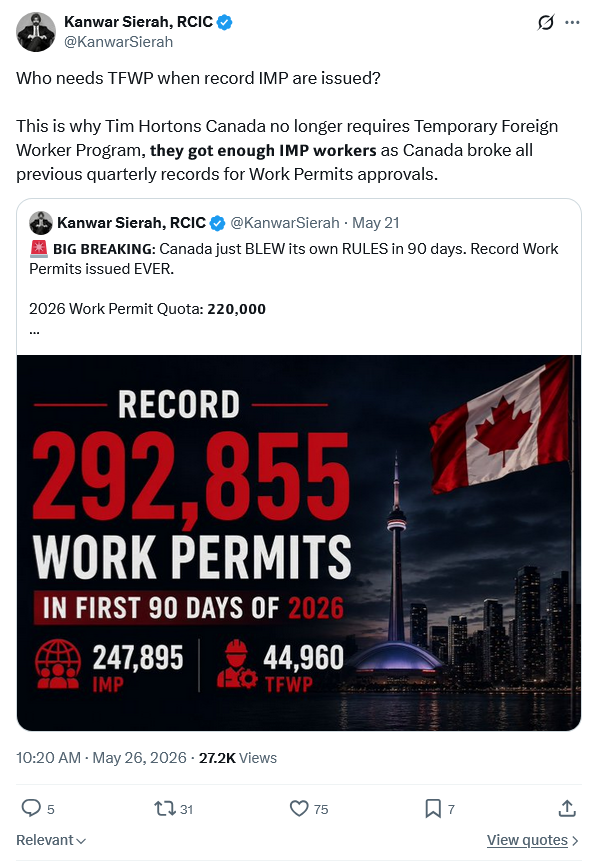
Nevertheless, Government of Canada data shows that 105,195 Temporary Foreign Worker permits were awarded in just the first six months of 2025.

Temporary migration has been disproportionately responsible for the record-breaking population growth witnessed in Canada over the last four years. Since 2021, Canada’s population has grown from 38 million to 41.7 million. This represents an average annual increase of 900,000, which puts Canada well beyond the population growth rates of any other G7 country.

In late 2024, Statistics Canada estimated that the country was home to an unprecedented three million “non-permanent residents,” be they international students or temporary foreign workers.

Temporary migration is also the category on which Ottawa has promised to crack down hardest. Late in 2024, when then prime minister Justin Trudeau announced plans to “turn off the taps” on immigration, temporary migrants represented seven per cent of the overall Canadian population.

August 26, 2025

Table saws, technological patents, and rent-seeking

Tom Knighton, who I’ve “met” on my favourite woodworking forum, celebrates a small victory in the never-ending battle against the rent-seekers of the corporate world:

“SawStop” by Comfr is licensed under CC BY-SA 4.0 .

What does this have to do with rent-seeking?

Well, there’s a company called SawStop. They make really great table saws with a unique safety feature. They’re equipped with a brake and sensor that, when it detects moisture such as one might find in a human finger, it locks the saw and drops the blade down into the saw’s body.

It’s a really great bit of technology, and the saws happen to be really good saws, too, so the company has done well for itself.

However, it started out as a company seeking to license the technology, only no one wanted it at the time.

SawStop decided to try and press the United States government to mandate their technology on all new table saws, and the government was going to.

Was.

This video has a good rundown of the whole thing. (I’d embed it, but the channel doesn’t allow it for some reason.)

The short of it is that the rule that was being considered has now been tossed because it would specifically give SawStop a monopoly on table saw sales in the United States, legally. Yes, they were going to offer up a patent for the public domain, but it wouldn’t be enough to replicate the technology in and of itself.

Plus, at a time when woodworking isn’t the biggest hobby in the world, even if it had been enough, driving up the cost for a central piece of tooling that most consider essential for woodworkers ain’t the way to change that.

For example, Skil makes a jobsite saw that typically runs under $300. SawStop’s equivalent is around three times that much, and that’s a lot of money to spend on something you’re not sure you’ll even enjoy.

Especially since just being careful can prevent the need for the brake in the first place, to say nothing of the fact that if you cut wet wood, it’ll trigger the brake, which is a pain for a lot of people, especially building contractors whose lumber isn’t super dry to begin with.

Seeing the rug pulled out from under SawStop is great, but the real issue here is that it doesn’t happen often enough. Rent-seeking is all too common and all too often works.

« Newer PostsOlder Posts »

Powered by WordPress