
World War Two
Published 31 Jul 2022In Italy the Fascists fall from power in a peaceful coup, while in Germany the RAF and USAAF bring down a rain of fire of biblical proportions in Operation Gomorrah, launching the Firestorm of Hamburg.
(more…)
August 1, 2022
Hamburg’s Citizens Burnt Alive – WAH 071 – July 31, 1943
Comments Off on Hamburg’s Citizens Burnt Alive – WAH 071 – July 31, 1943
July 31, 2022
Mussolini Falls from Power – WW2 – 205 – July 30, 1943
World War Two
Published 30 Jul 2022The Allied advance on Sicily continues, though they’re really gearing up for operations next week. The Soviet advances in the USSR and in New Georgia also continue, with the enemy deciding to withdraw in both; Allied firebombing kills tens of thousands of German civilians, but the big news is still the fall of Benito Mussolini from power in Italy.
(more…)
Comments Off on Mussolini Falls from Power – WW2 – 205 – July 30, 1943
July 28, 2022
Is the US Navy in crisis?
CDR Salamander outlines why he is very concerned about the current state of the United States Navy:
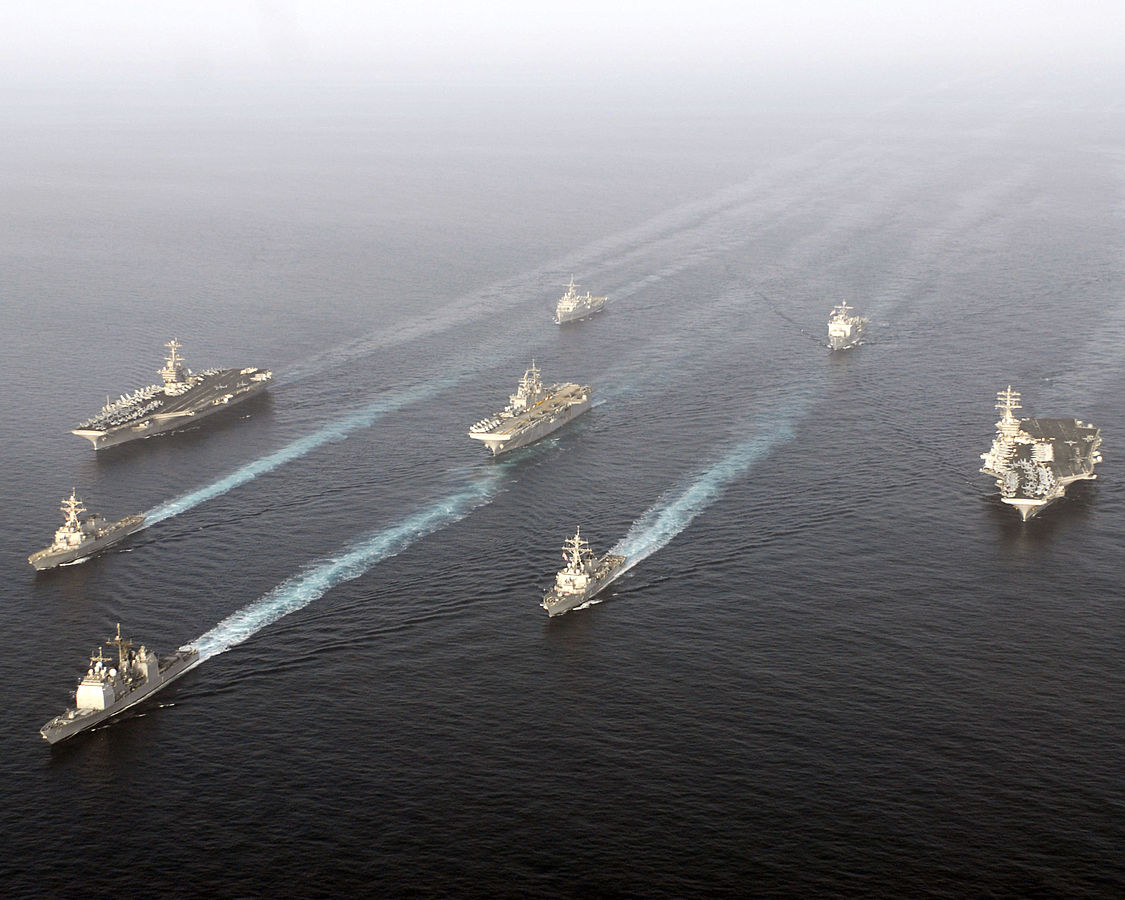
US Navy ships from the John C. Stennis and Nimitz Carrier Strike Groups with ships from the Bonhomme Richard Expeditionary Strike Group in the Gulf of Oman, 22 May 2007.
US Navy photo by Mass Communication Specialist 1st Class Denny Cantrell via Wikimedia Commons.
If you believe the threat from China is overblown, our Navy is well led, and that our fleet is big enough, then this is not the post for you. If you are concerned for all of it, grab a fresh drink and dive right in.
We are facing of something our nation has not had to seriously consider in well over three decades; we do not have free and unfettered access to the sea.
Even when Soviet submarines roamed the world’s oceans at will – though closely watched – and the Red Banner Fleet could send battle groups on cruises through the Gulf of Mexico, we had fair confidence in one thing – the Pacific was an American lake.
No more.
The leaders of the USN seem to have very different notions about what the Navy needs:
f you feel the Navy needs a larger share of the budget to meet the challenge of China, then you need to advocate for it. You need to fight for it … and when I say “you” I mean “we” and the most important and powerful parts of that “we” are our institutions; our maritime power institutions dedicated to seeing the USA remain the premier seapower.
Let’s start with the most obvious. Our uniformed Navy is itself an institution. It reports to its civilian leadership in the Executive Branch with oversight from the Legislative Branch. There are your big pixel maritime governmental institutions; the uniformed and civilian leaders in the Department of the Navy.
As reviewed yesterday, the CNO is engaged in a rather low-energy talking point about 500-ships, but in 2022 that is not even remotely achievable. He knows it, you know it, Congress knows it as well. A number is not an argument, and yet he is investing personal and institutional capital on this line that is almost immediately ignored if it is heard at all. Why?
In the last year one of his highest profile public appearances was when he shoveled heaping piles of personal and institutional capital in a fight defending a red in tooth and claw racial essentialist Ibram X. Kendi against who would normally be the US Navy’s natural allies in Congress. Ultimately he lost that battle and removed Kendi’s racist book and others from his reading list, but in the face of everything else going on in the maritime world, why?
What about the Vice CNO, Admiral William K. Lescher, USN? Maybe he could throw some sharp elbows for the maritime cause? Sadly, not. Just look at his exchange with Rep. Mike Gallagher (R-WI) back in March. He seems to be the “Vice Chief of Joint Force Operations” more than anything else. He is focused on something, but advocating for sea power is not it.
With the night orders from the CNO and VCNO as they are, if you expect any significant advocacy from the uniformed Navy leadership who report to them for — checks notes — the Navy, you are going to have to wait for a long time, time we don’t have. It isn’t going to happen.
[…]
Take a moment and ponder – when was the last time you heard the SECNAV or Under out front on The Hill or to the greater public about our maritime requirements? Yes, I fully understand what goes on behind closed doors, but that slow roll in an ever-slower bureaucracy infested with scoliotic nomenklatura is well past being of use. The American people must be provided the information and motivation to understand how their entire standard of living – and to a great extent their freedoms – is guaranteed by our mastery of the seas. Is even a rudimentary effort being made in this regard?
Just look at the USN’s YouTube feed – a primary communication device for the American people. What has the SECNAV talked about there this year? LGBTQ+ Pride Month, Juneteenth, Army birthday, Asian-Pacific Islander Month, Mental Health Awareness Month, Women’s History Month, carrier air birthday, and Black History Month.
There you go. There’s your communication. Dig harder if you want … but if you read CDRSalamander and you are not readily aware, then imagine the general population’s situational awareness of the dragon just over the horizon.
Comments Off on Is the US Navy in crisis?
July 27, 2022
Poland and South Korea Ink Huge Arms Deal
Ed Nash’s Military Matters
Published 26 Jul 2022Poland and South Korea are apparently on the verge of signing a huge arms deal that will replace much of the heavy frontline equipment of the Polish Army.
Sources for this video can be found at the relevant article on:
https://militarymatters.online/
(more…)
Comments Off on Poland and South Korea Ink Huge Arms Deal
July 25, 2022
Stalin, Hitler, and Churchill – Architects of Death – WAH 070 – July 24, 1943
Comments Off on Stalin, Hitler, and Churchill – Architects of Death – WAH 070 – July 24, 1943
July 24, 2022
After a Victory at Kursk, The Soviets Attack Everywhere – WW2 – 204 – July 23, 1943
World War Two
Published 23 Jul 2022The Allied invasion of Italy powers on and puts the future of a key axis power at play. In the USSR, the Soviets have learnt to deal with German offensives, as the Wehrmacht struggles to make a dent.
(more…)
Comments Off on After a Victory at Kursk, The Soviets Attack Everywhere – WW2 – 204 – July 23, 1943
July 17, 2022
Who Let the Dogs Out?! – The Invasion of Sicily – WW2 – 203 – July 16, 1943
World War Two
Published 16 Jul 2022The Allies have begun their fight to take back Western Europe with Operation Husky. That’s not the only news though. They are also trying to extend their foothold in the Solomons, and Germany and the USSR continue smashing into one another at Kursk.
(more…)
Comments Off on Who Let the Dogs Out?! – The Invasion of Sicily – WW2 – 203 – July 16, 1943
July 12, 2022
Kursk, When Titans Clash – 202 – July 9, 1943
World War Two
Published 10 Jul 2022Adolf Hitler launches his huge summer offensive in the USSR, Operation Citadel, known as the Battle of Kursk. Men in the millions clash. The Allies’ New Georgia campaign continues in the Solomons, both on land and with fighting at sea this week, and the preliminary actions begin for the Allied invasion of Sicily, scheduled to go off tomorrow.
(more…)
Comments Off on Kursk, When Titans Clash – 202 – July 9, 1943
July 11, 2022
The Master Race of Asia? – WAH 067 – July 3 1943
World War Two
Published 8 Jul 2022
(more…)
Comments Off on The Master Race of Asia? – WAH 067 – July 3 1943
July 9, 2022
QotD: Chinese “technocracy”
For a while, all (or almost all) of China’s top officials had engineering degrees.
When Xi Jinping first joined the Politburo Standing Committee in 2008, eight of its nine members were engineers. Paramount Leader Hu Jintao was a hydroelectric engineer. His second-in-command Wen Jiabao was a geological engineer. There were two electrical engineers, a petroleum engineer, a radio engineer, and two chemical engineers (including Xi himself). The only non-engineer was Li Keqiang, an economist.
And this was actually a low point in engineers’ dominance of Chinese power. The term before, 100% of Politburo Standing Committee officials had been engineers! What’s going on?
For one thing, Deng Xiaoping thought engineers were cool, and he was powerful enough to do whatever he wanted. A government made up entirely of engineers? Sure, whatever you say. And since the top echelons of Chinese government appoint their own successors, these engineers could appoint other engineers and so on.
But also: during the Cultural Revolution, about half of Chinese people who got degrees at all got engineering degrees. The Cultural Revolutionaries were really not big on education (according to one article, “Xi’s secondary education [was cut short] when all secondary classes were halted for students to criticise and fight their teachers.”) But engineering was useful for building factories, and so was grudgingly tolerated. That meant that of the people smart and ambitious enough to get into college at all, half did engineering.
The other half? I’m not sure. Law is a popular major for would-be politicians in the US, but here’s a Chinese person explaining why it doesn’t work that way in China (short version: China doesn’t have great rule of law, so lawyers don’t matter much and are low status).
Here is an article telling us not to take China’s engineer-kings too seriously. It argues that (aside from Deng’s original picks), most of them never did much engineering, and just studied the subject in school as a generic prestigious-sounding degree to springboard their government career. Chinese engineering curricula are easy, and powerful people frequently cheat or pay others to write their dissertations.Aside from a few of Deng’s personal picks, we should think of this less as “China is a magic place where rational scientists hold power”, and more as “for idiosyncratic reasons, social climbers in China got engineering degrees.” Certainly none of these people were selected for the Politburo on the basis of their engineering acumen. They got their power by bribing, flattering, and backstabbing people, just like everyone else.
In any case, Xi’s old Politburo class was the last one to be made primarily of engineers. The current Politburo has only one engineer — Xi himself.
Scott Alexander, “Dictator Book Club: Xi Jinping”, Astral Codex Ten, 2022-04-07.
Comments Off on QotD: Chinese “technocracy”
July 6, 2022
Decapitating the French Resistance – WAH 066 – June 26, 1943
World War Two
Published 5 Jul 2022The Gestapo deals a devastating blow to French Resistance, and in Bengal, British India the famine is only getting worse.
(more…)
Comments Off on Decapitating the French Resistance – WAH 066 – June 26, 1943
July 5, 2022
The Republic of China’s “Porcupine strategy”
Originally published in the New York Sun and reposted by the New English Review, Conrad Black believes any attempted amphibious invasion of Taiwan will become the worst invasion outcome since the Athenians assaulted Syracuse in 414-413 BC:
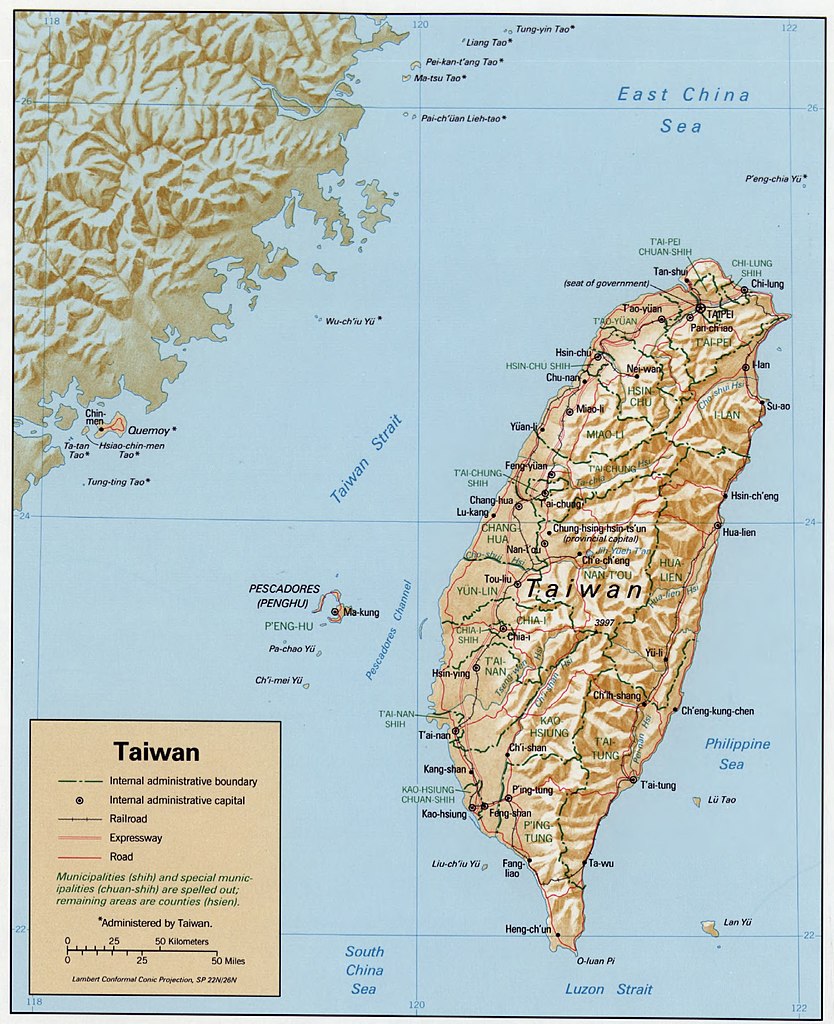
Taiwan relief map.
Library of Congress Geography & Map Division via Wikimedia Commons.
There has for some time been a good deal of flippant talk about a Communist Chinese invasion of the Republic of China on Taiwan, as if that would be a simple military undertaking. It seems to be inadequately appreciated that Taiwan has thought of little else for many years, and is, unlike Ukraine, a very prosperous and technologically sophisticated country that is armed to the teeth with the most advanced American weaponry, and has plotted out a defense in depth that is called its “porcupine strategy”.
Though it is probably accidental, “porcupine” is the word applied to Switzerland by Adolf Hitler in 1941, when, after careful analysis by the German General Staff, he concluded Swiss defenders would inflict a much larger number of casualties on a German invasion force than could possibly be justified by the occupation of the country. (It can be lamented that more recent Western strategists did not apply the same test to Afghanistan.)
Comparisons with Ukraine are inapplicable, other than the fanatical determination of the defenders. Most obviously, Taiwan is not only an island but the Formosa Straits are three to four times as wide as the English Channel from the southern British ports to the beaches of Normandy. The People’s Republic of China would have no choice but to attack amphibiously as they could not possibly imagine success with fewer than 500,000 combat soldiers and no force remotely as large could be parachuted onto Taiwan.
A strike force of 500,000 would probably have to be supplemented by a follow-up force at least as large, all conveyed in a huge armada of slow and vulnerable craft. Taiwan has been supplied with the precise ground and air-launched missiles that the Ukrainians have used to such deadly effect in the Black Sea, including the sinking of the Russian flagship, the heavy missile cruiser Moskva.
Taiwan has a front-line Air Force of about 300 of the latest fully equipped fighter and interceptor aircraft that along with shore batteries could rain a dense and prolonged fire of missiles upon any invasion fleet. Such a fleet, even in the best of weather, would plod through open water for at least ten hours. They would be sitting, or at least slowly moving, ducks throughout that journey. It brings to mind the conclusion of one of Churchill’s Demosthenean addresses in the autumn of 1940: “We are still awaiting the long-promised invasion; so are the fishes.”
Comments Off on The Republic of China’s “Porcupine strategy”
July 3, 2022
Tougher than Guadalcanal: New Georgia – 201 – July 2, 1943
World War Two
Published 2 Jul 2022The Allies begin the next phase of their Solomon Islands offensives, the invasion of New Georgia, even as the regional fighting continues on New Guinea. Adolf Hitler schedules his summer Kursk offensive for July 5th, and the Allied invasion of Sicily is set for July 10th.
(more…)
Comments Off on Tougher than Guadalcanal: New Georgia – 201 – July 2, 1943
June 26, 2022
Two Hundred Weeks of War – WW2 – 200 – June 25, 1943
World War Two
Published 25 Jun 2022The Allies make some preliminary moves ahead of their next big operation in the Solomon Island as well as a few before their impending invasion of Sicily. Meanwhile, in the Soviet Union, Soviet citizens are laying over a million mines in anticipation of the impending German attack at Kursk.
(more…)
Comments Off on Two Hundred Weeks of War – WW2 – 200 – June 25, 1943
June 25, 2022
Colonial Berthiers: 1902 Indochina and 1907 Senegalese
Forgotten Weapons
Published 21 Jul 2017http://www.patreon.com/ForgottenWeapons
The sharpshooters of the French colonial forces in Indochina (the Tirailleurs Indochinois) had never been issued Lebel rifles, and were still using single shot Gras rifles at the turn of the century. The Indochinese soldiers were rather short statured, and the Lebel was simply too long for them to use efficiently. The colonial government requested a special weapon for these men, and the result was the 1902 Berthier.
The Berthier carbine was much more compact than the Lebel, and it was also less expensive to manufacture and simpler to instruct troops with. So after some brief experimentation, a version was produced with a 25 inch (635mm) long barrel, which was a nice balance between the carbines and the Lebel rifle. In my opinion, the 1902 is the ideal size for a Berthier, and I think it handles best of all the different variations made.
An initial production run of 22,500 of these 1902 rifles was made by Chatellerault between 1902 and 1912. A second batch of about 25,000 more would be produced in the 1920s, but we will discuss these in a separate video, as they incorporated the 1916 upgrades.
With the successful implementation of the Berthier in the Indochinese colonial forces, it would stand out as an obvious solution for the need to upgrade the arms of France’s African colonial troops as well. These soldiers were not short, but also had outdated Gras rifles, and Lebel production was no longer active by 1907. As a result, a further lengthened Berthier was suggested for the Senegalese troops, with a barrel 31.5 inches (800mm) long; equal to that of the Lebel. This was accepted into service, and 25,000 were manufactured by Chatellerault between 1907 and the beginning of the Great War in 1914.
With the urgent need for more rifles because of World War One, the 1907 Berthier (renamed to the 1907 Colonial and issued to colonial troops besides just the Senegalese as of 1908) would attract the interest of the military because it was cheaper to manufacture than the Lebel, and still in active production. The result would be the 07/15 Berthier, which would become a dual standard infantry rifle alongside the 1886 Lebel in the war.
If you enjoy Forgotten Weapons, check out its sister channel, InRangeTV! http://www.youtube.com/InRangeTVShow

Comments Off on Colonial Berthiers: 1902 Indochina and 1907 Senegalese


