History Clarified
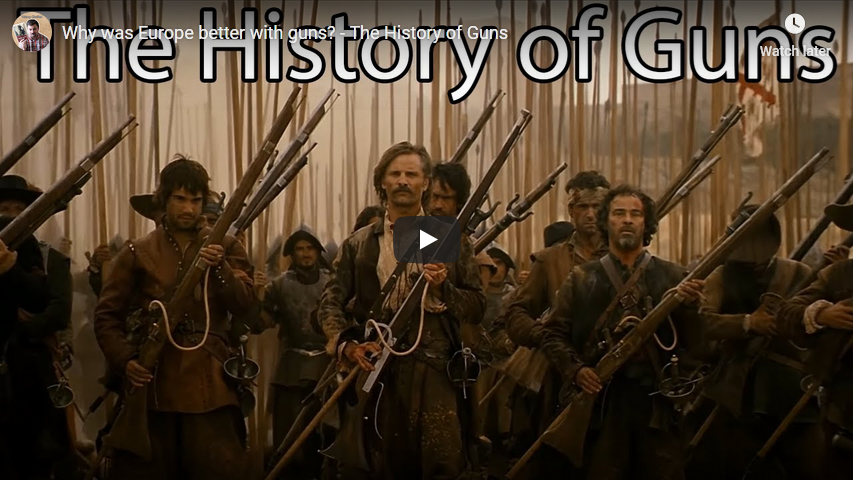
Published 3 Dec 2018China invented gunpowder (combustible powder), so why was it the European nations that went out and conquered the world using firearms?
This video looks at some geographical factors to examine what allowed Europe to innovate while China and most of the world fell behind with gunpowder weapons.
This focuses heavily on Kenneth Chase’s Book, Firearms: A Global History to 1700. He tries to get away from just looking at drill, organization, and state production of firearms to see how geography helped create the necessary conditions for those other innovations.
Interested in your own copy? Check out the link below:
DISCLAIMER: This video description contains affiliate links, which means that if you click on one of the product links below, I’ll receive a small commission.
The map of Japan is under Creative Commons 4.0.
August 31, 2020
Why was Europe better with guns? – The History of Guns
August 21, 2020
British Deserters, Sword Fights, and Poison Gas – WW2 – OOTF 016
World War Two
Published 20 Aug 2020What happened to deserters in the British Army? Did Chinese and Japanese troops ever engage in sword to sword combat? Why didn’t Germany use poison gas on the battlefield? Find out the answers to all these questions in today’s Out of the Foxholes!
Join us on Patreon: https://www.patreon.com/TimeGhostHistory
Or join The TimeGhost Army directly at: https://timeghost.tvFollow WW2 day by day on Instagram @World_war_two_realtime https://www.instagram.com/world_war_two_realtime
Between 2 Wars: https://www.youtube.com/playlist?list…
Source list: http://bit.ly/WW2sourcesHosted by: Indy Neidell
Written by: Rune Væver Hartvig
Director: Astrid Deinhard
Producers: Astrid Deinhard and Spartacus Olsson
Executive Producers: Astrid Deinhard, Indy Neidell, Spartacus Olsson, Bodo Rittenauer
Creative Producer: Joram Appel
Post-Production Director: Wieke Kapteijns
Research by: Rune Væver Hartvig
Edited by: Jakub Janiec
Sound design: Marek KamińskiColorizations:
Mikołaj UchmanVisual Sources:
Imperial War Museums: HU 762498, Q 79508, El Alamein 1942, E 18542, B5114, MH 26392, F2845,
Library of Congress
Antoine from Flickr.com
National Archives NARA
Bundesarchive
Narodowe Archiwum Cyfrowe
The icons from Noun Project by: Milinda Courey, Arthur Shlain, Delwar Hossain, ahmad, Muhamad Ulum, Rooty, Simon Child, carlotta zampini, Wonmo Kang, Vectors Point, EucalypMusic:
“Break Free” – Fabien Tell
“Ancient Saga” – Max Anson
“Defeated” – Wendel SchererArchive by Screenocean/Reuters https://www.screenocean.com.
A TimeGhost chronological documentary produced by OnLion Entertainment GmbH.
August 16, 2020
Surviving the surrender of Japan as allied Prisoners of War
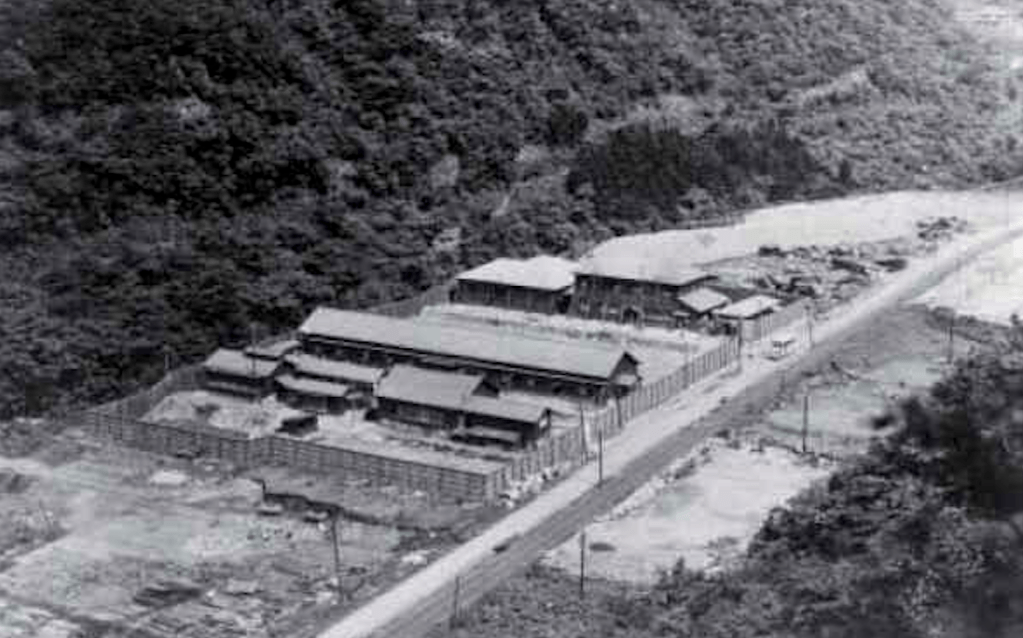
Seventy-five years ago, the war in the Pacific had ended with the surrender of Japanese imperial forces after the atomic bombing attacks at Hiroshima and Nagasaki. The war may have technically ended, but there was still plenty of danger for the surviving POWs in various camps around the Japanese home islands. George MacDonnell was a Canadian soldier who had been captured in the fall of Hong Kong early in the Japanese swathe of conquest that engulfed so many areas. He had been held as a slave labourer at a prison camp in the mountains of northern Honshu in Iwate Prefecture. In Quillette, he tells how his captivity came to an end:
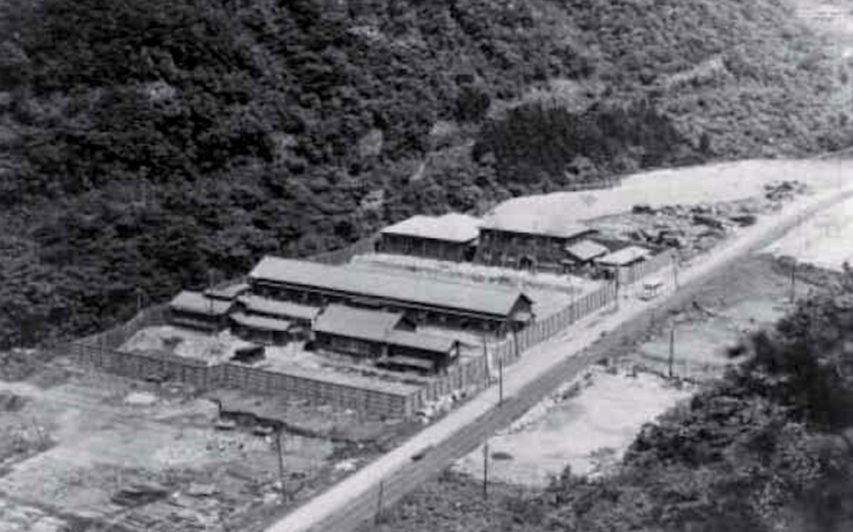
It was noon on August 15th, 1945. The Japanese Emperor had just announced to his people that his country had surrendered unconditionally to the Allied Powers.
To those of us being held at Ohashi Prison Camp in the mountains of northern Japan, where we’d been prisoners of war performing forced labour at a local iron mine, this meant freedom. But freedom didn’t necessarily equate to safety. The camp’s 395 POWs, about half of them Canadians, were still under the effective control of Japanese troops. And so we began negotiating with them about what would happen next.
Complicating the negotiations was the Japanese military code of Bushido, which required an officer to die fighting or commit suicide (seppuku) rather than accept defeat. We also knew that the camp commander — First Lieutenant Yoshida Zenkichi — had written orders to kill his prisoners “by any means at his disposal” if their rescue seemed imminent. We also knew that we could all easily be deposited in a local mine shaft and then buried under thousands of tons of rock for all eternity without a trace.
We had no way of notifying Allied military commanders (who still hadn’t landed in Japan) as to the location of the camp (about a hundred miles north of Sendai, in a mountainous area near Honshu’s eastern coast), whose existence was then unknown. Because of the devastating American bombing, Japan’s cities had been reduced to rubble, its institutions were in chaos, and millions of Japanese were themselves close to starvation, much like us. The camp itself had food supplies, such as they were, for just three days.
Lieut. Zenkichi seemed angry, and felt humiliated by the surrender. Yet he appeared willing to negotiate our status. And after some stressful hours, we reached an agreement: The Japanese guards would be dismissed from the camp, while a detachment of Kenpeitai (the much feared Military Police) would provide security for Zenkichi, who would confine himself to his office.
To our delight, the local Japanese farmers were friendly, and agreed to give us food in exchange for some of the items we’d managed to loot from the camp’s remaining inventory — though, unfortunately, not enough to feed the camp. Meanwhile, through a secret radio we’d been operating, we learned that the Americans were going to conduct an aerial grid search of Japan’s islands for prison camps. We followed the broadcasted instructions and immediately painted “P.O.W.” in eight-foot-high white letters on the roof of the biggest hut.
Two days later, with all of our food gone, we heard a murmur from the direction of the ocean. The sound turned into the throb of a single-engine airplane flying at about 3,000 feet altitude. Then, suddenly he was above us — a little blue fighter with the white stars of the US Navy painted on its wings and fuselage. But the engine noise began to fade as he went right past us. Please, God, I thought — let him see our camp.

August 9, 2020
August 5, 2020
August 2, 2020
July 26, 2020
July 25, 2020
“The Ballad of Bull” Pt.2 – Combat Medics – Sabaton History 077 [Official]
Sabaton History
Published 24 Jul 2020Sometimes war is killing, sometimes war is saving lives.
In the first episode we have seen Leslie “Bull” Allen become a hero, not through the death of his enemies, but by saving his comrades’ lives. And there were others like him. Soldiers and medics, whose first duty it was to preserve lives during war, even when it meant endangering their own safety. Here are three short stories of men and women, who served as medics at the front line of the Second World War, and became heroes to their country.
Support Sabaton History on Patreon: https://www.patreon.com/sabatonhistory
Listen to “The Ballad of Bull” on the album Heroes:
CD: http://bit.ly/HeroesStore
Spotify: http://bit.ly/HeroesSpotify
Apple Music: http://bit.ly/HeroesAppleMusic
iTunes: http://bit.ly/HeroesiTunes
Amazon: http://bit.ly/HeroesAmz
Google Play: http://bit.ly/HeroesGooglePListen to Sabaton on Spotify: http://smarturl.it/SabatonSpotify
Official Sabaton Merchandise Shop: http://bit.ly/SabatonOfficialShopHosted by: Indy Neidell
Written by: Markus Linke and Indy Neidell
Directed by: Astrid Deinhard and Wieke Kapteijns
Produced by: Pär Sundström, Astrid Deinhard and Spartacus Olsson
Creative Producer: Joram Appel
Community Manager: Maria Kyhle
Executive Producers: Pär Sundström, Joakim Broden, Tomas Sunmo, Indy Neidell, Astrid Deinhard, and Spartacus Olsson
Post-Production Director: Wieke Kapteijns
Edited by: Iryna Dulka
Sound Editing by: Marek Kaminski
Maps by: Eastory – https://www.youtube.com/c/eastoryArchive by: Reuters/Screenocean https://www.screenocean.com
Music by SabatonColorizations:
– Olga Shirnina, a.k.a. Klimbim – https://klimbim2014.wordpress.com/Sources:
– Photos of Desmond Doss Courtesy of the Desmond Doss Council
– Frame vector created by milano83 – www.freepik.com
– Arkiv i Nordland
– P.Fisxo from WikimediaAn OnLion Entertainment GmbH and Raging Beaver Publishing AB co-Production.
© Raging Beaver Publishing AB, 2019 – all rights reserved.
From the comments:
Sabaton History
2 days ago
The medical staff in war — combat medics, field surgeons and nurses, ambulance drivers and medevac crews — are often the unsung heroes of war, literally and figuratively.That doesn’t mean that they don’t deserve to be remembered and their sacrifices honored. There are undoubtedly many instances of exceptional bravery among the medical staff of wars throughout history — for which they rightly should be praised. But they should also be remembered for their everyday work in trenches or field hospitals, in jungles and deserts, at sea or in mid-air. Treating a seemingly endless stream of incoming wounded, trying to give relief to those in pain, comfort to those in agony, and hope to to those who have lost theirs — day in and day out, for as long as the war will last.
If you missed part one of “The Ballad of Bull” you can see it right here.
July 24, 2020
Winston Churchill and the 1943 Bengal famine
Christopher Howarth on a recent BBC production that threw facts out the window in a rush to condemn British Prime Minister Winston Churchill for the famine in Bengal during 1943:

A 1945 map of Bengali districts as of 1943.
Famine Inquiry Commission (1945): Report on Bengal via Wikimedia Commons.
This argument was put forward by the BBC’s own Yogita Limaye, an Indian engineer and reporter on Women’s safety, based on the book Inglorious Empire by Shashi Tharoor, who was interviewed to give his opinion that Churchill was an “odious figure of reprehensible views and racist attitudes.”
No doubt the narrative of British evil and oppression is believed in India and elsewhere, but that does not make it true or worthy of the BBC reporting it as fact without any semblance of balance. The BBC failed its licence fee paying audience in two main regards, namely, conceptually and factually.
The British ruled India, one of the largest populations on earth, for well over two centuries. Good and bad things happened, just like everywhere else ever. You can join the dots to create whatever picture you like – Dr Tharoor chose the picture he wished to create. Why is the Bengal famine uniquely interesting to a BBC audience in 2020 over say a mini-series on British Railways and development in India? BBC presenters are demonstrably more interested in the first narrative: this is a major conceptual failing on their part. Being equal mixtures primitivism and solipsism. Always the borderline racist Western assumption is that “we” did things to “them”: we had agency, they were passive brutes. They are boring, we are endlessly interesting. Let’s talk about us. However even the slightest knowledge of the British-in-India teaches one that “we” did nothing without them. How on earth could we? There were famously few of us.
Yet it’s the second great BBC failing – over accuracy – which is so especially galling. On the actual allegation the BBC is plain wrong. Churchill was not responsible for the Bengal famine as any actual delving into the facts would have shown. Note well that they didn’t even try.
In 1943 Britain was at war with Japan, who were at the gates of India having occupied Burma, a major supplier of grain to Bengal. Important facts. Bengal was in the grips of a famine, nobody disputes that. But Churchill was not responsible, neither for the weather nor the agriculture nor the Japanese aggression.
Even the BBC did not allege that Churchill instigated the famine, the charge sheet is that he refused to help when he could. There were “stockpiles [of food] in the UK” and shipping which was retained in the northern hemisphere, prioritised for use there. Stockpiles of food in the UK in 1943? Even if there was the food and shipping, transporting US corned beef to Bengal would have been ludicrous. If there was shipping and protection from Japanese naval assault the food would have come from the rest of India. So why was food not transported from other parts of India to Bengal?
War Diplomats, Japanese/Soviet Neutrality, and why not Sweden? – WW2 – OOTF 015
World War Two
Published 23 Jul 2020What happened to Allied ambassadors? And how did Hitler react to the Soviet-Japanese Neutrality Pact? And why didn’t he invade Sweden? Once again, Indy is in the Chair of Infinite Knowledge answering all your exciting questions about World War Two!
Join us on Patreon: https://www.patreon.com/TimeGhostHistory
Or join The TimeGhost Army directly at: https://timeghost.tvFollow WW2 day by day on Instagram @World_war_two_realtime https://www.instagram.com/world_war_two_realtime
Between 2 Wars: https://www.youtube.com/playlist?list…
Source list: http://bit.ly/WW2sourcesHosted by: Indy Neidell
Written by: Rune Væver Hartvig
Director: Astrid Deinhard
Producers: Astrid Deinhard and Spartacus Olsson
Executive Producers: Astrid Deinhard, Indy Neidell, Spartacus Olsson, Bodo Rittenauer
Creative Producer: Joram Appel
Post-Production Director: Wieke Kapteijns
Research by: Rune Væver Hartvig
Edited by: Mikołaj Cackowski
Sound design: Marek Kamiński
Map animations: Eastory (https://www.youtube.com/c/eastory)Colorizations by:
Jaris Almazani (Artistic Man), https://instagram.com/artistic.man?ig…
Norman Stewart – https://oldtimesincolor.blogspot.com/
Daniel WeissSources:
Bundesarchiv
Narodowe Archiwum Cyfrowe
Portrait of Charles Howard Smith, courtesy National Portrait GallerySoundtracks from the Epidemic Sound:
Howard Harper-Barnes – “London”
Fabien Tell – “Other Sides of Glory”
Johannes Bornlof – “The Inspector 4”Archive by Screenocean/Reuters https://www.screenocean.com.
A TimeGhost chronological documentary produced by OnLion Entertainment GmbH.
July 18, 2020
QotD: Peace can also be the health of the state
War, we libertarians are fond of telling each other, is the health of the state. Peruse the most recent posting here by our own WW1 historian, Patrick Crozier, to see how we often think about such things. So, what about that increasingly obtrusive and kleptocratic Brazilian state that has been putting itself about lately, stirring up misery and libertarianism? There have been no big wars to make the Brazilian state as healthy as it now is, and especially not recently. What of that?
The story Bruno Nardi told made me think of the book that explains how peace is also the health of the state, namely Mancur Olson’s public choice theory classic, The Rise and Decline of Nations. It is years since I read this, but the story that this book tells is of the slow accumulation and coagulation of politics, at the expense of mere business, as the institutions of a hitherto thriving nation gang up together to form “distributional coalitions” (that phrase I do definitely recall). The point being that if you get involved in a war, and especially if you lose a war, the way Germany and Japan lost WW2, that tends to break up such coalitions.
The last thing on the mind of a German trade unionist or businessman, in 1946, was lobbying the government for regulatory advantages or for subsidies for his particular little slice of the German economy. Such people at that time were more concerned to obtain certificates saying that they weren’t Nazis, a task made trickier by the fact that most of them were Nazis. Olson’s way of thinking makes the post-war (West) German and then Japanese economic miracles, and the relative sluggishness of the British economy at that time, a lot more understandable. Winning a war, as Olson points out, is not nearly so disruptive of those distributional coalitions, in fact it strengthens them, as Crozier’s earlier posting illustrates.
Brian Micklethwait, “The view from Brazil is that peace is also the health of the state”, Samizdata, 2018-04-13.
July 3, 2020
“Nuclear Attack” – Atomic Bombings – Sabaton History 074 [Official]
Sabaton History
Published 2 Jul 2020At 0815 on 6 August 1945, the first atomic bomb, nicknamed “Little Boy”, was dropped out of the B-29 Enola Gay and descended towards the Japanese city of Hiroshima. 43 seconds later, the city was engulfed in a flashing bright light and a shockwave of unimaginable heat and deadly pressure. From the hypocenter of the resulting mushroom-cloud, a blue-green fireball burned and blinded the city and its inhabitants with unprecedented power. 140,000 people were killed in the first few moments. Tens of thousands would die from wounds and radiation. The age of atomic warfare had begun.
Support Sabaton History on Patreon: https://www.patreon.com/sabatonhistory
Listen to “Nuclear Attack” on the album Attero Dominatus
CD: http://bit.ly/AtteroDominatusStore
Spotify: http://bit.ly/AtteroDominatusSpotify
Apple Music: http://bit.ly/AtteroDominatusAppleMusic
iTunes: http://bit.ly/AtteroDominatusiTunes
Amazon: http://bit.ly/AtteroDominatusAmzn
Google Play: http://bit.ly/AtteroDominatusGooglePlayListen to Sabaton on Spotify: http://smarturl.it/SabatonSpotify
Official Sabaton Merchandise Shop: http://bit.ly/SabatonOfficialShopHosted by: Indy Neidell
Written by: Markus Linke and Indy Neidell
Directed by: Astrid Deinhard and Wieke Kapteijns
Produced by: Pär Sundström, Astrid Deinhard and Spartacus Olsson
Creative Producer: Joram Appel
Community Manager: Maria Kyhle
Executive Producers: Pär Sundström, Joakim Broden, Tomas Sunmo, Indy Neidell, Astrid Deinhard, and Spartacus Olsson
Post-Production Director: Wieke Kapteijns
Edited by: Iryna Dulka
Sound Editing by: Marek Kaminski
Maps by: Eastory – https://www.youtube.com/c/eastoryArchive by: Reuters/Screenocean https://www.screenocean.com
Music by Sabaton.Colorizations:
– Dememorabilia – https://www.instagram.com/dememorabilia/Sources:
– U.S. Department of Energy
– Bomb icon by P Thanga Vignesh from the Noun Project
– bockelsound from freesound.org
– Vilna Gaon State Jewish MuseumAn OnLion Entertainment GmbH and Raging Beaver Publishing AB co-Production.
© Raging Beaver Publishing AB, 2019 – all rights reserved.
From the comments:
Sabaton History
2 days agoAugust 6, 1945. On this fateful Monday morning our world changed forever.
Nuclear weapons were now a reality, destruction on a whole new level a possibility. International power dynamics, foreign politics and conflict handling would never be the same once this new kind of weapon of mass destruction had entered the scene. The threat of potentially world-ending nuclear war, the fear that the men in power would push “the red button”, would hang over people like a dark cloud from this day on. The Nuclear Age had begun.
If you’re interested in how politics developed during The Nuclear Age, you can explore that in the day-by-day coverage of The Cuban Missile Crisis over on TimeGhost History. The first introduction, “USA Starts the Atomic Arms Race”, is already up and you can watch it right here: https://youtu.be/zEXjoBe5ZdI
June 28, 2020
June 21, 2020
Burma Victory (1945)
PeriscopeFilm
Published 31 May 2016Support Our Channel: https://www.patreon.com/PeriscopeFilm
Made in 1945, BURMA VICTORY is a British documentary about the Burma Campaign during World War Two. It was directed by Roy Boulting. The introduction to the film outlines the geography and climate of Burma, and the extent of the Japanese conquests. The film then describes the establishment of the South East Asian Command (SEAC) under Mountbatten, “a born innovator and firm believer in the unorthodox”, and gives a comparatively detailed account of subsequent military events, including the Battle of Imphal-Kohima and Slim’s drive on Mandalay, Arakan landings, the northern offensive of the Americans and Chinese under Stilwell, and the roles played by Chindits and Merrill’s Marauders. The film ends with the capture of Rangoon and the Japanese surrender. The film focuses on the difficulties of climate, terrain, the endemic diseases of dysentery, malaria, etc., the vital role of air supplies, the shattering of the myth of Japanese invincibility and the secondary role of the Burma campaign in overall Allied strategy.
This film represents a British look at the campaign and was the pet project of Admiral Lord Louis Mountbatten, Supreme Allied Commander, South-East Asia, and he planned it as a joint Anglo-American production. But this scheme foundered over the inability of the U.S. leadership and British to agree on the main theme of the film. The British wanted it to concentrate on the drive southwards to liberate Burma. The Americans, anxious not to be seen to be participating in the restoration of the British Empire, wanted to emphasize the heroic building of the Ledo Road and the drive northwards to relieve the Chinese. In the end the two sides went their separate ways. The Americans produced the Ronald Reagan narrated film The Stilwell Road and the British made Burma Victory. It was the final production of the Army Film and Photographic Unit (AFPU) and was directed, like Desert Victory (1943), by Roy Boulting. Not released until after the war was over, it was hailed and promoted as “the real Burma film”.
The Burma Campaign in the South-East Asian theatre of World War II was fought primarily between the forces of the British Empire and China, with support from the United States, against the forces of the Empire of Japan, Thailand, and the Indian National Army. British Empire forces peaked at around 1,000,000 land, naval and air forces, and were drawn primarily from British India, with British Army forces (equivalent to 8 regular infantry divisions and 6 tank regiments), 100,000 East and West African colonial troops, and smaller numbers of land and air forces from several other Dominions and Colonies. The Burmese Independence Army was trained by the Japanese and spearheaded the initial attacks against British Empire forces.
The campaign had a number of notable features. The geographical characteristics of the region meant that factors like weather, disease and terrain had a major effect on operations. The lack of transport infrastructure placed an emphasis on military engineering and air transport to move and supply troops, and evacuate wounded. The campaign was also politically complex, with the British, the United States and the Chinese all having different strategic priorities.
South East Asia Command (SEAC) was the body set up to be in overall charge of Allied operations in the South-East Asian Theatre during World War II. Admiral Lord Louis Mountbatten served as Supreme Allied Commander of the South East Asia Command from October 1943 through the disbandment of SEAC in 1946.
This film is part of the Periscope Film LLC archive, one of the largest historic military, transportation, and aviation stock footage collections in the USA. Entirely film backed, this material is available for licensing in 24p HD and 2k. For more information visit http://www.PeriscopeFilm.com
June 5, 2020
“The Ballad Of Bull” – Leslie “Bull” Allen – Sabaton History 070 [Official]
Sabaton History
Published 4 Jun 2020Sometimes war is killing, sometimes it’s saving lives. This week we turn a soldier who became a hero, not for killing his foes, but for saving his fellow men. Medic Leslie “Bull” Allen’s story is a story about courage in the face of fire. The battle for Mount Tambu in 1943 in Papua New Guinea was vicious and bloody, and the field was soon littered with many wounded men crying for help. Without much regard for his own safety, “Bull” Allen stormed forward into the fray. 12 times he went, and 12 times he came back with a wounded soldier on his back.
Support Sabaton History on Patreon: https://www.patreon.com/sabatonhistory
Listen to “The Ballad Of Bull” on the album Heroes here:
CD: http://bit.ly/HeroesStore
Spotify: http://bit.ly/HeroesSpotify
Apple Music: http://bit.ly/HeroesAppleMusic
iTunes: http://bit.ly/HeroesiTunes
Amazon: http://bit.ly/HeroesAmz
Google Play: http://bit.ly/HeroesGooglePCheck out the trailer for Sabaton’s new album The Great War right here: https://www.youtube.com/watch?v=HCZP1…
Listen to Sabaton on Spotify: http://smarturl.it/SabatonSpotify
Official Sabaton Merchandise Shop: http://bit.ly/SabatonOfficialShopHosted by: Indy Neidell
Written by: Markus Linke and Indy Neidell
Directed by: Astrid Deinhard and Wieke Kapteijns
Produced by: Pär Sundström, Astrid Deinhard and Spartacus Olsson
Creative Producer: Joram Appel
Executive Producers: Pär Sundström, Joakim Broden, Tomas Sunmo, Indy Neidell, Astrid Deinhard, and Spartacus Olsson
Post-Production Director: Wieke Kapteijns
Edited by: Iryna Dulka
Sound Editing by: Marek Kaminski
Maps by: Eastory – https://www.youtube.com/c/eastoryArchive by: Reuters/Screenocean https://www.screenocean.com
Music by Sabaton.Sources:
– State Library Victoria
– Motorboat sound by bockelsound from freesound.orgAn OnLion Entertainment GmbH and Raging Beaver Publishing AB co-Production.
© Raging Beaver Publishing AB, 2019 – all rights reserved.