Quotulatiousness

August 14, 2021

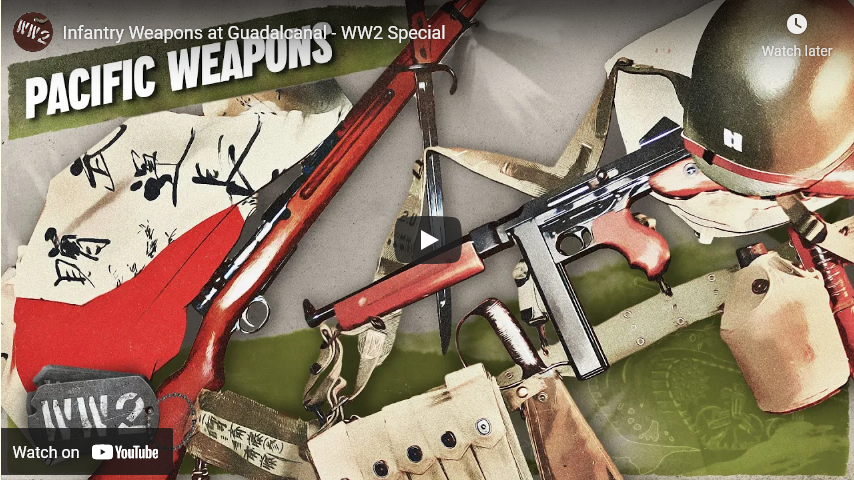
Infantry Weapons at Guadalcanal – WW2 Special

Filed under: History, Japan, Military, Pacific, USA, Weapons, WW2 — Tags: , , , , , , , — Nicholas @ 04:00

Update: The folks at the World War Two channel have taken down this video due to technical errors in the script. Here’s their explanation.

World War Two
21 hours ago
Video on Infantry Arms at Guadalcanal retracted. Indy explains why:

Hi everyone. Indy here. As most of you know, I do the research and writing for all of the regular weekly episodes here. I host many of the specials as well, though I do not do the research for most of them- occasionally so, if it’s something that’s really in my field of expertise, like geopolitics, strategy, personal stories, communications, and international relations. The research for the other specials is done by a variety of specialists in their fields or historians, so we can maintain the quality you’ve come to expect from us. I understand, though, that many of you have serious issues with the research for the Guadalcanal infantry special. Our apologies for that- the research was done by an historian, a PhD [student], actually, and we also ensured it was double fact-checked, but obviously some serious mistakes slipped through. Live and learn. I will say that I think it is important that you continue to tell us when you take issue with something we present, since we strive to make the most complete and accurate documentary series possible, so although some of them are hard to read we appreciate such feedback from our community.

And this is from the researcher who worked on the script:

Marlon Londoño
18 hours ago
Hey guys! This is Marlon, the PhD student in question who helped with the researching and writing of the episode. Just to give a little background, I’m a volunteer researcher who helps with the channel over the summer while I’m not teaching/researching/taking coursework. I’m a military historian and my main academic focus is on social and cultural military history (i.e. what people’s wartime experiences were like and why. I’m especially interested in how people justify wartime violence and oftentimes the types of weapons they use play a role in that mental process, so that’s the context in which I usually think about weapons on the battlefield).

I’m sorry that I let a lot of you down with the mistakes about the Garand and Arisaka, among others. To be honest, I was surprised to learn they were myths. But I certainly know now, and I don’t think I’ll be forgetting any time soon 😅 One thing that I firmly believe as a researcher and educator is that nobody has a monopoly on the truth, least of all me. I tell that to my students on the first day of class each semester. I certainly don’t presume that the degree I’m pursuing makes me infallible or instantly qualified for anything. And this was a classic example of just how wrong I can be sometimes!

For what it’s worth, I love war history just as much as anyone else in the community, and I’m sorry that my research wasn’t as rigorous as it might otherwise have been. I hope you all might be willing to give any future episodes of mine a second chance, and of course I’m all ears for any mistakes that you want to point out!

August 12, 2021

QotD: Ignoring the warnings

Filed under: History, Japan, Middle East, Military, Pacific, Quotations, USA, WW2 — Tags: , , , , — Nicholas @ 01:00

… on Dec. 7, 1941, a U.S. Army Air Force lieutenant was spending his first-ever shift with a radar unit atop some Hawaiian high ground. Radar was brand new technology, and the U.S. was still figuring out how to best use it. The poor lieutenant watched on a scope as a big blob of something approached the naval base. He assumed it was a bunch of friendly planes coming in from the U.S. — what else would it be, right? Besides, even if he had been worried, there was no established protocol to sound an alarm. Forty-some-odd years before the release of Ghostbusters, the poor lieutenant was living the iconic tagline — when there’s a big mass of planes flying toward your base, who ya gonna call? And so the lieutenant and his men could only watch Japan’s massively successful attack on the U.S. fleet, an attack that caught the American defenders totally unprepared, with sailors asleep in their racks and senior officers golfing or breakfasting. There had been some intelligence warnings that Japan was up to something, but no one guessed that an attack on Hawaii was imminent. Not even the guys who quite literally saw it coming.

Let’s jump forward a few decades: in 1973, Israeli military intelligence was fully aware of a huge build-up of men and weapons on its borders with Syria and Egypt. The mobilizations were impossible to hide — tens of thousands of troops, tanks, artillery, the whole apparatus of modern warfare was lining up across Israel’s borders. But Israel’s top military intelligence officer concluded that the build-up was intended to apply political pressure ahead of negotiations, not actually to prepare for an assault. Israel was militarily superior, after all, and had handily defeated the combined Arab armies before, including just six years prior. The Arabs simply wouldn’t dare try again. Right?

Wrong. They dared, Israel was caught totally by surprise, and the Jewish state came shockingly close to defeat and likely destruction.

Ideally, these kinds of mistakes — mistakes of preparedness, mistakes of erroneous conclusion — are studied, learned from and then never repeated. In the real world, of course, we tend to make the same mistakes over and over.

Matt Gurney, “How the COVID crisis broke our leaders’ minds”, The Line, 2021-04-23.

August 11, 2021

The Symphony That Defeated the Wehrmacht – WAH 040 – August 1942, Pt .1

Filed under: China, Europe, Germany, History, Japan, Military, Russia, USA, WW2 — Tags: , , , , , , — Nicholas @ 04:00

World War Two
Pubished 10 Aug 2021

The Big Action at the Warsaw Ghetto continues, while The Japanese carry out retaliations against the Chinese for aiding American airmen. Dmitri Shostakovich’s “Symphony no. 7” premieres in the besieged city of Leningrad.
(more…)

August 8, 2021

Guadalcanal – Allies Take the Initiative – WW2 – 154 – August 7, 1942

Filed under: Britain, Germany, History, Japan, Military, Pacific, Russia, USA, WW2 — Tags: , , , , , , — Nicholas @ 04:00

World War Two
Published 7 Aug 2021

The Axis Forces are on the move on the Eastern Front and in the Caucasus, but this week the Allies begin an offensive of their own: this week come Allied landings and attacks on Guadalcanal and nearby islands, the first American offensive against the Japanese.
(more…)

August 1, 2021

Not a Step Back! – Wehrmacht Closes in on Stalingrad – WW2 – 153 – July 31, 1942

World War Two
Published 31 Jul 2021

Operation Edelweiss opens with a blast, and as the Wehrmacht closes in on Stalingrad, Stalin issues that famous order. There aren’t just big actions in the East, the Japanese have landed in New Guinea, the Allies try one more offensive at El Alamein, and the Americans have locked in on Guadalcanal.
(more…)

July 23, 2021

FDR Knew about Pearl Harbor?! – WW2 – Reading Comments

Filed under: Germany, History, Japan, Military, Pacific, USA, WW2 — Tags: , , , , — Nicholas @ 04:00

World War Two
Published 22 Jul 2021

Here is another installment of Across the Airwaves where Indy and Sparty take the opportunity to directly address some of the comments left by our community. In this episode, we take a look at some of the more controversial comments left on our videos.
(more…)

July 13, 2021

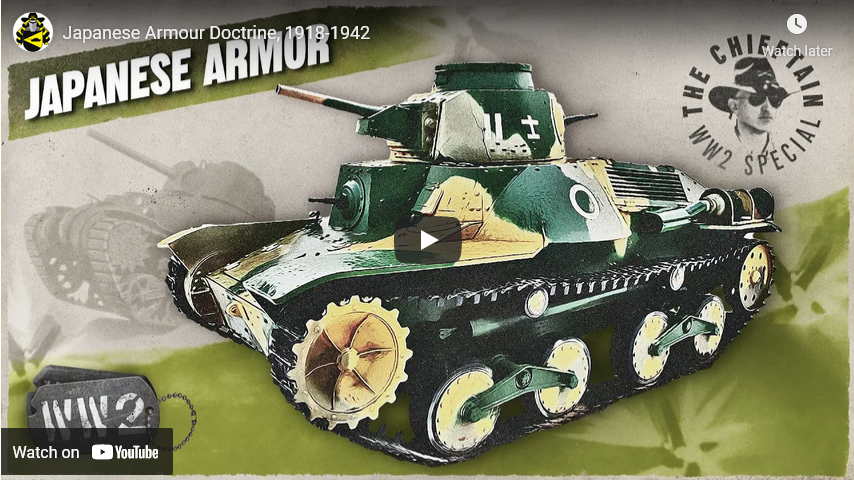
Japanese Armour Doctrine, 1918-1942

Filed under: China, History, Japan, Military, Russia, USA, Weapons, WW2 — Tags: , , , , , — Nicholas @ 04:00

The_Chieftain
Published 11 Jul 2021

Sources include:
Japanese tanks and armoured Warfare 1932-45, David McCormack
WW2 Japanese Tank Tactics, Gordon Rottmen, Akira Takizawa
Japanese Tanks, Tactics and anti-tank weapons, Donald McLean
Type 89 and Tankette books, Kazunori Yoshikawa

Continuing on this series of videos supporting the WW2 Channel, I look at what I can find about how the Japanese thought of tanks and their usage, tempered by quite a bit of combat experience.

Improved-Computer-And-Scout Car Fund:
Patreon: https://www.patreon.com/The_Chieftain
Direct Paypal https://paypal.me/thechieftainshat

July 9, 2021

The Western Warlords of Asian Armies – WW2 Gallery 004

World War Two
Published 8 Jul 2021

From the Battle of Shanghai to the Burma Campaign and beyond, Western military advisors have played a big role in the actions of East Asian armies in the Pacific Theatre. Watch the videos to learn the stories of Joseph Stilwell, Claire Lee Chennault, the Flying Tigers, the Chindits, and more.
(more…)

July 2, 2021

Japan’s Institutionalization of Rape – WAH 037 – June 1942, Pt. 2

Filed under: Britain, Germany, History, India, Japan, Military, WW2 — Tags: , , , , , , , , — Nicholas @ 04:00

World War Two
Published 1 Jul 2021

During the occupation of South-East Asia, Japan builds a large system of institutionalised rape to “keep their soldiers happy”. Meanwhile, Allied refugees from Burma find a safe haven in India, but for some, hardship continues.
(more…)

June 29, 2021

QotD: Carrier dive bombers in the early Pacific war

Filed under: History, Japan, Military, Pacific, Quotations, USA, Weapons, WW2 — Tags: , — Nicholas @ 01:00

The Japanese Nakajima B5N “Kate” (235mph, 1 x 7.7mmm mg, 1760lbs torpedo or bombs, 1,075 mile range) torpedo bomber had been introduced in 1941, and was the mainstay of the early years of the wartime Japanese carrier operations. It had good range, was reliable, and had a good payload. But it still lacked armour or self-sealing fuel tanks. As a result it was desperately vulnerable to daytime operations against reasonable fighter opposition.

Almost exactly the same could be said for the American Douglas Dauntless dive bomber (255mph, 2 x 0.5 and 2 x 0.3 mg, 1,200lbs bombs, 1,115 mile range). Arrived at the same time, same strengths, similar weaknesses. Like all American aircraft it could absorb considerably more damage than any Japanese plane, but like all daylight attack aircraft, its top speed made it a sitting duck against organized fighter defenses. The greatest success of the Dauntless was at Midway, where the sacrificial run of the TBD Devastator torpedo bombers fortuitously arrived just far enough in advance to pull the entire Japanese fighter cover away and allow the Dauntlesses exactly the sort of unopposed attacks that the theoretically inferior Japanese “Val” dive bombers had enjoyed at Ceylon and Coral Sea. The increased success of the Dauntless later in the war was in direct parallel to the increased ability of American fighters to clear a path. By the time of the sinking of the Yamato in 1945, Dauntless formations always had almost completely unopposed runs. (Perhaps that is why it continued in operation when every other contemporary aircraft had been replaced?)

Nigel Davies, “Comparing naval aircraft of World War II”, rethinking history, 2010-12-20.

June 27, 2021

Fall Blau Starts … or Does it? – WW2 – 148 – June 27, 1942

World War Two
Published 26 Jun 2021

Fall Blau, the huge Axis summer offensive in the Soviet Union, is supposed to being this, but is postponed to next. The smaller Operation Fridericus II does begin though, and what does Josef Stalin make of that and the intelligence he’s received? Meanwhile in North Africa, after the fall of Tobruk, the British 8th Army gets a leadership change, but Erwin Rommel is still on the move eastward into Egypt. Where will the Allies try to hold him? Half the world away, the Allies begin to establish a base at Milne Bay, New Guinea. It’s a start, a small one, but a start.
(more…)

June 17, 2021

The Real Indiana Jones and his Jurassic Quests | BETWEEN 2 WARS I E.20 Summer 1923

Filed under: Asia, History, Japan, USA — Tags: , , , , , , , — Nicholas @ 04:00

TimeGhost History
Published 16 Jun 2021

On their search for the origins of humanity, the expedition led by Roy Chapman Andrews makes some amazing discoveries in the Gobi Desert, including the uncovering of dinosaur eggs and velociraptors. Who knew paleontology could be so cool?
(more…)

June 16, 2021

By Sea, By Land – A Global History of the Marines – WW2 Special

Filed under: Britain, History, Japan, Military, Russia, USA, WW2 — Tags: , , , , — Nicholas @ 04:00

World War Two
Published 15 Jun 2021

Naval infantrymen have long been a feature of warfare. In the build-up to 1939, they took on new functions and tactics. The Royal Marines, the US Marine Corps, Black Death, Kaiheidan, and more are ready for all-out amphibious warfare in the Pacific Theatre and beyond.
(more…)

June 14, 2021

QotD: Obsolescent carrier aircraft in the Pacific war

Filed under: Britain, History, Japan, Military, Quotations, USA, WW2 — Tags: , , , — Nicholas @ 01:00

The most obsolete first-line strike aircraft in any carrier force in 1942 was the American Douglas TBD Devastator torpedo bomber (206mph, 2 x.303 mg. 1,000lbs of a torpedo or bombs, range 716 miles). Despite — or because of — being the first monoplane on any carrier air-wing (1937!), it had never been a very good aircraft. Fully loaded with a torpedo (a much lighter torpedo than used by anyone else), it had a hard time getting off the deck, and had a much reduced speed and range. In fact its attack speed was actually slower than a [British Fairey] Swordfish, and it lacked the Swordfish’s maneouvrability or capacity to take damage. Used in daylight (the only way it could be used), it was an absolute death-trap if there was any airborne opposition at all. In fact the role played by the Devastators at the Battle of Midway was as [unintentional] kamikaze decoy targets to draw the Japanese fighter forces out of place. A point made even clearer by the fact that the few Devastators which had managed to attack at Coral Sea had usually seen their torpedoes fail to work anyway. (The American carrier fleet would not get a successful airborne torpedo until mid 1943!)

The next most obsolete was the Japanese Aichi D3A “Val” dive-bomber (266mph, 3 x 7.7 mg, 1 x 500lb and 2 x 60lb bombs, 970 mile range) which had also entered service in the mid 30’s. It was a fixed landing gear dive-bomber modeled on the famous Junkers Ju87 (183mph, 1 x 7.7mm mg, 1,000lb bomb load, 621 mile range), and was just as good a dive bomber … if there was no opposition. Unlike the Ju87 (and like the [British Blackburn] Skua) the Val also had the ability to defend itself as a second-rate fighter once the bombs had been dropped. Still, the Val relied for success on clear skies, and achieved excellent results under those conditions at Ceylon (cruisers Devonshire and Cornwall and unarmed old carrier Hermes) and Coral Sea (carrier Lexington). Under even moderate air pressure at Trincomalee and Midway the performance fell off markedly, and later in the war the phrase that comes to mind is “Great Marianas Turkey Shoot”. Nonetheless they had to soldier on because the replacement aircraft was too fast for the smaller carriers that were to become the majority of the Japanese carrier fleet after Midway.

Nigel Davies, “Comparing naval aircraft of World War II”, rethinking history, 2010-12-20.

June 8, 2021

Midway pt.2 – A New War? – WW2 – 145c – June 7, 1942

Filed under: History, Japan, Military, Pacific, USA, WW2 — Tags: , , , , , , — Nicholas @ 04:00

World War Two
Published 7 Jun 2021

We left off last time with several burning behemoths. Watch today to see the action that follows, not just on the high seas, but also in Alaska. We also turn to Washington DC and Tokyo and follow the reaction to the Battle of Midway there. The Japanese one may surprise you.
(more…)

« Newer PostsOlder Posts »

Powered by WordPress