
I am old enough to remember when almost everyone believed that the Russians were, as Khrushchev put it, going to “bury” us. Even leading economists such as Paul Samuelson were taken in by such nonsense. Of course, no such burial occurred, because just producing vast quantities of concrete, steel, and H-bombs is no evidence that anything of genuine value is being produced. Later Japan became the Godzilla that was going to eat the U.S. and European economies with its bureaucratic setup for picking and subsidizing “winners.” Before long that setup too collapsed in a heap and gave way to perpetual stagnation. Now almost everyone quakes in his boots while beholding the mighty Chinese economy. Again the hysteria has no firm foundation. An economy shaped and guided by government bureaucrats and Communist bigwigs by means of tariffs, subsidies, state-controlled credit, and state-owned industries cannot be a real growth miracle for long. This too shall pass.
And when it does Americans will learn nothing from their most recent mistake. If people really understood sound economics, they would not continue to make this same mistake again and again.
Robert Higgs, “China — Americans’ Economic Bugaboo du Jour”, The Beacon, 2018-12-19.
October 14, 2021
QotD: Americans’ perception of foreign economic threats
October 12, 2021
Richard Overy looks at the “Great Imperial War” of 1931-1945
I missed Rana Mitter‘s review of Richard Overy’s latest book when it was published in The Critic last week:
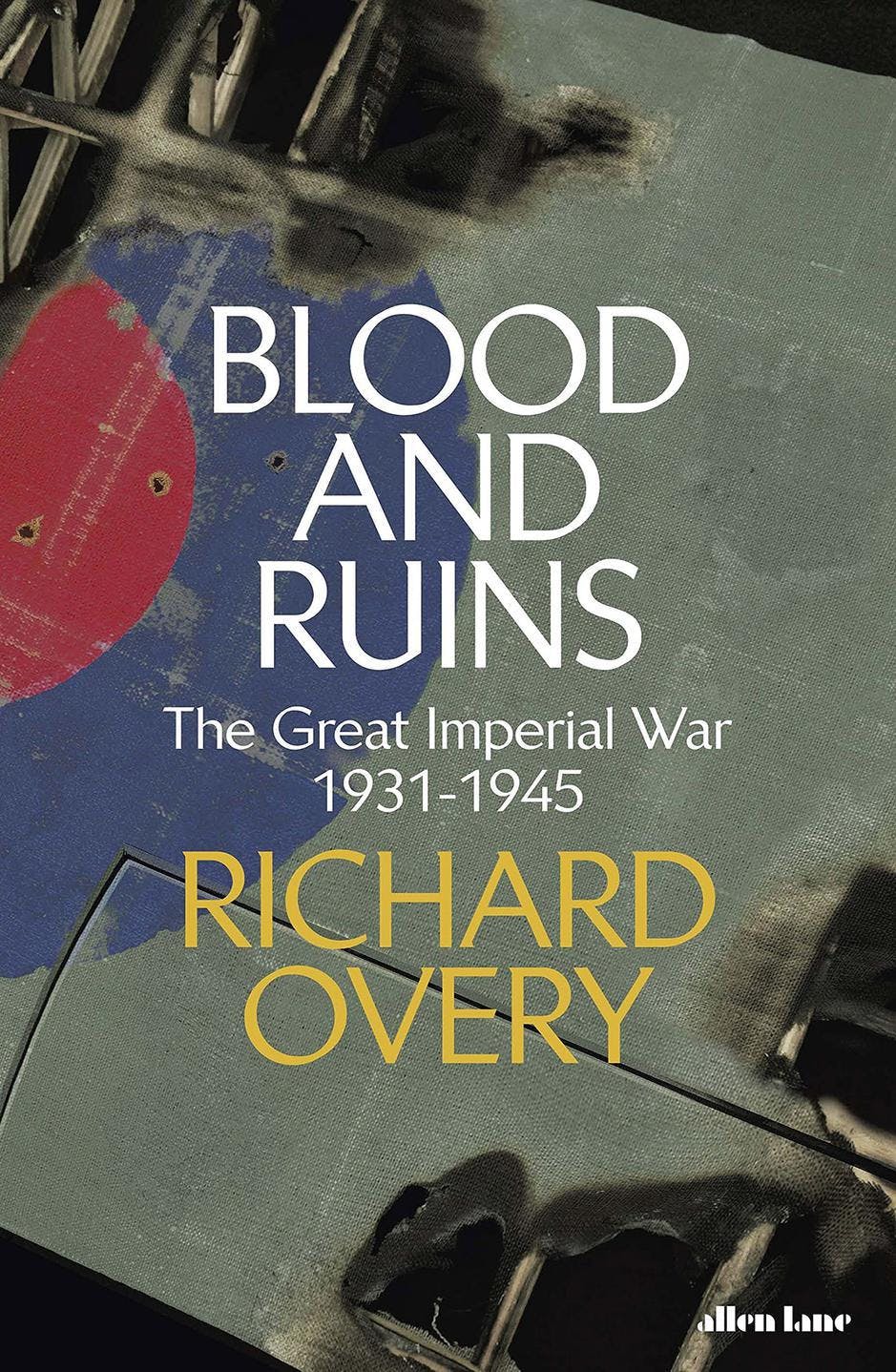
Imagine there’s no Hitler. It’s not that easy, even if you try, at least if you’re a westerner thinking about the Second World War. But for millions of Asians, those years of conflict had little to do with the horrors of Nazi invasion and genocide, and it is their experience that frames Richard Overy’s account of a seemingly familiar conflict. For most non-Europeans, the war was not a struggle for democracy, but a conflict between empires, and in this book, that imperial struggle begins not with the invasion of Poland by Germany in 1939 but the occupation of Manchuria by the Japanese in 1931.
Blood and Ruins is really two books in one. The first is perhaps the single most comprehensive account of the Second World War yet to appear in one volume. You might think that by reading extensively, you could construct a book like this one. You could not — unless you have Overy’s control over a staggering range of World War II scholarship, much of it drawn from his own decades of research on the economics of total warfare, the development of technology, from radar to aerial bombing, and the idea of the “emotional geography” of war, encompassing morale, hope, and despair. Then you’d need to go back and cover all those categories for each of the major Allied and Axis belligerents: Britain, the US, Japan, Germany, France, Italy and China among them.
The second book is an argument about what kind of conflict the Second World War really was. Overy is clear: on a global as opposed to European scale, it was not (just) a war about democracy, but about empires and their fate, although “the starting point in explaining the pursuit of territorial empire is, paradoxically, the nation.”
Overy points out what is generally lost to view when the European war is placed at the centre of the historiography: both Britain and France were undertaking an “awkward double standard” in their defence of democratic values, as their Asian and African possessions “rested on a denial of those liberties and the repression of any protest against the undemocratic nature of colonial rule”. While this argument has been made before (not least by figures such as Nehru and Gandhi in India at the time), Overy does something unusual and revealing: he compares the western empires with Japan’s justification for its own imperial project in the early twentieth century.
The book is scrupulously careful not to endorse or excuse the worldview of Tokyo’s imperialists, and gives full weight to the voices of the Chinese nationalists and communists who were bitterly opposed to Japan’s expansion on the Asian mainland. Still, the comparison of Japan’s pre-war and wartime empire to those of the western powers provides an important and original broadening of a contemporary debate.
There is ongoing public British (and to some extent French) argument about whether empire was a “good” or “bad” thing. Yet neither attackers nor defenders of the British empire tend to analyse it alongside the Japanese equivalent that lasted nearly half a century. Britain committed colonial massacres (Amritsar) and deadly repression (Mau Mau). So did Japan (the rape of Nanjing, invasion of Manchuria).
Britain’s empire also created an aspirational middle class full of cosmopolitan nationalists, and drew on ideas of loyalty to recruit its subjects to fight in world wars. All these things are also true of Japan, which like Britain was a multi-party democracy for much of its period as an overseas empire (between 1898 and 1932), and whose capital city was an intellectual hub for political activists from across Asia.
As a colony of Japan between 1895-1945, Taiwan developed a middle class that was Japanese-speaking and keen to draw on new economic opportunities brought by empire: Lee Teng-hui, the first democratically elected president of the Republic of China on Taiwan, always thought of Japanese as his mother tongue. Park Chung-hee, the American-sponsored dictator of Cold War South Korea, learned his political craft as an army officer in the Japanese Manchukuo Army that occupied Manchuria.
October 10, 2021
Stalingrad Thunderdome: Paulus vs. Chuikov! – WW2 – 163 – October 9, 1942
World War Two
Published 9 Oct 2021Things are looking pretty grim for Vassily Chuikov’s 62nd Army in Stalingrad this week, as the German 6th Army launches its biggest series of attacks so far. The Axis are unable to get anywhere in the Caucasus, though, and the American Marines win a local victory over the Japanese on Guadalcanal, but everyone’s thoughts there are on reinforcing and more reinforcing.
(more…)
October 8, 2021
The case for defending Taiwan
Roberto White explains why the west should help protect the Republic of China from the People’s Republic of China:
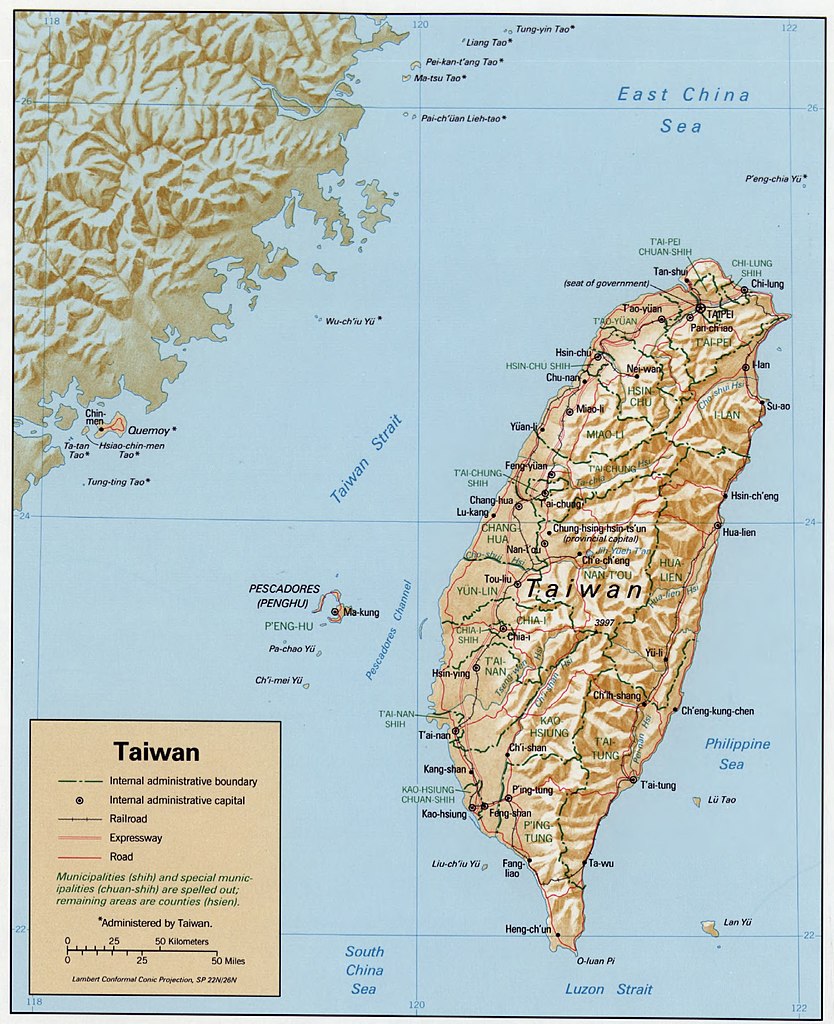
Taiwan relief map.
Library of Congress Geography & Map Division via Wikimedia Commons.
The past few days have seen Taiwan subjected to another wave of continuous harassment by China. Of course this is nothing new; China has violated Taiwan’s airspace since at least 2014. But, on Monday, a record 34 fighter jets were dispatched to Taiwan. Beijing’s increasingly erratic behaviour towards Taiwan brings to the fore why the West must defend them.
Taiwan is a free-market democracy that, despite its overbearing northern neighbour, has managed to create a vibrant economy that ranks as the sixth freest economy in the world. Crucially, it is a major producer of semiconductors (a device that helps power everything from cars to satellites), accounting for 92 per cent of all production of the world’s most sophisticated and important chips. Thus, from both an ideological and strategic standpoint, defending Taiwan is a mutually beneficial move.
The case for Taiwan’s defence is further strengthened when we look at what could happen in Asia should China take Taiwan by force.
With Taiwan’s ports and air bases, the People’s Liberation Army (PLA) could extend its maritime militia northwards through the Ryukyu (the chain of islands between Taiwan and Japan) and the Senkaku Islands (disputed by China and Japan). This would give China increased leverage over Japan in a time of crisis by, for example, restricting its maritime commerce.
The CCP could further use Taiwan as a base for tighter control of the South China Sea by blocking the Luzon Strait (between Taiwan and the Philippines) and the Balintang channel, which would cut off the traditional route used by the US Navy to navigate regional waters. In essence, China would immediately become the foremost power in the Indo-Pacific that could eventually kick the US and its allies out of the region. Unfortunately, the threat of a Chinese invasion is not a distant reality. In March of this year Admiral Philip Davidson, the United States’ top military officer in the Asia-Pacific, warned that China could invade Taiwan by 2027.
Given the perilous scenario that would emerge from a Chinese invasion of Taiwan, it is vital that, should an invasion happen, the West comes to Taiwan’s defence. However, until such a time, Western allies should aim to help Taiwan by promoting its participation in international forums. The first step would be to allow diplomats and other officials with Taiwanese passports to enter UN buildings, which they currently cannot do. This would most likely provoke a backlash from China, yet it would also confer Taiwan the dignity and respect that officials from every other state have.
The West should also stand firm against Chinese attempts to exclude Taiwan from international organisations. Between 2008-2016, Taiwan was invited to be an observer at the World Health Organization (WHO) under the name “Chinese Taipei”. In 2016, after Tsai Ing-Wen was elected Taiwan’s President, Beijing rescinded the invitation and Taiwan has not been allowed to participate since.
October 1, 2021
The Russian 2nd Pacific Squadron – Voyage of the Damned
Drachinifel
Published 13 Mar 2019The story of a few good men’s struggle, against their own commanders, their own fleet, their own ships and their own men.
Want to support the channel? – https://www.patreon.com/Drachinifel
Want to talk about ships? https://discord.gg/TYu88mt
September 26, 2021
Stalingrad, Factory by Factory, Room by Room – WW2 – 161 – September 25, 1942
World War Two
Published 25 Sep 2021Franz Halder, German Army Chief of Staff since the war began, loses his job this week, but the offensive this summer has failed to gain any of its objectives and someone has to take the blame. In the Caucasus it’s slowing to a crawl, and in Stalingrad the fighting is now block by block. Meanwhile, the Japanese are making new plans for a big offensive of their own, to take Guadalcanal once and for all.
(more…)
September 19, 2021
Stalingrad Falls? – WW2 – 160 – September 18, 1942
World War Two
Published 18 Sep 2021It’s a big week, but by now they all are. The fighting in Stalingrad is intense, the fighting on Guadalcanal is intense, and the US loses a carrier in the Pacific. And the German quest for oil in the Caucasus … how’s that going again?
(more…)
September 18, 2021
What if Pearl Harbor Never Happened, Life in Cyprus, and Peasant Armies of China – WW2 – OOTF 024
World War Two
Published 17 Sep 2021Ever wonder what would have happened if Japan just never attacked Pearl Harbor but invaded the Indies anyway? Or how the people of Cyprus are faring in the war? Or if the Chinese armies had any specialized combat forces? Find out in this Out of the Foxholes!
(more…)
September 12, 2021
Hitler Finally Fed Up with his Army – WW2 – 159 – September 11, 1942
World War Two
Published 11 Sep 2021Adolf Hitler sacks Wilhelm List, Army Group Commander in the Caucasus. His replacement does not have military command experience. The fighting there is still successful this week, though, as is the advance through the suburbs of Stalingrad. The Japanese are advancing along the Kokoda Trail and on Guadalcanal, but the Axis attacks in North Africa have failed badly.
(more…)
September 5, 2021
This War is Three Years Old – WW2 – 158 – September 4, 1942
World War Two
Published 4 Sep 2021As the war turns three there is is no slacking in the fighting. Erwin Rommel launches another Axis attack in North Africa, but it is foiled in only days, though the Axis are advancing in the Caucasus as well as on Stalingrad, where the fight for the suburbs is now beginning. They’re also advancing in the South Pacific, as the Japanese fight their way along the Kokoda Trail.
(more…)
September 2, 2021
Road to WWII: A Basic Causal Analysis
Thersites the Historian
Published 19 Nov 2019This video is a primer for undergraduates in broad history survey courses that will hopefully help make sense of the interwar years between World War I and World War II.
Patreon link: https://www.patreon.com/thersites
PayPal link: paypal.me/thersites
Twitter link: https://twitter.com/ThersitesAthens
Minds.com link: https://www.minds.com/ThersitestheHis…
Steemit/dtube link: https://steemit.com/@thersites/feed
BitChute: https://www.bitchute.com/channel/jbyg…
Backup Channel: https://www.youtube.com/channel/UCUrD…
August 29, 2021
Yamamoto: Midway Round Two? – World War Two – 157 – August 28, 1942
World War Two
Published 28 Aug 2021The Battle of the Eastern Solomons takes place this week — another carrier battle. As for the Germans, they’re advancing on Stalingrad, slowing down in the Caucasus, and Erwin Rommel is preparing to launch another assault in North Africa.
(more…)
August 28, 2021
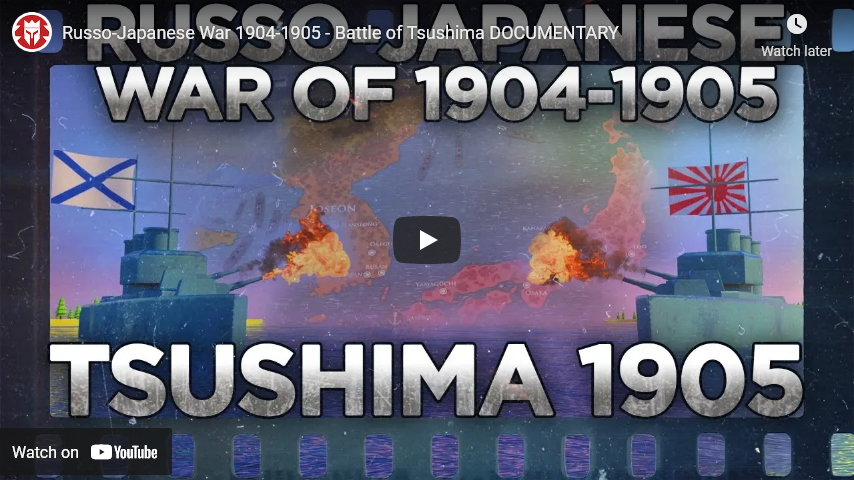
Russo-Japanese War 1904-1905 – Battle of Tsushima
Kings and Generals
Published 16 Dec 2018In our new historical animated documentary, we will cover the Russo-Japanese War of 1904-1905 with a focus on the naval engagements at Tsushima, the Yellow Sea, and Port Arthur. This conflict between Russia and Japan was unique due to the heavy usage of the battleships and its results influenced the First and Second World Wars.
Support us on Patreon: http://www.patreon.com/KingsandGenerals or Paypal: http://paypal.me/kingsandgenerals
Check out our Merch Store: teespring.com/stores/kingsandgenerals
We are grateful to our patrons and youtube members, who made this video possible: https://drive.google.com/open?id=1Tff…
This video was narrated by Officially Devin (https://www.youtube.com/user/OfficiallyDevin)
✔ Merch store ► teespring.com/stores/kingsandgenerals
✔ Podcast ► Google Play: http://bit.ly/2QDF7y0 iTunes: https://apple.co/2QTuMNG
✔ Twitter ► https://twitter.com/KingsGenerals
✔ Instagram ► http://www.instagram.com/Kings_GeneralsSources:
Robert Forczyk – Russian Battleship vs Japanese Battleship
William Koenig – Epic Sea Battles
Левицкий – Русско-японская война 1904—1905
Сорокин – Оборона Порт-Артура. Русско-японская война 1904—1905Production Music courtesy of Epidemic Sound: http://www.epidemicsound.com
#Documentary #RussoJapaneseWar #KingsAndGenerals
August 23, 2021
Swastika Raised on Highest Point in Europe – WW2 – 156 – August 21, 1942
World War Two
Published 21 Aug 2021The Axis advance in the Caucasus takes Mt. Elbrus, and the one on Stalingrad continues, and there are several raids of note this week- a Japanese one on Guadalcanal is destroyed, an Allied one on Dieppe is badly savaged, and an American one at Makin Atoll is successful in the short term, but with bad long term ramifications.
(more…)
August 15, 2021
No Soviet Oil for Hitler – WW2 – 155 – August 14, 1942
World War Two
Published 14 Aug 2021The Axis advance into the Caucasus is going great … except the oil towns they take have no oil, and wasn’t that the whole purpose? Meanwhile in the Pacific, the US Navy is suffering perhaps its greatest defeat ever off Savo Island, even as the Marines take Tulagi, Gavutu, and Tanambogo.
(more…)


