Kiran Pfitzner posted the first part of a series on everyone’s favourite Prussian, Carl von Clausewitz, fleshing out some of the, er, skimmed-over sections of his career:
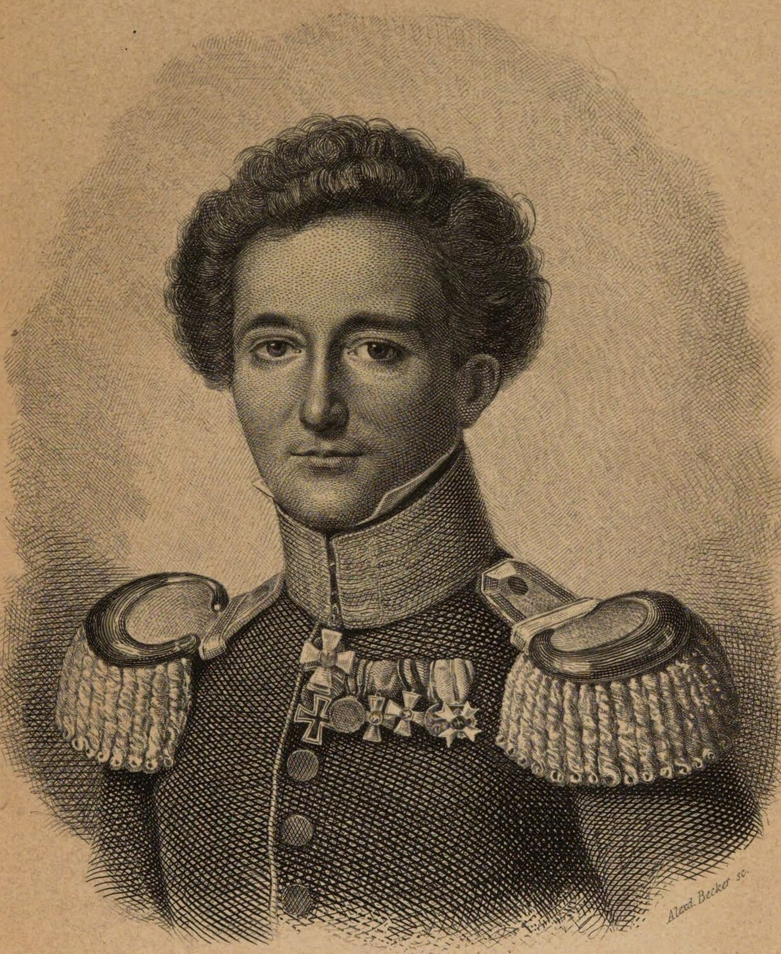
Carl von Clausewitz by Alexander Becker, circa 1867.
If you read a summary of the life and career of Carl von Clausewitz, the impression you will get is that he served in the Napoleonic Wars as a staff officer, joined the Russians rather than serve under Napoleon, and — come peace — worked a desk job that gave him the time to write his magnum opus, left unfinished by his early death from cholera. While true statements, taken together they paint only a muddy picture of the arc of his life and provide one little help in understanding the man and his thought.
Central to understanding Clausewitz is that his political isolation and the stagnation of his career were not merely a product of royal disfavor over his actions in 1812, but a consequence of his views (shared by his friend Field Marshal August von Gneisenau) that Prussia needed to modernize. Specifically, Prussia needed to liberalize and rationalize by encouraging middle-class political participation, removing barriers to trade, establishing the rule of law, and granting a constitution. It was these views that were responsible for he and Gneisenau being treated as potential “Jacobins”, something that became a subject of embarrassment for later generations of Germans. With unification, the figures of the Wars of Liberation were heroicized, and so national mythology papered over the sharp divides of the Restoration. This is significant not only for the history of Germany’s political development, but accepting this framing obscures the real discontinuity between Clausewitz and later generations of Prussian officers. This discontinuity is nowhere better exemplified than in his conviction that it was necessary to be — and demand — far more intellectually than was expected of the traditional officer.
In this respect, Clausewitz certainly succeeded. Examining Clausewitz’s personal life reveals him as part of a humanistic, intellectual tradition, discussing war and politics in the informal, mixed-sex environment of salons, where aesthetics and poetry were no less frequent or serious topics. This social milieu forms a marked contrast with the near-monastic technocratic professionalism that would come to characterize the German General Staff, particularly during the Schlieffen years.1 Understanding Clausewitz’s life not only enables a greater understanding of his work, but is valuable in providing an understanding of the kind of environment that produced the only enduring theory of war.
In Donald Stoker’s recent biography, he writes, “Clausewitz was a Prussian officer to his core”, citing Clausewitz’s self-description in these terms in his “Observations on Prussia in her Great Catastrophe”. This was true in certain respects, but Clausewitz was far from the stereotypical Prussian officer, and taking this statement at face value elides Clausewitz’s conscious distance from his contemporaries. Indeed, the piece which Clausewitz felt the need to preface with this profession was so inflammatory in its criticism of Prussia’s policies and leading personalities in the 1806 campaign that it was not published until 1888, more than half a century after Clausewitz’s death. Clausewitz and his works should therefore not be understood as in direct continuity with the later Prusso-German tradition, but as an expression of views that, despite considerable overlap, were contrary to prevailing sentiments. Clausewitz saw his contemporaries as relying on a haphazard mix of truisms, maxims, anecdotes, and principles, producing assertions that could not bear the scrutiny of logic and history, which any valid theory required. On War was written because of what he saw as the failure of these military thinkers to look at war systematically, producing either illogical and inconsistent propositions, or else neat systems that could not withstand historical analysis. Thus, the ideas in On War are not completely original, but as a whole represent a dissent against the existing approach to thinking and teaching about military affairs.
This lone voice was powerful enough to make an impact, but it could not overturn the forces that had hitherto prevented war from being studied in a systematic and holistic manner. Clausewitz did not have a personality suited for propagating his views, and the political situation and his own position meant he had no institutional means of doing so. The result was a lack of continuity, so that later readers of his works interpreted them in light of the theories Clausewitz had rejected, failing to make real use of his contributions to military theory.
This all might well be taken as nothing more than a matter of historical curiosity were it not for the fact that Clausewitz continues to be victim of misinterpretation today — often in precisely the same way as he was by later German officers. For all that Clausewitz is taught and vaunted in the military academies of the United States, American officers have shown remarkable reticence to reckon with political factors, as Clausewitz insists is essential, and as history has demonstrated.2 Clausewitz’s work remains not only valid, but especially relevant precisely because its assertions remain contentious, no matter how common-sense they may appear. A right understanding of how to think and learn about war is a matter not only of success or failure, but of life or death for many.
- See Herbert Rosinski, “Scharnhorst to Schlieffen: The Rise and Decline of German Military Thought“, Naval War College Review 29, no. 3 (Summer 1976): 83–103.
- This is, of course, far from a uniquely American problem, but the American veneration of Clausewitz is particularly intense.