
The period after the First World War in Weimar Germany was a huge break with the Wilhelmine past, especially in Berlin and some other large cities. Hitler wasn’t wrong about the moral decadence of the 1920s and the reaction helped build his movement. At The Grim Historian, Carlyn Beccia illustrates what life was like in Berlin for those who fully indulged in the excesses of the new liberalized society that so outraged Hitler and his supporters:
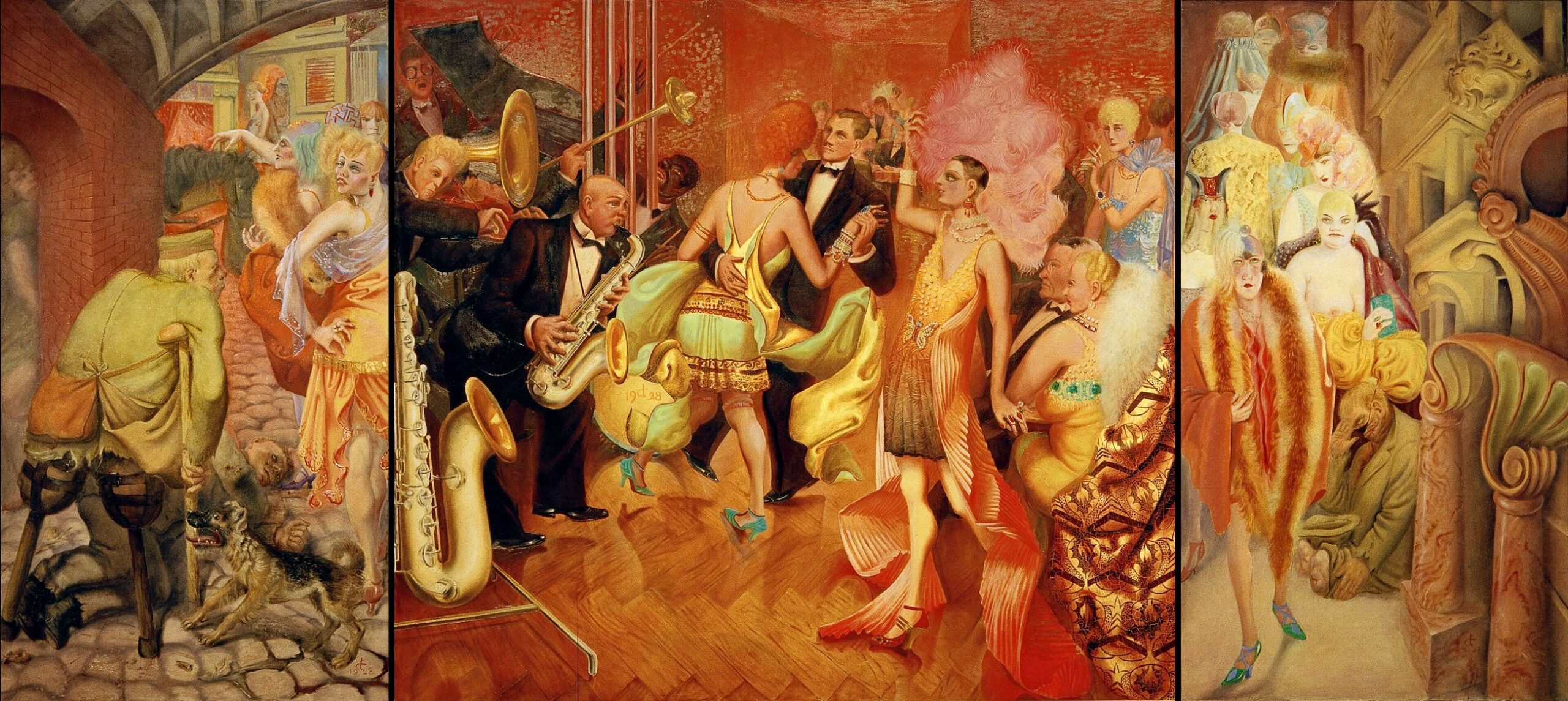
Metropolis by Otto Dix, 1927–1928,
Kunstmuseum Stuttgart
It’s 1929, and Berlin is having the kind of night respectable people will later insist never happened.
Neon bleeds across wet pavement. A taxi hisses past, throwing gutter water onto a woman whose dress has misplaced most of its back. Somewhere below street level, a trumpet murders a respectable German melody while a girl in a tuxedo leans in to kiss another girl.
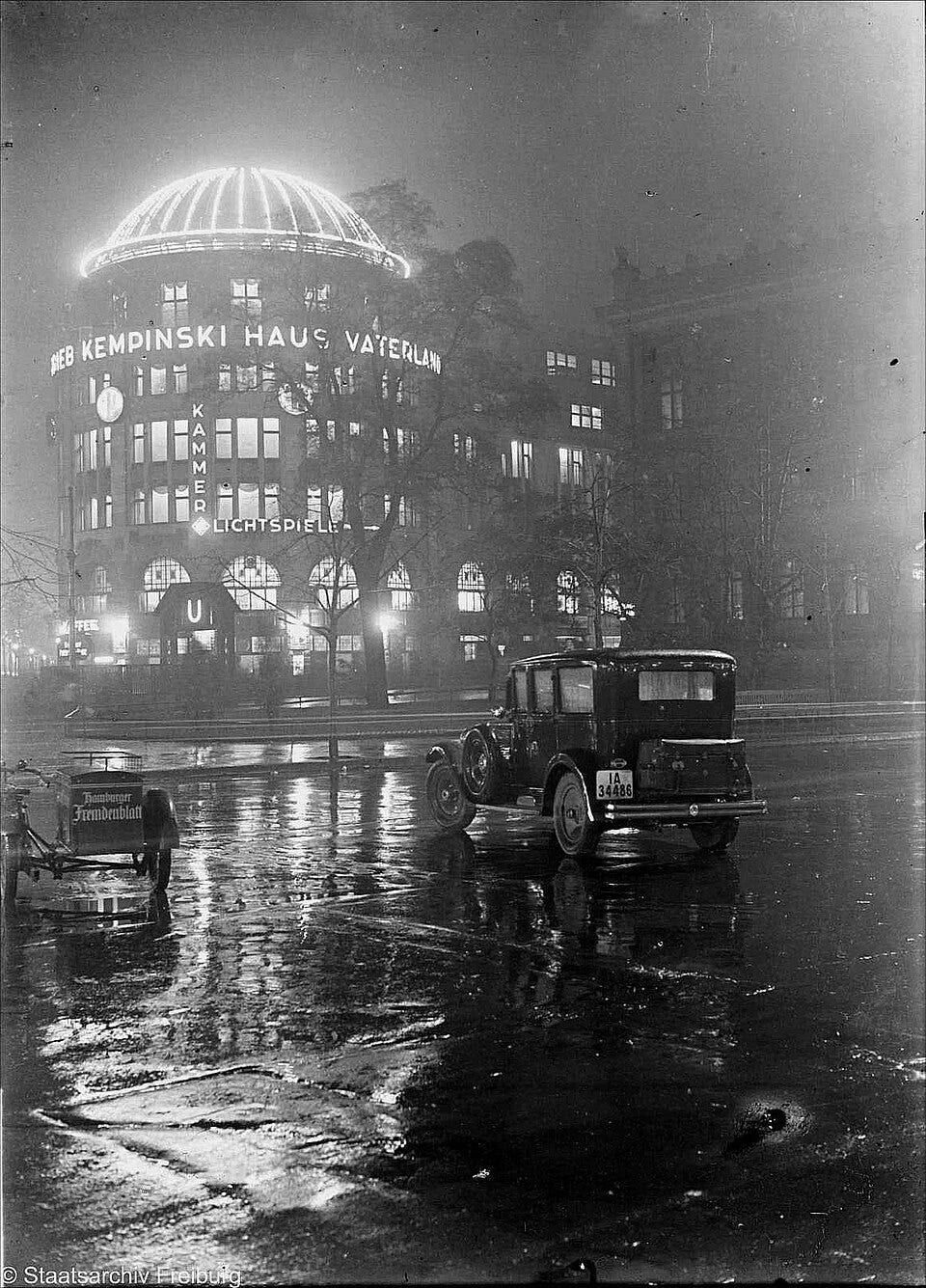
Berlin, 1929: Haus Vaterland, where Berliners could drink, dance, dine around the world, and enjoy an hourly fake thunderstorm over the Rhine because subtlety had apparently taken the night off. The pleasure palace could accommodate as many as 8,000 people.
CC BY 4.0She goes in. Another comes out laughing. The door swings.
They call these women the Neue Frau — “new woman”. Hair bobbed to the jawline as though she took a knife to the nineteenth century. Hemline at the knee, one stocking laddered at the ankle.
The new woman works behind a counter at a department store. When the doorman holds out his hand, she pays him with her own wages from her own bank account. Today, we would call these progressive women “girlbosses” while silently hating ourselves for not having a less cringy word.
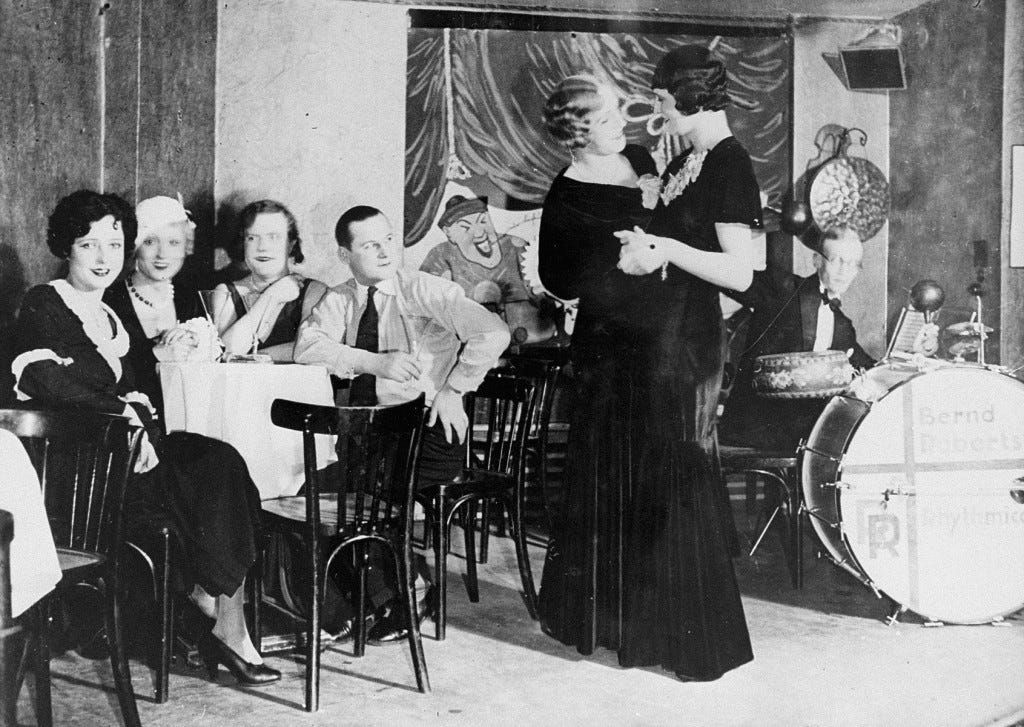
Berlin, 1929: Two women dance at the Eldorado, where lipstick, tuxedos, and heterosexual expectations were all optional. Four years later, the Nazis shut it down.
Bildarchiv Preussischer Kulturbesitz, via United States Holocaust Memorial Museum, Holocaust EncyclopediaOther young women belonged to a more slippery category Berliners called the Halbseidenen — the “half-silks”. Half-silk was fabric woven partly from real silk and partly from cheaper thread. The fabric was glossy enough to pass at a distance, suspect once you got close.
The nickname landed on women who were equally difficult to classify — shopgirls, dancers, sexually independent working women, occasional prostitutes, girls dressed just a little better than their wages should have allowed.
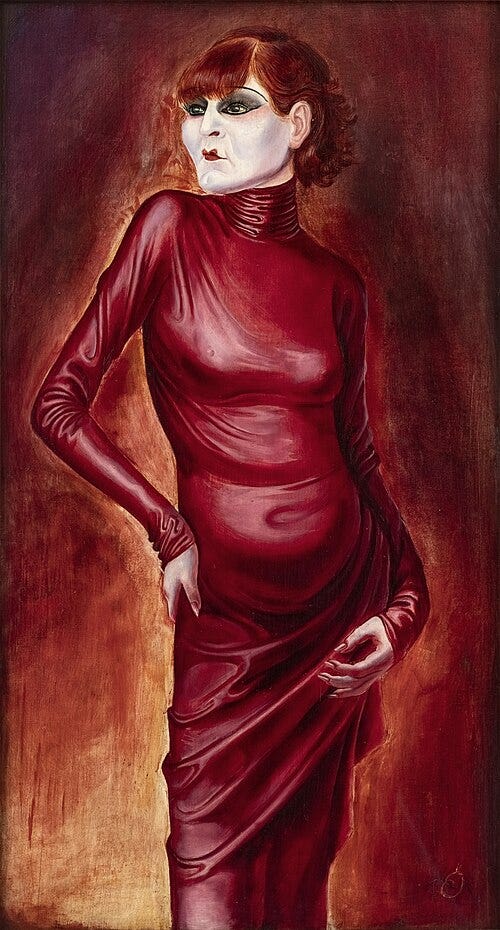
These women do not dance politely. Anita Berber, Berlin’s cocaine-addicted queen of nude dance, had made Dances of Vice, Horror and Ecstasy infamous. Grosz and Otto Dix paint Lustmord — sex murder — as a genre, and sell it.
Otto Dix – Portrait of the Dancer Anita Berber, 1925
Public DomainInside the club, smoke curls from red-stained lips like a genie escaping its lamp. Champagne sweats in silver buckets and sloshes in chipped glasses. A folded banknote, a razor’s quick flash, two white lines cut across a mirror while dancers stamp and spin inches away.
Women arrive as men, men arrive as women, and bankers disappear into back rooms with people their bankers’ wives would not have invited to luncheon.
This particular den of iniquity has competition. Weimar Berlin supports somewhere between 65 and 80 gay bars and another fifty lesbian ones.
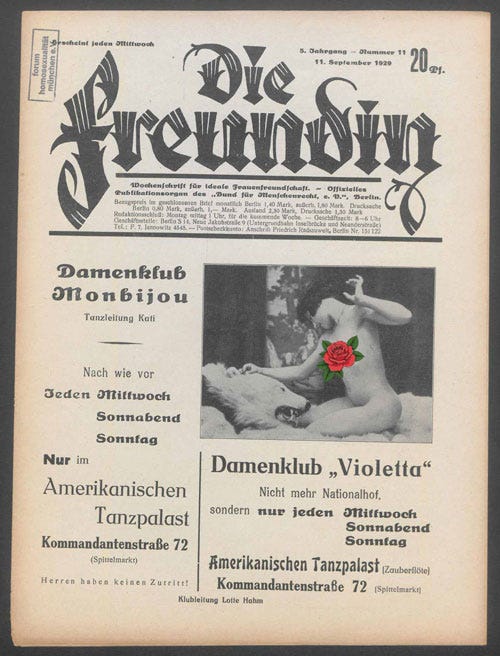
And the sexual revolution does not stop at closing time. It is sitting on the newsstands. By the end of the decade, more than twenty publications cater to gay, lesbian and gender-nonconforming readers — romance serials, political essays, personal ads, and club listings. A lonely girl in Leipzig can get Die Freundin without ever setting foot in a dancehall.
Berlin, 1929: Die Freundin, Germany’s lesbian weekly, advertises two women’s clubs at the Amerikanischer Tanzpalast. The fine print reads: “Men are not admitted.” I added the flowers. Weimar Berlin did not. | Forum Queeres Archiv München.
Across town, Magnus Hirschfeld has spent years trying to drag sex out of whispers and into science. The physicians in his Institute for Sexual Science would soon help pioneer some of the first gender-affirming surgeries. The institute also offers birth control and counseling, and works with Berlin police on “transvestite passes” — documents that let trans people walk the city without being arrested for their clothes.
Berlin has somehow managed to give gender nonconformity paperwork.
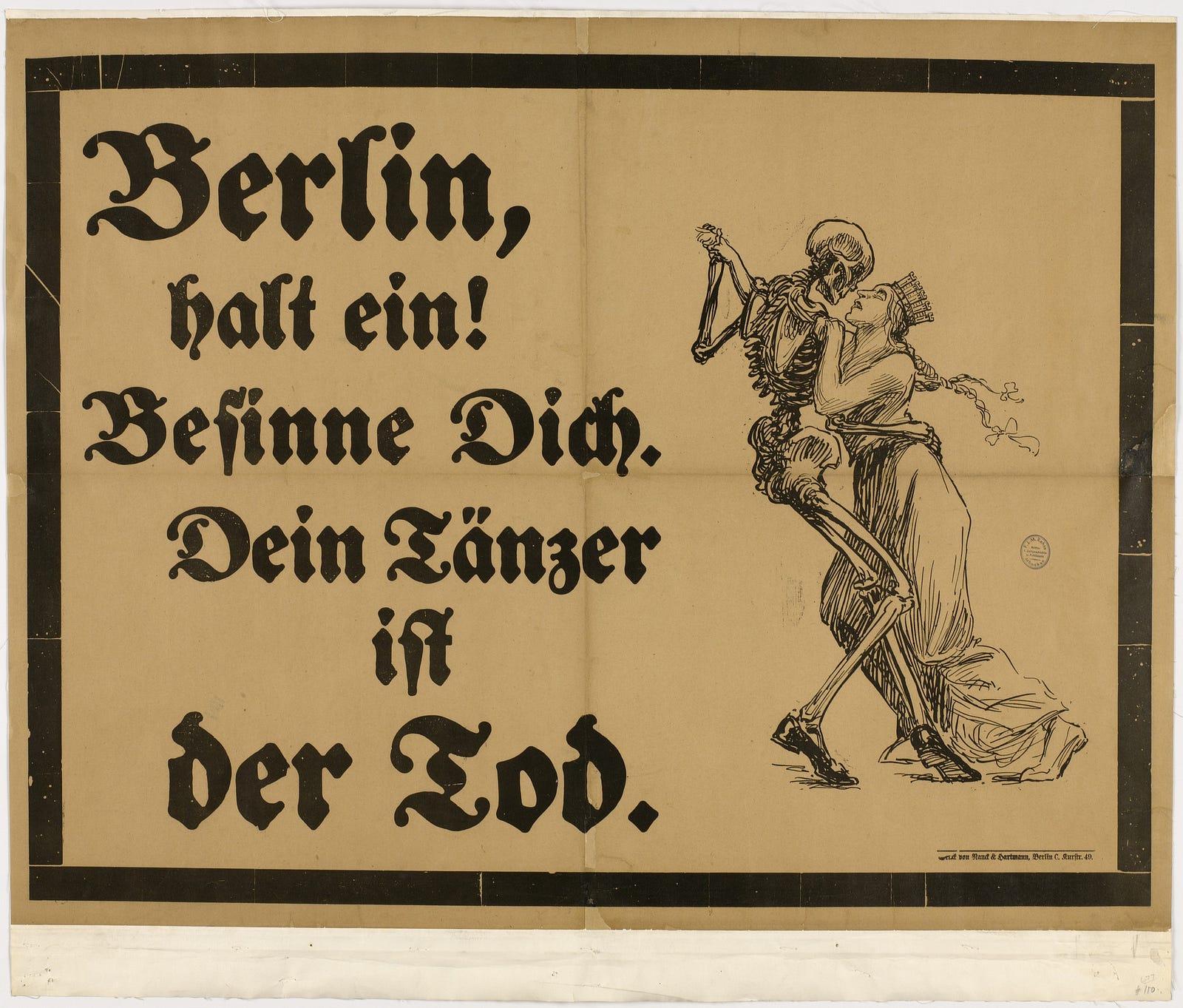
Not everybody finds this charming. Berlin has been hearing the opposite sermon since the republic was born. Ten years earlier, in the political convulsions after World War I, a poster showed a crowned Berlin locked in a waltz with a skeleton, “Berlin, halt ein! Besinne dich. Dein Tänzer ist der Tod” — Berlin, stop. Come to your senses. Your dance partner is Death.
The poster was not about lesbians in tuxedos. It came from the political chaos of 1919. But the accusation is already there.
Berlin is losing itself. It must return to the past and what once made it great.
Of course, by the late 1920s, the people making that nostalgic argument have begun pointing at sex. In 1927, Wilhelm Frick warns that homosexuality will lead to the “disintegration of the German people”. Large numbers of Germans describe Weimar’s new sexual visibility as decadent, immoral, and evidence of national degeneration. Right-leaning religious organizations and parties preach family, restraint, and traditional German culture.
Looking back on the inflation era, Austrian writer Stefan Zweig remembered the city transforming into “the Babel of the world”, with gay bars multiplying like mushrooms and transvestite balls so extravagant he thought ancient Rome had been outdone.
Berlin read the room. Berlin went on dancing, spending, and fucking.
Berlin, 1919: Ten years before Fritz stands outside our nightclub, Berlin is already being warned about its dance partner. “Stop! Come to your senses! Your dancer is Death.” | Van Santen, Berlin, Stop! 1919.
Lithograph. Library of Congress Prints and Photographs Division. Public DomainBerlin’s own tourist bureau was advertising Jeder einmal in Berlin! — everyone should visit Berlin at least once. In 1929, nearly 1.7 million guests did.
But not everyone enjoyed watching Berlin turn its private vice into a tourist attraction.
Because while people inside experienced liberation, and the moral right experienced decadence and national decline, young men experienced something else.
Exclusion.



That all sure has a familiar ring to it.
Comment by Mike Porter — September 12, 2026 @ 15:20