
Back in the early days of the internet, a lot of us were enthusiastic about schools adopting digital technology, as it seemed to be the way of the future for kids to be fully immersed in the online world as part of their education. Reality has harshed the mellow for a lot of us misguided techno-fossils, as there seems to be a very strong correlation between childrens’ (computer) screen use and lower educational achievements. Sweden is trying to reverse this pattern:
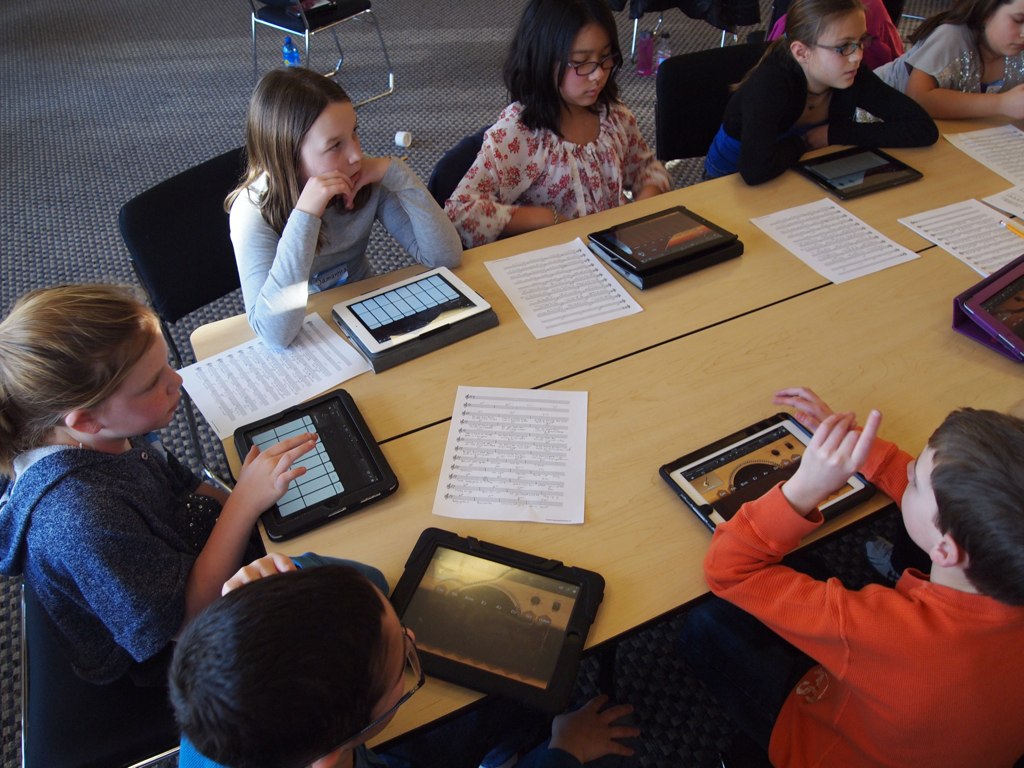
“student_ipad_school – 038” by flickingerbrad is licensed under CC BY 2.0 
 .
.
According to primary school teachers, many children shamble through the doors today zombified and crying out for their iPads.
Their parents, lined at the school gates, barely say goodbye, what with the hypnotic drivel spewing from their iPhones.
The kids greet their teachers with the YouTube vernacular: “Hi, guys!” When handed a book, they swipe and tear at the unfamiliar paper. They greet each other with: “Welcome to my channel!”
Finally, when they leave, they don’t say goodbye. They say: “Remember to like and subscribe!”
I’m not taking the piss. A friend of mine, tasked with civilising these screen-addled sprogs, confirms what one reads in the newspapers. These chirpy little addicts ransack classrooms crying out for more iPad with the fanatical calculation of tweaking crackheads.
Wherever you may sit on the political spectrum, I hope you agree that a functioning democracy might one day need citizens who can read and write, and who can concentrate beyond a ten-second video clip.
At least one functioning democracy agrees. Recently, Swedish politicians reversed their digital-first obsession by announcing a return to paper and pen. The sensible Swedes have gone analogue. Why? Literacy rates in the cosy Nordic social democracy have collapsed.
“We’re actually trying to get rid of screens as much as possible,” said the Liberal party’s Joar Forsell.
Since 2025, pre-schools are no longer obliged to employ digital ‘tools’ and teachers no longer dole out tablets to kids under two. According to Mr Forsell, reading real books on paper does what schools have for decades avoided: it teaches kids to think. Tablets for toddlers is now från skärm till pärm (from screen to paper.)
High school students now drag their textbooks and notepads to classrooms stripped of screens.
The evidence piles up. Researchers found that hyper-digital tablets-for-toddlers eroded basic skills. Writing by hand, Swedish students learned more and retained more. Wiping away digital mandates, Swedish lawmakers promise more handwriting and books, fewer devices, and quiet reading time.
But it’s not just the Swedes.
Psychologists Pam A. Mueller (Princeton University) and Daniel M. Oppenheimer (UCLA) found handwriting beats typing — at least if learning something is your thing. Students who pecked down verbatim notes on their laptops wrote twice as many words as their pen-and-paper classmates. Who learned and remembered more? Take a guess.
How could this be? Writing by hand is slower. You’re forced to process and reframe information in your own words — the art of thinking. Screens hamper this essential process. When we write by hand, there’s a greater connection between the brain and the finger. This act, they say, cements the information in one’s brain. Essentially, the typists transcribed much. They absorbed little. It’s like paying someone else to have sex for you.
Researchers claim that writing on paper improves everything from recalling a random series of words to grasping and understanding complicated or conceptual ideas. Writing by hand ties down the balloons of motor, visual, and sensory memory.
When studying from their notes, the longhand writers did better on tests. This persisted even when the typists were told to rephrase the material into their own words. They didn’t absorb the material. They parroted it, much like ChatGPT doesn’t know that flipping a glass spills water. It merely knows that the words “flip” and “glass of water” are statistically related to the word “spill”.
And yet, British schools continue marching to the drumbeat of post-literate doom.


