Quotulatiousness

December 11, 2025

US Democrats, like Canadian Liberals, love performative gestures but ghost on delivery

Filed under: Cancon, Media, Politics, USA — Tags: , , , , , , — Nicholas @ 05:00

I’ve remarked many times that Canada’s federal Liberals love themselves some photo ops, sound bites, ribbon-cuttings, and making announcements in front of temporary stages … they can’t help themselves, they’re what happens to theatre kids who don’t have to grow up. The American Democrats seem to be falling into the same pattern of “putting on a show” rather than implementing policies that address whatever the declared problem really is:

In 2015, the City of Los Angeles announced an ambitious plan (led by the person we then referred to as Mayor Yogapants) to completely eliminate traffic deaths by 2025. It was a vision: Vision Zero, they called it. Ten years later, traffic deaths in Los Angeles have doubled. A wonderfully progressive local government announced a plan to eliminate something, so we got much more of that thing. A community group, @peoplesvisionzero, is now trying to carry out some version of the failed plan with guerilla traffic engineering, sneaking new safety infrastructure into place without city permission. Recent result:

In similar fashion, Gavin Newsom announced his ten-year plan to end California homelessness in 2008. I struggle with the math, but there’s a possibility that we’ve passed the ten-year mark since then. […]

Theater-kid governance is the empty-to-the-point-of-ruin declaration of a symbol-desire, a performance about what we want and don’t want. It doesn’t do anything; it’s a posture, not an action. To the extent that it does do any actual thing in physical reality, it creates pots of money to be looted by NGOs and metastasizing government bureaucracies.

Infamously, when California audited $24 billion in state homelessness spending last year, auditors couldn’t track where a bunch of the spending went, or figure out what it had paid for. See also the growing scandal over Somalian immigrant social services fraud in Minnesota. Facial expressions are made. Symbols are invoked. Money goes … somewhere. It’s a show, with a rich loot bucket, not an actionable set of policies that produce positive trends toward declared goals. By the way, it’s been fifteen years since the Obama administration and a Democratic-majority Congress made healthcare affordable.

California infrastructure is a persistent disaster, because the California legislature and our sociopathic idiot governor are deeply invested in signaling about warm and wonderful trans kids and standing up to Mean Orange Hitler. They don’t stoop to highways and bridges — they’re much too progressive. Related, the increasingly sharp near-term projected decline of fuel production in California is becoming a national security problem in a state that needs to gas up a lot of military traffic. The state performs constantly against Big Oil and its mean climate change agenda, and somehow keeps losing refineries. The endless symbol-gestures cause the loss of real things.

Lines of Fire: Operation Market Garden Part 2 of 2 – WW2 in Animated Maps

Filed under: Britain, Germany, History, Military, USA, WW2 — Tags: , , , , , — Nicholas @ 04:00

TimeGhost Cartographic
Published 10 Dec 2025

September 17, 1944. A slight morning fog over Britain gives way to clear skies, as the first of hundreds of Allied aircraft leave the ground to execute the largest airborne operation ever attempted. Will Montgomery’s gamble pay off? Or are the Germans in the Netherlands far less beaten than he believes? Last time out we covered the planning, rationale, and logistics of the idea. Now, watch it unfold from beginning to end, map by map.
(more…)

Your words are violence to an astounding 91% of US college students surveyed

Filed under: Education, Media, Politics, USA — Tags: , , , , , — Nicholas @ 03:00

J.D. Tuccille presents some depressing poll results from American college students who have massively bought into the illogical position that words can be the same as actual violence:

Of all the stupid ideas that have emerged in recent years, there may be none worse than the insistence that unwelcome words are the same as violence. This false perception equates physical acts that can injure or kill people with disagreements and insults that might cause hurt feelings and potentially justifies responding to the latter with the former. After all, if words are violence, why not rebut a verbal sparring partner with an actual punch? Unfortunately, the idea is embedded on college campuses where a majority of undergraduate students agree that words and violence can be the same thing.

Most Believe Words Can Be Violence

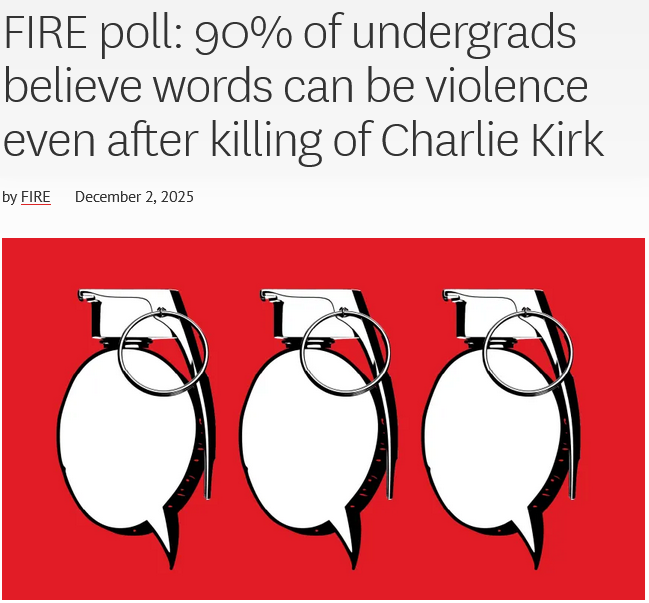
“Ninety one percent of undergraduate students believe that words can be violence, according to a new poll by the Foundation for Individual Rights and Expression [FIRE] and College Pulse”, FIRE announced last week. “The survey’s findings are especially startling coming in the wake of Charlie Kirk’s assassination — an extreme and tragic example of the sharp difference between words and violence.”

The survey posed questions about speech and political violence to undergraduate students at Utah Valley University, where Kirk was murdered, and at colleges elsewhere — 2,028 students overall. FIRE and College Pulse compared the student responses to those of members of the general public who were separately polled.

Specifically, one question asked how much “words can be violence” described respondents’ thoughts. Twenty-two percent of college undergraduates answered that the sentiment “describes my thoughts completely”, 25 percent said it “mostly” described their thoughts, 28 percent put it at “somewhat”, and 15 percent answered “slightly”. Only 9 percent answered that the “words can be violence” sentiment “does not describe my thoughts at all”.

It’s difficult to get too worked up about those who “slightly” believe words can be violence, but that still leaves us at 75 percent of the student population. And almost half of students “completely” or “mostly” see words and violence as essentially the same thing. That’s a lot of young people who struggle to distinguish between an unwelcome expression and a punch to the nose.

Depressingly, 34 percent of the general public “completely” or “mostly” agree. Fifty-nine percent at least “somewhat” believe words can be violence.

In 2017, when the conflation of words and violence was relatively new, Jonathan Haidt, a New York University psychology professor, worried that the false equivalence fed into the simmering mental health crisis among young people. He and FIRE President Greg Lukianoff wrote in The Atlantic that “growing numbers of college students have become less able to cope with the challenges of campus life, including offensive ideas, insensitive professors, and rude or even racist and sexist peers” and that the rise in mental health issues “is better understood as a crisis of resilience”.

Conflating Words and Violence Encourages Violence

Telling young people who haven’t been raised to be resilient and to deal with the certainty of encountering debate, disagreement, and rude or hateful expressions in an intellectually and ideologically diverse world plays into problems with anxiety and depression. It teaches that the world is more dangerous than it actually is rather than a place that requires a certain degree of toughness. Worse, if words are violence it implies that responding “in kind” is justified.

“At a time of rapidly rising political polarization in America, it helps a small subset of that generation justify political violence,” Haidt and Lukianoff added.

Britain’s Top 10 UGLIEST Aircraft

Filed under: Britain, History, Humour, Military, Technology, WW1, WW2 — Tags: , , , , , — Nicholas @ 02:00

Rex’s Hangar
Published 13 Aug 2022

Today we take a look at the top 10 ugliest aircraft every to grace the skies of the United Kingdom. Some were failures, some were hugely successful, but all were lacking in the good looks department, lets check out these ugly planes!
(more…)

QotD: Being a bore

Filed under: Humour, Quotations — Tags: , , — Nicholas @ 01:00

Of course, the true bore, like the true eccentric, doesn’t know or even suspect that that is what he is. The eccentric does strange things because to him they are the most natural things in the world to do. The true bore doesn’t know that he is boring others because what he says is so very interesting to himself, which is why at dinner parties my wife sometimes has to kick me under the table.

My problem is that I have two modes of socializing: to be silent or boring. I cannot make small talk, for when I try to do so my words turn to dust in my mouth, as it were, before I have even uttered them. I can talk only on matters of impersonal interest.

My problem is that I am a serial monomaniac, with one subject occupying the foreground of my mind for up to a few months. In the midst of my enthusiasm, I cannot imagine that other people are not as fascinated by the subject as I. The subject of my monomanias are various: Haitian history; the disappearance of the cuckoo from the English countryside; the life of Caradoc Evans, the Welsh writer of the early part of the 20th century; etc. I never stick with anything long enough to be a scholar of it.

When my wife kicks me under the table, it is usually in mid-anecdote. I cannot stop straightaway, abruptly, for that would look peculiar, as if I were having a fit or a stroke. But I have to bring it to a quicker end than I had anticipated, omitting details that to me had seemed choice and amusing. Often, I have to admit, my wife has heard them before.

Of course, I don’t agree that I am being, or have ever been, boring. Bores don’t know that they are boring, just as people with halitosis don’t know that their breath smells. I look at the people around the dinner table and think they are glued to what I am saying. The fact that I don’t really give them any alternative doesn’t occur to me. How, in any case, could anyone be uninterested in the story of le Roi Christophe who built, or had built, one of the wonders of the world, La Citadelle, near Cap-Haitien, or of how people threw bricks through Caradoc Evans’ windows, so disgusted were they by his literary portrayal of his countrymen? In those days, literature was important.

Theodore Dalrymple, “Full Bore”, Taki’s Magazine, 2020-05-29.

December 10, 2025

Fantasy or Sci-Fi? I Pick …

Filed under: Books — Tags: , — Nicholas @ 09:25

Jill Bearup
Published 28 Jul 2025

Miles Naismith Vorkosigan, what have you done this time?

Let us stop lying to children about the world they’ll have to face

Filed under: Books — Tags: , , , — Nicholas @ 05:00

Recommendations for good books intended for young readers is pretty far from my usual bailiwick, so I’ll let John Carter step in with his suggestion that Fables for Young Wolves is worth your attention:

    “You should move to a small town, somewhere the rule of law still exists. You will not survive here. You are not a wolf, and this is a land of wolves now.” – Sicario (2015)

Children’s literature has gotten soft. Disney turned every woodland creature into a cute little forest friend, and tacked a happy ending onto every dark fairy tale. The bloodstains were scrubbed out, death was swept under the rug, and the moral lessons became saccharine platitudes about being kind and sharing … a helpful aid to management of kindergarten classrooms, perhaps, but worse than useless for the moral instruction of the young, who will one day need to navigate a world where the shadows of the human soul conceal sharpened knives, and the truth is not always what well-meaning young women with associates degrees in early childhood education might wish. Children go along with it, but deep down they know that they’re being lied to, that the adult are keeping something from them when they pretend that every story has a happy ending, that everyone can be friends and get along if they’re just sufficiently nice to one another.

Contemporary children’s literature has gotten even worse under the pressure of politics, with bookshelves filling with stories about antiracist babies who grow up to become boys who become girls, and girls who save themselves from dragons and therefore don’t need help from the boys who foolishly refused to become girls. This is less moral instruction than moral inversion, literature meant to turn children against their own natures, stories that deliberately deceive developing minds in order to neuter them, soften them, make them malleable and unthreatening for a managerial culture in which the socially acceptable lie is always preferable to the uncomfortable truth.

Fables For Young Wolves is not that sort of book.

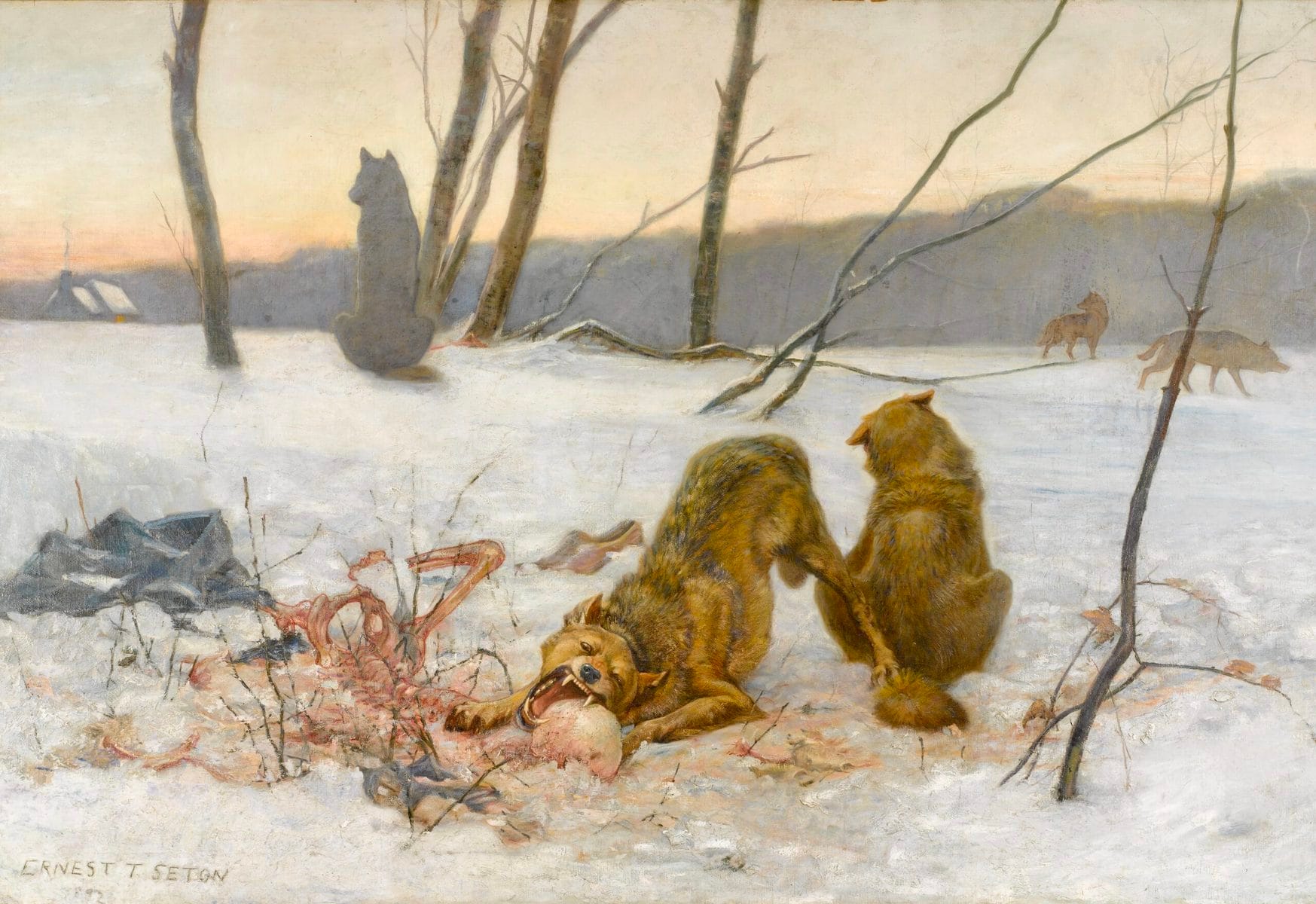
Triumph of the Wolves by Ernest Thompson Seton (1892)

The stories in Fables For Young Wolves are true fables in the Aesopian tradition: tales in which animals are used as symbols for particular facets of human character, or for particular kinds of humans. Foxes are wily, crows are wise but conniving, pigs are greedy and vulgar, asses are stupid, sheep are conformist and dull, dogs are loyal but credulous.

    For after being brought up from childhood with these stories, and after being as it were nursed by them from babyhood, we acquire certain opinions of the several animals and think of some of them as royal animals, of others as silly, of others as witty, and others as innocent. – Apollonius, on Aesop (quoted in the foreword).

The titular wolves around whom the fables revolve are true wolves: noble, cruel, cunning, vicious enemies to their foes but faithful to a fault to their friends, playing roles of villain, victim, and hero as each tale requires. As the most psychologically complex of the animals, they stand for everything that is highest in the human soul, and so are also suited to plumb the depths. These are not Disneyfied vegan wolves that make friends with rabbits: these wolves are hunters and killers, and unashamed of it.

Illustration by Monachvs.

Thomas O. Bethlehem‘s fables are intended, as all fables should be, to impart lessons about human nature and about the world, not as we might wish it to be but as it is, with the intent that the young reader will be guided away from bad decisions and towards the good. Many of the stories are anecdotes of a couple of pages, which communicate simple ideas about controlling your base impulses, having your friend’s back, knowing who your real friends are, the consequences of helping those who cannot be helped, and so on. Interspersed between these are longer and more psychologically complex tales which build upon well-known folk-tales such as “The Boy Who Cried Wolf”, “The Three Little Pigs”, “The Wolf in Sheep’s Clothing”, and “Little Red Riding Hood”.

The Korean War Week 77: The Korean Winter Bites Hard – December 9, 1951

Filed under: China, History, Military, USA — Tags: , , , , , — Nicholas @ 04:00

The Korean War by Indy Neidell
Published 9 Dec 2025

Now that they’ve agreed on a Demarcation Line, the talk this week at the Panmunjom peace talks has turned to whether there will be restrictions or not after the signing of an armistice. Also, how would inspections work to make sure the other side is complying with the armistice terms? Perhaps a group of representatives from neutral nations? Meanwhile the troops are digging in to their winter defenses, as the frozen Korean winter descends upon them.

Chapters
00:00 Intro
00:48 Recap
01:16 Two New Points
08:42 Korean Winter
11:47 Communist Defenses
13:20 Summary
13:33 Conclusion
14:28 Call to Action
(more…)

Murmurs of dissent from within Canada’s supply management cartel

At Juno News, Sylvain Charlebois shares a sign of internal dissent inside the supply management system that prioritizes protecting producers at the cost of significantly higher prices and reduced choice for Canadian consumers — not to mention getting Trump’s attention (and anger) for shutting out American competitors:

Every once in a while, someone inside a tightly protected system decides to say the quiet part out loud. That is what Joel Fox, a dairy farmer from the Trenton, Ontario area, did recently in the Ontario Farmer newspaper. In a candid open letter, Fox questioned why established dairy farmers like himself continue to receive increasingly large government payouts — even though the sector is not shrinking, but expanding. His piece, titled “We continue to privatize gains, socialize losses“, did not come from an economist or a critic of supply management. It came from someone who benefits from it. And yet his message was unmistakable: the numbers no longer add up.

Fox’s letter marks something we have not seen in years — a rare moment of internal dissent from a system that usually speaks with one voice. It is the first meaningful crack since the viral milk-dumping video by Ontario dairy farmer Jerry Huigen, who filmed himself being forced to dump thousands of litres of perfectly good milk because of quota rules. Huigen’s video exposed contradictions inside supply management, but the system quickly closed ranks. Until now. Fox has reopened a conversation that has been dormant for far too long.

In his letter, Fox admitted he would cash his latest $14,000 Dairy Direct Payment Program (DDPP) cheque, despite believing the program wastes taxpayer money. The DDPP was created to offset supposed losses from trade agreements like CETA, CPTPP, and CUSMA. These deals were expected to reduce Canada’s dairy market. But those “losses” are theoretical — based on models and assumptions about future erosion in market share. Meanwhile, domestic dairy demand has strengthened.

Which raises the obvious question: why are we compensating dairy farmers for producing less when they are, in fact, producing more?

This month, dairy farmers received another 1% quota increase, on top of several increases totalling 4% to 5% in recent years. Quota — the right to produce milk — only increases when more supply is needed. If trade deals had truly devastated the sector, quota would be falling, not rising. Instead, Canada’s population has grown by nearly six million since 2015, processors have expanded, and consumption remains stable. The market is expanding.

Understanding what quota is makes the contradiction clearer. Quota is a government-created financial asset worth $24,000 to $27,000 per kilogram of butterfat. A mid-sized dairy farm may hold $2.5 million in quota. Over the past few years, cumulative quota increases of 5% or more have automatically added $120,000 to $135,000 to the value of a typical farm’s quota — entirely free. Larger farms see even greater windfalls. Across the entire dairy system, these increases represent hundreds of millions of dollars in newly created quota value, likely exceeding $500 million in added wealth — generated not through innovation or productivity, but by regulatory decision.

QotD: The “rules” of Gonzo journalism

Filed under: History, Media, Quotations, USA — Tags: , , , , — Nicholas @ 01:00

Thompson now had the recipe for his journalism career, and it involved three conceptual breakthroughs.

  1. The story behind the story is the real story.
  2. The writer is now the hero of each episode.
  3. All this gets written in the style of a personal communication to the reader of the real, dirty inside stuff — straight, with no holds barred.

Why couldn’t you write journalism like this? In fact, a whole generation learned to do just that, mostly by imitating Hunter S. Thompson.

But it grows tired and predictable in the hands of today’s imitators — and the Gonzo King never invited either of those modifiers. Yes, blogs and Substacks are part of his legacy, formats that blur the line between diary, confession, and journalism. But he did it before all the rest, not as a desktop publisher — instead putting his life at risk on the road with total fear and loathing.

So if Substack is the grandchild of Hunter Thompson and New Journalism, it is a tame, well-behaved descendant — and nothing like its brave forebear, who kept going full speed without a helmet until the end.

Even the reader has to run to keep up.

Ted Gioia, “The Rise and Fall of Hunter Thompson (Part 2 of 3)”, The Honest Broker, 2025-09-08.

December 9, 2025

The age of Trump – “America has ‘walked away’ from its allies”

Filed under: Cancon, Government, Military, USA — Tags: , , , , , — Nicholas @ 05:00

In The Line, Matt Gurney talks about last month’s annual Halifax International Security Forum, where the biggest change from previous events was the official absence of US government representation:

Late last month, attending the Halifax International Security Forum, I was having the damndest feeling. Can you have déja vu for something that you only experienced via fiction? Because it was kind of like that.

The fiction in question was a novel by an Australian, published during the Second Iraq War. Anti-American sentiment was running rampant all over the world. The premise of the novel is out there in the realm of sci-fi — America disappears. Specifically, Americans disappear — some mysterious wave of energy scours most of North America clean of life. Virtually all of the U.S. is wiped out; most of Canada and Mexico, too. Somewhat to the surprise of the anti-Americans, this does not result in an improvement in life on Planet Earth.

Standing around at the forum, eating the delicious snacks and drinking the good coffee and chatting with friends old and new, that was what I kept thinking about. Where are the Americans? And what the hell are we going to do without them?

And, in case you’re wondering what’s up with that headline, here’s another question — what will we do if they one day try and come back?

The forum is an annual gathering of senior military officers, defence and intelligence officials from across the free world, and representatives from the media, think tanks, large companies and civil society organizations whose work relates to defence and security issues or in some way seeks to promote and preserve a healthy democratic world. Funded by NATO, the Canadian government and private-sector sponsors, the event is a major part of Canada’s “soft power” offering to our allies — we host the big party and show everybody a good time. The actual schedule is split between on-the-record panel talks or presentations, off-the-record sessions, and informal time for mingling and schmoozing. I am grateful to have been invited to participate again this year.

Especially this year. I’ve been going to the forum for years, and the event always had a strongly American flavour.

Not anymore! Yankee went home.

Like, literally. He was ordered to go home, or stay there. Secretary of Defense Pete Hegseth ordered the Pentagon to avoid a series of high-profile annual defence summits. That includes Halifax, and others in places like Munich and Singapore, and even inside the United States itself. The reason, according to the Pentagon’s press apparatus, was that, and I swear to God this is the actual quote, such events promote “the evil of globalism, disdain for our great country and hatred for the president of the United States”.

Oh. Well, then.

That’s what made the forum so fascinating this year. As I told my colleague Jen Gerson while I was in Halifax, the entire event felt a little bit like the first Thanksgiving after a divorce. It’s great to see everyone, but there’re some notable absences, is the thing.

The “Great Feminization” of western culture

In the National Post, Barbara Kay outlines the way society has been trending further away from traditional values and more and more toward the values of “empathy, safety, and cohesion” which have been predominantly feminine values in contrast to more male-oriented values of “rationality, risk, and competition”:
In September, public intellectual Helen Andrews caused a stir when she delivered a provocative 17-minute speech, titled “Overcoming the Feminization of Culture”, to the National Conservatism Conference, later published as an article for Compact, titled “The Great Feminization“.

Andrews summarized feminization as the prioritizing of feminine over masculine interests, but additionally prioritizing “empathy over rationality, safety over risk, cohesion over competition”. All these traits combine, she believes, in institutions where females are numerically dominant, to define “wokeness” and “cancel culture”.

Andrews points to Bari Weiss’ 2020 resignation letter from the New York Times where Weiss was labeled and ostracized for her social ties and cut off by perceived friends. In 2018, the newsroom there had tipped to a female majority which Andrews argues changed the work environment’s dynamics to one where cohesion is preferred, and covert undermining would replace open debate in favour of emotional harmony.

And I would argue that the more feminized society’s institutions become, the more readily extreme, empathic attitudes replace rational decision-making at policy-making levels, and the more society loses confidence in its ability to thrive.

Ironically, instead of directing empathy towards our own citizens, feminization also tends to direct empathy internationally. That is exactly what is happening at our national level, when our government earmarks funds for programs such as “Gender-Just, Low-Carbon, Rice Value Chains in Vietnam”.

This is also happening at a micro-level to the Jewish community in North America. Our spiritual leadership in non-orthodox synagogues is growing increasingly female, and, by no coincidence, is wokeness spreading, and, by no further coincidence, so is alignment with radical anti-Zionism.

[…]

Claims that Israel was guilty of genocide and apartheid, the authors write, were a constant feature of their education. Most shockingly, they write — and this at a rabbinical training institution headed by a female rabbi — that “the sexual violence Israelis experienced (on October 7) was never mentioned, even during Women’s History Month”.

What about the Christian clergy? A 2024 report on female Christian clergy found that in a 2018 sample, about 14 per cent of U.S. churches were headed by a senior female clergyperson. So, churches are not yet in danger of feminization. Good luck to them.

If there is a solution to the feminization-linked problem of anti-Zionism in the non-Orthodox rabbinate, I don’t know what it is. I only know this trend cannot end well for our community. What is essential in Jews’ spiritual homes now, more than ever in our history, is that they be spaces where “ahavat Yisrael” — love of Israel — is the prevailing norm. If we are not for ourselves, who will be?

On a more individual level, the Great Feminization has worked not to make women equal, but to increase their existing privileges and to demonize men who even notice the inequality now runs directly opposite to the narrative:

Image from Steve’s Substack

Over thirty years ago, I knew a woman who felt ecstatic joy taunting men with her nudity. She loved to flash her breasts at truckers on the highway. Thrilled at the thought that she left them frustrated, she would boast about her sexual power.

This is clear, unequivocal abuse. Imagine her taunting a village of starving Africans with BBQ’d steak. She then flees to her 5-star hotel, laughing and bragging that she had left them hungry and frustrated. This is how the West raises women. Self-obsessed, over-entitled and insufferable (insert obligatory, “not-all-women” clause here – yawn).

Feminists have gotten more sophisticated with their abuse since then. We now have transgressions that include absurd accusations like prolonged looking, mansplaining and manspreading. TikTokers go to the gym essentially nude in order to video and humiliate men who happen to notice.

We had the, “Yes means Yes” campaign that insists a man should repeatedly pester his partner with endless questions for permission during every intimate encounter. Never mind that a normal woman is likely to leave the bed after a few of these interruptions, rightly despising the insecure man who obeys that tripe. Anywhere outside of a deep feminist indoctrination camp, a woman will wonder whether your mother dropped you on your head as a child. I’ll bet that not even the most committed believer follows their own advice. This is not good communication — it denies healthy context, body language and facial expression.

And there’s nothing romantic about it; it is designed for feminist power. There is no number of reassurances that could possibly satisfy. The emphasis upon a non-stop verbal Q&A is courtroom strategy. And that’s the point: eliminate the human context, and set a trap for the man. “Did he ask permission to engage in number 17 of the 32 listed steps before sex? No, your honor, that’s where the sexual assault happened.”

Human intimacy is negotiated using mostly unspoken signals, and everybody likes it that way. Obviously there’s a need for clear communication, especially in a new relationship. I only need to include this disclaimer because the world is filled with pedantic manhating feminists eager to accuse me of denying women’s humanity. Grow up, child. Healthy women have absolutely no problem setting their own limits during intimacy. I’ve never met one who didn’t.

We cover for even the worst of women’s transgressions. When a woman murders her child, we call it infanticide and blame postpartum depression. When she murders her husband we call it battered wife syndrome, which is the title of a book by Canadian feminist law professor, Elizabeth Sheehy. Feminist lawyers even argue to eliminate female incarceration and close all women’s prisons, and for decriminalization of husband murder. This nonsense from the feminist cult for women with daddy issues protects mentally ill women who need psychological help, and/or belong in prison.

Every woman has a plethora of options, and near-infinite sympathy and support, in Western culture. Maybe that’s the problem: we don’t hold women responsible for their own behavior. Many women have not been socialized into adulthood.

At risk of making this a TLDR post, here’s Mark Steyn on the cultural side of our ever-more-feminized culture:

Welcome to another in our ongoing series of As I Said Twenty Sod-Bollocking Years Ago. Women have inherited the thrones of great powers — Elizabeth I, Catherine the Great, Victoria — and presided over massed ranks of courtiers drawn from the “pale, male and stale” (thank you, David Cameron). But America and its client states are the first in history in which every significant venue aside from ladies’ sport is now dominated by women. The west is closer than any society should be to the end of men — which is a big source of the terrible confusion in our schools that has led children to offer themselves up for bodily mutilation and irreversible infertility. Helen Andrews’ much noted “viral” essay on the phenomenon informs us inter alia that by 2024 American law schools were fifty-six per cent female and that sixty-three per cent of judges appointed by Joe Biden’s autopen are likewise on the distaff side. Elsewhere, fifty-five per cent of New York Times reporters are women (up from ten per cent half-a-century ago) and 57.3 per cent of US undergraduates are what we would once have called “coeds”.

At the same time, the principal source of immigration to the west is from a patriarchal culture even more severe (if you can believe it) than 1950s sitcom dads. If you live in London, Paris, Brussels, Stockholm, Dearborn, do you see more body-bagged crones on the streets than you did a generation back? Are you figuring on seeing more still in another twenty years? Or are you betting that the tide will have receded?

It is at the intersection of these two not entirely compatible trendlines — a feminised society with a patriarchal immigration policy — where lies the future (such as it is) of the western world. With that in mind, the annual commemoration of the 1989 Montreal massacre each December 6th has a symbolism that extends far beyond my own deranged dominion. Not just because it was an early example of the state hijacking the actual news to impose a narrative more helpful to its own needs. In the dismantling of manhood and manliness, no lie is too outrageous. As I wrote in The National Post of Canada on December 12th 2002 – twenty-three years ago:

    For women’s groups, the Montreal Massacre is an atrocity that taints all men, and for which all men must acknowledge their guilt. Marc Lépine symbolizes the murderous misogyny that lurks within us all.

    M Lépine was born Gamil Gharbi, the son of an Algerian Muslim wife-beater, whose brutalized spouse told the court at their divorce hearing that her husband “had a total disdain for women and believed they were intended only to serve men”. At eighteen, young Gamil took his mother’s maiden name. The Gazette in Montreal mentioned this in its immediate reports of the massacre. The name “Gamil Gharbi” has not sullied its pages in the thirteen years since.

The Gazette notwithstanding, that might open up many avenues of journalistic investigation, don’t you think? The potential implications of Canadian immigration policy. The misogyny in particular of Islam, and its compatibility with developed societies. But instead everyone who mattered in the Dominion’s elite decided it was all the fault of Canadian manhood in general — of Gordy and Derek’s, or Émile and Pierre’s, culture of toxic masculinity. That narrative has held for two generations. The only even slight modification has been from a sliver of academics who posit Gamil Gharbi as “the first incel“. I’m not sure “incels” — young men who are “involuntarily celibate” — existed as a mass phenomenon back in 1989: they are a consequence of the societal feminisation Ms Andrews writes about. The “incel” segment was by far the most interesting part of the Tucker/Fuentes convo, and the least remarked upon, but the notion that they’re itching to kill women bolsters the original 1989 framing, so the media are minded to entertain it.

Yet we all know, surely, that the young ladies in that Montreal classroom would have benefited from a little bit of available “masculinity” that day. Alas, the men to hand were in a certain sense far more profoundly disarmed than the wildest dreams of “gun control” advocates. From my book After America:

    To return to Gloria Steinem, when might a fish need a bicycle? The women of Montreal’s École Polytechnique could have used one when Marc Lépine walked in with a gun and told all the men to leave the room. They meekly did as ordered. He then shot all the women.

Which is the more disturbing glimpse of Canadian manhood? The guy who shoots the women? Or his fellow men who abandon them to be shot? For me, the latter has always been the darkest element of the story. From my column in Maclean’s, January 9th 2006:

    Every December 6th, our own unmanned Dominion lowers its flags to half-mast and tries to saddle Canadian manhood in general with the blame for the Montreal massacre — the fourteen women murdered by Marc Lépine, born Gamil Gharbi, the son of an Algerian Muslim wife-beater, though you wouldn’t know that from the press coverage. Yet the defining image of contemporary Canadian maleness is not M Lépine/Gharbi but the professors and the men in that classroom, who, ordered to leave by the lone gunman, obediently did so, and abandoned their female classmates to their fate — an act of abdication that would have been unthinkable in almost any other culture throughout human history. The “men” stood outside in the corridor and, even as they heard the first shots, they did nothing. And, when it was over and Gharbi walked out of the room and past them, they still did nothing. Whatever its other defects, Canadian manhood does not suffer from an excess of testosterone.

So the annual denunciation of manhood in general is the precise inversion of the reality of the event. That was unusual in 1989, but has become routine since: the UK Government’s “Prevent” programme, set up in the wake of the July 7th Tube bombings to “prevent” further “Islamist” attacks, now focuses its energies on the threat from a “far right” boorish enough to insist on noticing all these Islamic provocations; January 6th is an insurrection for which trespassing gran’mas have to be hunted down and banged up in solitary, but Thoroughly Modern Milley telling the ChiComs he’ll ignore his commander-in-chief or James Comey taking to Twitter to urge his chums to “eighty-six” the President is true patriotism of the highest order; in German cities saving democracy is so critical that it is necessary to ban the leading political party.

So the inversion of reality is pretty much standard operating procedure these days. There is, however, a sense in which that terrible one-off atrocity from the late Eighties has become a portent of tomorrow — of a western world thoroughly unmanned. Your average feminist lobby group doesn’t see it that way, naturally. “The feminism I think of is the one that embodies inclusivity, multiculturalism and the ability to change the world through the humanity that women do bring,” says Stephanie Davis, executive director of Atlanta’s Women’s Foundation. “If there were women in power in representative numbers — fifty-two per cent — I think that the World Trade Center would still be standing.”


Auditing where the money goes, First Nations edition

I don’t think many Canadians would argue with the government providing funding to First Nations groups in remote areas so they have access to services and amenities that most of us take for granted. But the government has been giving so much money for so long with very little evidence that the money is actually making a difference. Surely, a regular system of audits would show what happens to the money after the feds cut a cheque and why conditions in First Nations communities aren’t improving? Well, on the social media site formerly known as Twitter, @The Reclamare shares a thread detailing some of the findings of a recent audit of a First Nations NGO and it’s kind of disturbing:

Where our taxes go, First Nations Edition

KPMG audited the Federation of Sovereign Indigenous Nations (FSIN) representing 74 First Nations in Saskatchewan

They analyzed spending between April 2019 and March 2024

Hang on🧵


#1 – COVID Funding

$26 million was audited
KPMG found $23.5 million was questionable
** an 89% failure rate**

– no records
– missing contracts
– missing invoices


# 2 – Travel expenditures

$800K of travel spending was audited
$316K was flagged by auditors, a 39% failure rate

Half the travel bookings couldn’t be justified, either policy violations or they couldn’t explain the purpose. And one Vice Chief was billing personal trips


# 3 – Executive Pay Raises during Covid

On November 5, 2020, a briefing note went to FSIN’s Treasury Board recommending:

$60,000 pay raise for the Chief
$40,000 pay raise for each Vice Chief

Retroactive 8 months prior


(more…)

Krieghoff’s Bizarre Prototype FG42 Proposal

Filed under: Germany, History, Military, Weapons, WW2 — Tags: , , , , , — Nicholas @ 02:00

Forgotten Weapons
Published 23 Jul 2025

When the Luftwaffe was looking for its new universal paratrooper rifle, six different German arms companies were asked to submit proposals. Only two actually did; Krieghoff and Rheinmetall. Krieghoff designed this very interesting system, clearly optimized to reduce weight and length as required by the design brief. It uses a tiny vertically traveling locking block and an unusual gas trap system combined with an under-barrel piston. The total number made is unknown, but both fixed- and folding-stock models were produced (the German museum at Koblenz has a fixed-stock example on display). This particular example appears to have been tested after the war by engineers at Springfield Armory by drilling a hole in the gas tube to measure pressure while it cycled.

Thanks to the Springfield Armory National Historic Site for giving me access to this rare prototype from their reference collection to film for you! Don’t miss the chance to visit the museum there if you have a day free in Springfield, Massachusetts:

https://www.nps.gov/spar/index.htm
(more…)

QotD: The development of army discipline and drill in pre-modern armies

Filed under: Europe, History, Military, Quotations — Tags: , , , , , — Nicholas @ 01:00

The usual solution to this difficulty [maneuvring units on the battlefield] often goes by the terms “drill” or “discipline” though we should be clear here exactly what we mean. Discipline in particular has a number of meanings: it can mean the personal restraint of an individual, a system of rewards and punishments (and the effects of that system; the punishments are typically corporal) and what we are actually interested in: the ability of a large body of humans to move and act effectively in concert (all of these meanings are present to some degree in the root Latin word disciplina). For clarity’s sake then I am going to borrow a term (as is my habit) from W. Lee, Waging War (2016), synchronized discipline to describe the “humans moving an acting in concert” component of discipline that we’re most interested in here. That said, it is worth noting that those three components: personal restraint, corporal punishments and the synchronized component of discipline are frequently (but not universally) associated for reasons we’ll get to, not merely in the Roman concept of disciplina, but note also for instance their close association in Sun Tzu’s Art of War in the first chapter (section 13).

The reason we cannot just call this “drill” is because while drill is the most common way agrarian societies produce this result, it is not the only way to this end. For instance as we’ve discussed before, steppe nomads could achieve a very high degree of coordination and synchronization without the same formal systems of drill because the training that produced that coordination was embedded in their culture (particularly in hunting methods) and so young steppe nomad males were acculturated into the synchronicity that way. That said for the rest of this we’re going to place those systems aside and mostly focus on synchronized discipline as a result of drill because for most armies that developed a great deal of synchronized discipline, that’s how they did it.

Fundamentally the principle behind using drill to build synchronized discipline is that the way to get a whole lot of humans to act effectively in concert together is to force them to practice doing exactly the things they’ll be asked to do on the battlefield a lot until the motions are practically second nature. Indeed, the ideal in developing this kind of drill was often to ingrain the actions the soldiers were to perform so deeply that in the midst of the terror of battle when they couldn’t even really think straight those soldiers would fall back on simply mechanically performing the actions they were trained to perform. That in turn creates an important element of predictability: an individual soldier does not need to be checking their action or position against the others around them as much because they’ve done this very maneuver with these very fellows and so already know where everyone is going to be.

The context that drill tends to emerge in (this is an idea invented more than once) tends to give it a highly regimented, fairly brutal character. For instance in early modern Europe, the structure of drill for gunpowder armies was conditioned by elite snobbery: European officer-aristocrats (in many cases the direct continuation of the medieval aristocracy) had an extremely poor view of their common soldiers (drawn from the peasantry). Assuming they lacked any natural valor, harsh drill was settled upon as a solution to make the actions of battle merely mechanical, to reduce the man to a machine. Roman commanders seemed to have thought somewhat better of their soldiers’ bravery, but assumed that harsh discipline was necessary to control, restrain and direct the native fiery virtus (“strength/bravery/valor”) of the common soldier who, unlike the aristocrat, could not be expected to control himself (again, in the snobbish view of the aristocrats).

In short, drill tends to appear in highly stratified agrarian societies, the very nature of which tends to mean that drill is instituted by a class of aristocrats who have at best a dim view of their common soldiers. Consequently, while the core of drill is to simply practice the actions of battle over and over again until they become natural, drill tends to also be encrusted with lots of corporal punishments and intense regulation as a product of those elite attitudes. And though it falls outside of our topic today it seems worth noting that our systems of drill to produce synchronized discipline have the same roots (deriving from early modern musket drill).

Bret Devereaux, “Collections: Total Generalship: Commanding Pre-Modern Armies, Part IIIa”, A Collection of Unmitigated Pedantry, 2022-06-17.

« Newer PostsOlder Posts »

Powered by WordPress