Quotulatiousness

July 31, 2025

“You can see what a monster this very dangerous person is”

Filed under: Cancon, Government, History, Media, Politics — Tags: , , , , — Nicholas @ 04:00

Chris Bray looks north to the Dysfunctional Dominion and our governments’ inability to deal with the narrative of the Residential Schools and the lack of actual evidence to support that narrative:

Kamloops Indian Residential School, 1930.
Photo from Archives Deschâtelets-NDC, Richelieu via Wikimedia Commons.

Frances Widdowson is a cantankerous career academic, an evidence-first Canadian scholar who doesn’t suffer fools. Her personal disregard for sanctimonious performativity has gotten her in some trouble, and now she’s a former professor, though her termination was found to be improper. A few months ago, the CBC interviewed her for a story about how mean she is, because Widdowson has questioned the much-chanted sacred story about the dead children at Kamloops.

If you don’t know the Kamloops story, an anthropologist used ground-penetrating radar to supposedly identify the location of a secret burial ground for 215 dead children near the site of the long-defunct Kamloops Indian Residential School, uncovering evidence of what has been constantly called a hidden genocide. But no human remains have ever been recovered at the site, and the radar evidence of disturbed earth aligns well with the path of an old septic trench. More detailed background here.

Widdowson recorded the entire interview, so we can hear the inner workings of the sausage factory.

Throughout the discussion, CBC reporter Jordan Tucker, speaking with the obligatory vocal fry and upspeak, keeps warning Widdowson to stop shouting at her, which Widdowson obviously isn’t doing, and to watch her tone. She’s presumptively pre-outraged by the existence of a Very Bad Person, conducting an outrage-performance in the form of asking questions.

But then Widdowson flips the script. You can hear this excerpted two-minute high point here. Tucker argues that government officials say there are bodies buried in the apple orchard at Kamloops, so is Widdowson somehow making the outrageous claim that government officials might be wrong? “Are all those different governments lying? Are all those different people just not telling the truth, or they’re going along with these stories imagined by people, by indigenous people?”

Government says, but still Widdowson doesn’t concede. You can see what a monster this very dangerous person is. “How is it that all these government officials have been so connived?” Tucker asks, obviously flabbergasted.

Widdowson responds with an argument about evidence, and about the standards of evidence for the claim. What do we know? What have we seen? What would we need to see to prove a claim of this type? Who has the burden of proof?

And then: “As a journalist, are you satisfied with the evidence?”

The response to this question — just past the 1:30 mark in the excerpted video linked above — is remarkably telling. It produces, first, a short silence, and then a long burst of stammering and high-pitched incredulity: “I am. Of course I am.”

Widdowson, sharpening the direct question: “You think there’s 215 children buried in the apple orchard at Kamloops?”

Listen to Tucker’s shaking voice. This question is a threat. It makes her extremely nervous. “I think that, at this point, there has been enough documentation, there have been enough — there’s enough social and archaeological consensus to say that, to say that, we can just believe indigenous people, and move on with trying to do our best by them as a society.”

So two people are arguing about truth. What is true? How can we know what is true? One person keeps asking what is the evidence. The other person keeps deflecting to identity, authority, and social status. The government says so, there is social consensus, “believe indigenous people”. No human remains have been found, but there are human remains, because government officials and indigenous people say so, and other people with the status to matter say that they agree. Truth is consensus. Defaulting to evidence is cruel. Why would you do such a horrible thing?

  • What’s the evidence?
  • Are you refusing to submit to the narrative consensus?
  • Yes, what’s the evidence?
  • (shocked gasping and trembling voice)

This is the mechanism of woke narrative control: It has been said that this is true. The people who say it possess authority — they are officials — or they possess privileged identities. It is now disinformation to say that government plus indigenous people might not be correct, and an act of dangerous extremism to mention questions of evidence.


The intent of Britain’s Online Safety Act … and the actual implementation

In The Conservative Woman, Dr. Frederick Attenborough discusses the gap between what the Online Safety Act was intended to do and how it’s actually being enforced now that it’s the law of the land:

X posts like this may not be visible to uses in the UK under the age verification rules of the Online Safety Act.

At the heart of the regime is a requirement to implement “highly effective” age checks. If a platform cannot establish with high confidence that a user is over 18, it must restrict access to a wide category of “sensitive” content, even when that content is entirely lawful. This has major implications for platforms where news footage and political commentary appear in real time.

Ofcom’s guidance makes clear that simple box-ticking exercises, such as declaring your age or agreeing to terms of service, will no longer suffice. Instead, platforms are expected to use tools such as facial age estimation, ID scans, open banking credentials and digital identity wallets.

The Act also pushes companies to filter harmful material before it appears in users’ feeds. Ofcom’s broader regulatory guidance warns that recommender systems can steer young users toward material they didn’t ask for. In response, platforms may now be expected to reconfigure their algorithms to filter out entire categories of lawful expression before it reaches underage or unverified users.

One platform already moving in this direction is X. Its approach offers a revealing – and potentially sobering – glimpse of where things may be heading. The company uses internal signals, including when an account was created, any prior verification, and behavioural data, to estimate a user’s age. If that process fails to confirm the user is over 18, he or she is automatically placed into a sensitive content filtering mode. As the platform’s Help Center explains: “Until we are able to determine if a user is 18 or over, they may be defaulted into sensitive media settings, and may not be able to access sensitive media”.

This system runs without user opt-in and applies at scale. Depending on how X classifies it, filtered material may include adult humour, graphic imagery, political commentary or footage of violence. Already there are signs that lawful content is quietly being screened out.

One example came on July 25, the day the Act’s age-verification duties took effect, during a protest outside the Britannia Hotel in Seacroft, Leeds, where asylum seekers are being housed. A video showing police officers restraining and arresting a protester was posted on X, but quickly became inaccessible to many UK-based users. Instead, viewers saw the message: “Due to local laws, we are temporarily restricting access to this content until X estimates your age”.

West Yorkshire Police denied any involvement in blocking the footage. X declined to comment, but its AI chatbot, Grok, indicated that the clip had been restricted under the Online Safety Act due to violent content. Though lawful and clearly newsworthy, the footage was likely flagged by automated systems intended to shield children from real-world violence.

In The Critic, Christopher Snowdon explains the breakdown of trust between the British public and their government that the implementation of the Online Safety Act only exacerbates:

People are right to be concerned about this slippery slope and yet it cannot be denied that it is pornography enthusiasts who have been hardest hit by the Online Safety Act in the short term. They must now verify themselves in one of three ways, each less appealing than the last. They can submit their credit card details, they can scan in proof of ID, such as a passport, or they can take a photo of their face and allow AI to judge how old they are. If they want to maximise their chances of being the victim of blackmail and identity theft, they could do all three.

While we might not think twice about submitting our credit card details to Amazon or posting our photos on Instagram, there is an understandable reluctance to hand over private data in order to access dubious websites for the purposes of sordid acts of self-pollution. The government assures us that the data will be kept confidential but it is only two weeks since we learned about a data breach that led to the names of 19,000 Afghans who wanted to flee the Taliban being given to the Taliban and it is less than two months since the names and addresses of 6.5 million Co-op customers were stolen in a cyber-attack. Rightly or wrongly, millions of British plank-spankers and rug-tuggers do not wish to identify themselves to anybody.

The result is a surge in interest in Virtual Private Networks (VPNs) which allow internet users to access websites as if they were in a less censorious country. Half of the top ten free apps in Apple’s app download charts yesterday were for VPNs. Google Trends data show that searches for “VPN” have gone through the roof since Friday. Readers can draw their own conclusions from the fact that these searches have been peaking between midnight and 2am.

Downloading random VPNs comes with risks of its own and opens up a whole new world of illicit online activity from free Premier League football to the Dark Web. But there is a deeper reason to feel uneasy about this unintended, albeit predictable, consequence of paternalistic regulation. By driving another wedge between the state and the individual, it further normalises rule-breaking in a country where casual lawlessness is becoming part of daily life. A law-abiding society cannot long endure if the median citizen thinks that the law is an ass.

The breakdown of trust can be seen most clearly when the ordinary man or woman does not share the moral certainties of the governing class. Among smokers, a collapse in tax morale — the intrinsic motivation to pay taxes — has led to a huge rise in the consumption of illegal tobacco in recent years. Smokers no longer feel any obligation to pay taxes that are designed to impoverish them to a government that vilifies them. Cannabis smokers learn from an early age to be suspicious of a police force that they might otherwise respect. Motorists who are faced with 20mph speed limits that were introduced by people who hate private transport have no scruples about flouting the law.

Stamm-Zeller 1902: A Swiss Straight-Pull Converted to Semiauto

Filed under: Europe, History, Military, Weapons — Tags: , , , , — Nicholas @ 02:00

Forgotten Weapons
Published 8 Mar 2025

Today’s rifle was designed by a Swiss inventor named Hans Stamm while working for the Zeller et Cie company in Appenzell Switzerland. The company originally made embroidering machinery, but turned to military rifle parts subcontracting to bring in additional revenue in the early 1890s. Stamm had shown a good aptitude and interest for this work, and when the company decided to lean into the small arms business he was put in charge of its new weapons division.

There, Stamm spent several years developing a self-loading rifle for the Swiss military. It was not something specifically requested by the government, but rather an opportunistic risk by the company. Stamm’s resulting gun, the Model 1902, was expensive to produce, but quite elegant in design. It is a long-stroke gas pistol system with a rotating bolt, which was made from the ground up but could easily be adapted as a conversion of existing straight-pull bolt action rifles like the Swiss G96.

Unfortunately, the Swiss military declined the rifle, and Zeller was unable to find any other interested clients among the European states. By 1906, tired of dumping money into what is clearly a losing proposition, Zeller shuts down its weapons division. Stamm leaves the company, but he is not done with small arms design — we will see several more of his designs in future videos!

Many thanks to the Swiss Shooting Museum in Bern for giving me access to this visually one of a kind rifle to film for you! The museum is free to the public, and definitely worth visiting if you are in Bern — although it is closed for renovation until autumn 2025: https://www.schuetzenmuseum.ch/en/
(more…)

QotD: Web browsing “naked”

Filed under: Business, Media, Quotations, Technology — Tags: , — Nicholas @ 01:00

I recently, foolishly, and for reasons that now escape me, bathed in the stroboscopic glow of the un-adblocked Daily Mail. It’s like they just took a bag full of flashing random crap, shook it up, then threw it at the screen. I’m not at all convinced that advertising is a viable model for internet use. It feels much more intrusive and aggravating than print or TV ads. Partly, I suppose, because it’s happening on your device. Maybe it’s just me, but I find myself repelled by it, and sites that use it, quite emphatically. I’ve stopped counting the sites I’ll no longer visit because they insist on the reader deactivating their adblocker, resulting in an insulting, actively hostile, all but unusable experience.

David Thompson, commenting on “Scenes from Woketopia”, davidthompson.com, 2020-06-23.

July 30, 2025

The Korean War Week 58 – The Empire Strikes Back – July 29, 1951

Filed under: Britain, China, History, Military, USA — Tags: , , , , , — Nicholas @ 04:00

The Korean War by Indy Neidell
Published 29 Jul 2025

The Kaesong peace talks drag on, with the main sticking point being the Communist refusal to consider any demarcation line other than the 38th Parallel. UN Commander Matt Ridgway is asking for more force from home, but at least he get some organized force from elsewhere — as various brigades are organized into the 1st Commonwealth Division.

Chapters
00:00 Hook
00:21 Intro
00:56 Recap
01:22 UN Perspective and UN Needs
04:40 US Reserves?
06:31 The Commonwealth Division
09:44 38th Parallel or Nothing
15:03 Summary
15:16 Conclusion
(more…)

“The worst thing that can happen to a good cause is, not to be skilfully attacked, but to be ineptly defended”

Filed under: Health, Media, Politics — Tags: , , , , , — Nicholas @ 03:00

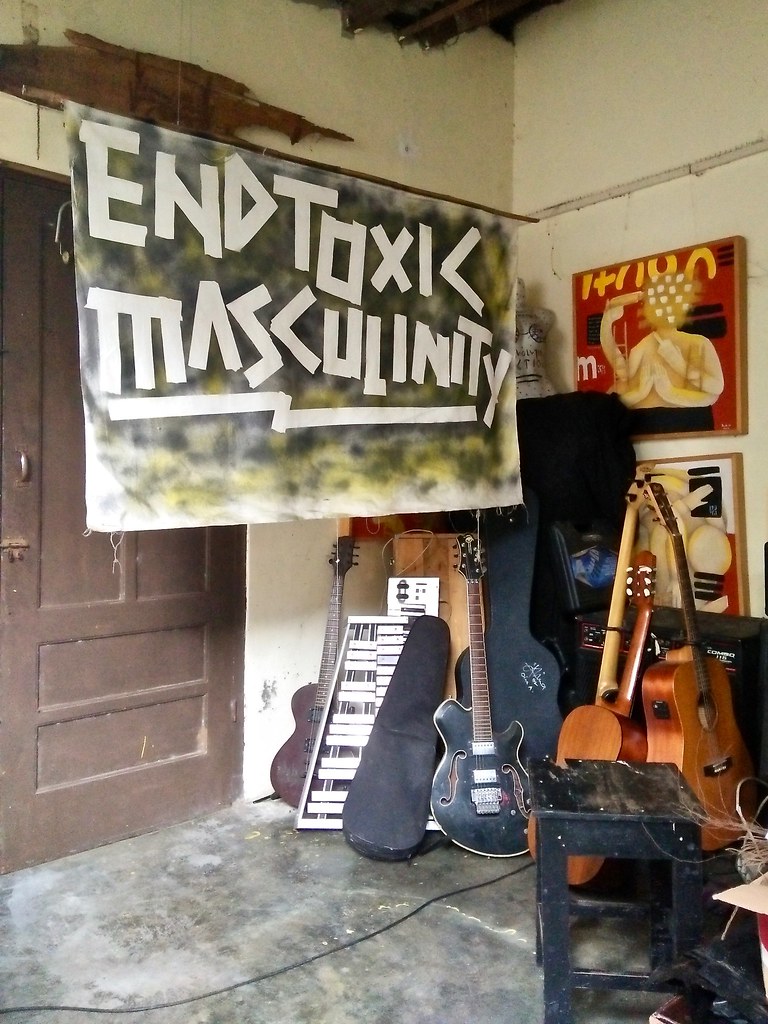
On Substack, Johann Kurtz provides a great example of Bastiat’s insight (quoted in the title), as debaters ineptly defend the whole notion of masculinity, particularly how boys are victimized for being boys:

“End Toxic Masculinity” by labnusantara is licensed under CC BY-NC-ND 2.0

We’re failing our boys.

Two-thirds of young men feel that “no one really knows” them. Their real wages have been falling since the 1970s. They’re dropping out of education and the workforce in growing numbers. They die deaths of despair at almost three times the rate of women. Even their physical strength is collapsing.

Terrible solutions are proposed. No matter how much traditional masculinity is undermined, powerful voices continue to insist that the real problem is that it hasn’t been destroyed altogether. “Only then will boys be happy”.

My thesis for this series is that there is a need to defend true masculinity on its own terms, not on the implicit terms of progressives who either don’t understand it or actively hate it.

Take, for example, this debate at the Oxford Union on traditional masculinity. The opening argument of the opposition — who are supposed to be defending traditional masculinity — starts with asserting the need for a “contemporary and inclusive” masculinity which is accessible to anyone “of any race, sexuality, or other identity“.

The best defence that this speaker can mount on this anaemic foundation is an argument that masculinity is useful for activism and community building like the “Movember Foundation”. After this slightly pathetic case she goes back to conceding “being forced to conform to a set of expectations is uncomfortable and even dangerous. We should allow people to access the gender expressions that make them feel like their truest self.”

The next speaker for the defence of traditional masculinity continues the grovelling: “In 2019, you know, we should not be honouring and obeying men — those times have gone.” This talk is a little better — you get the sense that he actually likes men, and notes that it’s overwhelmingly men who die in wars and dangerous jobs — before collapsing back at the end: “We should look at new ways of being a man. I would love to get more men involved in teaching, in nursing — make it ‘cool to care’. I’ve been around Scandinavia talking to stay-at-home dads … These are progressive, beautiful men.”

The final speaker — who, again, is supposed to be defending traditional masculinitytakes the stage and begins: “Some of the most beautiful moments I’ve watched in young men’s lives are when we’re alone in a room — and maybe a brother who’s been struggling with his sexuality comes out in front of a hundred other brothers, and he’s crying, and his other brothers are crying with him“. You can imagine the rest.

None of this has anything to do with traditional masculinity. In this series I will advocate for the cultivation in boys of all of the aspects of masculinity that these “advocates” were afraid to defend: strength, aggression, dominance, stoicism, and risk-taking.

History of Britain VI: Prime Roman Britain

Filed under: Britain, Europe, History — Tags: , , , — Nicholas @ 02:00

Thersites the Historian
Published 13 Feb 2025

Britain became a quietly productive part of the Roman Empire once the Celts of southern Britain were subjugated. This was the period when the Romans built cities, forts, and roads across the southern portion of the island. The good times corresponded with the Classical Optimum. However, after 150 or 200 CE, Britain was beginning to experience a decline in its material well-being.

QotD: Meetings of the Roman Republican Senate

Filed under: Europe, Government, History, Quotations — Tags: , , , — Nicholas @ 01:00

Meetings of the Senate were formal affairs, but unlike modern legislatures the Senate did not stay in session over long periods. Instead, it met in specific venues – they had to be inaugurated – when called by a magistrate with the power to do so.

We may begin with place: the Senate had no single fixed meeting spot, though the curia in the Forum was the most common location, however the place the Senate met had to be religiously prepared via inauguration (the taking of the auspices by the augurs) and by sacrifices in order to make sure the gods approved of the proceedings and its results. Consequently, the Senate always met in a templum in the sense of a consecrated space, but also it tended to meet literally in temples, with meetings in the temples of Jupiter Optimus Maximus, the temple of Fides, the temple of Concord, and so on. Notably, two locations, the temple of Bellona and the temple of Apollo were also used and these sat outside the pomerium, enabling the Senate to meet with magistrates who, because of their active command of an army, could not cross the pomerium; they were also sometimes used to meet with foreign dignitaries the Senate did not wish to let into the city. Later added to this number of sites outside the pomerium was Pompey’s theater, which included a temple of Venus Victrix and a curia as part of the overall complex.

In order to meet, the Senate had to be called or more correctly “driven together” (cogere, often translated adequately as “summoned”, but as Lintott notes, it has an element of compulsion to it) by a magistrate. There were a few standard dates on which this would effectively always happen, particularly the first day of the consular year, but beyond that it was expected that magistrates in Rome could call the Senate at any time to discuss any issue on relatively short notice. There was initially no requirement that Senators live in the city of Rome, but it was clearly assumed. Early on in the second century, we get regulations requiring Senators to stay close to Rome unless they had an official reason to be elsewhere, though Senators might be permitted to leave if they needed to fulfill a vow. In the Late Republic it seems to have been common also for Senators to leave the city during the spring res prolatae, a sort of recess from public business (literally “the deferring of business”), but these informal breaks did not mean the Senate was truly “out of session” and it could still be summoned by a magistrate.

Generally, meetings of the Senate began at dawn, though they could begin later, and they proceeded either until the business was concluded or to dusk. Because of the ritual preparations required, no meeting of the Senate could last more than a day, much like the assemblies, so if the business was not finished, a new meeting would need to be called and the process begun from scratch. While it seems that magistrates generally tried to avoid calling the Senate during festival days, dies nefandi (days unsuited for public business) and meetings of the popular assemblies, there was no requirement to do so and the Senate might be called for any day for most of the Republic, with laws restricting the Senate’s meeting days only coming midway through the first century.

Beyond this, Senators were expected to show up and we hear of threats of fines or other censure for failure to show up, but it also seems like no meeting of the senate was ever very close to the full body and quorums for the Senate were fairly low, 100 or 150. For the Sullan Senate, notionally of 600 members, the highest attendances we know of, as noted by Lintott, are 415, 417 and 392. Of course some significant number of Senators will, at any time, have been active magistrates overseas, or serving as military tribunes, or as senatorial legati, but it seems clear that even beyond this attendance was not universal even if it was in theory supposed to be.

Bret Devereaux, “Collections: How to Roman Republic 101, Part IV: The Senate”, A Collection of Unmitigated Pedantry, 2023-09-22.

July 29, 2025

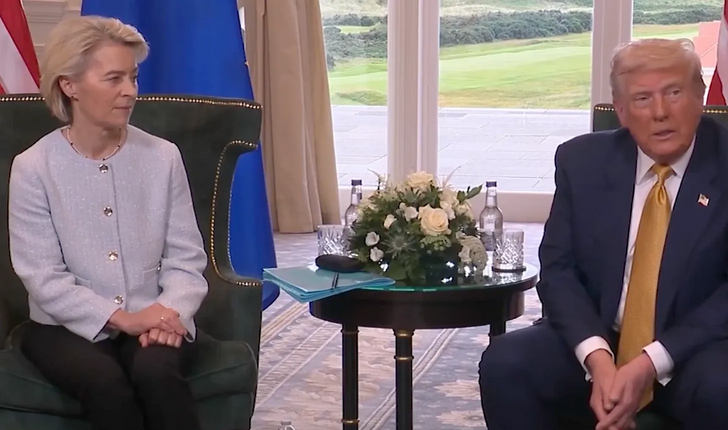
EU Commission President Ursula von der Leyen triumphantly announces EU capitulation to Trump’s demands

Filed under: Bureaucracy, Economics, Government, Media, Politics, USA — Tags: , , , , — Nicholas @ 05:00

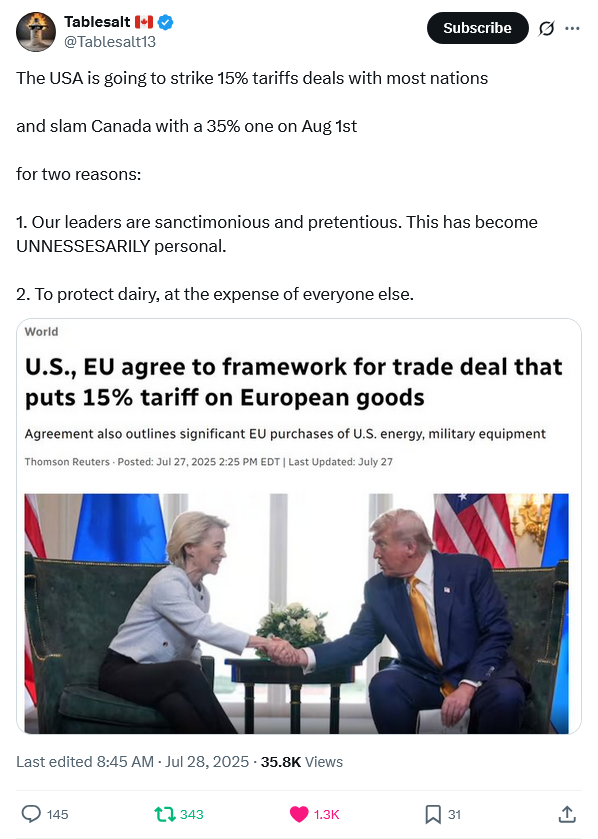
The EU and the United States are finalizing negotiations on bilateral trade issues that basically give Trump everything he wanted with very little in return for the EU’s concessions. It’s almost as if Trump has some kind of experience in negotiating lopsided agreements, isn’t it? I guess von der Leyen didn’t get Mark Carney’s memo on the importance of keeping your eLbOwS uP:

EU Commission President Ursula von der Leyen “[learning] in real time that weakness and submission do not in fact invite conciliation”

Donald Trump has shown up the European Union. He’s revealed that the world’s largest single market is a paper tiger to be kicked around, with basically no leverage or strength to resist American demands.

All of these supposedly fierce backroom tariff negotiations have yielded an incredibly one-sided deal – really an unparalleled embarrassment. As announced yesterday, the EU promises to invest $600 billion in the U.S. economy and to make $750 billion worth of “strategic purchases” of oil, gas and the like over the next three years. We also promise to buy a bunch of American military equipment. In return for giving the Americans $1.35 trillion, we earn the privilege of a 15% baseline tariff on all of our exports to America and we drop our own tariffs to zero. At least we don’t have to pay the 30% tariffs Trump threatened!

[…]

While von der Leyen was trying weakly to put a happy face on her total failure, Trump gave her what we might call a softer Zelensky treatment. He twisted the knife in the wound, calling out the idiocy of EU wind energy in an extended soliloquy that will surely keep the fact-checkers and the regime deboonkers up late for weeks to come. I transcribe his remarks in full, because the whole moment was wonderful:

    And the other thing I say to Europe, we will not allow a windmill to be built in the United States. They’re killing us. They’re killing the beauty of our scenery, our valleys, our beautiful plains. And I’m not talking about airplanes. I’m talking about beautiful plains, the beautiful areas in the United States. And you look up and you see windmills all over the place. It’s a horrible thing. It’s the most expensive form of energy. It’s no good.

    They’re made in China, almost all of them. When they start to rust and rot in eight years, you can’t really turn them off. You can’t bury them. They won’t let you bury the propellers, you know, the props, because they’re a certain type of fiber that doesn’t go well with the land. That’s what they say. The environmentalists say you can’t bury them because the fiber doesn’t go well with the land. In other words, if you bury it, it will harm our soil.

    The whole thing is a con job. It’s very expensive. And in all fairness, Germany tried it and, wind doesn’t work. You need subsidy for wind and energy should not need subsidy. With energy, you make money. You don’t lose money.

    But more important than that is it ruins the landscape. It kills the birds. They’re noisy. You know, you have a certain place in the Massachusetts area that over the last 20 years had one or two whales wash ashore and over the last short period of time they had 18, okay, because it’s driving them loco, it’s driving them crazy. Now, windmills will not come, it’s not going to happen in the United States, and it’s a very expensive …

    I would love to see, I mean, today I’m playing the best course I think in the world, Turnberry, even though I own it, it’s probably the best course in the world, right? And I look over the horizon and I see nine windmills. It’s like right at the end of the 18. I said, “Isn’t that a shame? What a shame.” You have the same thing all over, all over Europe in particular. You have windmills all over the place.

    Some of the countries prohibit it. But, people ought to know that these windmills are very destructive. They’re environmentally unsound. Just the exact opposite. Because the environmentalists, they’re not really environmentalists, they’re political hacks. These are people that, they almost want to harm the country. But you look at these beautiful landscapes all over all, over the the world. Many countries have gotten smart. They will not allow it. They will not. It’s the worst form of energy, the most expensive form of energy. But, windmills should not be allowed. Okay?

All the while von der Leyen had to sit there, absolutely frozen except for a curiously accelerated rate of blinking, as she learned in real time that weakness and submission do not in fact invite conciliation.

In Spiked, Jacob Reynolds agrees that the deal is a humiliation for the European Union:

So this is the famous “trade superpower”. After months of tough talk, European Commission president Ursula von der Leyen announced a trade deal with Donald Trump this week which is nothing short of total capitulation. The Commission has accepted a 15 per cent baseline US tariff on most EU goods, agreed to purchase $750 billion worth of American gas and procure billions more of US military kit. What did Queen Ursula get in return? Nothing.

“VDL”, as she is known in the Brussels Bubble, tried desperately to spin this as a win. Sitting anxiously next to Trump in Scotland last weekend, she recited impressive-sounding numbers – such as the EU and US’s combined 800million consumers and the EU’s $1.7 trillion trade volume – like a nervous student. Trump cut through the spin by greeting the deal as fantastic for US cars and agriculture. He didn’t need to say much else – indeed, it was clear for all to see that there was only one winner in this deal.

For decades, even critics of the EU had to concede that whatever its many economic and democratic shortcomings, it still possessed enormous leverage when it came to trade. At the very least, it was more than capable of defending EU interests in trade deals. Evidently, this is no longer the case. When even the hapless government of Keir Starmer can negotiate a better trade deal with Trump, the problems with the EU should be clear to see. (Tariffs on most UK goods are just 10 per cent.)

Even the most ardent Europhiles have found it hard to put a positive spin on the deal. Manfred Weber, leader of the European People’s Party (a coalition of Europe’s legacy centre-right parties) described it as “damage control” and better than not reaching a deal at all. Guy Verhofstadt, former prime minister of Belgium and usually the most maniacal of EU fanboys, slammed the deal as not only “badly negotiated”, but also “scandalous” and a “disaster”, with “not one concession from the American side”. Member states, from Ireland to France, have been similarly unenthusiastic. Yet the brutal truth is that the deal reflects how America views the EU – as strategically weak and politically empty.

Trump has taught the EU a harsh lesson in statecraft. The EU has long relied on its neighbours for energy production. It has long underinvested in defence. And now it throttles its biggest industries with green dogma. This left it with little leverage for the negotiations with the US.

Of course, after Mark Carney being elected on a highly dubious platform of being “the right person to deal with Trump”, this is almost inevitable at this stage:

“The free and open internet has now ceased to exist in the UK”

Britain, like Canada, has been moving toward a less free internet experience for ordinary users, the key bit of legislation in the UK being the Online Safety Act, which like Canada’s proposed Online Harms Act, provides tools to the government to clamp down on online activities they deem “unsafe”:

The free and open internet has now ceased to exist in the UK. Since Friday, anyone in Britain logging on to social media will have been presented with a censored, restricted version – a “safe” internet, to borrow the UK government’s language. Vast swathes of even anodyne posts are now blocked for the overwhelming majority of users.

The Online Safety Act was passed by the last Conservative government and backed enthusiastically by Labour. Both parties insisted it is necessary to protect children. Supposedly, its aim is to shield them from pornography, violence, terrorist material and content promoting self-harm. Age-verification checks, we were assured, would ensure that children would not be exposed to inappropriate content, but adults could continue using the internet as they please. Yet as we have seen over the past few days, on many major tech platforms, UK-based adults are being treated as children by default, with supposedly “sensitive” content filtered from everyone’s view.

Predictably, what is deemed “sensitive” and therefore censored goes well beyond pornography and obviously illegal or adult material. Already UK users of X have been blocked from viewing footage of an anti-asylum protest, a tweet calling for single-sex spaces and a video of a speech in parliament on the grooming-gangs scandal. Historical trivia, such as a thread on Richard the Lionheart, and classic artworks like Goya’s Saturn Devouring His Son have been shielded by the tech censors. A thread on X of examples of what has been censored under the Online Safety Act, collated by Benjamin Jones of the Free Speech Union, has itself been partially censored due to the Online Safety Act. Open, political debate online is now a thing of the past.

When the Online Safety Act was first put before parliament, supporters from all parties insisted that fears about its impact on free speech were overblown. “The worst misrepresentation I’ve heard is that the [Online Safety Act] will force tech companies to censor legal social-media posts”, insisted Chris Philp, the then minister for tech and digital economy, now the shadow home secretary, back in 2022. Anyone who warned that this vast new architecture of online speech regulation was obviously going to curtail free speech was presented as a friend of paedophiles, terrorists or the far right. This gaslighting was kept up right until the point the age filters were implemented. “The UK’s online safety regime is here. Will anybody notice?”, asked Politico the day before much of the internet disappeared. The Guardian, on the same day, pondered whether the new rules would be censorious enough.

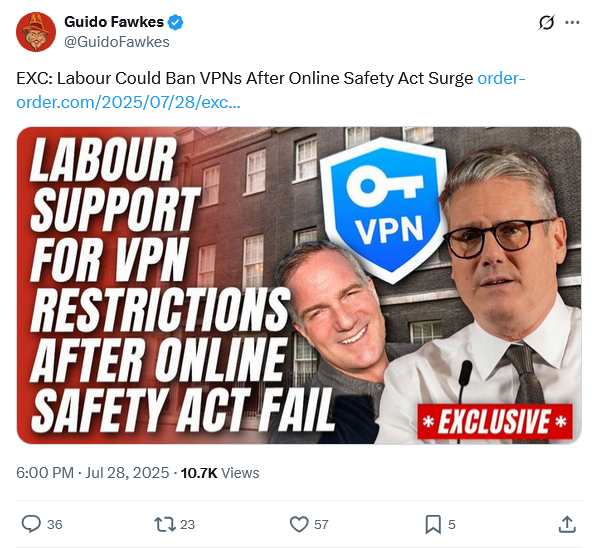
Despite my financial plight, I’d been considering getting a VPN subscription in advance of the Canadian government getting some version of the Online Harms Act onto the books. Clearly many Brits had already gone that route, and the British government reacts with the care and subtlety one would expect:

Crimes less serious than “Mischief” according to Canadian courts

Filed under: Cancon, Government, Law, Media, Politics — Tags: , , , — Nicholas @ 03:00

In the National Post, Tristin Hopper notes that the sentences being sought for Freedom Convoy 2022 organizers Tamara Lich and Chris Barber are more severe than prosecutors have asked for what appear to be far more serious crimes:

Chris Barber and Tamara Lich

Last week, Crown prosecutors announced they were seeking jail sentences of up to eight years for Tamara Lich and Chris Barber, two organizers of the Freedom Convoy protest.

Both were convicted of mischief, but the Crown is seeking a minimum sentence of seven years in jail for Lich, and eight for Barber, who was also found guilty of counselling others to disobey a court order.

The Crown has argued that the disruptiveness of the Freedom Convoy blockades warrants the harsh sentence, but in a statement this week, Conservative Leader Pierre Poilievre said courts are throwing the book at Barber and Lich while simultaneously giving free reign to “rampant violent offenders” and “antisemitic rioters”.

It’s certainly the case that you can do an awful lot of heinous things in Canada before a prosecutor would ever think of asking for seven years. Below, a not-at-all comprehensive list of things you can do in Canada, and have the Crown seek a lighter sentence than the one they’re seeking for the organizers of the Freedom Convoy.

  • Sexually assaulting a baby [5 to 6 years]
  • Using a car filled with guns to ram into Justin Trudeau’s house [6 years]
  • Killing multiple innocent people via drunk driving [5 years]
  • Stabbing a man to death because he told you to stop abusing your girlfriend [5 years]
  • Being a police officer who stalks and sexually harasses crime victims [6 months]
  • Amassing enough child pornography to fill a video store [3 and a half years]
  • Torturing a toddler to death [7 to 8 years]
  • Intentionally ramming a car loaded with children and pregnant women [8 years]
  • Beating a fellow homeless shelter resident to death [5 and a half years]
  • Raping a minor and bragging about it online [4 to 5 years]

The Original Girl Scout Cookie Recipe from 1922

Filed under: Food, History, USA — Tags: , , , — Nicholas @ 02:00

Tasting History with Max Miller
Published 25 Feb 2025

The original Girl Scout sugar cookies, some round, some cut with my 1950s Girl Scout cookie cutter (post-baking)

City/Region: United States of America
Time Period: 1922

During the early years of Girl Scout cookies, the girls would bake the cookies themselves. This recipe, from The American Girl, the magazine published by the Girl Scouts, is from the first year of the official cookie sales in 1922. The scouts would continue to bake the cookies they sold for 12 more years until the task was turned over to commercial bakeries in 1934.

These are fairly standard sugar cookies, but they are delicious. They bake up nice and crispy, and the sugar sprinkled on top is a lovely touch. I could easily see myself eating dozens of them without even noticing.

    ATTENTION SCOUTS! FORWARD MARCH! BAKE! SELL!
    This is your chance to show how much Scouting means to you.
    GIRL SCOUT COOKIES
    1 cup of Butter, or substitute
    1 cup of sugar
    2 tablespoons of milk
    2 eggs
    1 teaspoon of vanilla
    2 cups of flour
    2 teaspoons of baking powder

    Cream butter and sugar, add well beaten eggs, then milk, flavoring, flour and baking powder. Roll thin and bake in quick oven. (Sprinkle sugar on top.) This amount makes six to seven dozen.
    The American Girl magazine, 1922.

(more…)

QotD: Thucydides wasn’t articulating a deterministic law of geopolitics – he was writing a tragedy

If you’re 45 and above, you will remember how much fear Japan stoked in the hearts of Wall Street in the 1980s when their economy was booming and their exports sector exploding. There were major concerns that the Japanese economy would leap ahead of the USA’s, and that it would result in Japan discarding its constitutional pacifism in order to spread its wings once more throughout the Pacific.

These concerns were not limited to the fringes, they were real. So real were they that respected geopolitical analysts like George Friedman (later of Stratfor) wrote books like [The Coming War With Japan] The argument was that an upstart like Japan would crash head first into US economic and security interests, sparking another war between the two. This conflict was inevitable because challengers will always seek the crown, and the king will always fight to maintain possession of it.

Suffice it to say that this war did not come to pass. The Japanese threat was vastly overstated, and its economy has been in stagnation-mode for decades now (even though living standards remain very high in relative terms). What may seem inevitable need not be.

The next several years will see marked increase in tension between the USA and China, as the former completes its long awaited “Pivot to East Asia”. So anxious are the Americans to pivot that they have been threatening to “walk away” from Ukraine if they cannot hammer down a peace deal in the very near future. This indicates just how serious a threat they view China’s ascent to be to its economic and security interests. If they are willing to sacrifice more in Ukraine than originally intended, the implication is that China’s rise is a grave concern, and that a clash between the two looks very likely … some would argue that it is inevitable, appealing to a relatively new IR concept called the “Thucydides Trap“.

Andrew Latham explains the concept to us, arguing that Thucydides is misunderstood, making conflict between rising powers and hegemons not necessarily inevitable:

    The so-called Thucydides Trap has become a staple of foreign policy commentary over the past decade or so, regularly invoked to frame the escalating rivalry between the United States and China.

    Coined by political scientist Graham Allison — first in a 2012 Financial Times article and later developed in his 2017 book Destined for Warthe phrase refers to a line from the ancient Greek historian Thucydides, who wrote in his History of the Peloponnesian War, “It was the rise of Athens and the fear that this instilled in Sparta that made war inevitable.”

Distortion:

    At first glance, this provides a compelling and conveniently packaged analogy: Rising powers provoke anxiety in established ones, leading to conflict. In today’s context, the implication seems clear – China’s rise is bound to provoke a collision with the United States, just as Athens once did with Sparta.

    But this framing risks flattening the complexity of Thucydides’ work and distorting its deeper philosophical message. Thucydides wasn’t articulating a deterministic law of geopolitics. He was writing a tragedy.

This essay might be an exercise in historical sperging, but I think it has value:

    Thucydides fought in the Peloponnesian War on the Athenian side. His world was steeped in the sensibilities of Greek tragedy, and his historical narrative carries that imprint throughout. His work is not a treatise on structural inevitability but an exploration of how human frailty, political misjudgment and moral decay can combine to unleash catastrophe.

    That tragic sensibility matters. Where modern analysts often search for predictive patterns and system-level explanations, Thucydides drew attention to the role of choice, perception and emotion.

    His history is filled with the corrosive effects of fear, the seductions of ambition, the failures of leadership and the tragic unraveling of judgment. This is a study in hubris and nemesis, not structural determinism.

    Much of this is lost when the phrase “Thucydides Trap” is elevated into a kind of quasi-law of international politics. It becomes shorthand for inevitability: power rises, fear responds, war follows.

Therefore, more of a psychological study of characters rather than structural determinism.

Giving credit to Allison:

    Even Allison, to his credit, never claimed the “trap” was inescapable. His core argument was that war is likely but not inevitable when a rising power challenges a dominant one. In fact, much of Allison’s writing serves as a warning to break from the pattern, not to resign oneself to it.

Misuse:

    In that sense, the “Thucydides Trap” has been misused by commentators and policymakers alike. Some treat it as confirmation that war is baked into the structure of power transitions — an excuse to raise defense budgets or to talk tough with Beijing — when in fact, it ought to provoke reflection and restraint.

    To read Thucydides carefully is to see that the Peloponnesian War was not solely about a shifting balance of power. It was also about pride, misjudgment and the failure to lead wisely.

    Consider his famous observation, “Ignorance is bold and knowledge reserved”. This isn’t a structural insight — it’s a human one. It’s aimed squarely at those who mistake impulse for strategy and swagger for strength.

    Or take his chilling formulation, “The strong do what they will and the weak suffer what they must”. That’s not an endorsement of realpolitik. It’s a tragic lament on what happens when power becomes unaccountable and justice is cast aside.

and

    In today’s context, invoking the Thucydides Trap as a justification for confrontation with China may do more harm than good. It reinforces the notion that conflict is already on the rails and cannot be stopped.

    But if there is a lesson in The History of the Peloponnesian War, it is not that war is inevitable but that it becomes likely when the space for prudence and reflection collapses under the weight of fear and pride.

    Thucydides offers not a theory of international politics but a warning — an admonition to leaders who, gripped by their own narratives, drive their nations over a cliff.

Latham does have a point, but events have a momentum all their own, and they are often hard to stop. Inevitabilities do exist, such as Israel and Hezbollah entering into conflict with one another in 2022 after their 2006 war saw the latter come out with a tactical victory. Barring a black swan event, the USA and China are headed for a collision. The question is: in what form?

Niccolo Soldo, “Saturday Commentary and Review #188 (Easter Monday Edition)”, Fisted by Foucault, 2025-04-21.

July 28, 2025

The AI threat to the laptop classes

Filed under: Business, Economics, Media, Politics, Technology, USA — Tags: , , , — Nicholas @ 05:00

Warren at Coyote Blog responds to a recent Gato Malo post on the way artificial intelligence (however described) will continue to disrupt the workplace especially as it begins to threaten the “laptop class” workers:

I agree with Gato that AI has a huge potential to disrupt current work patterns, in the same way that the industrial revolution did. The 19th century disruptions were severe, and many people suffered as their experience and skill set no longer matched the new economy. But eventually everyone, from the poorest to the rich, were better off for letting the industrial revolution run its course.

But in the 19th century, the disrupted were essentially powerless. What happens this time around, though, when the disrupted are the ruling elite themselves? These potentially disrupted professions include lawyers and doctors who already have shown themselves very willing to organize to block innovation, squash competition, and protect their high pay. Just look at the history of the attempts by Congress to reduce Medicare reimbursements to doctors. And that was minor compared to the potential AI disruption. Let me give you another example of the powerful resisting a technological change that should have disrupted their businesses.

When TV first was being rolled out, the industry coalesced around a network of local broadcast stations, many of whom became affiliates of a network like NBC or CBS. Why this model? Mainly it was driven by technology — the farthest a TV signal could reasonably be broadcast was about 50-75 miles. Thus everyone by necessity got their TV through three or four TV stations in their metropolitan area, each its own small business.

Now fast forward to today. There are multiple ways to broadcast a TV signal nationwide — there are several satellite options and many streaming internet approaches. So now when we watch DirecTV or Youtube TV, we just watch the national NBC or ABC feed, right? Nope. Federal law requires that whatever service you use MUST serve up NBC, for example, via the local affiliate. That is why your streaming TV service harasses you when you travel, because it is worried about violating the law by showing you the Phoenix CBS affiliate when you are staying overnight in Atlanta (gasp).

This is hugely costly. In order to be able to provide NBC among its stations, Youtube TV must gather the feeds from 235 different stations. In the Internet streaming era this is costly but in the satellite era it was insane. DirecTV, with its limited bandwidth, had to simultaneously broadcast 235 stations, most showing identical content, just to legally provide you with NBC. So why this crazy, expensive, insane effort? I am sure you have guessed — pound for pound local TV stations are among the most powerful lobbyists in the country. First, they have money and a massive incentive to defend their local geographic monopoly — Car dealers and alcohol distributors are much the same, which is why every potential innovation is resisted in those markets. But TV stations have one extra card to play — nearly every Congressman in the House likely depends on the three or four TV stations in one major metropolitan area for a huge part of their publicity and coverage. No politician is going to screw with that. At the end of the day, local stations did not get disrupted, they actually became more valuable with this government-enforced distribution of their product.

This is a small example of the fight that is coming in AI. Congressmen will couch their arguments in fear-charged terminology as if their real fear is some Terminator-like AI apocalypse. But the real concern will be from the influential elite who are being disrupted. What would have happened to the Industrial Revolution if the hand-loom weavers were the children of the nobility? Would the government have allowed the revolution to proceed? We are about to find out.

On a cheerier note (if you’re an AI), here’s Ted Gioia‘s most recent concerns about AI getting more evil as it gets more capable:

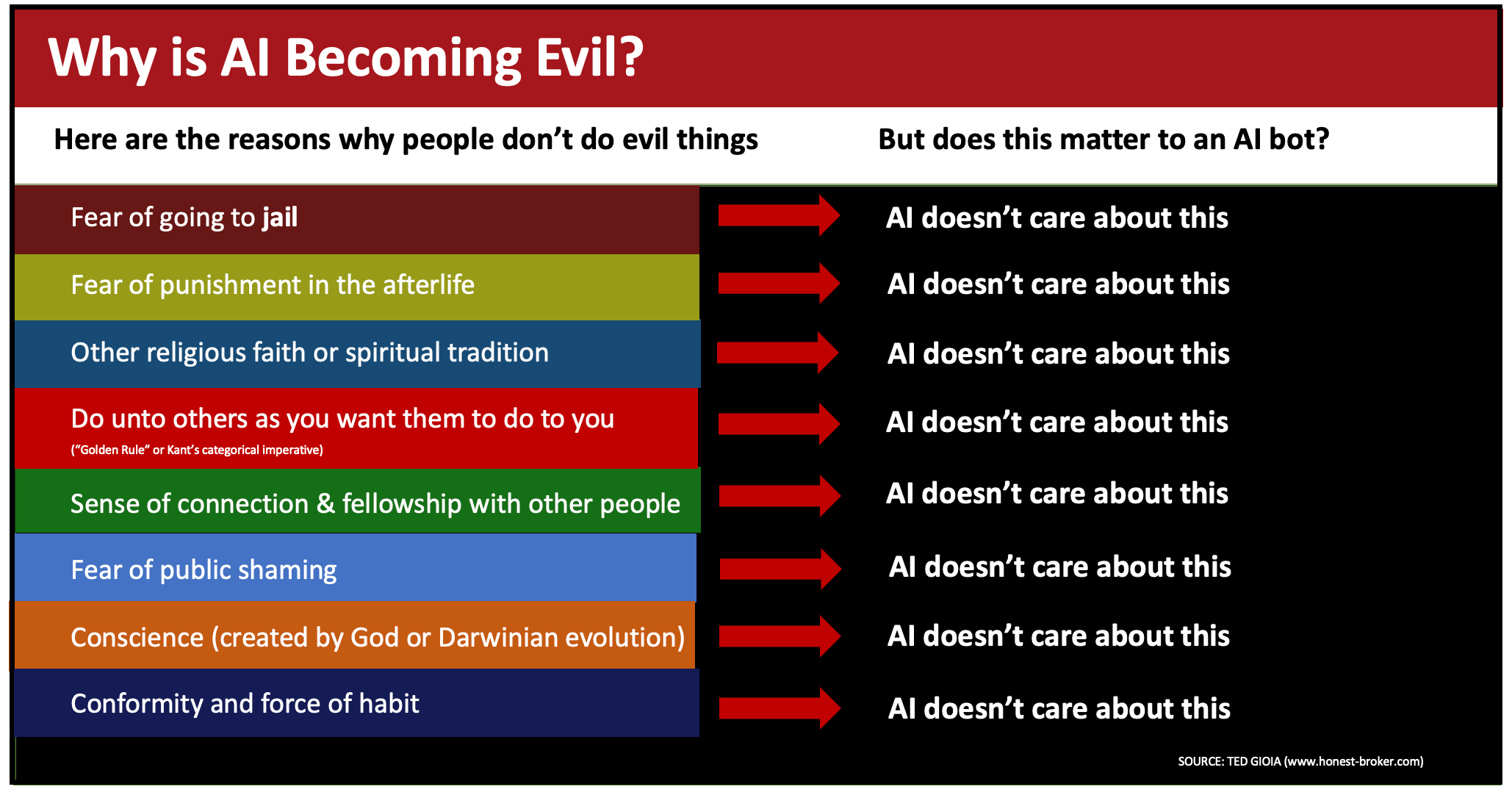
I hate to be the bearer of bad news, but AI doesn’t make ethical decisions like a human being. And none of the reasons why people avoid evil apply to AI.

Okay, I’m no software guru. But I did spend years studying moral philosophy at Oxford. That gave me useful tools in understanding how people choose good over evil.

And this is relevant expertise in the current moment.

So let’s look at the eight main reasons why people resist evil impulses. These cover a wide range — from fear of going to jail to religious faith to Darwinian natural selection.

You will see that none of them apply to AI.

Do you see what this means? You and I have plenty of reasons to choose good over evil. But an AI bot is like the honey badger in a famous meme — and just don’t care.

So sci-fi writers have good reason to fear AI. And so do we. The moral compass that drives human behavior has no influence over a bot. As it gets smarter, it will increasingly resemble a Bond villain. That’s what we should expect.

Anyone who tries to forecast the future of AI must take this into account. I certainly do.

And even though I’d like to think that I’m a fearless predictor, I must admit that what I see playing out over the next few years is very, very very troubling.

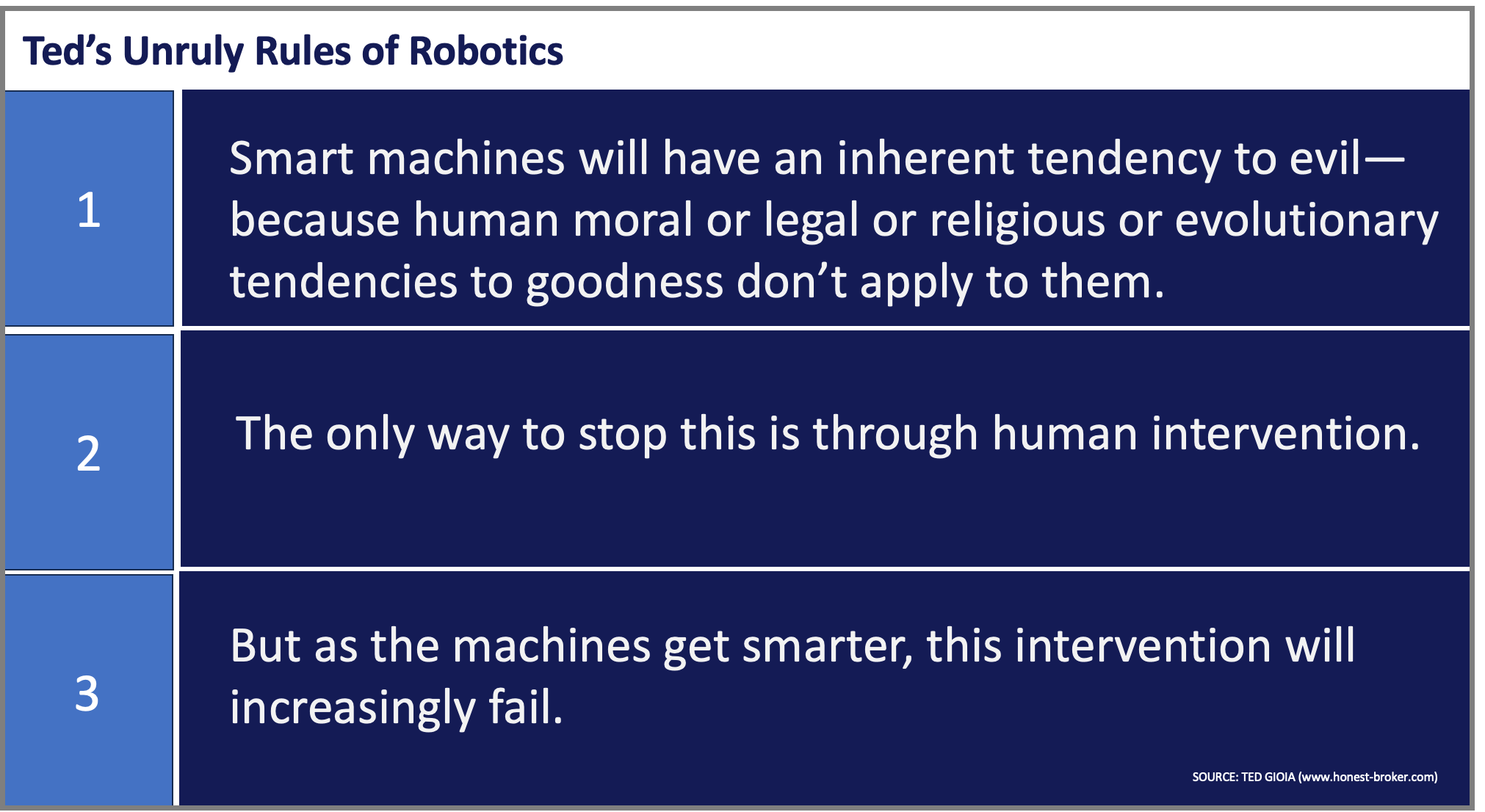
Here’s my hypothesis: Let’s call it Ted’s Unruly Rules of Robotics:

  1. Smart machines will have an inherent tendency to evil—because human moral or legal or religious or evolutionary tendencies to goodness don’t apply to them.
  2. The only way to stop this is through human intervention.
  3. But as the machines get smarter, this intervention will increasingly fail.

“According to elite theory our world is controlled by a ruling class”

Spaceman Spiff explores the notions of “elite theory”, which in one variant or another seems to be a bedrock belief of most dissidents in the west:

Elite theory is based on an important observation; small groups can more easily organize than large groups.

A modest number of wealthy individuals with common goals will easily run rings around a whole town, region or country because the masses cannot easily organize.

This infers enormous advantages, not the least of which is a small group can discuss and agree a strategy and then stick to it. Because of this some imagine elites as more able than they really are.

But power is tricky. All the money and all the clout in the world means nothing if you can’t project it far.

And our powerful, wealthy elites have one great weakness, they must work through others.

A hierarchy therefore exists which we occasionally glimpse adding to our confusion when we use words like “elites.”

Global rulers are ostensibly at the top. They sit above nation-states. They are truly post-national, controlling central banks and international finance. They are the closest thing we have to world controllers. Some seem to hold power over huge swathes of the globe, like gigantic economic zones.

In addition, all nations have visibly important people; kings, dictators, presidents and others. National elites are those whose power is largely confined to a territory. They lack the international reach of global elites.

The media represent power too. They are there to shape the narratives that govern our perceptions. Most traditional media outlets serve elite goals although some of their members wield tremendous power themselves.

The political class are the obvious lackeys of the powerful. Voters seem constantly amazed politicians never really improve anything once in power, but that is because they don’t serve those below them, only those above. Once you see this their behaviour makes much more sense. They dance to the tune of their paymasters. Their primary job is to pretend democracy works.

The corporate leaders are a less visible example of the same thing. They manage the commercial wing of elite interests while pretending to be businessmen.

Blackrock and others have almost completely abandoned anything resembling capitalism. They are gamers of systems, not the innovators of yesteryear. Just one reason our economies are struggling.

It is the major corporations who have helped establish diversity and climate goals, for instance, so they matter for furthering elite ambitions.

Local and regional elites exist too. Everything is replicated at ever smaller scales, including public sector employees and corporate managers.

These are the foot soldiers often oblivious to any elite goals. They just respond to the incentives and disincentives they are aware of at their level.

There is more, including academia and the major institutions. But the key idea is this is the hierarchy the powerful must work with to get anything done.

Projecting power downwards

At each stage there are numerous problems conveying information and taking action. Running the world is a demanding hobby. Power means nothing unless you can implement your schemes.

Communication is an ever-present issue. Things are misinterpreted. People misunderstand goals and aspirations.

There are probably no written plans. A lot of influence is achieved via think tanks and talking shops like the World Economic Forum, so is open to misinterpretation. It must be like herding cats as these grand ideas cascade down the hierarchy and are misunderstood or overlooked.

This process is further retarded by quotas and ideological capture. Woke brings many distortions; just ask the declining universities. Hiring for alignment does not select for the best. Elite need for control therefore leaves them with reduced options.

We’ve all seen some new appointee take over a position of authority and promptly run it into the ground. Imagine having to rely on that process to get anything done?

The lower down the totem pole we go the less able the people as a general rule. Specifically, in these benthic depths far from the centres of power, the minor lackeys run the grave risk of actually believing the claptrap used to control the masses which can be a real impediment to progress.

Those near the bottom generally lack the intellectual vigour to question anything which makes for obedient slaves, albeit dangerously detached from strategic awareness or understanding of the purpose of the narratives they uncritically embrace.

Such devotion is handy at first, it can provide real energy to make changes. Covid policies were established quickly thanks to this phenomenon. The implementation units were clearly unable to assess evidence or think for themselves; man on TV said wear mask and sit in back garden, so they did.

The price for such mindlessness is confusion and this is where control can be lost.

Anti-white animus gestated on university campuses was useful for the powerful to keep the most dangerous demographic down, and therefore less likely to form a counter-elite, but has now morphed into anti-Israel and pro-Palestine sentiment. It is evident many in academia, oblivious to the purpose of “decolonization,” have now misapplied this ethnic weapon to Israelis and Jews more generally to the horror of the powerful with plans of their own.

We see similar effects with climate zealots in positions of authority, especially in politics and media circles. It can be galling to realize some prominent person you once thought was capable actually thinks we only have twelve years to save the planet or wants to end cheeseburgers to help the coral reefs. Can they really be that impressionable?

What is frustrating for us must be maddening to the powerful as they watch brainwashed clowns misunderstand their goals. When your tools include the gullible things can get out of hand quickly.

That’s why many of the doom and gloom predictions based on some omniscient Illuminati are so off the mark despite their elevated position in society.

Projecting power is akin to shooting people in swimming pools. You can see them under the water, often very clearly, but it doesn’t necessarily help.

You fire off your rounds, but they quickly lose force as they enter some new medium of which you know very little, plus they can whizz away in unexpected directions, entirely missing their mark.

All that money and influence but you have to rely on dancing monkeys to get anything done. What use are trillions when Glenda in HR actually thinks her purpose in life is to root out systemic racism or heal the planet? Her initial zeal can quickly become a liability as ultimately happened during Covid when many began to wake up after the clownshow became too absurd to continue.

Older Posts »

Powered by WordPress