
Adam Smith Institute
Published 3 Jan 2025In November 2023, Argentina elected Javier Milei, a libertarian economist armed with a chainsaw and a bold plan to rescue the country from decades of decline. Facing 142% inflation, a crumbling peso, and 40% poverty, Milei slashed spending, deregulated markets, and delivered a historic budget surplus — all within a year.
Sam Bidwell dives into Milei’s radical reforms, exploring the challenges that have made them necessary. He traces the country’s rise as a global economic powerhouse in the early 20th century, its decline through years of government intervention and Peronism, and its resurgence under Milei’s leadership.
Discover how this fiery libertarian turned Argentina’s economic fortunes around — and what the world can learn from his audacious blueprint for recovery.
🔗 Subscribe for more insights on global economics, history, and leadership!
🔗 Check out our website for more economics content: https://www.adamsmith.org/TIMESTAMPS
00:00 Start
00:53 Golden Years
02:59 Decline of Argentina
05:20 Peron
08:47 The Legacy of Peronism
11:56 After the Falklands
15:38 Javier Milei
18:17 Challenges
24:31 Lesson for the UK and the wider world
January 4, 2025
More on the “Boomers and Year Zero” thing
I sent the link I posted yesterday to Severian and asked for his reaction, saying that “Eric is three years older than me, so I’m on a cultural time-delay both for that and for not being American, but I still felt he was much more right than wrong here”. Sev’s thoughts as posted at FQ in the weekly mailbag post:

The upshot is that it isn’t the Boomers’ fault — they got tricked into it by Marxists, for whatever value of “it” is foremost in your mind, every time you’re tempted to say “OK, Boomer.”
I largely agree, with the caveat that “tricked” is a bit strong. There were conscious, indeed State-directed, attempts at outright cultural subversion — Raymond cites Yuri Bezmenov, and we’re all familiar with that. But there’s a limit to how much damage that kind of thing can do. What mostly happened, I think, circles back to that “excess calories” bit, above. That’s overly reductive — it’s a springboard for discussion, not a categorical statement — but the fact is, you need a certain baseline of physical security before Chesterton’s Fence becomes a thing. Or, as Confucius (or whoever) said, “The man with an empty belly has one problem, but the man with a full belly has a thousand”.
By 1960, at least in AINO, you had a critical mass of people who had never gone to bed hungry. Ever. And so it never crossed their minds that “going to bed hungry” is a thing people have to worry about. That had profound effects, that we’re still working through. It was never the case, ever, in the entire history of mankind, that the average person didn’t have to put some thought into where his next meal was coming from.
The entire human organism — physically, mentally, culturally — is oriented around the problem of caloric supply. Again, I acknowledge that’s overly reductive, but roll with me here: Our biochemistry has been profoundly fucked up by high fructose corn syrup, for the simple reason that a teaspoon of that shit has more, and more highly bioavailable, energy than an entire feast for our Paleolithic ancestors. At the risk of looking like a fool for using an engineering, especially an automotive, metaphor with this crowd, it’s like trying to run rocket fuel through a Model T.
You cannot blame the Boomers for fumbling a situation that has never before been seen, in the history of mankind.
And it’s even hard to blame them for not getting it, even now. One’s mental habits ossify, like one’s tastes, sometime in one’s twenties. It is very, very hard to break the conditioning of a lifetime, and it gets exponentially harder the older you get. I myself thought Ace of Normies was just crazy edgy — how can that maniac say these things?!? — when I first started reading him …
… back around 2004. That’s because I was in my 30s, which means my worldview was stuck a decade earlier. Even now, all my go-to cultural touchpoints are in the 1990s — Alanis, obviously, but pretty much all of them; the 21st century might as well not exist for me, culturally, if you go just by what I’ve written here. Which means that my own worldview tends to be kinda Boomerish, thanks to that weird telescoping effect TV had on the culture. The Boomers grew up watching TV, and then they made TV, such that you can ask anyone who was there — your typical college campus in 1994 was all but indistinguishable from a “liberal” campus in 1968 (your typical college campus in 1968 would’ve had sex-segregated dorms, a whole bunch of “married student housing”, and so on).
I got over it, obviously — and just as obviously tend to go a little overboard with my getting over it — but it takes tremendous effort. As I like to say, the Red Pill is really a suppository, usually administered by jackhammer. To expect a Donald Trump (born 1946), to say nothing of a million lesser lights, to fundamentally grok that it’s not 1968 anymore, is asking an awful lot. It is what it is.
Winning WW2’s Most Important Battle – Battle of the Atlantic
Historigraph
Published 15 Aug 2024The Second World War featured many important land battles on a colossal scale. They involved hundreds of thousands of participants, ranged across hundreds of miles and inflicted the most terrible destruction. But none of them were as long-running, as vast or as crucial to allied victory as that fought at sea in the Atlantic, where for four years Allied navies and civilian sailors fought a life or death struggle against Germany’s U-boats. This is the story of how it was fought, and how it was won.
00:00 – WW2’s most important battle
00:45 – The U-boat menace in the early years
08:53 – The massacre off the eastern seaboard
13:12 – American ship printer go brrrrrrrrr
19:31 – The Allies gain the upper hand
21:49 – Black May: the convoy battles of 1943
24:41 – The most important victory of WW2
(more…)
QotD: The “show pillows”
The female need to pile a bed with useless pillows is an old and not particularly novel observation. It mystifies men. It’s like serving a meal where the plate is loaded with Show Potatoes, and you have to remove ten tubers before you can start. It’s like having a workbench in the garage with Show Hammers. Don’t pound with that! That’s the nice hammer we want company to see! It’ll get nicked and dinged. Or like going to someone’s house and finding out they have a Show Dog. No, no, don’t pat him on the head. Here, use this dog. And there’s some panting happy mutt they pull out of a closet. This is the company dog.
It reminds me of the bathrooms of my childhood, which were stocked with forbidden things: decorative soap in a nice dish engraved with intricate patterns that evaporated on contact with water, and decorative towels. You ended up drying your hands on the curtains, or patting them dry on the inevitable polyester shag toilet-seat cover.
Anyway. You’re wondering how I recovered from this grotesque embarrassment. I fetched two pillows from Daughter’s unoccupied room, apologized on behalf of the male side of the species, and figured the matter was closed. Oh no. Ohhhh, no. The next morning my wife made up the guest room, and emerged with an expression of despair.
The pillowcases did not match.
One was white. The other — and I tremble with shame to write these words — was ivory.
Well, an apology was in order. But how? Maybe bring it up in a roundabout way at breakfast.
“So … how’d you sleep?”
“Oh … okay, I guess. Weird dreams. I was in a paint store, looking at those strips with the different hues, and two of the shades of white looked different but I couldn’t really tell if they were and then I started crying tears in two different shades of white and when the tears hit the floor they burned like acid, and then horrible off-white slugs oozed out of the hole and started singing ABBA songs in two different keys.”
“Huh. And you?”
“I had weird dreams too. There were two philosophers who agreed on everything except for one minor, obscure point, but instead of focusing on their agreement they argued about the small difference until they decided to have a duel, but the guns didn’t fire.”
“Ah, those would be the Show Pistols. Freud had something to say about those. Well, that’s on me. The pillowcase hues were not in sync. I hope we can get past this and enjoy the day.”
James Lileks, “Show Me the Pillows”, LILEKS (James), 2024-09-30.
January 3, 2025
The Boomers and “reset to Year Zero”
On Twit-, er, I mean “X”, ESR responds to a post from Devon Eriksen decrying the Baby Boomers for effectively destroying the culture of the postwar “American Dream”:
… I’m a late Boomer, born in ’57. I can dimly remember the day JFK was shot. I watched the moon landing. My teens and early twenties coincided with the 1970s. I was there for it all.
And even then, even in the 1970s, feeling a sense of subtle disintegration all around me, I already dimly grasped that we weren’t just falling. We were being pushed.
But I was very young then; I wouldn’t come to fully understand why, and by whom, for almost another 30 years
We Boomers didn’t burn down our heritage in a fit of thoughtless hedonism. I mean, we did some thoughtless hedonism, yeah, but that’s not where the real damage came from.
If you want to know where the damage came from, look up Yuri Bezmenov. Listen to him explain “demoralization” and the long game of Soviet culture-jamming against the West in general and the U.S. in particular.
Reset to year zero was a Marxist idea. It was part of a suite of memetic weapons, infectious propaganda bombs deployed against the social and cultural cohesion of the “main enemy”.
Often, they were successful in damaging us by leveraging not our vices but our virtues. Valorizing tolerance and liberality until they became helplessness in the face of more and more extreme forms of deviance was one of their attacks.
We didn’t fall on our own. We were pushed. The Boomer fault wasn’t that we were hedonists or nihilists, it’s that we didn’t have sufficient cultural immune defenses against what was being done to us.
Why that is exactly is a long sad story that I’m still not sure I completely understand. But I can hit some highlights.
One is that religion failed us. This is nobody’s fault and I don’t think it could have gone differently; it’s a failure that had been on the cards ever since the mechanistic worldview reached effective completion by Darwin. One of the things the Marxists did was work to accelerate the inevitable decay of religious authority.
Secular conservatives failed us, too. They had one job — just one job — which was to explain why all those Chesterton’s fences shouldn’t be torn down. They utterly flubbed that on all three levels of awareness, analysis, and persuasion. That could have gone differently.
It didn’t help that after the Army-McCarthy hearings in 1954 conservatives developed a severe case of cowardice about calling out Communist subversion.
That may have been their single greatest dereliction of duty. The result was that over the next 50 years Communist institutional capture of academia and other institutions went almost unopposed. Which is why today we struggle with “woke”.
Most of us Boomers weren’t wreckers, even by accident. Most of us were duped. It’s easy to say in hindsight we should have done better, but the enemy was very clever and determined.
Try not to judge us too harshly, kids. It’s nice to think that a later generation might have done better, but … I haven’t seen it happen yet.
5 Ways to Pesto Eggs – You Suck at Cooking (episode 174)
You Suck At Cooking
Published 10 Sept 2024Pesto. Fried eggs. Eggs coquette. Breakfast pasta. A little something for everyone to hate.
Book: http://yousuckatcooking.com or wherever you get books
Recipe
Combine eggs and pesto
QotD: Whimsy
Grant McCracken, “Discontinuous innovation and the mysteries of Roger Ebert”, This Blog Sits at the, 2005-08-03.
January 2, 2025
How to solve Britain’s housing crisis
Tim Worstall outlines why just increasing the number of building permits allowed won’t — by itself — increase the total number of houses built. This is because the process of awarding the permits has been largely captured by the biggest players, and the supply is artificially restricted by local governments:
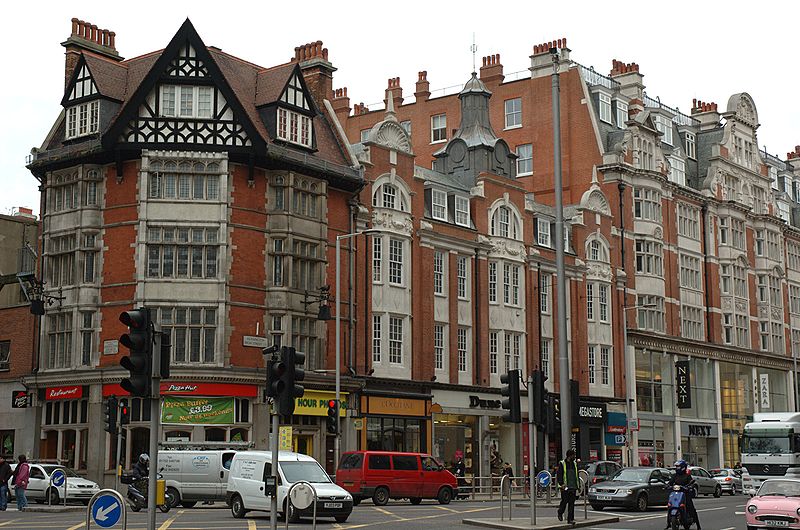
Kensington High Street at the intersection with Kensington Church Street. Kensington, London, England.
Photo by Ghouston via Wikimedia Commons.
The first bit is to diagnose the problem properly. If the big builders won’t build because they don’t want to then and therefore we want to find other builders who will and do want to. And the important part of this is that the big builders do indeed have market power. It costs a lot — a lorra lots — of money to be able to get a scheme through planning. Thus we not only have that problem of a shortage of places to build — because planning — but we’ve also handed market power to those able to build — because planning.
The answer is to shoot the planners, obviously. But then that always is the correct answer. Here, more specifically, we need to flood the zone with permissions. Really, grossly, oversupply. Like issue 15 million permits. Say. At which point the value of a permit is zero. So, anyone with a scrap of land can gain a permit and build.
This brings back the small housebuilder. Instead of being held back by the ideals of half a dozen national builders we’ve got 50,000 blokes all looking to build 2 or 3 houses a year. Or 10 or 20 even.
There’s no way that the big builders can then delay building on their plots. For they don’t have market power any more. And even if they do want to delay then it doesn’t matter a damn.
And this always is the way that you deal with those with market power. You flood that zone with supply so as to destroy their market power.
Forgotten War – Ep 6 – The Battle of the Admin Box – Feb. 1944
HardThrasher
Published 1 Jan 2025A short video on the highlights of the Battle of the Admin Box, and its build up DO NOT PANIC IF YOU HAVEN’T WATCHED THE OTHER VIDEOS IN THIS SERIES
Please consider donations of any size to the Burma Star Memorial Fund who aim to ensure remembrance of those who fought with, in and against 14th Army 1941–1945 — https://burmastarmemorial.org/
(more…)
DOGE has a lot of low-hanging fruit to pick
Patrick Carroll selects some of the least-defendable ways the US government has been spending taxpayer money from Senator Rand Paul’s 2024 Festivus Report, including pickleball courts, $10B in unused office space, DEI initiatives for birdwatchers, crop fertilizer in foreign countries, and literal circus performances:

Rand Paul by Gage Skidmore is licensed under CC BY-SA 2.0 

 .
.
Why does such government waste persist year after year? A significant part of the explanation traces back to the concept of concentrated benefits and dispersed costs. Essentially, the beneficiaries tend to be a small, concentrated group, so they lobby hard for these outlays because they stand to gain a lot from them. Taxpayers, on the other hand, tend to be dispersed and only minimally affected by any single expense, so it’s not usually worth it for them to lobby against the spending, or even learn about it in the first place.
Economist Gordon Tullock famously illustrated this concept with his fictional Tullock Economic Development Plan. The plan “involves placing a dollar of additional tax on each income tax form in the United States and paying the resulting funds to Tullock, whose economy would develop rapidly”.
Think about the incentive Tullock would have to advocate for this plan, compared to the incentive that an ordinary taxpayer would have to look into it and voice their objections. With campaign contributions and votes to be gained from the special interest beneficiaries, is it any wonder politicians often go for these kinds of wealth transfers?
The ubiquity and stubborn persistence — year after year — of all this waste, combined with the economic theory that explains why it happens, suggests that there is a fundamental problem with the process of government as we know it. This is not, as many are itching to believe, a “Democrat” problem or a “Republican” problem. The degree of government waste changes very little with changing administrations. No, this is a problem with the government as such.
To solve this problem, we need to ask not just who should run the government, but what the government should be allowed to spend money on in the first place, given what we know about its entirely predictable and repeatedly demonstrated propensity for waste and dysfunction.
Milei has already started that conversation in Argentina. Let’s hope that with the new Trump administration and DOGE, that’s a conversation we can have here as well.
Why Germany Lost the Battle of Britain
Real Time History
Published 2 Aug 2024Summer 1940. The United Kingdom is gripped by the fear of a German invasion. Even if the Luftwaffe secures the sky over Britain, could Germany’s Operation Sea Lion ever really work?
(more…)
QotD: Sincerity
This is what the French call le horse pucky. If we may be so bold as to speak of “the human spirit” — which is pretty heavy for a column starting with a professional wrestler — the 90s killed it stone cold dead. The human spirit can flourish in the most awful situations, but one indispensable requirement is: Sincerity. You just can’t be snarky about the “Ode to Joy” or ironic about the Sistine Chapel. If you do, then there really is no difference between Beethoven and MC Funetik Spelyn, nothing to choose between Michelangelo and a dog turd on the sidewalk — someone placed them there intentionally, which is the only distinguishing characteristic of “art” possible in a world overrun by Postmodernists and Deconstructionists.
Severian, “Why the 90s Was the Worst Decade Ever”, Rotten Chestnuts, 2021-07-04.
January 1, 2025
3,500 Years of Hangover Cures – Kishkiyya from Baghdad
Tasting History with Max Miller
Published 31 Dec 2024A slightly sour lamb stew with herbs, chickpeas, and fat, eaten as a hangover cure in 10th century Baghdad
City/Region: Baghdad
Time Period: 10th CenturyWhere there are hangovers, there are hangover cures. Throughout history they’ve varied from having a good wash, drinking lemonade while drinking alcohol, and the dubious prairie oyster. This stew is kind of like 10th century Baghdad’s version of my favorite hangover food: a greasy burger and fries.
Fatty lamb is stewed with kishka (a dried yogurt-like dairy product), verjuice, chickpeas, herbs, and greens, along with some olive oil just to make sure there’s enough grease involved. It doesn’t look all that pretty, but it tastes good. It’s complex and layered, with each flavor following the last, and the variety of textures is wonderful.
Wash 3 ratls meat and put it in a pot. Add ½ ratl chopped onion, ¼ ratl fresh herbs, a handful of chickpeas, 1 piece galangal, and ¼ ratl olive oil. Pour water to submerge the ingredients in the pot. Let the pot cook until meat is almost done. Add any of the seasonal green vegetables and a little chard. When everything in the pot is cooked, add 3 pieces of sour kishk, and ½ ratl kishk of Albu-Sahar, Mawsili, or Bahaki. Pound them into fine powder and dissolve them in 1 ratl (2 cups) ma’hisrim (juice of unripe sour grapes).
When kishk is done, add 2 dirhams (6 grams) cumin and an equal amount of cassia. Add a handful of finely chopped onion. Do not stir the pot. When the onion cooks and falls apart, add to the pot 2 danaqs (1 gram) cloves and a similar amount of spikenard.
Stop fueling the fire, let the pot simmer and rest on the remaining heat then take it down, God willing.
— Kitāb al-Tabīkh by ibn Sayyār al-Warrāq, 10th Century, translation from Annals of the Caliph’s Kitchen by Nawal Nasrallah
The EU emulates King Canute
The headline is a bit misleading, as Canute’s failed attempt to control the tides was intended to refute courtiers’ exaggerations about his royal powers. The EU, on the other hand, is determined to impose stasis on a very dynamic and changing field:

The European Union will have the continent-wide standard for the buggy whip real soon now. That’s the logical conclusion to draw from that recent announcement about USB-C.
For those who’ve not been following along at home the European Commission is very proud of itself. They’ve managed to pass a law mandating that USB-C (don’t worry, it’s a shape of cable) be the only flavour of connector now allowed within the EU. This has caused the less intellectual of our own rulers — St Stella for example — to just quiver, gasp, with excitement. This is proof of the ability of the collective bureaucracy to really stick one to The Man or something. A vast victory over Big Cable it seems.
Well, yes. Those with a little history to their name will know that the EU has been trying to do this for some time now. So much time that they’d originally intended to make Micro-USB the Europe-spanning insistence but it took them so long to make their rules that USB-C had already superseded it.
At which point we might draw a couple of conclusions. Even, suggest an insistence or two. That first insistence would be that a time of rapid technological change is really not quite le moment juste to be insisting upon only the one way of doing things. Because change, d’ye see? No, this is important for we know, absolutely, that there’re people out there just itching to insist upon the one connector for electric vehicles. Who would, in the name of a vapid uniformity, insist upon freezing technology at its current state rather than allow it to develop.
We could, should, also go on to insist that such a legal insistence on the only form allowed means that technological development cannot happen any more. For, in order to advance or even just change it will be necessary to change that law, that definition.
Legal changes in the European Union are not easy. Of course, the Parliament cannot do it — they are not allowed to even propose law changes, let alone enact them. It is necessary first to convince the European Commission of the need for a change. That means convincing the bureaucracy of course. Once that’s done it must pass the Council of Ministers, which is all the national governments. Parliament is then allowed to say yes. Then, and only then, would it be possible to put the new technology — say, a new cable — on the market.
But the only method we’ve got of testing whether a new cable is better is by putting it on the market. That is — no, really — the only process by which we find out whether consumers desire this new cable with all its delights, at the price that suppliers are willing to make it. But in the European system they cannot undertake the basic usefulness test until they’ve convinced a continent full of politicians that the new is in fact necessary and compulsory.
The Korean War 028 – Happy Nuke Year! – December 31, 1950
The Korean War by Indy Neidell
Published 31 Dec 2024Matt Ridgway arrives in Korea to find his Eighth Army broken and dysfunctional from top to bottom. He has a mere few days to rectify these issues and get them combat-ready before the Communist Chinese forces approach once more. But the stakes are high; UN forces commander Douglas MacArthur continues to pressure Washington to expand the war, through either conventional or atomic means. As 1950 expires, the doomsday clock is ticking.
(more…)


