
… I’ll be the first to admit that I not only don’t understand the business side of it, but the whole concept leaves me cold. Yes, of course, like any young man from the latter half of the 20th century I’ve seen a few pornos, gone to a few strip clubs, and so forth. Both were bachelor party rites of passage in my day; lord knows what they do now, and maybe that’s part of the OnlyFans sales model — since guys can’t go out to seedy strip clubs or get together as a bachelor party and watch a porno (too much Toxic Male Gaze, #MeToo) they have to do it virtually. And I don’t get that, either. Looking at sex strikes me as pointless — either put me in, coach, or I’m going to find some other, more productive use of my time — and looking but not touching at a strip club seems even dumber.
Given that I am not in the target audience for OnlyFans, then, perhaps all my speculations are hilariously wrong. And obviously there’s a robust market for porn, so it stands to reason that a la carte porn would have, if anything, an even bigger market …
… but do we trust those numbers? Everything in Clown World is fake and gay, and everything to do with the Internet has always been … how shall we put this? Factually dubious. This was true even when the Internet was a Libertarian paradise (for the young guys out there: Back in the build-your-own-modem days, I’m told, the Internet was hardcore Libertarian. By the time I got there, it was still very, very Right. Which stands to reason — you needed patience, discipline, and a little savvy to be online back then, and those are not Leftist qualities). OnlyFans claims a subscriber base of X, with revenues of Y. Do we have any reason to believe those are even within shouting distance of reality?
Money laundering seems like a live option.
My other guess was kompromat. I understand that Chinese Intelligence has all but openly admitted that TikTok is part of a targeted program to spread deviance, and if it has some intel benefit that’s a bonus. I figure OnlyFans had some sort of similar function. We all know that the classic “honey pot” is alive and well — Eric Swalwell and of course Hunter Biden say hi — but why bother running a real agent at somebody when he’s perfectly willing to put all his deviant desires in writing, backed by his credit card number?
I checked out OnlyFans — on Wikipedia; for research — and hey, whaddaya know, they got in on The Current Thing in Ukraine. Given what we know about Vladimir Putin, I’m sure he’s real broken up about that. It probably works pretty well as “open source” domestic intelligence, too — just as your enemies are busy uploading their own blackmail photos, so your domestic deviants are busy outing themselves on the other side of the transaction. Indeed, the only thing that surprises me is that the usual (((retards))) aren’t blaming it on the Mossad …
… actually I’m sure they are, and I do NOT want to know about it, but the point is, the whole thing seems really sketchy. So what are your thoughts? Money laundering scheme? PsyOp? Really obvious intelligence ploy? Or is it exactly what it seems like, desperately horny betas doing their thing?
(Based on what I saw on Facebook etc., I’m almost willing to believe the latter. All a recognizably human female has to do is post a cleavage shot on Facebook and she’ll get a hundred thirsty simps complimenting her. It’s the money thing that gets me, though. Being a simp in the Facebook comments is free).
Severian, “The E-Thot Economy”, Founding Questions, 2022-10-05.
January 6, 2023
January 5, 2023
Trudeau’s government has paid 30 times as much to consultants McKinsey and Company as the Conservatives did
Paul Wells on the amazing profit margins McKinsey and Company must be making thanks to their booming business with the Canadian federal government under Justin Trudeau:
From Radio-Canada, and not yet translated into English at this hour, comes news that the Trudeau Liberals have paid 30 times as much to the global consulting firm McKinsey and Company as the Harper Conservatives did, even though the Liberals have so far spent less time in office than the Conservatives did.
That’s $2.2 million in nine years under Harper, against $66 million in seven years under Trudeau.
And this chart, which I’ve taken from the Rad-Can report, shows the recourse to McKinsey is accelerating: the company’s take from the feds last year was almost as much as its combined take from all previous years.
Rad-Can reporters Romain Schué and Thomas Gerbet write: “What was the firm’s precise role? It’s impossible to know for sure. [McKinsey] refused to answer our questions … And despite our requests, Ottawa didn’t want to share the reports the firm produced.”
This is only the latest evidence of a massive trend in government in Canada’s federal government, in many provinces, and abroad: the contracting-out of complex problems to private firms that charge a premium; are never around when problems arise later; often produce work of questionable quality; and are too often exempt from even the minimal transparency and accountability that’s expected of work done in-house by the regular public service.
We’re seeing that latter point play out in a Commons committee’s attempts to find out how the ArriveCan app came to cost so much. The app was developed by outside contractors (not McKinsey — today’s Rad-Can story is about McKinsey but the use of contractors benefits many firms), and MPs seeking details have so far received only shrug emojis from the Trudeau government.
This increasing resort to secretive external consultancies impoverishes public discussion about ideas for the future. It is brutally demoralizing to the professional public service, which means it pays nasty dividends by making public-service worse ever less attractive to talented people. It allows timid elected officials to buy a backbone, in the form of a commissioned study supporting their preferred option, and the only cost is the burden on public finances, which elected officials plainly soon learn not to worry about.

Roman Emperors, Part 8 – Nero: Life and Death
seangabb
Published 20 Dec 2022This is a video record of a lecture given by Sean Gabb, in which he discusses what we can know or suspect about the life of the Emperor Nero. Some criticism here of Tacitus as a reliable source.
The Roman Empire was the last and the greatest of the ancient empires. It is the origin from which springs the history of Western Europe and those nations that descend from Western Europe. It is the political entity within which the Christian faith was born, and the growth of the Church within the Empire, and its eventual establishment as the sole faith of the Empire, have left an indelible impression on all modern denominations. Its history, together with that of the Ancient Greeks and the Jews, is our history. To understand how the Empire emerged from a great though finally dysfunctional republic, and how it was consolidated by its early rulers, is partly how we much understand ourselves.
(more…)
The injustices inherent in “asymmetrical multiculturalism”
Ed West traces the start of “asymmetrical multiculturalism” to a 1916 article in The Atlantic by Greenwich Village intellectual Randolph Bourne and traces the damage that resulted from widespread adoption of the policy:

“Asymmetrical multiculturalism” was first coined by demographer Eric Kaufmann in his 2004 book The Rise and Fall of Anglo-America, and later developed in his more recent Whiteshift, in a chapter charting Bourne’s circle, the “first recognisably modern left-liberal open borders movement”.
Kaufmann wrote how asymmetrical multiculturalism “may be precisely dated” to the article where Bourne, “a member of the left-wing modernist Young Intellectuals of Greenwich Village and an avatar of the new bohemian youth culture,” declared “that immigrants should retain their ethnicity while Anglo-Saxons should forsake their uptight heritage for cosmopolitanism.”
Kaufmann suggested that: “Bourne’s desire to see the majority slough off its poisoned heritage while minorities retained theirs blossomed into an ideology that slowly grew in popularity. From the Lost Generation in the 1920s to the Beats in the ’50s, ostensibly ‘exotic’ immigrants and black jazz were held up as expressive and liberating contrasts to a puritanical, square WASPdom. So began the dehumanizing de-culturation of the ethnic majority that has culminated in the sentiment behind, among other things, the viral hashtag #cancelwhitepeople.”
The hope, as John Dewey said of his New England congregationalist denomination around the same time as Bourne, was that America’s Anglo-Saxon core population would “universalise itself out of existence” while leading the world towards universal civilisation.
These ideas certainly didn’t remain in New England or even the United States, as Britain has certainly seen just how destructive they can be recently:
Late last year I wrote about the tragedy of Telford, a town in the English midlands where huge numbers of young girls had been sexually abused. Telford, along with Rotherham in South Yorkshire, had become synonymous with this form of sexual abuse, mostly committed by men of Kashmiri origin against girls who were poor, white and English.
This is the subject of an upcoming GB News documentary by journalist Charlie Peters, and it is quite clear, from all the various reports, that grooming had been allowed to carry on in part because of the different ways the system treats different groups.
Had the races of the perpetrators and victims been reversed, this tragedy would almost certainly be the subject of countless documentaries, plays, films and even official days of commemoration. But it wouldn’t have come to that, because the authorities would have intervened earlier, and more journalists would have been on the case.
Sex crime is perhaps the most explosive source of conflict between communities, and most recently the 2005 Lozells riots began over such a rumour. It is understandable why journalists and reporters were nervous about this subject; less forgivable is the way that, away from the public eye, those in charge signal how gravely they view what happened.
Until Peters revealed the story, Labour had planned to make the former head of Rotherham council its candidate for Rother Valley; this week Peters revealed that one of the councillors named in a report into the town’s failures to deal with the grooming gangs scandal has gone onto become a senior Diversity & Inclusion Manager working for the NHS. Presumably the people who hired Mahroof Hussain knew about his previous job, and still felt that it was appropriate to have him in a “diversity and inclusion” position. Again, were things different, would a Mr Smith whose council had been condemned for its handling of the gang rape of Asian girls have landed that job? The whole thing seems as morbidly comic as Rotherham becoming Children’s Capital of Culture.
Such a clear inconsistency can only exist because of socially-enforced taboos and norms which have developed over race. In Whiteshift, Kaufmann cited sociologist Kai Erikson’s description of norms as the “accumulation of decisions made by the community over a long time” and that “each time the community censures some act of deviance … it sharpens the authority of the violated norm and re-establishes the boundaries of the group”. Every time an individual is punished for violating the anti-racism norm, it strengthens society’s taboo around the subject, to the point where it begins to overwhelm other moral imperatives.
Then there is regalisation, the name for the process “in which adherents of an ideology use moralistic politics to entrench new social norms and punish deviance”, in Kaufmann’s words. This has proved incredibly effective; after paedophilia or sexual abuse, racism is perhaps the most damaging allegation that can be made.
Few people wish to be accused of deviance, which perhaps explains why Peters’s story has received so little coverage in the press this week. Again, were the roles reversed, it’s not wild speculation to suggest that it would feature on the Today programme, seen as clear evidence of racism at the heart of Britain. When the Telford story broke, it did not even feature on the BBC’s Shropshire home page.
Tank Chats #162 | Springer | The Tank Museum
The Tank Museum
Published 2 Sep 2022Join Curator David Willey in his latest Tank Chat as he delves into the Springer, a German demolition vehicle.
(more…)
QotD: The Broken Window Fallacy
Bastiat debunked this reasoning in his 1848 essay “That Which Is Seen and that Which Is Not Seen“, and countless economists since have echoed his remarks. In the essay, he tells the parable of a shopkeeper whose careless son breaks a window, and he asks the reader whether this is good for the economy. At first glance, it’s tempting to say yes. But as Bastiat shows in the story, this conclusion ignores the unseen effects of the broken window.
“If … you come to the conclusion,” he writes, “as is too often the case, that it is a good thing to break windows, that it causes money to circulate, and that the encouragement of industry in general will be the result of it, you will oblige me to call out, ‘Stop there! your theory is confined to that which is seen; it takes no account of that which is not seen.'”
What is not seen, briefly, is the lost opportunities, the things that could have been done with our resources had they not been needed to replace the broken window. Taking those into account, it becomes clear that the broken window is harmful to the economy. After all, there is now one less window in our stockpile of goods.
The same reasoning applies on a larger scale. There may be plenty of jobs and demand when a hurricane destroys a town, but saying this is “good” for the economy is simply wrong. If this logic were true, the more destruction we experience the better off we’d be! But economic reasoning — and plain common sense — tells us this can’t be right.
Patrick Carroll, “3 Economic Fallacies to Watch Out for during Hurrican Season”, Foundation for Economic Education, 2022-09-30.
January 4, 2023
“Sarajevo” – Assassination of Archduke Franz Ferdinand – Sabaton History 116
Sabaton History
Published 3 Jan 2023Where did the war to end all wars begin? The assassination in Sarajevo may have only killed two, but the repercussions killed millions, destroyed empires, and changed the course of history.
(more…)
Sarah Hoyt on some of the dystopian futures we’ve avoided (so far)
Sarah Hoyt outlines a few of the grim future scenarios that appeared to be the future to people who earned a living writing about possible futures:

1 – World government.
To be fair, it seemed an absolutely sane and inescapable prediction for people who had seen the centralized nation states of the twentieth century consolidate. With faster communication, would come total union, right?I note Heinlein stopped believing this after his world tour. In fact in Friday he has a fractured USA.
That second vision is more likely. There are too many cultures in the world and too many competing interests to have a world government. Even on the administrative side, a world government might be absolutely impossible, unless it’s a nominal government and the sub-governments do everything really.
In which case, you know what? It’s no different than what we have, except we call any war a civil war.
The only people this idea still makes sense to are people who think they can change reality by changing the words.
Of course, just because there isn’t a formal world government doesn’t stop national governments and legacy media organizations from pretending that there is some supranational body whose directives they must always follow … at least when they want to do something the voters don’t want them to do. Lockdowns, anyone? Vaccine mandates? Social media censorship at the micro level? Oh, we have to do them because the WHO/UN/WEF/etc. insist.
2 – Overpopulation.
Yeah, I know what the population “counts” are, but we don’t have overpopulation. We don’t have any of the signs of overpopulation, and it’s becoming plainly obvious, country by country, locality by locality that there’s no overpopulation.Malthus was an unpleasant fatalist. he was also wrong. Humanity doesn’t keep reproducing like mindless rabbits.
To be fair, this makes perfect sense because we’re a scavenger species. For scavenger species the population curve is the bell curve, not an exponential climb.
It’s funny how third world governments can “accurately” report booming populations — at least partly because foreign aid from the west is often directly tied to those reports — yet many of them don’t even know how many civil servants they employ. And western governments and aid agencies just pretend to believe them.
3 – Total depletion of resources leading to the “rusty future” in a lot of eighties science fiction.
A lot of resources are in fact depleted, but we have found others This is something that the “Greens” seem unable to grasp. Humanity is a continuous depleting of resources, and discovering new resources and new ways to use them. For instance, given our population, I don’t think we have enough flint to knap for knives for all of us. It’s an obvious crisis.In the same way, do you think it’s even possible for all of us to have a horse? Our cities would be hip-deep in horse poo.
But we are the ape that adapts. Things change. And the future will be as shiny as we want it. Unless fashion calls for dull, of course.
If you’ve been educated in a zero-sum economic picture, then it’s difficult or impossible for you to recognize that when resources begin to run short and prices rise, individuals and companies look for more efficient ways to use the now more expensive resource or to consider substitutions. This is why economies who try to suppress normal market signals, like rising prices due to diminished supplies, end up far worse off … humans in aggregate are adaptable and will try to find alternatives when they can.
4 – The world isn’t a communist state, or filled with communist states.
There are some yes, but the ones there are are in obvious trouble, and only the propagandized and the ignorant believe it is a way to live, or a way that brings about paradise. In fact, most of today’s communists are merely wanting to reign in hell.
They know they’d unleash hell, they just think they’d be king.
As bad as it is that people are still fighting for this, it’s miles ahead of the status quo till the eighties, where people actually believed planned centralized states were better.
We still have a fight ahead of us, and we might still fail, but there will never be a whole-word communism. and those of use devoted to freedom will eventually win. It just will take probably more than my life. At least on a world-scale.
Among the governments most likely to resort to market denial (and autarky) are socialist and communist states. Central planning is one of the fastest methods to starving your population aside from total war. Central planners are always confident that they “know better” than filthy capitalists, and with proper “scientific” planning they can avoid all the “waste” that market societies produce. For a detailed look, consider the plight of poor, imaginary Wyatt, a factory manager under GOSPLAN in the old Soviet Union. If anything, Sev underestimates the economic disaster that Soviet central planning perpetrated.
5 – We don’t have some sort of central authority that contols all of something: genetics; who is arrested; etc.
A lot of places have crazy authorities, but not the whole world. we’re not enslaved by the Tech Lords (and what a pitiful lot those turned out to be) and the agencies trying to subjugate us are not all powerful, more along the lines of a bunch of venal chuckleheads. Annoying, with no morals and insane, but not all powerful. It could be worse.
It certainly could be worse, and useful idiots in western governments and legacy media are doing what they can to bring everything possible under tighter control, but as I’ve pointed out repeatedly the more a government tries to do, the worse it does everything.
The First Modern Military Rifle: The Modele 1886 Lebel
Forgotten Weapons
Published 5 Dec 2017The Lebel was a truly groundbreaking development in military small arms, being the first rifle to use smokeless powder. This gave it — and in turn the French infantry — a massive advantage in range over everyone else in the world at the time. This advantage was short-lived, but the French did their best to exploit it.
French chemist Paul Vielle successfully developed his smokeless powder (“poudre B“) formula in 1884, and French ordnance spent 1885 experimenting with different calibers of small bore bullet to see what would work best. They also began looking at rifle actions to use, including specifically the Remington-Lee and the Mannlicher. However, a new Minister of War was appointed in January of 1886 and he demanded a completed prototype rifle and ammunition be completed by May 1886. This was a nearly impossibly short deadline to meet, and it meant that the Ordnance officers could not possibly develop a wholly new rifle, and instead would have to modify something already in the inventory.
The only suitable option was the Model 1884/5, a combination of the Gras bolt and Kropatschek tube magazine. The new smokeless cartridge was made by simply necking down the 11mm Gras round, and the 1884 rifle was given a new barrel in 8mm and a new dual-locking-lug bolt head to accommodate the high chamber pressure of the new powder. The result was the Lebel, and it was formally accepted in April 1887 after a relatively short period of testing. The weapon may not have been used the most advanced elements, but it was without any doubt the foremost military rifle in the world at the time, by a substantial margin.
The three main French state arsenals of St Etienne, Chatellerault, and Tulle would all tool up to produce the Lebel, and by the end of 1892 approximately 2.8 million had been produced, enough to equip the entire Army. The rifle would remain in service as France’s primary infantry rifle until World War One, would be declared obsolete in 1920, and remain in inventory and in use until the end of World War Two.
(more…)
QotD: Hate speech
However he who will attend to the motions of his own mind (to use Doctor Johnson’s wonderful, but sadly disregarded, formula for real and searching self-examination) will discover that hatred is by far the most powerful and durable of political emotions. One’s feelings for one’s political enemies are warm and lively, while those for one’s political friends are cool and torpid. It is obvious that the rich and the foreigner are in general hated much more than the poor and the fellow-countryman are loved; while hatred of oppression is much stronger than love of freedom, especially when it is other people’s freedom. To hate injustice is easy, to love justice, or even to know what it is, is difficult. Hatred, in short, makes politics, and much else besides, go round; and while Freud spoke of the narcissism of small differences, he might just as well have spoken of the hatred caused by small differences.
Nor is hatred exhaustible. On the contrary, it is indefinitely expandable. It often increases with its own expression, becoming more virulent with every word uttered; it is not a fixed quantity like fluid in a bottle. It is very easy, as most people must surely know, to work oneself up into a fury of indignation and insensate rage merely by dwelling on some slight or humiliation. Above all, hatred is fun: it gives a meaning to life to those who otherwise lack one.
The idea therefore that hate speech can be banned, is of course, is a sign of impatience with the intractability of the human condition. It wants to legislate people into kindness, decency and fellow-feeling. It appeals to the sort of people who forget (or never knew) that supposed solutions to human problems frequently throw up further problems that are greater than that which the solution is designed to solve. For its protagonists, it has the advantage of creating a bureaucracy of virtue with pension arrangements to match.
Theodore Dalrymple, “Hating the Truth”, The Salisbury Review, 2011-06.
January 3, 2023
1943 in Numbers – WW2 Special
World War Two
Published 1 Jan 2023This war is massive. Our chronological coverage helps give us an understanding of it, but sometimes statistics help us understand the bigger picture.
(more…)
For the King’s coronation, amp up the pageantry and pomp
In The Critic, Thomas Brian makes the case against a quiet, restrained coronation for King Charles III:
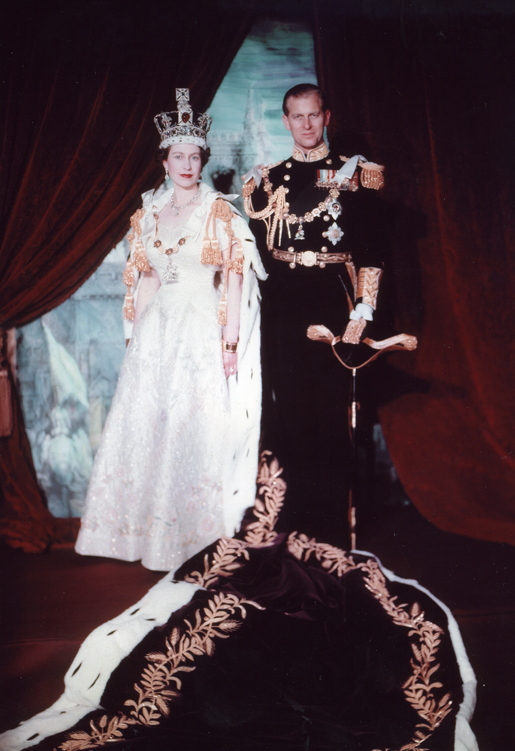
Queen Elizabeth II and Prince Philip, Duke of Edinburgh. Coronation portrait, June 1953, London, England.
Photographed by Cecil Beaton, Public Domain image via Library and Archives Canada reference number DAPDCAP82719.
As surely as the sun rises, the Sisyphean hacks take up their pens. The occasion is the State Opening of Parliament, or some such ceremony, and the audacity of it angers them. A golden throne, polished boots, diamond-encrusted crowns and scarlet cloth. Is it not, they jointly wonder, a bit childish? A bad look? I mean, in 21st century Britain, should we not be more like a grown up country, where all of this procession and pomp and prayer business is left behind? A bit like Germany?
Of course not. Year after year such questions are raised, and year after year, God willing, we shall ignore them. Had you raised this subject with me until this year, I would not be so optimistic. Our country rarely expresses much appreciation for the rich and dignified pageantry that still surrounds so much of our daily life. Yet the unfortunate events of September brought on such an expression of grief, such a wide-eyed fascination and enthusiasm for the ancient rituals of mourning and accession, that I have more faith in Britain knowing and valuing its common heritage. Valued it should be. In an ever more fractious age, what can be more unifying than the binding power of these ceremonies? As we proclaim a new king, we are reminded that the defining feature of “Britishness” is not race or birth, but fealty. Subjects need not have jus soli.
The debunkers denounce such precious things as childish. Even if it were, what shame would it be? The instincts of the child continue to move us with love and wonder. In a letter to the Times last month, a judge described a visit he made to a school where, when he shed the gown and wig, no pupil would believe he was really a judge. In few places is this power of the higher and mystical seen more vividly than in the courtroom. In fact, almost all countries understand this — even grown-up Germany.
When posing as normal people, officials lose their power to move and inspire — whether they wish to inspire trust, or hope, or virtue. States will fail if they are not taken seriously by their subjects. States will not be taken seriously if they do not take themselves seriously. How can we expect any degree of good government, any degree of duty, any degree of seriousness from someone who has so little respect for the service of his country that he thinks its business should be carried out with such casualness that not even a child could be awed into understanding?
For all the virtues of the child, and for all we preserve those adoring childish instincts, it is not we who are childish. That honour goes to the debunker. Perhaps “adolescent” is a better word. These are men who ignore the clear and ready power of the tried and true, the proven, in favour of wordy essays and papers which promise snake oil solutions to the problem of government. What is more a mark of youth than fervour for novel, abstract ideas? What more of a mark of age is love of the proven and experienced? Nothing is more proven, more experienced than the British constitution, with all its pageantry and paraphernalia.
Debunking the Myths of Leonardo da Vinci
Tasting History with Max Miller
Published 9 Aug 2022
(more…)
QotD: Spartan dominance over the Peloponnese
The core of this control lasted until 371, when Spartan defeat at the Battle of Leuktra shattered this control. Epaminondas, the Theban commander, used the opportunity to free the helots of Messenia and reform them into a polis to provide a local counter-weight to Sparta, while Arcadia and Elis split off from Sparta’s alliance to form their own defensive league against Sparta and, to top it off, a number of the perioikic communities – including the Spartans’ elite light infantry scouts, the Skiritae – along with various borderlands also formed the new polis of Megalopolis on the northern Spartan border – it promptly joined the Arcadian league (this polis would later give us the historian Polybius; his anti-Spartan stance comes out clearly in how he treats Cleomenes III). Sparta, surrounded now by hostile poleis who had once been allies, would spend the rest of Antiquity as a political non-entity, save for one brief effort to restore Spartan greatness in the 220s, crushed by the Macedonian Antigonids who were in no mood to entertain Spartan delusions of grandeur.
We might then say that Sparta is successful – though not entirely so (Argos!) – in establishing a hegemony over the Peloponnese, but only maintains it for c. 175 years. That’s not a bad run, but for the record of a larger state dominating its backyard, it is not tremendously impressive either.
Bret Devereaux, “Collections: This. Isn’t. Sparta. Part VII: Spartan Ends”, A Collection of Unmitigated Pedantry, 2019-09-27.
January 2, 2023
An in-depth look at the Type 26 frigate design
Navy Lookout
Published 31 Dec 2022The Type 26 frigates being built for the Royal Navy [and Royal Canadian and Royal Australian navies] are specialist submarine hunters but with a range of other capabilities. This video provides a primer on the overall warship design, its weapons, sensors and decoys.
(more…)


