Quotulatiousness

January 2, 2023

How much of the media coverage of the Bosnian War was fake news?

Filed under: Cancon, Media, Military — Tags: , , , , , , , , — Nicholas @ 03:00

Kate at Small Dead Animals linked to this rather disturbing collection of intelligence cables from the Canadian peacekeeping force in Bosnia to NDHQ in Ottawa during the conflict, which contradicts the media narrative of the time:
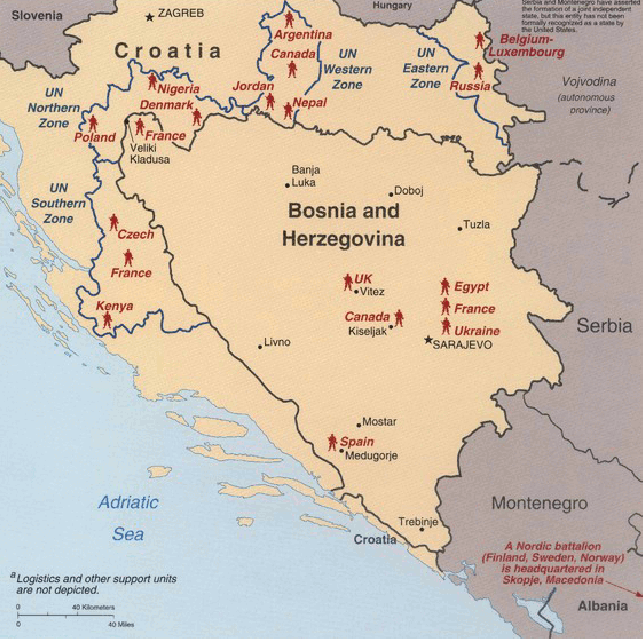
Map of deployment of National Battalions in UN Forces in Croatia and Bosnia and Herzegovina – Early 1993 (Balkan Battlegrounds Map I)
Balkan Battlegrounds: A Military History of the Yugoslav Conflict, 1990-1995 author credit: Central Intelligence Agency.

A trove of intelligence files sent by Canadian peacekeepers expose CIA black ops, illegal weapon shipments, imported jihadist fighters, potential false flags, and stage-managed atrocities.

The established mythos of the Bosnian War is that Serb separatists, encouraged and directed by Slobodan Milošević and his acolytes in Belgrade, sought to forcibly seize Croat and Bosniak territory in service of creating an irredentist “Greater Serbia”. Every step of the way, they purged indigenous Muslims in a concerted, deliberate genocide, while refusing to engage in constructive peace talks.

This narrative was aggressively perpetuated by the mainstream media at the time, and further legitimized by the UN-created International Criminal Tribunal for the former Yugoslavia (ICTY) once the conflict ended. It has become axiomatic and unquestionable in Western consciousness ever since, enforcing the sense that negotiation invariably amounts to appeasement, a mentality that has enabled NATO war hawks to justify multiple military interventions over subsequent years.

However, a vast trove of intelligence cables sent by Canadian peacekeeping troops in Bosnia to Ottawa’s National Defence Headquarters, first published by Canada Declassified at the start of 2022, exposes this narrative as cynical farce.

The documents offer an unparalleled, first-hand, real-time view of the war as it developed, with the prospect of peace rapidly degrading into grinding bloodshed that ultimately caused the painful death of the multi-faith, multi-ethnic Yugoslavia.

The Canadian soldiers were part of a wider UN Protection Force (UNPROFOR) dispatched to former Yugoslavia in 1992, in the vain hope tensions wouldn’t escalate to all-out-war, and an amicable settlement could be reached by all sides. They stayed until the bitter end, long past the point their mission was reduced to miserable, life-threatening failure.

The peacekeepers’ increasingly bleak analysis of the reality on the ground provides a candid perspective of the war’s history that has been largely concealed from the public. It is a story of CIA black ops, literally explosive provocations, illegal weapon shipments, imported jihadist fighters, potential false flags, and stage-managed atrocities.

Read the complete Canadian UNPROFOR cables here.

See key excerpts of the files referred to in this article here.

Shaping your Saw Handle | Paul Sellers

Filed under: Tools, Woodworking — Tags: , — Nicholas @ 02:00

Paul Sellers
Published 15 Jul 2022

I have encouraged people to customise wooden saw handles to make them more dynamic in hand, but here is the simplest one yet and one I can thoroughly recommend doing as it makes the saw yours! Removing the studs and replacing them is more of a faff than it is worth when all you want is a decent saw.

In this video, I take a saw that cuts well and can be resharpened a thousand times with a simple triangular saw file. By doing this, you are no longer buying into the throwaway saw market and you own a lifetime saw.

You can do this, and we will show you how!
(more…)

QotD: Academic incentives and the Bobo lifestyle

The road to tenure takes only left turns, you’ll recall, because only “original” “research” gets published, and since Shakespeare ain’t writing no more sonnets, the only way to be “original” is through radical politics. As above, so below — since nobody’s going to upvote or retweet a sentiment like “Things are pretty much ok the way they are,” social media becomes little more than competitive #wokeness.

[…]

Here again, academia provides the answer. But first, let’s talk about David Brooks, the “conservative” infamously aroused by Obama’s perfectly creased pants. There are few sillier people than David Brooks, but “take wisdom where you find it” is my motto (well, that and “mihi dare vinum“), and he really knocked it out of the park with Bobos in Paradise. No, seriously. […] A Bobo, in other words, is a Gen Xer who could compete with the Boomers on their turf … but since he also took the Boomers at their word when they went on (and on and on and on and on) about Sticking It to the Man (an all too common generational failing), the Bobo sees the Boomer’s luxury car / vacation home / trophy wife conspicuous consumption as unbearably gauche. So instead, the Bobo spends $500 on a can opener because it’s good for the environment or is handcrafted by paraplegic Brazilian Eskimos or something, anything, so long as it a) obviously costs a shitload, and b) has some kind of Save-the-World rationale attached to it.

Academia reinforces this. Lots of Gen Xers went into the ivory tower for precisely that reason. Y’all know that the average professor hauls in nearly $200 large, right? The median income for an American worker in 2019 was approximately $46,800. I was in History, not math, but even I can see that the eggheads take home over four times what the average Joe makes. Which sets up another lifestyle contest. When you’re a) richer than sin, b) surrounded by a caste on slave wages, and c) ideologically committed to seeing yourself as The People’s Champion, the only way out is to live Bobo-style. Sure, sure, I have a $500 can opener … but Maricela the cook is really empowered by using it, because it was made by transgendered aborigines Of Color.

And since those Bobos are middle aged now, they’ve indoctrinated two generations of students with this garbage. And those two generations also came up with social media, so now you’ve got the heady combination of lifestyle and persona striving. That’s why the DC crew do what they do. Competitive #wokeness is the only way to go … and since they’ve got their $400-manicured mitts on the levers of power, we all get to be the bit players and stagehands in the big Broadway show that is their special unique wonderfulness.

Severian, “Why So #Woke?”, Rotten Chestnuts, 2020-01-07.

January 1, 2023

The days when just graduating high school was a significant life achievement

Filed under: Britain, Education, History, USA — Tags: , — Nicholas @ 05:00

At Founding Questions, Severian responds to a reader comment about educational achivement before WW2 (when the US economy was almost the last one standing among major industrialized nations, and high school graduates finally passed 50% of the population):

Proposed coat of arms for Founding Questions by “urbando”.
The Latin motto translates to “We are so irrevocably fucked”.

In the “Friday Questions” post yesterday, toastedposts asks:

    I’ve been reading some more old random things (bits of philosophy and history in no particular order with no particular program.) I’m again struck by the impression that people from around 1700 to 1920 or so were noticeably smarter than people before or since. It’s something that seems obtrusive when I read the sort of things they write. Compared to the sullen stupidity and fanatacism of the communists and fellow pseudo-intellectual travellers, compared to the childish level of the propaganda with which people were manipulated post 50s and pre modern, it is striking …

    I wonder why the idiocracy? Did all these supergeniuses get killed preferentially in world wars and communist enslavement afterwards? Did something about our culture change disastrously, and can it be reversed? What was in their water, and can I have some?

I’ve seen this myself. You go look at any random letter collection from the 18th or 19th century, and even their “How’s it going? The weather is nice here”-type letters are just smarter

Or maybe not. I hate to sound like one of those “Education Theory” numbnuts here, but it’s hard to separate what you might call “native intelligence” from “rigorous schooling”. Since we’ve all been on the Internet within the last 30 years, we’ve seen that “This was a fifth grade math test in 1905” thing. Here’s an example published in The Guardian, the paper that all the very Smartest people these days read. I’ll just stick with math and history:

Arithmetic

1. Multiply 642035 by 24506

2. Subtract 3.25741 from 3.3; multiply 28.436 by 8.245; divide 0.86655 by 26.5

3. Simplify 183/4 minus 22/3 divided by 11/5 minus 31/2 multiplied by 4/7

English history

1. What kings of England began to reign in the years 871, 1135, 1216, 1377, 1422, 1509, 1625, 1685, 1727, 1830?

2. Give some account of Egbert, William II, Richard III, Robert Blake, Lord Nelson.

3. State what you know of Henry II’s quarrel with Becket, the taking of Calais by Edward III, the attempt to make Lady Jane Grey queen, the trial of the Seven bishops, the Gordon riots.

I’d have trouble with some of those. Isn’t Robert Blake an actor?

That said, those questions aren’t particularly hard. Muti-digit multiplication is more time-consuming than anything else; it’d look like a Christmas tree, spread across the page. The fact that I can’t do them now (without a refresher course) doesn’t mean I couldn’t do them then. I was taught the process; I’m just rusty. Same thing with English history. The Lady Jane Grey thing … ummm, something something Reformation? But if I’d recently taken a course on it, I’d be much more up on it.

But then again, I was able to grok the process in the first place. “Universal” education is very new, and on balance I’d have to say it’s a negative. A high school diploma was a real achievement almost within living memory. This here table says that high school graduation rates didn’t top 50% until 1940, and didn’t clear 60% until 1950. It used to be a trope in the “rags to riches” story that “So-and-So only had a fifth-grade education”, but in that world, 5th grade was plenty. Even now, 5th graders kinda sorta have the Three Rs. (Adding the fourth R, of course — that would be “Rainbow”, or maybe “rump rangering” — but still).

So the entrance exam for “King Edward’s School” — the example in the Graun article — in 1898 would be the equivalent of a very tough college entrance exam today (and note that the referenced school is very pricey and very, very elite, even now).

This is not to say that people back then weren’t smarter. They sure seem to be, and I’ve written many times that the not-elite but certainly very respectable school that awarded me a PhD in the early 21st century wouldn’t have admitted me as an undergrad as late as 1960, if not 1970. I’m just noting some context — in 1898, 5th graders were already something of an intellectual elite, and their day-to-day education reflected that.

Canadians Take Little Stalingrad – WW2 – 227 – December 31, 1943

World War Two
Published 31 Dec 2022

1943 reaches its end with no end in sight for the war. In Italy, the Canadians take Ortona after bloody close fighting, the US Marines advance on New Britain, and a new Soviet offensive makes huge gains in the USSR. This isn’t enough for the Allies, though, who have a big shake up in their European Command to help prepare for future attacks.
(more…)

Public Domain Day for 2023

Filed under: Books, Law, Media, USA — Tags: , , — Nicholas @ 03:00

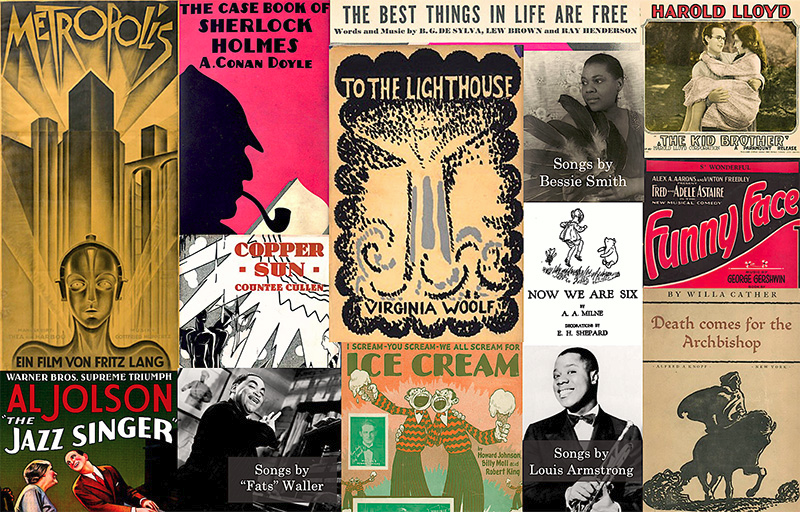
Duke University School of Law’s Center for the Study of the Public Domain highlights just some of the creative works that have entered into the public domain (in the United States: other countries’ laws may vary substantially) today:

Here are just a few of the works that will be in the US public domain in 2023. They were supposed to go into the public domain in 2003, after being copyrighted for 75 years. But before this could happen, Congress hit a 20-year pause button and extended their copyright term to 95 years. Now the wait is over. (To find more material from 1927, you can visit the Catalogue of Copyright Entries.)

Books:

  • Virginia Woolf, To the Lighthouse
  • Arthur Conan Doyle, The Case-Book of Sherlock Holmes
  • Willa Cather, Death Comes for the Archbishop
  • Countee Cullen, Copper Sun
  • A. A. Milne, Now We Are Six, illustrated by E. H. Shepard
  • Thornton Wilder, The Bridge of San Luis Rey
  • Ernest Hemingway, Men Without Women (collection of short stories)
  • William Faulkner, Mosquitoes
  • Agatha Christie, The Big Four
  • Edith Wharton, Twilight Sleep
  • Herbert Asbury, The Gangs of New York (the original 1927 publication)
  • Franklin W. Dixon (pseudonym), The Tower Treasure (the first Hardy Boys book)
  • Hermann Hesse, Der Steppenwolf (in the original German)
  • Franz Kafka, Amerika (in the original German)
  • Marcel Proust, Le Temps retrouvé (the final installment of In Search of Lost Time, in the original French)

[…]

Movies Entering the Public Domain

  • Metropolis (directed by Fritz Lang)
  • The Jazz Singer (the first feature-length film with synchronized dialogue; directed by Alan Crosland)
  • Wings (winner of the first Academy Award for outstanding picture; directed by William A. Wellman)
  • Sunrise (directed by F.W. Murnau)
  • The Lodger: A Story of the London Fog (Alfred Hitchcock’s first thriller)
  • The King of Kings (directed by Cecil B. DeMille)
  • London After Midnight (now a lost film; directed by Tod Browning)
  • The Way of All Flesh (now a lost film; directed by Victor Fleming)
  • 7th Heaven (inspired the ending of the 2016 film La La Land; directed by Frank Borzage)
  • The Kid Brother (starring Harold Lloyd; directed by Ted Wilde)
  • The Battle of the Century (starring the comedy duo Laurel and Hardy; directed by Clyde Bruckman)
  • Upstream (directed by John Ford)

1927 marked the beginning of the end of the silent film era, with the release of the first full-length feature with synchronized dialogue and sound. Here are the first words spoken in a feature film from The Jazz Singer: “Wait a minute, wait a minute, you ain’t heard nothing yet.” Read about the transition from the silent film to the “talkie” era, and the quest to preserve some of the remarkable silent films on this list, here. Please note that while the original footage from these films will be in the public domain, newly added material such as musical accompaniment might still be copyrighted. If a film has been restored or reconstructed, only original and creative additions are eligible for copyright; if a restoration faithfully mimics the preexisting film, it does not contain newly copyrightable material. (Putting skill, labor, and money into a project is not enough to qualify it for copyright. The Supreme Court has made clear that “the sine qua non of copyright is originality.”) In the list above, while some of the titles were not registered for copyright until 1928 or 1929, the original version of the film was published with a 1927 copyright notice, so the copyright expires over that version in 2023.

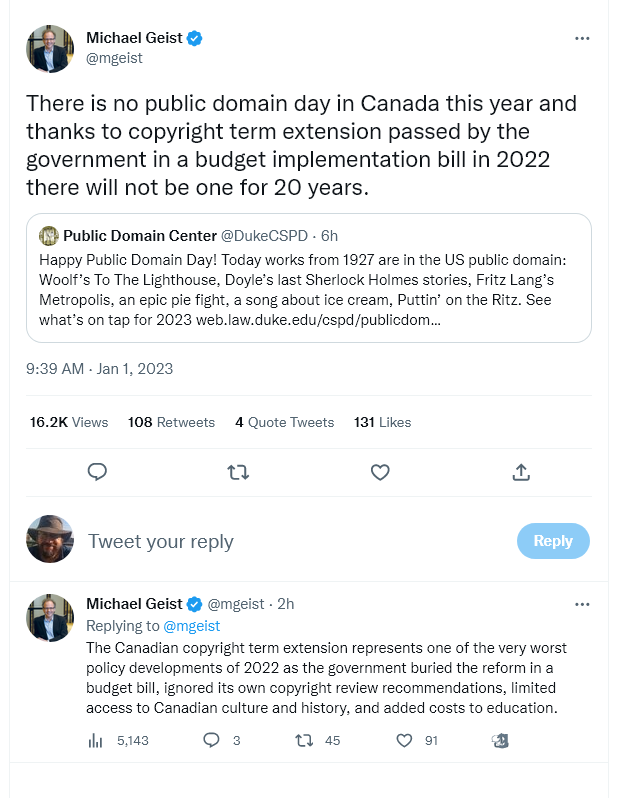
Update: Michael Geist explains why there’s no equivalent Public Domain day for Canada:

Full Cabin Build – 4K Full Length – Townsends Wilderness Homestead

Filed under: History, Technology, Tools, USA, Woodworking — Tags: , , , — Nicholas @ 02:00

Townsends
Published 29 Aug 2022

0:00 – Laying the Foundation
4:39 – The Walls Begin
8:22 – Prepping the Fireplace
9:52 – Finishing the Walls
15:58 – The Roof Design
17:04 – Adding the Purlins
20:29 – The Doorframe
21:32 – The Final Purlins
24:00 – Roofing Materials
25:47 – Adding the Bark Shingles
27:37 – Roof Wrap-Up
29:03 – Door Jams
29:47 – Opening the Fireplace
30:58 – Building the Fireplace
36:06 – Adding the Door
37:54 – The First Fire
39:02 – A Winter Safe Haven
(more…)

QotD: The amazing economic impact of mobile phones in the developing world

Filed under: Africa, Asia, Economics, Quotations, Technology — Tags: , , — Nicholas @ 01:00

One of the interesting findings about mobile phones is that they grow the economy. In a country without a general landline network – ie, all the poor ones – 10% of the population gaining a mobile increases GDP by 0.5%. No, not the growth rate goes up from 2% to 2.01%. But an additional 0.5% of GDP each year. Which is, by the standards of these things, pretty big.

We also know why too. Being able to contact people means that markets complete, contracts and transactions are possible. It’s no longer necessary to near randomly meet someone physically in order to be able to organise a transaction. Thus more transactions happen – the value added in voluntary transactions being that GDP which is increasing.

Tim Worstall, “Mobile Phones Cut The Murder Rate – For the Same Reason They Grow The Economy”, Continental Telegraph, 2019-05-30.

« Newer Posts

Powered by WordPress