
The Tank Museum
Published 11 Mar 2022► TIMESTAMP:
00:00 – INTRO
00:43 – FEATURES
(more…)
July 9, 2022
Tank Chat #151 Plastic Tank | The Tank Museum
Comments Off on Tank Chat #151 Plastic Tank | The Tank Museum
QotD: Chinese “technocracy”
For a while, all (or almost all) of China’s top officials had engineering degrees.
When Xi Jinping first joined the Politburo Standing Committee in 2008, eight of its nine members were engineers. Paramount Leader Hu Jintao was a hydroelectric engineer. His second-in-command Wen Jiabao was a geological engineer. There were two electrical engineers, a petroleum engineer, a radio engineer, and two chemical engineers (including Xi himself). The only non-engineer was Li Keqiang, an economist.
And this was actually a low point in engineers’ dominance of Chinese power. The term before, 100% of Politburo Standing Committee officials had been engineers! What’s going on?
For one thing, Deng Xiaoping thought engineers were cool, and he was powerful enough to do whatever he wanted. A government made up entirely of engineers? Sure, whatever you say. And since the top echelons of Chinese government appoint their own successors, these engineers could appoint other engineers and so on.
But also: during the Cultural Revolution, about half of Chinese people who got degrees at all got engineering degrees. The Cultural Revolutionaries were really not big on education (according to one article, “Xi’s secondary education [was cut short] when all secondary classes were halted for students to criticise and fight their teachers.”) But engineering was useful for building factories, and so was grudgingly tolerated. That meant that of the people smart and ambitious enough to get into college at all, half did engineering.
The other half? I’m not sure. Law is a popular major for would-be politicians in the US, but here’s a Chinese person explaining why it doesn’t work that way in China (short version: China doesn’t have great rule of law, so lawyers don’t matter much and are low status).
Here is an article telling us not to take China’s engineer-kings too seriously. It argues that (aside from Deng’s original picks), most of them never did much engineering, and just studied the subject in school as a generic prestigious-sounding degree to springboard their government career. Chinese engineering curricula are easy, and powerful people frequently cheat or pay others to write their dissertations.Aside from a few of Deng’s personal picks, we should think of this less as “China is a magic place where rational scientists hold power”, and more as “for idiosyncratic reasons, social climbers in China got engineering degrees.” Certainly none of these people were selected for the Politburo on the basis of their engineering acumen. They got their power by bribing, flattering, and backstabbing people, just like everyone else.
In any case, Xi’s old Politburo class was the last one to be made primarily of engineers. The current Politburo has only one engineer — Xi himself.
Scott Alexander, “Dictator Book Club: Xi Jinping”, Astral Codex Ten, 2022-04-07.
Comments Off on QotD: Chinese “technocracy”
July 8, 2022
Dutch government clearly has been cribbing notes from Justin Trudeau’s brownshirt tactics for dealing with unarmed protests
For such a big story, the revolt of the Dutch farmers doesn’t seem to be getting as much international coverage as you might expect … almost as though governments and the tame mainstream media are trying to hide it:
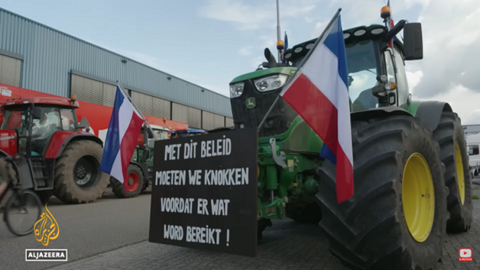
Whether it’s the Netherlands or Canada, the story is the same across the globe. Over the past several years, elitists occupying positions of power within governments have grown accustomed to imposing their will on ordinary citizens.
It doesn’t matter that they’re blatantly violating the social contract established by their own people. For the elitist, the only item on the agenda is maintaining power and dominion over the populace, whom they view as nothing more than subjects meant to obey their diktats without question.
Avoiding such power grabs, however, requires a vigilant citizenry, whose dedication to liberty must be stronger and more widespread than elitists’ devotion to tyranny. As witnessed during the Covid regime, compliance with the state gives birth to more draconian edicts, which only continue to erode the line between democracy and oligarchy.
Make no mistake, if the Dutch farmer protesters let their foot off the gas for one second, the state will not hesitate to shove their alarmist, degrowth policies down the people’s throats without remorse. Any form of surrender will likely continue to enable more overreaching policies, which will undoubtedly infringe upon the everyday lives of Dutch people.
The other day it was reported that police had opened fire on a tractor driven by a 16-year-old. Today, the young man was released from custody without charges:
Farmers’ protests in the Netherlands have reached the royal palace at Dam Square in Amsterdam. 16-year old Jouke, who was shot at by a police officer on Tuesday, was released without charges.
Opposition leader Geert Wilders released a bombshell letter showing the globalist Dutch government wants to use expropriated agricultural land for asylum centers.
Around 40,000 Dutch farmers paralyzed traffic in the Netherlands and blocked around 20 food distribution centers over the weekend with trucks and tractors. Yesterday the protests reached Dam Square in Amsterdam and the seat of government in The Hague. The airport in Groningen was blockaded by demonstrators on Wednesday, German farmers joined the protests in Heerenberg near the Dutch-German border.
In an incident near the blockaded food distribution center at Heerenveen in Friesland, police officers shot at 16-year-old Jouke’s tractor, which was already turning away from the roadblock, missing the boy’s head by an inch (Gateway Pundit reported). Jouke and two other protestors were arrested on suspicion of “attempted manslaughter” after which an angry crowd gathered in front of the police station in Leeuwarden. All three have now been released without charges.
A farmer in Leeuwarden told Canadian journalist Keean Bexte that the Rutte government had “created a climate where the police think they can shoot”. Dutch farmers are being dispossessed and committing suicide, the protester said, while China, for example, fails to meet any environmental regulations.
[…]
Sky News Australia host Rowan Dean compared the Dutch police tactics to the violent quashing of Canadian trucker protests by uparmored riot police, calling Premiers Trudeau and Marc Rutte the “golden pin-up boys for Klaus Schwab and the globalist fantasists of the World Economic Forum.”
“The similarities between Canada and Holland are as startling as they are disturbing,” Dean said. “Only a few months ago, it was the Canadian government that attacked its own citizens in the most grotesque and terrifyingly authoritarian manner during the so-called Truckers’ Convoy when the government actually froze the bank accounts and basically starved out any individuals in what was legitimate peaceful democratic opposition to Covid (vaccine) mandates. That ended badly for Trudeau.”
At the World Economic Forum in Davos 2021, Dutch PM Marc Rutte had boasted about “Holland’s involvement with the World Economic Forum’s Global Food Innovation Hubs, which is busily ‘transforming food systems and land use'”, Dean said.
At Ace of Spades H.Q., J.J. Sefton had this to say about the protests and the repressive measures taken by the Dutch and Canadian governments toward peaceful protestors:
Mind you, this is in Holland. I’m no ethnographer, but the Netherlands is a country and people that are about as liberal, peaceful and secular as they come. Like many other European nations, they atoned for the collective guilt over what happened to its Jews during the war (among other things) by opening its borders to a massive influx of Muslim immigrants with predictable results. Strange how what happened to Theo Van Gogh was all but ignored and someone like Geert Wilders is vilified. Yet with this green madness, somehow the people have woken up to the Globalist/EU wolf at their throat. The Dutch government’s response? Crush the farmers. You have to wonder what the reaction would have been had most or even some of them had been Muslim? Meh, Muslims don’t farm. But, think about it. This is Holland. Not North Korea, Cuba, Venezuela or Iran. Holland. A supposedly enlightened European democratic society that imposes its will on people and sets the water cannon and tear gas on them for daring to object.
Well, look at Canada only a few short months ago. In the wake of the truckers’ convoy protest over forced injections, how did Justin Castreau-cescu react? Arrests, confiscation of vehicles and bank accounts, among other things. Cana-fucking-da. Now look at what that maple syrup sucking hoser is up to:
The Canadian government is funding a booklet being sent to schools across the country that teaches children to be wary of people who champion “free speech.”
Yes, really.
It’s a Paul Joseph Watson video, hence the short quote. But it says it all. Holland is no longer Holland. Canada is no longer Canada and America is no longer America. You know it. They know it. The forces that hijacked those governments and societies know it. The question is not do they know that we know? Of course they know we know. Yet they are betting the farm that we are not going to do a damned thing about it. So, okay, J.J. What about this “optimism” thing? In a sense, as Dave in FL and CBD talked about, I am optimistic in that I understand that what cannot go on will not go on. And this crap for sure cannot go on.
In Spiked, Brendan O’Neill comments on the lack of interest among the people you’d expect to be most vocal in support of working people protesting against out-of-touch, arrogant elites:
If police were opening fire on protesters in a European nation, we would have heard about it, right? If there was a mass uprising of working people in a European Union country, taking to the streets in their thousands to cause disruption to roads, airports and parliament itself, it would be getting a lot of media coverage in the UK, wouldn’t it? The radical left would surely say something, too, given its claims to support ordinary people against The System. Cops shooting at working men and women whose only crime is that they pounded the streets to demand fairness and justice? There would be solidarity demos in the UK, for sure.
Well, all of this is happening, right now, in a nation that’s just an hour’s flight from Britain, and the media coverage here is notable by its absence. As for the left in Britain and elsewhere in Europe – there’s just silence. This is the story of the revolting Dutch farmers. These tractor-riding rebels have risen up against their government and its plans to introduce stringent environmental measures that they say will severely undermine their ability to make a living. They have been protesting for a couple of years now, but their fury has intensified in recent weeks. They’ve blocked motorways, blocked roads to airports, set fire to bales of hay, and descended on The Hague. Things are so serious that yesterday, in the province of Friesland, police opened fire. Mercifully, no one was injured.
There has been some reportage outside of the Netherlands, of course. But it has been strikingly muted. And it isn’t hard to see why. This is a people’s revolt against eco-tyranny, against the modern elite’s determination to slash “harmful” emissions with little regard for the consequences such action will have for working people and poor people. To the formers of elite consensus opinion, for whom environmentalism is tantamount to a religion, the sight of pesky little people rebelling against green diktats is too much to bear. So they either demonise these dissenters, as is happening in the Netherlands, or they ignore them in the hope they will go away, as is happening outside the Netherlands.
The farmers have a very good case. Their concern is that the government’s plans for slashing greenhouse gases will hit farming – and other industries – very hard indeed. The targets, introduced last month, commit the Netherlands to halving its use of nitrogen compounds by 2030. The government says emissions of nitrogen oxide and ammonia, both of which emanate from livestock, will need to be drastically cut. This will entail farmers getting rid of vast numbers of their livestock, potentially devastating their livelihoods. Fishermen are concerned, too. As of next year, fishing permits will be given out on the basis of the eco-friendliness of the trawler the fisherman is using, and many are worried that they’ll end up permit-less, unable to earn a living. They have blocked harbours in solidarity with the farmers. The construction industry could also suffer. Courts have blocked numerous infrastructure projects on the basis that the emissions they cause will breach the new eco-rules.
Comments Off on Dutch government clearly has been cribbing notes from Justin Trudeau’s brownshirt tactics for dealing with unarmed protests
The Early Emperors – Part 7: The Imperial Women
seangabb
Published 11 Jan 2022The Roman Empire was the last and the greatest of the ancient empires. It is the origin from which springs the history of Western Europe and those nations that descend from Western Europe. It is the political entity within which the Christian Faith was born, and the growth of the Church within the Empire, and its eventual establishment as the sole faith of the Empire, have left an indelible impression on all modern denominations. Its history, together with that of the ancient Greeks and the Jews, is our history. To understand how the Empire emerged from a great though finally dysfunctional republic, and how it was consolidated by its early rulers, is partly how we understand ourselves.
Here is a series of lectures given by Sean Gabb in late 2021, in which he discusses and tries to explain the achievement of the early Emperors. For reasons of politeness and data protection, all student contributions have been removed.
More by Sean Gabb on the Ancient World: https://www.classicstuition.co.uk/
Learn Latin or Greek or both with him: https://www.udemy.com/user/sean-gabb/
His historical novels (under the pen name “Richard Blake”): https://www.amazon.co.uk/Richard-Blak…
Comments Off on The Early Emperors – Part 7: The Imperial Women
The Russian way of war
In First Things, George Weigel identifies what we’ve learned about the Russian “way of war” from the ongoing conflict with Ukraine:
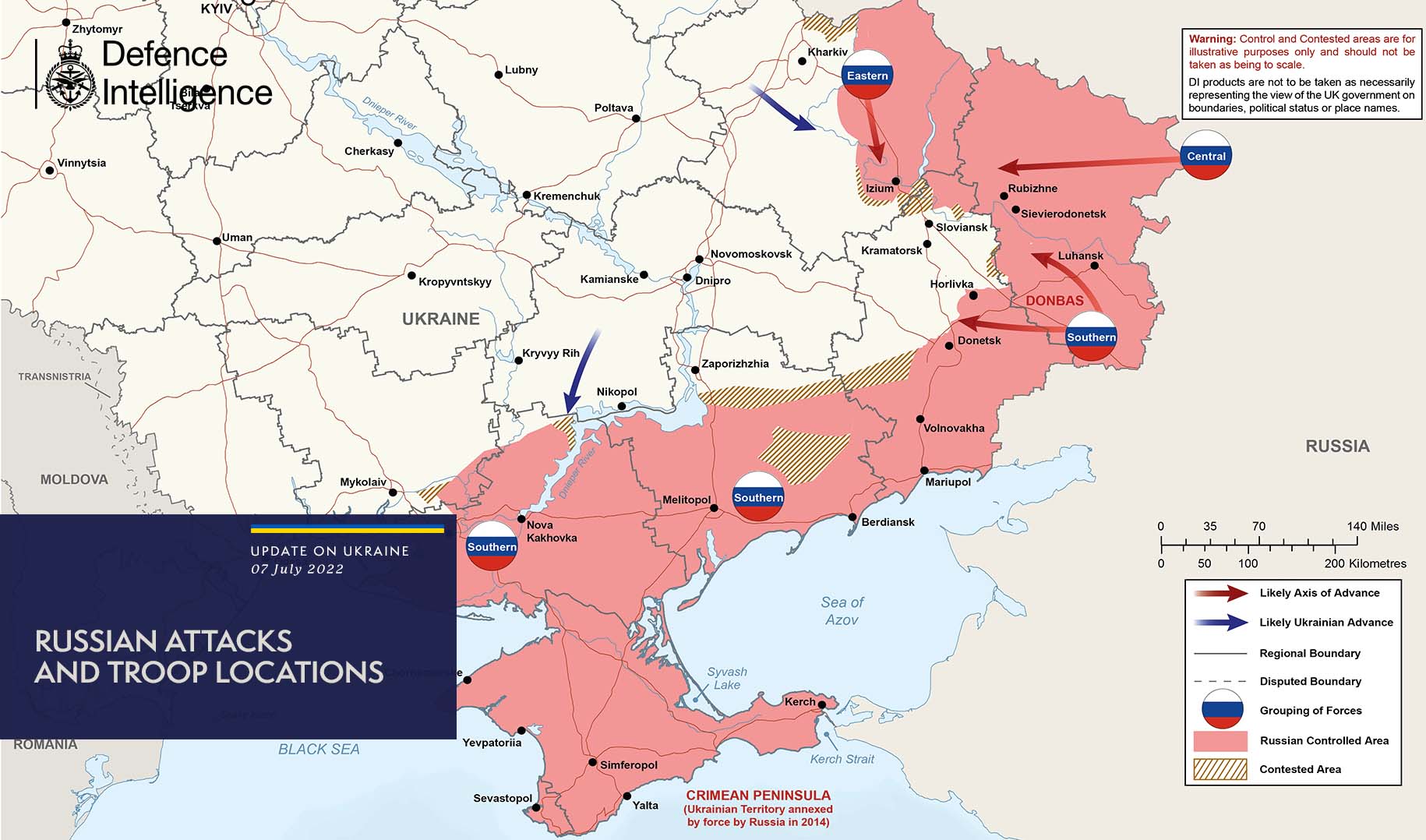
Four and a half months after Russia invaded Ukraine on the Orwellian pretext of displacing a “Nazi” regime — a regime that enjoys a democratic legitimacy absent from Russia for two decades — what have we learned about, and from, the Russian way of war?
We have learned that the Russian way of war is inept strategically, tactically, and logistically: an army using inferior equipment, bereft of competent non-commissioned officers, and replete with ill-trained draftees; an army that relies on brute force to bludgeon its way toward its objectives. We have learned that the Russian way of war willfully obliterates cities and deliberately destroys economic infrastructure. We have learned that the Russian way of war targets hospitals and schools, cultural and educational institutions, churches, synagogues, and mosques in an attempt to eradicate a culture and a nation that Russian president Vladimir Putin insists has no right to exist, save as a Russian vassal. Thus the twenty-first-century Russian way of war breathes the spirit of eighteenth-century imperialism, with President Putin comparing himself to that quintessential Russian imperialist, Peter the Great, and telling schoolchildren asked to name Russia’s borders in a geography bee that “the borders of Russia never end”.
We have learned that the Russian way of war is insensible to casualty rates, its own army’s and Ukraine’s. We have learned that the Russian way of war includes abandoning the Russian dead or disposing of their remains in mobile cremation units, so that body bags don’t flood the home front and raise questions about the wisdom of Putin and his generals. We have learned that the Russian way of war includes the humiliation, torture, and probable execution of prisoners of war. We have learned that the Geneva Conventions on the humane treatment of POWs mean no more to the Russian military and its political masters than does the Fifth Commandment.
We have learned that the Russian way of war includes the use of cluster munitions and unguided missiles specifically forbidden by international law. Thus the Russian way of war systematically violates the two in bello (war-fighting) principles of the just war tradition: proportionality of means (no more force than necessary to achieve a legitimate military objective) and discrimination (non-combatant immunity). We have learned that the Russian way of war features widespread rape, gross theft, and the summary execution of civilians, as well as kidnapping civilians in Russian-occupied territories, relocating them, and attempting to coerce them into renouncing their Ukrainian allegiance.
We have learned that the Russian way of war includes illegal blockades of Ukrainian ports to prevent grain shipments, thus threatening starvation in Third World countries. We have learned that the Russian way of war includes energy blackmail, threats of nuclear-weapons use, and blatant bullying of other countries, including Lithuania and Kazakhstan.
Comments Off on The Russian way of war
The Missing Rings • The Story Of The 1969 Minnesota Vikings
Randy Fast
Published 28 May 2016I know that this video has already been posted on YouTube, but for those of you that have never seen it, here’s a great documentary by NFL Films on the 1969 Minnesota Vikings season. I was only seven at the time, and professional football wasn’t quite yet on my radar, but for hardcore Vikings fans, the finale of this season must have been a pretty hard pill to swallow. Anyway, I hope YouTube/NFL Films allows me to keep this video posted, so until then…

Comments Off on The Missing Rings • The Story Of The 1969 Minnesota Vikings
QotD: Sparta’s vaunted hoplite phalanx differed little from hoplite armies from other Greek cities
That comes with all sorts of implications. The Spartans used the same military equipment as all of the other Greeks: a thrusting spear (the dory), a backup sword (a xiphos or kopis; pop-culture tends to give Spartans the kopis because it looks cool, but there is no reason to suppose they preferred it), body armor (either textile or a bronze breastplate), one of an array of common Greek helmet styles, and possibly greaves. We might expect the Spartiates – being essentially very wealthy Greeks – to have equipment on the high end of the quality scale, but the Perioikoi, and other underclasses who fought with (and generally outnumbered) the Spartiates will have made up the normal contingent of “poor hoplites” probably common for any polis army.
Xenophon somewhat oddly stops to note that the Spartiates were to carry a bronze shield (kalken aspida; Xen. Lac. 11.3 – this is sometimes translated as “brass” – it is the same word in Greek – but all Greek shield covers I know of are bronze). This is not the entire shield, as in [the movie] 300 – that would be far too heavy – but merely a thin (c. 0.25mm) facing on the shield. It’s odd that Xenophon feels the need to tell us this, because this was standard for Greek shields. Perhaps poorer hoplites couldn’t afford the bronze facing and used a cheaper material (very thin leather, essentially parchment, is common in many other shield traditions) and Xenophon is merely noting that all of the Spartiates were wealthy enough to afford the fancy and expensive sort of shield (it has also been supposed that elements of this passage have dropped out and it would have originally included a complete panoply, in which case Xenophon is just uncharacteristically belaboring the obvious).
The basics of the formation – spacing, depth and so on – also seem to have been essentially the same. The standard depth for a hoplite phalanx seems to have been eight (-ish; there’s a lot of variation). The Spartans seem to have followed similar divisions with a fairly wide range of depths, perhaps trending towards thinner lines in the fourth century than in the fifth, though certainty here is difficult. The drop in depth may be a consequence of manpower depletion, but it may also indicate a greater faith held by Spartan commanders of their line’s ability to hold. Depth in a formation is often about morale – the deeper formation feels safer, which improves cohesion.
It’s hard to say if the Spartan phalanx was more cohesive. It might have been, at least for the Spartiates. The lifestyle of the Spartiates likely created close bonds which might have aided in holding together in the stress of combat – but then, this was true of essentially every Greek polis to one degree or another. The best I can say on this point is that the Spartan battle record – discussed at length below – argues against any large advantage in cohesion.
That said, the Spartan battle order does seem to have been notably different in two respects:
First: it had a much higher ratio of officers to regular soldiers. This was clearly unusual and more than one ancient source remarks on the fact (Thuc. 5.68; Xen. Lac. 11.4-5, describing what may be slightly different command systems). Each file was under the command of the man in front of it (Xen. Lac. 11.5). Six files made an enomotia (commanded by an enomotarchos); two of these put together were commanded by a pentekonter (lit: commander of fifty, although he actually had 72 men under his command); two of those form a lochos (commanded by a lochagos) and four lochoi made a mora, commanded by a polemarchos (lit: war-leader) – there were six of these in Xenophon’s time. Compared to most Greek armies of the time, that’s a lot of officers, which leads to:
Second: it seems to have been able to maneuver somewhat more readily than a normal phalanx. This follows from the first. Smaller tactical subdivisions with more command personnel made the formation more agile. Xenophon clearly presents this ability as exceptional, and it does seem to have been (Xen. Lac. 11.4). Hoplite armies victorious on one flank often had real trouble reorganizing those victorious troops and wheeling them to flank and roll up the rest of the line (e.g. the Athenians at Delium, Thuc. 4.96.3-4). The Spartans were rather better at this (e.g. at Mantinea, Thuc. 5.73.1-4). They also seem to have been better at marching and moving in time.
Now, I do not want to over-sell this point. We’re comparing the Spartans to other hoplite forces which – in the fifth century especially – were essentially dumbfire missiles. The general (or generals) point the phalanx at the enemy, hit “go” and then hope for the best. Really effective command – what Everett Wheeler refers to as the general as “battle manager” – really emerges in the fourth century, mostly after Spartan power was already broken (E. Wheeler, “The General as Hoplite” in Armies of Classical Greece, ed. Wheeler (2007)). While “right wing, left wheel” is hardly the most complicated of maneuvers (especially given that the predictable rightward drift of hoplite armies in battle meant that it could be planned for), compared to the limitations of most hoplite forces, it marked the Spartans out as unusually adept.
More complicated Spartan maneuvers often went badly. Spartan forces at Plataea (479 – Hdt. 9.53) failed to effectively redeploy under orders, precipitating an unintended engagement. Plugging a gap in the line once the advance was already underway, but before battle was joined (something Roman armies did routinely) was also apparently beyond the capabilities of a Spartan army (Thuc. 5.72). While the Spartans are often shown in popular culture with innovative tactical formations – like the anti-cavalry wedge or anti-missile shield-ball (both of which, to be clear, are nonsense) formations in 300 – in practice the Spartan army was tactically uncreative. Like every other hoplite army, the Spartans formed a big rectangle of men and smashed it into the front of the enemy’s big rectangle of men. Notably, as we’ll see, the Spartans made limited and quite poor use of other arms, like light infantry or cavalry, even compared to other Greek poleis (and the bar here is very low, Greek combined arms, compared to say, Roman or Macedonian or Persian combined arms, was dismal). If anything, the Spartans were less adaptable than other hoplites.
Bret Devereaux, “Collections: This. Isn’t. Sparta. Part VI: Spartan Battle”, A Collection of Unmitigated Pedantry, 2019-09-20.
Comments Off on QotD: Sparta’s vaunted hoplite phalanx differed little from hoplite armies from other Greek cities
July 7, 2022
Coping with the excesses of ideologists
In New English Review, Theodore Dalrymple considers how best to cope with fanatics bearing ideology and demanding your compliance and self-abasement:

Theodore Dalrymple on 24 September 2007.
Photo by jaapstronks at Flickr via Wikimedia Commons.
Ideologists are inherently totalitarian, especially when a still small voice tells them that their opinions are vulnerable to criticism. Shrillness then becomes the mental white noise with which they drown out their own doubts. They can’t allow any corner of the world to escape their attention. Uniformity will both demonstrate their correctness and, if it lasts long enough, make criticism unthinkable. Just as the white noise of shrillness once did, so will perpetual silence eventually allay their doubts.
Surrender is wrought by cowardice and, slightly less dishonorably, by boredom. What intelligent person wants to spend his life disputing evident absurdity? […]
There are one of two possible responses (other than outright opposition) to the Augean stable of ideological folly.
The easiest thing to do in both cases is to give in to the monomaniacs; but the first response is to go into what Germans in the time of Hitler called “inner emigration”, that is to say, to try to find a niche in which to get on with one’s life undisturbed by the surrounding idiocy and viciousness, for example by laying low and taking up an interest that flies below the ideological radar.
This method can’t be a hundred percent successful, because the ideological monomaniacs demand not merely the absence of dissent from their ideology, but also some proof of positive adherence to it: for example, by signing up to policies on equality, inclusion, and diversity.
By signing up to such self-contradictory nonsense, of course, the person who seeks inner emigration feels soiled; he has undermined his own probity. But at least, or so he hopes, he will then be free of interference. This hope is usually dashed because, to quote another poem:
… that is called paying the Dane-geld;
But we’ve proved it again and again,
That if once you have paid him the Dane-geld
You never get rid of the Dane.In other words, the ideologist always comes back for more self-abasement: Today it’s transgenderism, tomorrow it will be — what? The glories of incest, the social necessity and benefit of infanticide? It doesn’t matter: The aim is not improvement, it’s the exertion of power, for one of the cultural or psychological characteristics of the age, at least among the educated, is the belief that, in human relations, everything is a matter of power and therefore that only power counts or is to be trusted.
Another way of dealing with the ideologists is to obey the old slogan that if you can’t beat them, join them. People therefore join up to what is, in effect, a new secular religion, and since most people who do so are not out-and-out villains or opportunists, they have to persuade themselves that they actually do believe the tenets of the new religion; and, as is often the way with converts, they become fanatics, not merely to persuade themselves, but to expunge their wicked past in which they were not believers and were quite possibly mockers.
Comments Off on Coping with the excesses of ideologists
Import Tool Madness: $8 Drawknife
Rex Krueger
Published 6 Jul 2022Can this possibly be a good tool? Plus tips on a quick and easy shavehorse.
(more…)
Comments Off on Import Tool Madness: $8 Drawknife
“Boris was the latest incarnation of the slippery mountebank in politics”
As I’m writing this, Boris Johnson seems to be losing a cabinet minister every couple of hours, and there’s a finite number of them so at some point soon he’s likely to resign — or in Tory tradition, be knifed by a former trusted colleague. Ed West gets in an early political obituary for Boris:

However bad Boris Johnson’s career ends, it will surely be a better finale than that of his great-grandfather, the Turkish journalist, editor and liberal politician Ali Kemal. Almost exactly a century ago, following the trauma of defeat and the end of the Ottoman Empire, Kemal was attacked by a mob of soldiers, hanged from a tree, his head smashed in with cudgels before being beaten to death. I can’t imagine that the Tory backbenchers will go that far.
There is something charming and colourful about Johnson’s background, the mixture of Turkish, Russian, Jewish and even a Circassian slave just a few generations back (according to Boris himself, and if you can’t trust his version of events, who can you trust?). Just like David Cameron, he is also descended (via a mistress) from George II, the last king of England to fight in battle.
As Rod Liddle once put it, Boris is “the esoteric product of millennia of Eurasian toff miscegenation”, and that’s part of the attraction. It explains his ease with people of different backgrounds, and his liberal persona as London Mayor, which felt like the real him, more than his later populist act. It’s why the charges of racism never stuck; he has his faults, but racial prejudice isn’t one of them.
It’s often been noted that Boris was the latest incarnation of the slippery mountebank in politics while his opponents, both Keir Starmer and Jeremy Corbyn, came from that other British political archetype, the do-gooding Puritan. Disraeli and Gladstone were the Platonic examples of these contrast, but the division dates back further to the Civil War, and there could be no doubt which side Boris would have fought for at Marston Moor.
In fact he is almost more like an oriental potentate, a benevolent and cosmopolitan sultan, hampered by court intrigue and presiding over a crumbling empire. At the time of his ascension to Downing Street, Wikipedia listed Johnson’s de jure and de facto spouses, making Boris the first polygamous ruler of England since King Canute. Since coming to power his rule has been marked by unprecedented court drama, with quite obvious parallels to the reign of Henry VIII, with Carrie Symonds as Anne Boleyn and Dominic Cummings playing Thomas Cromwell.
And on his political legacy, such as it might be:
There’s a whole new generation out there who hate progressivism, who don’t want social norms dictated by dysfunctional, miserable people, and yet the Tories have nothing to offer them. Everywhere there is a sense of overwhelming gloom about the state of the country and its lack of future. Boris Johnson, one of the funniest men to inhabit Number 10, has left his audience with a feeling of dread and sadness, a lesson perhaps in allowing newspaper columnists too much of a say.
As Johnson’s rule nears it end, it feels like everything is collapsing, from the health service to the police, even a shared faith in institutions — and as a Conservative voter I’ve got no “buts” to give in response, except perhaps that Corbyn would have been worse.
In clear expectation of the smash, Mark Steyn reposted what he wrote when Boris took possession of Number 10 Downing Street:
Boris Johnson, it seems, is determined to hang on. Tonight I chanced to see, on the one hand, his father, apparently breezy and unperturbed. On the other hand, a senior Tory backbencher told me that, were another confidence vote to be held, Boris would win the support of fewer than sixty Conservative MPs, with over three hundred voting against him.
I don’t really have anything new to say about this failed prime minister because, in the third of a century since I first met him, he has been, in the turbulence of a constantly changing world, eternally unchanging. Here is what I wrote about him upon the occasion of him taking office as PM:
Is he a nice person? Well, he’s left an awful lot of human wreckage in his wake. Some of the women he’s used and discarded seem to me, without naming names, to be sad and profoundly damaged from their brief intersection with his wandering zipper. His latest squeeze seems likely to be moving into Number Ten without benefit of clergy — a first for the Tories and a sign of how desperate they are after years of letting all the sober, serious, earnest types turn their party into a laughingstock.
What does he believe in? Other than himself, not terribly much. About a decade ago, I was in London for a couple of days and had lunch with him and Stuart Reid at a favorite Italian restaurant. Stuart was the deputy editor who did all the hard grind at the Speccie, while Boris was the great fizzing impresario fronting the operation — a business model he transferred successfully into his mayoral regime, and will no doubt be trying again in Downing Street. He was going on the BBC’s Question Time that night and was worried that he didn’t have anything sufficiently arresting to say, so asked if I had any tips. I gave him a few thoughts on the passing scene, and he considered them not in terms of his own public-policy positions (if any) but in terms of attitudinal cachet. Finally, I said, “Why don’t you really stir them up and put in a word for social conservatism?”
“You mean abortion and all that? Oh, God …” he sighed, and ordered dessert.
If that seems to be (for self-interested reasons) his most firmly drawn red line, don’t nevertheless overstate his ideological flexibility. Like Boris, Theresa May schemed and maneuvered for decades to reach the top spot … and, by the time she pulled it off, she’d spent so much time and effort on the scheming and maneuvering that she had no idea of what to do once she got there. Boris is likewise invested in himself, but, having reached the finial of Disraeli’s greasy pole, he doesn’t intend to be just the latest seat-filler. Mrs May wanted to be prime minister; Johnson wants to be a great and consequential prime minister.
So much for that. That was July 2019. Six weeks later came the first of what would become an avalanche of ministerial resignations …
Comments Off on “Boris was the latest incarnation of the slippery mountebank in politics”
M38 Carcano Carbine: Brilliant or Rubbish?
Forgotten Weapons
Published 1 Aug 2017http://www.patreon.com/ForgottenWeapons
Cool Forgotten Weapons merchandise! http://shop.bbtv.com/collections/forg…
Carcano vs K98k Match video: https://www.youtube.com/watch?v=FAyxL…
I would like to propose that the M38 Carcano short rifle was, despite the poor reputation of the Carcano series of rifles, one of the best thought-out bolt action weapons of World War 2. Why, you ask? Well, let’s consider …
Only a few nations actually recognized the short ranges at which combat actually took place. Germany was one, as seen with its 8x33mm cartridge development, and Italy was another. The sights on the M38 series of carbines were made as simple fixed notches, with no adjustments to be knocked out of place unintentionally. With a 200 meter zero (or 150 meters, with the Finnish replacement front sight), the weapon needed no adjustment to make hits out to 300 meters, which is as far as anyone could realistically engage a target.
The M38 is a light and handy weapon compared to its contemporaries — 8.1 pounds and 40.2 inches (3.7kg and 1.02m) — and it fired a significantly lighter cartridge as well. The 7.35x51mm round used a 128gr (8.3g) bullet at 2400-2500 fps (735-755 m/s) depending on barrel length. This produced noticeably less recoil than rounds like the .30-06 or 8mm Mauser, which made it easier for troops to shoot effectively. The Carcano also had a 6-round capacity and fed with Mannlicher type clips, which are potentially faster to load than Mauser-type stripper clips.
Today we will discuss the M38 and these features (along with its predecessor, the M91 rifle) as they appear on paper. At the same time, over on InRangeTV, today we have the first stage of a 2-Gun Action Challenge Match in which I am shooting this M38 Carcano against Karl, who is using a Mauser K98k – so we will see how the theory works out in the field!
If you enjoy Forgotten Weapons, check out its sister channel, InRangeTV! http://www.youtube.com/InRangeTVShow

Comments Off on M38 Carcano Carbine: Brilliant or Rubbish?
QotD: Predestination
Modern people see that as carte blanche to do whatever we want, because hey, if we do it, God made us do it … which, if you think about it for half a second, means God Himself is responsible for “sin” (quotation marks necessary, because it can’t be evil if I have no possible choice in the matter). Calvin, Knox, et al thought of that too, of course — they were crazy, not stupid — and they even had an answer: Shut up, that’s why. Not the most theologically sophisticated reasoning, but when you’re being burned at the stake for Arminianism it’s remarkably persuasive. Meanwhile, you’d best live like the holiest Puritan that ever lived … even though it’s exquisitely pointless, because you’re almost surely damned.
Severian, “Public Piety”, Rotten Chestnuts, 2019-01-29.
Comments Off on QotD: Predestination
July 6, 2022
The ongoing protests by Dutch farmers demand your attention
Protests in many countries in the western world can get violent and even be claimed (by the targets of the protest) to be “insurrections”, but protests in the Netherlands always have more of an edge to them than elsewhere, because when the Dutch really get angry they have, in the past, gone so far as to kill AND EAT their prime minister. The current protests haven’t gone that far yet, but politicians should keep in mind that Dutch farmers can react primally to being treated in the way the Soviets treated the kulaks:
This is really important – you know, on the level of “pay attention or your food supply is next”.
We reported last week that Dutch farmers were attacking government vehicles, blocking roads, and dumping manure on government buildings in response to a new “climate” policy that shut down numerous family farms because their cows were farting too much.
These farmers are now banned from working their own land to feed their families.
Let me explain what’s happening and why it is of the utmost importance as I randomly drop in videos of what the Dutch farmers are doing to keep your attention.
Unelected elites at the World Economic Forum, World Bank, United Nations, and BlackRock think us little people are rodents that are polluting the Earth, and that it’s their job to cull us and tame us so we can follow their smartypants amazingness into what is obviously a glorious future.
These elites get corporations to fall in line by promoting “Environmental-Social-Governance” metrics (a scorecard, if you will) that shows how many woke policies a company is adopting. Do they have a climate pledge? Are they hiring based on skin color, gender, and sexual fetish? Do they fly a rainbow flag over their headquarters? Do they have at least a few dozen “equity” executives to make sure everyone is a good little Marxist?
Companies lose customers by joining this radical, perverse cult, but they get access to the trillions of dollars represented by the elites and the corrupt organizations, from the WEF to the WHO to the mega-investment firms. They don’t care if you boycott them because they are expecting to simply outlast you.
The elites then get governments to fall in line by lobbying, pushing big money into local elections, and taking over school boards and classrooms to ensure good little disciples are being churned out to vote for the right people. They get young people riled up, telling them the planet is burning and that unarmed black men are yelling “Hands up, don’t shoot!” while being gunned down by racist white cops in the streets. Good people watch as their cities burn and politicians bail out the rioters.

Comments Off on The ongoing protests by Dutch farmers demand your attention
Decapitating the French Resistance – WAH 066 – June 26, 1943
World War Two
Published 5 Jul 2022The Gestapo deals a devastating blow to French Resistance, and in Bengal, British India the famine is only getting worse.
(more…)
Comments Off on Decapitating the French Resistance – WAH 066 – June 26, 1943
“The Great Charter of the Liberties” was signed on June 15, 1215 at Runnymede
Ed West on the connections between England’s Magna Carta and the American system (at least before the “Imperial Presidency” and the modern administrative state overwhelmed the Republic’s traditional division of powers):
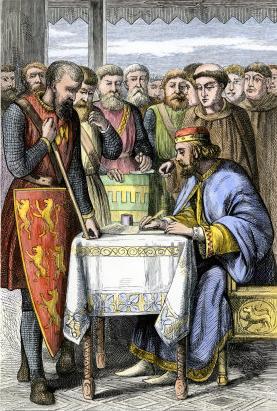
King John signs Magna Carta on June 15, 1215 at Runnymede; coloured wood engraving, 19th century.
Original artist unknown, held by the Granger Collection, New York. Image via Wikimedia Commons.
England does not really go in for national monuments, and when it does they are often eccentric. There is no great shrine to Alfred the Great, for example, the great founder of our nation, but we do have, right in the middle of London, a large marble memorial to the animals that gave their lives in the fight against fascism. And Runnymede, which you could say is the birthplace of English liberty, would be a deserted lay-by were it not for the Americans.
Beside the Thames, some 10 miles outside London’s western suburbs, this place “between Windsor and Staines”, as it is called in the original document, is a rather subdued spot, with the sound of constant traffic close by. Once there you might not know it was such a momentous place were it not for an enclosure with a small Romanesque circus, paid for by the American Association of Lawyers in 1957.
American lawyers are possibly not the most beloved group on earth, but it would be an awful world without them, and for that we must thank the men who on June 15, 1215 forced the king of England to agree to a document, “The Great Charter of the Liberties”.
Although John went back on the agreement almost immediately, and the country fell into civil war, by the end of the century Magna Carta had been written into English law; today, 800 years later, it is considered the most important legal document in history. As the great 18th-century statesman William Pitt the Elder put it, Magna Carta is “the Bible of the English Constitution”.
It was also, perhaps more importantly to the world, a huge influence on the United States. That is why today the doors to America’s Supreme Court feature eight panels showing great moments in legal history, one with an angry-looking King John facing a baron in 1215.
Magna Carta failed as a peace treaty, but after John’s death in 1216 the charter was reissued the following year, an act of desperation by the guardians of the new boy king Henry III. In 1300 his son Edward I reconfirmed the Charter when there was further discontent among the aristocracy; the monarch may have been lying to everyone in doing so, but he at least helped establish the precedent that kings were supposed to pretend to be bound by rules.
From then on Parliament often reaffirmed Magna Carta to the monarch, with 40 such announcements by 1400. Clause 39 heavily influenced the so-called “six statutes” of Edward III, which declared, among other things, that “no man, of whatever estate or condition he may be … could be dispossessed, imprisoned, or executed without due process of law”, the first time that phrase was used.
Magna Carta was last issued in 1423 and then barely referenced in the later 15th or 16th centuries, with the country going through periods of dynastic fighting followed by Tudor despotism and religious conflict. By Elizabeth I’s time, Magna Carta was so little cared about that Shakespeare’s play King John didn’t even mention it.
Comments Off on “The Great Charter of the Liberties” was signed on June 15, 1215 at Runnymede


