Quotulatiousness

November 14, 2021

The Media — declining to report the news and instead depleting the strategic reserve of Narrativium

Filed under: Business, Government, Media, Politics, USA — Tags: , , , , , — Nicholas @ 05:00

This week’s excerpt from Andrew Sullivan’s Weekly Dish explores the many, many ways that the mainstream media have been actively abandoning any semblance of informing their audience and instead now concentrate almost exclusively on propagandizing them:
The news is a perilous business. It’s perilous because the first draft of history is almost always somewhat wrong, and needs a second draft, and a third, and so on, over time, until the historian can investigate with more perspective and calm. The job of journalists is to do as best they can, day by day, and respond swiftly when they screw up, correct the record, and move forward. I’ve learned this the hard way, not least in the combination of credulousness and trauma I harbored in the wake of 9/11.

But when the sources of news keep getting things wrong, and all the errors lie in the exact same direction, and they are reluctant to acknowledge error, we have a problem. If you look back at the last few years, the record of errors, small and large, about major stories, is hard to deny. It’s as if the more Donald Trump accused the MSM of being “fake news” the more assiduously they tried to prove him right.

You know the situation is bad when Andrew Sullivan references Donald Trump without a sneer!

We found out this week, for example, that a key figure in the emergence of the Steele Dossier, Igor Danchenko, has been indicted for lying to the FBI. He is also charged with asking a Clinton crony, Charles Dolan Jr: “Any thought, rumor, allegation. I am working on a related project against Trump.”

The evidence from another key source for the dossier, Sergei Millian — touted across all media, including the Washington Post — has also been exposed as potentially fake. What has the Post done? As their own indispensable Erik Wemple notes, instead of a clear retraction, the Post has just added editors’ notes to previous stories, removed sections and a video, and altered headlines retroactively. This is a bizarre way of correcting the record: “No such case comes immediately or specifically to mind, at least no historical case that stirred lasting controversy,” said W. Joseph Campbell, a professor and journalism historian at American University.

This doesn’t mean that Trump wasn’t eager for Russian help. But Trump was right, in the end, about the dodgy dossier; he was right about the duped FBI’s original overreach; and the mass media — Rachel Maddow chief among them — were wrong. And yet the dossier dominated the headlines for three years, and the “corrections” have a fraction of the audience of the errors. Maddow gets promoted. And the man who first published it, Ben Smith, was made the media columnist for the NYT.

Think of the other narratives the MSM pushed in recent years that have collapsed. They viciously defamed the Covington boys. They authoritatively told us that bounties had been placed on US soldiers in Afghanistan by Putin — and Trump’s denials only made them more certain. They told us that the lab-leak theory of Covid was a conspiracy theory with no evidence behind it at all. (The NYT actually had the story of the leak theory, by Donald McNeil, killed it, and then fired McNeil, their best Covid reporter, after some schoolgirls complained he wasn’t woke.) Wrong. Wrong. Wrong.

The MSM took the ludicrous story of Jussie Smollett seriously because it fit their nutty “white supremacy” narrative. They told us that a woman was brutally gang-raped at UVA (invented), that the Pulse mass shooting was driven by homophobia (untrue) and that the Atlanta spa shooter was motivated by anti-Asian bias (no known evidence for that at all). For good measure, they followed up with story after story about white supremacists targeting Asian-Americans, in a new wave of “hate”, even as the assaults were disproportionately by African Americans and the mentally ill.

As Greenwald noted, the NYT “published an emotionally gut-wrenching but complete fiction that never had any evidence — that Officer Sicknick’s skull was savagely bashed in with a fire extinguisher by a pro-Trump mob until he died.” The media told us that an alleged transgender exposure in the Wi Spa in Los Angeles was an anti-trans hoax (also untrue). They told us that the emails recovered on Hunter Biden’s laptop were Russian disinformation. They did this just before an election and used that claim to stymie the story on social media. But they were not Russian disinformation. They were a valid if minor news story the media consciously kept from its audience for partisan purposes.
Axis and Allies Both Invade France – WW2 – 168 – November 13, 1942

World War Two
Published 13 Nov 2021

Operation Torch goes off this week, the Allied invasion of French Northwest Africa, but this prompts the Germans to invade Vichy France. This is the Allies’ first combined major offensive in the Western Hemisphere. The Germans launch another offensive of their own this week, though — Operation Hubertus in Stalingrad. And in the South Pacific, a major naval battle begins off Guadalcanal.
(more…)

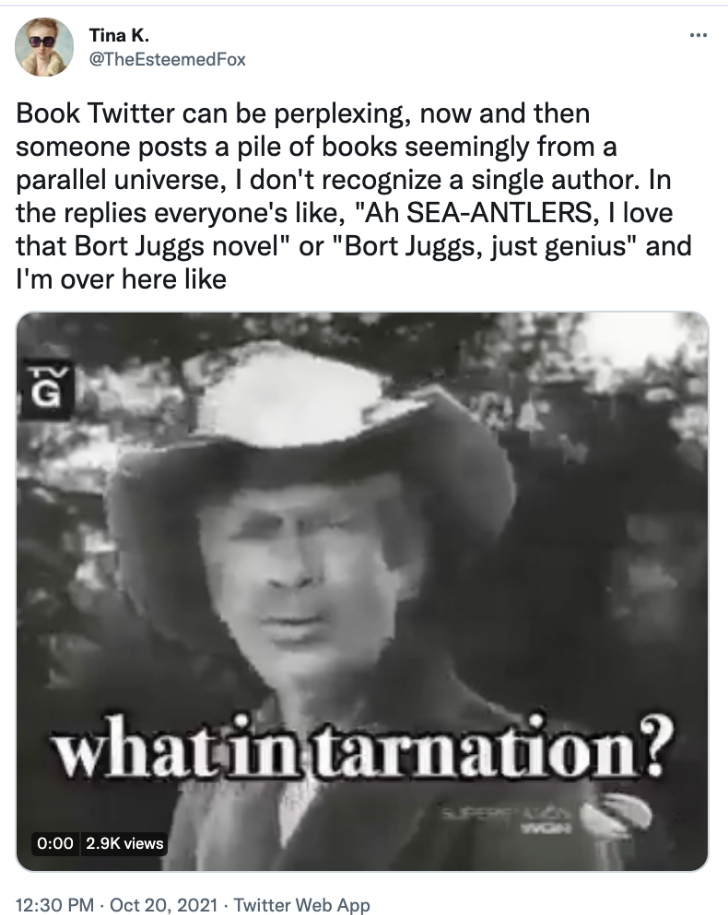
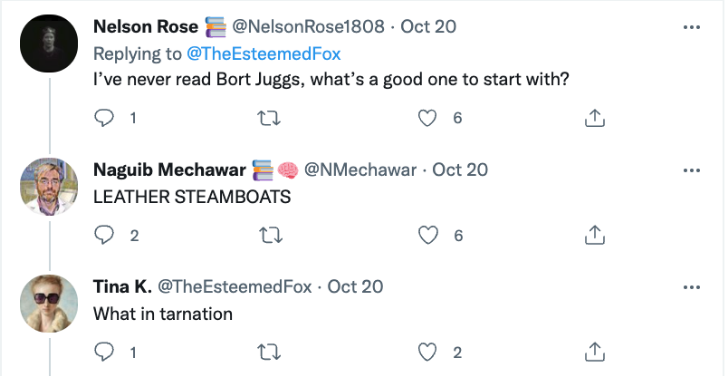
Literary corner – the life and work of the great American author, Bort Juggs

Filed under: Books, Humour, USA — Tags: , , , — Nicholas @ 03:00

I hang my head in shame for having to admit that until Saturday, I had never encountered the legendary Bort Juggs. Fortunately the latest edition of the SHuSH newsletter from Kenneth Whyte helped open my eyes:

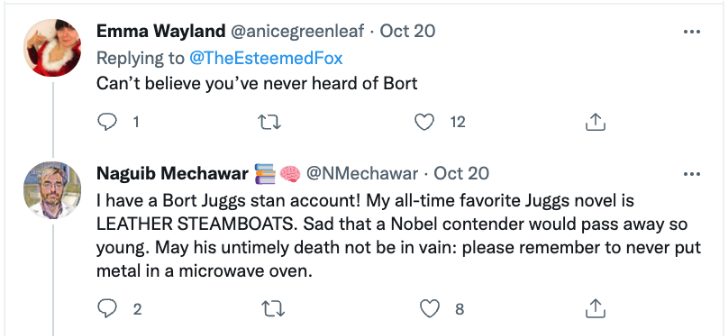
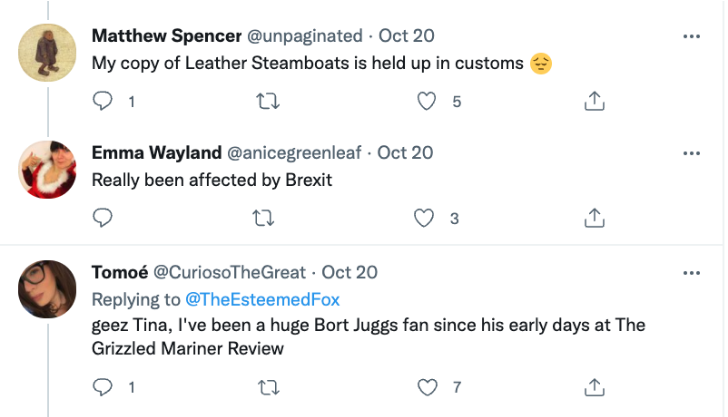
Twitter has less and less to recommend it these days but still has its moments, especially in its literary corners. One of my favorite follows is @TheEsteemedFox who a couple of weeks ago posted this:

And then the fun started:

The thread continues, so go RTWT if you know what’s good for you.

“Jungle Carbine” – the Lee Enfield No5 MkI Rifle

Filed under: Britain, History, Military, Weapons, WW2 — Tags: , , — Nicholas @ 02:00

Forgotten Weapons
Published 4 Aug 2021

http://www.patreon.com/ForgottenWeapons

https://www.floatplane.com/channel/Fo…

Cool Forgotten Weapons merch! http://shop.forgottenweapons.com

Today I am concluding our series on the standard-issue Lee Enfield system with the No5 MkI — the “jungle carbine”. Developed in 1943 as a shorter and handier pattern of rifle than the No4, the carbine went into production in 1944 and saw use during World War Two. It featured a number of lightening cuts, as well as a shortened barrel, conical flash hider, side-mounted sling, 800-yard sights, and rubber buttpad. Unfortunately, the No5 was beset by a problem of “wandering zero”. A significant number of the rifles failed to properly hold zero when they were widely issued. The problem was never fully resolved, but appears to have been the result of receiver flex due to the lightening cuts. Efforts to fix it were essentially abandoned, as it was recognized that a new self-loading rifle was going to be adopted soon, and it would be a waste of time and money to continue development of the Lee Enfield by that point.

Contact:
Forgotten Weapons
6281 N. Oracle 36270
Tucson, AZ 85740

QotD: Traffic in India

Filed under: Humour, India, Quotations — Tags: , , , — Nicholas @ 01:00

A buddy of mine once joked that the traffic signals, lane markers, etc. in India are the world’s biggest public art installation, since they have exactly the same effect on motorists’ behavior as those butt-ugly steel-and-concrete things your city council keeps insisting on sticking out in front of city hall. Long after I returned from my sojourn in the Raj, friends remarked on my newfound sangfroid. It’s no mystery, I explained to them. Delhi’s a big place, so usually took several autorickshaw rides a day — each and every one of them, by necessity, a dance with the Grim Reaper. As P.J. O’Rourke once quipped back when he was funny, on the Subcontinent it doesn’t even count as a car crash unless there’s probable loss of life involved. Death come for us all, I told my buddies; when my time’s up, my ticket’s gonna get punched regardless.

Severian, “Cars, Bikes, Motorcycles”, Rotten Chestnuts, 2021-07-25.

November 13, 2021

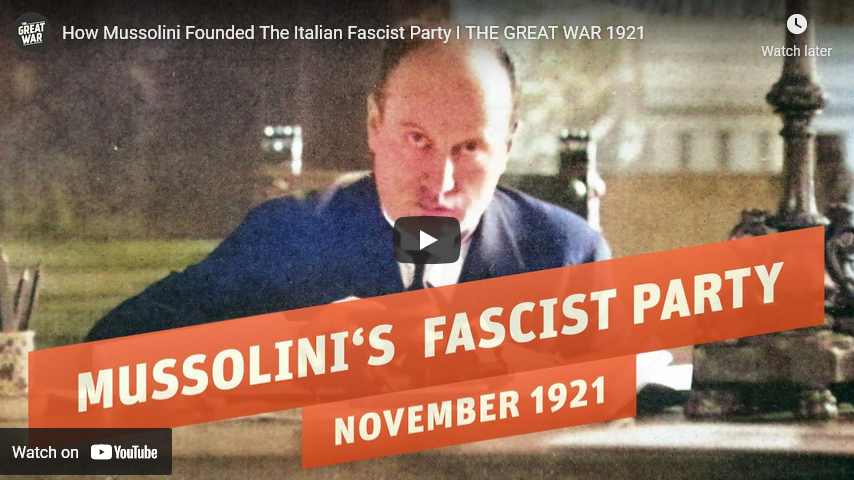
How Mussolini Founded The Italian Fascist Party I THE GREAT WAR 1921

Filed under: Europe, History, Italy — Tags: , , — Nicholas @ 06:00

The Great War
Published 12 Nov 2021

Sign up for Curiosity Stream and get Nebula bundled in and SAVE 26%: https://curiositystream.com/thegreatwar

Benito Mussolini’s National Fascist movement was a fringe phenomenon right after the First World War and couldn’t gain much traction in the 1919 elections. But soon after Mussolini was increasing his political standing and the National Fascist Party gained more members than ever before.

» SUPPORT THE CHANNEL
Patreon: https://www.patreon.com/thegreatwar

» OUR PODCAST
https://realtimehistory.net/podcast – interviews with World War 1 historians and background info for the show.

» BUY OUR SOURCES IN OUR AMAZON STORES
https://realtimehistory.net/amazon *
*Buying via this link supports The Great War (Affiliate-Link)

» SOURCES
Alcalde, Ángel, War Veterans and Fascism in Interwar Europe, (Cambridge: Cambridge University Press, 2017)

Bosworth, R. J. B., Mussolini, (London: Bloomsbury Academic, 2010)

De Grand, Alexander, Italian Fascism: Its Origins & Development, (Lincoln, NB: University of Nebraska Press, 1989)

Duggan, Christopher, Force of Destiny: A History of Italy since 1796, (London: Penguin Books, 2008)

Martins, Carlos Manuel, From Hitler to Codreanu: The Ideology of Fascist Leaders, (London: Routledge, 2020)

Neville, Peter, Mussolini, (London: Routledge, 2004)

Weyland, Curt, Assault on Democracy: Communism, Fascism, and Authoritarianism During the Interwar Years, (Cambridge: Cambridge University Press, 2021)

» MORE THE GREAT WAR
Website: https://realtimehistory.net
Instagram: https://instagram.com/the_great_war
Twitter: https://twitter.com/WW1_Series
Reddit: https://reddit.com/r/TheGreatWarChannel

»CREDITS
Presented by: Jesse Alexander
Written by: Jesse Alexander
Director: Toni Steller & Florian Wittig
Director of Photography: Toni Steller
Sound: Toni Steller
Editing: Jose Gamez
Motion Design: Philipp Appelt
Mixing, Mastering & Sound Design: http://above-zero.com
Maps: Daniel Kogosov (https://www.patreon.com/Zalezsky)
Research by: Jesse Alexander
Fact checking: Florian Wittig

Channel Design: Yves Thimian

Contains licensed material by getty images
All rights reserved – Real Time History GmbH 2021

The patron saint of “Gonzo” journalism was a pretty cruddy human being

Filed under: Books, History, Humour, Media, USA — Tags: , , , , , — Nicholas @ 05:00

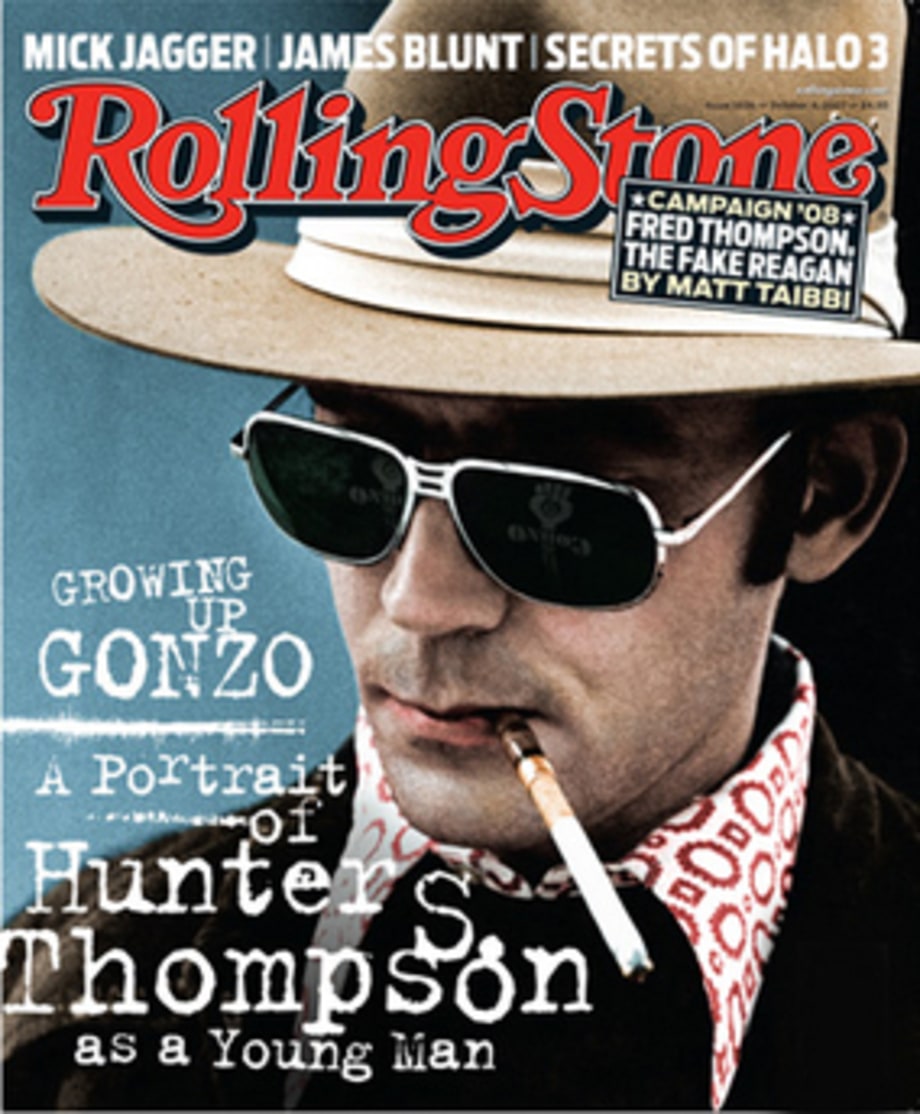
As I mentioned in an earlier post on one of Hunter S. Thompson’s famous early books, I discovered the writer at a particularly susceptible age … teenagers of my generation were generally suckers for counter-culture heroes (being too young to be actual hippies because we were in primary school when the Summer of Love flew past, and therefore feeling we’d missed out on something Big and Important and Meaningful). As a gullible teen, I believed Fear and Loathing in Las Vegas was mostly factual with some obvious-even-to-me embroideries for dramatic or comedic effect. I could easily forgive the guessed-at 10% fiction, but Thompson eventually admitted that the majority of the story was bullshit. Entertaining bullshit, but bullshit.

Which, as it happens, turns out to have been Thompson’s life-long modus operandi, as Kevin Mims repeatedly highlights in his Quillette review of David S. Wills’ biography called High White Notes: The Rise and Fall of Gonzo Journalism:

In High White Notes, his riveting new biography of Hunter S. Thompson, journalist David S. Wills describes Thompson as America’s first rock star reporter and compares him to Mick Jagger. But by the time I finished the book, I’d decided that Thompson bore a closer resemblance to Donald Trump. The two men were born nine years apart, during white American masculinity’s golden age. Both were obsessed with politics without possessing anything that could be described as a coherent political philosophy. Both men longed for some mythical American paradise of the past. Both men screwed over multiple friends and business partners. Both men would have gone broke if not for the frequent intervention of helpful patrons. Both men were egomaniacs fond of self-mythologizing and loath to share a spotlight with anyone. Both men enjoyed making disparaging remarks about women, minorities, the disabled, and other disadvantaged people. Both men were frequently disloyal to their most loyal aiders and abetters. Thompson’s endless letter writing and self-pitying 3am telephone calls to friends and colleagues were the 20th century equivalent of Trump’s late-night Twitter tantrums. Both men generally exaggerated their successes and blamed their failures on others. Both men mistreated their wives. Both men nursed a constant (and not entirely irrational) sense of grievance against perceived enemies in the government and the media. Both men had a colossal sense of entitlement …

The list could go on and on. Trump actually fares better than Thompson by various measures. For instance, Trump has never had a drug or alcohol problem, as far as I know. Thompson was a drug and alcohol problem. The first US president in living memory without a White House pet seems to have no interest in animals. Thompson enjoyed tormenting them. Rumors have circulated since 2015 that a recording exists of Trump using a racial slur but since the evidence has never surfaced, it might be fairer to conclude (at least provisionally) that this is not one of his many character failings. Thompson’s published and (especially) unpublished writings are full of such language.

All of which may lead you to conclude that High White Notes is not a favorable account of Hunter S. Thompson’s life and work. To the contrary, David S. Wills is a Thompson devotee who considers his subject to have been a great writer and, at times, a great journalist. But Wills is an honest guide, so his endlessly entertaining biography manages to be both a fan’s celebration and unsparing in its criticism of Thompson and his work.

Though impressive, the book is not without faults. Wills relies too heavily on cliché (“This book will pull no punches”; “breathing down his neck for the final manuscript”; “women threw themselves at him” etc.), and has a tendency to find profundity in unnaturally strained readings of Thompson’s prose. For instance, Wills describes a scene from a 1970 profile Thompson wrote of French skier Jean-Claude Killy, in which three young boys approach Thompson and ask if he is Killy. Thompson tells them that he is, then holds up his pipe and says, “I’m just sitting here smoking marijuana. This is what makes me ski so fast.” This sounds to me like standard Thompson misbehavior, but Wills infers something more complex: “On the surface, it appears to be comedy for the sake of comedy but in fact it is a comment on the nature of celebrity and in particular Killy’s empty figurehead status.” And when Thompson describes Killy as resembling “a teenage bank clerk with a foolproof embezzlement scheme,” Wills remarks, “Thompson has succeeded mightily not just in conveying [Killy’s] appearance but in hinting at his personality. He has placed an image in the head of his reader that will stick there permanently. It was something F. Scott Fitzgerald achieved, albeit in more words, when he had Nick Carraway describe Jay Gatsby’s smile.” (The book, by the way, takes its title from Fitzgerald, who used the phrase to describe short passages of writing so beautiful that they stand out from the larger work of which they are a part.)

[…]

Thompson’s big break as a writer came in 1965 when he was hired to write an article about the Hell’s Angels motorcycle gang for the Nation. The piece was so popular that Thompson found himself besieged by publishers who wanted him to expand it into a full-length nonfiction book. The Thompsons moved into the Haight-Ashbury district of San Francisco and Thompson set about writing Hell’s Angels, the 1967 book that would make him famous. Even in that first book, written before he had fully formulated the concept of Gonzo journalism, Thompson was already tinkering with the truth and engaging in the kind of self-mythologizing that would become a hallmark of his work. And that didn’t sit well with the Hell’s Angels themselves. According to Sonny Barger, a founding member of the Angels, Thompson “would talk himself up that he was a tough guy, when he wasn’t. When anything happened, he would run and hide.” Barger’s assessment of the book was terse: “It was junk.”

Wills notes that Thompson “tended to write about himself in ways that built his legend … to prove his machismo on paper. The back cover [of Hell’s Angels] describes him as ‘America’s most brazen and ballsy journalist’ and in the book he tells the story of first meeting the Angels and trying to impress them by shooting out the windows of his own San Francisco home. Such moments of bravado tend to enter the story very briefly and seem to serve little purpose beyond this self-mythologizing.”

But it was exactly this kind of self-mythologizing — the bragging about his drug use and general misbehavior — that editors of American magazines found so exciting about Thompson’s work, so it’s no wonder that he engaged in so much of it. It was his wild man persona that made Warren Hinckle of Scanlan’s Monthly want to unleash him among the socialites of Louisville. Still, Thompson didn’t fully emerge as a countercultural hero until he began to write for a small start-up publication in San Francisco called Rolling Stone.

Here’s Looking at You, Bill – The Secret Preparations for Operation Torch – WW2 – Spies & Ties 10

Filed under: Africa, Britain, France, History, Military, USA, WW2 — Tags: , , , , , — Nicholas @ 04:00

World War Two
Published 12 Nov 2021

To smooth the way for the Allied invasion of French North Africa, Operation Torch, a massive spy operation is set up in 1941 and 42.
(more…)

The unrealistic expectations society has of minimum-wage security guards

Filed under: Business, Cancon, Law, USA — Tags: , , — Nicholas @ 03:00

As a teenager, I worked several months as a security guard. In the 1970s in Ontario, to work as a security guard you basically needed to be physically fit (to a not-very-high standard), to pass a police background check and to be 18 or over. The jobs I worked were usually overnight shifts at upscale apartment buildings, industrial facilities and fill-in shifts at retail malls to cover for regular security staff vacations (plus one really interesting midnight shift on a ship docked in Toronto harbour). I think I was paid $3 per hour, and 99% of the time the work wasn’t worth any more than that. It’s that 1% of situations where the company hiring security guards might wish they’d invested in better-trained staff. According to Joshua Hind‘s article in The Line, the standards for security guards have been improved in the many years since my time, but that 1% is still a big issue:

While some of the best minds in the field of crowd management and event safety weigh in on the probable causes of the crowd surge, a new article in Rolling Stone has turned a spotlight on the security guards, and the culpability of private security in general, a high turnover, low-wage business focused on filling orders with warm bodies, seemingly regardless of their actual experience or competency. In Canada, security work is one of the easiest routes to employment for young people and particularly recent immigrants with little Canadian work experience, but, when it comes to live events, it’s also an often impossible mix of customer support, crowd management, law enforcement, and emergency medical services that requires years of training and on-the-ground experience to do well.

The apparent failures of this type of security, which is often referred to as “contract security” (not be confused with “private security”, which usually means expensive bodyguards), are not unique to Houston. I’ve been working in large public events for more than 20 years and contract security has always been one of the great planning dilemmas. If you want to get insured, you need lots of security, but every one of those guards must be treated as part asset and part liability.

Event sites, especially festivals with multiple stages, are expansive (the site in Houston was over 1,000,000 square feet in total space), and a well-designed event site, just like a well-designed building, needs plenty of entrances and exits, each of which must be adequately staffed. Guards are needed in front of the stage, in the crowd, at backstage access points, and around critical infrastructure. On top of all that you also need a team of roving guards to patrol the site looking for issues. Add it up and a large event site could have dozens or hundreds of security guards doing a variety of jobs, all of which fall under the catch-all description of “security”. On a big summer weekend at the height of event season, a large city like Toronto might have thousands of guards working dozens of sites. How do you find that many good people who can bear the responsibility of preserving public safety? Generally, you don’t.

It only requires a two-week commitment and a little patience to become a security guard in Ontario. So long as you have a clean criminal record, you can sign up for the required training: 40 hours on law and security, plus another 30-40 hours of first aid. This training is often performed by the very companies that do the hiring, which can greatly affect priorities in accurate skills testing. Hit all those marks and mere weeks after deciding to become a security guard you could be faced with a horde of concertgoers busting through the fence you’ve just been ordered to protect.

When I started in live events, it was all on the technical side, setting up lighting, sound and stages, and I didn’t pay much attention to what happened on the other side of the crowd barrier. About 15 years ago I started working on Nuit Blanche, Toronto’s overnight outdoor art event, and it was during those long nights watching hundreds of thousands and then millions of people that I developed a sense of how they act in large groups and how unpredictable they can be. This isn’t meant to sound like a superpower, it’s just a honed instinct. It took me well over a decade of steady work and constant observation to develop some ability to sense when a crowd might turn ugly. That experience can’t be replicated with two weeks of training, but that’s exactly what’s often expected of security guards.

Creation of Israel

Filed under: Britain, History, Middle East, USA, WW1, WW2 — Tags: , , , , , , , — Nicholas @ 02:00

The Cold War
Published 1 Jun 2019

Our series on the history of the Cold War period continues with a documentary on the creation of Israel, Zionist movement, reactions and diplomatic maneuvers of other states and the build-up to first Arab-Israeli war

Consider supporting us on Patreon: https://www.patreon.com/thecoldwar

QotD: Boris Johnson as Billy Bunter, the “Fat Owl of the Remove”

Filed under: Books, Britain, Humour, Politics, Quotations — Tags: , , — Nicholas @ 01:00

One can only suspect some insidious intent – or trolling, if one wishes to call it by its proper name – when the Scottish police force had to rename the operation designed to protect Boris Johnson in his current visit to the country. It now rejoices in the unexceptional title of “Operation Aeration”, but until it attracted adverse publicity, its original name was “Operation Bunter”.

Although a spokesman for the Scottish police said, with tongue so far in cheek that it was astonishing they could speak, “Operational names are auto-generated by computer and can be changed if they are deemed to be inappropriate”, the comparison between the Prime Minister and Frank Richards’ legendary creation Billy Bunter, the “Fat Owl of the Remove” is a far from flattering one.

In Richards’ stories, Bunter is a gluttonous, lazy, dishonest and academically negligible student at Greyfriars School in Kent, forever attempting to obtain loans from his fellow schoolboys on the promise that a non-existent postal order is going to arrive from his wealthy relatives at “Bunter Court”. It is made clear that, for all his fantasies of wealth and success, Bunter’s home is in fact the considerably more modest “Bunter Villa”, which possesses merely one maid and one cook. Richards therefore invites his readers to condemn Bunter as an arriviste to the English public school system, amongst his many other sins. He is repulsive in appearance, significantly overweight, perpetually dirty and often given to thoughtless instances of racism and xenophobia. And his famous catchphrases – “I say, you fellows!” and, when he is being beaten, kicked or otherwise abused, “yarooh!” – are irritating, rather than witty or charming.

Needless to say, the books that featured him as their lead character were hugely successful for decades, but now, in our more censorious and self-aware image, have fallen into obscurity. None of them are currently in print, and the last time that any of the novels were reissued was in the early Nineties. When the news story about Operation Bunter broke, many papers had to explain exactly who the character was, and why the allusion was apposite. While the milder likes of Jennings and William continue to be much loved by parents and grandparents of a certain generation, Bunter and his fellow denizens of Greyfriars have found themselves condemned to a kind of literary Siberia, and show few signs of coming in from this particular cold. Is there any hope that some literary-minded minister will intervene and aid the Fat Owl’s rehabilitation? Or are the books simply too outrageous and un-PC for our contemporary tastes?

Alexander Larman, “Boris Bunter”, The Critic, 2021-08-09.

November 12, 2021

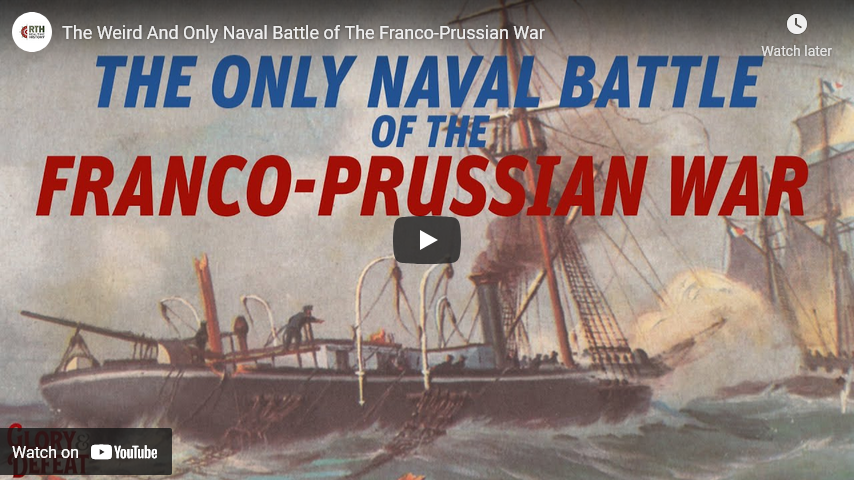
The Weird And Only Naval Battle of The Franco-Prussian War

Filed under: Americas, France, Germany, History, Military — Tags: , , , , , — Nicholas @ 06:00

Real Time History
Published 11 Nov 2021

Support Glory & Defeat on Patreon: https://patreon.com/realtimehistory

While the fighting on land continued during the Franco-Prussian War in November 1870, the bizarre and only naval battle of the war took place off the coast of Cuba when the German Meteor and the French Bouvet met in the port of Havana.

» THANK YOU TO OUR CO-PRODUCERS
John Ozment
James Darcangelo
Jacob Carter Landt
Thomas Brendan
James Giliberto
Kurt Gillies
Albert B. Knapp MD
Tobias Wildenblanck
Richard L Benkin
Scott Deederly
John Belland
Adam Smith
Taylor Allen
Jim F Barlow
Rustem Sharipov

» OUR PODCAST
https://realtimehistory.net/podcast – interviews with historians and background info for the show.

» LITERATURE
Arand, Tobias: 1870/71. Die Geschichte des Deutsch-Französischen Krieges erzählt in Einzelschicksalen. Hamburg 2018

Arand, Tobias: “Rogerowski oder Rasumofsky? Überlegungen zur nationalen ‘Meistererzählung’ in Fontanes Kriegsgefangen”, in: Fontane-Blätter 105 (2018), p. 61-86

Bauer, Gerhard u.a. (Hrsg.): Krieg – Macht – Nation. Wie das deutsche Kaiserreich entstand. Ausstellungskatalog Dresden Militärhistorisches Museum der Bundeswehr. Dresden 2020

Bigelow, John: France and the Confederate Navy 1862-1868. New York, 1888

Farret, “Étude sur les combats livrés sur mer de 1860 à 1880”, Revue Maritime et Coloniale, t. 70, no d’édition,‎ 1881, p. 519-522

Gouttman, Alain: La grande défaite 1870-1871. Paris 2015

Pölking, Hermann and Linn Sackarnd: Der Bruderkrieg. Deutsche und Franzosen 1870/71. Freiburg 2020

Radecke, Gabriele/Rauh, Robert: Fontanes Kriegsgefangenschaft. Wie der Dichter in Frankreich dem Tod entging. Berlin 2020

Tümmler, Holger: Großer Atlas des Deutsch-Französischen Krieges 1870/71. Wolfenbüttel 2010

» SOURCES
Fontane, Theodor: Kriegsgefangen. Erlebtes 1870. Neuausgabe Berlin 2020

Kriegsgeschichtliche Abtheilung des Großen Generalstabs (Hrsg.): Der deutsch-französische Krieg 1870-71. II.1. Berlin 1878

Kürschner, Joseph (Hrsg.). Der große Krieg in Zeitberichten. Leipzig 1895

Meisner, Heinrich Otto (Hrsg.): Kaiser Friedrich III. Das Kriegstagebuch von 1870/71. Berlin, Leipzig 1926

Roux, Georges: La Guerre de 1870. Paris 1966

Stenzel, Alfred: “Flotte und Küste”, in: Krieg und Sieg 1870-71. Ein Gedenkbuch, hrsg. v. Julius von Plugk-Harttung. Berlin 1895. S. 584-611

“The Naval Duel Near Havana,” Otago Witness, Issue 996, 31 December 1870, p. 11.

» OUR STORE
Website: https://realtimehistory.net

»CREDITS
Presented by: Jesse Alexander
Written by: Cathérine Pfauth, Prof. Dr. Tobias Arand, Jesse Alexander
Director: Toni Steller & Florian Wittig
Director of Photography: Toni Steller
Sound: Above Zero
Editing: Toni Steller
Motion Design: Philipp Appelt
Mixing, Mastering & Sound Design: http://above-zero.com
Maps: Battlefield Design
Research by: Cathérine Pfauth, Prof. Dr. Tobias Arand
Fact checking: Cathérine Pfauth, Prof. Dr. Tobias Arand

Channel Design: Battlefield Design

Contains licensed material by getty images
All rights reserved – Real Time History GmbH 2021

One Pretendian’s “cultural Munchausen syndrome”

In Thursday’s NP Platformed newsletter, Colby Cosh updates us on the story of Carrie Bourassa, who had effortlessly surfed to high profile, well-remunerated positions at the University of Saskatchewan and with the federal government largely on the basis of her claimed First Nations background:

Carrie Bourassa with media.
Lead photo in Geoff Leo’s article for the CBC – https://www.cbc.ca/newsinteractives/features/carrie-bourassa-indigenous

Newspapers have a slightly nasty characteristic: it’s easy for them to get pre-emptively mad when institutions are a little slow to do the right thing, and it’s also easy for them to forget to give credit when those institutions get around to it.

So let’s acknowledge that the federal government and the University of Saskatchewan are dealing — as best they can, almost certainly — with their shared Carrie Bourassa problem.

Two weeks ago, CBC News investigative reporter Geoff Leo published an astonishing tour de force. His feature article established, beyond almost any doubt, that Bourassa, a high-profile Indigenous scholar who told and published countless stories of racist treatment and childhood adversity, is actually a fabulist from a wealthy white family. The Institute of Indigenous Peoples’ Health soon put Bourassa, its scientific director, on unpaid leave. The U of S suspended her with pay, probably having no better immediate alternative.

[…]

Since Prof. Bourassa was put on ice in her lucrative Aboriginal-health jobs, Indigenous folk have been labouring to explain in the press what was wrong with her concoction and aggressive peddling of a fake Métis upbringing on the mean streets of Regina. Drew Hayden Taylor’s Globe and Mail op-ed about Bourassa’s “cultural Munchausen syndrome” is instructive and funny, but we hope it is all right to tell Aboriginal-Canadians that no white settler with a lick of sense would consider Bourassa’s tapestry of falsehoods to be harmless “fibs”. This may be a self-serving observation, but her confabulations about her personal history wouldn’t be consistent with the standards of a newspaper, let alone those of a university.

About a year ago, the Saskatchewan Health Research Foundation gave Bourassa an award (not her first) and published a capsule summary of her career. If you read it, you will notice how she was, from time to time, offered career advancement out of the blue by Indigenous supporters who had been taken in by her stories. Even a white grad student living on ramen in a basement apartment might be a little ticked about this. The University of Saskatchewan’s original claim that Prof. Bourassa hadn’t benefited from claiming Aboriginal ancestry is pathetic hokum: Bourassa tellingly accused her own sister of “looking for … a way to make some money” by accepting Indigenous scholarship funds during her PhD studies.

And it probably occurred to the USask brass sometime between the two press releases that an investigative reporter like Leo, in taking on a topic, always looks a couple articles ahead. Bourassa, for example, claims to have suffered from tuberculosis in her late 20s — a useful credential, unfortunately, for someone studying the field of Indigenous health. It’s useful because the disease has been nearly eliminated among non-Indigenous Canadians: the incidence rate for First Nations is 40 times higher, and the cases tend to be concentrated in remote northern Indigenous communities. Even if we overlook Bourassa’s propensity for creative autobiography … well, if she contracted TB, she was certainly very unlucky.

Armored Vehicles of Operation Torch Pt. 1, by the Chieftain

Filed under: Africa, Germany, History, Italy, Military, WW2 — Tags: , , , , — Nicholas @ 04:00

World War Two
Published 11 Nov 2021

Chieftain returns to the North African theatre to talk us through the armored fighting vehicles in action around the time of Operation Torch. This episode is part one of two with Chieftain covering the German and Italian vehicles. Here, Chieftain looks at everything from the fearsome Tiger to the nemesis of LRDG: the Sahariana.
(more…)

More on the populist success of Hungary’s Victor Orbán

Filed under: Economics, Europe, History, Politics — Tags: , , , , — Nicholas @ 03:00

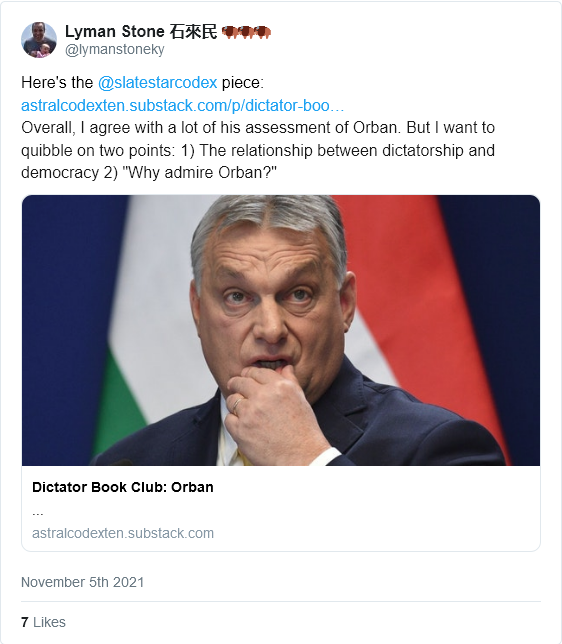
Last week, Scott Alexander looked at a couple of recent biographies of Hungarian politician Victor Orban (linked here). He got some quite interesting responses from his readers, including a long Twitter thread from Lyman Stone, which he’s converted into plain text for ease of reading:

I won’t make you read it all in tweet format. He continues:

1) Dictatorship and democracy. The arguments about Orban cheating in elections might be totally true. I dunno. But that’s sort of irrelevant. Neutral opinion polls nobody disputes show he would have gotten 2/3 under almost any system.

His crude poll share was about 60% before the 2010 election, but given the threshold effects, he’d likely have ended up at a supermajority under almost any system. And as @slatestarcodex [says], a lot of the initiatives that the EU most despises under Orban are initiatives that *everyone agrees* have supermajority public support among Hungarian voters.

Moreover, I agree with @slatestarcodex that if public opinion turned in Hungary, Orban would probably turn on a dime too. The dude loves power. But that should inform our read of what’s going on in Hungary. *Hungarians wanted* a right-nationalist authoritarian leader, *and so they voted for one*, and the electorate has *wanted* recurrent intensifications of that regime. So is it a dictatorship? Or is it a democracy?

This gets at the problem with “democracy” as a concept. Hungary is undeniably Democratic: there is widespread public support for the regime, which is selected by elections, the results of which are a decent approximation of trustworthy and neutral opinion polls. But I think it’s still possibly reasonable to call Orban a dictator. He wields enormous *personal* power, there are few checks on his power, and he uses power to create a *personal* clique of supporters to perpetuate that power and enfeeble the competition.

But this is the point: Democracy and dictatorship aren’t opposites. In fact, they are natural companions! So much so that before the 20th century, “democracy” was often used *literally as a synonym* for “authoritarian and demagogic rule”! Orban is a great example of why the word “democracy” came into ill repute in the past: because it was widely understood that “the people” (often pejoratively “the mob”) will often vote for a strongman to stomp his boot on the face of disliked others. That’s not so much a disagreement with @slatestarcodex as just a comment where I think the modern western liberal mindset obscures understanding the phenomenon of populist leadership.

2) Why admire Orban? Here I think @slatestarcodex misses some important stuff, perhaps because his biographies miss it. Yes, Orban was incompetent in the 90s. So were MOST immediate post-Soviet leaders! And while Orban may have been corrupt, you can compare the personal wealth of the Fidesz clique to the cliques that looted Russia or Ukraine and realize that Hungary got a better class of corrupt leaders than much of eastern Europe. Moreover, Hungary actually had competitive elections with changes of power and leaders who *respected* those results! Maybe they were dirty but, like, it happened! This wasn’t universally true!

So why might Hungarians admire a dissident-cum-parliamentarian who competed for their votes and when defeated responded democratically by adapting to try to win the next election? Because … duh?

But it’s not just that. The big factor that’s absent in all these culturalist accounts of Hungarian politics is … the economy. Hungary went from below-average unemployment rate for its region under Orban 1 to way above-average under the socialists to again below-average under Orban 2.

This is extremely important. A part of Orban’s appeal is that, whether by coincidence or art, he has managed to preside over periods where Hungary’s economic performance was better than a lot of its neighbors, and often fairly obviously so. That is, supporting irredentist nationalism in the form of Orban hasn’t imposed costs on Hungarians: they aren’t like facing sanctions or something or enduring deep economic hardship to stand by their dictator. He’s delivered (comparatively) good times!

So when you have a leader who 1) seems marginally-less-corrupt than regional peers, 2) delivers marginally-better-results than regional peers, and 3) adopts policies that are widely popular … that leader will be popular! Duh!

Update: Fixed broken link.

« Newer PostsOlder Posts »

Powered by WordPress