Quotulatiousness

June 5, 2020

Toronto radio station to be required to denounce itself in Canadian Content “Struggle session”

Filed under: Cancon, Media — Tags: , , , , , — Nicholas @ 05:00

Wikipedia defines a “Struggle session” as “a form of public humiliation and torture that was used by the Communist Party of China (CPC) at various times in the Mao era, particularly years immediately before and after the establishment of the People’s Republic of China and during the Cultural Revolution. The aim of a struggle session was to shape public opinion and humiliate, persecute, or execute political rivals and those deemed class enemies.” It seems that Canada is becoming just a bit more like China (whose “basic dictatorship” has been publicly admired by our Prime Minstrel), as Toronto’s CFRB has been found in violation of the whims of the Canadian Broadcast Standards Council:

The Canadian Broadcast Standards Council has ruled that a news broadcast that jokingly criticized Canadian content violates the Canadian Association of Broadcasters’ (CAB) Code of Ethics and the Radio Television Digital News Association of Canada’s (RTDNA) Code of Journalistic Ethics. The complaint arose from a December 2019 broadcast on Toronto radio station CFRB. David McKee used his lead-in to a report on a possible Netflix tax to state “the libraries of streaming services like Netflix, Disney+ could soon have more of a Canadian flavour that nobody watches or wants if the federal government gets its way.”

That comment was too much for one listener, who filed a complaint with the CBSC, arguing that “Canadian Content is important, and Mr McKee seems to forget that he is part of a Canadian Content Broadcaster. His opinions should be kept off of the regular news sections and limited to a specific commentary section if he is so transfixed on being a commentator.”

The CBSC agreed, taking aim at the words “nobody watches or wants”, which it concluded constituted inserting personal opinion into the broadcast […]

As a penalty, CFRB must now broadcast that it breached the ethics standards on several broadcasts. While few will likely take notice, Canadians should take notice of the regulatory policing of the line between news and commentary on a radio broadcast. Indeed, one wonders if there would be a similar outcome if the broadcaster had expressed support for Canadian content.

Moreover, the Broadcast and Telecommunications Legislative Review Panel, which Canadian Heritage Minister Steven Guilbeault plans to implement, recommended extending Canada’s broadcast regulatory framework to the Internet, including sites and services that aggregate the news.

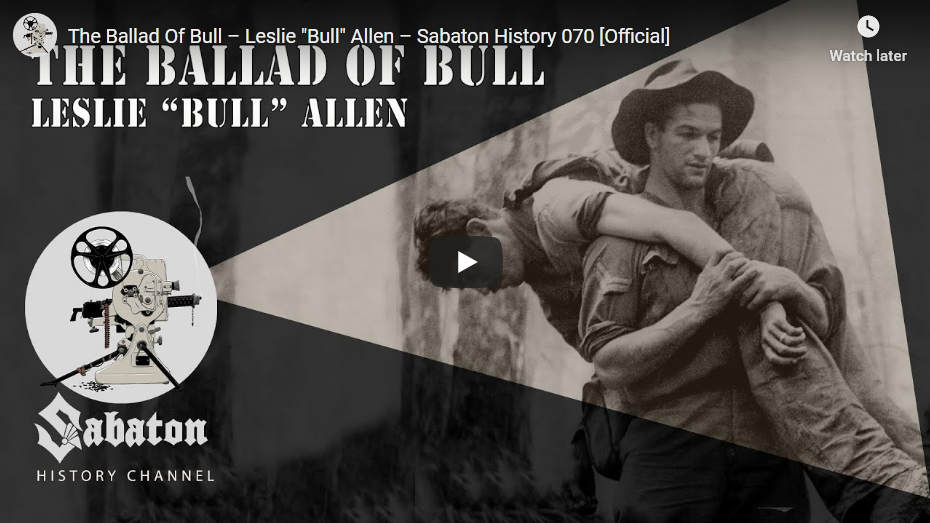
“The Ballad Of Bull” – Leslie “Bull” Allen – Sabaton History 070 [Official]

Filed under: Australia, History, Japan, Media, Military, Pacific — Tags: , , , , — Nicholas @ 04:00

Sabaton History
Published 4 Jun 2020

Sometimes war is killing, sometimes it’s saving lives. This week we turn a soldier who became a hero, not for killing his foes, but for saving his fellow men. Medic Leslie “Bull” Allen’s story is a story about courage in the face of fire. The battle for Mount Tambu in 1943 in Papua New Guinea was vicious and bloody, and the field was soon littered with many wounded men crying for help. Without much regard for his own safety, “Bull” Allen stormed forward into the fray. 12 times he went, and 12 times he came back with a wounded soldier on his back.

Support Sabaton History on Patreon: https://www.patreon.com/sabatonhistory

Listen to “The Ballad Of Bull” on the album Heroes here:
CD: http://bit.ly/HeroesStore
Spotify: http://bit.ly/HeroesSpotify
Apple Music: http://bit.ly/HeroesAppleMusic
iTunes: http://bit.ly/HeroesiTunes
Amazon: http://bit.ly/HeroesAmz
Google Play: http://bit.ly/HeroesGoogleP

Check out the trailer for Sabaton’s new album The Great War right here: https://www.youtube.com/watch?v=HCZP1…

Listen to Sabaton on Spotify: http://smarturl.it/SabatonSpotify
Official Sabaton Merchandise Shop: http://bit.ly/SabatonOfficialShop

Hosted by: Indy Neidell
Written by: Markus Linke and Indy Neidell
Directed by: Astrid Deinhard and Wieke Kapteijns
Produced by: Pär Sundström, Astrid Deinhard and Spartacus Olsson
Creative Producer: Joram Appel
Executive Producers: Pär Sundström, Joakim Broden, Tomas Sunmo, Indy Neidell, Astrid Deinhard, and Spartacus Olsson
Post-Production Director: Wieke Kapteijns
Edited by: Iryna Dulka
Sound Editing by: Marek Kaminski
Maps by: Eastory – https://www.youtube.com/c/eastory

Archive by: Reuters/Screenocean https://www.screenocean.com
Music by Sabaton.

Sources:
– State Library Victoria
– Motorboat sound by bockelsound from freesound.org

An OnLion Entertainment GmbH and Raging Beaver Publishing AB co-Production.

© Raging Beaver Publishing AB, 2019 – all rights reserved.

Australia’s 1975 constitutional crisis back in the news

Filed under: Australia, Government, History, Law — Tags: , , — Nicholas @ 03:00

Colby Cosh outlines the events of 1975, where the Governer-General of Australia, Sir John Kerr, used his reserve powers to dismiss the government of Gough Whitlam and call for a fresh federal election in which Whitlam’s party was soundly defeated. In taking this action, Sir John corresponded with Queen Elizabeth and after his retirement deposited those documents with the National Archives. The bulk of his papers were made available to researchers after the statutary 30 year delay, but the letters involving Her Majesty were withheld for 60 years. An Australian historian has now successfully challenged the National Archives in Federal Court:

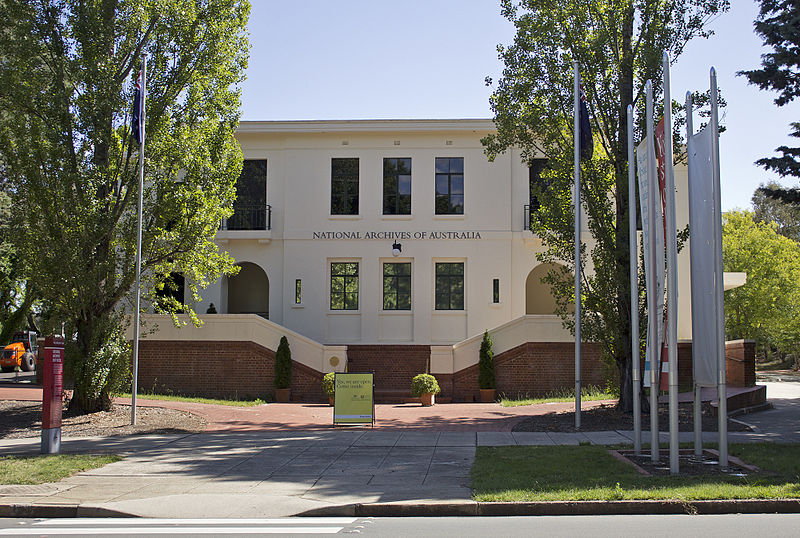
National Archives of Australia in Parkes, Australian Capital Territory.
Photo by Bidgee via Wikimedia Commons.

The confrontation at Yarralumla, and the various narrative twists and turns leading up to it, are a major event in Australian constitutional history. Which brings us to Jenny Hocking, a left-leaning historian who is a top specialist on the 1975 crisis.

Hocking knew that Kerr, after his retirement, had deposited copies of his correspondence with the Queen in Australia’s National Archives. Hocking made good professional use of Kerr’s formal papers, made available to the public in 2005 under the 30-year rule that covers Australian state papers. But Kerr had, with the agreement of the Archives, made separate arrangements for his letters to and from the Queen — the so-called “(Buckingham) Palace letters”.

[…]

The National Archives, trying to stand by its bargain with Kerr as a donor, successfully argued that while papers generated or received by “the official establishment of the Governor-General” would clearly be ordinary public records under Australian law, the letters that Hocking wanted to see didn’t involve “the official establishment,” but merely Kerr himself as … well, just a guy. The Federal Court found that the Palace letters therefore had the legal status of one of Sir John’s grocery bills, or sex diaries, or anything else that he would be perfectly entitled to stick in a locked box for 50 years.

(Or to burn in private. Which was an option he had, but rejected, explaining explicitly that he wanted future historians to have access to the material. But not for them to have it so soon that it might surprise or embarrass the Queen during her own lifetime.)

What happened last week was that the case reached Australia’s top court and Hocking won a smashing victory. Kerr’s correspondence with the Queen is known to have contained discussions of the Australian constitutional situation, and in view of that, the High Court said, the Federal Court’s distinction between Commonwealth records and personal correspondence must be regarded as a bogus artifice. The concepts aren’t mutually exclusive.

The Archives also asserted that queen-viceroy letters attract a higher level of secrecy “by convention” in all the Queen’s realms, but they couldn’t produce evidence that such a convention exists. Hocking’s costs must be covered by the Archives, and as far as the letters go, the ball is in their court legally. They could still use a “national security” exemption to withhold some of the material, and the freedom with which this magic formula is used by archival gatekeepers is notorious. But it may soon be possible for Australians to read the final chapter of the cataclysmic Kerr-Whitlam story.

Hundred Years War | 3 Minute History

Filed under: Britain, France, History, Military — Tags: , , , — Nicholas @ 02:00

Jabzy
Published 18 Oct 2015

Thanks to Xios, Alan Haskayne, Lachlan Lindenmayer, William Crabb, Derpvic, Seth Reeves and all my other Patrons. If you want to help out – https://www.patreon.com/Jabzy?ty=h

Apologies, especially to the Patreon supporters for not uploading recently, I’ve changed jobs/moved house etc. I should be back on the usual schedule now.

Plus, thanks for the 12,000 subs.

QotD: Recognizing the work of famous painters

Filed under: History, Humour, Media, Quotations — Tags: , — Nicholas @ 01:00

#1 If Everyone – Including The Women – Looks Like Putin, Then It’s Van Eyck

#2 If Everyone Looks Like Hobos Illuminated Only By A Dim Streetlamp, It’s Rembrandt

#3 If It’s Something You Saw On Your Acid Trip Last Night, It’s Dali

#4 If The Paintings Have Lots Of Little People In Them But Also Have A Ton Of Crazy Bulls#%t, It’s Bosch

#5 If Everybody Has Some Sort Of Body Malfunction, Then It’s Picasso

#6 Lord Of The Rings Landscapes With Weird Blue Mist And The Same Wavy-Haired Aristocratic-Nose Madonna, It’s Da Vinci

#7 Dappled Light And Unhappy Party-Time People, Then It’s Manet

#8 If You See A Ballerina, It’s Degas

#9 Dappled Light But No Figures, It’s Monet

#10 If Everyone Is Beautiful, Naked, And Stacked, It’s Michelangelo

#11 Dappled Light And Happy Party-Time People, It’s Renoir

#12 If The Images Have A Dark Background And Everyone Has Tortured Expressions On Their Faces, It’s Titian

#13 Excel Sheet With Coloured Squares, It’s Mondrian

#14 If All The Men Look Like Cow-Eyed Curly-Haired Women, It’s Caravaggio

#15 If The Paintings Have Tons Of Little People In Them But Otherwise Seem Normal, It’s Bruegel

#16 If Everyone In The Paintings Has Enormous Asses, Then It’s Rubens

#17 If Every Painting Is The Face Of A Uni-Browed Woman, It’s Frida

#18 If Everything Is Highly-Contrasted And Sharp, Sort Of Bluish, And Everyone Has Gaunt Bearded Faces, It’s El Greco

#19 If The Painting Could Easily Have A Few Chubby Cupids Or Sheep Added (Or Already Has Them), It’s Boucher

Aušrys Uptas, “Someone Created A Funny Guide On How To Recognize Famous Painters And It’s Surprisingly Accurate (19 Pics)”, deMilked, 2019.

June 4, 2020

Performance, Plague, and Politics in Shakespeare’s London

Filed under: Britain, Health, History, Humour, Media — Tags: , , , , , , , — Nicholas @ 06:00

Atun-Shei Films
Published 27 Mar 2020

Help us make the first feature film ever made (that we know of) spoken entirely in Original Pronunciation, the accent of Shakespeare: https://igg.me/at/sudburydevil/x/1502…

Did William Shakespeare write King Lear under quarantine? That is the question. In this video I introduce you to the actor’s process in Elizabethan theater; dive deep into first-hand accounts of the bubonic plague epidemics that Shakespeare lived through; explore the politics of late 16th and early 17th century England, onstage and off; and discuss OP, Original Early Modern English Pronunciation, the accent and dialect in which the Bard’s plays were originally performed.

The rest is silence.

Support Atun-Shei Films on Patreon ► https://www.patreon.com/atunsheifilms

#English #Theater #History

Watch our film ALIEN, BABY! free with Prime ► http://a.co/d/3QjqOWv
Reddit ► https://www.reddit.com/r/atunsheifilms
Twitter ► https://twitter.com/atun_shei
Instagram ► https://www.instagram.com/atunsheifilms
Merch ► https://atun-sheifilms.bandcamp.com

From the comments:

Atun-Shei Films
1 month ago
CORRECTION: The Great Vowel Shift was a SEPARATE linguistic trend to the R-dropping in 18th century English. My mistake, sorry!

Fallen flag — the Texas & Pacific Railway

Filed under: Business, History, Railways, USA — Tags: , , , , — Nicholas @ 05:00

This month’s fallen flag article for Classic Trains is the story of the Texas & Pacific Railway by J. Parker Lamb:
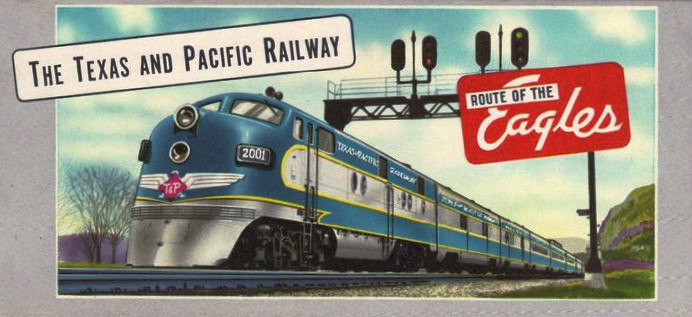
Decorative ticket cover for a Texas & Pacific passenger train. T&P passenger trains were called “Eagles”, as in the Texas Eagle.
Image via Wikimedia Commons.

What grew to become the 20th century’s Texas & Pacific Railway sprouted from some of Texas’s earliest railroads. The Lone Star State’s pre-Civil War network included 11 operating companies. One of the earliest was the Texas Western Railroad, chartered in 1850 and soon renamed Vicksburg & El Paso. In 1856 its name changed again, to Southern Pacific Railroad Company. Of course, this SP had no relation to the Southern Pacific incorporated in 1865 in California, although the convoluted histories of their successors later would intersect.

Backers of this railroad envisioned it as part of a southern transcontinental route from the Mississippi River to San Diego. By 1860, construction of 27 miles was completed between Waskom, on the Louisiana border, and Marshall. The eastern connection was planned as the Vicksburg, Shreveport & Pacific, which already stretched from Waskom across Louisiana to the west bank of the Mississippi at Vicksburg (later part of Illinois Central, it is now part of Kansas City Southern’s “Meridian Speedway”).

The Memphis, El Paso & Pacific, chartered in 1856, planned to start at the Red River near Texarkana and build to a connection with the SP near Dallas, thereby bringing Midwestern traffic into the transcontinental route. Little progress was made before the Civil War, however, with only 5 miles of track built, near Jefferson.

Within a decade after the war, these two lines would be fused into one company. In 1870 the Memphis road was renamed Southern Transcontinental Railroad, and in 1872 Congress issued a charter for the Texas & Pacific Railway, which soon acquired both the ST and SP. The new charter approved a route from Marshall to El Paso and San Diego, and required 100 consecutive miles of construction by 1882. Backers hired Gen. Grenville Dodge, who had been chief engineer of Union Pacific’s recently completed transcontinental line to Utah.
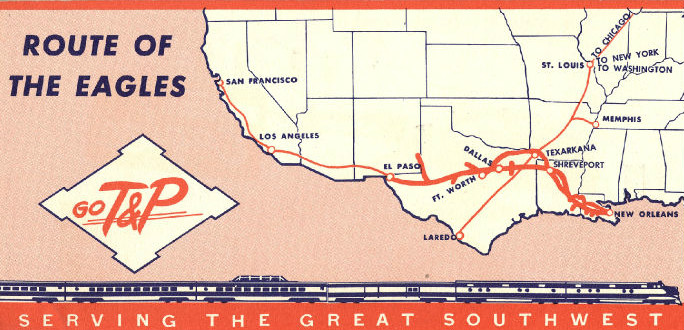
The route of the Texas & Pacific from the back of a ticket.
Image via Wikimedia Commons.

In 1880, the infamous “Robber Baron” Jay Gould joined the board and quickly became the president, and the T&P became a key part of his corporate empire (he already controlled the Union Pacific after 1873 and the Missouri Pacific from 1879):
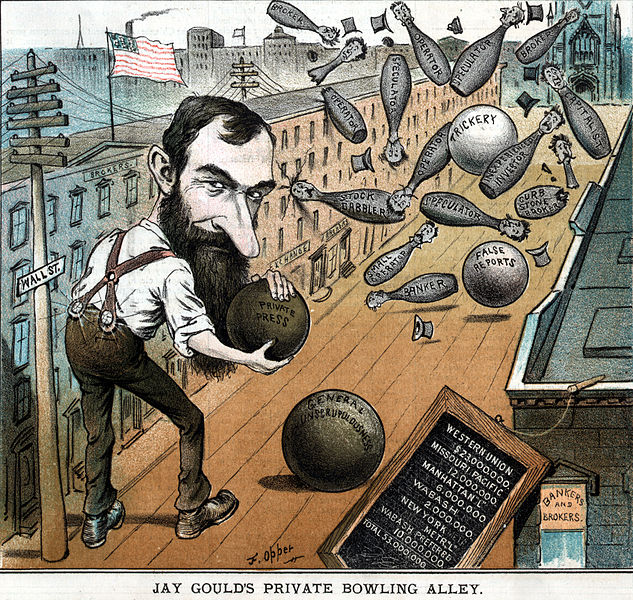
“Jay Gould’s Private Bowling Alley.” Financier and stock speculator Jay Gould is depicted on Wall Street, using bowling balls titled “trickery,” “false reports,” “private press” and “general unscrupulousness” to knock down bowling pins labeled as “operator,” “broker,” “banker,” “inexperienced investor,” etc. A slate shows Gould’s controlling holdings in various corporations, including Western Union, Missouri Pacific Railroad, and the Wabash Railroad.
From the cover of Puck magazine Vol. XI, No 264 via Wikimedia Commons.

Meantime, Gould directed Chief Engineer Dodge to begin an all-out effort to lay rails through the vast and nearly uninhabited desert of west Texas. Construction crews reached Big Spring, 267 miles, in April 1881 and Sierra Blanca (522) on December 16, 1881. However, it was at Sierra Blanca where Gould’s dream of a transcontinental railroad evaporated. He had been bested by Collis P. Huntington, another determined and ruthless railroad tycoon. Huntington’s eastward construction crews had passed through Sierra Blanca three weeks earlier, on November 25, en route to their own “last spike” ceremony of the Sunset Route at the Pecos River (west of Del Rio) in January 1883.

Under the banner of the Galveston, Harrisburg & San Antonio, controlled by Huntington and T. W. Pierce, construction crews had left El Paso in June 1881. When it was clear that Huntington was winning the race for a transcontinental line, a series of court battles ensued, followed by nefarious delaying tactics (including sabotage) by each construction crew, and finally by personal negotiation between the two principals. Gould’s legal case was based on T&P’s 1870 charter to build to San Diego, whereas Huntington’s Southern Pacific charter allowed him to meet the T&P at the Colorado River (between California and Arizona).

Wikipedia provides this sketch of Gould’s railway activities after his involvement in the Erie War:

After being forced out of the Erie Railroad, Gould started to build up a system of railroads in the midwest and west. He took control of the Union Pacific in 1873 when its stock was depressed by the Panic of 1873, and he built a viable railroad that depended on shipments from farmers and ranchers. He immersed himself in every operational and financial detail of the Union Pacific system, building an encyclopedic knowledge and acting decisively to shape its destiny. Biographer Maury Klein states that “he revised its financial structure, waged its competitive struggles, captained its political battles, revamped its administration, formulated its rate policies, and promoted the development of resources along its lines.”

By 1879, Gould gained control of three more important western railroads, including the Missouri Pacific Railroad. He controlled 10,000 miles (16,000 km) of railway, about one-ninth of the rail in the United States at that time, and he had controlling interest in 15 percent of the country’s railway tracks by 1882. The railroads were making profits and set their own rates, and his wealth increased dramatically. He withdrew from management of the Union Pacific in 1883 amid political controversy over its debts to the federal government, but he realized a large profit for himself. He obtained a controlling interest in the Western Union telegraph company and in the elevated railways in New York City after 1881. In 1889, he organized the Terminal Railroad Association of St. Louis which acquired a bottleneck in east–west railroad traffic at St. Louis, but the government brought an antitrust suit to eliminate the bottleneck control after Gould died.


Make beautiful moldings with basic hand tools

Filed under: Tools, Woodworking — Tags: , , , — Nicholas @ 04:00

Rex Krueger
Published 3 Jun 2020

No trim, no problem. Make your own decorative moldings with common hand tools.

More video and exclusive content: http://www.patreon.com/rexkrueger
Sign up for Fabrication First, my FREE newsletter: http://eepurl.com/gRhEVT
(more…)

Trudeauvian “performative sanctimony” on display … again

Filed under: Cancon, Government, Media, Politics — Tags: , , , , — Nicholas @ 03:00

Chris Selley on the Prime Minstrel’s latest attempt to virtue signal on racial issues:

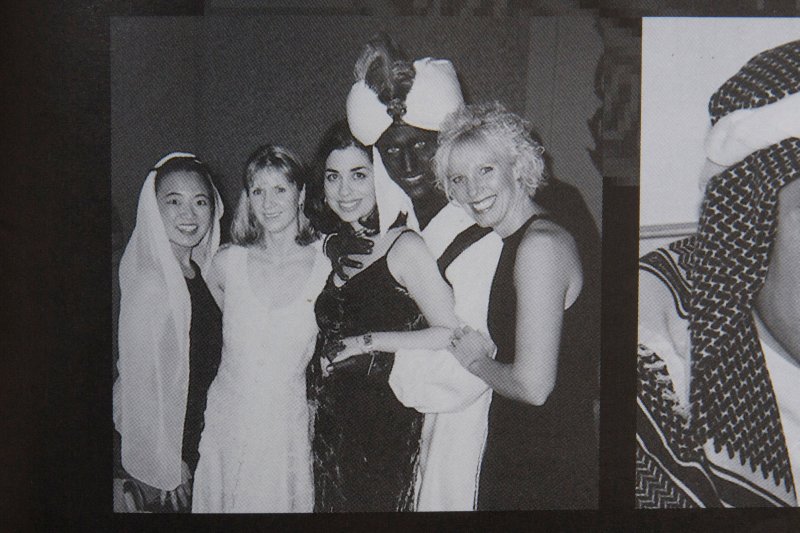
Justin Trudeau with dark makeup on his face, neck and hands at a 2001 “Arabian Nights”-themed party at the West Point Grey Academy, the private school where he taught.
Photo from the West Point Grey Academy yearbook, via Time

In agonizing for 21 seconds before answering a question about President Donald Trump’s threat to send the military after civilian protesters in American cities, Prime Minister Justin Trudeau likely risked causing as much trouble as he was hoping to avoid. Those who would like to see him denounce the president in full throat might be as annoyed as those who think he should accept there’s nothing Canada can really do to help and look out for our own best interests while the socio-political nightmare plays out.

Trudeau’s response wasn’t anything inspiring or novel or revolutionary. “It is a time for us as Canadians to recognize that we too have our challenges — that black Canadians and racialized Canadians face discrimination as a lived reality every single day,” he said. “There is systemic discrimination in Canada, which means our systems treat Canadians of colour, Canadians who are racialized, differently than they do others.”

He continued: “We need to see that, not just as a government and take action, but we need to see that as Canadians. We need to be allies in the fight against discrimination. We need to listen, we need to learn and we need to work hard to figure out how we can be part of the solution on fixing things.”

But here, at least, he was getting to the nub of the issue: To the extent the federal government can make things better for marginalized Canadians, Trudeau is the guy driving the boat. To read some of his ministers’ pensées, you would think they were just regular folks.

[…]

In the meantime, however, you can bet the farm we will soon learn that the Liberals’ changes to impaired driving laws — allowing police to stop and breathalyze drivers without any suspicion of impairment — have disproportionately affected black and Indigenous drivers in particular. Literally everybody saw it coming except Trudeau and his ministers.

OK, I’m kidding — they saw it coming too. They might want to log off, dial down the performative sanctimony and think on that a while.

Tank Chats #71 M3 Stuart Hybrid | The Tank Museum

Filed under: Britain, History, Military, USA, Weapons, WW2 — Tags: , , , — Nicholas @ 02:00

The Tank Museum
Published 29 Mar 2019

David Fletcher talks about the Second World War M3 Stuart and why this particular version is a hybrid.

The M3 Stuart was built by the USA for WW2 and went into service in 1941. The tank in this video was gifted to The Tank Museum by the Brazilian Army.

Support the work of The Tank Museum on Patreon: ► https://www.patreon.com/tankmuseum

Visit The Tank Museum SHOP: ► https://tankmuseumshop.org/
Twitter: ► https://twitter.com/TankMuseum
Tiger Tank Blog: ► http://blog.tiger-tank.com/
Tank 100 First World War Centenary Blog: ► http://tank100.com/ #tankmuseum #tanks #tankchats

QotD: Islamofascism

Filed under: Middle East, Politics, Quotations, USA — Tags: , , , , — Nicholas @ 01:00

The great silence by left-leaning Western feminists, and other large parts of the left, to human rights abuses carried out in the name of Islam is, to see it as its kindest, caused by an overdeveloped sense of tolerance or cultural relativism. But it is also part of the new anti-Americanism. Look at American Christian fundamentalism, they say.

Dislike of George Bush’s foreign policy has led to an automatic support of those perceived to be his enemies. Paradoxically, this leaves the left defending people who hold beliefs that condone what the left has long fought against: misogyny, homophobia, capital punishment, suppression of freedom of speech. The recent reaffirmation by Iran’s Ayatollah Khamenei of the fatwa against Salman Rushdie has been met by virtual silence; as has the torture and murder in Iraq of a man who would be presumed to be one of the left’s own — Hadi Salih, the international officer of the Iraqi Federation of Trade Unions. The hard left these days is soft on fascism, or at least Islamofascism.

The religious right in America would, if it could, wind back access to abortion and some other women’s rights. But as far as I am aware, no Christian fundamentalist in the US has suggested banning women from driving cars, or travelling without their husbands’ permission, or forcing them to cover their faces. Contrary to popular opinion, one is not the same as the other.

Pamela Bone, “The silence of the feminists”, The Age, 2005-02-04

June 3, 2020

How to be a Pirate: Quartermaster Edition 📙📈

Filed under: Britain, Business, Economics, History, Humour — Tags: , , , — Nicholas @ 06:00

CGP Grey
Published 2 Jun 2020

‣ Adapted largely from The Invisible Hook. It’s great, go read it: https://amzn.to/36PLKSE
‣ Director’s Commentary later today: https://www.patreon.com/cgpgrey

## Special Thanks

Peter T. Leeson for reviewing a draft of the script. Check out his newest book, WTF?!: An Economic Tour of the Weird: https://amzn.to/3eEMm09

## Crowdfunders

Steven Snow, Bob Kunz, John Buchan, Nevin Spoljaric, Donal Botkin, BN-12, Chris Chapin, Richard Jenkins, Phil Gardner, Martin, سليمان العقل, Steven Grimm, Colin Millions, Saki Comandao, Jason Lewandowski, Andrea Di Biagio, David F Watson, Ben Schwab, Elliot Lepley, rictic, Bobby, Marco Arment, Shallon Brown, Shantanu Raj, emptymachine, George Lin, Henry Ng, Jeffrey Podis, Thunda Plum, Awoo, David Tyler, Derek Bonner, Derek Jackson, Fuesu, iulus, Jordan Earls, Joshua Jamison, Mikko, Nick Fish, Nick Gibson, Orbit_Junkie, Ron Bowes, Tómas Árni Jónasson, Tyler Bryant, Zach Whittle, Oliver Steele, Kermit Norlund, Kevin Costello, Ben Delo, Arctic May, Bear, chrysilis, David Palomares, Emil, Erik Parasiuk, Esteban Santana Santana, Freddi Hørlyck, Frederick The Great, John Rogers, ken mcfarlane, Leon, Maarten van der Blij, Peter Lomax, Rhys Parry, ShiroiYami, Tijmen van Dien, Tristan Watts-Willis, Veronica Peshterianu, Dag Viggo Lokøen, John Lee, Maxime Zielony, Bryan McLemore, Elizabeth Keathley, Alex Simonides, Felix Weis, Melvin Sowah, Giulio Bontadini, Paul Alom, Ryan Tripicchio, Scot Melville

## Music

David Rees: http://www.davidreesmusic.com

The Wehrmacht‘s License to Kill the Innocent – War Against Humanity 012 – May 1941

Filed under: Europe, Germany, History, Military, WW2 — Tags: , , , , , , , — Nicholas @ 04:00

World War Two
Published 2 Jun 2020

As the Blitzes of Britain slow down considerably, violence in Croatia increases dramatically as the Ustaše government purges the country of Jews and Serbs and the Wehrmacht gets deadly instructions for their invasion of the Soviet Union.

Join us on Patreon: https://www.patreon.com/TimeGhostHistory
Or join The TimeGhost Army directly at: https://timeghost.tv

Follow WW2 day by day on Instagram @World_war_two_realtime https://www.instagram.com/world_war_t…
Between 2 Wars: https://www.youtube.com/playlist?list…
Source list: http://bit.ly/WW2sources

Hosted by: Spartacus Olsson
Written by: Joram Appel and Spartacus Olsson
Director: Astrid Deinhard
Producers: Astrid Deinhard and Spartacus Olsson
Executive Producers: Astrid Deinhard, Indy Neidell, Spartacus Olsson, Bodo Rittenauer
Creative Producer: Joram Appel
Post-Production Director: Wieke Kapteijns
Research by: Joram Appel
Edited by: Mikołaj Cackowski
Sound design: Marek Kamiński
Map animations: Eastory (https://www.youtube.com/c/eastory)

Colorizations by:
Norman Stewart – https://oldtimesincolor.blogspot.com/
Adrien Fillon – https://www.instagram.com/adrien.colo…
Carlos Ortega Pereira – BlauColorizations, https://www.instagram.com/blaucoloriz…
Cassowary Colorizations – https://www.flickr.com/people/cassowa…

Sources:
Bundesarchiv
Narodowe Archiwum Cyfrowe
IWM D 5984, D 1091
USHMM

Bibliography:
Barton, Brian, “A Belfast Blitz Memorial?”. In: History Ireland 24:2 (March/April 2016) 8-9.
Biondich, Mark, “Religion and Nation in Wartime Croatia: Reflections on the Ustaša Policy of Forced Religious Conversions, 1941-1942″. In: The Slavonic and East European Review 83:1 (Jan 2005) 71-116.
Clapson, Mark, “Air Raids in Britain, 1940-45”. In: The Blitz companion: Aerial Warfare, Civilians and the City since 1911 (2019) 37-76.
Gotovich, Aron, Dictionnaire de La Seconde Guerre Mondiale En Belgique (2008).
MacDonald, David B., “From Jasenovac to Srebrenica; Subaltern Genocide and the Serbs”. In: Nicholas Robins, Adam Jones (ed.), Genocides by the Oppressed: Subaltern Genocide in Theory and Practice (2009) 103-121, 106.
Tanner, Marcus, “The Ustashe”. In: Croatia: A Nation Forged in War; Third Edition (2010) 141-167.
Williamson, Murray, and Allan Millett, “Barbarossa 1941”. In: A War To Be Won (2000) 110-142.

Primary Sources:
Barbarossa Decree, 13 May 1941. http://users.clas.ufl.edu/ggiles/barb….
Commissar Order, 6 June 1941. http://users.clas.ufl.edu/ggiles/barb….
William Sansom: Westminster in War, 1947.

Soundtracks from the Epidemic Sound:
Cobby Costa – “From the Past”
Reynard Seidel – “Deflection”
Johan Hynynen – “Dark Beginning”
Gunnar Johnsen – “Not Safe Yet”
Farell Wooten – “Blunt Object”
Peter Sandberg – “Document This 1”
Andreas Jamsheree – “Guilty Shadows 4”
Cobby Costa – “Flight Path”

Archive by Screenocean/Reuters https://www.screenocean.com.

A TimeGhost chronological documentary produced by OnLion Entertainment GmbH.

From the comments:

World War Two
2 hours ago
For many living in newly occupied territories in South-Eastern Europe, May 1941 marked the start of a hellish life under fascist occupation. For many more, May 1941 will be the month in which their fate is sealed. Many hundreds of thousands more will suffer by the decisions made this months. From this episode, and the next ones, it will become very clear that there is no such thing as a “clean Wehrmacht“, and that this is very much a myth. Some parts of the internet still seem to hold on tight to this, but we will counter it time and again, wether it is about occupying forces, Operation Barbarossa or Erwin Rommel.

Cheers,
Joram

Fanatics gonna fanatic … they can’t help it

It’s funny that no matter what the claimed crisis, the answers always go in the same direction, as Kristian Niemietz points out with the demands to turn our still unending lockdown toward “protecting the environment”:

The change, superficially, is to encourage “a safe return to work” allowing more social distancing between pedestrians, but more substantially in order to preserve the cleaner air that has resulted from the lockdown.

The health and safety excuse for the policy change can be largely dismissed. The simple truth of the pandemic and national policy is that if social distancing matters, the centre of London is not safe to return to work. It is too densely populated and almost entirely reliant on mass transit which cannot operate above 10-15% capacity with 2m exclusion rules. With average commutes over 9 miles each way, substitution effects to walking and cycling will be extremely limited and temporary.

It is then hard to see then how the policy’s architects imagine the streets will fill up to the extent urgent measures are needed. Conversely, if social distancing does not matter (and it will cease to matter eventually), then a policy to enable more social distancing outside by widening the pedestrian streetscape is redundant. If it is safe to sit on a crowded train, it is safe to walk on a crowded pavement. It is not hard then to cut through the pandemic packaging to note that the motive for this policy is opportunistic, to accelerate a pedestrianisation plan that is the dream of many an urban planner.

Many will see this as self-evidently a good thing. Removing vehicle traffic from densely populated narrow streets will reduce air pollution, congestion and road traffic accidents. As a policy it will have more supporters than opponents; very few people drive into the centre of London to commute and there is very little capacity for parking. London’s leaders are not wrong to think that this is the future, the question is really one of timing and how they go about it, which is far more difficult and does not have anything to do with managing a coronavirus.

What the pandemic allows is the ability to use emergency powers for something that is not an emergency. This matters, in normal times it took several years to close one dangerous junction at Bank to most traffic, and this under a hail of protests from local businesses and taxi drivers. The same result can now be achieved in a few weeks across many streets. The democratic checks and balances that differentiate the UK from authoritarian states can be ditched and London officialdom granted extraordinary powers to do as they please. If the protestors don’t like it this time, they should note the right to protest has also been suspended, at least for now.

Inglis High Power: How a Chinese Whim Became A British Service Pistol

Filed under: Cancon, China, History, Military, Weapons, WW2 — Tags: , , , — Nicholas @ 02:00

Forgotten Weapons
Published 25 Jan 2018

Sold for $3,163.

During World War Two, the Canadian government set up a loan program to help Chinese companies provide all manner of material aid to Canada’s allies. Among many others, one recipient of this aid was the Nationalist Chinese government under Chiang Kai Shek. Chinese representatives asked the John Inglis company to manufacture no less than 180,000 Browning High Power pistols, and the company agreed.

After some wrangling, Inglis acquired a license from FN representatives to make the guns, got a complete technical package through the British government and FN’s representatives in exile, and the direct personal aid of Laloux and Saive from FN. Delivery proved difficult, though, with only about 4000 guns being shipped to Karachi and then needing to be flown over The Hump in cargo planes, along with massive amounts of other aid — and a few pistols didn’t get a lot of priority there.

By the fall of 1944, the contract was cancelled under concerns that it was not really contributing to any progress in the war against the Japanese, along with insistence from American General Stilwell that the Chinese forces be armed with weapons that could be supplied more easily through the American logistic network. Production restarted after the defeat of Germany, with another 40,000 or so being made and delivered before it was cancelled again when the Nationalist Chinese forces were seen to be clearly losing to their Communist opponents.

Each of these pistols was supplied with a combination shoulder stock and holster. In the US, attaching a stock to a pistol would normally subject it to registration as a Short Barreled Rifle, but the Inglis High Powers are among the guns exempted from this requirement. They are, in fact, among the least expensive and most modern guns to be exempted in this way.

http://www.patreon.com/ForgottenWeapons

Cool Forgotten Weapons merch! http://shop.bbtv.com/collections/forg…

If you enjoy Forgotten Weapons, check out its sister channel, InRangeTV! http://www.youtube.com/InRangeTVShow

« Newer PostsOlder Posts »

Powered by WordPress