Quotulatiousness

July 8, 2018

Swedish home defence

Filed under: Europe, Military — Tags: , , — Nicholas @ 03:00

Last week, Strategy Page took a look at Sweden’s home defence arrangements, including their first surprise mobilization of the Hemvärnet – Nationella skyddsstyrkorna (Home Guard) in over 40 years:
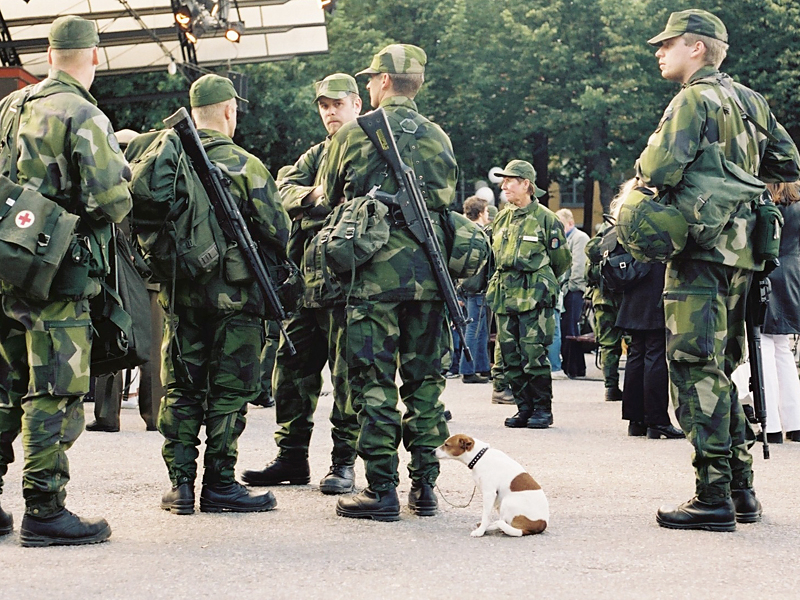
Swedish Home Guard soldiers in Kungsträdgården, Stockholm on 6 August, 2001.
Photo by Peter Fristedt, via Wikimedia Commons.

On June 4th Sweden held its first nationwide, unannounced mobilization of the Home Guard since 1975. This is another effort to prepare Sweden to deal with the renewed Russian threat. The Home Guard consists of reservists and volunteers whose job is local defense and maintenance of order in a national or local emergency. The Home Guard currently has about 22,000 members organized into 70 infantry battalions (each with 2-5 companies) that are assigned to areas where their part-time soldiers work and live. The Home Guard was created in 1940 and now depends on volunteers who are either former full time or reservist personnel who have at least three months of basic training. Twice a year Home Guard personnel two four day long training exercises. These four-day events involve practicing mobilization and doing what they are expected to do in wartime or a major emergency. In addition, most Home Guard companies (about 70 troops each) hold weekend training sessions ten times a year.

The unannounced mobilization of the Home Guard serves to find out how well the Home Guard as a whole would function. The Home Guard is voluntary and members can leave the force any time they choose to. Since 2014 there have been more volunteers and the Home Guard units could be more selective in who they accepted. The Home Guard mobilization is but the latest effort by Sweden to rebuild its traditional defense. The Home Guard take their training and readiness very seriously, especially when there is an obvious threat. In 1940 it was the Germans but after 1945 it was the Russians, at least until 1991. Now the Russians are once more a threat and the government had to agree that the Home Guard required more attention, resources and training.

Yet the Home Guard is more a police and emergency services than a military one. While the guardsmen are armed they are not expected to be a primary defense against invaders. This point was made when the people of Gotland Island recently pointed out that the local Home Guard was not enough to protect areas like Gotland from a surprise attack. The resulted in the government taking action to put a military garrison back on Gotland.

The Home Guard is not the only component of Swedish military readiness being tested. In late 2017 Sweden held its largest military exercises since the 1990s. Some 19,000 full-time soldiers and reservists were involved and the exercise was based on Russia attempting to seize and hold the island of Gotland after a surprise attack. The defense of Gotland has been an issue in Sweden ever since conscription was ended in 2010. Since the 1990s the military budget and number of full-time troops were cut. That led to the elimination of the Gotland garrison, a small force of full-time soldiers to watch for a Russian surprise attack and alert the reserve forces on the island to mobilize. With the end of conscription, it proved impossible to attract enough volunteers from Gotland to sustain the traditional force of military reservists, who would quickly mobilize and confront the invaders.


Western Approaches – the bunker from which they won the war

Filed under: Britain, History, Military, WW2 — Tags: , , , — Nicholas @ 02:00

Lindybeige
Published on 17 Jun 2018

The command bunker ‘Western Approaches’ is now a museum in Liverpool. I was invited to take a look before it re-opened.
Support me on Patreon: https://www.patreon.com/Lindybeige

The Museum’s website: http://www.liverpoolwarmuseum.co.uk

Many thanks to Richard MacDonald for inviting me and showing me around (you saw him plugging the big fuse in).

Lindybeige: a channel of archaeology, ancient and medieval warfare, rants, swing dance, travelogues, evolution, and whatever else occurs to me to make.

QotD: Marx on how to run a true communist state

Filed under: Government, History, Politics, Quotations — Tags: , , , — Nicholas @ 01:00

What really clinched this for me was the discussion of Marx’s (lack of) description of how to run a communist state. I’d always heard that Marx was long on condemnations of capitalism and short on blueprints for communism, and the couple of Marx’s works I read in college confirmed he really didn’t talk about that very much. It seemed like a pretty big gap.

[…]

I figured that Marx had just fallen into a similar trap. He’d probably made a few vague plans, like “Oh, decisions will be made by a committee of workers,” and “Property will be held in common and consensus democracy will choose who gets what,” and felt like the rest was just details. That’s the sort of error I could at least sympathize with, despite its horrendous consequences.

But in fact Marx was philosophically opposed, as a matter of principle, to any planning about the structure of communist governments or economies. He would come out and say “It is irresponsible to talk about how communist governments and economies will work.” He believed it was a scientific law, analogous to the laws of physics, that once capitalism was removed, a perfect communist government would form of its own accord. There might be some very light planning, a couple of discussions, but these would just be epiphenomena of the governing historical laws working themselves out. Just as, a dam having been removed, a river will eventually reach the sea somehow, so capitalism having been removed society will eventually reach a perfect state of freedom and cooperation.

Singer blames Hegel. Hegel viewed all human history as the World-Spirit trying to recognize and incarnate itself. As it overcomes its various confusions and false dichotomies, it advances into forms that more completely incarnate the World-Spirit and then moves onto the next problem. Finally, it ends with the World-Spirit completely incarnated – possibly in the form of early 19th century Prussia – and everything is great forever.

Marx famously exports Hegel’s mysticism into a materialistic version where the World-Spirit operates upon class relations rather than the interconnectedness of all things, and where you don’t come out and call it the World-Spirit – but he basically keeps the system intact. So once the World-Spirit resolves the dichotomy between Capitalist and Proletariat, then it can more completely incarnate itself and move on to the next problem. Except that this is the final problem (the proof of this is trivial and is left as exercise for the reader) so the World-Spirit becomes fully incarnate and everything is great forever. And you want to plan for how that should happen? Are you saying you know better than the World-Spirit, Comrade?

I am starting to think I was previously a little too charitable toward Marx. My objections were of the sort “You didn’t really consider the idea of welfare capitalism with a social safety net” or “communist society is very difficult to implement in principle,” whereas they should have looked more like “You are basically just telling us to destroy all of the institutions that sustain human civilization and trust that what is baaaasically a giant planet-sized ghost will make sure everything works out.”

Scott Alexander, “Book Review: Singer on Marx”, Slate Star Codex, 2014-09-13.

July 7, 2018

The Incel Rebellion will (almost certainly) be streamed

Filed under: Health, Politics, USA — Tags: , , , , , — Nicholas @ 05:00

Fraser Myers looks at the incel ?movement? (not quite sure if that’s the right word to encapsulate that group of people, honestly) and explains some of the more commonly used terms by and about incels:

Incels are ‘involuntary celibates’ – men frustrated with their inability to find a sexual partner. Estimates on the size of the incel community vary from thousands to hundreds of thousands. The forum ‘r/incels’ on Reddit had 41,000 members when it was banned in November 2017 for violating the site’s rules on violent content.

Incel forums, like the website incel.me and the message board /r9k/ on 4chan, are awash with anonymous declarations of self-pity, self-loathing and, at times, a violent misogyny directed at the women deemed responsible for their loneliness. Behind a great deal of mindless chatter and ‘shitposting’ is a shared understanding of how they came to be despised by the opposite sex, alongside a bewildering array of slang terms to describe and explain the various states of ‘inceldom’.

According to the incels, there is a ruthless sexual hierarchy, and as ‘beta males’, they find themselves at the bottom. The foil to the incel is a ‘Chad’ – a confident, attractive man with multiple sexual partners, comprising usually attractive but supposedly shallow women, known as ‘Stacys’. Chads are envied and despised in equal measure. Then there are the ‘normies’ (normal people), hated for their herd-like mentality and mocked for their ignorance of incel culture. ‘Blackpilling’ refers to the acceptance that the traits you are born with mean you are destined to be romantically unsuccessful. The term is a play on the moral dilemma presented by the 1999 film, The Matrix, in which Neo is offered a blue pill to remain in a world of illusion and a red pill to see the world as it truly is – ‘redpilling’ is a central trope in online men’s rights’ activism, while blackpilling is the incel equivalent. Physical traits such as height, facial features or penis size (sometimes posted with accompanying pictures), are said to play a big role in the incels’ low status, while a large number of them also blame self-diagnosed mental-health problems, particularly autism-spectrum disorders.

But while many incels are open about their flaws, ultimately the blame is laid on the women who overlook them. Women are seen as effectively slaves to their biology, guided by so-called ‘hypergamy’: an attraction to higher-status men linked to evolutionary psychology. Some parts of the so-called manosphere – a loose constellation of male-dominated online subcultures, including men’s rights activists and pick-up artists – believe that evolutionary psychology can be used to a man’s advantage, that certain techniques can be deployed to overcome a lack of attractiveness and confidence to manipulate women into bed or into a relationship. Incels reject even this bleak view and insist that beta males accept their place in the social-pecking order.

This belief in a rigid social hierarchy inevitably produces problems when it comes to race. ‘Ricecels’ (incels of Chinese and South East Asian origin) and ‘currycels’ (of South Asian descent) are often found posting photos of ‘proof’ of a theory called ‘JBW’, that in order for them to be successful with women they should ‘just be white’. Some white incels look upon black men with envy for their perceived sexual success, while a minority rail against any kind of ‘race mixing’ – even as a form of escape from inceldom.

In addition, incels speak of an ‘80:20 rule’ when it comes to sexual competition: the most attractive 20 per cent of men are said to be sought after by the most attractive 80 per cent of women, with the least attractive 80 per cent of men left to compete for the remaining 20 per cent of women. In previous eras, this situation would have supposedly been prevented by institutionalised monogamy. Some incels call explicitly for a return to a patriarchal society. Today’s world of relative sexual freedom, contraception, no-fault divorce and dating apps, on the other hand, is blamed for offering an abundance of opportunities for Chads and women, at the expense of incels.

History Buffs: Gettysburg

Filed under: History, Military, USA — Tags: , , , , — Nicholas @ 04:00

History Buffs
Published on 19 Feb 2018

The bad economics of rooftop solar installations

Norman Rogers points out where the numbers don’t add up for many jurisdictions’ domestic solar power schemes:

Photovoltaic panels on a roof, 28 April, 2015.
Photo by Antonio Chaves, via Wikimedia Commons.

A modest proposal:

We’ve all heard about “shop local” and “get your food from local farmers, not distant corporate farms.” Lots of people have apple trees in their backyards. Often they can’t begin to eat or give away all the apples. In the meantime, big supermarkets sell corporate apples for one dollar a pound and up. I propose that people with backyard apples be able to take them to the supermarket and sell them to the supermarket for the same price at which the supermarket is selling apples. Furthermore, they should be able to take them at any time and receive payment. If the store gets too many local apples, it can reduce its purchase of corporate apples.

My apple proposal may seem ill advised, but that is exactly how rooftop solar power works. The homeowner gets to displace power from the power company, and if the homeowner has more power than he needs, the power company is obligated to purchase it, often for the same retail price at which it sells electricity. That policy is called net metering. In order to accommodate the homeowner’s electric power, the utility has to throttle down some other power plant that produces power at a lower wholesale price.

The exact arrangements for accepting rooftop solar vary by jurisdiction. In some places, net metering is restricted in one way or another.

A large-scale natural gas-generating plant can supply electricity for around 6 cents per kilowatt-hour. Rooftop solar electricity costs, without subsidies, around 30 cents per kilowatt-hour, or five times as much. Average retail rates for electricity in most places are between 8 cents and 16 cents per kilowatt-hour. Yet, paradoxically, the homeowner can often reduce this electric bill by installing rooftop solar.

It is actually worse than forcing the power company to take 30-cent electricity that it could get from a natural gas plant for 6 cents. When the company throttles down a natural gas plant to make room for rooftop electricity, it is not saving six cents, because it already has paid for the gas plant. All it saves is the marginal fuel that is saved when the plant is throttled down to make room for the rooftop electricity. The saving in fuel is about 2 cents per kilowatt-hour. So 30-cent electricity displaces grid electricity and saves two cents.

Zimbabwe and Hyperinflation: Who Wants to Be a Trillionaire?

Filed under: Africa, Economics, Government, History — Tags: , , , — Nicholas @ 02:00

Marginal Revolution University
Published on 3 Jan 2017

How would you like to pay $417.00 per sheet of toilet paper?

Sound crazy? It’s not as crazy as you may think. Here’s a story of how this happened in Zimbabwe.

Around 2000, Robert Mugabe, the President of Zimbabwe, was in need of cash to bribe his enemies and reward his allies. He had to be clever in his approach, given that Zimbabwe’s economy was doing lousy and his people were starving. Sow what did he do? He tapped the country’s printing presses and printed more money.

Clever, right?

Not so fast. The increase in money supply didn’t equate to an increase in productivity in the Zimbabwean economy, and there was little new investment to create new goods. So, in effect, you had more money chasing the same goods. In other words, you needed more dollars to buy the same stuff as before. Prices began to rise — drastically.

As prices rose, the government printed more money to buy the same goods as before. And the cycle continued. In fact, it got so out of hand that by 2006, prices were rising by over 1,000% per year!

Zimbabweans became millionaires, but a million dollars may have only been enough to buy you one chicken during the hyperinflation crisis.

It all came crashing down in 2008 when — given that the Zimbabwean dollar basically ceased to exist — Mugabe was forced to legalize transactions in foreign currencies.

Hyperinflation isn’t unique to Zimbabwe. It has occurred in other countries such as Yugoslavia, China, and Germany throughout history. In future videos, we’ll take a closer look at inflation and what causes it.

QotD: Crony rules

Filed under: Law, Quotations — Tags: , , — Nicholas @ 01:00

The direction [by government] of economic activity thus necessarily involves discrimination between persons, the creation of monopoly and privilege, while the aim of the Rule of Law is the abolition of all privilege, be it in favor of the strong or of the weak. And it is no less fatal to freedom if exemption from general legal rules is granted to the weak than when it is granted to the strong. Once the door is opened to differentiation on the ground of deserts or needs, it will be arbitrary will instead of objective rule which will govern men.

F.A. Hayek, “The Political Ideal of the Rule of Law”, 1955.

July 6, 2018

Lac-Mégantic, five years on

Filed under: Cancon, Railways — Tags: , — Nicholas @ 05:00

Five years ago today, we learned of the tragedy that had struck the Quebec town of Lac-Mégantic in the small hours of the morning:

Updates as they came in: initial post, locomotive fire, media access, still questions more than a week later, first anniversary, and the Transportation Safety Board report.

Earlier this week, Asad Iqbal reported from Lac-Mégantic:

Rail safety advocates say that five years after the Lac-Mégantic train derailment, not enough has been done to prevent similar tragedies from happening elsewhere in Canada.

On July 6, 2013, 47 people died when a train loaded with 7.7 million litres of fuel rolled unmanned into the downtown core and exploded in the middle of the night.

Commemorative events honouring the victims will take place throughout the day on Friday.

Meanwhile a citizens’ committee for rail safety and surveillance will mark the disaster by heading north to the neighbouring town of Nantes, where the train started rolling down the steep hill toward Lac-Mégantic in 2013.

“Five years after the tragedy we have not seen a significant improvement of rail safety measures,” said Robert Bellefleur, a spokesperson for the Coalition des citoyens et organismes engagés pour la sécurité ferroviaire.

The federal and provincial governments announced in May a bypass would be built around the town of Lac-Mégantic, Que. (Julia Page/CBC)

Tanker cars carrying dangerous goods are regularly parked at the top of this steep hill above the town, Bellefleur said, a disturbing image for people who drive past.

“The main risk factor that contributed to the tragedy is not even solved,” said Bellefleur.

The First Modern Battle – The Battle of Hamel I THE GREAT WAR Week 206

Filed under: Australia, Germany, History, Military, WW1 — Tags: , , , — Nicholas @ 04:00

The Great War
Published on 5 Jul 2018

Meet us at the Tank Museum: http://bit.ly/TankMuseumFanMeeting

The Battle of Hamel is considered as the first modern battle. Masterminded by Australian general John Monash, it included meticulous planning and integrated tanks, artillery, airplanes and infantry into one cohesive strategy.

“That’s what governments are for — get in a man’s way”

Filed under: Bureaucracy, Business, Government, USA — Tags: , , , , , — Nicholas @ 03:00

Veronique de Rugy says that the 4th of July is a good time to reflect on the American Founding Fathers fighting to gain independence from a distant tyrannical government … and the rest of the year is devoted to coping with a less-distant but no-less tyrannical government in Washington:

Consider the oil and gas industry. Over the years, the federal government has adopted many regulations meant to hinder the industry. As Nick Loris, an energy policy analyst at the Heritage Foundation, reminds me, one such regulation is the Merchant Marine Act, also known as the Jones Act, which makes it more expensive to ship oil and natural gas from coast to coast. Then there are the past administrations’ outright moratoriums on drilling in certain areas of America’s coasts, which massively increases the cost of doing business. As Loris notes, there are many costly bureaucratic delays in issuing leases and processing applications for permits to drill (APDs), which stalls production on federal lands. On average, the federal processing of APDs in the last year of the Obama administration was 257 days, while state processing is typically 30 days or less.

Since Uncle Sam has a lot of regulations in place to make the operations of domestic oil and gas companies more costly, why is the biggest beneficiary of loans from the federal government export credit agency (the U.S. Export-Import Bank) the gigantic Mexico state-owned oil and gas company Pemex? Between 2007 and 2013 (the most complete data set we have), Pemex received over $7 billion in loans backed by American taxpayers to buy U.S. goods. Thanks to Uncle Sam, this discounted borrowing power gives Pemex a leg up on its competition with domestic oil and gas companies.

Then there’s the Trump administration tariffs. These import taxes on foreign goods coming from Europe, China, and other countries have not only raised the cost of doing business but also triggered retaliatory measures from foreign governments. For instance, the farm industry is paying a steep price from the tariffs on steel because they increase the cost of farm machinery, lowering profit margins. Farmers are also hurt by the European, Mexican, Canadian, and Chinese governments that have imposed retaliatory export restrictions on U.S. farm products. Many small farms are calling for help to survive. It’s so bad that the entire Iowa congressional delegation sent a letter to President Trump on June 25 in which it called the tariffs “catastrophic for Iowa’s economy.”

Quote in the headline from Firefly episode “Serenity, Part 1”.

Funny British Army Recruitment Video

Filed under: Britain, Humour, Military — Tags: , — Nicholas @ 02:00

Matsimus
Published on 9 Jun 2018
Some old school British Army recruitment video which was very well made but also just hilarious lol!

Hope you enjoy!!

(DISCLAIMER: This video is for entertainment purposes only. The views and opinion come from personal experience or information from public accessible sources.)

QotD: “Afflict the comfortable and comfort the afflicted”

Filed under: Media, Quotations — Tags: , , — Nicholas @ 01:00

And there we have it in a nutshell. “Afflict the comfortable and comfort the afflicted.” That phrase, it should be pointed out, is not what “they” say it’s a journalist’s duty to do. That phrase was satirical, uttered by the fictional Irish bartender “Mr. Dooley,” the 1893 creation of Chicago Evening Post humorist Finley Peter Dunne. It was not intended to be taken seriously. Here’s the phrase in its original context: “Th’ newspaper does ivrything f’r us. It runs th’ polis foorce an’ th’ banks, commands th’ milishy, controls th’ ligislachure, baptizes th’ young, marries th’ foolish, comforts th’ afflicted, afflicts th’ comfortable, buries th’ dead an’ roasts thim aftherward.”

It was a satire of newspapers, not a how-to manual for journalists. Yet that is exactly what Jackman — and, I would wager, the majority of his crusading colleagues — has turned it into. And let’s just ruminate for a moment on what that means. Afflict (“cause pain or suffering to”) the comfortable (“those who are free from worry or pain”). In other words, give pain to those who don’t have it. What a motto, what a career description. Forget the five Ws, forget just telling the truth. Journalists are here to give pain to those they feel are too pain-free. And of course the press takes it upon itself to determine just who is comfortable enough to deserve affliction. Now, make no mistake, in an active situation on the street, the police do, absolutely, wield the power. They have a license to take lives, and they have the muscle of the state behind them. That said, can we really call inner-city beat cops “the comfortable”? Are we talking the Rockefellers here? Are we claiming that your typical parking-ticket scribe is a caviar-eating, yacht-racing, Fabergé-egg-collecting one-percenter?

That’s why those who elect themselves the rainmakers and the pain bringers are so dangerous — we are at the mercy of their judgment regarding who among us needs the misery they have decided they must inflict.

David Cole, “Afflicting the Comfortable”, Taki’s Magazine, 2016-10-06.

July 5, 2018

The soon-to-be-announced target of the two-minute unceasing hate

Filed under: Law, Politics, USA — Tags: , , , , — Nicholas @ 05:00

At Reason, Jacob Sullum says Trump did well with his first Supreme Court pick, and the unwillingness of Trump’s opponents to acknowledge that shows how much blind partisanship has gripped the left:

Anthony M. Kennedy, Associate Justice of the Supreme Court of the United States, swears in Supreme Court Justice Neil M. Gorsuch on Monday, April 10, 2017, in the Rose Garden of the White House in Washington, D.C. Also shown, Gorsuch’s wife Louise stands on stage holding a family Bible. Justice Gorsuch is the Supreme Court’s 113th justice.
White House photo via Wikimedia Commons.

“We have to STOP the next Trump nominee!” says a pop-up solicitation on People for the American Way’s website. Before you rush to “donate now,” you might want to consider the organization’s assessment of Trump’s last Supreme Court nominee.

“Far from being a fair-minded constitutionalist,” PFAW says, Neil Gorsuch “has proven to be a narrow-minded elitist who consistently votes in favor of corporations and the powerful.” The gap between that description and Gorsuch’s actual performance on the Court speaks volumes about the blind partisanship of Trump critics who care more about scoring political points than defending civil liberties.

PFAW is echoing the criticism of Democratic senators who worried, before Gorsuch was confirmed in April 2017, that he was not inclined to stand up for “the little guy.” Gorsuch’s record during a decade on the U.S. Court of Appeals for the 10th Circuit belied that claim, and his 15 months on the Supreme Court provide further evidence that he is not shy about defending the principles that protect politically disfavored individuals from the whims of the powerful.

In sharp contrast with the man who nominated him, Gorsuch worries about abuses of the government’s power to take people’s property “for public use.” In June 2017, when the Court declined to hear a case that raised the question of whether a state can impose limits on the “just compensation” it owes for takings under the Fifth Amendment, Gorsuch, joined by Clarence Thomas, urged his colleagues to address that issue at the “next opportunity.”

That pairing was notable because Gorsuch is on record as admiring Thomas’s passionate dissent from the widely condemned 2005 decision in which the Court approved the use of eminent domain to transfer property from one private owner to another in the name of economic development. Big businesses routinely use such arrangements to override the wishes of little people who get in the way of their plans.

World of Warships – HMCS Haida

Filed under: Cancon, Gaming, History, Military, WW2 — Tags: , , , — Nicholas @ 04:00

The Mighty Jingles
Published on 3 Jul 2018

Oh Canada! Your ship finally made it into World of Warships even if your flag didn’t. I could just tell you what I think of her right now but that would spoil the video, so go on, watch it!

Little White Mouse Haida Review: https://forum.worldofwarships.com/top…

All music licensed from www.epidemicsound.com and www.machinimasound.com Really, I’m not kidding. Stop trying to claim license-free music you record company scumbags!

« Newer PostsOlder Posts »

Powered by WordPress