Quotulatiousness

July 5, 2018

Barbara Kay on revising Ontario’s sex-ed curriculum

Filed under: Cancon, Education, Health, Politics — Tags: , , , , , — Nicholas @ 03:00

Her latest column in the National Post has some advice for Premier Doug Ford and his merry band of (dare I say) reformers:

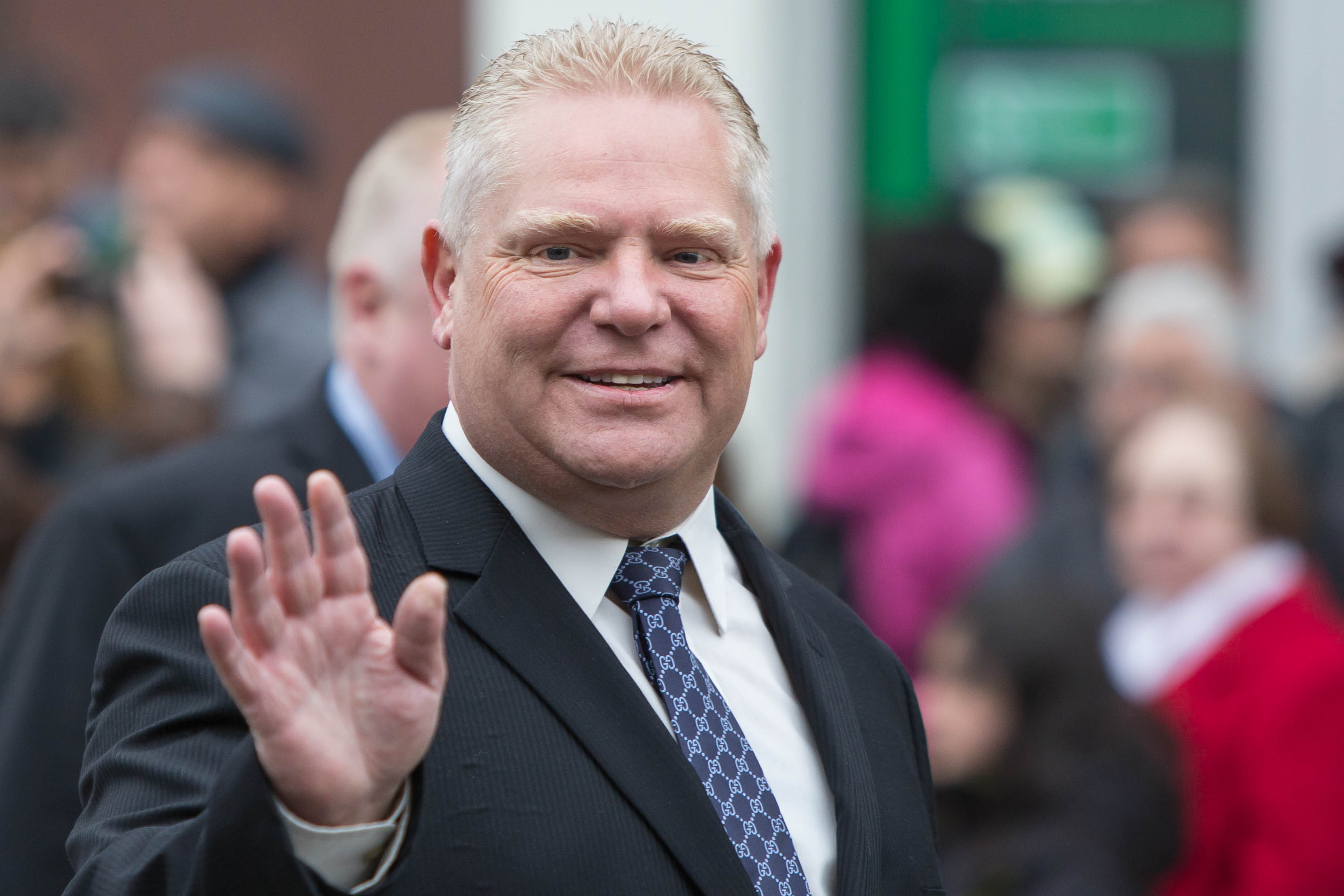
Doug Ford at the 2014 Good Friday procession in East York, Ontario.
Photo via Wikimedia Commons.

Doug Ford’s victory was in some measure due to his promise — I believe a heartfelt one — to repeal the sex ed curriculum in Ontario schools. I assume there’s a replacement program in the works. A sex-ed vacuum is not politically tenable, or even what most conservative parents want.

What principles will undergird a Doug Ford inspired curriculum? I’d suggest four guidelines for his consideration.

First, take sex ed out of the hands of ideologues and activists. Constitute a task force made up of a variety of stakeholders, involving both liberal and conservative parents (including parents of LGBT students), disinterested scientific authorities and, yes, religious representatives, to hammer out recommendations for a sex ed paradigm, in which science is separated from theory, and in which proponents of morality and modesty-based sex ed have a voice and a vote.

Second, revisit the underlying premise in sex ed today that all children must learn everything under the sun that touches on sexuality from the state.

[…]

Third, there is the question of readiness. Children can be taught the facts of biology quite early, but there is no need to engage young children in detailed discussion of sexual preferences before they fully understand the nature of sexual desire. It is obviously appropriate to warn against internet porn and social media perils at a fairly early age, and the reality of same-sex couples (including parents of students) openly acknowledged, but full engagement in the nature of sexual desire in all its diversity and detail is best left for adolescence.

Finally, nowhere is the need for distinction between science and theory more urgently required than in the area of transgenderism.

Much of what children are learning about transgenderism today, at a very tender age, is not science-based, but activist-dictated theory that can result in psychological harm.

Tales of Cromwell tanks

Filed under: Books, Britain, History, Military, Technology, WW2 — Tags: , , , — Nicholas @ 02:00

Lindybeige
Published on 6 Apr 2016

War memoirs are filled with amazing anecdotes. Here I relate two, and ramble a bit about British WW2 tank units.
Support me on Patreon: https://www.patreon.com/Lindybeige

I am likely to return to this topic – anecdotes from war memoirs. It is a rich vein of stories. These come from Troop Leader by Bill Bellamy, which describes the author’s time commanding a trio of fast Cromwell tanks in World War Two, when fighting the Germans in Holland.

Lindybeige: a channel of archaeology, ancient and medieval warfare, rants, swing dance, travelogues, evolution, and whatever else occurs to me to make.

QotD: Vegetarians

Filed under: Food, Health, Humour, Quotations — Tags: — Nicholas @ 01:00

Vegetarians, and their Hezbollah-like splinter-faction, the vegans, are a persistent irritant to any chef worth a damn.

To me, life without veal stock, pork fat, sausage, organ meat, demi-glace, or even stinky cheese is a life not worth living.

Vegetarians are the enemy of everything good and decent in the human spirit, an affront to all I stand for, the pure enjoyment of food. The body, these waterheads imagine, is a temple that should not be polluted by animal protein. It’s healthier, they insist, though every vegetarian waiter I’ve worked with is brought down by any rumor of a cold.

Oh, I’ll accomodate them, I’ll rummage around for something to feed them, for a ‘vegetarian plate’, if called on to do so. Fourteen dollars for a few slices of grilled eggplant and zucchini suits my food cost fine.

Anthony Bourdain, Kitchen Confidential, 2007.

July 4, 2018

The War of 1812 on the frontier

Filed under: Britain, Cancon, History, Military, USA — Tags: , , , — Nicholas @ 06:00

Danny Sjursen on what he calls the “Forgotten and Peculiar War of 1812”, specifically the odd situation on the US/Canadian border:

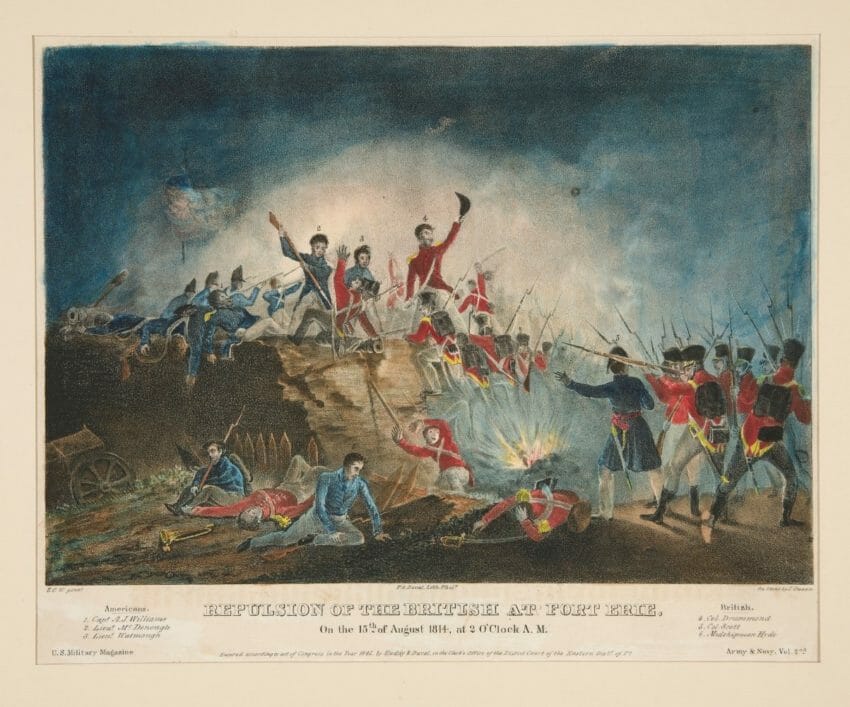
A lithograph based on an E.C. Watmough painting titled “Repulsion of the British at Fort Erie, 15 August 1814.” It depicts an attack that occurred at the U.S.-Canadian border during the War of 1812.
Image via AntiWar.com

“The acquisition of Canada, this year, as far as the neighborhood of Quebec, will be a mere matter of marching.” —Thomas Jefferson (1812)

“People speaking the same language, having the same laws, manners and religion, and in all the connections of social intercourse, can never be depended upon as enemies.” —Baron Frederick de Gaugreben, British officer, in 1815

No one seems to know this (or care), but the United States had long coveted Canada. In two sequential wars, the U.S. Army invaded its northern neighbor and intrigued for Canada’s incorporation into the republic deep into the 19th century. Here, on the Canadian front, the conflict most resembled a civil war.

Canada was primarily (though sparsely) populated by two types of people: French Canadians and former American loyalists — refugees from the late Revolutionary War. Some, the “true” loyalists, fled north just after the end of the war for independence. The majority, however, the “late” loyalists, had more recently settled in Upper Canada between 1790 and 1812. Most came because land was cheaper and taxes lower north of the border. Far from being the despotic kingdom of American fantasies, Canada offered a life rather similar to that within the republic. Indeed, this was a war between two of the freest societies on earth. So much for modern political scientists’ notions of a “Democratic Peace Theory” — the belief that two democracies will never engage in war. Britain had a king, certainly, but also had a mixed constitution and one of the world’s more representative political institutions.

In many cases families were divided by the porous American-Canadian border. Loyalties were fluid, and citizens on both sides spoke a common language, practiced a common religion and shared a common culture. Still, if and when an American invasion came, the small body of British regular troops would count on these recent Americans — these “late” loyalists — to rally to the defense of mother Canada.

And came the invasion did. Right at the outset of the war in fact. Though the justification for war was maritime and naval, the conflict opened with a three-pronged American land invasion of Canada. The Americans, for their part, expected the inverse of the British hopes — the “late” loyalists, it was thought, would flock to the American standard and support the invasion. It never happened. Remarkably, a solid base of Canadians fought as militiamen for the British and against the southern invaders. Most, of course, took no side and sought only to be let alone.

It turned out the invading Americans found few friends in Canada and often alienated the locals with their propensity for plundering and military blunder. Though the war raged along the border — primarily near Niagara Falls and Detroit — for nearly three years the American campaign for Canada proved to be an embarrassing fiasco. Defeats piled up, and Canada would emerge from the war firmly in British hands. In the civil war along the border, the Americans were, more often than not, the aggressors and the losers.

[…]

The Treaty of Ghent, which ended the war, changed nothing. There was no change of borders, and the British said nothing about impressment — the purported casus belli! So just what had those thousands died for?

Certainly it was no American victory that forced the British to the peace table. By 1814 the war had become a debacle. Two consecutive American invasions of Canada had been stymied. Napoleon was defeated in April 1814, and the British finally began sending thousands of regular troops across the Atlantic to teach the impetuous Americans a lesson — even burning Washington, D.C., to the ground! (Though in fairness it should be noted that the Americans had earlier done the same to the Canadian capital at York.) The U.S. coastline was blockaded from Long Island to the Gulf of Mexico; despite a few early single ship victories in 1812, the U.S. Navy was all but finished by 1814; the U.S. Treasury was broke and defaulted (for the first time in the nation’s history) on its loans and debt; and 12 percent of U.S. troops had deserted during the war.

The Americans held few victorious cards by the end of 1814, but Britain was exhausted after two decades of war. Besides, they had never meant to reconquer the U.S. in the first place. A status quo treaty that made no concessions to the Americans and preserved the independence of Canada suited London just fine.

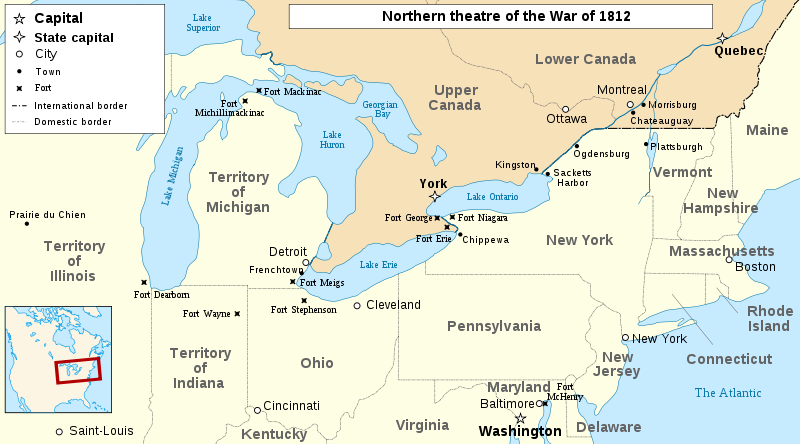
Northern theatre of the War of 1812 (note that Ottawa was not founded until 1826 and shouldn’t appear in this view, and the Niagara River is shown at least 45 degrees off its actual course)
Image via Wikimedia Commons

It’s never a good idea to expand the power of the state

Francis Porretto on the problem of giving the state yet another tool for its already overflowing toolbox:

    The party in power is smug and arrogant. The party out of power is insane.” – Megan McArdle, a.k.a. “Jane Galt”

Among the older maxims of politics is to beware handing the State a new power without first reflecting on how your opponents could use it against you. For as sure as the Sun rises in the East, your opponents will return to dominance someday, and whatever powers you awarded the State will be in their hands.

Just now, the focus is on President Trump’s choice of a replacement for retiring Supreme Court Associate Justice Anthony Kennedy. The Democrats are tearing their collective hair out over this, as now that the filibuster is a dead letter for judicial appointees, their minority status in the Senate leaves them no way to block his selection. Yet it was Senate Democrats during the Obama Administration who first attacked the filibuster – when they were in the majority and sought to confirm Obama appointees. Coulda told ‘em then, but they weren’t in a mood to listen.

Today’s critical battles are over freedom of expression and “deplatforming.”

Some folks of sound mind and generally good will are exercised about how Silicon Valley giants such as Facebook and Twitter regulate their immensely popular social-media platforms to disfavor conservatives. The complaints have been many, and a great many of them are both accurate (i.e., the things complained about really happened) and valid (i.e., only persons of conservative or libertarian bent were silenced). However, they come up against a barrier that’s proved impassable to date: the right of private property.

So a lot of those folks have embraced the notion that those platforms could be regulated by the federal government as public accommodations. That’s the conception under which the Civil Rights Acts were deemed to hold legitimate authority over restaurants, hotels, movie theaters, and other nominally private properties. If you present your facility as “open to the public,” the logic runs, then you can be forbidden to discriminate – i.e., to provide your services to some members of the “public” but not others.

(For those who remember the “nationwide Bell System,” the phrase common carrier might rise to mind. The concept is essentially the same, as was the federal government’s assertion of authority over it. However, in that particular case, the rationale was that the Bell System was a monopoly, protected by that same federal government. Telecom deregulation and the breakup of the Bell System put paid to that scheme, thank God.)

Those in the Right who favor this notion are asking for trouble. Someday the balance of power will shift leftward once again. What would the Democrats – an increasingly totalitarian bunch who’ve never seen a law, a regulation, or a tax it didn’t love – do with the precedent that an Internet platform can be regulated as a public accommodation, despite being private property?

H/T to Bill St. Clair for the link.

Open office plans do not increase personal interaction among workers

Filed under: Business, Health, Technology — Tags: , , , — Nicholas @ 03:00

From the abstract of a recent study:

Example of an open plan office
Photo by VeronicaTherese via Wikimedia Commons.

Organizations’ pursuit of increased workplace collaboration has led managers to transform traditional office spaces into ‘open’, transparency-enhancing architectures with fewer walls, doors and other spatial boundaries, yet there is scant direct empirical research on how human interaction patterns change as a result of these architectural changes. In two intervention-based field studies of corporate headquarters transitioning to more open office spaces, we empirically examined — using digital data from advanced wearable devices and from electronic communication servers — the effect of open office architectures on employees’ face-to-face, email and instant messaging (IM) interaction patterns. Contrary to common belief, the volume of face-to-face interaction decreased significantly (approx. 70%) in both cases, with an associated increase in electronic interaction. In short, rather than prompting increasingly vibrant face-to-face collaboration, open architecture appeared to trigger a natural human response to socially withdraw from officemates and interact instead over email and IM. This is the first study to empirically measure both face-to-face and electronic interaction before and after the adoption of open office architecture. The results inform our understanding of the impact on human behaviour of workspaces that trend towards fewer spatial boundaries.

This certainly matches my own experiences working at companies that changed their offices to more open or fully open spaces. The accountants may have loved the new spaces as being less expensive, but one of the key advantages claimed for open designs does not appear to be true.

H/T to Claire Lehmann for the link.

Tank Chats #32 Cromwell | The Tank Museum

Filed under: Britain, History, Military, Technology, WW2 — Tags: , — Nicholas @ 02:00

The Tank Museum
Published on 24 Feb 2017

The thirty second in a series of short films about some of the vehicles in our collection, presented by The Tank Museum’s historian David Fletcher MBE. The Second World War, British, Cromwell tank was one of the fastest tanks of the war.

QotD: “The world is rich and will become still richer. Quit worrying”

Filed under: Economics, Food, History, Quotations — Tags: , , , — Nicholas @ 01:00

Not all of us are rich yet, of course. A billion or so people on the planet drag along on the equivalent of $3 a day or less. But as recently as 1800, almost everybody did.

The Great Enrichment began in 17th-century Holland. By the 18th century, it had moved to England, Scotland and the American colonies, and now it has spread to much of the rest of the world.

Economists and historians agree on its startling magnitude: By 2010, the average daily income in a wide range of countries, including Japan, the United States, Botswana and Brazil, had soared 1,000 to 3,000 percent over the levels of 1800. People moved from tents and mud huts to split-levels and city condominiums, from waterborne diseases to 80-year life spans, from ignorance to literacy.

You might think the rich have become richer and the poor even poorer. But by the standard of basic comfort in essentials, the poorest people on the planet have gained the most. In places like Ireland, Singapore, Finland and Italy, even people who are relatively poor have adequate food, education, lodging and medical care — none of which their ancestors had. Not remotely.

Inequality of financial wealth goes up and down, but over the long term it has been reduced. Financial inequality was greater in 1800 and 1900 than it is now, as even the French economist Thomas Piketty has acknowledged. By the more important standard of basic comfort in consumption, inequality within and between countries has fallen nearly continuously.

Dierdre N. McCloskey, “The Formula for a Richer World? Equality, Liberty, Justice”, New York Times, 2016-09-02.

July 3, 2018

French North Africa in World War 1 I THE GREAT WAR Special

Filed under: Africa, France, History, Military, WW1 — Tags: , , , , , , — Nicholas @ 04:00

The Great War
Published on 2 Jul 2018

Algeria, Tunisia and Morocco were all part of French North Africa before and during World War 1. They all contributed in material and men to the war effort and the French colonial soldiers were praised for their bravery.

Andrés Manuel López Obrador wins Mexican presidential election

Filed under: Americas, Government, Politics — Tags: , — Nicholas @ 03:00

Tom Phillips and David Agren report from Mexico City for the Guardian:

A baseball-loving leftwing nationalist who has vowed to crack down on corruption, rein in Mexico’s war on drugs and rule for the poor has been elected president of Latin America’s second-largest economy.

Andrés Manuel López Obrador, President-Elect of Mexico, who will assume office on 1 December, 2018
Photo via Wikimedia Commons

Andrés Manuel López Obrador, a silver-haired 64-year-old who is best known as Amlo and counts Labour leader Jeremy Corbyn among his friends, was elected with at least 53% of the vote, according to a quick count by Mexico’s electoral commission.

López Obrador’s closest rival, Ricardo Anaya from the National Action party (PAN), received around 22% while José Antonio Meade, a career civil servant running for the Institutional Revolutionary party, or PRI, which ruled Mexico for most of last century, came in third with around 16%.

Addressing the media after those results were announced, López Obrador vowed to repay the trust put in him by millions of Mexicans. “I will govern with rectitude and justice. I will not fail you. I will not disappoint you. I won’t betray the people,” he said.

Mexico’s president-elect vowed to rule for people of all social classes, all sexual orientations and all points of view. “We will listen to everyone. We will care for everyone. We will respect everyone,” he said. “But we will give priority to the most humble and to the forgotten.”

[…]

Analysts also expect him to pursue a less aggressive and less militarised approach to Mexico’s 11-old ‘war on drugs’ which has claimed an estimated 200,000 lives and is widely viewed as a calamity. During the campaign, Amlo has argued “you cannot fight violence with more violence, you cannot fight fire with fire” and proposed an amnesty designed to help low-level outlaws turn away from a life of crime.

Eric Olson, a Mexico and Latin America specialist from Washington’s Woodrow Wilson Centre, said he saw Mexico stepping back from regional affairs under its new leader. “Amlo is not an internationalist … we can expect him to play less of an active role in the region on Venezuela, on Nicaragua and other trouble spots.”

Olson also expected tense moments with US president Donald Trump whose family separation policy Amlo recently denounced as arrogant, racist and inhuman. “But it’s impossible for the US to walk away from Mexico or for Mexico to walk away from the US. They are joined at the hip and need to work together even if their presidents don’t like each other and don’t get along.”

Carlos Bravo, a politics expert from Mexico City’s Centre for Economic Research and Teaching, predicted President Amlo would make fighting poverty a flagship policy, just as former Brazilian president Luiz Inácio Lula da Silva did after his historic 2002 election with projects such as Bolsa Família and Zero Hunger. Under Amlo he foresaw “massive investment in social policy” which Mexico’s new president could use to show he was attacking not just poverty and inequality but also the social roots of crime and violence.

However, Bravo said the “motley coalition” behind Amlo’s election triumph was so diverse – featuring former communists, ultra-conservatives and everything in-between – that trying to guess how he might rule was a fool’s errand. “Quite frankly, right now there is a lot of uncertainty regarding what the López Obrador government will do.”

The Animals – The House of the Rising Sun

Filed under: Britain, Media — Tags: , — Nicholas @ 02:00

José Antonio
Published on Sep 3, 2010

By José Antonio…. Because the original version of this video, has low quality in both audio and video, I took the trouble to improve with better sound, better image quality, better zoom and better edition with the best of intentions, thanks.

En vista de que la versión original de este video, tiene baja calidad tanto en audio como en video, me tomé la molestia de mejorarlo con mejor sonido, mejor calidad de imágen, mejor zoom y mejor edición con la mejor de las intenciones, gracias.

QotD: The fatal conceit

Filed under: Economics, Government — Tags: — Nicholas @ 01:00

… each of these questions, like the larger point made here, applies not only to proposals for complete, economy-wide central planning of the sort that was fashionable during the mid-20th century. These questions apply to any proposal for government direction of economic affairs, however ‘partial’ it might be (or seem to be).

We can all agree, for example, that economic equality is fine thing – but do we count only monetary income as relevant for assessing equality, or do we count monetary income plus monetary wealth? What about the value of voluntarily chosen leisure: does it count? if not, why not? if so, how is it weighed against monetary income or wealth? And even if we all agree upon just what sources of utility do and don’t count as relevant for assessing economic equality, and agree also on the weights of the various sources of utility for making this assessment, how is the goal of economic equality itself to be traded off against competing goals – such as economic growth, or environmental sustainability (however that might be defined!)?

The previous paragraph gives only one small example of a huge problem that confronts those who believe that entrusting the state with the power to engineer economic outcomes is really just a matter of science, of empirically discovering the allegedly objective costs and benefits of various economic arrangements and then choosing that particular arrangement that best satisfies society’s object preferences.

The very notion that there is an objective ‘best’ arrangement of economic affairs that can be discovered independently of actual market processes and then imposed by the state to improve everyone’s, or most everyone’s, well-being is, truly, a fatal conceit.

Don Boudreaux, “Quotation of the Day…”, Café Hayek, 2016-09-03.

July 2, 2018

Mark Steyn on 49th Parallel

Filed under: Cancon, Germany, History, Military, WW2 — Tags: , , , , — Nicholas @ 05:00

His annual Canada Day post this year featured a World War 2 British film about Canada intended for Americans:

The film stars, in order of billing, Leslie Howard, Laurence Olivier, Raymond Massey, Anton Walbrook, Eric Portman “and the music of Ralph Vaughan Williams”, which gets an above-the-title credit – as well it should. Vaughan Williams’ score is an integral part of the picture and, if not especially Canadian (save for a very short evocation of Calixa Lavallée’s “O Canada” right at the beginning), accompanies the country’s physical landscape beautifully, particularly in the opening travelogue, mostly shot by Freddie Young leaning out of a plane with a hand-held camera and edited back in England by David Lean. (Lean and Young, of course, subsequently worked together on Lawrence of Arabia, Doctor Zhivago and Ryan’s Daughter.) And, if you’re thinking that (with one exception) none of these participants seems terribly Canuck, well, if it’s any consolation, the English also get to play all the Nazis, too. The Canadians are largely relegated to small roles and extras – like the real seamen who play the survivors of the Canadian ship torpedoed in the Gulf of St Lawrence at the opening of the picture. “So,” pronounces the German U-boat commander, “the curtain rises on Canada.”

U-37 decides to flee to Hudson’s Bay to evade the RCAF and RCN patrols looking for it. Six Germans are put ashore to scout for supplies. But, even as they set foot on land, they hear the swoop of planes and look back to see Canadian bombers destroying their submarine. In order to lend verisimilitude to the scene, Michael Powell destroyed a real – or real-ish – sub, built for him in Halifax, Nova Scotia. The RCAF gave him two thousand-pound bombs to make it look good, and he put them on “U-37” and was cunning enough to neglect to tell the actors, lest it made them nervous. The sub was then towed to the Strait of Belle Isle between Labrador and Newfoundland to be blown sky high. That was Powell’s only mistake. Notwithstanding that he named the film after Canada’s southern border, the director’s grip on the country’s eastern border was a little hazier. He had forgotten that Newfoundland was not (yet) in Canada but was a British possession in its own right. So HM Customs impounded “U-37” and Powell had to go directly to the Governor to get it back.

Other than that, he and Pressburger didn’t put a foot wrong. The location footage was impressive in its day, and still striking in ours; Pressburger’s script is subtle and humane; and the episodic structure allows for plenty of variety. Following the loss of U-37, the six Germans are now beached in northern Canada and have to figure out a way to get to safe, neutral America. They make their way to a Hudson’s Bay trading post, where the factor (played by the great Scots actor Finlay Currie) is welcoming back an old friend who’s spent the last eleven months hunting in the wilds and so has no idea Canada is at war. Johnny is a French-Canadian trapper played by – who else? – Laurence Olivier. We first meet him in the bath tub singing “Alouette”, and, as often with Olivier, the attention to detail on the accent is so good that it becomes oddly intrusive: “Diss is one big country, but verra few pipple. Ever-wan know ever-body. You can’t make goosestep trew it widdout da police fine out,” he tells the senior German officer (Eric Portman).

The window shot Michael Powell uses to get the Nazis into the factor’s small cabin is cool and clinical and all the more chilling for it. The six Germans enter and announce that they’re now in control. When you’ve just come in off the tundra after eleven months and you want to have a soak in the tub and unwind, the Master Race showing up is a bit of a downer. “Okay, you are German. Why yell about it? I am Canadian,” says the Frenchie. “He is Canadian” – he points to the Scots factor – “and he is Canadian” – and to the smiling eskimo lad: French, English and Inuit all with the same unhyphenated label “Canadian”. That’s a lot simpler than the fractious diversity at Parliament Hill earlier today.

The Nazi lieutenant attempts to beguile his captives with a copy of Mein Kampf, but Trapper Johnny isn’t interested. “What’s the matter with Negroes?” he asks.

“They’re semi-apes,” explains the German. “One step above the Jews.” This is something of a remote concern at a Hudson’s Bay trading post. The Nazis seems as enraged by their prisoners’ geniality as by anything else. As they depart, one tears a portrait of the King and Queen off the wall and carves a swastika into the space.

Pressburger’s plot follows as you’d expect: There are six Germans, and soon there will be five, and then four, three, two… From Hudson’s Bay, they commandeer a seaplane that crashes near a Hutterite community in Manitoba, where a young pre-Mary Poppins Glynis Johns is sweetly trusting of them. They make their way to Indian Day in Banff National Park, for a rather Hitchcockian scene, and thence to a camp in the Rockies, where an arty pacifist (Leslie Howard) is discoursing on Thomas Mann. The tone is set by Olivier’s Frenchie coming in from the bush: He may not be interested in war, and nor is Glynis Johns or Leslie Howard. But war is interested in them. This was the purpose of the film, as the British Ministry of Information saw it: That’s why they wanted it set in Canada, rather than in, say, England, across the Channel from Occupied Europe. These trappers, Hutterites, and pacifists didn’t come looking for trouble. But, even five thousand miles from the fighting, trouble came looking for them – in big, empty, peaceable Canada. And the implicit message to America was: In the end, it will come for you, too. There is no 49th Parallel. Whichever side of it you’re on, it’s the same side.

History of Non-Euclidean Geometry – Lies – Extra History – #6

Filed under: History, Science — Tags: , — Nicholas @ 04:00

Extra Credits
Published on 30 Jun 2018

You gently corrected out our math mistakes and artistic slip-ups, and we’re here to tell you it was all part of Bismarck’s plans—er, it’s Euclid’s fault. Time for another episode of Lies!

The holy book of Marx and the religion of progress

Filed under: Europe, History, Politics, Religion, USA — Tags: , , — Nicholas @ 03:00

In the latest Libertarian Enterprise, Sarah Hoyt discusses the religious nature of progressive thought in the western world:

While the left not only filled every nook and cranny of twentieth century “narrative industries” to the point the only way a conservative could work in one of those was under deep, deep cover, the engineers made the internet.

The left didn’t even know it really had any serious opposition left. You can’t blame them too much. Even those of us who were very opposed and very disgusted kept it polite in public and treated them as retarded children who couldn’t take opposition.

Would it have made any difference if we’d talked back, say 30 years ago?

I doubt it.

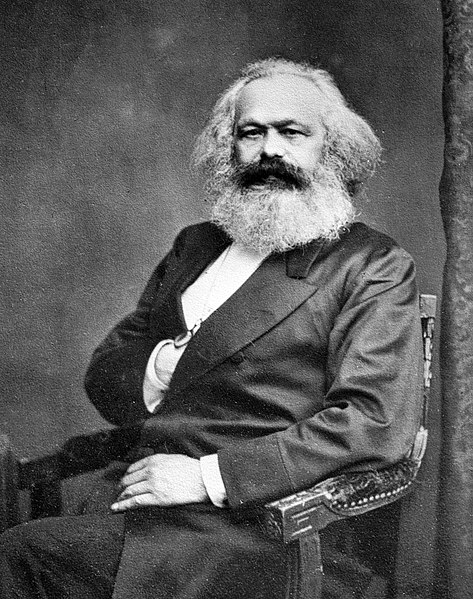
You see, leftism is as much as anything else a religion. The crazy Marx with his vision of the future created an entire narrative from paradise (pre-capitalism, i.e. it never existed, guys, not even as apes. Apes, as we now know, trade) through fall into capitalism to eventual paradise again, where the New Man (what used to be called the Soviet Man) will be so altruistic and communally oriented that a government isn’t needed. (Like the peace of Islam, there’s only one way to obtain that, and no. Just no. Worldwide species extinction is as fantastical as the idea of that primordial paradise. Humans are humans, and someone will survive. I’m just not interested in letting them send us back ten thousand years.)

You hear it in the talk of the left — particularly the rather intellectually inbred fourth generation, who ate the pap the older people fed them and never had an original thought in their lives — stuff like calling us “reactionaries” (when they’re the ones in power, and have been for a long time, and the ones knee-jerk reacting) and talking about “the future” as belonging utterly to them, and the arrow of history, as though history were the chart in their book, with an arrow beneath.

Their faith doesn’t align particularly well with reality. For instance there’s the whole thing of them talking about us — always — as though we were the ones in power, when they have all the gatekeeping positions and all the contacts.

This dissonance has required them to make up invisible monsters that give us all the power: Patriarchy (a laughable idiocy in America and weak everywhere in the west. While they refuse to see it in the Middle East and Latin America where it actually exists in spades.) Micro aggressions. White privilege (which is so strong that it gives an edge to concentration camp survivors.)

All the while they refuse to admit the real privilege: Leftist privilege. The fastest way to rise in the narrative fields is to be lefter-than-thou. Because they’re in charge and that’s how the system is setup, so they can stay in charge.

Unfortunately this has created their isolation. You see, every song, every movie, ever history book, every fictional book, assures them they’ll win. They know that “the people united shall never be defeated.” They also know that though held back by patriarchy, racism, sexism and all the micro aggressions, the people really are with them. HAVE TO BE, because they’re ideology of the future, and history’s arrow points to their paradise. Every book, movie, etc. says so either subtly or openly. So they KNOW. Everybody knows.

« Newer PostsOlder Posts »

Powered by WordPress