
TheSnakeCharmer
Published on 4 Jun 2018When a 200 year old Traditional Scottish Folk song gets a Punjabi Dubstep revival by The Snake Charmer. A multi cultural music video with Britain’s Castles, highland dancers, Bagpipes, Graffiti walls from India, punjabi folk, bhangra dancers, Russian violinist and a crazy dhol player get together to showcase the amazing diversity in the world and how we all have something in common and can contribute to each other despite the distance and differences. Enjoy this brand new Celtic punjabi mix with Bagpipes.
Patreon (Support me for as less as $1) – https://www.patreon.com/thesnakecharmer
GET MP3
iTunes – https://goo.gl/eoszgf
Google Play – https://goo.gl/3sGBgbBagpipes – Archy Jay
Violin – MadinaHighland Dancers – Northumberland Church of England Academy combined cadet Force, Laura Greyson, Whistle School of Highland Dance.
Bhangra Group – https://www.facebook.com/bhangrainspire/
Dhol Player – Sarthak Pahwa
July 2, 2018
Drowsy Maggie – Scottish Indian Punjabi Mix (The Snake Charmer)
QotD: Perverse incentives, death penalty edition
People cheered when, in the 1990s, Speaker of the House Newt Gingrich advocated mandatory executions for drug dealers. But economists wondered why Gingrich wanted to decrease the penalty for murder. How does the death penalty for drug dealers decrease the penalty for murder? Think about it this way: Suppose that Gingrich’s bill becomes law and the police bust into an apartment where three drug dealers have hidden their stash. What happens? The drug dealers know that if they give up, they will be put to death. So why not try to kill the police? If the dealers are lucky, they get away. If the dealers are unlucky, they are no worse off than if they didn’t fight because when drug dealing is a capital offense, drug dealers face no additional penalty for murder.
Tyler Cowen and Alex Tabarrok, Modern Principles: Microeconomics (3rd Edition), 2015.
July 1, 2018
Mapping medieval trade routes
Open Culture linked to a fascinating new map by a Swedish grad student, showing trade routes during the Medieval period:
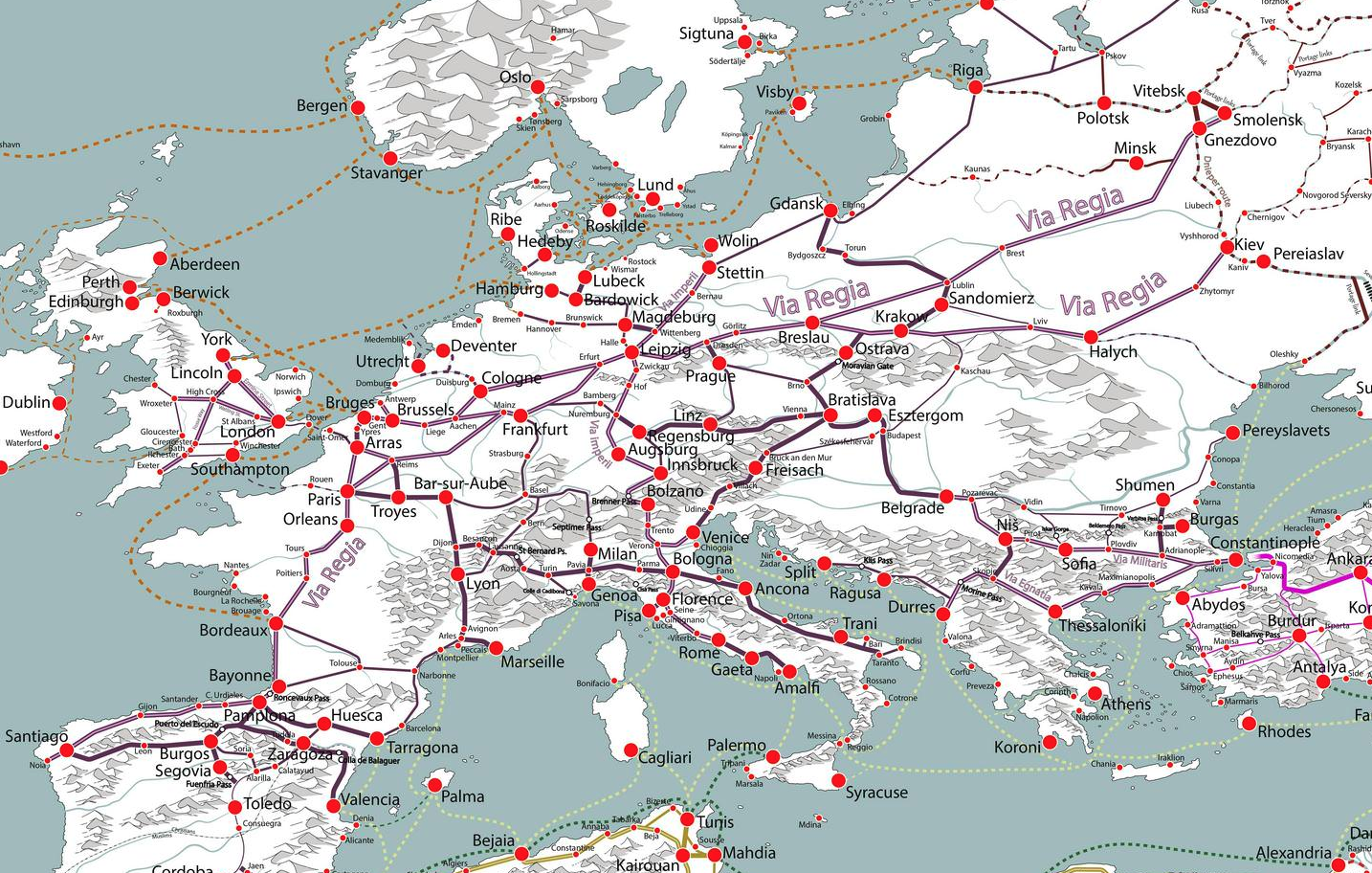
A small portion of Martin Jan Månsson’s trade map of the Middle Ages.
“I think trade routes and topography explains world history in the most concise way,” Månsson explains in the very small print at the map’s lower right corner. “By simply studying the map, one can understand why some areas were especially important–and remained successful even up to modern times.”
The map covers 200 years, spanning both the 11th and 12th centuries, and “depicts the main trading arteries of the high Middle Ages, just after the decline of the Vikings and before the rise of the Mongols, the Hansa and well before the Portuguese rounded the Cape of Good Hope.”
It also shows the complex routes already available to Africa and Asia, and the areas where Muslim and Christian traders would meet. The open-to-trade Song Dynasty ruled China, and the competitive kingdoms in the Indonesia region provided both Muslims and Europeans with spice.
Looking like a railway map, Månsson’s work shows how interconnected we really were back in the Middle Ages, from Greenland in the west to Kikai and Kagoshima in the East, from Arkhangelsk in the frozen north to Sofala in modern-day Mozambique.
The full-sized, high-resolution map can be downloaded here.
Update: Tim Worstall was kind enough to link to this post and uses Månsson’s map to help explain the gravity model of trade:
A standard observation is that places which are closer together trade with each other more than places which are further apart. Add to that the thought that larger economies will trade more with other larger economies – well, you know, more economic activity means more economic activity – and you get the gravity model of trade. So, therefore Britain’s trade future lies with those places nearby, in the EU, than with places further away like the Commonwealth or the US.
This is, sadly, actually the level of debate over Brexit at times. We should trade with France because it’s 26 miles away, so there. The point being that while the gravity model is true – among the best empirically supported of all economic observations – that’s not actually what it says. Rather, that those places which are closer by trade distance trade more with each other. Trade distance being a more complex point than mere geographical location.
[…]
The point here being that by showing the trade routes it is showing us this trade, or perhaps economic, distance which is what the gravity model is about. Valencia and Palma were very much closer – and trade very much more – than Valencia and Toledo, despite roughly equal distances crowfly wise.
Naval Legends: HMCS Haida | World of Warships
World of Warships Official Channel
Published on 28 Jun 2018“The most fightingest ship of the Royal Canadian Navy”, and the last survivor of the Tribal-class! Find out more in the new Naval Legends episode!
Naval Legends is a series about the construction, service, and daring deeds of legendary 20th-century ships. Very few vessels survived World War I and II — most were decommissioned and scrapped. The Naval Legends production crew travels all across the globe to visit almost every active museum ship and chronicle her story.
Each episode has our own footage, military chronicles, and data from archives. The story of each ship is narrated by military historians, museum staff, and navy veterans for maximum historical accuracy. Computer graphics based on archival blueprints illustrate critical engineering elements and components, along with the ship’s armament, so you can observe these colossal war machines from your armchair!
Over-generous subsidies encourage fraud and waste
At Catallaxy Files, Rafe Champion continues discussing Matt Ridley’s book Climate Science: The Facts:
Ridley went on to criticise biodiesel programs and the promotion of diesel cars. Then he mentioned one of the most outlandish schemes – the clearing of forests on the west coast of the US to convert into wood pellets to burn in British furnaces instead of coal to generate electricity. The Daily Mail reported that this was one of the legacies of Energy Secretary Chris Huhne.
Mr Huhne, who served in the coalition government and was later jailed for perverting the course of justice, championed the energy source in office and is now European chairmen of Zilka Biomass, a US supplier of wood pellets.
Nice work if you can get it.
And then there are the household biomass furnaces in Britain, promoted by Huhne under the Renewable Heat Incentive (RHI) scheme whereby businesses and households pay for a renewable energy boiler upfront then receive payments for up to 20 years depending on the amount of heat they produce.
Some unscrupulous homeowners can double the amount they produce by using heat generated under the RHI to dry wood or other materials.
This can then be fed back into the boiler to burn it and generate even more heat – and money from the public purse.
The scheme was started in 2011 by Chris Huhne, then Liberal Democrat energy secretary, for businesses then extended to domestic customers three years later. Households and firms can apply for grants to switch from fossil fuel heating systems to renewable ones such as biomass boilers, which burn wood pellets, chips or logs.
As the scheme is open to applications until 2021, final payments to participants will run to at least 2041. By this time, the bill for taxpayers is expected to hit £23billion.
Closely related is the the Irish “Cash for Ash” scandal that paid more than the cost of the fuel. An orgy of corruption was sparked by renewables in Spain and there was the strange phenomenon of solar power generated in the dark because the Spanish subsidy was initially so generous is was worthwhile to shine diesel-powered lights on the panels overnight.
A point about historical advisors in films
Lindybeige
Published on 24 Mar 2011In which I relate an anecdote which is fairly depressingly illuminating when it comes to how much Hollywood really cares about historical authenticitude.
QotD: Homework
Let’s end homework forever — just end it now — and open up more daylight hours for life’s inexhaustible succession of microlessons. Knowing how to paddle a canoe, or fix a faucet, or work a cash register, or bake a coffeecake, or comfort someone who is unhappy, is much more important than knowing the names of the six kingdoms of living organisms, or the layers of the atmosphere, even if you’re going to become a naturalist or an atmospheric physicist — and paddling and faucet-fixing and cash-registering and cake-baking and the offering of sympathy, like most memorable proficiencies, happen best when they’re voluntary, after school is out.
Nicholson Baker, “Fortress of Tedium: What I Learned as a Substitute Teacher”, New York Times Magazine, 2016-09-07.


