Quotulatiousness

May 9, 2015

Every time you extend copyright terms, you reduce the availability of our musical heritage

Filed under: Business, Cancon, Law — Tags: , , — Nicholas @ 03:00

Michael Geist on the negative aspects of the Canadian government’s surprise extension of copyright terms:

The government yesterday tabled its budget implementation bill (Bill C-59), which includes provisions to extend the term of copyright for sound recordings and performances. The extension adds 20 years to the term (to 70 years). It also caps the term at 100 years after the first fixation of the sound recording or performance. The change is not retroactive, so sound recordings currently in the public domain will stay there. The government’s unexpected decision to extend the term of copyright for sound recordings and performances will not only cost consumers by reducing competition and stop cheaper, legal music alternatives from coming to the market – but it will also reduce access to Canada’s music heritage.

This is the inescapable conclusion based on studies elsewhere, which find that longer copyright terms discourage re-issuing older releases, which often means that the musical heritage is lost. For example, Tim Brooks conducted a detailed study in 2005 on how copyright law affects reissues of historic recordings. He concluded that longer copyright terms significantly reduce public access. First, he examined the data in the United States, which at the time had the longest term of protection:

    our analysis shows that rights-holders have reissued – or as a practical matter allowed legal access to – only a small fraction of the historic recordings they control. Overall, 14 percent of listed pre-1964 recordings were found to be available from rights holders, mostly from the 1940s, 1950s and early 1960s. The figure drops to ten percent or less for most periods prior to World War II, and approaches zero for periods before 1920. This study focused on recordings in which there is demonstrated interest; it is likely that the percent of all recordings that have been reissued is even less.

Fighting in 15th century plate armour

Filed under: Europe, History, Weapons — Tags: , — Nicholas @ 02:00

By way of Open Culture, here’s a brief video of what you could do while wearing full plate armour of the mid- to late-fifteenth century:

Above, Le Musée National du Moyen-Âge (otherwise known as The National Museum of the Middle Ages) and The University of Geneva recreate fight scenes from the 15th century, demonstrating the movements and techniques of combatants who clanked around in full suits of armor. If you’re like me, you’re watching with surprise — surprised by their agility and dexterity. Wasn’t quite expecting that!

QotD: “Constructive” criticism

Filed under: Media, Quotations — Tags: , , — Nicholas @ 01:00

Upon the low practical value of so-called constructive criticism I can offer testimony out of my own experience. My books are commonly reviewed at great length, and many critics devote themselves to pointing out what they conceive to be my errors, both of fact and of taste. Well, I cannot recall a case in which any suggestion offered by a constructive critic has helped me in the slightest, or even actively interested me. Every such wet-nurse of letters has sought fatuously to make me write in a way differing from that in which the Lord God Almighty, in His infinite wisdom, impels me to write — that is, to make me write stuff which, coming from me, would ‘be as false as an appearance of decency in a Congressman. All the benefits I have ever got from the critics of my work have come from the destructive variety. A hearty slating always does me good, particularly if it be well written. It begins by enlisting my professional respect; it ends by making me examine my ideas coldly in the privacy of my chamber. Not, of course, that I usually revise them, but I at least examine them. If I decide to hold fast to them, they are all the dearer to me thereafter, and I expound them with a new passion and plausibility. If, on the contrary, I discern holes in them, I shelve them in a pianissimo manner, and set about hatching new ones to take their place. But constructive criticism irritates me. I do not object to being denounced, but I can’t abide being school-mastered, especially by men I regard as imbeciles.

H.L. Mencken, “Footnote on Criticism”, Prejudices, Third Series, 1922.

May 8, 2015

Resolved – aircraft carriers are obsolete

Filed under: Military, USA — Tags: , — Nicholas @ 04:00

Jerry Hendrix thinks it’s time the US Navy re-assesses its dependence on the aircraft carrier, specifically that the Navy needs to stop building aircraft carriers altogether:

This might seem like a radical change. After all, the aircraft carrier has been the dominant naval platform and the center of the Navy’s force structure for the past 70 years — an era marked by unprecedented peace on the oceans. In the past generation, aircraft have flown thousands of sorties from the decks of American carriers in support of the nation’s wars. For the first 54 days of the current round of airstrikes against ISIS in Iraq, the USS George H. W. Bush was the sole source of air power. But the economic, technological, and strategic developments of recent years indicate that the day of the carrier is over and, in fact, might have already passed a generation ago — a fact that has been obscured by the preponderance of U.S. power on the seas.

The carrier has been operating in low-threat, permissive environments almost continuously since World War II. At no time since 1946 has a carrier had to fend off attacks by enemy aircraft, surface ships, or submarines. No carrier has had to establish a sanctuary for operations and then defend it. More often than not, carriers have recently found themselves operating unmolested closer to enemy shores than previous Cold War–era doctrine permitted, secure in the knowledge that the chance of an attack ranged between unlikely and impossible.

Such confidence in the dominance of the carrier encouraged naval architects to put more capabilities into their design, going from the 30,000-ton Essex-class carrier in 1942 to the 94,000-ton Nimitz-class carrier in 1975. Crew size of a typical carrier went from 3,000 to 5,200 over the same period, a 73 percent increase. Costs similarly burgeoned, from $1.1 billion for the Essex to $5 billion for the Nimitz (all in adjusted 2014 dollars), owing to the increased technical complexity and sheer physical growth of the platforms in order to host the larger aircraft that operated at longer ranges during the Cold War. The lessons of World War II, in which several large fleet carriers were lost or badly damaged, convinced Navy leaders to pursue a goal of a 100,000-ton carrier that could support a 100,000-pound aircraft capable of carrying larger bomb payloads, including nuclear weapons, 2,000 miles or more to hit strategic targets, making the platform larger, more expensive, and manned with more of the Navy’s most valuable assets, its people. Today’s new class of carrier, the Ford, which will be placed into commission next year, displaces 100,000 tons of water, and has a crew of 4,800 and a price of $14 billion. The great cost of the Cold War–era “super-carriers” has resulted in a reduction of the carrier force, from over 30 fleet carriers in World War II to just ten carriers today. While the carrier of today is more capable, each of the ten can be in only one place at a time, limiting the Navy’s range of effectiveness.

And putting the case for continued dependence on the aircraft carrier as the key capital ship, Seth Cropsey and Bryan McGrath say that the situation favours the continued development and deployment of the carriers:

Hendrix invests 2,700-plus words in an argument for eliminating the aircraft carrier, yet undercuts himself effectively with only 32: “The same outside observer would also discern where the difficulty with the carrier design lies. The efficacy of the carrier lies not in the ship but in the capabilities of its planes.” This raises the question of whether Hendrix’s target is the aircraft carrier or the weapons system (airplanes) it employs. And while he wishes to ride the wave of notoriety as a notable carrier critic, his argument essentially boils down to this: “The airplanes the carrier employs require it to operate too close to danger. Therefore, we should get rid of carriers.”

This logic ignores seven decades of history and experience in which the airplanes assigned to the carrier have changed dramatically in response to the missions that were asked of the Navy. And while he quite rightly points to the current airwing’s lack of useful range as highly problematic, he fails to note this was itself a choice made by the Navy to reflect the threat environment. When the Berlin Wall fell, there was no power that could check the U.S. Navy at sea, and therefore the carrier could operate much closer to land. Aircraft range as an attribute was [de-emphasized]. Now that there is a rising threat of powers capable of more aggressively targeting the carrier, it will, in some scenarios, have to operate from farther away. If the Navy chooses to build the right airplanes, the carrier will remain central to U.S. power projection.

Keep in mind, though, that the carrier does not simply charge into the teeth of an aggressive targeting environment and disgorge itself of its strike aircraft from unending sanctuary. It fights as part of a larger combat system, that of the Joint Force. Elements of the enemy’s surveillance network would necessarily be targeted for destruction by precision weapons launched from submarines, other ships, or long-range bombers. An elaborate cyber campaign would also be key to blinding an opponent, creating a window of opportunity for the carrier to launch its strikes before relocating. As this process is repeated over time, the risks to the carrier dissipate, and it can move closer to the defended territory, thereby enabling higher-tempo strike operations.

The Lusitania Sinking & The Gorlice–Tarnów Offensive I THE GREAT WAR – Week 41

Filed under: Europe, Germany, History, Military, USA, WW1 — Tags: , , — Nicholas @ 03:00

Published on 7 May 2015

Ignoring the warnings and cruising carelessly slow the RMS Lusitania is hit by a torpedo of the German U-Boat U20. Almost 2000 people die during the sinking of the Lusitania, a sister ship of the famous RMS Titanic. At the same time the German and Austro-Hungarian army start a combined surprise offensive in the Carpathians. The Gorlice-Tarnów Offensive is a huge success for German commander August von Mackensen.

Quantum Insert

Filed under: Britain, Technology, USA — Tags: , , , , , — Nicholas @ 02:00

Kim Zetter talks about some of the NSA’s more sneaky ways of intercepting communications:

Among all of the NSA hacking operations exposed by whistleblower Edward Snowden over the last two years, one in particular has stood out for its sophistication and stealthiness. Known as Quantum Insert, the man-on-the-side hacking technique has been used to great effect since 2005 by the NSA and its partner spy agency, Britain’s GCHQ, to hack into high-value, hard-to-reach systems and implant malware.

Quantum Insert is useful for getting at machines that can’t be reached through phishing attacks. It works by hijacking a browser as it’s trying to access web pages and forcing it to visit a malicious web page, rather than the page the target intend to visit. The attackers can then surreptitiously download malware onto the target’s machine from the rogue web page.

Quantum Insert has been used to hack the machines of terrorist suspects in the Middle East, but it was also used in a controversial GCHQ/NSA operation against employees of the Belgian telecom Belgacom and against workers at OPEC, the Organization of Petroleum Exporting Countries. The “highly successful” technique allowed the NSA to place 300 malicious implants on computers around the world in 2010, according to the spy agency’s own internal documents — all while remaining undetected.

But now security researchers with Fox-IT in the Netherlands, who helped investigate that hack against Belgacom, have found a way to detect Quantum Insert attacks using common intrusion detection tools such as Snort, Bro and Suricata.

QotD: The barbarians in our midst

Filed under: Quotations, Science, Technology, USA — Tags: , , — Nicholas @ 01:00

… possibly the most dangerous barbarians live in the West. These, by being born there, assume they are Westerners by inheritance or osmosis. They also regard Western civilization as “found”, its goodies a stash waiting to be used or distributed. Nor do they trouble themselves as to its provenance, for there has always been plenty more where the stash came from.

For these barbarians Western civilization and its associated quest for God or Truth are a bothersome impediment, a “white man’s culture”, a hundred year old relic ideology nobody bothers with, some irksomely judgmental superfluity that gets in the way of fun and spreading the fruits to arrivals at the border and various victim groups.

For the barbarian the only reality is appearances. Cargo cultists, for instance, believe that function comes from form. If they build something which resembles an airport then gift giving airplanes will arrive there to bring goodies. The 21st century barbarian completely lacks the attitude of Roger Bacon, who lived in the 13th century. Bacon knew that the truth was not a “white man’s” culture — in fact in his day nearly all learning came from the East — but believed the truth was nature’s culture; baked into reality; another word for what used to be called God. Of barbarian ignorance Bacon wrote:

    Many secrets of art and nature are thought by the unlearned to be magical. … The empire of man over things depends wholly on the arts and sciences. For we cannot command nature except by obeying her.

In today’s post-Western environment, we’ve forgotten Bacon’s adage.

Richard Fernandez, “Sword and Sorcery”, Belmont Club, 2014-06-23.

May 7, 2015

The political landslide in Alberta

Filed under: Cancon, Politics — Tags: , , , — Nicholas @ 05:00

In Maclean’s, Colby Cosh reflects on the sudden end to the Conservative era in Alberta:

…[i]t made me start to believe the impossible: that Alberta could really elect an NDP government, and snuff out the PCs like a cheap cigar. Even with plenty of local knowledge, it’s dangerous to model an election without some further model in your head of what your friends, neighbours and family — really, any people who don’t have non-negotiable partisan commitments — are thinking.

With the Alberta Progressive Conservatives in flames, their leader having fled not only his leadership but the Assembly seat to which he was just re-elected, there will now commence a certain amount of mythologizing of new NDP premier-designate Rachel Notley. It’s inevitable; it might even be wrong to resist it. She did what literally dozens of opposition politicians in Alberta before her could not. It’s a file of men and women stretching back through time — intelligent, sincere, often likeable people, Notley’s father among them, who spent careers trying to make holes in the great PC wall and never left a respectable dent. Even the coldest-hearted conservative crank must wish that the irresistible, gamine Pam Barrett could be here to see all this, or that Sheldon Chumir were on hand to make penetrating observations about the fate of his Liberals.

But even Notley might admit that the main difference between her and them is timing and good fortune; that this election was not really about her, or about any sudden mass affection for the NDP. By many, the New Democrats were adopted, temporarily or not, as a vehicle for retribution. The nearly unanimous sentiment of the Alberta voter on this night was: taken for granted for too long. Albertans were determined to send a message to pervasive, enduring power that had begun to resemble Philip K. Dick’s Black Iron Prison.

It’s been more than 25 years since I last visited Alberta, so I can’t even pretend to know what the average voter has been thinking over the last few months, but I can’t imagine that anyone on the political right was happy with the contrived collapse of the Wildrose Party. It showed that all the people who’d been working so hard to create a more conservative option to the Alberta PC party were either suckers or traitors. The budget the PC government brought in would have been offensive to many supporters even in less traditionally conservative provinces than Alberta (I don’t think Premier Wynne could have been re-elected in Ontario on the basis of a budget quite like that). In the wake of the Alison Redford era, the very last thing the PCs should have done is shown just that much contempt for the people who elected them.

Yet, they did.

And now they reap the just reward for their sins. And with the size of the majority they’ve handed the NDP under Premier-designate Rachel Notley, it’ll be at least five years for the conservatives to meditate on their sins … if they stick around to contest the next election, that is.

Vancouver – where “happiness” doesn’t co-relate with “quality of life”

Filed under: Cancon, China, Economics — Tags: , , , , , — Nicholas @ 04:00

Reducing the realities of life in a given city to a quick numerical value or data point on a chart requires you to ignore subtleties and local influences. Last month, Mark Collins linked to this article by Terry Glavin on what the “quality of life” numbers for Vancouver actually conceal:

If the Economist Intelligence Unit’s annual top 10 world cities rankings are what you’ve been relying on, you probably weren’t surprised last month when the global human resources outfit Mercer tagged Vancouver on its Quality of Living index as the best city in North America. But you might have been surprised this week when Statistics Canada released a study showing that, by a variety of indices, Vancouverites are the unhappiest people in Canada, falling dead last among the residents of 33 cities across the country.

We like to think of Lotusland’s grand metropolis as a place where people ski, sail, ride their bikes, swim, and hike though lush rainforests, all in the same day. But StatsCan’s annual survey of median household income in Canadian cities routinely puts Vancouver close to the bottom of the heap on that same list of 33 cities, and in January the Demographia International research institute ranked Vancouver second to last in a global survey of 378 cities on its Housing Affordability Survey.

Vancouver’s median household income in 2014 was $66,400, while the city’s median home price was 10.6 times higher: $704,800. Only Hong Kong fared worse, and just barely. Hong Kong also tops Vancouver, again only barely, as the property investment bolt-hole most favoured by Mainland China’s loot-laden millionaires. For years, we’ve been instructed to pretend that this is somehow mere coincidence. You can’t get away with talking to Hong Kongers like that, but Vancouverites take it sitting down.

In happier places like Saguenay, Sudbury and Thunder Bay, there’s manufacturing, dairy farming, forestry and mining, and there’s a high degree of neighborliness and civility. But Vancouverites make most of their money from increases in the real estate value of whatever property they might be lucky to own. This tends to skew any real sense of hometown belonging, and nothing quite so rattles the cages as loose talk about the elaborate, federally-sanctioned swindle that has been keeping the bubble inflated all these years.

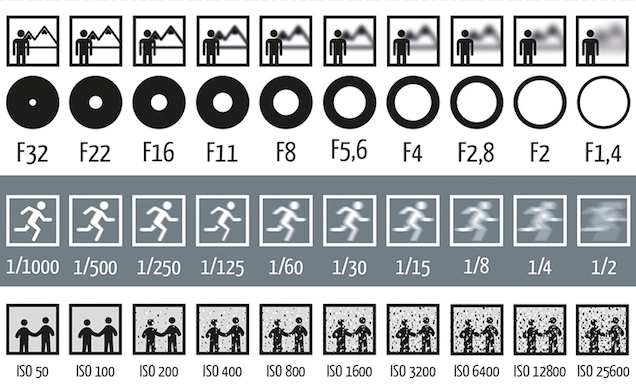
Understanding photography: aperture, shutter speed, and ISO

Filed under: Technology — Tags: — Nicholas @ 03:00

At LifeHacker, Thorin Klosowski has a quick visual reminder of how the basic photography concepts of aperture, shutter speed, and ISO setting impact the photo you want to take:

Photography concepts

Commodity Taxes

Filed under: Economics — Tags: , , — Nicholas @ 02:00

Published on 27 Jan 2015

In this video we cover taxes and tax revenue and subsidies on goods. We discuss commodity taxes, including who pays the tax and lost gains from trade, also called deadweight loss. We’ll take a look at the tax wedge and apply what we learn to the example of Social Security taxes.

QotD: Pina Colada

Filed under: Humour, Quotations — Tags: , , — Nicholas @ 01:00

Not that we down south have any excuse for self-satisfaction while we allow the atrocity of the Pina Colada to flourish unchecked in our midst. I ask your tolerance while I explain this disgusting concoction is made by pouring into a tumbler over ice a measure of something called Malibu, which describes itself as tropical coconut laced with light Jamaican rum, and filling up with a semblance of pineapple juice, fizzy or still according to whim. Just the thing for a little 95-IQ female, fresh from a spell on the back of the bike, to suck at while her escort plunges grunting at the fruit machine.

Mind you, he’ll be no ornament to his sex either, quite likely clutching a lager and lime — an exit application from the human race if ever there was one.

Kingsley Amis, Everyday Drinking: The Distilled Kingsley Amis, 2008.

May 6, 2015

China’s burgeoning wine industry

Filed under: Business, China, Wine — Tags: , , — Nicholas @ 05:00

At The Diplomat, Jack Detsch looks at the rapidly increasing Chinese wine sector:

China has surpassed France, the world’s foremost producer and exporter of wine, in total acreage, but don’t expect to bring a Ningxia over to a dinner party any time soon.

“I think they largely have the wrong grapes planted,” Geoff Kruth, Chief Operation Officer of the Guild of Sommeliers, a Sonoma-based non-profit, says. “They’re trying to model Bordeaux and plant cabernet – things that may not even really grow well there.”

Production is still on the rise, with China pushing through the ranks from the world’s eighth largest producer of wine in 2013 to the sixth biggest in 2016, due to growing acreage and soaring domestic demand. Wine consumption in China has increased by nearly 45 percent in the past 15 years, and vine planting jumped by 5 percent in 2014 alone, up to a total of 1.97 million acres, according to the International Organization of Vine and Wine. Chinese consumers have an especially discerning palate for red wine. In 2013, China became the world’s largest market for reds, a lucky color in folklore, downing 1.86 billion bottles, moving past France in that category. Per capita consumption is also on the rise.

But many Chinese vineyards aren’t producing wines yet, and much of the acreage dedicated to growing grapes is still used for appetizers and brandy, not wine. The majority of wine producers in Eastern and Western China, where companies in Xinjiang, Ningxia, and Gonsu have had success, produce bulk wine. At times, they’ve been competitive on a global level: in 2011, Jia Bei Lan, a winery in Ningxia, took home a coveted international gold medal for its 2009 Bordeaux blend.

“No means no” but apparently sometimes “Yes” also means “no”

Filed under: Media, Politics, USA — Tags: , , , — Nicholas @ 04:00

Losing your bearings in the “rape culture” debate? You’re not alone. Even some of the active participants seem to be losing their bearings, too. Katherine Timpf reports:

When it comes to consent, it’s not enough to teach that “no means no” or even that only “yes means yes” — because sometimes “yes” can actually mean “no.”

At least that’s the point of view expressed in an op-ed written by Jordan Bosiljevac for Claremont McKenna College’s student newspaper, the Forum.

In the piece, Bosiljevac explains that she and her friends even came up with a phrase to describe someone having sex with you who you didn’t want to have sex with even though you told him that you did, which they apparently consider a form of rape:

“We coined the term ‘raped by rape culture’ to describe what it was like to say yes, coerced by the culture that had raised us and the systems of power that worked on us, and to still want ‘no,’” she writes in the April 30 article, titled “Why Yes Can Mean No.”

[…]

She does, however, clarify that you can actually be a person in one of these groups, or, as she explains it, “a person oppressed in these systems of power,” and still be capable of having “empowering consensual experiences.” Yep — even if you’re a female, you’re still capable of maybe actually wanting to have sex and enjoying it sometimes! Glad she clarified. If she hadn’t, I would have never imagined such a thing could be possible.

So what do we do? After all, there’s no way to tell if a woman is actually wanting to have sex or just saying that she wants to have sex even though she doesn’t because she’s a helpless victim of male oppression that makes it impossible for her to use the right words. Lest you think Bosiljevac is just complaining, she does offer a solution:

“First, we have to realize that all oppression is connected, and all rape is racist, classist, ableist, patriarchal, hetero and cissexist,” she writes. “We cannot make consent available to all if we are not simultaneously disrupting these structures.”

The “salted caramel inquisition”

Filed under: Business, Food, USA — Tags: , — Nicholas @ 03:00

Food fashions and the current tyranny of the salted caramel inquisition, by Megan McArdle:

I don’t need to tell you that food has fashions. Remember when every restaurant with any ambition had a spinach salad with pecans, goat cheese and some sort of onion shaving? That’s now passé even in its last refuge, the twee cafes of Rust Belt suburbs. Or when truffles seemed to sprout from menus like, er, mushrooms, only to disappear almost as quickly, presumably off to hibernate in some subterranean darkness?

We are currently living through what I like to call the salted caramel inquisition, with every perfectly law-abiding caramelized dish in the land, however perfect in its simple sweetness, assaulted and forcibly converted to its more aggressive modern version.

For the last 5 to 10 years, the most notable fashion has been for the complex, spicy and exotic. Foodies exchange worried tips for storing the “basic” spices now grown too numerous for any sort of conventional cupboard. Bitter supertasters exchange angry polemics on the snobs who don’t seem to realize that those of us with less blunted palates might not want every alcoholic beverage well fortified with hops, Campari and an extra-strong helping of Angosturas. Those whose sensitive or aging gastrointestinal tracts cannot cope with all that glorious capsaicin sigh, and order the roasted chicken. Again.

History is reaction and counterreaction. The pendulum is swinging back, as gravity says it must, and I detect a new movement afoot: KISS. Which means, yes: Keep it simple, stupid. And I have to say, I like it.

« Newer PostsOlder Posts »

Powered by WordPress


