Quotulatiousness

July 9, 2013

Time to let the media in to Lac-Mégantic

Filed under: Cancon, Media, Railways — Tags: , — Nicholas @ 10:46

In Maclean’s, Paul Wells makes a strong case that it’s high time to let the media in to the disaster area of downtown Lac-Mégantic so they can do their job:

It was when I saw that Justin Trudeau had toured the Lac-Mégantic disaster site that I started to think something is seriously screwy about this whole situation.

I take seriously the sincerity of every politician arriving at Lac-Mégantic to tour the site of Saturday’s early-morning train derailment, and I note that it is starting to be a long list. I stand to be corrected on this chronology, but in very rough order it has included Premier Pauline Marois, NDP leader Thomas Mulcair, Prime Minister Stephen Harper, several members of Marois’s cabinet, two members of Harper’s, and Trudeau. On Tuesday Olivia Chow and another NDP MP will add their names to the list of MPs, MNAs and other dignitaries who have walked through the zone where the devastation occurred and the lives were lost. I assume it has been a harrowing experience for all of them.

But to some extent I can only assume, because no journalist has been allowed to take the same walk the politicians have taken. I did a radio interview today, and the reporter said, “The Prime Minister said it’s like a war zone. What have you seen?” And I said, more or less, I’ve seen some Sûreté du Québec scrums, and the haunted eyes of a few lucky survivors.

Now. There are reasons reporters wouldn’t be allowed to see the accident zone, and reasons why politicians would. But the parade of the latter is starting to make the curtain drawn in front of the former seem faintly ridiculous. The accident zone was hot for days, although apparently not so hot that a succession of politicians couldn’t get close. There are other security concerns, though apparently not insurmountable (see: succession of politicians). And political figures are responsible for authorizing relief efforts. But that’s less true for opposition politicians, and a whole lot less so again when it comes to leaders of third parties.

CNN reports that the CEO of the parent company that owns the MMA claims the Lac-Mégantic train was tampered with before the runaway:

The driverless train that barreled into a small Quebec town and derailed, unleashing a deadly inferno that killed at least 13 people, may have had its brakes inadvertently disabled, the chairman of the company operating the train said Tuesday.

Firefighters in the nearby town of Nantes put out a blaze on the train hours before it rolled into Lac-Megantic. Ed Burkhardt, chief executive officer and president of Rail World, the parent company of the Montreal, Maine & Atlantic Railway, told media outlets there’s evidence the engine powering the brakes was shut down at some point.

The matter needs further investigation, he told the Montreal Gazette. His company has begun an internal inquiry, he said.

“There are a number of missing pieces here,” Burkhardt told the paper, saying he didn’t suspect “the event was malicious or an act of terrorism.”

Pressed to elaborate by CNN affiliate CTV, Burkhardt wrote in an e-mail exchange, “We are now aware the firefighters shut down the locomotive. By the time (Montreal, Maine & Atlantic) people found out, it was too late.”

It’s possible that the firefighters who were called to the scene of the earlier (small) fire may have shut down the diesel engines as a precaution, not realizing that the engines were maintaining the air pressure in the brake system. If the engineer who went off-shift had not locked down enough of the hand brakes to hold the train on that grade, it would account for the train later running downhill towards Lac-Mégantic.
Does Britain need a “big army”?

Filed under: Britain, Military — Tags: , — Nicholas @ 09:58

Sir Humphrey refutes the call for a bigger army in the United Kingdom:

Humphrey has a very personal view that when people call for the military to be changed, it usually involves change to try and make it reflect the military that they served in. For decades people have been complaining bitterly that the UK military doesn’t do what we want it to do, and that only deep change can possibly solve the problem. Meanwhile the British Armed Forces carry on deploying and succeeding on their missions, despite this lack of a ‘wonder weapon ORBAT’. It is very easy to look at an order of battle and decide that somehow the UK lacks a real army – indeed anything can be proved with statistics, and it’s easy to say that because the UK plans a relatively small force with only limited numbers of equipment relative to other powers, it somehow lacks a real army. The problem with such a simplistic argument is that it ignores several issues.

[. . .]

So, when we hear demands that the UK has to have a ‘real army’ the question must be ‘what does a real army look like’? We cling to a view that somehow because the British Army doesn’t possess thousands of tanks and legions of artillery batteries it somehow doesn’t have the same impact as other nations which possess much larger military forces. But to the authors mind there are two very different types of armed force out there – those which exist on paper, and those which have genuine capability to meet their missions. One only has to look across the world to see a plethora of nations who on paper possess large reserves of troops, weapons and equipment which theoretically place them at the top of whatever table one looks at. The problem is though that they are often poorly trained, funded and their equipment lacks support or maintenance – the ‘shiny toy in the shop window’ syndrome. When one reads accounts of large armies, it is often striking how they are in reality unable to deploy and effectively use more than a small fraction of their overall strength, or deploy at any distance. The author still shudders when he hears tales of various UN peacekeeping forces where nations with statistically large militaries deployed sizable contingents, only for them to arrive with next to no equipment, logistics or food, and then to have next to no effect on the job at hand. The other category of army is the one that is funded and equipped properly to do the job at hand. This is a much smaller category of nations, and the UK firmly falls into this category. It involves providing a force which may not be numerically large, but where the equipment – both first line and support, is of a good quality, and which works well together.

[. . .]

The reality for the British Army is that it is a force which does not have a likely opponent, nor an existential threat to defeat. It is all very well calling for it to grow, but at a time of very constrained budgets, and ever more expensive equipment, the question is where is the money to support this? The challenge for the UK in the next SDSR and beyond is perhaps to better justify why it warrants a regular British Army of 82,000 people at all – an island nation with no existential threats, and any likely deployments to be small in nature, perhaps the question is whether we need an Army that large in the first place? Given the Royal Navy and RAF are better suited for the type of expeditionary warfare that is so in vogue at present, does the Army warrant being the size it does? To the author at least the answer is a qualified ‘yes’. The current force provides sufficient personnel to be able to support coalition operations (for we are highly unlikely to deploy an armoured force in isolation), and to meet all likely outputs required of it. But, it is not just about numbers – the UK could do what the French does and pay smaller salaries, invest in front line equipment to the detriment of support equipment and put a numerically larger force in the field which struggles to support itself. This would not be sensible – rather the current structure means that the UK can afford some very useful ‘enabling capabilities’ which mean it seen as being an ally of value to other nations. Investing in ISTAR, in logistics and in other key but ‘unsexy’ assets makes the UK well placed to be able to maintain a force which other nations want to work with – one of the so-called benefits of soft power, as nations seek UK troops for training and support.

In conclusion then, Humphrey remains confused as to what exactly the benefit would be of the UK changing course and trying to fund a vastly larger army. The money doesn’t exist for such a course of action, and the infrastructure to support such a force no longer exists (even in BAOR days the majority of the Army wasn’t based in the UK, so we’d need to build it from scratch), and the costs associated with recruiting and equipping a large force are enormous. Given the lack of existential threats, and the reality that there is no real desire for sustained overseas operations for at least the next few years, it is hard to escape the view that the UK not only possesses a reasonably sized army proportionate to its current strategic position, but that by keeping it relatively small, it retains the funds to keep it well trained and well equipped, and in turn enabling it to punch above its weight as a partner of choice for other nations.

Narcissistic Policy Disorder on parade

Filed under: Middle East, Politics, USA — Tags: , , , — Nicholas @ 09:29

Greg Weiner looks at the full-blown Narcissistic Policy Disorder of Senator John McCain:

The recently published fifth edition of the American Psychiatric Association’s Diagnostic and Statistical Manual contains no diagnosis for Narcissistic Polity Disorder — the book’s scope being confined to the personality disorder of a similar name — but should the editors ever wish to expand into political science, they will find an excellent case study in the interview Senator John McCain gave on CBS’ Face the Nation last Sunday. It turns out the Egyptian coup, which gave all signs of being a conflict among Egyptians about Egypt, was in fact about — well, us.

[. . .]

Sectarian violence in the Middle East, an ancient and evidently incurable phenomenon, an American failure? That’s one powerful reflection staring back from the water. It is also a powerful fantasy, with roots in the same place — and the metaphor is separated from reality by only the narrowest of margins — as narcissistic personality disorder, one of whose hallmarks is the proclivity to interpret foreign events in terms of oneself. Any event, anywhere, anytime becomes a test of American leadership: He who does what America wished he had not done had no autonomous motives; he meant to stick a thumb in the American eye.

Thus McCain’s understanding of leadership and its breathtaking condescension — in, ironically, the name of the neoconservative project of spreading freedom. Note that within that model — someone is going to lead and it is therefore best for it to be a, make that the, righteous nation — little room is left for the very thing McCain claims he wants to promote: nations actually making choices about their own futures from within. In the present case, Egyptians are fighting about Egypt; the real issue, according to McCain, must be what the United States had to say, or failed to say, about it. The generals could not possibly have been motivated by (a) different aspirations for Egypt, (b) venality, (c) power or (d) some combination of the above: We must understand their motives for the coup in terms of whether they complied with our request that they “not do that.”

Replacing impartial courts with revolutionary tribunals

Filed under: Government, Greece, Law, Media, USA — Tags: , , , — Nicholas @ 08:57

Victor Davis Hanson talks about earlier experiments with tribunals:

In ancient Athens, popular courts of paid jurors helped institutionalize fairness. If a troublemaker like Socrates was thought to be a danger to the popular will, then he was put on trial for inane charges like “corrupting the youth” or “introducing new gods.”

Convicting gadflies would remind all Athenians of the dangers of questioning democratic majority sentiment. If Athenian families were angry that their sons had supposedly died unnecessarily in battle, then they might charge the generals with capital negligence — a warning to all commanders to watch their backs. As in the case of Socrates, a majority vote often led to conviction, and conviction to a death sentence, or at least ostracism or exile. The popular courts freelanced to ensure that “the people” would hold sway over the perceived powerful and elite.

For a couple of years in revolutionary France, a Tribunal Révolutionnaire tried royalists, clergy, the wealthy, and supposed counter-revolutionaries on trumped-up charges of crimes against the people. Their purpose was a more violent version of the Athenian idea that the courts should serve the public by targeting the prominent, influential, or wealthy.

We in the United States are in jeopardy of turning our own criminal-justice system into revolutionary tribunals — fanned by the popular media and public opinion and directed against so-called enemies of the people.

[. . .]

The American court system is insidiously focusing on social transformation rather than individual justice. If Neanderthal reactionaries in California twice voted to reiterate that marriage is between a man and a woman, then leave it to judges and courts to find them bigoted and politically incorrect. In the present revolutionary environment, the degree of the Obama administration’s enforcement of federal laws concerning gay marriage, or illegal immigration, or the new health-care law has hinged on politics and perceptions about social justice — and the courts increasingly predicate their own decision-making on these same considerations. The street can brand a court either an esteemed ally or a reactionary enemy of the people, and so the courts make the necessary adjustments.

Update: The New York Times editorial board expresses its concern about “the laws you can’t see”.

As Eric Lichtblau reported in The Times on Sunday, the Foreign Intelligence Surveillance Court has for years been developing what is effectively a secret and unchallenged body of law on core Fourth Amendment issues, producing lengthy classified rulings based on the arguments of the federal government — the only party allowed in the courtroom. In recent years, the court, originally established by Congress to approve wiretap orders, has extended its reach to consider requests related to nuclear proliferation, espionage and cyberattacks. Its rulings, some of which approach 100 pages, have established the court as a final arbiter in these matters.

But the court is as opaque as it is powerful. Every attempt to understand the court’s rulings devolves into a fog of hypothesis and speculation.

[. . .]

As outrageous as the blanket secrecy of the surveillance court is, we are equally troubled by the complete absence of any adversarial process, the heart of our legal system. The government in 2012 made 1,789 requests to conduct electronic surveillance; the court approved 1,788 (the government withdrew the other). It is possible that not a single one of these 1,788 requests violated established law, but the public will never know because no one was allowed to make a counterargument.

When judicial secrecy is coupled with a one-sided presentation of the issues, the result is a court whose reach is expanding far beyond its original mandate and without any substantive check. This is a perversion of the American justice system, and it is not necessary.

NYT writer files classic “First World Problem” article

Filed under: Business, USA — Tags: , , , , — Nicholas @ 08:35

In yesterday’s “Morning Jolt” email, Jim Geraghty made some sport of a New York Times article by James Atlas:

The comments section underneath the article raises the fairly glaring point that Atlas’s rose-colored memories of flying before these harsh Darwinist times (probably to be blamed on Republicans) ignore the fact that once you adjust for inflation, air travel is a lot more accessible to a lot more people today. In the “golden age” of attractive stewardesses that he romanticizes, flying was too expensive for most of middle-class America.

    Come on. Look at the prices (adjusted for inflation) of air travel back in the 60s that you so glorify. In 1972 it cost me about $350 round-trip to fly from Atlanta to Chicago to go to college (so usually I took Greyhound). According to online inflation calculators, that’s the equivalent of $1950 today. If we want the same level of service we got in the 60s and 70s, we’d need to pay equivalent prices. Airline travel in “economy” today is pretty much analogous to what bus travel was in the 70s; cheap enough that many people can afford it but dirty, uncomfortable, crowded, and miserable. Comfortable travel is available now, as it was then, to the more well-to-do — if you can afford to pay for first class, then your flight is far more tolerable than if you’re in economy. In 1972, the one time I flew, it was a lot more enjoyable than taking the bus. But then, as now, one got what one paid for. We expect airfares to be rock-bottom low and accessible to all — but we can’t then expect service levels to match what they would be if the airlines still charged the prices they used to charge.

I would note that higher-end air travel is one of those rare products where a large portion of the consumer base isn’t spending their own money. (How many business class or first-class passengers bought those tickets with personal funds, as opposed to having their employer pay for it?) When it’s somebody else’s money, hey, anything goes, or at least as much as you can get away with. (Of course, that’s at other employers. For the transatlantic flights for the Norway cruise, Jack Fowler has booked me a space in an overhead luggage rack.)

If everyone paid out of his own pocket, those passengers willing to pay $659 to $2,337 for a one-way first-class ticket from D.C. to Los Angeles nonstop would largely disappear. But those folks willing to pay those exorbitant costs — really, those companies willing to pay those costs for their employees — are what make the (relatively) cheap price of $234 for the same flight in coach possible. (I got those figures from plugging in a flight from D.C. to LA with one week’s notice into Expedia.)

Also … did no editor at the Times think it was bad timing to run a column complaining about insufficient legroom and stale ham sandwiches right after the crash at San Francisco airport?

July 8, 2013

Canadian Army to return to historical designations and rank insignia

Filed under: Cancon, History, Military — Tags: , — Nicholas @ 14:40

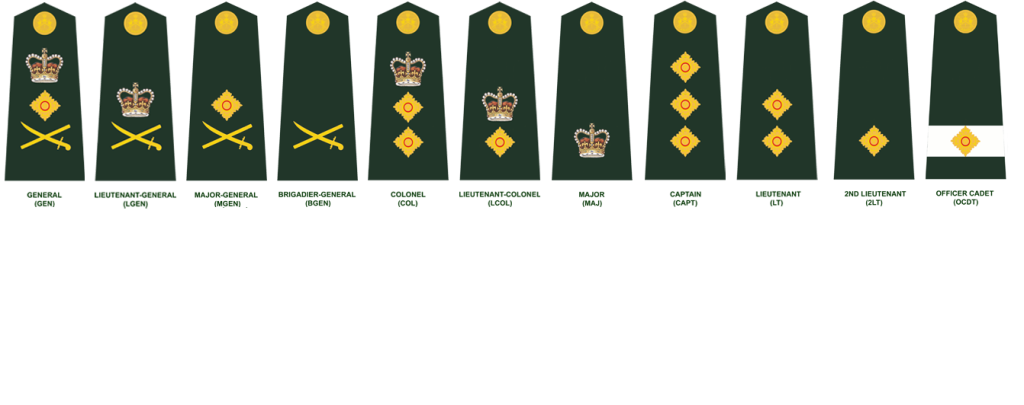
Oh, good: now nobody in the journalistic world will ever be able to figure out what the assemblage of items on a Canadian Army officer’s shoulder strap actually translates to in spoken English.

Traditional Insignia for Officers

In line with the formalization of historical rank names for non-commissioned members, the traditional army officer rank insignia – with the stars, or “pips,” and crowns – are being restored. This ranking system is more than a hundred years old and continues to be used by armies the world over. Historically, the variations of the stars and crown were used to delineate rank so that officers could recognize each other on the battlefield. Canadian Army colonels and general officers will also wear the traditional gorget patches.

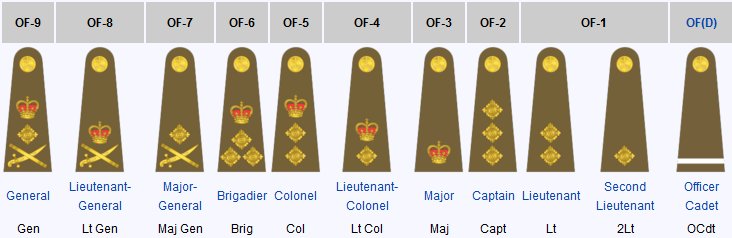
A quick search didn’t turn up any new graphics showing the rank insignia, but it’s similar to what the British army uses:

British army officer insignia

Divisional Nomenclature and Patches

Land Force Areas will be renamed as divisions and Canadian Army personnel will wear appropriate division patches. Formations will be renamed as follows:

  • Land Force Quebec Area will be referred to as “2nd Canadian Division”;
  • Land Force Western Area will be referred to as “3rd Canadian Division”;
  • Land Force Central Area will be referred to as “4th Canadian Division”;
  • Land Force Atlantic Area will be referred to as “5th Canadian Division”; and
  • Land Force Doctrine and Training System will be referred to as “Canadian Army Doctrine and Training Centre”.

There will be no change to 1st Canadian Division Headquarters.

Update 24 July: No wonder the official website didn’t have any updated graphics for the re-instated rank insignia … “The CA was not apprised of this announcement until days before the MND made it. It was announced less than 2 weeks ago so we can only offer preliminary information.

It is not generally understood how our Army came to wear the current Navy rank. This SITREP will hopefully allow you to dispel wrong information.

Key Talking Points

a. ‘Stars and Crowns’ is not British. The officers of almost 100% of the armies on every continent of the world including China, Russia, Finland, Colombia, and including the Salvation Army and RCMP wear a system of two identifiers: (i) a star, and (ii) a national symbol…it is an international convention and customary practice so an officer from any country can negotiate on the battlefield or work in coalitions like the UN or NATO and with civilian agencies. Canada’s Army used this international customary practice from 1885, officially recognized it in 1903, but lost it in 1968.

b. The CA lost stars and crowns as rank insignia in 1968 when the CA and RCAF plus the RCN were directed to put-up Merchant Navy rank. The RCN successfully got their ‘fighting-Navy’ executive curl back for their 100th anniversary. Now, the CA will return to Army vice Navy rank in time for the 100th anniversary of WWI and the 75th anniversary of WWII.

c. Cheaper. It costs $33.00 to tailor an officer’s DEU sleeve rank every time they get a new jacket or are promoted. It costs $5-6.00s for a pair of crowns or stars. The CA will save 80% of the costs and pay-off the initial project in just over 4 years. ‘Stars and crowns’ is going to save money for the CA not cost money.

This is what we can share now and will continue to share more in next Friday’s SITREP.

• Date of Implementation. Stars and Crowns cannot be implemented until a meeting off the National Defence Clothing and Dress Committee endorses the design for wear on DEU uniform. The CA will likely announce two dates: (i) the date that crowns and stars are available from each officer’s Logistik Unicorp account, and (ii) the date they need to be put-up.
• The full implementation may take considerable time to fully introduce because we were unaware of the change and there is no current stock of crowns or stars in the supply system.
• The CA will introduce the traditional rank system of WW II as found in Figure 14 of the 1953 CA Dress Regulations. We have already met with DHH and DSSPM for purchase discussions.
• DEU. The CA will buy and issue one pattern of star and crown at public expense based on one national CA/DHH approved pattern. The crowns and stars will be push pin like the NCM rank badges so the uniform is not damaged.
• Rifle and Guards Regiments. The CA will respect the traditional prerogative of rifle regiments and Regiments of Guards to purchase their alternate colours and patterns of stars and crowns respectively on DEU, patrol, ceremonial, and mess dress. For DEU, the CA HQ has requested public funding but the outcome is not known. For DEU, rifle regiments must still apply to the chain of command and submit their alternative designs for approval by the CCA and DHH. Rifle regiments may contact the G1 Heritage Pat Bryden at 613 415 7707 for additional guidance.
• CADPAT. There is a new high visibility CADPAT rank slip on/velcro project running as we speak. The project will change all CADPAT rank to higher visibility thread. This project will introduce stars and crowns for officers prior to mass production. Thanks to this project, there will be no new cost to put crowns and stars onto CADPAT slip-ons.
• DEU Slip-ons. The CA with DHH will also approve patterns for the officers’ slip-on for the CA. Decisions are now being made on the extent of patterns and the extent of public funding support. Vendors are already offering rank badges and insignia to units. Some units might lean forward and we suggest Divisions advise units to not proceed until key decisions are made on (a) permissible public and non-public purchasing, (b) the extent to which units will be permitted to deviate from the CA patterns, and (c) the CA date to implement new DEU rank is announced in a CANARMYGEN. All regiments can trust that our CA HQ is working in the interest of regimental identity and speed to meet the MND intent.
• Mess Dress. It is recognized that a substantial number of our CA units still informally use stars and crowns on their mess dress. The current CA recommendation will be that officers with Navy bars on their mess dress will only be required to put-up stars and crowns voluntarily (grandfathered) but it will be mandatory if/when the officer is promoted. This will be further developed.

Update, 11 June, 2014. While I wasn’t paying attention, the Canadian Army Insignia page was updated with the current rank insignia. For your inconvenience, I’ve bodged the officer shoulder insignia into one image:

Canadian Army Officer Rank Insignia 2014

The return of the fickle finger of fate (non-humour category)

Filed under: Media, Science — Tags: , , , — Nicholas @ 10:54

In sp!ked, Brendan O’Neill discusses the unlikely comeback of “fate”:

Fate is making a comeback. The idea that a human being’s fortunes are shaped by forces beyond his control is returning, zombie-like, from the graveyard of bad historical ideas. The notion that a man’s character and destiny are determined for him rather than by him is back in fashion, after 500-odd years of having been criticised and ridiculed by humanist thinkers.

Of course, we’re far too sophisticated these days actually to use the f-word, fate. We don’t talk about a god called Fortuna, as the Romans did, believing that this blind, mysterious creature decided people’s fates with the spin of a wheel. Unlike long-gone Norse communities we don’t believe in goddesses called Norns, who would attend the birth of every child to determine his or her future. No, today we use scientific terms to argue that people’s fortunes are determined by higher powers than their little, insignificant selves.

We use and abuse neuroscience to claim certain people are ‘born this way’. We claim evolutionary psychology explains why people behave and think the way they do. We use phrases like ‘weather of mass destruction’, in place of ‘gods’, to push the idea that mankind is a little thing battered by awesome, destiny-determining forces. Fate has been brought back from the dead and she’s been dolled up in pseudoscientific rags.

[. . .]

It’s hard to overstate what a radical idea this was at the tailend of the Dark Ages. It’s this idea that gives rise to the concept of free will, to the concept of personality even. And it was an idea carried through to the Enlightenment and on to the humanist liberalism of the nineteenth and early twentieth centuries. In the words of the greatest liberal, John Stuart Mill, it is incumbent upon the individual to never ‘let the world, or his portion of it, choose his plan of life for him’.

But today, in our downbeat era that bears a bit of a passing resemblance to the Dark Ages, we’re turning the clock back on this idea. We’re rewinding the historic breakthroughs of the Renaissance and Enlightenment, and we’re breathing life back into the fantasy of fate. Ours is an era jampacked with deterministic theories, claims that human beings are like amoeba in a Petri dish being prodded and shaped by various forces. But the new determinism isn’t religious or supernatural, as it was in the pre-Enlightened era — it’s scientific determinism, or rather pseudo-scientific determinism.

New diesel engine technology to erase the memory of Oldsmobile diesels

Filed under: Technology — Tags: , — Nicholas @ 09:30

The Economist has a glowing overview of new diesel engines for cars:

NOT to belittle the success Tesla Motors has had with its Model S luxury electric car — outselling its petrol-powered equivalents since being launched last year — the prospects for battery-powered vehicles generally may never shine quite as bright again. Babbage believes their day in the sun is about to be eclipsed by, wait for it, the diesel engine.

Surely not that dirty, noisy, smelly, lumbering lump of a motor that was difficult to start in the winter? Certainly not. A whole new generation of sprightly diesels — developed over the past few years — bear no resemblance to your father’s clattering, oil-burner of an Oldsmobile. It is no exaggeration to say that, with its reputation for unreliability and anaemic performance, the Olds 4.3-litre diesel from the late 1970s single-handedly destroyed the reputation of diesel engines in America for decades to come. Quite possibly, it also contributed to Oldsmobile’s own demise.

Later this year, Americans will get their first chance to experience what a really advanced diesel is like — and why Europeans opt for diesels over hybrids, plug-in electrics and even petrol-powered cars. The leader of the new pack is the Mazda 6, completely redesigned for 2014, with the choice of either a 2.5-litre four-cylinder petrol engine or a 2.2-litre turbo-charged diesel. The diesel has 30% better fuel economy and provides oodles more pulling power. Good as the petrol version is, motorists who choose it over the diesel will miss out on a lot.

[. . .]

With its old 1.4-litre diesel engine, the Volkswagen Polo still holds the record for being the most frugal non-electric car in Britain and the rest of Europe — with a fuel economy on the combined cycle of just 3.8 litres/100km (equivalent to 61.9 miles per US gallon). The Toyota Prius hybrid? A lowly twentieth on the league table of the most economical fuel-sippers, with 4.2 litres/100km, along with higher emissions of carbon dioxide. The 19 cars having better fuel economy than the Prius hybrid are all clean diesels.

Babbage fully expects the new generation of clean, low-compression diesels to raise the fuel-economy bar by a further 20% or more. That will put diesels on much the same footing — on an equivalent miles-per-gallon basis — as many of the electric vehicles available today. Their big advantage will be that they will come with none of the range anxiety and recharging difficulties to worry about. Roll on the day.

Restore Pluto!

Filed under: Science, Space — Tags: , , , — Nicholas @ 08:01

A letter from L. Neil Smith to this week’s Libertarian Enterprise:

Here’s a matter that may reveal more about psychology or politics than it does about astronomy. You’ll recall, a couple of years ago, the flap over the “demotion” of Pluto, theretofore the tenth planet of the Solar System, to the mean and niggardly status of “dwarf planet”.

I have always believed that an international conspiracy, possibly composed of those who hate our freedom, carried out this astronomical assassination because Pluto is the only planet discovered by an American, Clyde Tombaugh.

However, given the fact that Pluto, whatever its size, is an independent body circling the same primary we do (unlike the Asteroids of the Belt or those found at various Trojan positions around the System, or parked in orbit around Mars) and the pathetic and petty way this demotion was carried out, many people, including yours truly, objected to it as unnecessary, inaccurate, and stupid.

Now we learn (because we don’t always keep up on these things) that in addition to the moon Charon, which we’ve known about for a long while, Pluto possesses four other moons, Nix, Hydra, and more recently, Styx and Kerberos, all named for various underworld-related entities in Greek mythology.

The System’s “gas giants”, Jupiter, Saturn, Neptune, and the one whose pronunciation mysteriously changes whenever it’s mentioned on TV, all have more moons than we can properly keep track of. Mars, Earth, and Venus, which are also full-blown planets in good standing, possess, respectively, two, one, and zero moons.

And yet Pluto, the little world that has been ignominiously stripped of its rank, and its sword ceremonially broken, has five moons. Count ’em: five whole moons! I maintain that this confirms its proper dignity as a first-class planet, and to the list of historic phrases like “Carthage must be destroyed!” “Remember the Alamo”, and “Hillary wears army boots!”, we should now add “Restore Pluto!”

Scientifically yours,

L. Neil Smith

No matter who you vote for, the Ruling Party always gets in

Filed under: Britain, Politics — Tags: , , — Nicholas @ 00:01

Charles Stross has himself a theory on politics:

I’m nursing a pet theory. Which is that there are actually four main political parties in Westminster: the Conservatives, Labour, the Liberal Democrats, and the Ruling Party.

The Ruling Party is a meta-party; it has members in all of the three major parties, and probably the minority parties as well. It always wins every election, because whichever party wins (or participates in a coalition) is led in Parliament by members of the Ruling Party, who have more in common with each other than with the back bench dinosaurs who form the rump of their notional party. One does not rise to Front Bench rank in any of the major parties unless one is a paid-up Ruling Party member, who meets with the approval of the Ruling Party members one will have to work with. Outsiders are excluded or marginalized, as are followers of the ideology to which the nominal party adheres.

Your typical Ruling Party representative attended a private school, studied Politics, Philosophy and Economics at Oxford (or perhaps Economics or Political Science at the LSE). If they took the Eton/PPE route they almost certainly joined the Oxford debating society. Alternatively they might be a barrister (a type of lawyer specializing in advocacy before a judge, rather than in back-office work).

The Ruling Party doesn’t represent the general electorate, but a special electorate: the Alien Invaders and their symbiotes, the consultants and contractors and think-tank intellectuals who smooth the path to acquisition of government contracts or outsourcing arrangements — the government being the consumer of last resort in late phase consumer capitalism — arrangements which are supported and made profitable by government subsidies extracted from taxpayer revenue and long-term bonds. The Ruling Party is under no pressure to conform to the expectations of the general electorate because whoever the electors vote for, representatives of the Ruling Party will win; the only question is which representatives, which is why they are at such pains to triangulate on a common core of policies that don’t risk differentiating them in a manner which might render them repugnant to some of the electorate.

It would explain a lot, actually.

July 7, 2013

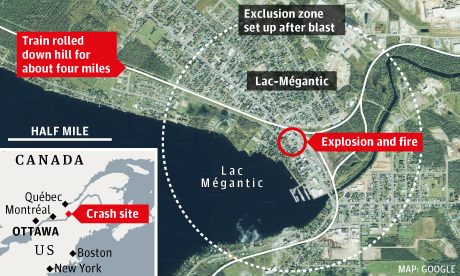
Locomotive in Lac-Mégantic derailment had been on fire hours before the crash

Filed under: Cancon, Railways — Tags: , — Nicholas @ 12:07

In the 680News round-up of details from the Lac-Mégantic explosion and fire, there’s a fascinating bit of news I hadn’t heard before:

Responding to a reporter’s question during Saturday’s news conference, Lauzon confirmed that firefighters in a nearby community were called to a locomotive blaze on the same train a couple of hours before the derailment. Lauzon said he could not provide additional details about that fire since it was in another jurisdiction.

This may or may not have any bearing at all on the subsequent runaway and crash, but it’s of interest. So far, there have been three reported deaths from the explosions and fire, with at least 40 people still unaccounted for. The PM will be visiting the town soon:

Prime Minister Stephen Harper is planning to visit this Quebec community Sunday, one day after powerful explosions caused by a train derailment levelled the town’s downtown core and killed at least one person, with police predicting the death toll would rise.

“We do expect we’ll have other people who will be found deceased unfortunately,” Lt. Guy Lapointe, a spokesman with Quebec provincial police, told a news conference Saturday night.

Authorities in Quebec say two more people are confirmed dead in the train derailment and massive fire in Lac-Mégantic to bring the declared death toll to five.

“We also expect that down the line … there will be more people reported missing than people actually found dead.”

Lapointe refused to give any estimate of people unaccounted for because emergency crews couldn’t reach a two-kilometre-square section of the town out of concern that five of the train’s tanker cars could still explode.

More details on US Army’s re-organization plans

Filed under: Military, USA — Tags: , — Nicholas @ 11:50

Strategy Page updates the headline news about the US Army disbanding over a dozen combat brigades in the most recent military cutbacks:

The U.S. Army recently announced its plan to reduce its 45 combat brigades to 32 but to retain most of the combat capabilities of the 45 brigade force. This will be done by transferring many of the troops and equipment from the disbanded brigades to the 32 that will remain in service. This will increase most brigades to 4,500 troops. Each new brigade will have three infantry or armor battalions (instead of two, as most now do) 18 (instead of 16) 155mm self-propelled artillery vehicles (organized into three batteries instead of two) and more engineer troops (the equivalent of a battalion) for each brigade. The new BCTs (Brigade Combat Teams) will initially consist of 14 infantry (two infantry and one tank battalion), 12 tank (two tank and one infantry battalion) and seven Stryker battalions. Three of these 35 brigades will be disbanded over the next few years, but which ones has not been decided yet. By late 2017 the army expects to reduce personnel strength ten percent (to 490,000 troops from the current 547,000).

All this shrinking is due to the fact that the army is facing some hefty budget cuts (at least 5-10 percent over the next decade). Linked with growing costs (for equipment, supplies and wages) makes this cut even larger. For example, over the next decade, defense spending will decline from 3.6 percent to 2.8 percent of GDP. Several years ago the army did the math and concluded that it would have to cut manpower up to 80,000 by the end of the next decade, and reduce combat brigades to as few as 32 (from the current 45) and total strength of 490,000 troops. Without the cuts training would have to be cut to the point where the troops would be unprepared for combat. The recent announcement simply confirms the initial army estimates.

These cuts are nothing new, as army leaders have seen it coming for some time. Four years ago, despite major combat operations in Iraq and Afghanistan, the U.S. Army went through a major reorganization. The end result was the increase in the number of combat brigades from 33 to 48 (soon reduced to 45 because of budget cuts). This required the transfer of over 40,000 people from combat-support jobs to the combat brigades. In doing this, the army got some experience in reducing personnel strength without losing capability. Most of this reset was completed, with all the new brigades ready for service, by 2010.

Trying to prevent another “flash crash”

Filed under: Business, Economics, Technology — Tags: , , , — Nicholas @ 10:57

Tim Harford discusses high speed trading and its potential problems:

“High-frequency trading” is a rich environment of algorithms, of predators and prey, all trying to make money by trading financial products at tremendous speed. But the basic proposition is simple to state. When the price of a share rises in New York, the price of related contracts will rise in Chicago just as soon as the news arrives. But if everyone else gets the news on the regular cable, and you’re renting space on the faster cable, you can see into everyone else’s future by (say) 0.7 milliseconds, plenty of time to buy soon-to-rise assets and then, less than a thousandth of a second later, to sell them again.

You don’t have to be a socialist to find this kind of thing discomfiting. There are three concerns. The first is that scarce resources are being spent on high-speed connections that have no social value in what is at best a zero-sum game. The second is that high-frequency traders may be making money at the expense of fundamental investors. The third problem is that such trading appears to introduce systemic risks. The “flash crash” of May 2010 is still poorly understood, which should ring alarm bells — especially since the need for speed means most high-frequency algorithms are simple and therefore stupid.

What, then, should be done? Rather than trying to slow down the algorithms, why not slow down the market? Most financial exchange markets run continuously, effectively assuming that traders can react instantaneously, withdrawing out-of-date offers and replacing them with up-to-the-picosecond prices. It’s this flawed premise — that all trades could be instantaneous — that means that no matter how fast the computers get, there will always be an incentive to go faster still.

A simple way for an exchange to improve matters would be to run an auction once a second, batching together all the offers to buy and sell that have been submitted during that second. Unsuccessful bids and asks would be published and would remain on the books for the next auction, unless withdrawn. One auction a second ought to be enough for anyone; it would deliver a stream of well-behaved data to regulators — currently unable to figure out what is going on — and it is plenty of time for a computer to weigh its options.

Update on the Lac-Mégantic train derailment

Filed under: Cancon, Railways — Tags: , — Nicholas @ 10:48

The Guardian provides more recent information about the situation in Lac-Mégantic:

Fires continued burning for more than 24 hours after a runaway train carrying crude oil derailed in eastern Quebec, igniting explosions and fires that destroyed a town’s centre and killed at least one person. Police said they expected the death toll to rise.

The explosions sent residents of Lac-Mégantic scrambling through the streets under the intense heat of towering fireballs and a red glow that illuminated the night sky, witnesses said. Flames and billowing black smoke could still be seen long after the 73-car train had derailed, and a fire chief likened the charred scene to a war zone.

Up to 2,000 people were forced from their homes in the lakeside town of 6,000 people, which is about 155 miles east of Montreal and about 10 miles west of the Maine border.

Quebec provincial police lieutenant Michel Brunet confirmed that one person had died. He refused to say how many others might be dead, but said authorities had been told “many” people have been reported missing.

Lt Guy Lapointe, a spokesman with Quebec provincial police, said: “I don’t want to get into numbers, what I will say is we do expect we’ll have other people who will be found deceased unfortunately. “People are calling in reported love ones missing, some people are reported two, three times missing by different members of the family,” he said.

Lac-Mégantic train derailment update

[. . .]

The cause of the accident was believed to be a runaway train, the railway’s operator said.

The president and CEO of Rail World Inc, the parent company of Montreal, Maine & Atlantic Railway, said the train had been parked uphill of Lac-Mégantic.

“If brakes aren’t properly applied on a train, it’s going to run away,” said Edward Burkhardt. “But we think the brakes were properly applied on this train.”

Burkhardt, who was mystified by the disaster, said the train was parked because the engineer had finished his run.

“We’ve had a very good safety record for these 10 years,” he said of the decade-old railroad. “Well, I think we’ve blown it here.”

Update: Of course, to a politician, it’s never too soon to turn headlines into props for your favourite causes:

[NDP leader Thomas] Mulcair, speaking in Montreal on Saturday, said the accident was “another case where government is cutting in the wrong area.”

“We are seeing more and more petroleum products being transported by rail, and there are attendant dangers involved in that. And at the same time, the Conservative government is cutting transport safety in Canada, cutting back the budgets in that area,” said Mulcair, who pointed to decreased transportation checks on petroleum at a time when production was increasing.

“When we have a discussion about these things in the coming months or years let’s remember this day. We are watching a magnificent little village being burned to the ground by toxic products that were being transported through it,” Mulcair said.

I really did think better of Mr. Mulcair. This is quite disappointing.

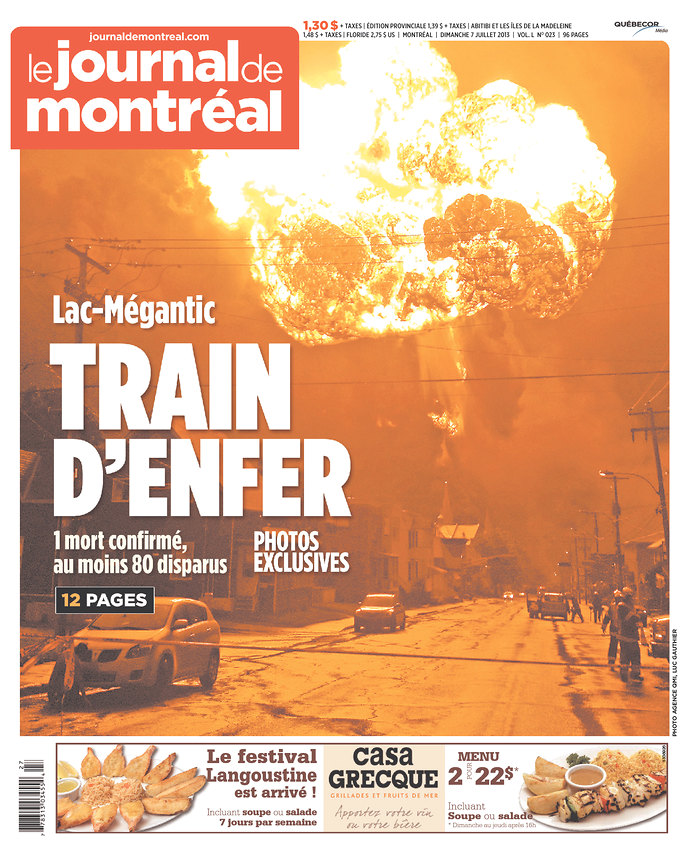
Update, the second: The front page of Le Journal de Montréal, courtesy of Newseum.

Front page of Le Journal de Montréal, 2013-07-07

America’s Ministerium für Staatssicherheit

Filed under: Europe, Germany, Government, USA — Tags: , , , , — Nicholas @ 10:36

Rick Falkvinge looks at an interesting appropriate pairing: the former German Democratic Republic’s Ministerium für Staatssicherheit (Stasi) and the American NSA:

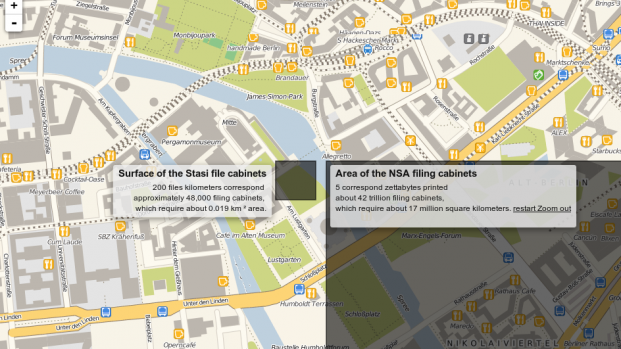
If you were to compare the evil, reprehensible Stasi to the NSA side by side in a visual comparison, who’s the worse surveillance hawk? The people over at OpenDataCity have put together a nice visual guide with astonishing results. We tend to think of Stasi-scale surveillance as the epitome of evil surveillance, and have completely lost track of what today’s governments are doing to their people.

When you go to this page (in German), you are presented with a nice map that compares the size of the Stasi archives — a large building in Berlin — with the corresponding NSA archives. It’s clear that the NSA’s archives — if used with Stasi technology, for an apples-to-apples comparison — would be quite a bit larger:

Comparison of the Stasi and NSA archives. The Stasi archives were a building in Berlin, the NSA archives seem to be more like a couple of entire blocks.

Comparison of the Stasi and NSA archives. The Stasi archives were a building in Berlin, the NSA archives seem to be more like a couple of entire blocks.

Keep reading … it’s like a “powers of ten” exercise.

« Newer PostsOlder Posts »

Powered by WordPress