
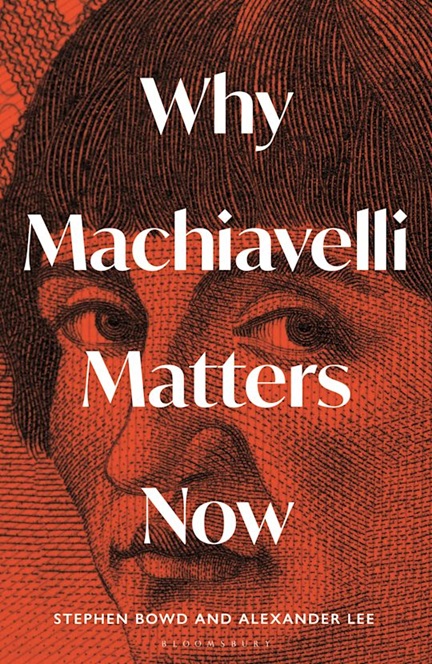
In The Critic, Tom Jones reviews a new work on Niccolo Machiavelli by Stephen Bowd and Alexander Lee:
Machiavellian is rather a dirty idea in politics, conjuring tired images of scheming Wormtongues, smoke and mirrors, nights of long knives, Peter Mandelson.
But a new book hopes to change that, by offering us a more rounded view of this important figure, who has been sadly lost — like Sun Tzu and Marcus Aurelius, but thankfully not Edward Gibbon or Carl von Clausewitz — to business bros who buy their books in branches of TG Jones in regional airports.
The first chapter of Why Machiavelli Matters Now is dedicated to the closest thing to methodology the Italian ever laid out. Halfway through The Prince, he writes that “it has seemed only proper to go straight to the effectual truth of the matter [alla verità effettuale della cosa], rather than to how it is imagined”. This, authors Stephen Bowd and Alexander Lee claim, “is perhaps the most crucial sentence in the whole of Machiavelli’s writings”.
But it might be best summarised as wanting to understand things not as they were, but as they came to be — or, more precisely, what caused them to change. That wasn’t all; since he used the concept in relation to a prince’s relations to “his subjects and friends”, it means the specifics of how human behaviour produces political change. This, as the authors note, “was genuinely revolutionary. No one until then had thought of politics in such overtly dynamic terms.”
This, at least, was Strauss’ reading. But as with most of Machiavelli’s work, the thing is more subtle than it first appears. Informed by both Aristotle and Lucretius (it should be obvious at this point how heavily I am cribbing from this interesting, short and consumable book), it was:
a truth that had to be decided pragmatically, through experience, on the basis of what felt right, rather than what could be rigorously verified – and all too often shaded off into mere verisimilitude. It sought to explain changes of all kinds but was preoccupied above all with the causes of civil unrest and factional struggles, which undermined rulers and republican regimes more than anything else
Understanding the effectual truth was, for Machiavelli, essential if princes were to avoid being either baffled or frightened by political developments. Alas, were our own princes aiming for such lofty ideals of governance.


