Quotulatiousness

November 29, 2012

The F-35 program in the cross-hairs

Filed under: Military, USA — Tags: , , , , , — Nicholas @ 09:10

I thought it had been a while since the last “bash the F-35” round of articles came past. Here’s Christopher Drew talking about the parlous state of the F-35 in light of the US government’s crushing budget woes:

The F-35 was conceived as the Pentagon’s silver bullet in the sky — a state-of-the art aircraft that could be adapted to three branches of the military, with advances that would easily overcome the defenses of most foes. The radar-evading jets would not only dodge sophisticated antiaircraft missiles, but they would also give pilots a better picture of enemy threats while enabling allies, who want the planes, too, to fight more closely with American forces.

But the ambitious aircraft instead illustrates how the Pentagon can let huge and complex programs veer out of control and then have a hard time reining them in. The program nearly doubled in cost as Lockheed and the military’s own bureaucracy failed to deliver on the most basic promise of a three-in-one jet that would save taxpayers money and be served up speedily.

[. . .]

“The plane is unaffordable,” said Winslow T. Wheeler, an analyst at the Project on Government Oversight, a nonprofit group in Washington.

Todd Harrison, an analyst at the Center for Strategic and Budgetary Assessments, a research group in Washington, said Pentagon officials had little choice but to push ahead, especially after already spending $65 billion on the fighter. “It is simultaneously too big to fail and too big to succeed,” he said. “The bottom line here is that they’ve crammed too much into the program. They were asking one fighter to do three different jobs, and they basically ended up with three different fighters.”

November 22, 2012

The rise of the sniper

Filed under: Military, USA — Tags: , , — Nicholas @ 10:27

Strategy Page looks at the changed — and increased — role of the sniper in modern US military doctrine:

In the last decade, American soldiers and marines have greatly increased their use of snipers and the success of this move spread to other countries. The more aggressive use of snipers in the last decade is one of many changes in ground combat. In that time, because of Iraq and Afghanistan, infantry tactics have changed considerably. This has largely gone unnoticed back home, unless you happen to know an old soldier or marine that remembers the old style of shooting. Put simply, the emphasis is on a lot fewer bullets fired and much more accurate shooting. Elite forces, like the Special Forces and SEALs, have always operated this way. But that’s because they had the skill, and opportunity to train frequently, to make it work. The army and marines have found that their troops can fight the same way with the help of some new weapons, equipment, and tactics, plus lots of combat experience and specialized training. This includes the use of new shooting simulators, which allows troops to fire a lot of virtual bullets in a realistic setting, without all the hassle and expense of going to a firing range.

One thing that helped, and that was developing for two decades, was the greater use of snipers. Currently, about ten percent of American infantry are trained and equipped as snipers. Commanders have found that filling the battlefield with two man (spotter and shooter) sniper teams not only provides more intelligence, but also a lot of precision firepower. Snipers are better at finding the enemy, and killing them with a minimum of noise and fuss. New rifle sights (both day and night types) have made all infantry capable of accurate, single shot, fire. With the emphasis on keeping civilian casualties down, and the tendency of the enemy to use civilians as human shields, lots of snipers, or infantrymen who can take an accurate shot at typical battle ranges (under 100 meters), are the best way to win without killing a lot of civilians.

June 29, 2012

US Army reluctantly admits USMC did better

Filed under: Military, Technology, USA — Tags: , , , , , — Nicholas @ 09:06

In developing camouflage, that is:

The U.S. Army has decided to scrap its digital pattern camouflage combat uniforms for the more effective, but more expensive, MultiCam. In the last decade, both the army and marines adopted new, digital, camouflage pattern field uniforms. But in Afghanistan, U.S. soldiers noted that the marine digital uniforms (called MARPAT, for Marine Pattern) were superior to the army UCP (Universal Camouflage Pattern). There’s been growing dissatisfaction with UCP, and it has become a major issue because all the infantry have access to the Internet, where the constant clamor for something better than UCP forced the army to do something. This is ironic because UCP is a variant of MARPAT, but a poor one, at least according to soldiers who have encountered marines wearing MARPAT. Even more ironic is that MARPAT is based on research originally done by the army. Thus some of the resistance to copying MARPAT is admitting the marines took the same research on digital camouflage, and produced a superior pattern for combat uniforms.

A digital camouflage pattern uses “pixels” (little square or round spots of color, like you will find on your computer monitor if you look very closely), instead of just splotches of different colors. Naturally, this was called “digital camouflage.” This pattern proved considerably more effective at hiding troops than older methods. For example, in tests, it was found that soldiers wearing digital pattern uniforms were 50 percent more likely to escape detection by other troops, than if they were wearing standard green uniforms. What made the digital pattern work was the way the human brain processed information. The small “pixels” of color on the cloth makes the human brain see vegetation and terrain, not people. One could provide a more technical explanation, but the “brain processing” one pretty much says it all.

May 21, 2012

The US Navy’s “brown water” sailors get re-assigned

Filed under: Middle East, Military — Tags: , , , — Nicholas @ 08:57

The US Navy had a problem in Iraq, which they addressed by setting up some squadrons of “brown water” riverine craft. Now that they’re no longer required in Iraq’s rivers and coastal areas, the question of what to do with these units needed to be answered:

The U.S. Navy has decided what to do with its “brown water navy,” including three Riverine Squadrons, now that they have no overseas assignment. The coastal and river force sailors are going to be divided between bases on the U.S. east and west coasts. There they assist with coastal and river patrol duties. The riverine force contains 2,500 active duty and 2,000 reserve sailors. There will also be opportunities for training with riverine forces of other countries, particularly in the Americas.

Organized for service in Iraq, the three riverine squadrons were rotated in and out of Iraq from 2007 to 2011. Before first arriving in Iraq the riverine sailors received lots of infantry and amphibious training, much of it provided by U.S. Marine Corps instructors. Until 2007, the army and marines had been providing most of the riverine units in Iraq. There are some sailors there as well, but not as organized riverine units. In 2005 the navy established Riverine Group One, which eventually had three squadrons (each with 230 sailors and twelve 12.5 meter/39 foot boats). With headquarters and support troops, the group had 900 personnel and 36 armed boats. Each boat has a crew of sixteen and is armed with machine-guns and automatic grenade launchers.

The navy riverine forces eliminated terrorist movements along, and across, the main rivers in Iraq. This was similar to the successful riverine campaign the navy waged in Vietnam four decades ago, using 16 meter (50 foot) “Swift” boats.

May 13, 2012

The military trade-off between protection and mobility

Filed under: Military, Technology, USA — Tags: , , — Nicholas @ 10:55

Strategy Page on what’s weighing down American infantrymen now:

There is a rebellion brewing in the U.S. Army and Marine Corps. It’s all about the protective vest. This lifesaving bit of equipment has saved thousands of lives in the last two decades, but has, because of political grandstanding and media distortions, become too heavy and restrictive. The troops want lighter body armor, even if it does increase vulnerability to bullets. Marine and army experts point out that the drive (created mainly by politicians and the media) for “better” body armor resulted in heavier and more restrictive (to battlefield mobility) models. This has more than doubled the minimum weight you could carry into combat.

Until the 1980s, you could strip down (for actual fighting) to your helmet, weapon (assault rifle and knife), ammo (hanging from webbing on your chest, along with grenades), canteen and first aid kit on your belt, and your combat uniform. Total load was 13-14 kg (about 30 pounds). You could move freely and quickly like this, and you quickly found that speed and agility was a lifesaver in combat. But now the minimum load carried is twice as much (27 kg) and, worse yet, more restrictive.

While troops complained about the new protective vests, they valued it in combat. The current generation of vests will stop rifle bullets, a first in the history of warfare. And this was after nearly a century of trying to develop protective vests that were worth the hassle of wearing. It wasn’t until the 1980s that it was possible to make truly bullet proof vests using metallic inserts. But the inserts were heavy and so were the vests (about 11.3 kg/25 pounds). Great for SWAT teams, but not much use for the infantry. But in the 1990s, additional research produced lighter bullet proof ceramic materials. By 1999, the U.S. Army began distributing a 7.3 kg (16 pound) “Interceptor” vest that provided fragment and bullet protection. This, plus the 1.5 kg (3.3 pound) Kevlar helmet (available since the 1980s), gave the infantry the best combination of protection and mobility. And just in time.

March 22, 2012

US Marine Corps facing 9% cut in troop strength and aviation

Filed under: Military, USA — Tags: , — Nicholas @ 08:18

Strategy Page has the details:

Because of budget cuts, the U.S. Marine Corps is losing four (of 27) infantry battalions and twelve (of 70) aircraft squadrons over the next five years. About half the marine aviation squadrons operate transport helicopters. Most of the fixed wing squadrons are bombers and fighters.

These cuts will result in jobs for 20,000 marines being eliminated, shrinking the marines to 182,000 personnel. Most of the units lost are from marine bases on the east coast. The Pacific, and China, is seen as the focus of Marine Corps attention in the future.

In effect the marines will lose nine percent of their personnel strength by the end of the decade. The marines want to do that without losing their most experienced and effective people. The idea is to keep officers and NCOs best able to expand the corps in the event of a national emergency, while at the same time maintaining, for as long as possible, a force that has lots of combat experience.

February 2, 2012

Where are the carriers today?

Filed under: Military, USA — Tags: , , — Nicholas @ 08:47

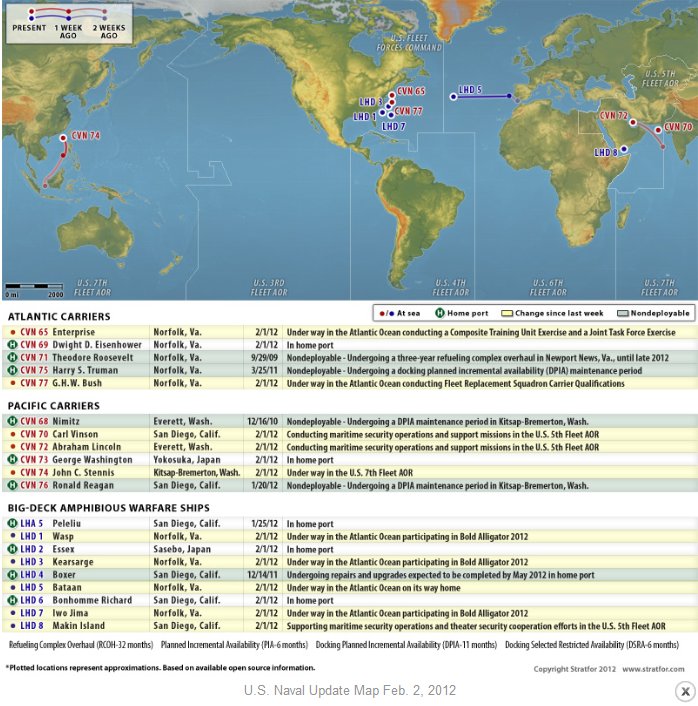
Just in case you were wondering where the US Navy has its major surface fleet components distributed, here’s a non-classified snapshot, courtesy of Stratfor:

The Naval Update Map shows an approximation of the current locations of U.S. Carrier Strike Groups (CSGs) and Amphibious Ready Groups (ARGs), based on available open-source information. No classified or operationally sensitive information is included in this weekly update. CSGs and ARGs are the keys to U.S. dominance of the world’s oceans. A CSG is centered on an aircraft carrier, which projects U.S. naval and air power and supports a carrier air wing (CVW). The CSG includes significant offensive strike capability. An ARG is centered on three amphibious warfare ships, with a Marine Expeditionary Unit (MEU) embarked. An MEU is built around a heavily reinforced and mobile battalion of Marines.

December 9, 2011

US Marine Corps has to economize on V-22 Osprey . . . by buying more helicopters

Filed under: Military, Technology — Tags: , , — Nicholas @ 08:39

The USMC is very happy with their V-22 Osprey tilt-rotor for its speed and durability, but it is still far more expensive than ordinary helicopters. As a result of the high individual cost of V-22’s, the USMC is having to buy upgraded CH-53 helicopters to carry some of the burden:

The U.S. Marine Corps recently admitted that the lifetime cost of operating their new V-22 Osprey tilt-rotor aircraft had increased 64 percent over the last three years (to $121.5 billion). Although the marines MV-22s have flown over 100,000 hours in Afghanistan and have an excellent safety and reliability record, they are very expensive. With major cuts in the defense budget coming, there is pressure to cease production of the MV-22, and put more money into cheaper helicopters. That is already happening.

Four years ago the U.S. Marine Corps began working on an updated version of their heavy, CH-53E, transport helicopters. The new version was the CH-53K. First flight of a CH-53K was to take place this year, with first CH-53Ks entering service in 2015. But now this has all been delayed. First flight won’t take place until 2013, and the CH-53K won’t enter service until 2018. Technical problems are blamed, although helicopter advocates imply that the marines don’t want to take money away from their MV-22 program to keep the CH-53K program on schedule.

There is still a lot of enthusiasm for the CH-53K. Two years ago, the marines decided to replace their elderly CH-53Ds with CH-53Ks, rather than the more expensive MV-22s. The CH-53K was to cost about $27 million each, compared to about three times that for an MV-22. However, delaying the introduction of the CH-53K will cost over a billion dollars, and add about $5 million to the cost of each CH-53K. Replacing the CH-53Ds means more CH-53Ks, for a total of about 200. It’s expected that the final costs of the CH-53D will be higher, but still about half the cost of an MV-22.


Image from Sikorsky website.

November 20, 2011

How is a member of the Joint Chiefs of Staff like a used car salesman?

Filed under: Government, Military, Politics, Technology — Tags: , , — Nicholas @ 09:58

Answer: when he uses the latest technology to get the Defense Secretary to a meeting on time.

Defense Secretary Leon E. Panetta shoved his head into a snug aviator helmet topped with goggles one September morning and swooped into Lower Manhattan on a V-22 Osprey, a $70 million aircraft that Marines use for battlefield assaults in Afghanistan.

“How’d you like that gizmo?” Mr. Panetta said after landing at the Wall Street heliport in the Osprey, which takes off like a helicopter, flies like an airplane — and has been responsible for the deaths of 30 people in test flights.

Defense Department officials say the hybrid aircraft was the fastest way to get Mr. Panetta and his entourage to New York that day. But anyone who has followed the tortured history of the Osprey over the past quarter-century saw the persistent, politically savvy hand of the Marines in arranging Mr. Panetta’s flight — and another example in what has become a case study of how hard it is to kill billion-dollar Pentagon programs.

“At a car dealership, what the salesman wants to do is get you inside the vehicle,” said Dakota Wood, a retired Marine lieutenant colonel and defense analyst. “You take the test drive and wow, it’s got a great stereo, it feels good, it has that new-car smell.”

That flight with Mr. Panetta, he said, is “an insurance policy against future defense cuts.”

November 15, 2011

Idiotic British defence decision is USMC’s gain

Filed under: Britain, Military, USA — Tags: , , , — Nicholas @ 12:44

Lewis Page explains why the USMC is getting a lovely windfall from Britain’s crack-brained decision to get out of the aircraft carrier business:

Blighty’s famous force of Harrier jump-jets, controversially disposed of during last year’s defence review along with the Royal Navy’s aircraft carriers, have been reprieved: the radical vectored-thrust jets, believed by many to have been the best strike planes in Britain’s arsenal, will fly (and almost certainly, fight) again.

However they won’t do so with British roundels on their sides or British pilots in their cockpits. The mothballed fleet of 74 Harriers, plus the UK’s inventory of spare parts, is being bought up lock, stock and barrel by the US Marines.

The US Marines possess a substantial air arm of their own and operate a large fleet of Harriers, with slightly different equipment but structurally the same. They anticipate that the British planes, engines and spares, many of which are in nearly-new condition and have been recently upgraded at significant expense, will allow them to keep flying Harriers into the mid-2020s without difficulty.

“We’re taking advantage of all the money the Brits have spent on them. It’s like we’re buying a car with maybe 15,000 miles on it,” Harrier expert Lon Nordeen tells the Navy Times.

June 29, 2011

Canada’s Cormorant fleet to stay airborne thanks to former “Marine One” helicopters

Filed under: Britain, Cancon, Italy, USA — Tags: , , , , — Nicholas @ 12:29

The Cormorant is not quite the success story we hoped for when we bought the helicopters for our search and rescue operations. Part of the problem is that spare parts for the choppers are in very short supply. An unexpected source of spare parts just happened to come our way recently:

The helicopters sold to Canada are the so-called US101 version of the EH101 aircraft developed during the 1980s and 1990s in the UK and Italy by companies which are now grouped as AgustaWestland. The UK forces, after massive delays and cost overruns, eventually received two versions, both known as “Merlin” — a naval submarine-hunting variant and a cargo or troop-carrying one for the RAF. Both types finally reached frontline useability around 2004-2005, but their availability rates have been poor: perhaps due to the fact that the Merlin didn’t sell well worldwide and thus parts were at a premium.

However the Merlin did sell to the Bush administration, which was seeking to replace its ageing VH-3 Sea King presidential helicopters operated by the US Marines (the president’s chopper becomes “Marine One” when he is aboard, just as his airforce-operated plane becomes “Air Force One”). But the US101 project, managed by Lockheed on behalf of AgustaWestland, soon became mired in cost and time overruns every bit as bad as those which had hit the Royal Navy’s HM1.

The plan might well have been doomed from the outset, with requirements calling for 14 VIP seats, hardening against electromagnetic pulse, an executive washroom and communications equivalent to “a flying Oval Office” — a pretty big ask for an aircraft which can only lift four tonnes in its RAF cargo-carrying incarnation.

The US101 problems became bad enough that each new Marine One copter was projected to cost as much as an Air Force One jumbo jet, and the costs became an issue in the presidential election — with both Mr Obama and his opponent John McCain vying to issue the strongest condemnation of the aircraft. Obama in particular described it as “procurement amok”, and unsurprisingly it was axed as soon as he took office.

Now the Canadians, who also operate the EH101 under the name “Cormorant”, have snapped up the former presidential fleet of nine aircraft for $164m.

May 14, 2011

The woes of the USS San Antonio

Filed under: Military, USA — Tags: , , , — Nicholas @ 09:54

What do you do when you buy a lemon? What if the lemon isn’t the anomaly, but the standard?

Some warships are cursed. They just don’t work right. When this happens to an automobile, you call it a lemon. But a defective warship is a more serious matter, and the U.S. Navy now fears it has an entire class of ships that is cursed. For the last five years, ever since the USS San Antonio, the first of the LPD 17 class amphibious ships entered service, there has been one problem after another. It began during sea trials, and there is no end in sight. Worse, all four subsequent LPD 17s to enter service exhibit similar problems. Most of the woes were created by poor workmanship and inadequate quality control by the builder. Contributing to these problems there are some poor design decisions and inadequate maintenance practices by the crew. But most of the problems occurred in the shipyard, while the ships were being built. The U.S. Navy sees this as symptomatic of what is wrong with the handful of yards that build most of American warships. This is especially embarrassing when compared to how well foreign shipyards produce similar warships.

Originally, the plan was for twelve LPD 17s to replace 41 smaller, older and worn out amphibious ships. Five LPD 17s have been built, four are under construction and another has been ordered. When the USS San Antonio entered service it was suddenly discovered that the builders had done a very shoddy job. It took the better part of a year to get the ship in shape. The second of the class, the USS New Orleans, was also riddled with defects that required several hundred million dollars to fix. This pattern of shoddy workmanship, incompetent management and outright lies (from the ship builders) continued, and resulted the order being cut to eleven ships. To add insult to injury, the last ship in the class is being named after politician John P. Murtha, who is generally hated by soldiers and marines for the way he politically exploited and defamed the troops who served in Iraq and Afghanistan. This is particularly painful because the LPD 17s carry marines into combat.

Many consider the San Antonio class as a poster child for all that’s wrong with American warship construction efforts. The ships are being delivered late, and hundreds of millions of dollars over budget. The list of problems with the ships is long, embarrassing and seemingly without end. Although the San Antonio did get into service, it was then brought in for more inspections and sea trials, and failed miserably. Repairs are still underway to catch all the shipyard errors.


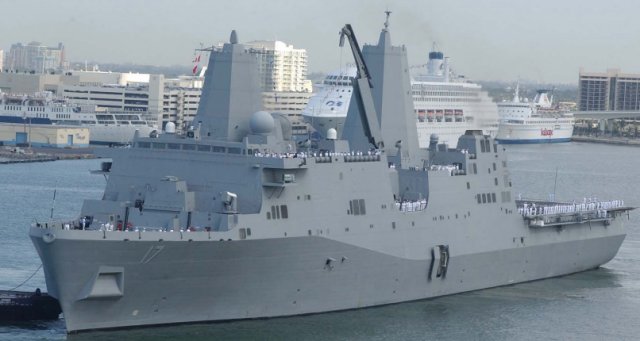
Detail from original image at Wikimedia.org.

Even more information on the long list of issues with the lead ship of the class here. According to the official website, the ship is “currently under going engine maintenance at Earl Industries shipyard in Portsmouth, VA”.

February 17, 2011

Building an (even better) army helmet

Filed under: Military, Technology, USA — Tags: , , — Nicholas @ 08:45

The US Army and USMC like the latest combat helmet even more than they liked the next-most recent improved model:

The U.S. Army and Marine Corps have found that their new Enhanced Combat Helmet (ECH) is even more bullet proof than expected. While testing the ECH, it was discovered that the machine firing metal fragments at the ECH (to represent shell and bomb fragments) could not fire fragments fast enough to penetrate. The ECH was supposed to be invulnerable to pistol bullets, and it was, but some types of metal fragments were expected to still be dangerous. So ECH was tested to see how well it could resist high-powered rifle bullets. ECH was not 100 percent invulnerable, but in most cases, it would stop anything fired from a sniper rifle. Overall, it was calculated that the ECH was 40 percent more resistant to projectiles and 70 percent stronger than the current ACH helmet.

The ECH is made of a new thermoplastic material (UHMWP, or Ultra-High Molecular Weight Polyethylene). It is lighter and stronger than the Kevlar used in the ACH and earlier PASGT and, it turned out, provided much better protection as well. The ECH will begin replacing the current ACH later this year, with 200,000 being eventually purchased. The ECH costs $600 each, twice as much as the ACH. But for troops under fire, the additional cost is well worth the additional protection.

Combat helmets, which appear to be low-tech, have been anything-but over the last three decades. Advances in the design and construction of helmets have been accelerating, especially in the last decade. For example, the current ACH (Advanced Combat Helmet) recently underwent some tweaks to make it more stable. That was required because more troops are being equipped with a flip down (over one eye) transparent computer screen. The device is close to the eye, so it looks like a laptop computer display to the soldier, and can display maps, orders, troop locations or whatever. If the helmet jumps around too much, it’s difficult for the solider to make out what’s on the display. This can be dangerous in combat.

February 11, 2011

Taming the US defence budget

Filed under: Bureaucracy, Economics, Military, USA — Tags: , , , , — Nicholas @ 07:29

The US government is in a financial bind — that’s not exactly news. What is new, however, is that the military may actually have to take cuts, not just smaller increases in the annual budget:

On one side of the argument are fiscal hawks like Rand Paul, newly elected senator from Kentucky, who fear that a national debt heading towards 100% of GDP by the end of the decade is in itself a menace to the nation and defence must take its share of the pain. The sheer size of America’s defence budget puts it in the crosshairs. At around $700 billion a year including war expenditures, it as big as those of the world’s next 20 highest military spenders combined. Last year American defence spending exceeded the average spent during the cold-war years by 50% (adjusted for inflation), while in the past 10 years it has grown by 67% in real terms.

[. . .]

Mr Gates, a canny operator whom Barack Obama retained after he took over from George Bush, began to sniff which way the wind was likely to turn in 2008. He calculated that if he took the initiative, he might stave off deeper and more unwelcome cuts. So he curbed or cancelled more than 30 weapons systems including the army’s Future Combat System, the F-22 Stealth fighter, two missile defence systems and the Zumwalt-class destroyer. Last year he went further, proposing the closure of the Joint Forces Command in Virginia and a 10% reduction in the budget for contract workers for each of the next three years. He asked the armed services to find at least $100 billion worth of “efficiency savings” over the next five years, which he promised to reinvest in other programmes.

[. . .]

Buck McKeon, the Republican who now leads the House Armed Services Committee, has responded with predictable fury to the Gates plan, saying it was “a dramatic shift for a nation at war and a dangerous signal from the commander-in-chief”. Mr Gates can take some comfort from the fact there has been at least as much “incoming” from critics who say he has not gone nearly far enough. They point out that what is being planned is not so much a cut as a small reduction on what the Pentagon had been planning to spend over the next four to five years. The budget will still creep up in real terms until it flattens off in 2015. Given his intention to retire from office later this year, Mr Gates may not have the stomach for attempting anything more radical on his watch.

February 6, 2011

US repositioning military forces near Egypt

Filed under: Middle East, Military, USA — Tags: , , — Nicholas @ 09:58

It should come as no surprise that the American government is changing the location and composition of forces around Egypt, as the situation becomes more volatile. Both US Navy and USMC units are involved in the moves. According to the L.A. Times, the USS Kearsarge is a key part of the redeployment:

The Pentagon is moving U.S. warships and other military assets to make sure it is prepared in case evacuation of U.S. citizens from Egypt becomes necessary, officials said Friday.

The Kearsarge, an amphibious assault ship carrying 700 to 800 troops from the 26th Marine Expeditionary Unit, and the Ponce have arrived in the Red Sea, putting them off Egypt’s shores in case the situation worsens.

Pentagon officials emphasized that military intervention in Egypt was not being contemplated and that the warships were being moved only for contingency purposes in case evacuations became necessary.

Business Insider reports that USMC units are being moved now:

A senior member of the US Marine corps is telling people “multiple platoons” are deploying to Egypt, a source tells us.

There is a system within the US Marines that alerts the immediate families of high-ranking marines when their marine will soon be deployed to an emergency situation where they will not be able to talk to their spouses or families.

That alert just went out, says our source.

For those of you not steeped in military jargon, a “platoon” is a small tactical unit of about 40 men, commanded by a lieutenant. This is not an “invasion force” sized move.

« Newer PostsOlder Posts »

Powered by WordPress