Forgotten Weapons
Published 8 Jan 2018The Winchester G30R is the final iteration of David Marshall Williams’ work on a full power .30 caliber military rifle. The project began with a design by Ed Browning (John Browning’s half brother) using a tilting bolt and annular gas piston, manufactured for US military trials by Colt. It moved to the Winchester company, which assigned Williams to the project when Browning died in 1939. Williams first replaced the annular gas piston with his gas tappet system, creating the G30M rifle. This performed poorly in trials, and the next iteration was the replacement of the tilting bolt with a Garand-type rotating bolt, creating the Winchester M2 rifle.
The US military was not interested in the M2 in .30-06, but thought the concept could be ideal for the Light Rifle trials then underway, and Winchester scaled it down to .30 carbine, and won the Light Rifle trials with it. That weapon would go on to become the M1 Carbine. Once it was in mass production, Winchester returned to the M2 design and improved it into this G30R. It was tested by the Marine Corps, but not adopted. The Canadian military also expressed an interest, but the US government opted to not allow any exports, and so Canada never tested it.
The US Army was quite satisfied with the M1 Garand, but suggested that this rifle might be made into a replacement for the BAR if it were redesigned a bit for greater sustained fire capacity. Winchester did so, creating the Winchester Automatic Rifle (WAR), which was on track for adoption until World War Two ended and immediate arms development became a much less important priority for the military.
Thanks to the Institute of Military Technology for allowing me to have access to this rifle so I can bring it to you! Check out the IMT at:
August 11, 2022
“Carbine” Williams’ Battle Rifle: The Winchester G30R
June 22, 2022
Johnson M1941 Rifle
Forgotten Weapons
Published 3 Oct 2016Cool Forgotten Weapons Merch! http://shop.bbtv.com/collections/forg…
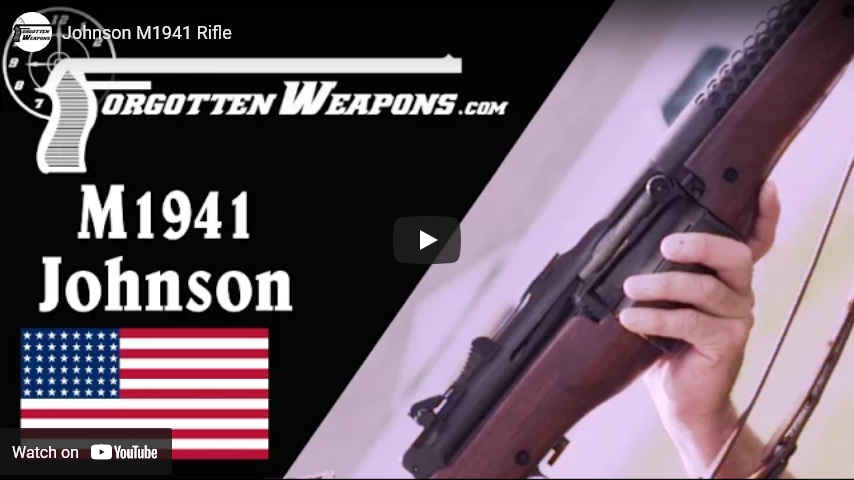
Designed in 1936 by Melvin Johnson, the M1941 Johnson Automatic Rifle was a competitor to the M1 Garand, but not introduced in time to actually be adopted in place of the Garand. Instead, Johnson hoped to have his rifle accepted as a parallel second option for the US military in case something went wrong with the rollout of the Garand, or production simply couldn’t meet the required levels.
However, Johnson was not able to make his case to the military successfully. A small number of Johnson Light Machine Guns were acquired by the US Paramarines and the First Special Service Force, and a large order (30,000 rifles) was placed by the Dutch government for shipment to the colonies in southeast Asia (it is from this order that the M1941 designation comes). However, those colonies fell to the Japanese before a significant number of rifles were able to be shipped out. This left a substantial number of rifles orphaned in the US, and a small number of these were unofficially put in service by acquisitive Marines, mostly in the Pacific theater.
Mechanically, the Johnson is a short recoil system with a rotating bolt (very similar to the later AR-15 bolt, which Johnson would influence). It is chambered for the standard .30-06 cartridge, and feeds from a 10-round rotary fixed magazine which can be fed by stripper clips or with individual cartridges.
May 11, 2022
M1944E1/M1945 Johnson Light Machine Gun
Forgotten Weapons
Published 27 Aug 2016http://www.patreon.com/ForgottenWeapons
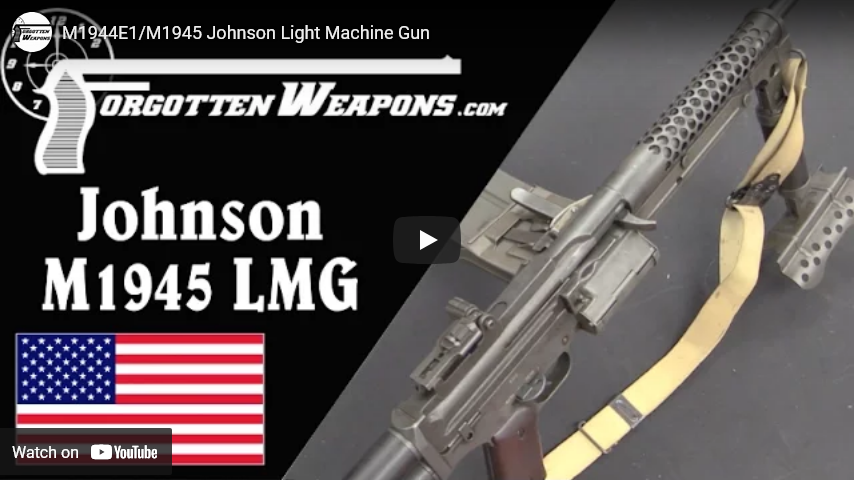
After getting his Model 1941 machine gun purchased in small numbers by the US military, Melvin Johnson continued to press for more sales and a general adoption. Following testing results and recommendations from soldiers in the field, he made a number of modifications to the gun and developed the M1944, which was quickly tweaked to become the M1944E1, also called the M1945. This new version included several improvements including:
* Replacing the bipod with a monopod less prone to interfering with barrel removal
* Improved stronger bolt anti-bounce latch
* Metal dual-tube buttstock in place of wood
* and most significantly, a gas-boosted hybrid recoil operating systemThis new model of the Johnson was in testing at the end of WWII, and weapons development budget cuts at the conclusion of the war prevented it from replacing the BAR as Johnson and many in the Marine Corps had hoped.
This particular M1945 Johnson is fully transferrable, as came out of the Winchester Museum Collection (now the Cody Firearms Museum) back many years ago when curators would occasionally sell items from the collection to raise money.
May 9, 2022
Military Civics: The Many Armies of the United States
The Chieftain
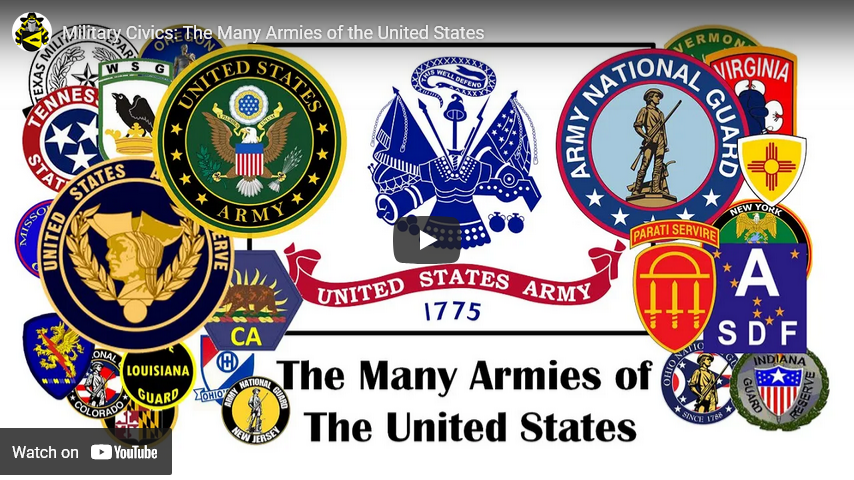
Published 19 Dec 2020There are just shy of a hundred official land component military organizations in the United States of America, each with their own unique legal structure and chain of command. In this video, I try to break down the details for you. It also seems to have taken several days for someone to observe I have the branches in the wrong sequence, Marines go before Navy.
Improved-Computer-And-Scout Car Fund:
Patreon: https://www.patreon.com/The_Chieftain
Direct Paypal https://paypal.me/thechieftainshat
Subscribestar: https://www.subscribestar.com/the_chi…
March 17, 2022
The “Three-Block”, “Four-Block”, or “n-Block” war
In The Line, Andrew Potter explains the genesis of the original “Three-Block War” idea and how a Canadian general tried to put theory into practice:
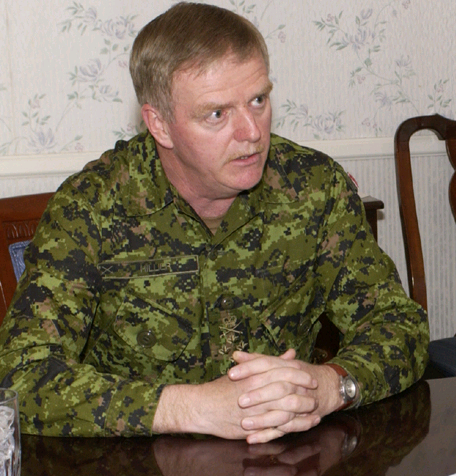
During General Rick Hillier’s first visit to Colorado Springs as Chief of Defence Staff, he takes a few minutes to talk with Tech. Sgt. Devin Fisher of NORAD and USNORTHCOM Public Affairs about Canada-U.S. Relations
Public domain image via Wikimedia Commons.
In 1999, a US Marine general named Charles Krulak wrote a piece in which he claimed that the future of combat for the Marines would be in urban environments in failed or failing states. In these situations, front line infantry might be doing humanitarian relief in one part of the city, performing peacekeeping duties in another, while doing intense urban combat in a third. He called this the “Three Block War“. Figuring out how to prepare and train for this scenario would be the central military challenge of the 21st century.
While the Three Block War was picked up and booted around as an interesting idea, it was never formalized into Marine doctrine. But one person who did take it seriously was Rick Hillier, the former head of the Canadian military who brought it into the Canadian forces when he took over as chief of the land staff in 2003, arguing that the Three Block War in failed and failing states was the future of warfare. He wanted a CAF that was trained and kitted out for this reality. When he became Chief of the Defence Staff in 2005, Hillier kept pushing this idea on Paul Martin and the Liberals, who loved his “vision” and firm sense of priority-setting.
In Hillier’s hands, the Three Block War concept was a disaster. Some American analysts blamed the strategy for Canada’s elevated casualty rates in Kandahar. The concept also came under considerable scrutiny from Canadian military analysts. In a highly critical paper, Walter Dorn and Michael Varey described the three block war idea as “fatally flawed“. While the Three Block War concept might have served as a useful description of a certain type of tactical reality (amplified maybe by a few too many viewings of Black Hawk Down), as a strategic concept it had a number of problems. For example, it wasn’t clear how it would apply to other armed services, or to theatres other than urban centres. It seemed to threaten the specificity of mandate and mission that is crucial to military operations. It clearly ran the risk of “block inflation” — why not throw governance, economic development, general nation building, and anything else you think you can get the military to do into the hopper? Indeed, in 2005 General James Mathis co-authored a piece proposing the concept of the four block war, which added psychological and information operations to the mix.
Ultimately, Dorn and Varey were concerned that crucial distinctions central to warfare were being elided. As they put it, the whole point of doctrine is to make a clear delineation between things that are “war” and things that are “not war”, and the Three Block War threatens to make everything into a type of war.
Two decades later the verdict is in, and it looks like everyone was right. When it comes to the tactical environment, people like Krulak, Hillier, and Mathis were more prescient than they might ever have imagined, at least if Ukraine is any template for how modern warfare is evolving. Yet at the same time, everything the critics of the Three Block War concept worried about has also come to pass: the confusion of mission and mandates, the endless proliferation of “blocks”, and most seriously, the assimilation of everything, and everyone, into “war”.
In his original article, Krulak argued that the reality of the Three Block War meant that any local engagement or interaction could have repercussions on the mission as a whole. For example, if a squad of Marines based in a “peacekeeping” block of the city gets jumpy and opens fire on a civilian truck carrying humanitarian aid (and not a truck bomb), that could have serious impacts for the entire strategic effort. And so he coined the notion of the “strategic corporal”, a front line soldier who would have the training, judgement, and moral fibre to do his or her job in a way that would always support strategic objectives.
February 18, 2022
Battle of Iwo Jima 1945 – Day by Day
Real Time History
Published 17 Feb 2022Support Real Time History on Patreon: https://patreon.com/realtimehistory
The battle of Iwo Jima in 1945 was one of the most brutal battles of the WW2 Pacific Campaign. The small volcanic island of Iwo Jima had an important strategic position for the US military. But the Japanese Army had learned how to defend in previous hard fought battles on other islands like Guam, Peleliu or Guadalcanal.
Special thanks to Project’44 co-created by Nathan Kehler and Drew Hannen from the Canadian Research and Mapping Association (CRMA). Check out their Iwo Jima map: http://iwojimamap.com/
» THANK YOU TO OUR CO-PRODUCERS
John Ozment, James Darcangelo, Jacob Carter Landt, Thomas Brendan, Kurt Gillies, Scott Deederly, John Belland, Adam Smith, Taylor Allen, Rustem Sharipov, Christoph Wolf, Simen Røste, Marcus Bondura, Ramon Rijkhoek, Theodore Patrick Shannon, Philip Schoffman, Avi Woolf,» OUR PODCAST
https://realtimehistory.net/podcast – interviews with historians and background info for the show.» BIBLIOGRAPHY
Akikusa Tsuruji, 17-sai no Iōtō (Tokyo: Bungei Shunjū, 2006)
Allen, Robert E, The First Battalion of the 28th Marines on Iwo Jima: A Day-by-Day History from Personal Accounts and Official Reports, with Complete Muster Rolls, (Jefferson, NC: McFarland & Company, Inc. Publishers, 1999)
Leckie, Robert, The Battle of Iwo Jima, (New York: Random House, 1967)
NHK Shuzaihan, Iōjima Gyokusaisen: Seikanshatachi ga kataru shinjitsu, (Tokyo: NHK Shuppan, 2007)
Rottman, Gordon L & Wright, Derrick, Hell in the Pacific: The Battle of Iwo Jima, (Oxford: Osprey Publishing, 2008)
Sandberg, Walter, The Battle of Iwo Jima: A Resource Bibliography and Documentary Anthology, (Jefferson, NC: McFarland & Company, Inc. Publishers, 2005)
United States Fleet, Headquarters of the Commander in Chief, Navy Department, “Amphibious Operations, Capture of Iwo Jima: 16 February to 16 March 1945” COMINCH P-0012, (17 July 1945)» OUR STORE
Website: https://realtimehistory.net» OTHER PROJECTS
16 DAYS IN BERLIN: https://realtimehistory.net/16-days-i…
RHINELAND 45: https://realtimehistory.net/rhineland45
THE GREAT WAR: https://youtube.com/thegreatwar»CREDITS
Presented by: Jesse Alexander
Written by: Mark Newton, Jesse Alexander
Director: Toni Steller & Florian Wittig
Director of Photography: Toni Steller
Sound: Above Zero
Editing: Toni Steller
Motion Design: Toni Steller, Philipp Appelt
Mixing, Mastering & Sound Design: http://above-zero.com
Maps: Project ’44 https://www.project44.ca/
Research by: Mark Newton
Fact checking: Mark NewtonChannel Design: Battlefield Design
Contains licensed material by getty images
All rights reserved – Real Time History GmbH 2022
From the comments:
Real Time History
8 hours ago
Support Real Time History on Patreon: https://patreon.com/realtimehistoryWe hope you liked this surprise episode. Special thanks to Project ’44 and the Canadian Research and Mapping Association for their help with this episode. Their map (http://iwojimamap.com/) was the inspiration for this Iwo Jima documentary. We wanted to try out if we could hook their map data to our motion graphics. Iwo Jima was the perfect test case since it was geographically a limited campaign. As you saw, our idea was a success and we will build on what we learned here for our upcoming Napoleon project.
October 22, 2021
The Vehicle That Will Win World War Two – WW2 Special
World War Two
Published 21 Oct 2021The Higgins Landing Craft, Higgins Boat, Landing Craft, or whatever you would like to call it, is one of the most important vehicles of the Second World War — perhaps just as much as tanks, planes, and warships. In a war full of amphibious invasions, landing on beaches in a safer and more efficient way is crucial to victory. So let’s find out the history of this war machine and its use by the World War Two allies.
(more…)
October 10, 2021
Stalingrad Thunderdome: Paulus vs. Chuikov! – WW2 – 163 – October 9, 1942
World War Two
Published 9 Oct 2021Things are looking pretty grim for Vassily Chuikov’s 62nd Army in Stalingrad this week, as the German 6th Army launches its biggest series of attacks so far. The Axis are unable to get anywhere in the Caucasus, though, and the American Marines win a local victory over the Japanese on Guadalcanal, but everyone’s thoughts there are on reinforcing and more reinforcing.
(more…)
August 14, 2021
Infantry Weapons at Guadalcanal – WW2 Special
Update: The folks at the World War Two channel have taken down this video due to technical errors in the script. Here’s their explanation.
World War Two
21 hours ago
Video on Infantry Arms at Guadalcanal retracted. Indy explains why:Hi everyone. Indy here. As most of you know, I do the research and writing for all of the regular weekly episodes here. I host many of the specials as well, though I do not do the research for most of them- occasionally so, if it’s something that’s really in my field of expertise, like geopolitics, strategy, personal stories, communications, and international relations. The research for the other specials is done by a variety of specialists in their fields or historians, so we can maintain the quality you’ve come to expect from us. I understand, though, that many of you have serious issues with the research for the Guadalcanal infantry special. Our apologies for that- the research was done by an historian, a PhD [student], actually, and we also ensured it was double fact-checked, but obviously some serious mistakes slipped through. Live and learn. I will say that I think it is important that you continue to tell us when you take issue with something we present, since we strive to make the most complete and accurate documentary series possible, so although some of them are hard to read we appreciate such feedback from our community.
And this is from the researcher who worked on the script:
Marlon Londoño
18 hours ago
Hey guys! This is Marlon, the PhD student in question who helped with the researching and writing of the episode. Just to give a little background, I’m a volunteer researcher who helps with the channel over the summer while I’m not teaching/researching/taking coursework. I’m a military historian and my main academic focus is on social and cultural military history (i.e. what people’s wartime experiences were like and why. I’m especially interested in how people justify wartime violence and oftentimes the types of weapons they use play a role in that mental process, so that’s the context in which I usually think about weapons on the battlefield).I’m sorry that I let a lot of you down with the mistakes about the Garand and Arisaka, among others. To be honest, I was surprised to learn they were myths. But I certainly know now, and I don’t think I’ll be forgetting any time soon 😅 One thing that I firmly believe as a researcher and educator is that nobody has a monopoly on the truth, least of all me. I tell that to my students on the first day of class each semester. I certainly don’t presume that the degree I’m pursuing makes me infallible or instantly qualified for anything. And this was a classic example of just how wrong I can be sometimes!
For what it’s worth, I love war history just as much as anyone else in the community, and I’m sorry that my research wasn’t as rigorous as it might otherwise have been. I hope you all might be willing to give any future episodes of mine a second chance, and of course I’m all ears for any mistakes that you want to point out!
August 8, 2021
Guadalcanal – Allies Take the Initiative – WW2 – 154 – August 7, 1942
World War Two
Published 7 Aug 2021The Axis Forces are on the move on the Eastern Front and in the Caucasus, but this week the Allies begin an offensive of their own: this week come Allied landings and attacks on Guadalcanal and nearby islands, the first American offensive against the Japanese.
(more…)
June 16, 2021
By Sea, By Land – A Global History of the Marines – WW2 Special
World War Two
Published 15 Jun 2021Naval infantrymen have long been a feature of warfare. In the build-up to 1939, they took on new functions and tactics. The Royal Marines, the US Marine Corps, Black Death, Kaiheidan, and more are ready for all-out amphibious warfare in the Pacific Theatre and beyond.
(more…)
March 10, 2021
Where Great Men Were Made: American Officer Training – WW2 Special
World War Two
Published 9 Mar 2021West Point and Annapolis are two of the most iconic military academies in America — maybe even the world. The two institutions have produced the men who are leading America’s fight against the Axis powers.
Join us on Patreon: https://www.patreon.com/TimeGhostHistory
Or join The TimeGhost Army directly at: https://timeghost.tvFollow WW2 day by day on Instagram @ww2_day_by_day – https://www.instagram.com/ww2_day_by_day
Between 2 Wars: https://www.youtube.com/playlist?list…
Source list: http://bit.ly/WW2sourcesHosted by: Indy Neidell
Written by: Markus Linke & Indy Neidell
Director: Astrid Deinhard
Producers: Astrid Deinhard and Spartacus Olsson
Executive Producers: Astrid Deinhard, Indy Neidell, Spartacus Olsson, Bodo Rittenauer
Creative Producer: Maria Kyhle
Post-Production Director: Wieke Kapteijns
Research by: Markus Linke
Edited by: Karolina Dołęga
Sound design: Marek KamińskiColorizations by:
– Daniel Weiss
– Mikołaj Uchman
– Norman Stewart – https://oldtimesincolor.blogspot.com/Sources:
United States Military Academy Library Digital Collection
United States Naval Academy Digital Collections
Library of Congress
New York Public Library
West Point Museum Art Collection
Imperial War Museums: IWM NYF 19427Soundtracks from Epidemic Sound:
– “Ominous” – Philip Ayers
– “The Inspector 4” – Johannes Bornlöf
– “London” – Howard Harper-Barnes
– “Please Hear Me Out STEMS INSTRUMENTS” – Philip Ayers
– “First Responders” – SkryaArchive by Screenocean/Reuters https://www.screenocean.com.
A TimeGhost chronological documentary produced by OnLion Entertainment GmbH.
From the comments:
World War Two
20 hours ago
This episode goes back to our roots of good old-fashioned military history. It’s something we’d like to start doing more of. Of course, West Point and Annapolis are the most famous, but we think that diving into the officer training of forces like the Wehrmacht or Red Army could tell us a lot about their histories. There is also a whole bunch of options for military history topics that we’d like to get into. Let us know in the comments if you have any suggestions.
January 7, 2021
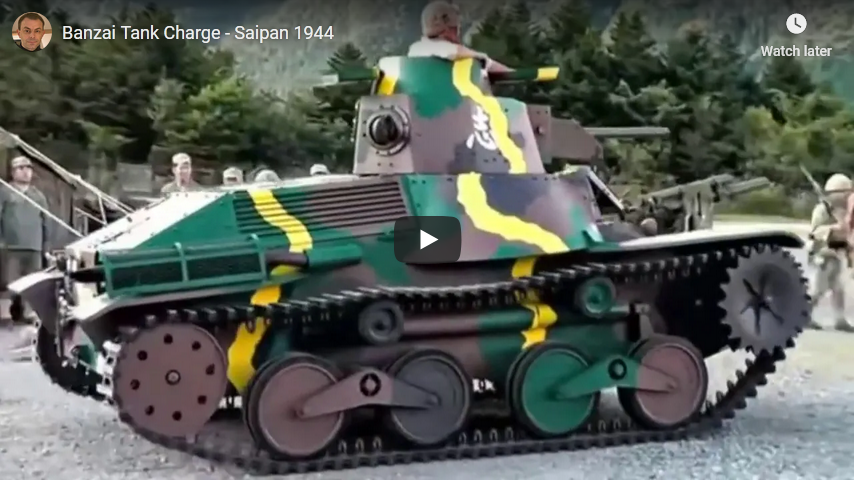
Banzai Tank Charge – Saipan 1944
Mark Felton Productions
Published 6 Jan 2020The story of the largest tank battle of the Pacific Campaign on the island of Saipan.
Dr. Mark Felton is a well-known British historian, the author of 22 non-fiction books, including bestsellers Zero Night and Castle of the Eagles, both currently being developed into movies in Hollywood. In addition to writing, Mark also appears regularly in television documentaries around the world, including on The History Channel, Netflix, National Geographic, Quest, American Heroes Channel and RMC Decouverte. His books have formed the background to several TV and radio documentaries. More information about Mark can be found at: https://en.wikipedia.org/wiki/Mark_Fe…
Visit my audio book channel “War Stories with Mark Felton”: https://youtu.be/xszsAzbHcPE
Help support my channel:
https://www.paypal.me/markfeltonprodu…
https://www.patreon.com/markfeltonpro…Disclaimer: All opinions and comments expressed in the ‘Comments’ section do not reflect the opinions of Mark Felton Productions. All opinions and comments should contribute to the dialogue. Mark Felton Productions does not condone written attacks, insults, racism, sexism, extremism, violence or otherwise questionable comments or material in the ‘Comments’ section, and reserves the right to delete any comment violating this rule or to block any poster from the channel.
June 8, 2020
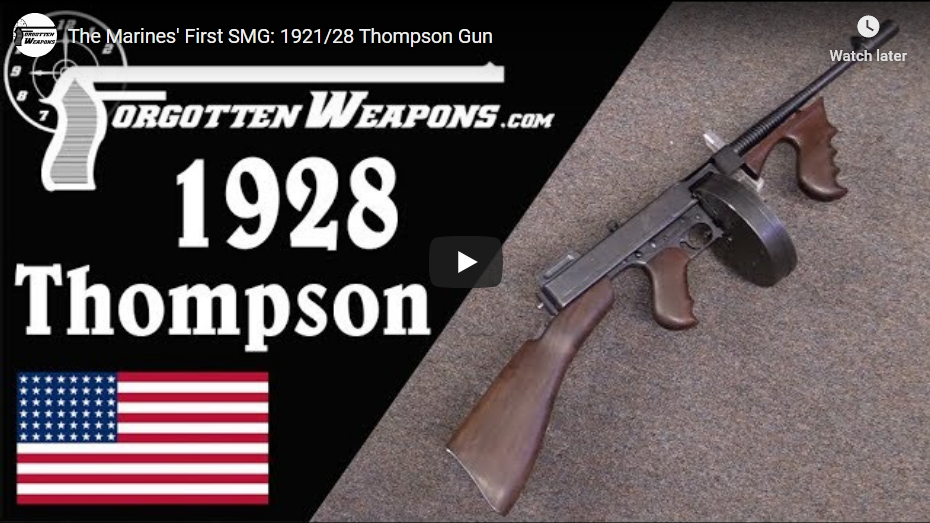
The Marines’ First SMG: 1921/28 Thompson Gun
Forgotten Weapons
Published 9 Oct 2018https://www.forgottenweapons.com/the-…
http://www.patreon.com/ForgottenWeapons
Cool Forgotten Weapons merch! http://shop.bbtv.com/collections/forg…
The USMC had acquired a few hundred early 1921 model Thompson submachine guns in 1926, and prompted the US Navy to formally test the guns. The Navy requested a reduction in the rate of fire, in order to improve controllability and reduce ammunition consumption (20 round magazines go quickly at 900rpm!). Auto-Ordnance happily complied, and Oscar Payne returned to the company on his spare time to modify the gun. He did this by adding a substantial amount of mass to the actuator, and was able to reduce the rate of fire substantially. The Navy subsequently ordered 500 guns, designated the Model of 1928.
Since most of the original 15,000 guns made by Colt were still in inventory, Auto-Ordnance simply overstamped the “1” at the end of “1921” with an “8” and put the new heavier bolt assemblies in the guns, leading to the collector term “21/28 overstamp” for these Thompsons. The lower rate of fire would become the new standard for the Thompson.
By late 1928, only about 6,000 Thompsons had been sold, and by the end of 1938 10,300 had been sold. Of these, about 1500 total had gone to the US government, about 4100 exported, and the remainder to American police and security agencies. Times were not good for the Thompson — it was an expensive military weapon without a war that needed it. Despite the gun’s huge notoriety, it was actually not used in particularly large numbers by the motor bandits of the 20s and 30s, nor in great numbers by the police. While the FBI did purchase Thompsons, they only bought 115 in total, and not until 1935.
This is the second part in a 5-part series on the development of the Thompson…
Contact:
Forgotten Weapons
PO Box 87647
Tucson, AZ 85754If you enjoy Forgotten Weapons, check out its sister channel, InRangeTV! http://www.youtube.com/InRangeTVShow
February 26, 2020
The Pacific War | Animated History
The Armchair Historian
Published 15 Jun 2018Huge thanks to Kan Shimada for the Japanese translation!
Our Website: https://www.thearmchairhistorian.com/
Our Twitter: https://twitter.com/ArmchairHist
This video has been sponsored and approved by Oasis Games
Sources:
The Pacific War Companion: From Pearl Harbor to Hiroshima, Daniel Marston (editor)
Iwo Jima: World War II Veterans Remember the Greatest Battle of the Pacific, Larry Smith
Hell is Upon Us: D-Day in the Pacific, Victor Brooks
Eyewitness Pacific Theater, Firsthand Accounts of the War in the Pacific from Pearl Harbor to the Atomic Bombs, John T. Kuehn and D.M. Giangreco
Lost in the Pacific: Epic Firsthand Accounts of WWII Survival Against Impossible Odds, L. Douglas Keeney (Editor)
This rather short-changes the Australian contribution to MacArthur’s campaigns in the southwest Pacific theatre, but it is a survey and can only cover so much of such a massive conflict.