Quotulatiousness

July 28, 2013

Snowden is not the story

Filed under: Liberty, Media, Technology — Tags: , , , , — Nicholas @ 10:16

In the Observer, John Naughton makes a few corrections to the way the media is reporting the saga of Edward Snowden and his revelations about the NSA’s global surveillance operations:

Repeat after me: Edward Snowden is not the story. The story is what he has revealed about the hidden wiring of our networked world. This insight seems to have escaped most of the world’s mainstream media, for reasons that escape me but would not have surprised Evelyn Waugh, whose contempt for journalists was one of his few endearing characteristics. The obvious explanations are: incorrigible ignorance; the imperative to personalise stories; or gullibility in swallowing US government spin, which brands Snowden as a spy rather than a whistleblower.

In a way, it doesn’t matter why the media lost the scent. What matters is that they did. So as a public service, let us summarise what Snowden has achieved thus far.

Without him, we would not know how the National Security Agency (NSA) had been able to access the emails, Facebook accounts and videos of citizens across the world; or how it had secretly acquired the phone records of millions of Americans; or how, through a secret court, it has been able to bend nine US internet companies to its demands for access to their users’ data.

Similarly, without Snowden, we would not be debating whether the US government should have turned surveillance into a huge, privatised business, offering data-mining contracts to private contractors such as Booz Allen Hamilton and, in the process, high-level security clearance to thousands of people who shouldn’t have it. Nor would there be — finally — a serious debate between Europe (excluding the UK, which in these matters is just an overseas franchise of the US) and the United States about where the proper balance between freedom and security lies.

These are pretty significant outcomes and they’re just the first-order consequences of Snowden’s activities. As far as most of our mass media are concerned, though, they have gone largely unremarked. Instead, we have been fed a constant stream of journalistic pap — speculation about Snowden’s travel plans, asylum requests, state of mind, physical appearance, etc. The “human interest” angle has trumped the real story, which is what the NSA revelations tell us about how our networked world actually works and the direction in which it is heading.

July 26, 2013

Justin Amash and the attempt to rein-in the NSA

Filed under: Government, Politics, USA — Tags: , , , , — Nicholas @ 10:19

Dave Weigel looks at the unexpectedly close vote in congress that would have forced the NSA to “walk back” some of its current domestic surveilance operations:

For a few minutes on Wednesday afternoon, Rep. Justin Amash thought he might have killed the National Security Agency’s metadata collection program. He’d optimistically expected maybe 90 Republicans to back his amendment to the Department of Defense budget. Ninety-four of them did. But he ran out of votes eventually — the Democrats didn’t come through — and by a 217–205 margin, the House killed his amendment.

Amash loaded the confetti cannon anyway. “My friends and colleagues stuck with me on my NSA amendment and changed the dynamic of the debate with tonight’s close vote,” the Republican congressman tweeted. “What an amazing staff I have. Thank you, thank you, thank you. You guys are awesome.”

[…]

Defenders of the NSA program are furious that Amash even got that far, and are working to undermine him. According to Politico’s Jake Sherman, Amash started this process with an “unworkable amendment” that would have failed easily, until staffers “held his hand” to fix it. That’s their story, but it doesn’t reflect what led up to the amendment. In the wake of Edward Snowden’s disclosures, every member of Congress who’d been sitting on some security state reform picked it back up and reintroduced it. In the Senate, Utah’s Mike Lee (a Republican) and Oregon’s Jeff Merkley (a Democrat) brought back the Ending Secret Law Act that they couldn’t pass when FISA was reauthorized. Oregon Sen. Ron Wyden and Colorado Sen. Mark Udall, both Democrats, introduced legislation to restrict NSA data collection unless the material contained a “demonstrated link to terrorism or espionage.”

At the time, the lack of quick action on those bills suggested that the Snowden story had been a blip. Privacy advocates in Congress now refer to those bills as the first wave, part of a strategy of attrition that will make the current policy politically untenable.

Amash proved the NSA will have to concede some ground when his amendment moved quickly from obscurity to reality to being under attack from the administration. On Monday night, before the Rules Committee voted on which amendments to bring up, Amash was told to meet with Speaker of the House John Boehner on the floor. He returned from that meeting convinced (and surprised) that he’d get a vote after all.

July 17, 2013

Nonsense on stilts – Civil libertarians “caused” 9/11, so we have to curtail civil liberties

Filed under: Government, Law, Liberty, USA — Tags: , , , , — Nicholas @ 13:02

While some pro-surveillance folks may be content to hint that the world is a far more dangerous place if we don’t let the NSA have access to everyone’s electronic communications, there are others willing to go a lot further:

    And so, when a law enforcement task force of the FBI found out in August of 2001 that al Qaeda had sent two dangerous operatives to the United States, it did … nothing. It was told to stand down; it could not go looking for the two al Qaeda operatives because it was on the wrong side of the wall. I believe that FBI task force would have found the hijackers — who weren’t hiding — and that the attacks could have been stopped if not for a combination of bad judgment by the FISA court (whose minimization rules were later thrown out on appeal) and a climate in which national security concerns were discounted by civil liberties advocates on both sides of the aisle.

Got that? Anyone advocating for basic civil liberties is to blame for 9/11. Holy fuck. This kind of thinking is about as anti-American as I can think of. As we’ve discussed, protecting civil liberties is at the core of the American way of life. “Give me liberty or give me death” is the phrase that Patrick Henry chose, and apparently Stewart Baker believes the American motto should be “you’re all going to die if you fight for civil liberties!” Shameful.

[…]

    Forty years later, though, we’re still finding problems with this experiment. One of them is that law changes slowly while technology changes quickly. That usually means Congress has to change the law frequently to keep up. But in the context of intelligence, it’s often hard to explain why the law needs to be changed, let alone to write meaningful limits on collection without telling our intelligence targets a lot about our collection techniques. A freewheeling and prolonged debate — and does Congress have any other kind? — will give them enough time and knowledge to move their communications away from technologies we’ve mastered and into technologies that thwart us. The result won’t be intelligence under law; it will be law without intelligence.

Basically, shut up with the debate, just let us go back to spying on fucking everyone. If we actually have to “debate” and “protect the Constitution,” some “bad guys” might talk without us knowing about it. And then we’ll all die.

[…]

He then tries to flip the whole thing around and argue that supporters of civil liberties are actually anti-technology, because they’re trying to limit the government’s use of technology. That’s ridiculous, since many of the loudest supporters of civil liberties come from the tech and innovation communities. No one thinks the government shouldn’t make efficient use of technology — but that’s very different from saying it’s okay for the government to either convince or force companies to cough up all sorts of private data on everyone or risk the wrath of the US government. That’s not a fair fight. The government has the power to compel people and companies to do things that they would not do otherwise, though I guess an extreme authoritarian like Baker either doesn’t realize this or doesn’t see it as a problem.

At the end, he makes a bunch of claims about how it’s the US government’s job to “protect” everyone — though I’d like to see where that’s laid out in the Constitution. As mentioned above, he makes some valid points that other countries are just as bad, if not worse, but that’s hardly a compelling argument, because that just allows others to flip it around, and claim that the US has no moral high ground, since it’s ignoring the civil liberties of the public — something that Baker notes he directly supports in this testimony — for some vague and impossible promises of “safety.”

QotD: The war on general-purpose computing

Filed under: Liberty, Quotations, Technology — Tags: , , , — Nicholas @ 00:01

As we wait for dessert, I ask him about his recent speeches at technology conferences discussing the “war on general purpose computing”. He runs through the argument with practised fluency. Computers are by nature general-purpose machines. It’s impossible to make a computer that does all the kinds of things we want computers to do yet is somehow disabled from making copies of copyrighted material, or viewing child pornography, or sending instructions to a 3D printer to produce a gun.

“Oh my God, that’s good,” says Doctorow after his first mouthful of crumble. My peanut butter shortbread is fantastic too, if absurdly calorific. We are interrupted only by another waiter dropping a tray of glasses.

He continues with the argument. The impossibility of making limited-purpose computers won’t stop governments or corporations trying to put on the locks, or changing laws to try to make those locks effective. But the only way these limits can possibly work is subterfuge: computers therefore tend to contain concealed software that spies on what their users are trying to do. Such software is inevitably open to abuse and has often been abused in the past.

Digital rights management systems intended to prevent copying have been hijacked by virus-writers. In one notorious case, the Federal Trade Commission acted against seven computer rental companies and the software company that supplied them, alleging that the rental companies could activate hidden software to grab passwords, bank account details and even switch on the webcam to take photos of what the FTC coyly calls “intimate activities at home”. As computers surround us — in our cars, our homes, our pacemakers — Doctorow is determined to make people realise what’s at stake.

Tim Harford, “Cory Doctorow has Lunch with the FT“, TimHarford.com (originally published at the Financial Times), 2013-07-15

July 16, 2013

State of play in the surveillance state

Filed under: Government, Liberty, USA — Tags: , , , , — Nicholas @ 08:38

If you’re just getting back from an extended vacation with no access to the news, “George Washington” at Zero Hedge has a cheat-sheet on spying that you might want to have a look at:

Lots more at Zero Hedge.

July 15, 2013

Edward Snowden as the modern Prisoner

Filed under: Media, USA — Tags: , , , , — Nicholas @ 08:34

Justin Raimondo responds to Melissa Harris-Perry’s open letter to Edward Snowden:

Why didn’t Edward Snowden agree to be jailed, abused, silenced, and quite possibly tortured? This is what Melissa Harris-Perry wants to know.

Harris-Perry is one of MSNBC’s minor weekend anchors, a professor currently at Tulane University who started out retailing her academic pretensions as a sometime guest on the Rachel Maddow and Chris Hayes shows: her job was to inject fancy words like “discourse” and “paradigm” into the standard lefty-“progressive” boilerplate propaganda we’ve come to expect from that venue. With a magisterial tone bordering on the parodic, and complete protection from having to defend her views against any contrary opinions, Harris-Perry soon carved out a niche for herself as a dogged defender of the Obama administration, no matter what the circumstances. So when Snowden emerged as the biggest whistleblower in American history, exposing the existence of a secret surveillance apparatus that snakes into every aspect of American life, she sprang to the Dear Leader’s defense and delivered an “open letter” to Snowden that underscores why no one needs to take her seriously

[. . .]

Listening to Harris-Perry’s tirade, I wondered whether I had stumbled on a heretofore unknown episode of The Prisoner, the cult classic 1960s television series written by and starring Patrick McGoohan, in which a former British intelligence agent who has committed some unknown treason finds himself imprisoned in a place known as The Village. McGoohan’s pioneering series presents a prescient portrait of the anesthetizing Prozac-ed out mass culture of America today: the Village, with it’s pastel houses, outfitted with every comfort, are set in a garden-like “controlled community,” where calming voices are carried on the wind and daily medication prevents coherent thought. Everyone is subject to 24-hour surveillance, and cameras are everywhere. Each episode tells the story of one unsuccessful escape attempt after another, while McGoohan – the prisoner – probes ever deeper into the true nature of the Village. We don’t know what crime he’s been imprisoned for, but the clear implication is that it’s something big, almost Snowden-like. I’m surprised no one has brought up the McGoohan connection: the story lines are parallel if not identical. Snowden seems to be fleshing out McGoohan’s scripts in the front page headlines of every newspaper.

In the series, the Village employs its agents, who are constantly trying to entrap McGoohan into confessing to his alleged crimes, and giving up some Big Secret he supposedly possesses, but he resists. Harris-Perry, in her faux concern for the issues raised by Snowden’s exposure of massive government spying on innocent Americans, is straight out of an episode of The Prisoner, in which an agent of the Village tells him to give up his secret because his “level of celebrity” will somehow protect him. Really? Not, I suspect, if Harris-Perry and her fellow Madam Defarges over at MSNBC have anything to say about it.

I agree with Harris-Perry on one point: it is valid to discuss Snowden, his politics, his personal journey from agent of the state to enemy of the state, but unlike her I don’t think this detracts at all from the actual content of the documents he has made available to Glenn Greenwald and the staff of the Guardian newspaper. Greenwald tells a very interesting back story to all this in his talk given at the “Socialism” conference, in which he relates how and under what circumstances he met Snowden, and how that meeting inspired him to think about how real change comes about.

July 7, 2013

America’s Ministerium für Staatssicherheit

Filed under: Europe, Germany, Government, USA — Tags: , , , , — Nicholas @ 10:36

Rick Falkvinge looks at an interesting appropriate pairing: the former German Democratic Republic’s Ministerium für Staatssicherheit (Stasi) and the American NSA:

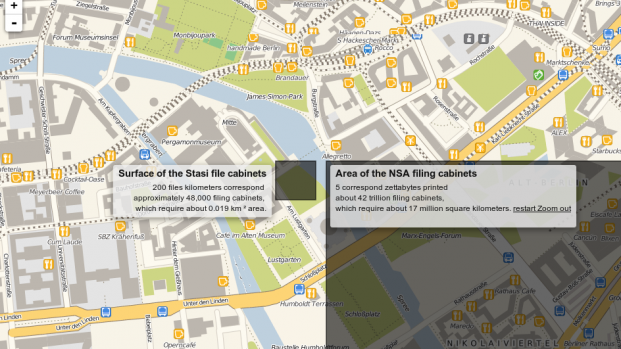
If you were to compare the evil, reprehensible Stasi to the NSA side by side in a visual comparison, who’s the worse surveillance hawk? The people over at OpenDataCity have put together a nice visual guide with astonishing results. We tend to think of Stasi-scale surveillance as the epitome of evil surveillance, and have completely lost track of what today’s governments are doing to their people.

When you go to this page (in German), you are presented with a nice map that compares the size of the Stasi archives — a large building in Berlin — with the corresponding NSA archives. It’s clear that the NSA’s archives — if used with Stasi technology, for an apples-to-apples comparison — would be quite a bit larger:

Comparison of the Stasi and NSA archives. The Stasi archives were a building in Berlin, the NSA archives seem to be more like a couple of entire blocks.

Comparison of the Stasi and NSA archives. The Stasi archives were a building in Berlin, the NSA archives seem to be more like a couple of entire blocks.

Keep reading … it’s like a “powers of ten” exercise.

July 4, 2013

Bonfire of the civil liberties

Filed under: Liberty, Media, Politics, USA — Tags: , , , , , , — Nicholas @ 11:06

A recent article by Dan Gillmore in the Guardian was reposted on Alternet yesterday:

No one with common sense believes Obama is planning to become a dictator. But the mail list question was indeed not paranoid — because Obama, building on the initiatives of his immediate predecessors, has helped create the foundation for a future police state. This has happened with bipartisan support from patriotic but short-sighted members of Congress and, sad to say, the general public.

The American media have played an essential role. For decades, newspaper editors and television programmers, especially local ones, have chased readers and ratings by spewing panic-inducing “journalism” and entertainment that helped foster support for anti-liberty policies. Ignorance, sometimes willful, has long been part of the media equation. Journalists have consistently highlighted the sensational. They’ve ignored statistical realities to hype anecdotal — and extremely rare — events that invite us to worry about vanishingly tiny risks and while shrugging off vastly more likely ones. And then, confronted with evidence of a war on journalism by the people running our government, powerful journalists suggest that their peers — no, their betters — who had the guts to expose government crimes are criminals. Do they have a clue why the First Amendment is all about? Do they fathom the meaning of liberty?

The founders, for all their dramatic flaws, knew what liberty meant. They created a system of power-sharing and competition, knowing that investing too much authority in any institution was an invitation to despotism. Above all, they knew that liberty doesn’t just imply taking risks; it absolutely requires taking risks. Among other protections, the Bill of Rights enshrined an unruly but vital free press and guaranteed that some criminals would escape punishment in order to protect the rest of us from too much government power. How many of those first 10 amendments would be approved by Congress and the states today? Depressingly few, one suspects. We’re afraid.

America has gone through spasms of liberty-crushing policies before, almost always amid real or perceived national emergencies. We’ve come out of them, to one degree or another, with the recognition that we had a Constitution worth protecting and defending, to paraphrase the oath federal office holders take but have so casually ignored in recent years.

What’s different this time is the surveillance infrastructure, plus the countless crimes our lawmakers have invented in federal and state codes. As many people have noted, we can all be charged with something if government wants to find something — the Justice Department under Bush and Obama has insisted that simply violating an online terms of service is a felony, for example. And now that our communications are being recorded and stored (you should take that for granted, despite weaselly government denials), those somethings will be available to people looking for them if they decide you are a nuisance. That is the foundation for tyranny, maybe not in the immediate future but, unless we find a way to turn back, someday soon enough.

H/T to Tim O’Reilly for the link.

July 2, 2013

Learning to love the leaker

Filed under: Government, Law, Media — Tags: , , , , — Nicholas @ 15:16

Glenn Reynolds, aka the Instapundit, explains why people who like government legitimacy should love the leakers:

… the Snowden affair occurs in the context of an unprecedented administration war on whistleblowers. And that’s a bad idea because whistleblowing is one of the things that maintains the legitimacy of a government as big, and otherwise unaccountable, as ours.

As recently reported by the McClatchy Newspapers, the Obama administration views whistleblowing and leaks as a species of terrorism. According to McClatchy: “President Obama’s unprecedented initiative, known as the Insider Threat Program, is sweeping in its reach. It has received scant public attention even though it extends beyond the U.S. national security bureaucracies to most federal departments and agencies nationwide, including the Peace Corps, the Social Security Administration and the Education and Agriculture departments. It emphasizes leaks of classified material, but catchall definitions of ‘insider threat’ give agencies latitude to pursue and penalize a range of other conduct. … Leaks to the media are equated with espionage.”

The Peace Corps? The Department of Agriculture? Really? There’s irony in this, given President Obama’s famous 2009 pledge to make transparency a “touchstone” in his administration. “For a long time,” he said, “there’s been too much secrecy in this city.” His views on this subject seem to have evolved. Now, like many officeholders, he wants to control information to avoid embarrassment.

But that’s a mistake. Because while leaks can bring embarrassment, leaks — or at least their possibility — also bring legitimacy.

The federal government is so huge that no one can really oversee it. (This was, remember, an excuse offered by Obama’s defenders in the IRS scandals.) It’s certainly too big for congressional oversight to do the job, as is evidenced by the numerous unfolding scandals ranging from the NSA to Benghazi to the IRS, all of which seem to have caught Congress by surprise.

June 29, 2013

Jeff Jarvis calls for private encryption

Filed under: Liberty, Media, Technology — Tags: , , , — Nicholas @ 10:27

In the Guardian, Jeff Jarvis makes the case for internet communications to be protected by encryption:

Assuring the security of private communications regardless of platform — email, VOIP, direct message — should be a top priority of the internet industry in the aftermath of Edward Snowden’s revelations that US and UK governments are tapping into the net’s traffic.

The industry needs to at least come together to offer encryption for private communications as protection against government surveillance.

Guarantee of private communications should be a matter of law already. But, of course, it is not. In the US, only our first-class physical mail is protected from government surveillance without a warrant. In the UK, it was a case of opened mail that led to the closing of the Secret Department of the Post Office. As a matter of principle, the protection afforded our physical mail should extend to any private communication using any means. Just because the authors of the Fourth Amendment could not anticipate the internet and email, let alone Facebook, that should not grant government spies a loophole from the founders’ intent.

That protection could come from Congress, but it won’t. It could come from the courts, but it hasn’t.

I argued in my book Public Parts that government may try to portray itself as the protector of our privacy, but it is instead the most dangerous enemy of privacy, for it can gather our information without our knowledge and consent — that is the lesson of Snowden’s leaks — and has the power to use it against us.

June 25, 2013

Snowden’s character doesn’t matter – Snowden’s revelations matter a great deal

Filed under: Government, Law, Liberty, Technology — Tags: , , , , , — Nicholas @ 15:08

Gene Healy says that it doesn’t matter what you think about Edward Snowden, you should care a lot about what he’s revealed:

Here, the most disturbing aspect of the Snowden revelations is the NSA’s comprehensive, multiyear call-records database, with communication and phone-location information on millions of Americans. Especially if combined with metadata on emails, website visits and financial transactions that the agency is also amassing, that information is a potential treasure trove for political abuse — it can be used to ferret out the sort of information governments have historically used to blackmail and neutralize political opponents: who’s leaking, who’s organizing, who’s having an affair. The potential abuse of that information represents a grave threat to American liberty and privacy regardless of Snowden’s character and motivations.

In an post last week, Buzzfeed‘s Ben Smith makes the key point: “You Don’t Have to Like Edward Snowden.” Snowden, Smith argues, is “a source,” and the information sources convey is far more important than their “moral status” or the “fate of [their] eternal soul[s].”

Smith mentions Mark Felt, the FBI honcho who served as Woodward and Bernstein’s “Deep Throat” during their investigation of the Watergate burglary and cover-up. Felt, it turned out, was simply settling scores in a bureaucratic power struggle. He had no scruples against criminal violations of privacy — in 1980 he was convicted of conspiring to violate the constitutional rights of Americans through warrantless break-ins as part of the FBI’s COINTELPRO program.

It was important for Americans to know that their president was a crook. That Mark Felt was also a crook is neither here nor there. As Smith puts it, “who cares?”

June 22, 2013

Interesting – and probably inevitable – legal wrinkle for the NSA

Filed under: Law, Liberty, Technology, USA — Tags: , , , — Nicholas @ 08:58

At Outside the Beltway, Doug Mataconis links to an interesting article:

It’s only been a few weeks since we learned to true scope of the National Security Agency’s data mining of the phone records of American citizens, but already lawyers in civil and criminal cases across the country are seeing the database as a potential discovery goldmine:

    The National Security Agency has spent years demanding that companies turn over their data. Now, the spy agency finds the shoe is on the other foot. A defendant in a Florida murder trial says telephone records collected by the NSA as part of its surveillance programs hold evidence that would help prove his innocence, and his lawyer has demanded that prosecutors produce those records. On Wednesday, the federal government filed a motion saying it would refuse, citing national security. But experts say the novel legal argument could encourage other lawyers to fight for access to the newly disclosed NSA surveillance database.

    “What’s good for the goose is good for the gander, I guess,” said George Washington University privacy law expert Dan Solove. “In a way, it’s kind of ironic.”

    Defendant Terrance Brown is accused of participating in the 2010 murder of a Brinks security truck driver. Brown maintains his innocence, and claims cellphone location records would show he wasn’t at the scene of the crime. Brown’s cellphone provider — MetroPCS — couldn’t produce those records during discovery because it had deleted the data already.

    On seeing the story in the Guardian indicating that Verizon had been ordered to turn over millions of calling records to the NSA last month, Brown’s lawyer had a novel idea: Make the NSA produce the records.

[. . .]

This particular criminal case is, of course, on where the Federal Government is a party to the case as a prosecutor. As such, the Judge must weight not simply the government’s argument that the information requested is classified and thus should not be disclosed, but also the question of whether the prosecution has a duty to turn over the evidence to the Defendant. As a general rule, the prosecution must turn over any evidence that is potentially exclupatory or which tend to call some aspect of the prosecution’s theory of the case into doubt. The rules for what must be turned over vary from state to state, and the Federal Courts have their own rules, but they all generally follow the principles set down by Brady v. Maryland, which established the general rule that Defendants are entitled to be provided with exculpatory evidence that prosecution may have against them.

Of more interest, though, is the likely hood that attorneys may try to gain access to this NSA metadata in cases where the Federal Government is not involved, such as state court criminal proceedings or even civil matters such as divorces

June 21, 2013

“Nobody is listening to your calls” … because the metadata is far more useful

Filed under: Government, Liberty, Technology, USA — Tags: , , , , , — Nicholas @ 09:50

John Naughton explains why the calming statement that “nobody is listening to your calls” is far from re-assuring:

‘To be remembered after we are dead,” wrote Hazlitt, “is but poor recompense for being treated with contempt while we are living.” Cue President “George W” Obama in the matter of telephone surveillance by his National Security Agency. The fact that for the past seven years the agency has been collecting details of every telephone call placed in the United States without a warrant was, he intoned, no reason for Americans to be alarmed. “Nobody is listening to your telephone calls,” he cooed. The torch was then passed to Dianne Feinstein, chair of the Senate intelligence committee, who was likewise on bromide-dispensing duty. “This is just metadata,” she burbled, “there is no content involved.”

At which point the thought uppermost in one’s mind is: what kind of idiots do they take us for? Of course there’s no content involved, for the simple reason that content is a pain in the butt from the point of view of modern surveillance. First, you have to listen to the damned recordings, and that requires people (because even today, computers are not great at understanding everyday conversation) and time. And although Senator Feinstein let slip that the FBI already employs 10,000 people “doing intelligence on counter-terrorism”, even that Stasi-scale mob isn’t a match for the torrent of voice recordings that Verizon and co could cough up daily for the spooks.

So in this business at least, content isn’t king. It’s the metadata — the call logs showing who called whom, from which location and for how long — that you want. Why? Because that’s the stuff that is machine-readable, and therefore searchable. Imagine, for a moment, that you’re an NSA operative in Fort Meade, Maryland. You have a telephone number of someone you regard as potentially “interesting”. Type the number into a search box and up comes a list of every handset that has ever called, or been called by, it. After that, it’s a matter of seconds before you have a network graph of second-, third- or fourth-degree connections to that original number. Map those on to electronic directories to get names and addresses, obtain a secret authorisation from the Fisa court (which has 11 federal judges so that it can sit round the clock, seven days a week), then dispatch a Prism subpoena to Facebook and co and make some coffee while waiting for the results. Repeat the process with the resulting email contact lists and — bingo! — you have a mass surveillance programme as good as anything Vladimir Putin could put together. And you’ve never had to sully your hands — or your conscience — with that precious “content” that civil libertarians get so worked up about.

June 17, 2013

QotD: Demands for less US control over the internet will get much more insistent

Filed under: Quotations, Technology, USA — Tags: , , — Nicholas @ 09:40

Writing about the new Internet nationalism, I talked about the ITU meeting in Dubai last fall, and the attempt of some countries to wrest control of the Internet from the US. That movement just got a huge PR boost. Now, when countries like Russia and Iran say the US is simply too untrustworthy to manage the Internet, no one will be able to argue.

We can’t fight for Internet freedom around the world, then turn around and destroy it back home. Even if we don’t see the contradiction, the rest of the world does.

Bruce Schneier, “Blowback from the NSA Surveillance”, Schneier on Security, 2013-06-17

June 16, 2013

Emmanuel Goldstein? Isn’t that some C-list celebrity from the 70s?

Filed under: Books, Government, Liberty, Media — Tags: , , — Nicholas @ 00:01

In Maclean’s, Colin Horgan says it’s the Huxley dystopia we’ve actually fallen into, rather than the Orwellian:

Over at the New Yorker, Ian Crouch wondered this week whether we really are living in some version of George Orwell’s Nineteen Eighty-Four. It seems like a perpetual question, but it has renewed relevance now, both in light of the revelations last week from the Glenn Greenwald at the Guardian that the National Security Association is, apparently, mining internet data from users (whether guilty or not), without their knowledge or consent, and because in the subsequent days, sales of Nineteen Eighty-Four skyrocketed.

But, as Crouch asked, are we living in Nineteen Eighty-Four? Not quite. It all looks pretty bad, and the nightmare scenario Orwell depicted is, technically speaking, quite possible but, Crouch noted, “all but the most outré of political thinkers would have to grant that we are far from the crushing, violent, single-party totalitarian regime of Orwell’s imagination.” Surely, though, this is not what was envisioned – even when the Patriot Act was debated back at the turn of the century, few (if any) could have envisioned that the laws might be one day stretched quite as far as they appear to have been under the Obama administration. So, if not Nineteen Eighty-Four then when? What time is this?

[. . .]

There are two ways for a culture to die, Neil Postman wrote back in the 1980s: One is Orwellian, “where culture becomes a prison,” and the second is Huxleyan, where “culture becomes a burlesque.” To answer Crouch’s question, we are living the second reality more than the first. Big Brother does not watch us by his choice; rather, as Postman put it, we watch him by ours. “Orwell feared that the truth would be concealed from us. Huxley feared the truth would be drowned in a sea of irrelevance,” Postman wrote.

[. . .]

To paraphrase Postman, we have not been ruined by what we hate, but instead, as Huxley predicted, by what we love. We are prisoners to our own egoism and passivity, drowning in a sea of irrelevant streaming data, presented not in with any hierarchy or inherent importance, but as equal and unweighted. The Harlem Shake and Nyan Cat are just as relevant as a civil war in Syria or a democratic nation spying on its own citizens, just as being watched by millions of strangers via webcam or TV broadcast feels just the same as being watched by the government. And, as Huxley thought we might, we have convinced ourselves that is freedom.

« Newer PostsOlder Posts »

Powered by WordPress