
Published on 5 Mar 2015
Modern war already took place in the sky and under water but the waring nations also wanted to gain an advantage in the trenches. So this week, we see the first use of another merciless invention on the battlefield: the flame thrower. The battles on the Western Front, in the Carpathian’s and near the Dardanelles continued nonetheless.
March 8, 2015
Playing With Fire – The First Flame Thrower I THE GREAT WAR Week 32
Comments Off on Playing With Fire – The First Flame Thrower I THE GREAT WAR Week 32
October 25, 2014
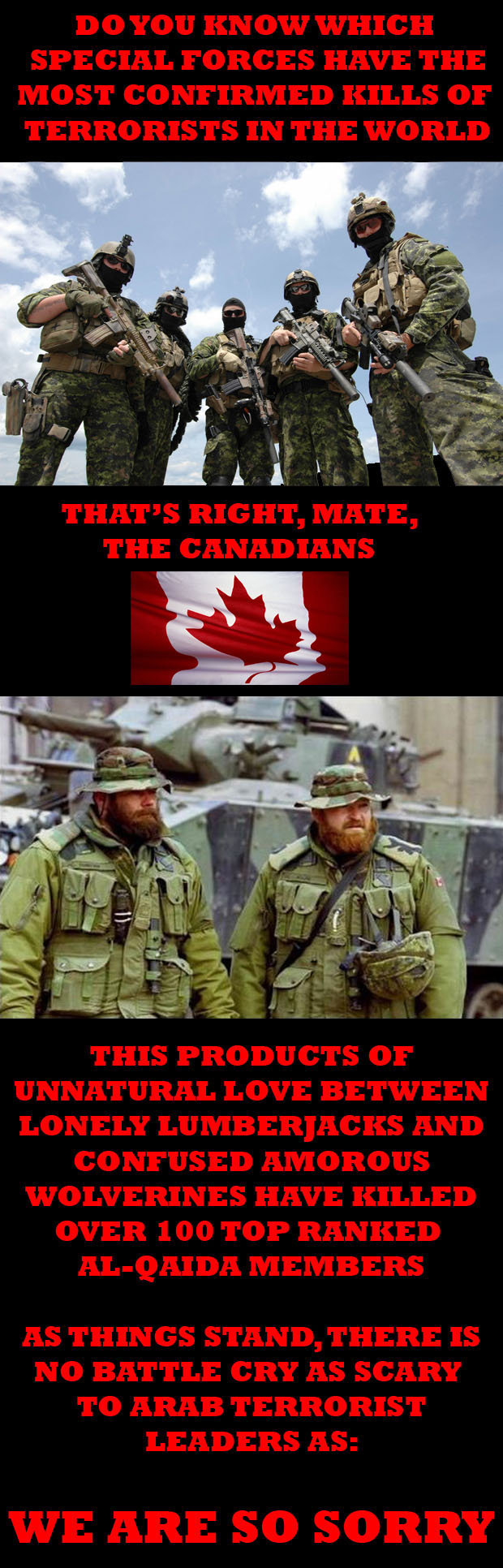
They don’t like to brag…
John Turner sent me this link. I found it quite amusing:
Comments Off on They don’t like to brag…
September 21, 2014
Dramatic Footage of British Troops Preparing for Operation Market Garden
Nearly ten minutes of both British and German footage of the launch of Operation Market — the airborne assault on the Netherlands by British and American troops in September, 1944 (Operation Garden was the corresponding ground attack by Montgomery’s troops to reach the landings by one British and two American airborne divisions.
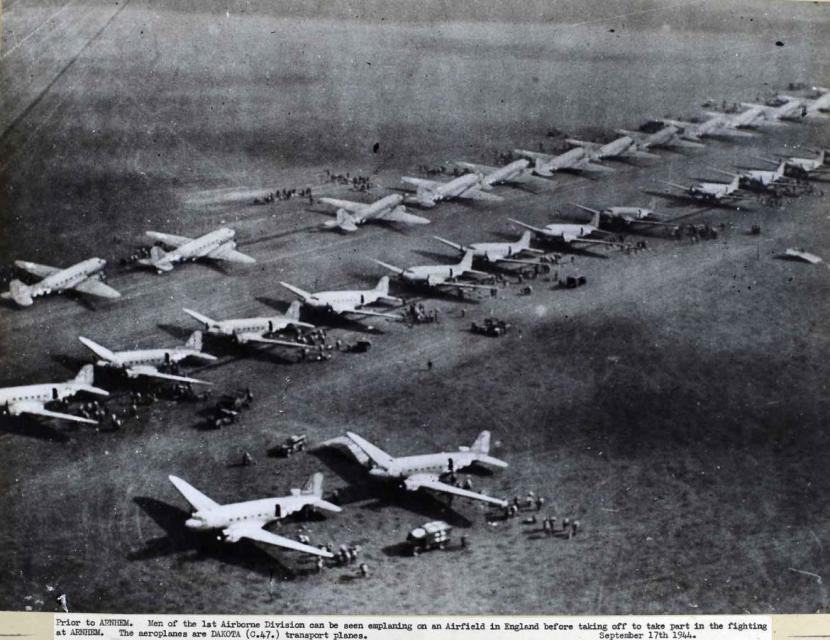
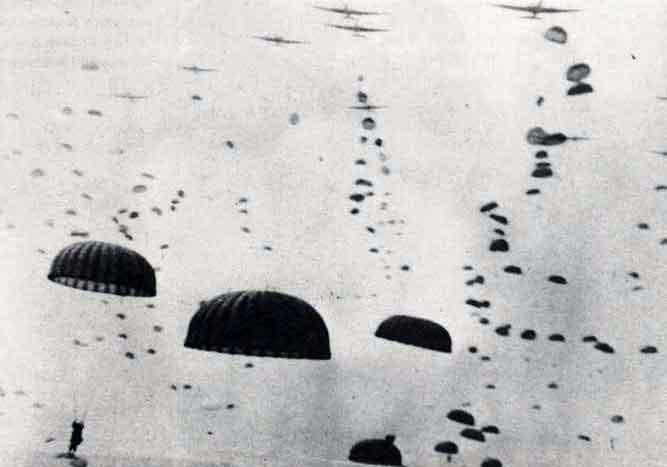
Paratroopers descend enmasse at the DZs near Arnhem, September 1944 Uploaded by Mac Magreehan. (via Forces.TV)
More photos of the operation can be viewed at Forces.TV.
Comments Off on Dramatic Footage of British Troops Preparing for Operation Market Garden
August 11, 2014
Canada’s Special Forces
 Last month, I posted an item on the organization of the Canadian Army, but I didn’t include the Canadian special forces … partly because the special forces are Canada’s “fourth” branch of service and not organizationally part of the Canadian Army … and partly because I just plain forgot about them. Having just read a short article in the most recent Dorchester Review, I was reminded to include Canada’s special forces units (as much as we know about them, anyway). Special forces fall under their own service command, separate from the Canadian Army, the Royal Canadian Navy, and the Royal Canadian Air Force, known as the Canadian Special Operations Forces Command (CANSOFCOM), established in 2006.
The core unit of CANSOFCOM is the original Joint Task Force-2 (JTF2) which was formed in 1992-3 when the Canadian Forces took over the domestic counterterrorism role from the RCMP. When JTF2 was included in the new command, other units were established to support a wider range of missions and capabilities. CANSOFCOM is headed by a Brigadier General and composed of a headquarters and the following units:
- Joint Task Force 2 (JTF 2), CFB Trenton
- Canadian Special Operations Regiment (CSOR), CFB Petawawa
- 427 Special Operations Aviation Squadron (SOAS), CFB Petawawa
- Canadian Joint Incident Response Unit – Chemical, Biological, Radiological and Nuclear (CJIRU-CBRN), CFB Kingston/CFB Trenton
- Canadian Special Operations Training Centre (CSOTC), CFB Petawawa
Although the official web page for CANSOFCOM emphasizes its domestic role, Canadian special forces have also been involved in overseas operations beginning (so far as we know) with Afghanistan in 2001-2. Very little information about JTF2 missions in specific or CANSOFCOM in general has been released by the government, and this is unlikely to change in the near future. Joseph Jockel’s article in the Dorchester Review states:
The consequences of the successful deployment […] are clearer. JTF2 had been tested and admitted to the “international tier 1 counterterrorism community”, the other members being the special forces of the US, UK, and Australia. A good indication of this was that the US military planned to include Canadian special forces in the 2003 invasion of Iraq. A year after Canada declined to go to Iraq, “the US government sends a démarche to Ottawa specifically requesting JTF2 deploy to Afghanistan for a second one-year commitment”. Ottawa “obliges relatively quickly to the US request for forces and CANSOF deploys for a second one-year commitment in the summer 2005”
The Wikipedia page has more:
Core tasks
CANSOFCOM’s core tasks are: to provide the Canadian Forces with a capacity to prevent and react to terrorism in all environments, to provide the CF with a capability to perform other missions as directed by the Government of Canada, such as direct action (DA), special reconnaissance (SR), defence diplomacy and military assistance (DDMA), as well as special humanitarian assistance (such as the evacuation of non-combatants).
Commanding officers
On September 12, 2005, Colonel David Barr was appointed the provisional commander of the CANSOFCOM. During his tenure as commander, Colonel Barr also deployed to Afghanistan as commander of the Canadian special operations task force in Operation Enduring Freedom.
Major-General D. Michael Day, OMM CD – Commander of the Canadian Special Operations Forces Command 2007–2011
Brigadier-General D.W. Thompson, OMM MSC CD is the current commander of the Canadian Special Operations Forces Command, appointed in April 2011.
The current command chief warrant officer is Chief Warrant Officer John H. Graham, MSM CD.
Uniform
With operational uniforms, all members of CANSOFCOM wear the tan beret, regardless of their environment (navy, army or air force), with the badge of their personnel branch or, in the case of the Royal Canadian Armoured Corps and Royal Canadian Infantry Corps members, the badge of their former regiment. With ceremonial and service dress, navy members wear service caps with tan bands, army members wear tan berets and air force members wear blue wedge caps with a tan insert.
Comments Off on Canada’s Special Forces
July 24, 2014
The current organization of the Canadian Army
 I posted a link about a military exercise to be held next month in the Niagara Peninsula, and it mentioned the 31st Brigade, which reminded me I’d lost track of the current organization of the Canadian Army (which back in my day was still hiding under the name “Mobile Command”). In common with other allied armies, the units and organizations have changed significantly since the end of the Cold War — in the case of the Canadian Army, many of the changes were triggered earlier by unification in 1968. In the case of the regular infantry regiments, Wikipedia has this to say about the post-WW2 era:
Comments Off on The current organization of the Canadian Army
June 8, 2014
CANSOFCOM develops habit of secrecy, even for events in the news
David Pugliese says CANSOFCOM remains unwilling (or unable) to discuss things that even our allies talk about publicly:
I’m not sure what’s happening at the Canadian Special Operations Forces Command (CANSOFCOM) these days. The command used to be open to the extent it could, particularly on non-classified issues like international exercises. In the old days that would have openly talked about Exercise Eager Lion, the annual exercise in Jordan. This year’s exercise includes countries from five different continents and more than 12,500 participants. The exercise provides multilateral forces with the opportunity to promote cooperation and interoperability among participation forces, build functional capacity, practice crisis management, and enhance readiness, according to Jordan’s military.
I asked CANSOFCOM about the training going on in Jordan (it had been reported by CTV) and was told the command couldn’t talk about it.
But thankfully the U.S. military understands what true OPSEC is about as well as the value of publicity. The article below is from the U.S. military public affairs (by Sgt. Melissa Parrish, with her photos as well).
Comments Off on CANSOFCOM develops habit of secrecy, even for events in the news
June 6, 2014
1st Canadian Parachute Battalion War Diary
Excerpt from 6 June, 1944:
6th June 1944
Place: Carter Bks, Bulford
The initial stages of operation OVERLORD insofar as the 1st. Cdn. Parachute Battalion was concerned, were divided into three tasks. The protection of the left flank of the 9th Para Battalion in its approach march and attack on the MERVILLE battery 1577 was assigned to “A” Company. The blowing of two bridges over the RIVER DIVES at 1872 and 1972 and the holding of feature ROBEHOMME 1873 was assigned to “B” Company with under command one section of 3 Para Sqdn Engineers. The destruction of a German Signal Exchange 1675 and the destruction of bridge 186759 plus neutralization of enemy positions at VARRAVILLE 1875 was assigned to “C” Company.
The Battalion was to drop on a DZ 1775 in the early hours of D Day, “C” Company dropping thirty minutes before the remainder of the Battalion to neutralize any opposition on the DZ. The Battalion emplaned at Down Ampney Airfield at 2250 hours on the 5th June, 1944. “C” Company travelled in Albemarles and the remainder of the Battalion in Dakotas (C-47). The flight was uneventful until reaching the French coast when a certain amount of A.A. fire was encountered. Upon crossing the coast-line numerous fires could be seen which had been started by the R.A.F. bombers. Unfortunately the Battalion was dropped over a wide area, some sticks landing several miles from their appointed R.V.. This factor complicated matters but did not deter the Battalion from securing its first objectives.
Protection of Left Flank of 9 Para Bn – A Company
“A” Company was dropped at approximately 0100 hours on the morning of 6th June, 1944. Lieut. Clancy, upon reaching the Company R.V. found only two or three men of the Company present. After waiting for further members, unsuccessfully, of the Company to appear, he decided to recce the village of GONNEVILLE SUR-MERVILLE 1676. Taking two men he proceeded and penetrated the village but could find no sign of the enemy. He then returned to the Company R.V. which he reached at approximately 0600 hours and found one other Officer and twenty Other Ranks of the Battalion and several men from other Brigade Units waiting. The entire body then moved off along the pre-arranged route to the MERVILLE battery. Encountering no other opposition enroute other than heavy R.A.F. Bombardment at GONNEVILLE SUR-MERVILLE. Upon completion of the 9th Battalion task the Canadian party acted first as a recce patrol to clear a chateau 1576 from which a German M.G. had been firing and then acted as a rear guard for the 9th Battalion withdrawal toward LE PLEIN 1375. The party left the battalion area (9th Battalion) at LE PLEIN at 0900 hours and reached the 1st Cdn. Para. Bn. position at LE MESNIL BAVENT cross roads 139729 at 1530 hours on the 6th June, 1944.ROBEHOMME – “B Company
Two platoons of “B” Company were dropped in the marshy ground south and west of ROBEHOMME. Elements of these platoons under Sgt. OUTHWAITE then proceeded toward the Company objective. Enroute they encountered Lieut. TOSELAND with other members of “B” Company making a total of thirty All Ranks. They were guided through the marshes and enemy minefields to the ROBEHOMME bridge by a French Woman. On arriving at the bridge they met Capt. D. GRIFFIN and a further thirty men from various sub-units of the Battalion, including mortars and vickers Platoons. MAJOR FULLER who had been there for some time left in an attempt to locate Battalion Headquarters. Capt. GRIFFIN waited until 0630 hours for the R.E.’s who were to blow the bridge. As they failed to arrive explosives were collected from the men and the bridge successfully demolished.
A guard was left on the bridge and the main body withdrawn to the ROBEHOMME hill. Although there were no enemy in the village there were several skirmishes with enemy patrols who were attempting to infiltrate through the village and some casualties were suffered by the Company. An O.P. was set up in the church spire. An excellent view was obtained of the road from PONT DE VACAVILLE 2276 to VARRAVILLE. Artillery and infantry could be seen moving for many hours along this road from the East. It was particularly unfortunate that wireless communication could not be made with Bn. H.Q. as the subsequent fighting of the Battalion was carried out in such close country that observation of enemy movement was almost impossible.
At 1200 hours on the 7th June, 1944, it was decided to recce the route to Bn. H.Q.. Upon the route being reported clear orders were issued for the party to prepare to join Bn. H.Q. Lieut. I. WILSON, Bn. I.O. came from LE MESNIL to guide the party back. The move was made at 2330 hours, the strength of the party by this time being 150 All Ranks, the addition having been made by stragglers of various units who had reported in. The wounded were carried in a civilian car given by the cure, and a horse and cart given by a farmer. The route was BRIQUEVILLE 1872 to BAVENT road 169729, through the BOIS DE BAVENT and on to LE MESNIL cross roads. Near BRIQUEVILLE the lead platoon was challenged by enemy sentries. The platoon opened fire killing seven and taking one prisoner. Shortly afterwards this same platoon was fortunate enough to ambush a German car which was proceeding along the road from BAVENT. Four German Officers were killed. Bn. Headquarters was reached at 0330 hours on the 8th June, 1944.
VARRAVILLE – “C” Company
The majority of “C” Company was dropped west of the RIVER DIVES, although some sticks were dropped a considerable distance away including one which landed west of the RIVER ORNE. Due to this confusion the company did not meet at the R.V. as pre-arranged but went into the assault on the Chateau and VARRAVILLE in separate parties. MAJOR McLEOD collected a Sgt. and seven O.R.’s and proceeded towards VARAVILLE. En route they were joined by a party under Lieut. WALKER. One of the Sgts. was ordered to take his platoon to take up defensive positions around the bridge that the R.E. sections were preparing to blow. This was done and the bridge was successfully demolished.
MAJOR McLEOD and Lieut. WALKER with the balance of the party then cleared the chateau and at the same time other personnel of “C” Company arrived from the DZ and cleared the gatehouse of the chateau. The gatehouse then came under heavy M.G. and mortar fire from the pill box situated in the grounds of the chateau. The pill-box also had a 75 mm A/Tk. Gun. The whole position was surrounded by wire, mines and weapon pits. MAJOR McLEOD, Lieut. WALKER and five O.R.’s went to the top floor of the gatehouse to fire on the pillbox with a P.I.A.T. the enemy 75mm A/Tk. Gun returned fire and the shot detonated the P.I.A.T. ammunition. Lieut. WALKER, CPL. OIKLE, PTES. JOWETT and NUFIELD were killed and MAJOR McLEOD and PTE. BISMUKA fatally wounded. PTES. DOCKER and SYLVESTER evacuated these casualties under heavy fire. CAPT. HANSON, 2 i/c of “C” Company was slightly wounded and his batman killed while proceeding to report to the Brigade Commander who had arrived in the village from the area in which he dropped. “C” Company, together with elements of Brigade H.Q. and the R.E.’s took up defensive positions around the village and a further party encircled the pill-box in order to contain the enemy. A further party of “C” Company under Lieut. McGOWAN who had been dropped some distance from the DZ arrived in VARAVILLE in time to catch two German Infantry Sections who were attempting to enter the town. Lieut. McGOWAN’s platoon opened fire causing casualties and the remainder of the enemy surrendered. This platoon took up firing positions firing on the enemy pill-box. “C” Company H.Q. which was located in the church yard pinned an enemy section attempting to advance in a bomb crater killing at least three. The chateau was evacuated by our troops and left as a dressing station. An enemy patrol re-entered the chateau and captured the wounded including Capt. BREBNER, the Unit M.O., and C.S.M. Blair of “B” Company. This patrol although attacked by our own troops managed to escape with their prisoners.
Heavy enemy Mortar Fire and sniping was brought to bear on our positions from the woods surrounding VARAVILLE. During this time the local inhabitants were of great assistance, the women dressing wounds and the men offering assistance in any way. One Frenchman in particular distinguished himself. Upon being given a red beret and a rifle he killed three German Snipers. This man subsequently guided the Brigade Commander and his party towards LE MESNIL. Although it is believed he was a casualty of the bombing attack that caught this party enroute to LE MESNIL.
At approximately 1030 hours the enemy pill-box surrendered. Forty-two (42) prisoners were taken and four of our own men who had been captured were released. From 1230 hours on artillery fire was brought to bear on VARAVILLE from the high ground east of the RIVER DIVES. At 1500 hours cycle troops of the 6th Commando arrived and at 1730 hours on 6 June, 1944, “C” Company proceeded to the Bn. area at LE MESNIL. The german prisoners giving evident satisfaction to the French population enroute.
VICKERS PLATOON – Initial Stages
The Vickers platoon was dropped in four sticks of ten or eleven each being a total of forty-one (41) All Ranks. For the first time their M.G.’s were carried in Kit Bags, a number of which tore away and were lost.
The Platoon was dropped over a wide area, a part of them joining “C” Company’s attack on VARAVILLE, part joining “B” Company at ROBEHOMME and part joining Bn. H.Q.. Casualties on the drop totalled twelve missing and three wounded. One of the missing, PTE. PHIPPS, was identified in a photo in a German newspaper found on a P.W. After the initial Company tasks had been accomplished the platoon was deployed to the Companies as single gun detachments or as Sections.
MORTAR PLATOON – Initial Stages
The Mortar Platoon was dropped over a wide area and suffered very heavy loss in equipment due to kit bags breaking away and a great majority of the men landing in marshy ground. As the platoon dropped they attached themselves to the nearest company they could find and assisted in the capture of the objectives. One detachment commander landed on top of the German pill-box at VARAVILLE. He was made prisoner and spent the rest of the time in the pill-box until the Germans surrendered to “C” Company. A point of interest was that the P.I.A.T. Bombs did definite damage to the interior of the pill-box and had a very towering effect upon the morale of the defenders.
Some of the Mortar Platoon which joined “B” Company at ROBEHOMME were detailed to guard the approaches to the destroyed bridge. Three enemy lorries full of infantry appeared on the other side of the bridge. The guard opened fire knocking out one truck killing most of its occupants. The other two lorries were able to withdraw. One of our own men who was a prisoner in the lorry was able to make good his escape.
Upon the detachments arriving at LE MESNIL they were re-grouped as a platoon and given three mortars which had arrived by sea. These mortars were set up in position in the brickworks where they engaged the enemy.
BATTALION HEADQUARTERS – Initial Stages
The Commanding Officer, 2 i/c, Signals Officer and the Intelligence Officer and a small portion of the Battalion Headquarters together with elements of 224 Para Fd. Ambulance and other Brigade Units met at the Battalion R.V. in the early hours of the morning of 6th June, 1944. The Signals Officer was detailed to look after the Enemy Signal Exchange near the R.V.. He went into the house and found a certain amount of Signals equipment which he destroyed but he found no Germans. The Intelligence Officer set out with two men to recce VARAVILLE and bring back a report on the situation. In the Battalion Headquarters meantime the party moved off to LE MESNIL taking with them many scattered elements including a 6 Pdr. A/Tk. Gun and crew. Upon reaching the Chateau 1574 they encountered part of the Brigade Headquarters. The party there upon split up into unit parties and continued until they reached the orchards 141729 where they came under heavy sniping fire from nearby houses. This fire caused several casualties including one Officer. The enemy were forced to withdraw from the buildings after an attack by the party. The party reached the Battalion area at approximately 1100 hours on 6th June, 1944.
H/T to @LCMSDS for the link.
Update: War diaries for units in the 3rd Canadian Division in Normandy can be read here.
Comments Off on 1st Canadian Parachute Battalion War Diary
Canadian paratroopers on D-Day – “he thought we were battle hardened and we were as green as green could be”
Lance Corporal John Ross tells the Ottawa Citizen about his D-Day experiences with the 1st Canadian Parachute Battalion:
“We attacked the strong point; there was an all-night fire fight. We had casualties and the Germans did too. At about 10 o’clock in the morning they surrendered. There were about 30 of us there, 42 Germans surrendered to us. They outnumbered us and they out gunned us,” describes Capt (Ret) John Ross, now 93 years-old recalling his time as a paratrooper who dropped several kilometers inland of Normandy on D-Day.
“We took off on the 5th of June, one day before D-Day. C Company was given the job to go in 30 minutes ahead to clear the drop zone of any enemy and attack the German complex.”
Capt (Ret) Ross served as a Lance Corporal in C Company, 1st Canadian Parachute Battalion, 3rd Airborne Brigade, 6th British Airborne Division. He was dropped from an Armstrong Whitworth Albemarle, a small two engine paratroop transport aircraft.
[…]
When thinking back to his time in Normandy Capt (ret) Ross remembers how Canadian soldiers were thought of as, seasoned warriors.
“I read an excerpt written by a German General after the war. He was in that area that we dropped in and he said that the reason they were overcome was because they faced battle hardened Canadians. I’d like to write a letter to him and say none of those Canadians had ever heard a shot fired in anger; he thought we were battle hardened and we were as green as green could be.”
Comments Off on Canadian paratroopers on D-Day – “he thought we were battle hardened and we were as green as green could be”
May 26, 2014
Confusion over extent of Canadian involvement in Nigeria’s hunt for the kidnapped schoolgirls
In the Ottawa Citizen, David Pugliese outlines what we know (or at least, what we’ve been told) about the extent of Canadian participation in the search for the kidnapped Nigerian schoolgirls:
Geoff York at the Globe and Mail had an interesting article a couple of days ago about what Canada may or may not be doing in Nigeria to help in the hunt for school girls kidnapped by Boko Haram.
The Canadian government has claimed that it has sent personnel, both in a liaison and advisory capacity. The government has said it has sent surveillance equipment but has offered no other details for security reasons. Government officials privately claim that Canadian special forces have been sent.
York interviewed a number of Nigerian military and government officials who question whether Canada is involved or say they don’t have any information about the involvement because they have yet to see any presence of Canadians.
Nigerian President Goodluck Jonathan expressed his gratitude to the countries helping search for more than 200 kidnapped schoolgirls. As York writes he specifically singled out four countries for special praise — France, Britain, the United States and Israel — but made no mention of Canada.
The two most likely explanations seem to be a) we’re doing nothing particularly useful but our politicians want to be seen to be doing something or b) we’ve got special forces troops in Nigeria, but for operational security reasons, don’t want it advertised even by the host country. Or possibly a little from column A and a little from column B: JTF2/CSOR or CSEC have a small number of operatives in Nigeria, but they’re not considered a major contribution by the Nigerian government (or, more charitably, Nigeria is keeping mum about it by Canadian request).
Comments Off on Confusion over extent of Canadian involvement in Nigeria’s hunt for the kidnapped schoolgirls
February 27, 2014
February 24, 2014
Argentina reported to be increasing military spending
The Argentine government has announced it will be increasing spending on their armed forces by a third in the coming year. While this report in the Daily Express takes it seriously, it fails to account for the overall sorry state of the Argentinian economy … it’s not clear if there’s any actual money to be allocated to the military:
Buenos Aires will acquire military hardware including fighter aircraft, anti-aircraft weapons and specialised radar, as well as beefing up its special forces.
The news comes months before drilling for oil begins in earnest off the Falkland Islands, provoking Argentina’s struggling President Cristina Fernandez de Kirchner.
Last month she created a new cabinet post of Secretary for the Malvinas, her country’s name for the Falklands.
Meanwhile, Defence Secretary Philip Hammond has refused to confirm that Britain would retake the Falklands if they were overrun by enemy forces.
The extra cash means Argentina will increase defence spending by 33.4 per cent this year, the biggest rise in its history. It will include £750million for 32 procurement and modernisation programmes.
They will include medium tanks and transport aircraft and the refurbishment of warships and submarines. The shopping list also includes Israeli air defence systems, naval assault craft, rocket systems, helicopters and a drone project.
As reported earlier this month, the economy is suffering from an inflation rate estimated to be in the 70% range, the government has expropriated private pensions and foreign-owned companies, and is unable to borrow significant amounts of money internationally due to their 2002 debt default. Announcing extra money for the military may well be the economic version of Baghdad Bob’s sabre-rattling press conferences … just for show.
On the other hand, military adventurism is a hallowed tradition for authoritarian regimes to tamp down domestic criticism and rally public opinion. Being seen to threaten the British in the Falkland Islands still polls well in Buenos Aires.
Comments Off on Argentina reported to be increasing military spending
January 25, 2014
War in the 21st century
Jim Dunnigan wrote this short piece as a proposal for a longer work to follow-on to his book The Perfect Soldier in 2003.
There are many new trends producing the dramatic changes in warfare. Many of these changes are missed by the media and even many military analysts because so much has changed so quickly. The new technologies and trends include;
Robots. Combat robots have actually been around for over a century. Naval mines and torpedoes are robotic weapons that proved themselves in the early years of the 20th century. There were some more robotic weapons in World War II (cruise and ballistic missiles plus the first “smart shells”), but the momentum for combat robots really didn’t get going until the late 20th century, when smaller, cheaper and more reliable microprocessors and similar electronics made it possible to create inexpensive, “smart”, dependable and useful battle droids. Combat robots have sneaked into the military, without many people in, or out of, uniform paying a lot of attention. That’s still the case, especially because the media and even many senior military and political leaders don’t fully understand the technology nor how it is implemented. One example of this confusion can be seen with the constant reference to UAVs (unmanned aerial vehicles) as “drones” or “robots.” They are neither, they are simply remotely controlled aircraft, something that’s been around for over half a century. But these UAVs are being given more and more robotic (operating autonomously) capabilities. This isn’t new either, as torpedoes have had this ability for over 60 years and missiles for over 50 years.
Battlefield Internet. The Internet appeared as a mass-market product in the mid-1990s just as a generation of PC savvy officers were rising up the chain of command. These guys had encountered the first PCs as teenagers and then had access to the pre-World Wide Web Internet in college. PCs and the web were not mysteries, but tools they were familiar with. By 2001 these men and women were majors and colonels, the people the generals turn to when they want something done, or explained. When the World Wide Web showed up in the mid-1990s, generals turned to the majors and colonels for an update and were told, “no problem sir, good stuff. We can use it.” There followed a scramble to create a workable “battlefield Internet.” But there was another trend operating, the 1980s effort to implement “information technology.” But as the ideas merged with workable and affordable hardware and software, sparks began to fly. Unlike earlier ventures into new technology, this was not just a case of the troops being given new gadgets and shown how to use them. With Internet stuff, and Internet savvy troops, a lot of the new technology was being invented by the users. This has created high speed development of new technology, putting new stuff through development, testing and into use much faster than ever before.
[…]
Commandos. These specialists have always been around. Think of the “Knights of the Round Table” or any legendary super warrior. During the 20th century, methods were developed to produce commando class troops at will. This was not possible in the past. While commandos are specialist troops that are only useful in certain situations, when you can use them, they often have a devastating effect. Those nations with large commando forces (the US, Britain, Russia, etc.) have a military advantage that is often the margin of victory.
Off the Shelf Mentality. Since the 1980s, the military has increasingly looked to commercial companies for the latest combat equipment. This recognizes that military procurement has become too slow, and technological advances too rapid to get the latest gear into the hands of troops before it becomes obsolete. In most cases, civilian equipment works fine, as is, for the military. This is because over half the troops that work at jobs that never take them from shops or offices indistinguishable from the work places civilians use. But even the combat troops can find a lot of equipment that is rugged enough for the battlefield. Soldiers have long noted that civilian camping equipment is superior to most of the stuff they are issued, and many soldiers have supplemented, or replaced, issued equipment with better off-the-shelf gear. In the last decade, it’s been common for combat troops to bring civilian electronics gear with them. Everything from laser range finders to GPS units, all of which are issued, but the official stuff tends to be heavier and less capable.
Comments Off on War in the 21st century
July 6, 2012
US Navy re-thinks their Pacific strategy options
Strategy Page discusses the historical uses of the submarine in the Pacific and why things would not be the same in the case of a Chinese war:
The U.S. Navy is rethinking how it will use its submarines in a future Pacific War. The problem is that a campaign against Chinese shipping is unlikely, in part because of what actually happened during the last great anti-shipping campaign, which occurred during World War II (1939-45). After the war, the U.S. analyzed its operations against Japanese shipping and found that submarines were important, but not the only weapon effective against shipping. Some 8.9 million tons of Japanese shipping was sunk or so seriously damaged (disabled) at the end of the war. Submarines accounted for 54.7 percent of this. But 16.3 percent was attributable to carrier-based aircraft, 14.5 percent to land- based planes and 9.3 percent to mines (most dropped by B-29s). Less than one percent was due to surface gunfire, and the balance of 4 percent was caused by accidents.
[. . .]
Meanwhile, the U.S. has adopted a new approach to any potential war with China. The U.S. Department of Defense has been told that, for the foreseeable future, there will be no more large-scale land campaigns. The air force, navy, and marines responded with a plan (AirSea Battle) that has been in the work for years. The new strategy is designed to cope with the rising power of China in the Pacific. AirSea Battle involves tighter planning and coordination of navy, marine, and navy forces, plus the development of some new weapons and tactics and cooperation with allies.
[. . .]
AirSea battle concentrates on military operations. But these will be heavily influenced by economic factors. For example, during World War II the United States was a largely self-sufficient “continental power.” We exported much (more than any other nation on the planet), but did not have to import much. That has changed. Now the U.S. has to import a lot of its oil, special raw materials (like “rare earths” from China) and a lot of manufactured goods. The U.S. is now like much of the rest of the world, China included. If there were a maritime blockade of China, the U.S. and many other Chinese trading partners would suffer severe economic disruptions. There would be massive unemployment for all concerned and that would happen despite energetic efforts by everyone to find alternative sources to goods no longer available because of the disruption of the China trade.
[. . .]
Meanwhile, the nuclear submarine community has done the math and found that their greatest contribution these days is not attacking enemy warships, but land bombardment with cruise missiles and intelligence collecting. Since the first nuclear subs showed up in the 1950s, only one, a British boat, has used a torpedo to sink a hostile warship. But hundreds of cruise missiles have been launched at land targets and uncounted (because they are highly classified) intelligence missions have been, and continue to be, carried out. All that is the recent past for subs, and is likely to be the future as well. World War II in the Pacific is not likely to be rerun. The U.S. Navy still expects its subs to go after enemy warships, and its surface and air forces to battle enemy subs. But a major war on shipping is much less likely.
Comments Off on US Navy re-thinks their Pacific strategy options
July 3, 2011
Women now being recruited for US Special Forces work
Strategy Page has the details:
Earlier this year, the U.S. Army Special Forces began recruiting women for the first time. The women were needed for “Cultural Support Teams” (CST) for use in Afghanistan. There, it has been found that, if you send in female troops to an area, you are much more likely to get useful information from Afghan women. This was a technique that was developed, and worked, in Iraq. The U.S. Marine Corps pioneered the use of these all-woman CSTs.
The Special Forces does it differently, by using the same selection and training routines (in abbreviated format) for the women as they do for the men. Thus the Special Forces Assessment for CST volunteers is nine days, rather than 24 for the men. About half the volunteers do not pass this, a bit higher than the third of male volunteers who don’t make it. That’s probably because Special Forces recruits mostly infantry and other troops in combat jobs (where there is constant training to prepare you for the stress and physical demands of combat). The year-long Special Forces basic training has been cut to six weeks for CST members. That’s because the women are not expected to do a lot of the training and combat operations the male operators must be prepared for. For the women, selection is mainly concerned with intelligence and adaptability. The CSTs, after all, specialize in intelligence work and forming relationships with Afghan women. But the women do get a lot of weapons and special skill (like roping down from a helicopter) training during those six weeks.
So far this year, 30 CST operators have been sent to Afghanistan and their performance has been outstanding. Special Forces commanders want more CST troops, and want them fast. As word gets around about the success of the program, more women will volunteer. The actual work of each team (of 3-6 women, attacked to a twelve man ODA or “A Team”) is providing health care to women and children, collecting intelligence and participating in raids (where they can more easily search women for weapons and other contraband).
Comments Off on Women now being recruited for US Special Forces work
May 15, 2011
US had prepared to fight Pakistan over Bin Laden raid
Strategy Page reports that the US military had made contingency plans to cover Pakistani military intervention in the raid that killed Osama bin Laden:
On May 2nd, the United States was prepared to go to war with Pakistan. The American raid on that day, which killed Osama bin Laden and seized a huge mass of al Qaeda data from his Pakistani hideout, was carried out without informing Pakistan beforehand. Although Pakistan had years earlier agreed that the U.S. could enter Pakistani territory in hot pursuit of terrorists fleeing Afghanistan, or to grab high ranking al Qaeda leaders, it was always assumed that the U.S. would let the Pakistani military know what was coming. But because the Pakistani government was full of bin Laden fans, the U.S. did not inform Pakistan about the raid until it was underway. Apparently, that message included a reminder that if the U.S. troops in the bin Laden compound were attacked by Pakistani forces, there would be instant, and far-reaching, consequences.
The extent of those consequences have since been pieced together, from unclassified information. By May 2nd, the U.S. had assembled a huge naval and air force in the region, that was pointed at Pakistan. This force would attack any Pakistani troops or warplanes that went after the U.S. forces in the bin Laden compound, or who might be able to do so. The U.S. had assembled three aircraft carriers, hundreds of air force aircraft in Afghanistan and the Persian Gulf, and dozens of helicopters, and thousands of troops, in Afghanistan. Most of these troops didn’t know what they were alerted for. Such alerts happen all the time, often for no reason (as far as the troops are concerned.) But this time, as word of the bin Laden raid got out, it became obvious (at least to those who know how these things work) that the alerts throughout the region were to prepare for the possible need to quickly get the American raiders out, and destroy any Pakistani forces that sought to interfere.


