
Quotulatiousness

July 3, 2011

Women now being recruited for US Special Forces work

Filed under: Military, USA — Tags: , , , — Nicholas @ 10:01

Strategy Page has the details:

Earlier this year, the U.S. Army Special Forces began recruiting women for the first time. The women were needed for “Cultural Support Teams” (CST) for use in Afghanistan. There, it has been found that, if you send in female troops to an area, you are much more likely to get useful information from Afghan women. This was a technique that was developed, and worked, in Iraq. The U.S. Marine Corps pioneered the use of these all-woman CSTs.

The Special Forces does it differently, by using the same selection and training routines (in abbreviated format) for the women as they do for the men. Thus the Special Forces Assessment for CST volunteers is nine days, rather than 24 for the men. About half the volunteers do not pass this, a bit higher than the third of male volunteers who don’t make it. That’s probably because Special Forces recruits mostly infantry and other troops in combat jobs (where there is constant training to prepare you for the stress and physical demands of combat). The year-long Special Forces basic training has been cut to six weeks for CST members. That’s because the women are not expected to do a lot of the training and combat operations the male operators must be prepared for. For the women, selection is mainly concerned with intelligence and adaptability. The CSTs, after all, specialize in intelligence work and forming relationships with Afghan women. But the women do get a lot of weapons and special skill (like roping down from a helicopter) training during those six weeks.

So far this year, 30 CST operators have been sent to Afghanistan and their performance has been outstanding. Special Forces commanders want more CST troops, and want them fast. As word gets around about the success of the program, more women will volunteer. The actual work of each team (of 3-6 women, attacked to a twelve man ODA or “A Team”) is providing health care to women and children, collecting intelligence and participating in raids (where they can more easily search women for weapons and other contraband).
May 15, 2011

US had prepared to fight Pakistan over Bin Laden raid

Filed under: Asia, Military, USA — Tags: , , , , , — Nicholas @ 12:16

Strategy Page reports that the US military had made contingency plans to cover Pakistani military intervention in the raid that killed Osama bin Laden:

On May 2nd, the United States was prepared to go to war with Pakistan. The American raid on that day, which killed Osama bin Laden and seized a huge mass of al Qaeda data from his Pakistani hideout, was carried out without informing Pakistan beforehand. Although Pakistan had years earlier agreed that the U.S. could enter Pakistani territory in hot pursuit of terrorists fleeing Afghanistan, or to grab high ranking al Qaeda leaders, it was always assumed that the U.S. would let the Pakistani military know what was coming. But because the Pakistani government was full of bin Laden fans, the U.S. did not inform Pakistan about the raid until it was underway. Apparently, that message included a reminder that if the U.S. troops in the bin Laden compound were attacked by Pakistani forces, there would be instant, and far-reaching, consequences.

The extent of those consequences have since been pieced together, from unclassified information. By May 2nd, the U.S. had assembled a huge naval and air force in the region, that was pointed at Pakistan. This force would attack any Pakistani troops or warplanes that went after the U.S. forces in the bin Laden compound, or who might be able to do so. The U.S. had assembled three aircraft carriers, hundreds of air force aircraft in Afghanistan and the Persian Gulf, and dozens of helicopters, and thousands of troops, in Afghanistan. Most of these troops didn’t know what they were alerted for. Such alerts happen all the time, often for no reason (as far as the troops are concerned.) But this time, as word of the bin Laden raid got out, it became obvious (at least to those who know how these things work) that the alerts throughout the region were to prepare for the possible need to quickly get the American raiders out, and destroy any Pakistani forces that sought to interfere.

May 5, 2011

“The operation was at this time effectively unknown to President Barack Obama”

Filed under: Government, Military, Politics, USA — Tags: , , , , — Nicholas @ 10:54

If this line of investigation is borne out, we can expect to see some interesting times in Washington:

The operation was at this time effectively unknown to President Barack Obama or Valerie Jarrett and it remained that way until AFTER it had already been initiated. President Obama was literally pulled from a golf outing and escorted back to the White House to be informed of the mission.

I have no idea how solid this line of reasoning is, but if Clinton and Panetta had to force the President’s hand by initiating the strike on Bin Laden’s safe house, the American government is well and truly divided.

H/T to Adam Baldwin for the link.

May 4, 2011

Britain’s SAS victims of their own success

Filed under: Britain, Military — Tags: , , — Nicholas @ 07:32

Strategy Page has an interesting article about the recruiting problems facing Britain’s elite Special Air Service as the regular army slims down:

The SAS has to recruit and train 20 or more new commandos a year just to maintain its current strength. Several thousand British troops apply to join the SAS each year, but the SAS is very selective in who it takes. Some SAS members felt that expanding to 480 troops would dilute the quality. This is not necessarily so, but the debate over the issue continues within the SAS. Another ongoing dispute has to do with how the SAS is sometimes used. There have been several actions in the last decade where an entire Sabre Squadron was used in one action. As one SAS officer observed, an infantry company would have been more suitable for these operations. But other SAS officers believe that only SAS men could have gotten to scene of the action and launched these attacks in time. Regular infantry may have been able to do the fighting effectively, but the SAS are the best trained force for getting to difficult locations, scouting them out adequately and then quickly coming up with an effective attack plan.

[. . .]

In peacetime, most SAS missions are at the request of the Foreign Ministry, and are usually to solve some problem overseas that does not require a lot of muscle, but must be done quietly. In these situations, the SAS will spend a lot of their time operating as spies, even though all they are doing is reconnaissance for some mission. In peacetime, the SAS rarely operates in groups of more than a dozen men. But the war in Afghanistan found British military planners realizing that the troops that could be moved to that isolated country most quickly were the SAS. For a while in Afghanistan, the only British combat troops available there were SAS. So anything that British commanders wanted to do had to be done by SAS. In effect, the SAS were victims of their own success in being able to get anywhere, anytime, in a hurry.

I posted about my own brief encounter with the SAS on the old blog.

May 2, 2011

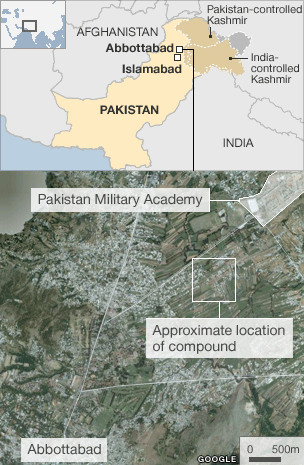
Location of Bin Laden’s hideaway difficult for Pakistan to explain away

Filed under: Asia, Military — Tags: , , , — Nicholas @ 09:59

From the BBC News website:

More details are emerging of how al-Qaeda leader Osama Bin Laden was found and killed at a fortified compound on the outskirts of Abbottabad in north-west Pakistan.


The compound is a few hundred metres from the the Pakistan Military Academy, an elite military training centre, which is Pakistan’s equivalent to Britain’s Sandhurst, according to the BBC’s M Ilyas Khan who visited the area.

Earlier reports put the distance at about 200 yards (182 metres). Pakistan’s military says the compound is 4km (2.4 miles) away from the academy.

But it lies well within Abbottabad’s military cantonment — it is likely the area would have had a constant and significant military presence and checkpoints.

Pakistan’s army chief is a regular visitor to the academy for graduation parades.

Someone very well placed in Pakistan’s army or intelligence organizations had to have been aware of, and actively protecting Bin Laden’s hideout. There’s no way he could have lived that close to high security military establishments without active collusion with high-ranking officers or intelligence chiefs.

March 6, 2011

Foreign troops in Libya?

Filed under: Africa, Military — Tags: , , , — Nicholas @ 11:52

While some are debating the possibilities of providing troops to help the Libyan rebels, others may already be there:

The rebellion against the Kadaffi dictatorship in Libya has not produced any official outside help, but Egypt has apparently sent some of its commandos in to help out the largely amateur rebel force. Wearing civilian clothes, the hundred or so Egyptian commandos are officially not there, but are providing crucial skills and experience to help the rebels cope with the largely irregular, and mercenary, force still controlled by the Kadaffi clan. There are also some commandos from Britain (SAS) and American (Special Forces) operators are also believed wandering around, mainly to escort diplomats or perform reconnaissance (and find out who is in charge among the rebels).

The Egyptian commandos come from Unit 777, a force that was established in the late 1970s, but underwent some ups and downs in the next two decades before achieving its current form. Today, the 250-300 -man Unit 777 is a significantly improved force. They fall under the command of the Army Commando Command, both of whom are based in Cairo. Force 777 trains with the help of the German GSG-9, French GIGN, and American Delta Force commandos.

« Newer Posts

Powered by WordPress
