
World War Two
Published 5 Mar 2022The Japanese again fail to reinforce New Guinea, losing many transport ships, and their forces there are ever more isolated. In Tunisia the Axis lose a bunch of new Tiger tanks, but in the Soviet Union it is the Axis forces that are on the offensive as Erich von Manstein’s offensive continues.
(more…)
March 6, 2022
Another Naval Disaster for Japan – WW2 – 184 – March 5, 1943
Comments Off on Another Naval Disaster for Japan – WW2 – 184 – March 5, 1943
March 4, 2022
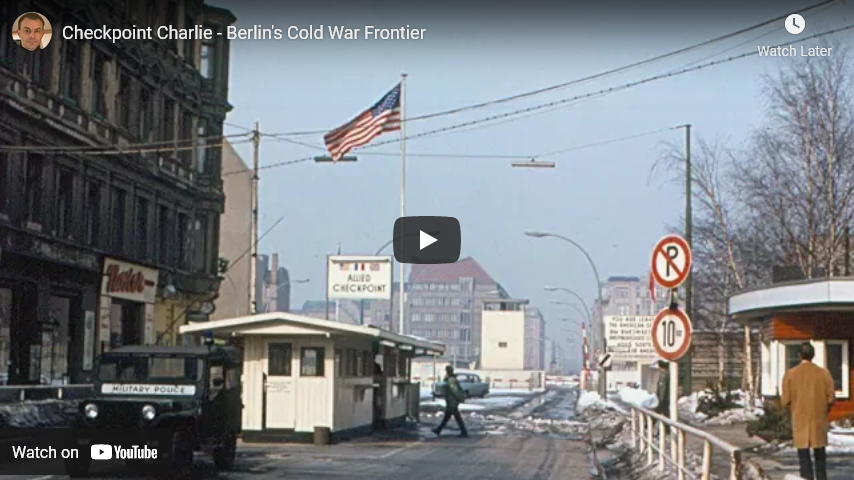
Checkpoint Charlie – Berlin’s Cold War Frontier
Mark Felton Productions
Published 4 Dec 2018The history of Checkpoint Charlie, the most famous of Berlin’s East-West crossing points and the focus of a serious standoff between the US and Soviet Union in 1961 that could have led to World War III.
Support Mark at Patreon for $1 a Month!
https://www.patreon.com/markfeltonpro…
Comments Off on Checkpoint Charlie – Berlin’s Cold War Frontier
March 1, 2022
Genocide in Ukraine: The Holodomor | Into Context | War in Ukraine 01
TimeGhost History
Published 28 Feb 2022What do you get when you combine vigorous grain-tax policies, bad harvests with Stalin’s fear and animosity for the rural population of Ukraine? A man-created murder famine, designed to kill millions of Ukrainian men, women and children.
(more…)
Comments Off on Genocide in Ukraine: The Holodomor | Into Context | War in Ukraine 01
February 27, 2022
The Blitzkrieg is Back – WW2 – 183 – February 26 1943
World War Two
Published 26 Feb 2022Erich von Manstein’s Axis counterattack on the Eastern Front begins this week and right away smashes through the Red Army lines, threatening all the recent Soviet gains. The Allies — the Americans — also suffer a big defeat in Tunisia at the Kasserine Pass, though in the Pacific it is the Americans who occupy the Russell Islands.
(more…)
Comments Off on The Blitzkrieg is Back – WW2 – 183 – February 26 1943
February 20, 2022
Can the Red Army Capture Hitler? – 182 – February 19, 1943
World War Two
Published 19 Feb 2022The Red Army liberates both Rostov and Kharkov this week, but their advancing spearheads are close to an even bigger prize, Adolf Hitler himself. It is the Axis, however, who are both advancing and consolidating in Tunisia, and gearing up for new offensive actions next week.
(more…)
Comments Off on Can the Red Army Capture Hitler? – 182 – February 19, 1943
February 19, 2022
When Goebbels Signed Germany’s Suicide Pact – WW2 Special
World War Two
Published 17 Feb 2022Outnumbered, outgunned, and outproduced by the Allies, the noose seems to be tightening slowly but surely around the Third Reich. For Joseph Goebbels, salvation lies in a radical transformation of the economy and society – Total War. But first, he must sell it to the German people.
(more…)
Comments Off on When Goebbels Signed Germany’s Suicide Pact – WW2 Special
February 18, 2022
Sudayev’s PPS-43: Submachine Gun Simplicity Perfected
Forgotten Weapons
Published 31 Aug 2017The PPS-43, designed by Alexei Sudayev based on a previous submachine gun design by I.K. Bezruchko-Vysotsky, was the Soviet replacement for the PPSh-41. The Shpagin submachine gun was a very effective combat weapon, but was time-consuming to produce and required specialized manufacturing tools. The Soviet military wanted a weapon that was cheaper and faster to make, and which could be produced at small shops not experienced in firearms production. The Sudayev design fit these criteria extremely well, being made almost entirely of simple bent metal components.
Production of the first prototype Sudayev submachine guns begin in 1942 in the besieged city of Leningrad, where guns were quite literally taken from the factory door to the front lines and put into service. A few minor flaws were discovered and corrected, and by the time the siege was broken the gun was suitable for mass production. It was designated the PPS-43, and while it was theoretically a replacement for the PPSh-41, it never did actually replace the former weapon. It was decided to continue PPSh-41 production in the factories already tooled up for it, while making use of the PPS-43’s simplicity to put it into production as a range of new factories that did not have the technical capacity to make more complex weapons.
Mechanically, the PPS-43 was a simple blowback gun, using basically the same conceptual operating system as the PPSH-41. However, Sudayev resolved the most significant practical problem with the PPSH-41 by abandoning its unreliable drums and developing his own new double-stack, double-feed 35-round box magazine. The PPS-43 magazine is simpler to load, more reliable in use, and much smoother to insert and remove from the weapon than PPSh magazines. The improvement was substantial enough to justify the use of different and incompatible magazines in the two guns. In conjunction with the discarding of the drum magazine, Sudayev also designed his gun to have a lower rate of fire than the PPSh, to better manage ammunition supply. However, the roughly 600 rpm rate of the PPS-43 is actually relatively difficult to control in that light weapon, where the PPSh-41 was substantially smoother shooting despite (or perhaps because of) firing faster.
http://www.patreon.com/ForgottenWeapons
Cool Forgotten Weapons merch! http://shop.bbtv.com/collections/forg…
Русская версия: https://youtu.be/TZxgn4iVMbg

Comments Off on Sudayev’s PPS-43: Submachine Gun Simplicity Perfected
February 16, 2022
Germany’s dual economy during WW2 (and why Himmler would have succeeded Hitler if the Nazis had won WW2)
At Founding Questions, Severian looks at the way the Nazi economy was actually two entities — the “wartime” economy and the effectively separate SS economy under the control of Heinrich Himmler:
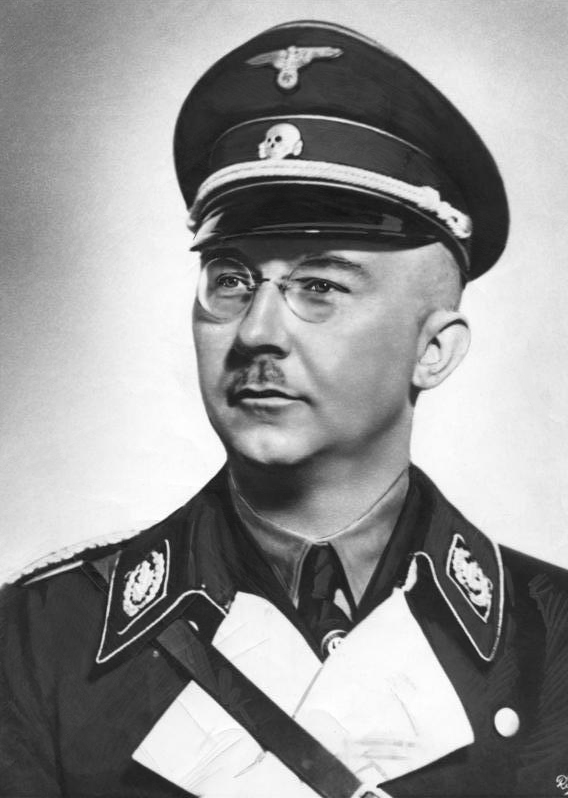
Reichsführer SS Heinrich Himmler, 1938.
German Federa Archive via Wikimedia Commons.
Here’s where the Nazis really blew it. “Nazism” should really be called “Hitlerism”, as it was a true cult of personality; there was no ideology without the specific individual man. That’s the tension at the heart of any collectivist ideology — somebody’s got to be The Boss, however temporarily — but Nazi Germany suffered it worse than most. Had the Nazis won the war, the bloodbath at the top would’ve been as spectacular per capita as the war itself. As thoroughgoing Social Darwinists, they only had one possible principle of succession …
Let’s provisionally call that the first consequence of an ideology in power: The personal is the political and vice versa. That seems trite, I realize, but I’m putting it here to emphasize its literalness – in an ideological state, building your own “affinity”, Bastard Feudalism-style, just IS politics. There’s no other possible political activity. And as much as the Nazis seemed to have screwed it up by going all in on the Fuhrerprinzip at the very top, their out-and-proud Organizational Darwinism (for lack of a better term) made them super-efficient at the lower levels.
Let’s bring Khrushchev back in. In many ways, he’s the Soviet Himmler. He was one of Stalin’s right hand men throughout the war, but somehow didn’t get tagged as a major player in the succession crisis until it was too late for all the other contenders for the purple to take effective countermeasures. In the same way, Hitler did announce a successor, sort of. In fact he did it twice: Before the war, it was Rudolf Hess; during the war, Hermann Goering. Neither of those guys had anything approaching the power Himmler had, but like Khrushchev, his personality was such that the other bigshots couldn’t help overlooking him. Just as the rest of the Politburo couldn’t wrap their heads around the idea of this uncouth quasi-Ukrainian peasant being a major threat, so the rest of the Nazi leaders couldn’t help seeing Himmler as this fussy little file clerk.
It’s a hell of a trick, and I’ll admit, I’m buffaloed. Even if Himmler (Khrushchev) was one hell of an actor, and the egos on the other top Nazis (Soviets) were gravity-defying, they still should’ve been able to see that this fussy little file clerk had some seriously hard boys working for him. Reinhard Heydrich was as ruthless a fuck as was ever born, and Himmler kept him in check. Ditto barbarians like Odilo Globocnik and Erich von dem Bach-Zelewski — they don’t come any nastier than those two, yet Himmler managed them easily. What other conclusion can you possibly draw about Himmler, other than that he was nastier than all of them put together? And yet, apparently, nobody did …
The only explanation for this that I can think of is the Nazis’ ideologization of governmental structures. As opposed to the Soviet experience, where the Party and the Bureaucracy were supposed to be, and often actually were, distinct. After some disastrous experiments with demoting technical experts to field hands, and vice versa, the Russian Communists learned that ideological correctness and “soviet power” does not, in fact, obviate the need for stuff like math. (See also: Mao’s backyard blast furnaces). So the Soviets made sure to separate what they called the “technical intelligentsia” from the Party. The head honcho at Gosplan, Gossnab, etc. would be a Party hack from way back, of course, but the actual brainworkers wouldn’t be. I don’t know just how many of them had Party membership cards, or if any of them did, but nobody I know of rose through the Party’s ranks via Gosplan.
Once a Gosplanner, always a Gosplanner. The technical intelligentsia got all kinds of perks in the Soviet system, but one thing they did not do was get perks inside the Party. You can be a technical expert, or you can be an up-and-coming Party man, but you can’t be both.
The Nazis did the exact opposite of that. The way the Third Reich actually functioned is still opaque in a lot of ways (especially to non-specialists), and of course the pressures of wartime forced a lot of ad hoc measures, but it seems like the SS was supposed to be a sort of All-Purpose Expert Corps. Not only did they have their own army and intelligence service, but they had their own economy — the brief history of the Third Reich makes a lot more sense when you realize that half or more of the official Reich economy was hamstrung by the informal but very real SS economy, operating largely (but far from exclusively) through the labor camps.
Indeed, the SS had their own administration. As incredible as it seems, the Nazis had no grand plan for what to do once they’d conquered Europe. Himmler did, at least as far as the East was concerned, and he tried his damnedest to put it into action in Poland (which is why the General Government was so legendarily brutal). Hitler apparently thought in terms of Germany’s lost late 19th century colonies, when he bothered to think about it at all … which wasn’t often. In his typical Fuhrer-riffic style, he just ignored the problem, trusting to Organizational Darwinism to sort it out …
… which is where the All-Purpose Experts of the SS stepped in. The General Government, for instance, was headed by a civilian lawyer, Hans Frank, but the day to day governance largely fell to the SS, because that’s who stepped up. Poland was an occupied zone, with vital war industries, but it was far behind the front for most of the war; the army couldn’t waste vital manpower garrisoning it. Thus the SSPF (the SS and Police Leader) stepped in, drawing manpower as needed from a wide variety of sources — the camp guards, the Wehrmacht (when garrison troops were available, and when they could wrangle them from the various army commanders), the civilian police, the “General SS”, and so on.
The details aren’t nearly as important as the big picture, which is: Unlike the technical intelligentsia in the Soviet Union, members of the SS could climb to the highest ranks of the Party. Indeed they were expected to: the SS was rapidly becoming a Party-within-the-Party at the outbreak of the war, not least because Himmler awarded a “ceremonial” SS rank to anyone who mattered politically in the various departments. The savvier guys refused the “honor,” of course, because they didn’t want to be subordinate to Himmler, even ceremonially, but many didn’t. Which meant that had the Nazis won the war, not only would Himmler have been the next Fuhrer, but the SS would’ve closed ranks, essentially taking over The Party — they’d be the Inner Party, as opposed to the “mere Nazis” of the Outer Party.
Comments Off on Germany’s dual economy during WW2 (and why Himmler would have succeeded Hitler if the Nazis had won WW2)
February 13, 2022
Victory at Guadalcanal – WW2 – 181 – February 12, 1943
World War Two
Published 12 Feb 2022Operation KE, the Japanese evacuation of Guadalcanal, concludes this week and the campaign has been a big loss for the Japanese. The Axis forces are also withdrawing — and the Red Army advancing — in the Donbas and the Caucasus, closing in on both Kharkov and Rostov. And a front that’s been quiet for a while, the Burma front, begins heating up again with an Allied advance out of India.
(more…)
Comments Off on Victory at Guadalcanal – WW2 – 181 – February 12, 1943
February 12, 2022
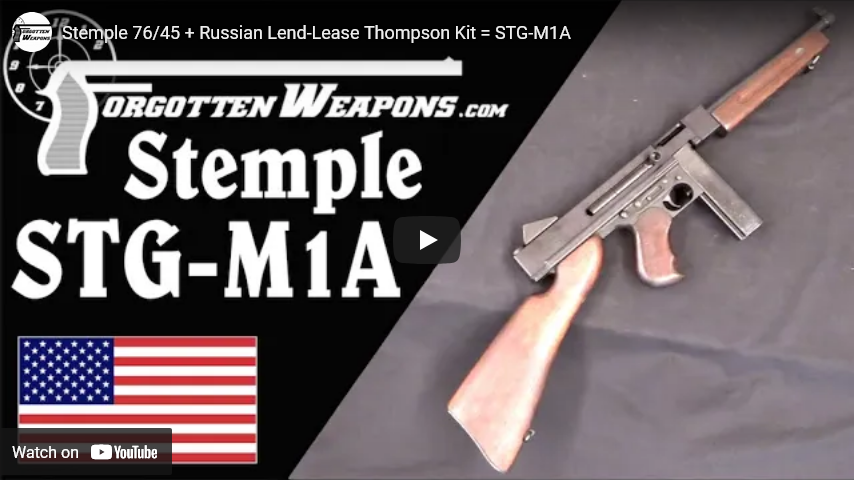
Stemple 76/45 + Russian Lend-Lease Thompson Kit = STG-M1A
Forgotten Weapons
Published 8 Oct 2021http://www.patreon.com/ForgottenWeapons
https://www.floatplane.com/channel/Fo…
Cool Forgotten Weapons merch! http://shop.forgottenweapons.com
The modularity and clever design of the Stemple Takedown Gun is perhaps best illustrated by the STG-M1A and STG-1928 (these are the same gun with either a horizontal or vertical front grip). In the early 2000s a bunch of Thompson parts kits came into the US, WW2 vintage lend-lease guns sent to Russia. They were M1 and M1A1 models, and had intact barrels but torch-cut receivers. BRP, who makes the Stemple, realized that the sear-to-magwell dimensions on the Thompson were almost identical to the Suomi and Stemple — and that he could make a version of the STG that was a nearly perfect clone of the M1 Thompson.
The registered Stemple receiver slides into a square Thompson lookalike housing, and original Thompson grips, stocks, and hand guards are used. It is chambered for .45ACP, using original Thompson stick magazines (naturally). The result is a submachine gun that almost perfectly duplicates the handling of a true Thompson, without the historical value that makes the Thompson so expensive and keeps many owners from wanting to actually take their Thompsons out to the range.
Note that the gun in this video is an early example, and models made today are able to take both stick and drum magazines. Also, due to the design of the disconnector in the original Thompson FCG, the semiauto setting is not functional in the Stemple version — it’s only full automatic.
Contact:
Forgotten Weapons
6281 N. Oracle 36270
Tucson, AZ 85740
Comments Off on Stemple 76/45 + Russian Lend-Lease Thompson Kit = STG-M1A
February 11, 2022
Eat the Nazis, There’s Nothing Else – WAH 052 – February 1943, Pt. 1
World War Two
Published 10 Feb 2022As the United Nations alliance, and the Resistance in occupied Europe increase their pressure on Nazi Germany, they continue to escalate their war on humanity. Meanwhile, in more and more parts of the world there is little to eat.
(more…)
Comments Off on Eat the Nazis, There’s Nothing Else – WAH 052 – February 1943, Pt. 1
February 6, 2022
Guadalcanal, A New Offensive – WW2 – 180 – February 5, 1943
World War Two
Published 5 Feb 2022This week sees the 10th anniversary of Hitler’s ascension to power in Germany, but while there may be celebrations and speeches in Germany, the Battle of Stalingrad comes to its end with the surrender of the German 6th Army. The Soviets are on the move all over, launching yet more winter offensives. It is the Axis who are attacking in Tunisia, and in the Solomon Islands … well, the Allies aren’t sure what the Japanese are up to.
(more…)
Comments Off on Guadalcanal, A New Offensive – WW2 – 180 – February 5, 1943
January 31, 2022
Stalingrad: Endgame – WW2 – 179b – January 31, 1943
World War Two
Published 30 Jan 2022The Battle of Stalingrad is nearing its end. Strong contingents of the 21st and 62nd Soviet Armies broke through the German defensive lines west of Stalingrad and were now pushing deep into the city. Despite the “Kessel” being split into several parts, the Axis soldiers are still resisting fiercely, fighting street by street, house by house. Yet it is a desperate last stand. Overwhelmed and undersupplied, many Generals push for surrender. But only their commander, the freshly promoted “Field-Marshal” Paulus, has the authority to do so.
(more…)
Comments Off on Stalingrad: Endgame – WW2 – 179b – January 31, 1943
January 30, 2022
Time to Fire Rommel? – WW2 – 179 – January 29, 1943
World War Two
Published 29 Jan 2022The Allies are unable to win in Tunisia, though further east Bernard Montgomery has achieved his goal of driving the enemy out of Libya. To the west, the Casablanca Conference comes to its end and the Allies write a list of their war priorities. The Soviets, however, are on the move everywhere, closing in on Stalingrad, and launching new operations up and down the eastern front, to the dismay and detriment of the Axis forces.
(more…)
Comments Off on Time to Fire Rommel? – WW2 – 179 – January 29, 1943
January 23, 2022
Hitler’s Interference is losing the war – WW2 – 178 – January 22, 1943
World War Two
Published 22 Jan 2022This is a rough week for the Germans — their trapped garrison at Velikie Luki is liquidated, and their trapped army at Stalingrad is … well, it isn’t going well for them. In fact, it isn’t going well for the Axis anywhere this week, being pushed back or retreating in New Guinea, the Caucasus, North Africa, and on Guadalcanal. Berlin is even bombed this week as well.
(more…)
Comments Off on Hitler’s Interference is losing the war – WW2 – 178 – January 22, 1943


