Quotulatiousness

September 9, 2017

Dr. Jerry Pournelle, 1933-2017

Filed under: Books — Tags: , — Nicholas @ 08:14

I saw this brief notice at Instapundit last night and shared it with my Facebook friends:

ALEX POURNELLE TEXTS:

    Hi
    I’m afraid that Jerry passed away
    We had a great time at DragonCon
    He did not suffer. Please feel free to post this news.

Rest in peace, Jerry. You will be missed.

I met Dr. Pournelle at SF conventions a couple of times, but you can’t say you knew someone on the basis of fleeting contacts like that. We did have a few minutes of discussion at one convention on the topic of why Harrison Ford’s portrayal of Indiana Jones was/was not a faithful characterization of how most people viewed archaeologists … which was highly entertaining. Although I enjoyed his SF writing, I actually thought of him more as a computer journalist, as I was a huge fan of his Chaos Manor columns in Byte magazine. As with George Orwell’s “As I please” columns, Pournelle didn’t let himself be limited to just bits and bytes and the range of topics was sometimes far outside the normal range for the magazine.

Here is his Wikipedia page.

September 8, 2017

QotD: Never ask where writers get their inspiration

Filed under: Books, Humour, Quotations — Tags: , — Nicholas @ 01:00

My Dark Age adventure, Shieldwall: Barbarians! is Young Adult, meaning, in this case, Sharpe or Conan but without the shagging, and with slightly more moral compass — really you can read it as being “in the tradition of” Harold Lamb and the Pulpmeisters of Yore and ignore the YA tag. When I wrote it, I had in my head “Robert E Howard does Rosemary Sutcliff (but not that way (though they would have made a lovely couple))”.

M Harold Page, Shieldwall: Barbarians! Writing and self-publishing an old school boy’s young officer story set in Attila’s invasion”, Charlie’s Diary, 2015-06-03.

September 1, 2017

QotD: Writing as a profession

Filed under: Books, Business, Quotations — Tags: , , — Nicholas @ 01:00

“Changing the world” or even “changing the world of science fiction” was never my goal, fortunately. “Not getting my utilities cut off for nonpayment of bills” was. That, happily, turned out to be a more feasible aim.

It is the nature of the book market that one cannot be financially successful without also being well-known, one’s name being one’s brand-name, more or less. Which is felt to be the means and which the end will vary from writer to writer, natch. And whether one really needs “rich and famous” or if “self-supporting and well-known in my field” will do. Beware those moving goalposts, which can always make one feel artificially bad.

“How high is up?” is one of those dangerous questions that each writer must answer for themselves. Setting goals unrealistically high guarantees frustration, too low risks not challenging oneself to do as well as one otherwise might. (As a rule of thumb, it is also better to focus on what you can do, and not on other people’s non-controllable responses. “Finish a book” is controllable, “sell a book” less so, “become a bestseller or win an award” still less so. Unhappy is the writer who boards this train wrong way round.)

As for time, it passes at exactly the same rate for everyone, regardless of how one chooses to apportion it. It’s all choices and tradeoffs. Some prices might really be too high, some rewards too meager; only the person who is leading that life can decide.

That said, when I contemplate the ever-upthrusting mountain range of reading matter in the world, effectively infinitely more than I could ever read in my remaining lifetime, I do sometimes wonder why on earth I’m trying to make more, yeah — if that were my only motivation. Except that writing is in itself an intrinsic pleasure for me, if a weird one — I sometimes wonder if writing fiction ought to be classified as a dissociative disorder. So I would likely still be making up stories even if no one else wanted them, only with less social approval.

Lois McMaster Bujold, “Ask the Author: Lois McMaster Bujold”, Goodreads, 2015-04-21.

August 31, 2017

“… as if millions of future lit-crit students suddenly cried out in terror and were suddenly silenced”

Filed under: Books, Britain, Media — Tags: , , — Nicholas @ 03:00

The late Sir Terry Pratchett hatched a cunning plan to thwart the inchoate plans of uncounted would-be literary ghouls:

A hard drive containing the unfinished books of Terry Pratchett has been destroyed by a steamroller, in fulfilment of the late author’s last wishes.

The works were crushed by a vintage John Fowler & Co steamroller at the Great Dorset Steam Fair, ahead of the opening of a new exhibition about the author’s life and work. It is thought up to 10 incomplete novels were flattened.

Friend Neil Gaiman, with whom Pratchett cowrote Good Omens, had revealed in 2015 that Pratchett had instructed that he wanted “whatever he was working on at the time of his death to be taken out along with his computers, to be put in the middle of a road and for a steamroller to steamroll over them all”.

Pratchett’s former assistant Rob Wilkins tweeted that he was “about to fulfil [his] obligation to Terry”.

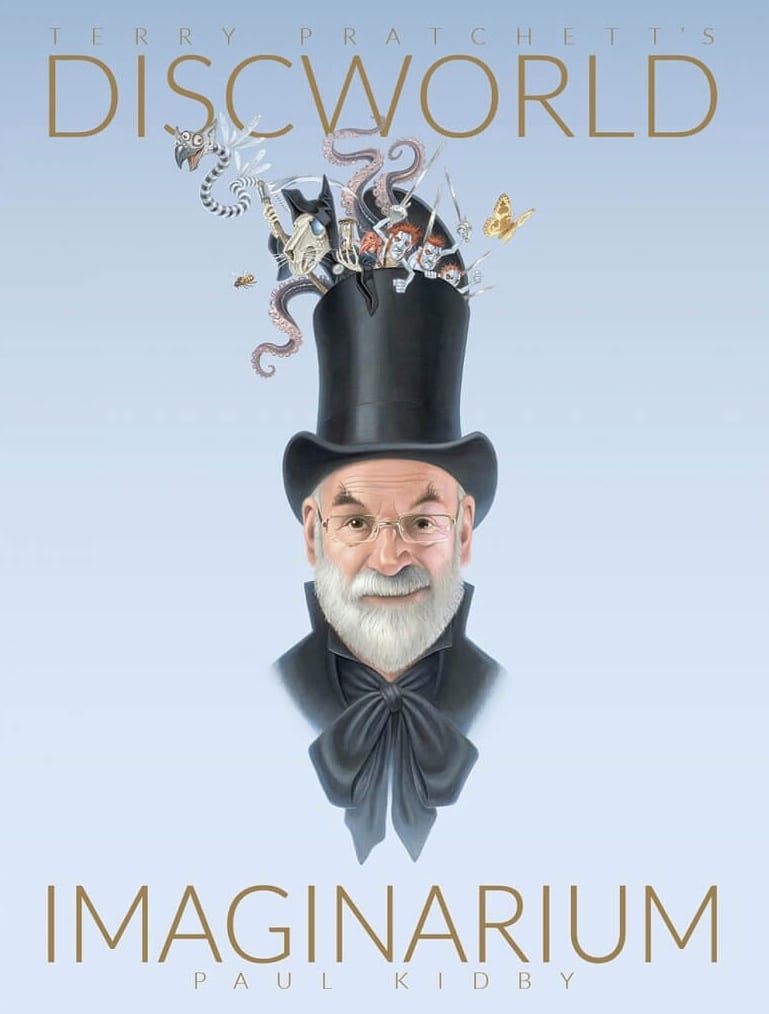
The hard drive will go on display as part of a major exhibition about the author’s life and work, Terry Pratchett: HisWorld, which opens at the Salisbury Museum in September.

August 24, 2017

Heinlein’s “Crazy Years”

Filed under: Books — Tags: , , — Nicholas @ 03:00

In his recent USA Today column, Glenn “Instapundit” Reynolds gives a shout-out to Robert A. Heinlein’s pre-WW2-era “Future History” timeline which included a segment presciently called “The Crazy Years”:

Very early in his writing career, about 1940, science fiction writer Robert Heinlein outlined a “future history” around which much of his writing would revolve, extending from the mid-twentieth century to the 24th century. Much of what he outlined hasn’t come to pass, but he nailed it in one respect: We live in the “Crazy Years.”

The Crazy Years, in Heinlein’s timeline, were when rapid changes in technology, together with the disruption those changes caused in mores and economics, caused society to, well, go crazy. They ran from the last couple of decades of the 20th Century into the first couple of decades of the 21st. In some of his novels set in that era — Time Enough for Love, for example — he includes random assortments of headlines that may have seemed crazy enough back then, but that seem downright tame today.

I’m not the first to make this connection — science fiction writers John C. Wright and Sarah Hoyt have remarked on it, and as Hoyt notes, “these are the Crazy Years” has become something of a stock joke among Heinlein fans.

But what does that mean? As Wright observes — invoking not only Heinlein but his contemporary A.E. Van Vogt, “craziness” comes when beliefs don’t match facts:

“Craziness can be measured by maladaptive behavior. The behavior the society uses to solve one kind of problem, when applied to an incorrect category, disorients it. When this happens the whole society, even if some members are aware of the disorientation, cannot reach the correct conclusion, or react in a fashion that preserves society from harm. As if society were a dolphin that called itself a fish: when it suffered the sensation of drowning, it would dive. But a dolphin is a mammal, a member of a different category of being. When dolphins are low on air, they surface, rather than dive. Putting yourself in the wrong category leads to the wrong behavior.”

QotD: Reader demands

Filed under: Books, Quotations — Tags: , , — Nicholas @ 01:00

Readers often ask for more of the same, but I think in many cases that’s not what they mean; what they are really saying is, “Give me a story that will make me feel the way that one did!” Which may actually be quite a different thing, but is much harder to articulate.

(Or, for all those fractal follow-ups, there’s always Fanficwoman. To the rescue!)

Lois McMaster Bujold, “Ask the Author: Lois McMaster Bujold”, Goodreads, 2015-04-21.

August 21, 2017

QotD: The (long-running) decline of written science fiction

Filed under: Books, Liberty, Politics, Quotations, USA — Tags: , , , — Nicholas @ 01:00

The problem with the Rabbits is not that left-wing politics is dessicating and poisoning their fiction. While I have made the case elsewhere that SF is libertarian at its core, it nevertheless remains possible to write left-wing message SF that is readable, enjoyable, and of high quality – Iain Banks’s Culture novels leap to mind as recent examples, and we can refer back to vintage classics such as Pohl & Kornbluth’s The Space Merchants for confirmation. Nor, I think, is the failure of Rabbit fiction to engage most SF fans and potential fans mainly down to its politics; I think the Evil League is prone to overestimate the popular appeal of their particular positions here.

No, I judge that what is dessicating and poisoning the Rabbit version of SF is something distinct from left-wing political slant but co-morbid with it: colonization by English majors and the rise of literary status envy as a significant shaping force in the field.

This is a development that’s easy to mistake for a political one because of the accidental fact that most university humanities departments have, over the last sixty years or so, become extreme-left political monocultures. But, in the language of epidemiology, I believe the politics is a marker for the actual disease rather than the pathogen itself. And it’s no use to fight the marker organism rather than the actual pathogen.

Literary status envy is the condition of people who think that all genre fiction would be improved by adopting the devices and priorities of late 19th- and then 20th-century literary fiction. Such people prize the “novel of character” and stylistic sophistication above all else. They have almost no interest in ideas outside of esthetic theory and a very narrow range of socio-political criticism. They think competent characters and happy endings are jejune, unsophisticated, artistically uninteresting. They love them some angst.

People like this are toxic to SF, because the lit-fic agenda clashes badly with the deep norms of SF. Many honestly think they can fix science fiction by raising its standards of characterization and prose quality, but wind up doing tremendous iatrogenic damage because they don’t realize that fixating on those things (rather than the goals of affirming rational knowability and inducing a sense of conceptual breakthrough) produces not better SF but a bad imitation of literary fiction that is much worse SF.

Eric S. Raymond, “SF and the damaging effects of literary status envy”, Armed and Dangerous, 2014-07-30.

August 18, 2017

QotD: “Justifying” the Holocaust

Filed under: Europe, History, Media, Politics, Quotations — Tags: , , , , , — Nicholas @ 01:00

… that underlying tone of “Of course what Hitler and the Nazis did was unjustifiable, they were wrong about what was going on around them” whenever the topic of the Holocaust is discussed implies that, if they had been right, what they did would have been, at least, justifiable. In other words, there’s an acceptance of the underlying logic of collective justice going on there, and when you put adjectives in front of justice, you almost never get justice.

Which brings us to the current brawl in SF/F and the wider culture. There’s a very large swathe, of Western society that has regressed, though they call it progress, to the idea that one should deliberately punish all members of a group for the actions, real or imagined, of a few members, and to the idea that because members of a group are over-represented in a particular area that it is a deliberate choice on the part of the group, rather than an accident of history.

You see it nearly everywhere. The idea that SF was somehow filled with racist, sexist hatemongers until … well, as near as I can tell, around five years ago is ludicrous when you have H. Beam Piper writing stories where racial intermarriage has turned almost all of humanity a nice shade of brown and there are heroic characters with names like Themistocles M’Zangwe. But, even if that were true — what, we should stop reading (and buying books from) straight white male authors for an entire year? Because a bunch of people they never even met were theoretically jerks?

Sarah Hoyt, “Social Injustice – 60 Guilders”, According to Hoyt, 2015-07-31.

August 12, 2017

QotD: The decline and fall of art

Filed under: History, Media, Quotations — Tags: , , , — Nicholas @ 01:00

It also turns out that when that sort of revolutionary who believes in tearing down for its own sake, gets power, all they can do is keep tearing down, until the product manages to be, objectively, both repulsive and boring to any sane person. […] In painting this is very obvious. The shock that doesn’t shock anyone does manage, nonetheless, to turn the normal, sane human being off the “art” being displayed. (Though even there most of it is just boring. Really, the Denver museum of art paid millions for a bunch of twisted together kitchen implements? Without the little card explaining what it is and how it relates to domestic dissatisfaction, that “art” evokes “my drawer got stuck again.”)

So this avant garde of the past aged without doing more than throwing continuous artistic tantrums at the world that refused to conform to their visions. Some of the early ones, when they still weren’t the establishment were magnificent and are probably art, just because, well, art includes tantrums too. BUT after they became the establishment all they could do was chase the thrill and shock that no longer existed ever further, off the plank of sanity and into the ocean of irrelevance.

When they realized this — when the museums emptied of the middle-brow and the print runs fell — they chased relevance by erecting ever more exacting rules saying “this you shall not do, that you shall not say, this thing you shall not even think.” This ranges from political correctness to the sort of stultifying mandates on style and manner that are the last gasp of any dying artistic movement. (I’m still sticking my middle finger up at the minimalists and the idiots who think first person is always bad. )

Which brings us to science fiction. Since science fiction in its heyday was not considered art or literature, it was just… what people wrote for fun. (Kind of like Shakespeare in his day.) There would be some reflexive classical references, which were the equivalent of Kit Marlowe putting his stage directions in Latin, just to prove his education wasn’t wasted. However, they weren’t exactly following any school.

Then came… the deluge. Or at least the “if we destroy all the rules and shock everyone, it will be literature and amazing.” And when they took over the establishment, the same thing followed as in the rest of the art.

Now… Now they — even those marginally younger than I — are the establishment. They are the authorities still vainly rebelling against an establishment that doesn’t exist, that probably never existed except in their heads. Which is probably why they attract so many people with issues with daddy or teacher or other authority figures who didn’t let them have their bugs and eat them too in childhood. (It also explains a certain fascination with the contents of their metaphorical diaper, now I think about it.) They must be FOREVER the first woman to write non-binary sex, even if it has been done for decades before they were born. They must be forever the most shocking thing Evah! even if what they’re doing was done better and more apropos by their grandparents’ generation. It’s all they have.

Sarah A. Hoyt, “Avant-Garde”, According to Hoyt, 2015-09-26.

August 9, 2017

Lois McMaster Bujold’s latest novella is out in ebook format

Filed under: Books — Tags: , , — Nicholas @ 03:00

Any book by Lois McMaster Bujold is an automatic buy for me, but with her current “Penric” series, I have to wait until it appears in hardcover (the first two were published by Subterranean Press, and I expect they’ll eventually get this one into print as well).

Penric’s Fox: a Penric & Desdemona novella in the World of the Five Gods. Book 3.

Some eight months after the events of Penric and the Shaman, Learned Penric, sorcerer and scholar, travels to Easthome, the capital of the Weald. There he again meets his friends Shaman Inglis and Locator Oswyl. When the body of a sorceress is found in the woods, Oswyl draws him into another investigation; they must all work together to uncover a mystery mixing magic, murder and the strange realities of Temple demons.

Penric and the Shaman was a 2017 Hugo Award nominee in the novella category.

For those of you who are all up-to-date and twenty-first-centurying like there’s no tomorrow, you can get the Kindle version here.

July 25, 2017

Great Man Theory? No. Impersonal Forces of History? No. How about the Bond Villain Theory?

Filed under: History, Humour — Tags: , , , , — Nicholas @ 03:00

Charles Stross may have cracked the mystery of what the heck is happening in our particularly odd time period:

History: is it about kings, dates, and battles, or the movement of masses and the invisible hand of macroeconomics?

There’s something to be said for both theories, but I have a new, countervailing theory about the 21st century (so far); instead of the traditional man on a white horse who leads the revolutionary masses to victory, we’ve wandered into a continuum dominated by Bond villains.

Consider three four five, taken at random:

Mr X: leader of a chaotic former superpower with far too many nuclear weapons, Mr X got his start in life as an agent of SMERSH the KGB. Part of its economic espionage directorate, tasked with modernizing a creaking command economy in the 1980s, Mr X weathered the collapse of the previous regime and after a turbulent decade of asset stripping rose to lead a faction of billionaire oligarchs, robber barons, and former secret policemen. Mr X trades on his ruthless reputation — he is said to have ordered a defector murdered by means of a radioisotope so rare that the assassination consumed several months’ global production — and despite having an official salary on the order of £250,000 he has a private jet with solid gold toilet seats and more palaces than you can shake a stick at. Also nuclear missiles. (Don’t forget the nuclear missiles.) Said to be dating the ex-wife of Mr Y. Exit strategy: change the constitution to make himself President-for-Life. Attends military parades on Red Square, natch. Bond Villain Credibility: 10/10

Mr Y: Australian multi-billionaire news magnate. (Currently married to a former supermodel and ex-wife of Mick Jagger.) Owns 80% of the news media in Australia and numerous holdings in the UK and USA, including satellite TV channels, radio stations, and newspapers. Reputedly had Arthur C. Clarke on speed-dial for advice about the future of communications technology. Was the actual no-shit model upon whom Elliot Carver, the villain in “Tomorrow Never Dies”, the 18th Bond movie, was based. Exit strategy: he’s 86, leave it all to the kids. Bond Villain Credibility: 10/10

[…]

I think there’s a pattern here: don’t you? And, more to the point, I draw one very useful inference from it: if I need to write any more near-future fiction, instead of striving for realism in my fictional political leaders I should just borrow the cheesiest Bond villain not already a member of the G20 or Davos.

July 17, 2017

QotD: Utopias

Filed under: Books, Britain, Quotations — Tags: , , , , , — Nicholas @ 01:00

All efforts to describe permanent happiness […] have been failures. Utopias (incidentally the coined word Utopia doesn’t mean ‘a good place’, it means merely a ‘non-existent place’) have been common in literature of the past three or four hundred years but the ‘favourable’ ones are invariably unappetising, and usually lacking in vitality as well.

By far the best known modern Utopias are those of H.G. Wells. Wells’s vision of the future is almost fully expressed in two books written in the early Twenties, The Dream and Men Like Gods. Here you have a picture of the world as Wells would like to see it or thinks he would like to see it. It is a world whose keynotes are enlightened hedonism and scientific curiosity. All the evils and miseries we now suffer from have vanished. Ignorance, war, poverty, dirt, disease, frustration, hunger, fear, overwork, superstition all vanished. So expressed, it is impossible to deny that that is the kind of world we all hope for. We all want to abolish the things Wells wants to abolish. But is there anyone who actually wants to live in a Wellsian Utopia? On the contrary, not to live in a world like that, not to wake up in a hygenic garden suburb infested by naked schoolmarms, has actually become a conscious political motive. A book like Brave New World is an expression of the actual fear that modern man feels of the rationalised hedonistic society which it is within his power to create. A Catholic writer said recently that Utopias are now technically feasible and that in consequence how to avoid Utopia had become a serious problem. We cannot write this off as merely a silly remark. For one of the sources of the Fascist movement is the desire to avoid a too-rational and too-comfortable world.

All ‘favourable’ Utopias seem to be alike in postulating perfection while being unable to suggest happiness. News From Nowhere is a sort of goody-goody version of the Wellsian Utopia. Everyone is kindly and reasonable, all the upholstery comes from Liberty’s, but the impression left behind is of a sort of watery melancholy. But it is more impressive that Jonathan Swift, one of the greatest imaginative writers who have ever lived, is no more successful in constructing a ‘favourable’ Utopia than the others.

The earlier parts of Gulliver’s Travels are probably the most devastating attack on human society that has ever been written. Every word of them is relevant today; in places they contain quite detailed prophecies of the political horrors of our own time. Where Swift fails, however, is in trying to describe a race of beings whom he admires. In the last part, in contrast with disgusting Yahoos, we are shown the noble Houyhnhnms, intelligent horses who are free from human failings. Now these horses, for all their high character and unfailing common sense, are remarkably dreary creatures. Like the inhabitants of various other Utopias, they are chiefly concerned with avoiding fuss. They live uneventful, subdued, ‘reasonable’ lives, free not only from quarrels, disorder or insecurity of any kind, but also from ‘passion’, including physical love. They choose their mates on eugenic principles, avoid excesses of affection, and appear somewhat glad to die when their time comes. In the earlier parts of the book Swift has shown where man’s folly and scoundrelism lead him: but take away the folly and scoundrelism, and all you are left with, apparently, is a tepid sort of existence, hardly worth leading.

George Orwell (writing as “John Freeman”), “Can Socialists Be Happy?”, Tribune, 1943-12-20.

July 9, 2017

Getting closer to science fiction technology every day

Filed under: Health, Science, Technology — Tags: , , — Nicholas @ 05:00

In Lois McMaster Bujold’s Vorkosigan Saga novels, one of the imagined technological innovations to play a key part in the story is the Uterine Replicator (spoiler: it’s used to save the life of a premature baby, who grows up — in a manner of speaking — to be the main protagonist of the saga). In Reason, Katherine Mangu-Ward looks at just how close we are getting to the gee-whiz tech Ms. Bujold invented some thirty years ago for her novels:

In April, researchers announced they had managed to keep several extremely premature lambs alive and growing in artificial wombs. After spending up to four weeks in a clear plastic “extra-uterine device” at the Children’s Hospital of Philadelphia, each sheep transformed from a decidedly undercooked fetal specimen to a much more robust critter with long limbs and a fluffy wool coat, the sort of animal you wouldn’t be terribly alarmed to see plop to the ground in a field on a spring afternoon.

The setup strongly resembles a sous vide cooking apparatus: a tiny, tender lamb floats in a large plastic ziplock, hooked up to tubes and monitors. But a video clip posted by the researchers has the emotional heft of feeling a fetus kick when you put a hand on a pregnant woman’s belly. Visible through the clear plastic, the lamb’s hooves twitch gently as it snuffles its nose and wiggles its ears.

The lambs in the experiment were selected for their developmental similarity to human babies born right on the edge of viability, or about four months premature. Babies born that early are equal parts horrifying and marvelous. Tiny creatures with organs visible through their translucent skin, they’re often called “miracle babies.” But there’s nothing particularly mysterious about those little beings curled up in nests of tubes and wires; they live because of the inspiration and hard work and risk-taking and study and pain of hundreds of people.

There are actually more of these struggling newborns now than there were a decade ago, simply because we’ve gotten so much better at keeping extremely premature babies — born before 24 gestational weeks — alive. Yet in the U.S., one-third of all infant deaths and one-half of all cases of cerebral palsy are still attributed to prematurity. Of the babies born that early who survive, more than 90 percent have severe and lasting health consequences, especially with their lungs, eyes, and intestines.

Previous efforts to improve those numbers have been stymied by difficulties duplicating the functions of the placenta, but the device attached to the “Biobag” looks deceptively simple: a pumpless blue plastic box hooked up to the umbilical cord that oxygenates the blood, removes carbon dioxide, and adds nutrients.

In their paper, published in Nature Communications, the Philadelphia researchers are careful to say that human applications of their work are at least a decade away. Yet these little pink lambs are already taking sledgehammers to some of the most precarious coalitions in American politics.

June 9, 2017

Charles Stross provides a crib sheet for his latest Laundry novel

Filed under: Books — Tags: , — Nicholas @ 03:00

As he’s done for several of his books, Charles Stross gives some interesting background on The Delirium Brief, the latest book in the Laundry series of spies-meet-H.P. Lovecraft stories:

It should be fairly obvious by now that, although initially the stories were set in the same year as publication, the Laundry universe has now dropped behind the real world calendar and diverged drastically from our own history. The Annihilation Score was set during the summer of 2013, in a UK suffering from a surplus of superheroes (or at least extradimensional brain-eater afflicted humans experiencing outbreaks of eldritch powers before their heads exploded: some of whom assumed that donning skin tight lycra and committing vigilante crimes was a sensible reaction to being parasitized). It reached a conclusive and grisly climax in the massacre at the Last Night of the Proms, an annual British cultural event; a horrible event the true nature of which was, nevertheless, suppressed and presented to the public as a terrorist incident not unlike the Moscow theater hostage crisis of 2002. At the end of The Annihilation Score the Laundry’s cordon of secrecy was in tatters but plausible deniability had been maintained—barely.

The Nightmare Stacks takes place in March-May 2014, and is the story of how the continually escalating threats faced by the Laundry finally overcame the agency’s ability to suppress and contain incursions without public notice, and is the first half of a two-book pivot point in the series (the ongoing consequences of the disaster in Leeds continue to the inevitable conclusion in The Delirium Brief); it’s the beginning of the tumble over the cliff-edge leading down to the Lovecraftian Singularity.

And we have a new narrative viewpoint, and sundry new protagonists showing up.

Many readers commented on the absence of Bob from The Annihilation Score and The Nightmare Stacks. Bob is back as the primary (but not the only) viewpoint in The Delirium Brief, but we’ve reached a point in the series where he has to be deployed with extreme parsimony. After fourteen years in the Laundry Bob is, despite his ongoing self-deception, not entirely human: watch what he does, not what he says. In The Rhesus Chart he walked into a nest of vampires and came out with his hair mussed but basically intact. You can’t use a guy like that routinely in an ongoing series without either sacrificing the sense of jeopardy (will our hero survive?) or escalating the threats he faces drastically. So Bob took a break for The Nightmare Stacks and was replaced by a plausible Bob 2.0 — a young PHANG called Alex Schwartz, introduced as a minor character in The Rhesus Chart.

[…]

Spoiler (for the record): The Laundryverse and the Merchant Princes multiverse do not coexist in the same fictional universe. (Who do you think I am, the elderly Robert A. Heinlein?)

June 3, 2017

Wonder Woman – “If this woman were running for any office at all, she would have my vote”

Filed under: Media, WW1 — Tags: , , — Nicholas @ 05:00

Kurt Loder clearly enjoyed watching Wonder Woman:

Wonder Woman is a bright, promising start for a new superhero franchise. The picture may be hobbled by familiar genre junk — in the beginning, an overabundance of origin-story narrative clutter; at the end, yet another fiery digital apocalypse — but in finally providing the kick-ass Amazon with a movie all her own (after 75 years of Wonder Woman comics), director Patty Jenkins has created something fresh and stylish — an action-romance that’s unusually light on its feet.

The movie is fueled almost entirely by the flashing, dark-eyed charisma of Gal Gadot, who introduced this Wonder Woman in a cameo in last year’s dismal Batman v Superman: Dawn of Justice. Gadot, a onetime Israeli beauty queen and former IDF combat instructor, has no trouble at all incarnating the warrior princess Diana, a young woman raised in an all-female society on a kind-of-mythical island who ventures into the world of men and is appalled by the violence and gutlessness she finds there and determines to do something about it. If this woman were running for any office at all, she would have my vote.

The movie is also fortunate in having secured the blue-eyed soul-hunk services of Chris Pine, whose romantic chemistry with Gadot is a rare combination of warmth and self-deprecating wit. Pine plays Steve Trevor, an intelligence officer with the American Expeditionary Forces (the year is 1918), who has discovered that the Germans have a horrible new weapon that could extend World War I beyond an armistice that is on the verge of being signed. They must be stopped.

[…]

The movie disregards the bondage overtones of the Wonder Woman comics, but does maintain a straightforward feminine POV. You might expect director Jenkins — who’s been unable to get any movie made in the 14 years since her first feature, Monster, enabled an Oscar win for Charlize Theron — to be a little bitter in this regard, but she seems entirely cheerful. True, when Steve’s assistant Etta (Lucy Davis), details all the duties she does for her boss, Diana does say, “We call that slavery.” But Jenkins also has Diana melting down at the sight of a baby on a London street, and the contrasts between feminine and masculine principles in this picture are for the most part gently conveyed: Steve is dedicated to snuffing warmongers; Diana is more concerned with war’s victims. When Steve teaches Diana how to slow-dance in a lamplit village square one night, she says, “Is this what people do when there are no wars to fight?”

Although some of its sets are shabbily artificial-looking, and some of its slo-mo action is wearily dated (Zach Snyder was one of the producers), this is nevertheless a movie you root for. It’s richly pulpy but cleanly wrought, and it creates a new comic-book world that’s blessedly free of the grim neuroses that darken so many superhero films. Most notably, its star is a gift to a genre that was long past the point of beginning to feel seriously depleted.

« Newer PostsOlder Posts »

Powered by WordPress