
Ain’t no party like a nanny state party.
Song written and performed by Remy. Video produced by Meredith Bragg. About 1:20 minutes.
July 2, 2013
Reason.tv – Up in My Grill: 4th of July Rap (featuring Remy)
Comments Off on Reason.tv – Up in My Grill: 4th of July Rap (featuring Remy)
June 30, 2013
“It’s very difficult to regulate greed”
Icewine is what originally put Canadian wine on the international map. Icewine is an expensive thing to produce, and therefore has drawn a lot of cheaters into the market:
Canada is tightening the rules for producing its popular icewine, a sweet dessert wine that is only made in cold climates, to crack down on fraudsters who sell mislabeled bottles that don’t make the grade.
In regulations published this week, the Canadian government said any bottle labeled and sold as icewine must be made only from grapes that have frozen on the vine.
[. . .]
Because the frozen grapes only yield a tiny amounts of sweet liquid, the dessert wine has a high cost and a high price. Grapes are left on the vine until the temperature falls to -8C (18F) over a prolonged period, and usually harvested overnight.
“It’s liquid gold,” said Paszkowski.
In China, where icewine has become hugely popular, a thriving counterfeit industry is flooding the market with wines that don’t live up to the label, he said.
“It’s very difficult to regulate greed,” said Paszkowski. “We’ve identified counterfeit icewines even in five-star restaurants and hotels.”
H/T to Elizabeth for the link.
Comments Off on “It’s very difficult to regulate greed”
June 28, 2013
June 25, 2013
“You cannot have a functioning democratic republic when the laws are so voluminous no one can know what the law is”
I really did think they were kidding about needing to pass the law to be able to find out what was in it, but this appears to be the way US laws are made nowadays:
When a bill is amended in a sneaky manner, as this one has been, no responsible senator could just read 100 new pages. The amendments are interspersed thoughout the bill — it’s not like you could sit and read them as a unit, even if you had the time. Since the proponents are clearly trying to pull a fast one, prudence, as Senator Cruz pointed out, would dictate rereading every line of text, old and new, to search for insertions — and, indeed, news reports indicate that numerous new buy-offs and pot-sweeteners have been inserted.
But there is a larger point: no “important legislation” should be 100 pages long, much less 1,200 (or the even more mind-boggling girth of monstrosities like Obamacare). The United States Constitution is about 4,500 words long — outfits like Cato and Heritage publish it in small pamphlets that can be read in a few minutes. Nowadays, not only are the bills so gargantuan that no one could conceivably master them and predict their consequences; each page produces even more pages of regulations. They can’t even be lifted, much less digested.
You cannot have a functioning democratic republic when the laws are so voluminous no one can know what the law is. And that is especially the case when (a) the rationale for passing new laws — according to “reform” proponents like Senator Marco Rubio and Rep. Paul Ryan — is that we don’t enforce the laws currently on the books; (b) key parts of legislation consist of commitments to do what previously enacted law already commands; and (c) the president, notwithstanding his oath to take care that the laws are faithfully executed, claims the power to refrain from enforcing whatever laws he disapproves of. Washington has made a farce of the legislative process and of the once proud boast that we are ”a nation of laws not men.”
Comments Off on “You cannot have a functioning democratic republic when the laws are so voluminous no one can know what the law is”
June 23, 2013
Ecuador press law to mandate coverage of government propaganda items
Ecuador has a new law on the books that may force the media to carry government propaganda or risk prosecution:
Under Ecuador’s new Communications Law, however, journalists may have to pay far more attention to ribbon-cutting ceremonies and other government PR events. Article 18 of the law forbids the “deliberate omission of … topics of public interest.” But this wording is so vague that nearly any action by local, state, or national government official could be considered of public interest.
“Newspapers don’t have enough journalists or space to cover all these events. Radio programs don’t have enough air time,” Paúl Mena, president of the Ecuadoran Journalists’ Forum, told CPJ. “If the government starts demanding coverage, there are going to be problems.”
More conflict between the media and the Correa government seems inevitable under the Communications Law, which was approved by the National Assembly on June 14 and will go into effect next month. Not only does the law create a state watchdog entity to regulate media content, but it is filled with ambiguous language demanding that journalists provide accurate and balanced information or face civil or criminal penalties. “This is completely crazy,” Monica Almeida, an editor at the Guayaquil daily El Universo, told CPJ. “The law is designed to regulate everything we do.”
[. . .]
The 44-page law contains 119 articles. In interviews with CPJ, Ecuadoran journalists were at a loss to pick out the worst provisions since they view nearly all of them as serious violations of press freedom.
For example, under the law reporters are now required to earn a journalism degree. Rather than serving as a neutral referee, the Superintendence of Information and Communication — the government’s new watchdog agency — could be used by Correa to simply bash the press. And reporters are especially incensed by Article 26 that prohibits “media lynching.” This is defined as “the dissemination of concerted and reiterative information … with the purpose of undermining the prestige” of a person or legal entity. Media outlets found violating this provision could be ordered to issue public apologies and would be subject to criminal and civil sanctions that are not specified in the legislation.
One magazine editor in Quito, who asked to remain anonymous, said the article seems designed to thwart investigations. That’s because such in-depth reporting often requires publishing a series of stories over several days or weeks that could be construed as harassment.
Comments Off on Ecuador press law to mandate coverage of government propaganda items
June 21, 2013
How many laws have you broken today?
Alex Tabarrok on the changes to US criminal law over the years: No One is Innocent.
I broke the law yesterday and again today and I will probably break the law tomorrow. Don’t mistake me, I have done nothing wrong. I don’t even know what laws I have broken. Nevertheless, I am reasonably confident that I have broken some laws, rules, or regulations recently because its hard for anyone to live today without breaking the law. Doubt me? Have you ever thrown out some junk mail that came to your house but was addressed to someone else? That’s a violation of federal law punishable by up to 5 years in prison.
Harvey Silverglate argues that a typical American commits three felonies a day. I think that number is too high but it is easy to violate the law without intent or knowledge. Most crimes used to be based on the common law and ancient understandings of wrong (murder, assault, theft and so on) but today there are thousands of federal criminal laws that bear no relation to common law or common understanding.
[. . .]
If someone tracked you for a year are you confident that they would find no evidence of a crime? Remember, under the common law, mens rea, criminal intent, was a standard requirement for criminal prosecution but today that is typically no longer the case especially under federal criminal law .
Faced with the evidence of an non-intentional crime, most prosecutors, of course, would use their discretion and not threaten imprisonment. Evidence and discretion, however, are precisely the point. Today, no one is innocent and thus our freedom is maintained only by the high cost of evidence and the prosecutor’s discretion.
Comments Off on How many laws have you broken today?
June 16, 2013
Chinese banks have a “hidden second balance sheet”
It’s been a while since I posted one of my links to articles about the Chinese economy. Time to redress that now:
“There is no transparency in the shadow banking system, and systemic risk is rising. We have no idea who the borrowers are, who the lenders are, and what the quality of assets is, and this undermines signalling,” she told The Daily Telegraph.
While the non-performing loan rate of the banks may look benign at just 1pc, this has become irrelevant as trusts, wealth-management funds, offshore vehicles and other forms of irregular lending make up over half of all new credit. “It means nothing if you can off-load any bad asset you want. A lot of the banking exposure to property is not booked as property,” she said.
[. . .]
Fitch warned that wealth products worth $2 trillion of lending are in reality a “hidden second balance sheet” for banks, allowing them to circumvent loan curbs and dodge efforts by regulators to halt the excesses.
This niche is the epicentre of risk. Half the loans must be rolled over every three months, and another 25pc in less than six months. This has echoes of Northern Rock, Lehman Brothers and others that came to grief in the West on short-term liabilities when the wholesale capital markets froze.
Mrs Chu said the banks had been forced to park over $3 trillion in reserves at the central bank, giving them a “massive savings account that can be drawn down” in a crisis, but this may not be enough to avert trouble given the sheer scale of the lending boom.
Overall credit has jumped from $9 trillion to $23 trillion since the Lehman crisis. “They have replicated the entire US commercial banking system in five years,” she said.
The ratio of credit to GDP has jumped by 75 percentage points to 200pc of GDP, compared to roughly 40 points in the US over five years leading up to the subprime bubble, or in Japan before the Nikkei bubble burst in 1990. “This is beyond anything we have ever seen before in a large economy. We don’t know how this will play out. The next six months will be crucial,” she said.
Comments Off on Chinese banks have a “hidden second balance sheet”
June 12, 2013
Changing the FDA to meet the new needs of personalized medicine
At Marginal Revolution, Alex Tabarrok links to a new paper by Peter Huber:
In a brilliant new paper (pdf) (html) Peter Huber draws upon molecular biology, network analysis and Bayesian statistics to make some very important recommendations about FDA policy.
[. . .]
The current regime was built during a time of pervasive ignorance when the best we could do was throw a drug and a placebo against a randomized population and then count noses. Randomized controlled trials are critical, of course, but in a world of limited resources they fail when confronted by the curse of dimensionality. Patients are heterogeneous and so are diseases. Each patient is a unique, dynamic system and at the molecular level diseases are heterogeneous even when symptoms are not. In just the last few years we have expanded breast cancer into first four and now ten different types of cancer and the subdivision is likely to continue as knowledge expands. Match heterogeneous patients against heterogeneous diseases and the result is a high dimension system that cannot be well navigated with expensive, randomized controlled trials. As a result, the FDA ends up throwing out many drugs that could do good:
Given what we now know about the biochemical complexity and diversity of the environments in which drugs operate, the unresolved question at the end of many failed clinical trials is whether it was the drug that failed or the FDA-approved script. It’s all too easy for a bad script to make a good drug look awful. The disease, as clinically defined, is, in fact, a cluster of many distinct diseases: a coalition of nine biochemical minorities, each with a slightly different form of the disease, vetoes the drug that would help the tenth. Or a biochemical majority vetoes the drug that would help a minority. Or the good drug or cocktail fails because the disease’s biochemistry changes quickly but at different rates in different patients, and to remain effective, treatments have to be changed in tandem; but the clinical trial is set to continue for some fixed period that doesn’t align with the dynamics of the disease in enough patients
Or side effects in a biochemical minority veto a drug or cocktail that works well for the majority. Some cocktail cures that we need may well be composed of drugs that can’t deliver any useful clinical effects until combined in complex ways. Getting that kind of medicine through today’s FDA would be, for all practical purposes, impossible.
The alternative to the FDA process is large collections of data on patient biomarkers, diseases and symptoms all evaluated on the fly by Bayesian engines that improve over time as more data is gathered. The problem is that the FDA is still locked in an old mindset when it refuses to permit any drugs that are not “safe and effective” despite the fact that these terms can only be defined for a large population by doing violence to heterogeneity. Safe and effective, moreover, makes sense only when physicians are assumed to be following simple, A to B, drug to disease, prescribing rules and not when they are targeting treatments based on deep, contextual knowledge that is continually evolving
Comments Off on Changing the FDA to meet the new needs of personalized medicine
New disclosure rules for Canadian oil, gas, and mining companies
David Akin in the Toronto Sun:
The Canadian government announced new measures Tuesday that will force oil, gas, and mining companies to publicly disclose every penny they pay to any government at home or around the world.
The move is seen as an anti-corruption measure and one that many activists groups that work in the developing world, such as Oxfam, have been demanding for years, particularly since Canada is home to a majority of the world’s mining companies.
The European Union and the United States have already moved towards mandatory reporting requirements for their mining companies.
There have been cases in some developing countries where multinationals pay a host government substantial sums for the rights to oil, gas or minerals, but the local population complains that they do not know how much their governments are getting and, as a result, cannot demand their governments spend some of that wealth on them.
It’s not just in developing countries, either, as some First Nations activists have complained that they can’t get information on what their band councils receive in various resource development deals here in Canada. Of course, some (many?) deals get done with a bit of bribery to sweeten the attraction, but not every country will have (or enforce) rules like this.
Comments Off on New disclosure rules for Canadian oil, gas, and mining companies
June 10, 2013
When recycling makes sense – and when it doesn’t
Michael Munger examines two of the most common myths about recycling:
Almost everything that’s said about recycling is wrong. At the very least, none of the conventional wisdom is completely true. Let me start with two of the most common claims, each quite false:
- Everything that can be recycled should be recycled. So that should be the goal of regulation: zero waste.
- If recycling made economic sense, the market system would take care of it. So no regulation is necessary, and in fact state action is harmful.
If either of those two claims were true, then the debate would be over. The truth is more complicated than almost anyone admits.
There are two general kinds of arguments in favor of recycling. The first is that “this stuff is too valuable to throw away!” In almost all cases, this argument is false, and when it is correct recycling will be voluntary; very little state action is necessary. The second is that recycling is cheaper than landfilling the waste. This argument may well be correct, but it is difficult to judge because officials need keep landfill prices artificially low to discourage illegal dumping and burning. Empirically, recycling is almost always substantially more expensive than disposing in the landfill.
Since we can’t use the price system, authorities resort to moralistic claims, trying to persuade people that recycling is just something that good citizens do. But if recycling is a moral imperative, and the goal is zero waste, not optimal waste, the result can be a net waste of the very resources that recycling was implemented to conserve. In what follows, I will illustrate the problems with each of the two central fallacies of mandatory and pure-market recycling, and then will turn to the problem of moral imperatives.
Comments Off on When recycling makes sense – and when it doesn’t
May 31, 2013
The congenital defect of politics
Jonah Goldberg talks about a new book from Kevin Williamson:
Kevin Williamson’s new book is quite possibly the best indictment of the State since Our Enemy, the State appeared some eight decades ago. It is a lovely, brilliant, humane, and remarkably entertaining work.
Though he sometimes sounds like a reasonable anarchist, Williamson is not in fact opposed to all government. But he is everywhere opposed to anything that smacks of the State. There’s an old line about how to carve an elephant: Take a block of marble and then remove everything that isn’t an elephant. Williamson looks at everything we call the State or the government and wants to remove everything that shouldn’t be there, which is quite a lot. In what may be my favorite part of the book, he demolishes, with Godzilla-versus-Bambi ease, the notion that only government can provide public goods. In fact, most of what government provides are nonpublic goods (transfer payments, subsidies, etc.), and a great deal of what the market provides — from Google and Wikipedia to Starbucks restrooms — are indisputably public goods.
[. . .]
Williamson’s core argument is that politics has a congenital defect: Politics cannot get “less wrong” (a term coined by artificial-intelligence guru Eliezer Yudkowsky). Productive systems — the scientific method, the market, evolution — all have the built-in ability to learn from failures. Nothing (in this life at least) ever becomes immortally perfect, but some things become less wrong through trial and error. The market, writes Williamson, “is a form of social evolution that is metaphorically parallel to biological evolution. Consider the case of New Coke, or Betamax, or McDonald’s Arch Deluxe, or Clairol’s Touch of Yogurt Shampoo. . . . When hordes of people don’t show up to buy the product, then the product dies.” Just like organisms in the wild, corporations that don’t learn from failures eventually fade away.
Except in politics: “The problem of politics is that it does not know how to get less wrong.” While new iPhones regularly burst forth like gifts from the gods, politics plods along. “Other than Social Security, there are very few 1935 vintage products still in use,” he writes. “Resistance to innovation is a part of the deep structure of politics. In that, it is like any other monopoly. It never goes out of business — despite flooding the market with defective and dangerous products, mistreating its customers, degrading the environment, cooking the books, and engaging in financial shenanigans that would have made Gordon Gekko pale to contemplate.” Hence, it is not U.S. Steel, which was eventually washed away like an imposing sand castle in the surf, but only politics that can claim to be “the eternal corporation.”
The reason for this immortality is simple: The people running the State are never sufficiently willing to contemplate that they are the problem. If a program dedicated to putting the round pegs of humanity into square holes fails, the bureaucrats running it will conclude that the citizens need to be squared off long before it dawns on them that the State should stop treating people like pegs in the first place. Furthermore, in government, failure is an exciting excuse to ask for more funding or more power.
Comments Off on The congenital defect of politics
May 16, 2013
You don’t have to be a “Little Englander” to think the UK would be better off outside the EU
In sp!ked, Rob Lyons explains that it’s not just the neanderthal throwback Tories who are questioning whether the UK should leave the European Union:
Over the past week, there has been the most serious discussion about Britain leaving the European Union since it first joined in 1973, and since the British electorate voted in its only referendum on EU membership, under Harold Wilson’s Labour government, in 1975. This discussion a good thing, because it really is time we made a collective dash for the exit from the EU.
[. . .]
The EU doesn’t only elevate technocrats in the economic sphere. More and more political and social policy is also effectively being guided from Brussels. Consider an opinion piece [in the] Guardian this week, by the head of policy at Friends of the Earth UK, Craig Bennett. Bennett argues that the ability of the EU to impose rules and regulations on Britain has improved our health and environment. To be explicit: Bennett thinks it is better that people outside Britain impose these things upon us, even over the heads of our elected representatives. Where a national government might have to balance costs and benefits, and take into consideration the stated desires and priorities of voters, regulations and directives from Brussels can be imposed free from such consequences and accountability. From the point of view of NGOs and lobbyists, this is great news. Why try to change popular opinion when you can simply get the green light from some unelected body of technocrats?
To be anti-EU does not mean being anti-Europe. True, there is a fair degree of parochialism and anti-immigrant sentiment among many of those in Britain who want out. But those of us who believe in having closer ties with Europe and greater freedom of movement across the continent should also be opposed to the EU. Because, thanks to its anti-democratic institutions and its imposition of draconian policies on unwilling citizens, the EU is now doing more harm than good for the cause of creating a sense of European common interest. It might be uniting national elites, allowing them to take refuge from their electorates in the citadels of Brussels, but it is disempowering and even dividing the peoples of Europe — Germans vs Greeks, for example, or enlightened Western Europeans against allegedly backward, racist Hungarians.
Despite the creation of the European Parliament in 1979, there is no meaningful European demos. But the ability to move and trade freely is a good thing — something we could surely retain without the bureaucratic honeypot of the EU’s institutions. It’s time for all Europeans to reimagine how we might live and work together — and Britain marking a sharp exit from the anti-democratic, pseudo-unifying mess that is the EU could be the perfect catalyst for that.
Comments Off on You don’t have to be a “Little Englander” to think the UK would be better off outside the EU
May 15, 2013
Canadians’ hypocrisy on climate change
Stephen Gordon fired off a tweetstorm yesterday:
Politicians have to deal with an unpleasant climate change fact: Canadian voters are rank hypocrites. We are willing to do … (1/n)
— Stephen Gordon (@stephenfgordon) May 14, 2013
… whatever it takes to reduce greenhouse gases – everything except suffer personal incovenience. Regulations are popular because … (2/n)
— Stephen Gordon (@stephenfgordon) May 14, 2013
.. politicians can claim that since they aren’t taking any $$ in, consumers won’t be paying more. Cap-and-trade is popular because …
— Stephen Gordon (@stephenfgordon) May 14, 2013
… politicans can claim that only Big Polluters (ptew! ptew!) will pay, and not consumers. Both claims are demonstably false, yet those …
— Stephen Gordon (@stephenfgordon) May 14, 2013
.. narratives are the only ones that can survive, given our manifest unwillingness to face the fact that real climate change action ..
— Stephen Gordon (@stephenfgordon) May 14, 2013
… involves accepting personal inceonvenience. No politician wins votes by saying “you people are hypocrites”, so these fictions …
— Stephen Gordon (@stephenfgordon) May 14, 2013
… will dominate Canadian climate change discussions until Canadians accept their responsibilities. That is to say, never. /rant
— Stephen Gordon (@stephenfgordon) May 14, 2013
May 1, 2013
April 29, 2013
US domestic firearms sales continue to grow
In the Wall Street Journal, Tom Gara shows us the booming market for firearms since 2008:
Gun buyers have long demonstrated a tendency to stock up on weapons and ammunition ahead of possible changes to gun laws, and a so-called “Obama surge” in gun sales kicked off in the lead-up to Barack Obama’s first election victory in 2008.
There was a similar pick up in 2012 as a second Obama victory looked likely, and another rush on stores when it became clear the Obama administration would push for tighter gun control laws in the wake of the Sandy Hook school shooting last December.
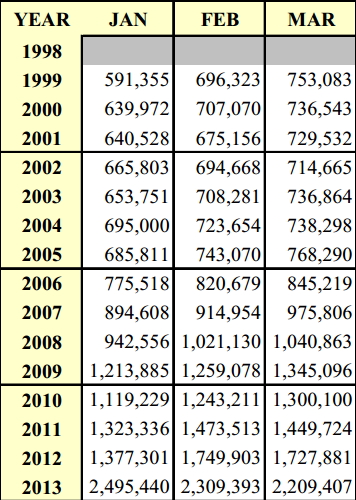
In fact, the rush beginning in December has been high even by historic standards: the FBI conducted just under 2.8 million background checks on prospective gun buyers in December 2012, the highest number in any single month since records begin in November 1998. That’s more than triple the number it was running in in December 2002.
And the rush has continued through 2013 so far. Here’s the number of monthly background checks in the first three months of each year since 1998. This year looks set to be the busiest ever.
Comments Off on US domestic firearms sales continue to grow


