
H/T to Martina for the link.
October 13, 2010
September 28, 2010
Most self-indulgent generation now also most suicidal?
Baby Boomers. It’s always about the frickin’ Baby Boomers isn’t it? Even if according to demographers I’m supposed to be one of them, while your prototypical Baby Boomer was indulging in free love, drugs, and all the other 60’s behavioural abberrations, I was in primary school. I have never identified with that group, and I’m often struck by how self-regarding members of that demographic can be.
Well, perhaps after a life of unparalleled opportunity, wealth, leisure, and general wallow-in-it-ness, Baby Boomers are starting to retire . . . and also killing themselves in numbers not seen in previous generations:
“As children, the baby boomers were the healthiest cohort that had ever lived, due to the availability of antibiotics and vaccines,” Idler says. “Chronic conditions could be more of a rude awakening for them in midlife than they were for earlier generations.”
Given the contrast between the Boomers’ passage through life and that experienced by their parents, one might suggest that they simply brace up a bit and get on with it. This might, however, be bad news financially for the following generations who are already saddled with the task of paying for the Boomers’ wastrel stewardship of the global finances, prolonged and luxurious retirements, hip replacements and various other costs and expenses.
It may be, as we look back from a more austere future in which the retirement age has been raised to 85 or so and the elderly — far from guzzling pina coladas on cruise ships whilst simultaneously occupying badly-needed residential property — are compulsorily relocated to robot-staffed retirement homes, that we will regard the Boomers as the jammiest generation ever to have lived. Their apparent propensity to top themselves out of drug-addled foolishness, in a tantrum at the “rude awakening” of middle age, or simply like mindless sheep because they have seen others do so, will be all the more puzzling.
Comments Off on Most self-indulgent generation now also most suicidal?
September 23, 2010
xkcd on a useful, but unlikely, public service agency
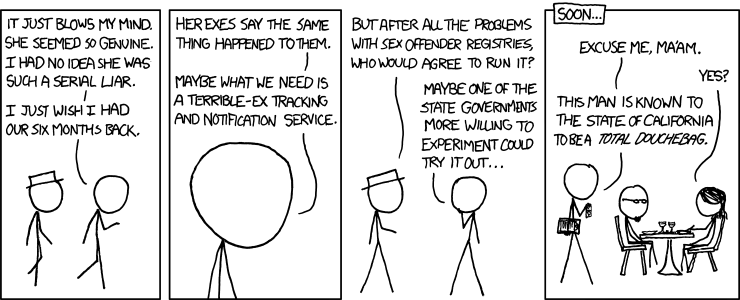
Comments Off on xkcd on a useful, but unlikely, public service agency
September 15, 2010
Recognize your password?

Password Authentication Tag Cloud
Earlier posts on this topic: Passwords and the average user, More on passwords, And yet more on passwords, and Practically speaking, the end is in sight for passwords.
H/T to Bruce Schneier for the link.
Comments Off on Recognize your password?
August 26, 2010
The (real, true, terrifying) risks of working at home
Working from home is one of those mixed blessings, you don’t have the morning commute, you don’t have to fight for parking space or room on the bus, and there’s no dress code. You also tend to lose some of that all-important human contact with your co-workers. But I didn’t realize it could be this bad:
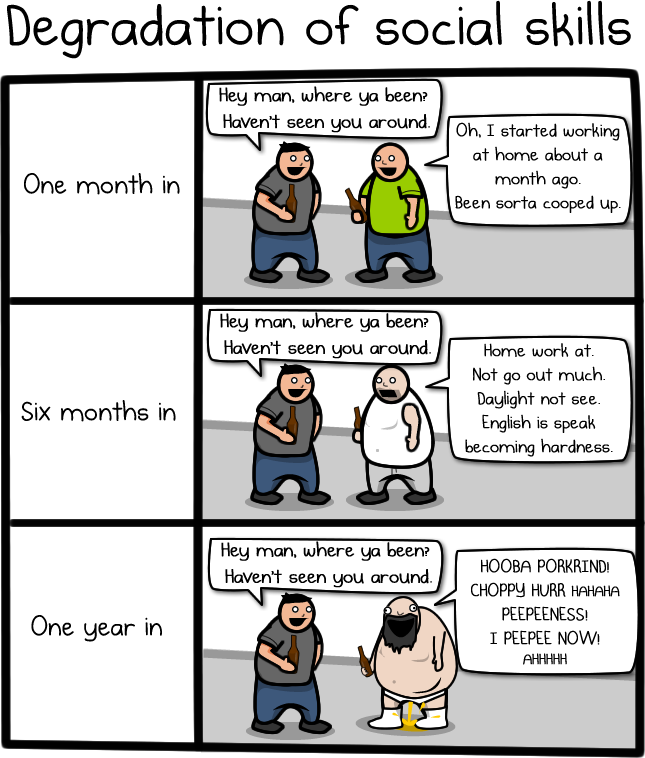
H/T to holykaw.alltop.com.
Comments Off on The (real, true, terrifying) risks of working at home
August 25, 2010
LED lightbulbs won’t save energy in the long run
Not because they aren’t more efficient than ordinary lightbulbs, but because of the inevitable side-effects of human nature:
Federal boffins in the States say that the brave new future in which today’s ‘leccy-guzzling lights are replaced by efficient LEDs may not, in fact, usher in massive energy savings.
This is because, according to the scientists’ research, people are likely to use much more lighting as soon as this becomes practical. The greater scope for cheap illumination offered by LEDs will simply mean that people have more lights and leave them on for longer.
“Presented with the availability of cheaper light, humans may use more of it, as has happened over recent centuries with remarkable consistency following other lighting innovations,” says Jeff Tsao of the Sandia National Laboratory. “That is, rather than functioning as an instrument of decreased energy use, LEDs may be instead the next step in increasing human productivity and quality of life.”
According to Tsao and his colleagues at Sandia, the fraction of gross domestic product spent on lighting has remained constant as candles were replaced by oil lamps, then again in the transition to the gaslight era, then yet again with the arrival of electric lighting. What changed with each of these innovations was that lighting became more and more common.
Hands up, anyone who didn’t see this one coming.
August 14, 2010
Business jargon got you down? Unsuck-it!
I’ve been known to print off Business Bingo cards for the inevitable business meeting jargon-fest, so I wholly support the notion behind Unsuck-it:

H/T to Xeni Jardin for the link.
Comments Off on Business jargon got you down? Unsuck-it!
July 24, 2010
QotD: Childhood in Britain
On no subject is the British public more fickle and more prone to attacks of intense but shallow emotion than childhood. Not long ago, for example, a pediatrician’s house in South Wales was attacked by a mob unable to distinguish a pediatrician from a pedophile. The attackers, of course, came from precisely the social milieu in which every kind of child abuse and neglect flourishes, in which the age of consent has been de facto abolished, and in which adults are afraid of their own offspring once they reach the age of violence. The upbringing of children in much of Britain is a witches’ brew of sentimentality, brutality, and neglect, in which overindulgence in the latest fashions, toys, or clothes, and a television in the bedroom are regarded as the highest — indeed only — manifestations of tender concern for a child’s welfare.
Theodore Dalrymple, “Who Killed Childhood?”, City Journal, Spring 2004
July 20, 2010
Useful neologism of the day
Eric S. Raymond performs a useful public service by naming and defining a very common tactic used to induce guilty feelings in the general populace:
One very notable pathology is a form of argument that, reduced to essence, runs like this: “Your refusal to acknowledge that you are guilty of {sin,racism,sexism, homophobia,oppression . . .} confirms that you are guilty of {sin,racism,sexism, homophobia,oppression . . .}.” I’ve been presented with enough instances of this recently that I’ve decided that it needs a name. I call this general style of argument “kafkatrapping”, and the above the Model A kafkatrap. In this essay, I will show that the kafkatrap is a form of argument that is so fallacious and manipulative that those subjected to it are entitled to reject it based entirely on the form of the argument, without reference to whatever particular sin or thoughtcrime is being alleged. I will also attempt to show that kafkatrapping is so self-destructive to the causes that employ it that change activists should root it out of their own speech and thoughts.
My reference, of course, is to Franz Kafka’s “The Trial”, in which the protagonist Josef K. is accused of crimes the nature of which are never actually specified, and enmeshed in a process designed to degrade, humiliate, and destroy him whether or not he has in fact committed any crime at all. The only way out of the trap is for him to acquiesce in his own destruction; indeed, forcing him to that point of acquiescence and the collapse of his will to live as a free human being seems to be the only point of the process, if it has one at all.
[. . .]
It is essential to the operation of [the kafkatrap] that the subject’s attention be deflected away from the fact that no wrongdoing by the subject, about which the subject need feel personally guilty, has actually been specified. The kafkatrapper’s objective is to hook into chronic self-doubt in the subject and inflate it, in much the same way an emotional abuser convinces a victim that the abuse is deserved — in fact, the mechanism is identical. Thus kafkatrapping tends to work best on weak and emotionally vulnerable personalities, and poorly on personalities with a strong internalized ethos.
Comments Off on Useful neologism of the day
July 15, 2010
Pleated-Jeans identifies the modern Maslow’s hierarchy
Pleated-Jeans has done the heavy lifting to pull the old, outdated Maslow diagram into the 21st century:
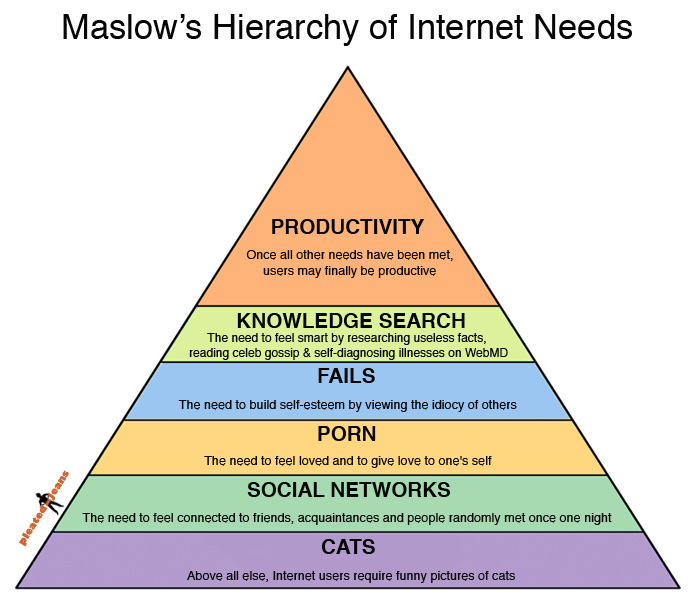
H/T to Michael O’Connor Clarke who advises “Caution: may cause psych majors to eject hot coffee through nasal passages.”
Comments Off on Pleated-Jeans identifies the modern Maslow’s hierarchy
June 18, 2010
When it’s rational to be irrational
Cory Doctorow really likes Dan Ariely’s The Upside of Irrationality:
. . . there are sections in which the science of irrationality is readily converted into practical techniques for living better, and these really shine. My favorite is the section on adaptation, that is, the way in which both terrible pain and incredible delights fade down to a kind of baseline normal over time. Ariely points out that adaptation can be slowed or even prevented through intermittent exposure to the underlying stimulus — that is, if you take a break, the emotional sensation comes back with nearly full force.
Here’s where our intuitive response is really wrong: we have a tendency to indulge our pleasures without respite, and to take frequent breaks from those things that make us miserable. This is exactly backwards. If you want to maximize your pleasure — a great dessert, the delight of furnishing your first real apartment after graduation, a wonderful new relationship — you should trickle it into your life, with frequent breaks for your adaptive response to diminish. If you want to minimize your pain — an unpleasant chore, an awful trip — you should continue straight through without a break, because every time you stop, your adaptive response resets and you experience the discomfort anew.
Comments Off on When it’s rational to be irrational
May 19, 2010
QotD: Action movie lines
“I know what you’re thinking, punk: Did I fire six bullets or only five. Being this is a Glock with seventeen rounds, it’s a moot point, but I’m doing a cognitive psychology study on people’s ability to count in stressful situation. You’ll get twenty dollars to participate. So, do you feel like helping science? Well, do ya, punk?”
Frank J. Fleming, “Action Movie Lines”, IMAO, 2010-05-18
Comments Off on QotD: Action movie lines
March 31, 2010
What “everybody knows” ain’t necessarily so
Rebecca L. Burch reviews Susan Pinker’s 2008 book The Sexual Paradox:
By page four, Pinker throws out the question of why women may or may not be allowed to be equal to men and posits a different one: why on earth do men get to be the standard? Why should females have the goal of meeting the male standard? This in itself denigrates females. So many books discuss how females are discouraged, disenfranchised, and disenchanted, citing numbers of women leaving traditionally “male” careers. Pinker dares to posit the idea that women don’t have the same preferences as men and therefore, might actually choose different paths, not be forced into them by the patriarchy. Now we’re talking! Let’s throw out the seemingly societal mandates and all that socialization and delve into actual differences, not perceptions or relative status, but the biology of the matter. Pinker “…began to wonder what would happen if all the ‘shoulds’ — the policy and political agendas — were shifted to the side for a moment to examine the science” (p. 5).
And that she does, spending little time on history and the patriarchy, Pinker explains the neurological and endocrinological processes that result in different talents and predispositions (with plenty of overlap) as well as different preferences. Thankfully, she goes beyond just differences in performance, assessment, or feelings regarding these differences. In particular, she examines the role testosterone plays in male risk taking (including those amusing Darwin Awards) and the role oxytocin and empathy play in female career choices. It is important to note that this is not the shallow glossing over seen in other books. Pinker is thorough enough to leave this biopsychologist satisfied, but also understandable enough for nonacademics.
[. . .]
After systematically breaking down each of these misconceptions about gender, gender differences, and the power of society, Pinker sums things up this way, “…forty years of discounting biology have led us to a strange and discomfiting place, one where women are afraid to own up to their desires and men—despite their foibles—are seen as standard issue” (p. 254). This belief of men as standard issue, and the assumption that women want this, only makes the situation harder for women. This may not be what they want, even if they are highly intelligent, capable, and encouraged. And most importantly, they are entitled to their preferences. This “vanilla male” model is also of no use to those disadvantaged males (those with Asperger’s, for example), whose ability examine concepts differently have usually come at a social price. They, also, are entitled to their preferences and should be given the opportunity to explore their skills. Once again, the belief in the SSSM [standard social science model] has set us back. This active disregard of biology and evolution has not improved gender equality. It has done just the just the opposite and even hindered a subset of males in the process.
H/T to Arts & Letters Daily for the link.
March 30, 2010
Self-esteem versus self-respect
Theodore Dalrymple on the crucial differences between self-esteem and self-respect:
With the coyness of someone revealing a bizarre sexual taste, my patients would often say to me, “Doctor, I think I’m suffering from low self-esteem.” This, they believed, was at the root of their problem, whatever it was, for there is hardly any undesirable behavior or experience that has not been attributed, in the press and on the air, in books and in private conversations, to low self-esteem, from eating too much to mass murder.
[. . .]
When people speak of their low self-esteem, they imply two things: first, that it is a physiological fact, rather like low hemoglobin, and second, that they have a right to more of it. What they seek, if you like, is a transfusion of self-esteem, given (curiously enough) by others; and once they have it, the quality of their lives will improve as the night succeeds the day. For the record, I never had a patient who complained of having too much self-esteem, and who therefore asked for a reduction. Self-esteem, it appears, is like money or health: you can’t have too much of it.
Self-esteemists, if I may so call those who are concerned with the levels of their own self-esteem, believe that it is something to which they have a right. If they don’t have self-esteem in sufficient quantity to bring about a perfectly happy life, their fundamental rights are being violated. They feel aggrieved and let down by others rather than by themselves; they ascribe their lack of rightful self-esteem to the carping, and unjustified, criticism of parents, teachers, spouses, and colleagues.
The other side of the coin is rather different:
Self-respect is another quality entirely. Where self-esteem is entirely egotistical, requiring that the world should pay court to oneself whatever oneself happens to be like or do, and demands nothing of the person who wants it, self-respect is a social virtue, a discipline, that requires an awareness of and sensitivity to the feelings of others. It requires an ability and willingness to put oneself in someone else’s place; it requires dignity and fortitude, and not always taking the line of least resistance.
[. . .]
Self-respect requires fortitude, one of the cardinal virtues; self-esteem encourages emotional incontinence that, while not actually itself a cardinal sin, is certainly a vice, and a very unattractive one. Self-respect and self-esteem are as different as depth and shallowness.


