
I think this is causing some confusion, blindness and otherwise inexplicably stupid behavior in people who never seemed stupid before. This is what I call The Years the Masks Fell off.
Look, take a just-now thing: the DNC says that all precincts in Iowa WERE counted. The app recorded every vote, they say. They just need to tally them.
Turns out that’s probably not precisely true.
As a friend noticed, that’s not precisely a lie, that’s just “making sh*t up.”
We’re seeing that a lot from the other side of the aisle suddenly. Unbelievably stupid behavior like the sham wow impeachment.
They keep telling us “Who you gonna believe, me or your lying eyes?” and being shocked and appalled when we choose our lying eyes.
[…]
And then they’re shocked, nay astonished, when these tactics don’t work. While we who are standing outside this look at them and go “Who would think that would work? Some two year old?”
I mean half of the bizarre behavior of our government and its agencies falls under that heading too. “Who could think that would work/wouldn’t be found out/made any sense?”
But the thing you have to understand is that you’re not dealing with stupid people. Not by half. You’re dealing with people who were very competent and comfortable in — for lack of a better term — the previous paradigm of politics, or publishing or whatever.
The more comfortable they were; the easier it was for them, the harder it is to accept that it’s gone and it’s not coming back
For instance, the dems could trust the media would cover for them absolutely and completely, and that their pettiness, idiocy or outright corruption would never be revealed.
They got used to it, they got comfortable. They got to believing it was their natural right. It was just the way things were. They were the good people. Their hearts were pure. No one would ever look into their behavior outside the limelight.
If some psychological tests are correct, they grew to believe they were entitled to corruption and unethical behavior for all the “good” they did, such as Clinton thinking he was entitled to all the women he wanted for “fighting for women’s rights” (Which for men like him always mean abortion, but never mind.)
They can’t adapt. They can’t believe things have changed.
Sarah Hoyt, “How Things Have Always Been”, Libertarian Enterprise, 2020-02-09.
February 12, 2020
QotD: Experienced political operators after an unexpected paradigm shift
February 9, 2020
QotD: Toronto and Vancouver
What the residents of these two cities have in common is an irrational smugness, an utterly unfounded belief that they are living in the best city in the world. We grasp desperately at warm comments from visitors, keen to be noticed by outsiders. The best of all is when we get acknowledged by international studies that rank the cities of the world. These surveys invariably come up with widely divergent results, and sometimes Toronto does well and other times it’s Vancouver.
Nicholas Pashley, Notes on a Beermat: Drinking and Why It’s Necessary, 2001.
January 24, 2020
QotD: Writing as a career
Colby Cosh “Who let him in?”, ColbyCosh.com, 2005-01-19.
January 18, 2020
QotD: Men and talking
Also, because many women tend to over-analyze, they assign all sorts of deep meaning to trivial gestures and then demand explanations. Sometimes a rose is just a rose and five minutes of silence is just a man thinking about what he has to do at work tomorrow. You want to get a man to talk? It’s not hard. Ask him to explain what’s going on in a UFC fight or what his favorite sexual fantasy is and you’ll have trouble getting him to shut up.
John Hawkins, “5 Things Women Do That Secretly Annoy Men”, PJ Media, 2012-08-23.
January 16, 2020
QotD: Progressive hatred
One reason for this, obviously, is that many people attracted to the Left are mentally unstable, so their politics are just a vehicle for their pathology. Many of the Antifa people, for example, have no coherent political thoughts. They just like being crazy on the streets and causing mayhem. This is the type of person who was attracted to the riots that used to follow the big economic summits. There was never any purpose to their rampages, other than the thrill of smashing things and causing mayhem.
Another more important reason for the rage is the nature of leftist politics in our post-national age. Being on the Left no longer means joining a group that has a tangible enemy, against whom the group throws themselves. The days of unionist, socialists and communists operating as collectives are gone. Even the post-modern movements like climate change and sexual politics is atomized. Much of it is backed by the sorts of people the Left used to oppose like rich people and business.
The Z Man, “It’s Personal”, The Z Blog, 2019-11-12.
January 12, 2020
QotD: Progressive snobbery is part of the kink
Yes, they do. For liberals, the distinction between the “dumb masses” and their enlightened selves renders life meaningful. Disdain for ordinary folks is not just an ancillary trait of liberalism. It is fundamental to the its nature.
At its heart, liberalism is a gnostic religion, and the essence of that religion is the believer’s faith that he possesses the means of changing the world for the better. The belief that the world must be changed requires there to be a mass of individuals whose lives are in need of change. Following this logic, it is the liberal, not those deplorables in need of change, who knows what must be changed. For liberals, there must be a mass of people in need of this knowledge for life to make sense.
Above all, liberalism is a hubristic faith. Its followers share the fatal flaw of pride in their own intellectual capacity. This is why liberalism appeals so strongly to those in the knowledge trades: teachers, journalists, writers, psychologists, and social workers. The sense of “knowing more than others” is its strongest attraction – particularly to the young, who otherwise know so little. Liberalism confers, or seems to confer, almost immediate power and authority to those who embrace it.
The left’s obsession with superior knowledge runs through its entire history. As Woodrow Wilson remarked, the “instrument” of political science “is insight. A nice understanding of subtle, unformulated conditions.” Lyndon B. Johnson thought “a president’s hardest task” is “to know what is right.” And the most hubristic of all is Obama’s “We are the ones we’ve been waiting for.” Yes, we are wonderfully bright, and we’ve been waiting eons for ourselves to appear.
Jeffrey Folks, “Leftists versus the People”, American Thinker, 2018-02-24.
January 5, 2020
More from Severian about modern girls at university
Having regaled us with shocking tales of the Basic College Girl (linked here), Severian now gets down to the not-very-salacious details of modern female mating behaviour at US colleges:

University College, University of Toronto (not one of the post-secondary institution Severian used to teach at).
Photo by “SurlyDuff” via Wikimedia Commons.
When people find out I’m retired from “higher” “”education,”” if they’re anything but rabid Leftists they usually ask me a series of questions: Why are professors such hypocritical assholes? and Is there really any point to ___ Studies? and Why do they pay the football coach umpteen zillion dollars a year to never finish higher than third in the conference? If the questioner is a man, though, and we’re out drinking, after a few martinis they always get around to: But what about … you know … the girls?
Where to start? Since there’s no avoiding prurience here let’s get one thing out of the way up front. This is TLP, not me, but it holds for coeds, too:
These people are prone to two errors. A psychological one: fetishization; and a biological one: mistaking for beauty what is merely youth.
Taking the second first: I made the same mistake. I came to the ed biz later than most, having had a “real” job back in my other life, so when I first got to grad school I was amazed at how hot the girls were. Like everyone else I was a TA for Intro to Studies 101, but unlike everyone else I must’ve gotten the “sorority girls only” section, because every single chick in it was a knockout.
Now I’ll cop to being a little slow on the uptake, but I’m not that dumb. So I started looking a little closer — purely in the interests of science, you understand — and it wasn’t long until I realized that yeah, what I thought at first was smokin’ hotness was just youth. Back in the office I’d been surrounded by women who were equally attractive, but not equally young. A few years in a high-stress job puts a lot of miles on you.
But the other, fetishization element came into it too. Not like that, get your minds out of the gutter, let me explain:
I don’t think it ever really was, but if “coed” was a fetish its days are long past. In a country where the vast majority of people have at least a semester or two of college, not even “sorority girl” really moves the needle much. Rather, all the “fetish” stuff comes from the other side. After spending oh-god-sooooo-many hours getting harangued by the HR ladies about “sexual harassment,” even the most cynical teacher finds himself wondering what he’d do if some slinky young thing really did show up at office hours, close the door, and declare she’ll do anything to pass the class…
Which never happens, of course. I’ve never even heard of it, and I taught at lots of places, for many years, among male colleagues (and a lot of lesbians) who were desperately horny losers. The reason is twofold. The first, and most obvious, is that even if some girl really is that mercenary / sociopathic — and y’all have me on record, at great length, describing what little sociopaths modern kids are — there’s a much simpler alternative available: Straight-up bribery. But notice that’s the one thing you never even hear suggested, though it’s the easiest thing in the world. TAs get paid peanuts; I don’t know how low the bidding could’ve gone, but having seen the squalor in which lots of my fellow grad students lived, twenty bucks doesn’t seem unreasonable …
[…]
Ironically, I’d bet #MeToo and the rest of it actually result in more, not less, of this behavior. Like I always say, today’s blue-haired, nose-ringed slam poet is tomorrow’s obergruppenfuhrer, and one of the main reasons I say it is that I’ve been around a LOT of college people. Shrinking violets who need “safe spaces” everywhere very obviously long to knuckle under to power, any power. Goofy losers who suddenly find themselves with a lot of power naturally start carrying on like Heinrich Himmler. Put them together in the closest possible proximity, in a place explicitly designed to shield them from the real world, and, well, you figure it out.
January 3, 2020
Magical thinking in names
Theodore Dalrymple relates the rather odd story of a young girl’s media-publicized objection to a math problem in school and then considers the girl’s given name in the larger context:

Popular first names in the United States, 2010.
Image from Behind the Name.
My attention was also caught by the first name of the politically-correct child: Rhythm. This is not a traditional name, though not actually ugly; but her parents have evidently accepted the increasing convention of giving a child an unconventional, and sometimes previously unheard of, name. This is a worldwide, or at least occident-wide, phenomenon. In Brazil, for example, parents in any year give their children one of 150,000 names, most of them completely new, made up like fake news, and in France, 55,000 children are born every year who are given names that are shared by three or fewer children born the same year. This latter is all the more startling because, until 1993, there was an old Napoleonic law (admittedly not rigidly enforced) that constrained parents to choose among 2000 names, mainly those of either saints or classical heroes.
What does the phenomenon of giving children previously unheard-of names signify — assuming that it signifies something? I think it is symptomatic of an egoistic individualism without true individuality, of self-expression without anything to express, which is perhaps one of the consequences of celebrity culture.
I performed an internet search on the words Rhythm as a given name. I soon found the website of a group called the Kabalarians, who believe that the name given to a child determines, or at least contributes greatly, to its path through life, especially in conjunction with the date of birth:
When language is used to attach a name to someone this creates the basis of mind, from which all thoughts and experiences flow. By representing the conscious forces combined in your name as a mathematical formula, one’s specific mental characteristics, strengths and weaknesses can be measured.
It invited readers to inquire about the psychological characteristics and problems of people with various given names. I invented a child called Rhythm of the same age, more or less, as Rhythm Pacheco. This was the result:
The name of Rhythm causes this child to be extremely idealistic and sensitive. She will find it difficult to overcome self-consciousness and to express her deeper thoughts and feelings in a free, natural way. She is too easily hurt and offended, and will often depreciate her own abilities. Because of her lack of confidence and her sensitivity, she will go to great lengths to avoid an issue. True affection, understanding, and love mean a great deal to her, as she is a romantic and emotional youngster. Often she will resort to a dream world when her feelings are hurt. She could be very easily influenced by others, for she will find it difficult to maintain her individuality. This problem could become more predominant during the teenage years. Although there is much that is refined and beautiful about her, the lack of emotional control could bring much unhappiness, repression, misunderstanding and loneliness later in life. Tension could also create fluid and respiratory problems. Because of the sensitivity created by this name, she will find it difficult to cope with the challenges of life.
There is, in fact, a semi-serious theory of nominative determinism, according to which a name may influence a person’s choice of career: two of the most prominent British neurologists of the first half of the twentieth century, for example, were Henry Head and Russell Brain. A recent Lord Chief Justice of England was called Igor Judge. And surely it must work in a negative direction too: no poet could be called Albert Postlethwaite. However rational one believes oneself, one might also experience a frisson of fear on consulting a doctor called Slaughter — as was called the doctor and popular novelist Frank G. Slaughter.
When I first went to Africa, I encountered patients whose first names were Clever, Sixpence or Mussolini. The first of these names was presumably an instance of magical thinking, while the second two were chosen merely because the naming parents liked the sound of them. Years later, during the civil war in Liberia, I met a constitutional lawyer called Hitler Coleman, who presumably desired to live his name down by concerning himself with the rule of law.
January 1, 2020
Dim views of polyamory
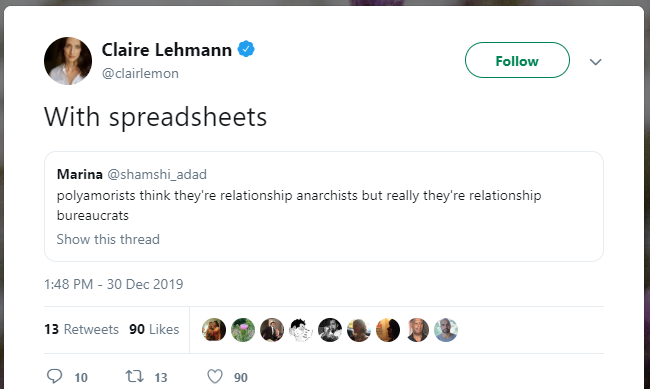
Claire Lehmann responded to a Tweet from @shamshi_adad on the topic of polyamory:
With spreadsheets https://t.co/vlJqICLWUj
— Claire Lehmann (@clairlemon) December 30, 2019
… which got some amusing responses:
Polyamory is the “parents aren’t home let’s eat all the candy” of sex.
A phase whose unwisdom will be soon understood.
— 🤖🦉Cyberowl 🦉🤖 (@Supreme_Owl_FTW) December 30, 2019
It's true. I had a poly friend once. The rules were Talmudic. I didn't understand how that was freeing. But she beat me over the head with her dog-eared copy of "Sex at Dawn" and assured me it was.
— Stephen Wood (@SlideQuintus) December 30, 2019
Polygyny: Just harem girls sharing an alpha.
Polyandry: Only 1 guy is getting laid, the rest are just there as utilities and servants.
Neither arrangement is a good deal for anyone except that one dude who's getting laid.
— Irreverant (@XTheIrreverantX) December 30, 2019
Communist jokes through the ages
At Catallaxy Files, Steve Kates recently read Hammer and Tickle: A History of Communism Told Through Communist Jokes by Ben Lewis:
It looks at the jokes themselves; the evolution of these jokes as communism aged and new leaders took over; it looks at the different kinds of jokes told in different communist countries; it examines the fate of those who told such jokes and the difference in the fate of those who made such jokes depending on who was the leader of the Party; it asks whether such jokes helped the communists consolidate power or whether they helped bring communism down; it looks into the difference between telling anti-Nazi jokes in Nazi Germany versus telling anti-communist jokes in communist countries; it asks about the psychology of those who told such jokes and whether they helped relieve tensions; and much else. But I will say this, some of I found really funny. This is my favourite.
Khrushchev is walking through the Kremlin, getting worked up about the Soviet Union’s problems, and spits on the carpet in a gesture of disgust.
“Behave yourself, Nikita Sergeyevich,” admonishes the aide. “Remember that the great Lenin walked through these halls!”
“Shut up,” responds Khrushchev. “I can spit all I like here; the Queen of England gave me permission!”
“The Queen of England?”
“Yes! I spat on her carpet in Buckingham Palace too, and she said, ‘Mr Khrushchev, you can do that all you like in the Kremlin if you wish, but you can’t behave like this here …'”
Easy to see this one added to the Donald Trump canon and now that I have pointed it out, I expect it to be.
I therefore thought I might have a look at what passes for Donald Trump jokes. And google all you like, there really is not much although there was this: Donald Trump Jokes. None were funny but I did like this:
Where’s Donald Trump’s favorite place to shop?
Wall-mart!
Mere pun though it is, it seems appropriate. At least it’s policy-related and almost entirely a joke that could only be told about Trump. The rest are re-treads, never specifically about anything related to Trump himself and his policies, but are almost entirely forms of insult than anything with any associated wit or insight. The most interesting part to me about the communist jokes was that the ones that became acceptable were those directed at the failures of communism relative to the promises that had originally been made. Lots like that. The way to end up in the gulag was to tell jokes about actual party leaders, especially Lenin and Stalin. Very few like that.
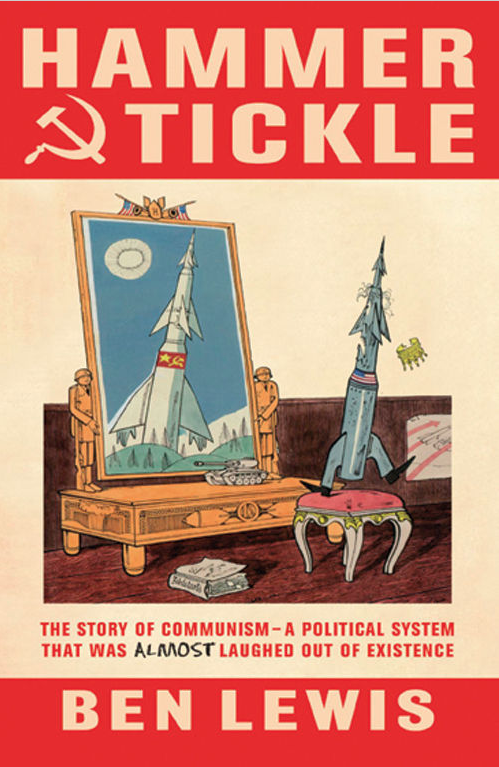
I rather liked the one from the Amazon page for the Kindle edition: “Q: Why, despite all the shortages, was the toilet paper in East Germany always 2-ply? A: Because they had to send a copy of everything they did to Moscow.”
December 26, 2019
QotD: “Saving” a special bottle of wine
If you find yourself earmarking a bottle of wine as particularly special, go a step further and decide immediately what you’re saving it for. Don’t expect a suitable event to materialize later, because our psychology is working against us and as time goes by the exalted wine becomes harder to open.
Richard Best, The Frugal Oenophile, 2004-12-09.
December 21, 2019
Expanding the definition again: “terms like nerd, geek, or boffin is hate speech”
Offensensitivity hits the eggheads:
Labeling super-smart people with terms like nerd, geek, or boffin is hate speech, and should be punishable as such, argues lecturer and Harley-Street psychotherapist Dr Sonja Falck.
Likewise wonk, smarty-pants, and know-it-all: these terms are “divisive and humiliating,” and the “last taboo,” the University of East London egghead said this week while promoting her new book about brainiacs. Such “anti-IQ” words set society’s Einsteins apart, she claimed, with the result that geeks end up “feeling like they’re a misfit and don’t belong.”
Calling someone a swot, whizkid, brainbox, smart-arse, or dweeb may seem “harmless banter,” but it is equivalent to hate speech, she reckons, and should be recognized as such in British law – with punishments including fines and imprisonment. “It is only with the benefit of hindsight and academic research that we realise how wrong we were,” she added.
That academic research includes her new book titled Extreme Intelligence, for which she interviewed 20 nerds for 90 minutes about when they realized they were so very clever.
She then embarked on a “contextual analysis of literature” and decided that calling someone a boffin was equivalent to the worst racial slurs. “The N-word was common parlance in the UK until at least the 1960s,” she said during her book launch, before noting that “other insulting slurs about age, disability, religion and gender identity remained in widespread use until relatively recently.”
Dr Falck does not have a chip on her shoulder, despite the fact that the whole idea behind the book stemmed from the fact that as a child she was offered a place at a school for gifted children but her mother turned it down because she feared it would result in her becoming socially difficult.

December 19, 2019
QotD: The “fitness club” scam
Here’s how you talk yourself into a
gymfitness club membership: “I need to get in shape. So I’ll buy a club membership. That way, I can go whenever I want.” In Festinger’s taxonomy […] you’re at step 2: You’ve taken a significant action in line with your belief.Gymsfitness clubs add a further refinement of late-20th century marketing, in that they offer you a yuuuuge “discount” off the outrageously-high signup fee, but the underlying psychological process is the same.And now you’re set up for the disconfirmations — that is, all those times you think about going to the gym, but don’t actually go. Objectively you’re wasting your money, but psychologically you’re committed to the idea of yourself as someone who does “fitness” — you’re in a fitness club, after all! And since everyone you know is doing the same thing — fully 75% of conversations one overhears at Starbucks are soccer moms griping about how they need to work out, but just can’t find the time — you’re in, all the way, […].
The “climate change” scam works the same way. When she’s on the campaign trail pimping the “Green New Deal,” Fauxcahontas Warren knows she doesn’t have to pitch it to the eco-freaks; they’d vote for her no matter what. She has to pitch it to the normies, fitness club-style. That’s where the “climate change” nomenclature really pays off. It’s shockingly easy to get people convinced of a lunatic belief. All you have to do is a) get ’em early, and b) overload them with “evidence.” You know the drill: These days, we’re lectured practically from birth that we must Do Something! for The Environment! … and the “evidence” for this, of course, is the ceaseless, dramatic variation in daily temperature the un-indoctrinated call “weather,” plus all the other dramatic variations in climate that didn’t happen. So long as you pitch it with complete self-righteousness, people with the critical thinking skills of five year olds will fall in line every time.
Then all you have to do is get people to take action … which the government, in all its wonderful helpfulness, has already done: Low-flow toilets, those stupid twisty “light” bulbs, toilet paper that either shreds on contact with skin or sandpapers your asshole off, plastic straw bans, mandatory recycling, you name it. And I’m sure y’all realize by now that the fact that none of this stuff actually works is a feature, not a bug. Since it’s the disconfirmations that get you. That’s the pitch to the normies — you obviously care about “the environment,” in the same way you care about “fitness.” Just as the “fitness club” owners will happily keep cashing your checks while you remain a diabetic lardass, so Fauxcahontas will keep cashing your checks while the weather stubbornly remains the weather …
Severian, “What Happens if the UFO Actually Comes?”, Rotten Chestnuts, 2019-09-25.
November 24, 2019
What every shared office kitchen is like
Alistair Dabbs describes most office kitchens I’ve encountered over my career:

Talking of timeslip, there is a wormhole in every shared office kitchen. I’ve experienced it at each of my clients’ premises so I guess it may be true everywhere.
When I arrive early in the morning, non-specific-gender-fascist swot that I am, I stride past the kitchen or kitchenette, admiring how spotless and twinkly it is from the deft attentions of the overnight cleaning contractors. Not for long.
It only takes a few seconds to pick my hot-desk location for the day since it’s always the same one, i.e. the only hot-desk not already baggsied by someone else the night before by leaving a spare jacket/cardigan/set of false teeth hanging on the back of the chair, i.e. the shitty desk next to the fire exit door that doesn’t quite shut properly and lets the weather in.
Pausing only a moment to brush away the mini snowdrift that has accumulated next to the power block, I put down my backpack and head straight back to the kitchen to brew up some chai.
When I get there, barely a minute after I passed it earlier, the kitchen has transformed into a disaster zone. Spilt milk, coffee and various puddles of water cover every level surface. Brown liquid of different shades are splattered artistically across the walls. The floor is carpeted with a layer of granulated sugar and broken mug handles which crunch unpleasantly underfoot.
Torn cardboard boxes and heaps of scrunched sheets of kitchen towel are arranged around the edge of the vast but glaringly empty dustbin. A cupboard door is swinging open on its only remaining hinge. The cutlery drawer has been pulled out and is now face-down in the sink. The kettle is on its side. The microwave is on fire. Where the dishwasher used to be is now a smouldering hole in the floor.
No worries, the cleaners will be back overnight to put it all shipshape again, wipe down the surfaces and shovel away any charred body parts.
As I have mused in this column on previous occasions, it makes one wonder what people’s houses must be like if their workplace kitchen etiquette extends to the personal domicile as well. This isn’t meant as a “bah dropping standards etc” whinge but a genuine interest in what the otherwise sane and talented individuals I meet in offices get up to in the privacy of their own homes.
November 19, 2019
QotD: [Trump | Obama | Bush | Clinton] Derangement Syndrome
Arthur Chrenkoff, “Denying the sky is blue because Orange Man Bad”, The Daily Chrenk, 2019-10-18.


