
At its core, liberalism can be defined in gnostic terms as the human mind’s idolizing of itself. In this sense, Obama’s famous aphorism is spot on. The liberal mind really is what the liberal mind has been waiting for.
What it seeks is not, however, goodness, or security, or higher living standards, or even better health care. What it seeks is the celebration of its own brilliance. “Smug” is a small word that perfectly captures the nature of the progressive mind.
This gnostic trait is the source of all of the damage liberalism has wrought for more than 300 years. From the French Revolution to the Third Reich, from Stalinism to North Korea, liberalism has brought with it repression of liberty, death camps, and executions on a mass scale. What’s often not well understood is the fact that violence and repression are inevitable because liberalism seeks to change what does not wish to change – and it does so not for the purpose of making things better, but as an attempt to confirm the superiority of the liberal mind and its ability to manage society.
Most Americans find this conception of existence repulsive. They follow the true path of love, marriage, childbirth, hard work, and faith in God and country. Liberals actively seek to destroy this conception of existence because it rejects their mission of transforming society. It’s either the true path or liberalism. Both cannot be true.
To succeed, liberalism must acquire and retain clients in need of change. It is not in the interest of the liberal to solve problems. What the liberal needs is continually to discover new problems and hold them up as in need of solution. The fate of the “DREAMers”, held in limbo by generations of liberals, is one example. The “downtrodden”, as they were once called, are indeed the pawns of liberal politicians.
Jeffrey Folks, “Leftists versus the People”, American Thinker, 2018-02-24.
September 21, 2024
September 19, 2024
QotD: “Solutions” to climate change
Quick: name a climate change remedy that does not result in you being less free and/or paying more money. It’s actually remarkable. Every single thing that we absolutely must do right now no time to wait how dare you pause to think how dare you is something leftists always wanted but could never talk people into doing until the threat of weather vengeance started lurking around the corner.
You can’t name any. There aren’t any, because the weird climate cult is not about weather but about separating you from your liberty and loot. And, apparently, your life if you won’t obey.
Kurt Schlicter, “TIME’s Commie Nag of the Year Can Go Pound Sand”, Townhall.com, 2019-12-15.
September 5, 2024
Is the DEI tide finally receding from corporate boardrooms?
At the Foundation for Economic Education, Jon Miltimore explains why many major US corporations are reconsidering their earlier “all in” approach to lecturing their customers about progressive causes:

Bud Light’s brand ambassador, Dylan Mulvaney, whose antics triggered a consumer boycott that cost the company over a billion in lost revenue.
DEI is just one form of corporate social activism, which comes in various forms and includes its cousin Environmental, Social, and Governance (ESG). Both ideas fall under, to some degree, Corporate Social Responsibility (CSR), the idea that corporations have a duty to take social and environmental actions into consideration in their business models.
If you’re wondering why Burger King has commercials on climate change and cow farts, and why Bud Light’s commercials went from featuring Rodney Dangerfield and Bob Uecker to trans activist Dylan Mulvaney, it’s because of CSR.
The idea that corporations should fight for social causes has skyrocketed in recent years to such an extent that activism is inhibiting companies in their primary mission: generating profits by serving customers.
“Firms leveraging situations and social issues is not new, but showcasing their moral authority despite a disinterested consumer base is,” Kimberlee Josephson, an Associate Professor of Business at Lebanon Valley College in Annville, Pennsylvania, has observed.
Bud Light’s decision to feature Mulvaney cost them an estimated $1.4 billion in sales, and it revealed the danger of corporations leaning into social activism, particularly campaigns and policies that alienate their own consumer bases.
Not very long ago, companies like Chick-fil-A faced backlash from progressive activists for supporting traditional marriage. Culture war advocates on the right have responded in similar fashion.
Conservative influencers have made a point of raising awareness around “woke” corporate initiatives — white privilege campaigns, climate change goals, LGBTQ events, etc. The most successful ones, such as Robby Starbuck who pioneered the campaign against Tractor Supply and John Deere, made a point of targeting corporations with conservative consumer bases.
“If I started a boycott against Starbucks right now, I know that it wouldn’t get anywhere near the same result,” Starbuck recently told the Wall Street Journal.
One can support Robby Starbuck’s tactics or oppose them. What’s clear is that corporations increasingly face risks for participating in social activism campaigns, and the threats now come from both sides of the political aisle.
Respectful neutrality on cultural issues used to be the default way for companies to avoid insulting the general public and potentially alienating customers. Under the influence of DEI/ESG/CSR advocates, corporations were persuaded that they could offend half of the population without suffering any meaningful financial losses. That turned out to be untrue.
September 2, 2024
“Queering Nuclear Weapons” … no, don’t laugh because it isn’t funny
At Postcards From Barsoom, John Carter looks into what at first seemed like a less-than-brilliant headline from The Babylon Bee, but is actually a much more serious concern:
Nuclear security is, I’m sure you do not need to be convinced, a deeply serious matter. Ever since we cracked the atom over Hiroshima our civilization has been walking a tightrope over an abyss. A single misstep could mean annihilation – hundreds of millions dead within minutes, billions within days. Doubtless there would be some survivors, but it’s doubtful that industrial civilization would survive. We’ve come within a hair’s breadth of this a few times, not only in the Cuban Missile Crisis, but on other occasions, when radar mulfunctions or computer glitches left launch officers in the USA and the former USSR unsure whether or not to press the big red buttons they were entrusted with. Fortunately for everyone, they didn’t. If they had, none of us would be here.
Nuclear power plants can be almost equally dangerous. We saw the consequences of mismanagement in the 80s, with Chernobyl. Political officers who had no idea what they were doing covered up one screw-up after another. The results horrified a continent and poisoned the good name of the nuclear energy to this day.
Nuclear security, of civilian infrastructure and especially of the strategic weapons reserve, is the kind of thing that you want deeply serious men in charge of. The kinds of guys who wear impeccable grey suits, didn’t laugh because they don’t think your joke is funny, and have multiple degrees in military history and nuclear physics.
[…]
And now, here we are again. The Department of Energy’s new Special Assistant for National Nuclear Security Administration, one Sneha Nair, is also the author of an article titled Queering nuclear weapons: How LGBTQ+ inclusion strengthens security and reshapes disarmament.
The National Nuclear Security Administration is a semi-autonomous alphabet agency responsible, as its name implies, for maintaining the security and efficacy of the USA’s nuclear weapons stockpile. Its remit also includes preventing the proliferation of WMDs, overseeing the provision of nuclear propulsion for the US Navy, and responding to radiological emergencies.
These are not small things to be responsible for, and one of their newly appointed senior administrators is apparently obsessed with painting rainbows on the warheads.
Let’s have a look at her.
Unlike Brinton, Nair doesn’t obviously look like a spiteful mutant. No aposematic hair colouring, no facial piercings, no obvious tattoos, nor any other obvious signs of mental illness. Her Xitter account doesn’t even proclaim her pronouns.
So unlike Brinton, there’s no obvious evidence that she’s a sexual deviant. By all appearances, she’s merely another overly earnest head girl, looking to burnish her virtue via demonstrative allyship.
Most of the media coverage was just lol’ing at the woke absurdity of the title of Nair’s article – what could adult diapers, dildos, bugchasing, and Monkeypox possibly have to do with preventing the fiery nuclear annihilation of the human species? Aside, that is, from keeping the observably mentally ill as far from the big red button as possible? What fresh madness is this? But we’re all inured to the regime’s infinite absurdity, these days, so after having a sensibly cynical chuckle we all moved on. I shrugged and moved on myself, until a few days ago when Stelios Panagiotou of Podcast of the Lotus Eaters took the time to actually read Nair’s work. What he found wasn’t lolcow fodder. It was deeply sinister.


There’s no limit to how progressive politicians want to control your life
In the National Post a couple of days ago, Carson Jerema provided many examples of how the Canadian federal government — despite failing and fumbling so many of its existing responsibilities — still wants to increase control over the daily lives of Canadians:
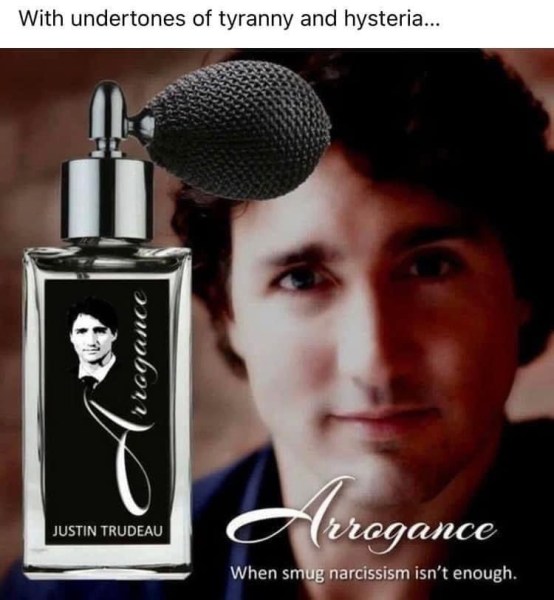
After a decade or so, progressives are on the defensive in Canada and elsewhere because regular people, as in those who are not activist weirdos, are tired of the agenda to control every aspect of our lives. Point this out to a progressive, and they will deny that anyone’s life is being interfered with and claim only some far-right monster would think otherwise. They can’t believe there are people out there who share a different view. They don’t understand how this could be.
But progressive governments are trying to control our lives in ways big and small, and in ways that range from subtle to a punch in the face.
In Canada, the federal government’s environmental policies are the most obvious example of this interference. The Liberals have banned plastic straws and plastic bags; even compostable bags are banned in grocery stores because they resemble plastic. Such bans are pointless irritants that make shopping more expensive, and life slightly less enjoyable as paper straws dissolve in one’s drink. People might dismiss these concerns as simply minor inconveniences, but this is how most people experience government policy, by being forced to replace their bag of plastic bags that they were already reusing, with more expensive, less useful options.
Next up, the Liberals are exploring options to bring in environmental regulations for clothing. The cost of clothes has actually gone down in recent years, so leave it to Ottawa to look for ways to bring the cost back up and to limit options.
There is also the plan to essentially force Canadians to purchase electric vehicles, that nobody would otherwise want, through government mandates to phase out the sale of gas-powered cars and trucks.
On a larger scale, the government is attempting to restrict the kind of work people do, specifically work in the oil and gas industry, through steep emissions targets, which will close off lucrative job opportunities in western oilfields. It will also limit the kinds of fuels people will be able to use to heat their homes.
There are also policies that the Canadian government hasn’t implemented, but which green activists have endorsed, such as the banning of gas stoves and the ludicrous suggestion from some academics that “climate lockdowns” be implemented to help cut emissions.
It is possible to be supportive of all these policies, despite their paternalistic and job-killing nature, but pretending that no one is trying to, or that no one wants to, interfere with our liberty is not a credible position to take.
September 1, 2024
The supermarket master plan to defeat the “far right” in Germany
There are elections ongoing in the German states of Thüringen and Saxony, and the polls show that the “far right” Alternative für Deutschland is potentially going to get 30% of the votes, which would give them more representation in those states than any of the other parties. Panic and hysteria have set in not only among the politicos and the mainstream media, but even among some businesses:
In Germany, all political parties have a colour. The Christian Democratic Union and the Christian Social Union are black, the Social Democratic Party is red, the liberal Free Democratic Party are yellow and the evil fascist Alternative für Deutschland are blue. This coming Sunday, Thüringen and Saxony will hold state elections, and the blue AfD are leading the polls in both states with about 30% support. This has a lot of people very, very upset. Most of them are merely upset with the AfD, but some psychologically unstable people have allowed their anger to embrace the colour blue more generally, because there can be no limits when it comes to resisting the evil antidemocratic forces of fascism.
Among the new sworn enemies of the blue band of the visible electromagnetic spectrum are the marketing team at Germany’s largest supermarket corporation, the Edeka Group. A few days ago, this supermarket chain, whose own logo strangely enough is primarily blue …
… ran an ad in Die Zeit and the Frankfurter Allgemeine Zeitung explaining “WHY BLUE IS NOT ON OFFER AT EDEKA”.
That wall of text in the middle reads as follows:
Yellow bananas, red tomatoes, green lettuce, purple grapes, orange carrots, pink dragon fruit … EDEKA’s fruit and vegetable department is full of colourful diversity. Or is it?
If you look closely, there’s one colour you won’t see: blue. And that’s no coincidence. Because blue food is nature’s way of warning us: ‘Watch out! I could be harmful!”
Evolution has taught us that blue is not a good choice.
And speaking of choices: Blue is not only the natural enemy of a healthy diversity of fruit and vegetables. In Germany, “the blues” are also the biggest threat to our diverse society.
So let’s read the warning signs correctly ahead of the state elections in Saxony, Thüringen and Brandenburg in September – and ensure that we can live together in harmony. Because we love diversity.
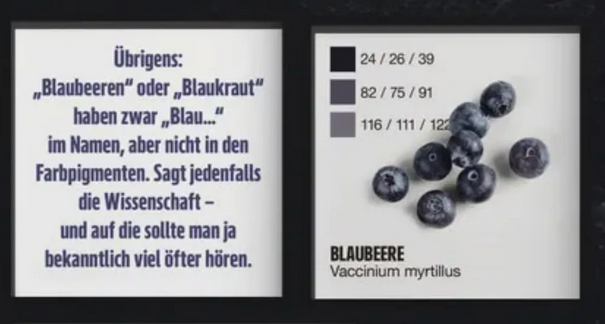
For those wondering whether Edeka have decided to cease selling fascist blue fruits like blueberries, there is a helpful note down in the corner:
There we learn that, while “‘Blueberries’ or ‘Blue cabbage'” may have “‘blue’ in their names”, their “colour pigments” are not blue. This is “at least what Science tells us – and as we know you should always listen to Science more”. Nothing about this is remotely obnoxious; indeed, if current-year Germany needs anything, it is more blind platitudinous calls to Follow the Science – particularly when it comes to exonerating innocent fruits and vegetables from suspicion of blue fascism.

August 31, 2024
QotD: Celebrity activism
Brian Micklethwait, “Minnie Driver and the changing meaning of goodness”, Samizdata, 2005-08-01.
August 29, 2024
How activists used lawfare to force the Boy Scouts to go woke (and then go broke)
A guest post from Cole Noble at Postcards From Barsoom discusses how progressive organizations and political activists have managed an immense take-over of the great outdoors, not least of which were the legal and political efforts to force the Boy Scouts of America to accept gay scouts and scout masters:

[…] This entertainment ecosystem, increasingly infested with culture warriors, also started chipping away at the longstanding prestige of organizations like the BSA [Boy Scouts of America]. Depicting someone as a scout became a kind of character development shorthand, signalling them as uncool.
The targeting wasn’t incidental; the existence of the pre-centennial BSA was a serious problem for the ruling class. Their organization’s commitment to values-based conservation served as living proof that going along with society’s adoption of critical theory was completely optional. If the BSA was free to refuse the push, others might start getting ideas.
Lawfare was inevitable.
In 2000, the United States Supreme Court heard Boy Scouts of America v. Dale. In one corner you had James Dale, an avowed gay rights activist, co-president of the Rutgers University Lesbian/Gay Alliance, and outspoken advocate for gay teens having gay role models. In the other, you had the BSA, who didn’t want someone like Dale around its young, impressionable members.
The BSA won, but there was blood in the water. Culture warriors circled back around, this time employing social pressure. They tried to make their demand sound as reasonable as possible: drop the policy against openly gay members. Just one teeny tiny rule. What’s the point anyway? It’s outdated. No real sense keeping it, right?
Smart members of the program clocked this Trojan Horse from miles away. Alas, the organization’s leadership did not. Possessing both the physique and fortitude of rice pudding, they caved, capitulated, and acquiesced some more — agreeing to an ever-escalating series of demands that hollowed out the once-proud group into an empty vessel for The Current Thing(TM).
The Boy Scouts of America is now all-inclusive! Not just to gay scouts and leaders, but girls too. In a show of solidarity with Black Lives Matter after the riots of 2020, a mandatory DEI merit badge has replaced camping as a requirement to attain the once coveted rank of Eagle Scout.
Let’s not forget the Scout Masters now left to deal with teens using the program’s overnight trips as cover for hookups.
Oh, and they went bankrupt.
The organization agreed to a 2.5 billion dollar settlement over tens of thousands of sex abuse cases perpetuated by adult men, against underage boys.
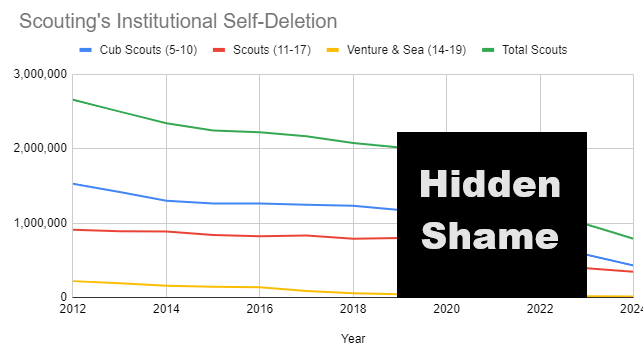
(data compiled from the BSA’s publicly available annual reports)
Rather than bolster ranks, adopting DEI cost the organization more than 1 million members.
The BSA – sorry, Scouting America1 – didn’t publish annual membership reports from 2020 to 2022, I imagine out of embarrassment. During this time, the Mormons, who used Scouting as a youth program for its boys, took their 400,000 members, and their money, and left.
[…]
Scouting was one of, if not the last bastion of quasi-unstructured outdoor activities. While the death of free-range childhood seems to be commonly understood, there is some debate about the precise cause.
Whatever your opinion on the matter, regime journalists shoulder enormous responsibility for eroding societal trust and inspiring mass paranoia through sensational reporting. Former latchkey kids became hysterical helicopter parents, petrified of letting their children out of sight.
Playing outside became a heavily supervised affair, usually relegated to fenced-in backyards with locking gates.
Kids have been robbed of the experiences that could lead them to develop an organic appreciation for outdoor recreation, and groomed into a hypersexualized version of early adulthood. All the while, the institutions which once taught conservation and virtue now serve as apparatuses of critical theory.
1. They changed their name in May of 2024, after 114 of being the Boy Scouts. Since they’re no long the Boy Scouts, this is at least honest.
Cole’s own Substack is Quandary Magazine, which you should check out if you’re generally interested in the great outdoors.
August 26, 2024
David Friedman – “my fargroup … are being attacked by my outgroup. My enemy’s enemy …”
I’m much of David Friedman‘s opinion on the candidates for both the Democratic and Republican parties in the current US presidential election … and I also find myself leaning more toward Trump even though his re-election would almost certainly be worse for Canada:

Donald Trump, surrounded by Secret Service agents, raises his fist after an attempt on his life during a campaign speech in Butler, PA on 13 July, 2024.
My opinion of the election is “a plague on both your houses”. Kamala Harris is an extreme representative of an ideology I have opposed for most of my life. Donald Trump has three major positions on two of which, immigration and trade, he manages to be even worse than his opponent. While I have some sympathy for his views on the third — I have been arguing against an interventionist foreign policy for something over fifty years now — I do not trust him to execute a consistent and competent alternative. His disinterest in whether what he says is true, extreme even for a politician, I find offensive.
That is my intellectual view of the matter. It is not my emotional view. Reading news stories and observing the effect on my feelings, I note that I am reacting like a Trump partisan. Poll results that look good for him make me happy, poll results that look bad for him make me sad. Accounts of outrageous statements by Trump or Vance I ignore — I don’t expect them to tell the truth. Accounts of demagoguery by Harris or Waltz arouse feelings of indignation. If Harris wins I will feel disappointed. If Trump wins I will feel relieved, at least until the first outrageous thing he does.
The explanation of my inconsistent reaction is provided by Scott Alexander in “I Can Tolerate Anything Except The Outgroup“, one of the best of his many good essays. In it he points out that someone’s outgroup, the group for whom he feels and expresses strongly negative views, is typically made up not of people distant from him, geographically and intellectually, but of people close. The outgroup of the Nazis was not their Japanese allies or the Chinese the Japanese were fighting, it was German Jews, people with the same language and, in most respects, the same appearance and culture. The outgroup of American leftists is not Muslim fundamentalists but American conservatives.
Conservatives have doubts about gay marriage. Muslim fundamentalists view homosexual intercourse as a capital offense.1 American conservatives would like their schools to be more tolerant of creationism. Muslim fundamentalists want their schools to teach the truth of Islam. And yet, when conservatives criticize Muslims, leftists defend them. When Muslims kill Jews and Jews respond by killing Muslims, it is the Muslims that the American leftists support, the Jews that they blame — although Israelis have much more in common, ideologically as well as culturally, with American leftists than Palestinians do.
We think of groups close to us in Near Mode, judging them on their merits as useful allies or dangerous enemies. We think of more distant groups in Far Mode – usually, we exoticize them. Sometimes it’s positive exoticization of the Noble Savage variety (understood so broadly that our treatment of Tibetans counts as an example of the trope). Other times it’s negative exoticization, treating them as cartoonish stereotypes of evil who are more funny or fascinating than repulsive. Take Genghis Khan – objectively he was one of the most evil people of all time, killing millions of victims, but since we think of him in Far Mode he becomes fascinating or even perversely admirable – “wow, that was one impressively bloodthirsty warlord”. (Scott Alexander, “Post-Partisanship Is Hyper-Partisanship“)
Conservatives are the leftists’ outgroup, Muslims their far group. The far group can be ignored; large parts of the world are more sexist and more racist than any part of America but invisible to progressives campaigning against sexism and racism. The far group can even be supported, at least if the outgroup is attacking it. My enemy’s enemy is my friend. Muslim fundamentalists. Hamas.
Kamala Harris is an American leftist. American leftists are my outgroup. Trump and Vance are American populists. I disagree with their views, in some cases more than I disagree with the views of American leftists, but I have nothing against them, just as I have nothing against believing Catholics or Orthodox Jews or Black Muslims or believers in Christian Science.
Trump and his movement are my fargroup. They are being attacked by my outgroup. My enemy’s enemy …
1. In some times and places Muslim culture has been tolerant of homosexuality; there are two famous medieval essays on the relative attractions of homosexual and heterosexual intercourse and quite a lot of poetry celebrating homosexual love. But the religious doctrine, which fundamentalists take seriously, holds homosexuality to be forbidden.
August 25, 2024
Woke libraries
Frank Furedi on the already well-advanced plan to turn public libraries into safe spaces for progressive indoctrination:



In recent times, the Library has become the target of what I characterise in my new book, as The War Against The Past. The current project of dispossessing Western society of its historical legacy has gained a powerful influence over the institutions of culture. That is why the Library – a repository of the knowledge and wisdom gained through the past – has become the target of cultural vandalism.
The promoters of the culture war in the Library often justify their action on the ground that their target is not so much the past – but the “racist past”. This is the argument used by the Government backed supporters of a campaign in Wales who wish to reorganise libraries along the lines of anti-racist principles. These racially obsessed cultural warriors insist that Libraries throughout Wales must embrace the goal of becoming anti-racists if the devolved Labour government’s pledge to “eradicate” systemic racism by 2030 would be realised. To ensure that libraries and the “racist” buildings holding their collection are cleansed of the sin of “whiteness”, a £130,000 project designed to indoctrinate local librarians in “critical whiteness studies” has been devised.
The project of racial indoctrination pursued in Wales warns that staff training sessions will be necessary to ensure that libraries align with anti-racist principles. However, it insists that such training sessions should not take place in buildings with a “racist past”. From the standpoint of the authors of the document proposing “critical whiteness studies”, many buildings housing libraries must be avoided because they serve as symbols of racism. Do they presume that the buildings in question can contaminate members of the public with the racist plague? Or are they merely interested in tearing down the walls of racist buildings in order to rebuild them as temples to the doctrine of decolonization?
In a world, where the racialisation of every dimension of life has acquired its own imperative, it was only a matter of time before buildings became demonised as racist. There is now a veritable literature authored by academic racial entrepreneurs who insist that buildings can be racist. One enthusiastic social scientist supporting this thesis offers numerous “examples of buildings being racist”. The racialisation of building and the material properties used in their construction has acquired the character of a veritable fetish. “Concrete, steel and glass buildings are ‘racist'” is the title of one contribution on this subject.
The Welsh Government appears to be consumed by the quest of ridding its nations of racist buildings. As far back as 2021 it published an audit of all such buildings as well as, schools, streets, statues and pubs that it regarded as the product of Wales’ racist past. In effect almost any building, street name or pub whose name was linked with a historical figure was by definition racist. Gone are the days when a pub is allowed to call itself Admiral Nelson or the Duke of Wellington.
The policy of renaming a building, street or a statue is bad enough. What is far worse is when a library is forced to subordinate its book collection to the imperative of racialization. In the name of ridding the book shelves of their “whiteness” and “racist past”, a library becomes a target of officially sanctioned cultural vandalism.
Throughout the Anglosphere. Cultural vandalism is justified on the ground of settling scores with colonialism, racism or white supremacy. For example, school libraries in Australia have removed “outdated and offensive books on colonialism” from their collection[v]. The purge of a school library in Melbourne was guided by Dr Al Fricker, a Dja Dja Wurrung man and expert in Indigenous education with Deakin University. In the course of auditing all 7000 titles on its library shelves. Fricker showed little nostalgia towards the collection. He stated that some of the books removed were almost 50-year-old and were “simply gathering dust anyway”. He stated that “we wouldn’t accept science books being that old in the library, so why do we accept other non-fiction books to be that old, because nothing is static”.
There is something truly disturbing about the idea that a library ought to rid itself of old non-fiction books. In my discipline of sociology that would mean ridding libraries of the 19th century pioneers of the field. In effect the call to reject old non-fiction books constitutes the annihilation of the intellectual legacy of the social sciences and the humanities.
August 22, 2024
“Say my pronouns, peasant!”
Andrew Doyle doubts that the push for bespoke personal pronouns will have any lasting impact on the language and how it is used despite all the political capital invested to coerce people to adopt them:
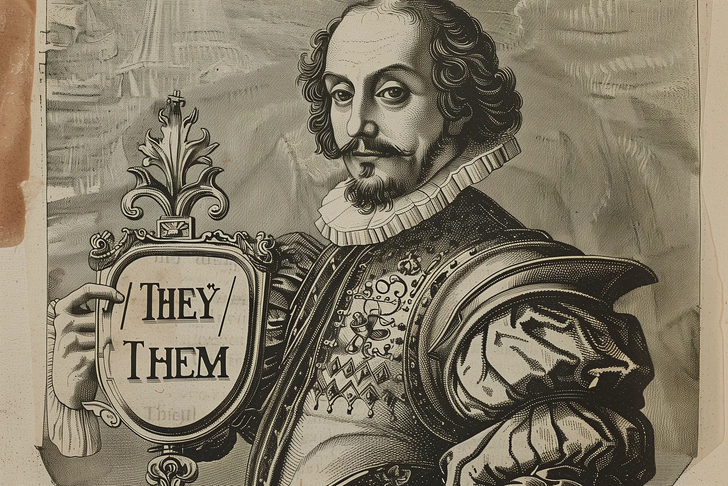
For all the demands of activists that “they” and “them” should be normalised as singular pronouns, very few members of the public have adapted their speech patterns accordingly. Even when the print media started following this odd new craze after Sam Smith declared himself to be “non-binary” in September 2019, the trend simply didn’t catch on.
This is hardly surprising. For one thing, most of the articles that adhere to this creed end up being both syntactically and stylistically incoherent. Take the following excerpt from a review of Judith Butler’s latest book in The Atlantic:
In essence, Butler accuses gender-crits of “phantasmatic” anxieties. They dismiss, with that invocation of a “phantasm”, apprehension about the presence of trans women in women’s single-sex spaces…
At first glance, “they” could appear to be referring to the “gender-crits”, but in this case it refers to Butler. A reader unfamiliar with the subject will inevitably find this confusing. Throughout the article, one is forced to reset one’s reading instincts – cultivated through a lifetime of universally-shared linguistic conventions – and even though the meaning eventually becomes clear, the prose is irredeemably maladroit. In other words, those who accept these new rules must first surrender their capacity to write well.
Of course, we all know that “they” is commonly used in the singular sense in cases of unknown identity. So we might say “Someone has left their car keys here” because we cannot be sure of the sex of the stranger in question. This causes no confusion at all because the sentence automatically conveys the uncertainty. Such colloquial exceptions aside, “they” is simply not used as a singular pronoun among the general population.
While identitarian activists love to dismiss Shakespeare as an irrelevant dead white male, they are happy to invoke him to support their attempts to impose their own modifications to the English language. In almost all articles on the singular “they”, one will find a reference somewhere to Shakespeare. “For decades, transgender rights advocates have noted that literary giants Emily Dickinson, William Shakespeare, William Wordsworth, and Geoffrey Chaucer all used singular they in their writing”, states one writer. “Shakespeare used the singular they, and so should you”, claims another. In the Washington Post, a professor of English writes that “Shakespeare and Austen both used singular “they” … just as many English speakers do now”.
It’s difficult to see how this argument is in any way compelling. Nobody is claiming that language does not evolve. The point is rather that the singular “they” has not caught on in modern usage, in spite of activists’ demands that it should. Are gender identity ideologues really urging us to adopt sixteenth-century language in the name of progress? I have yet to see any of them favouring “thou” as a familiar form of address. They tend to prefer “y’all”, and if this was ever used by Shakespeare I must have missed it.
August 18, 2024
A view of the near future – “What if calling someone stupid was illegal?”
Christopher Gage suspects that Lionel Shriver’s new book Mania didn’t require a lot of deep thinking about possible future trends, just a few glances at the headlines in British newspapers would provide all the inspiration necessary:

Lionel Shriver’s novel, Mania, asks “What if calling someone stupid was illegal?”
Set in an alternate timeline eerily flirtatious with our own, Mania depicts a world in which intelligence and competence, those oppressive agents of the modern bête noire — contrast — provoke outraged mobs.
The Mental Parity Movement demands a Khmer-Rouge-style Year Zero. To suggest the existence of differing abilities and competencies is to be “brain-vain”. In this final “great civil rights fight”, stupidity is euphemised as “alternative processing”. The mob cancels Frasier for brain vanity. After regulations prevent Pfizer from hiring qualified scientists, a toxic vaccine lays waste to millions.
The protagonist, a free-thinking academic named Pearson, cancels herself after she adds Dostoevsky’s The Idiot to her class syllabus. But the book is not the offending item. The word “idiot” is illegal. So too, is the “D-Word”. Pearson falls foul of social services after calling her seven-year-old daughter “dumb”. Her daughter grasses her up for this most heinous offence. For her crimes, Pearson endures a mandatory course entitled “Cerebral Acceptance and Semantic Sensitivity”.
Akin to our culture, mass neurosis devours that of Mania. The citizens scour the earth for evidence of the gravest offence: cognitive bigotry.
The Mental Parity Movement even renames “sage” — stripping the haughty herb of its sapiosexual swagger.
Mania imagines a world in which mediocrity is brilliance and where platitude is profundity. I suspect Shriver wasted little time on research. Turning on one’s television furnishes a commonplace book with a bottomless wealth of material.
This week, Harry and Meghan embarked on an unroyal tour of Colombia. On the agenda was a summit on misinformation and online harm. At this “responsible digital future” fandango, the former soap actress and the former royal spermatozoa relayed their fears. Essentially, hordes of toothless oiks with Wi-Fi often say nasty things online.
On stage, Harry adopted the pose of the modern soothsayer. His tieless open collar oozed Sicilian ease.
Speaking in Adverb English, Harry avoided anything as threatening or as harmful as a declarative sentence. Harry talks as if everything is a question as not to arouse predators. The Prince droned on, auditioning the Californication of his mother tongue. The same mother tongue Harry’s ancestors spread around the globe via what some may deign to be less than inclusive methods.
How can I put this in Mania-approved euphemism? Harry is minimally exceptional. Harry is to intelligent thought what lead pipes are to potable water.
August 15, 2024
QotD: The bitter fruit of deinstitutionalization
Freddie deBoer, “We Closed the Institutions That Housed the Severely Mentally Ill and We Made It Dramatically Harder to Compel Them to Receive Care”, Freddie deBoer, 2024-05-14.
August 13, 2024
Feelings … nothing more than (climate) feelings …
Have you been metaphorically beaten over the head about your climate sins? Your carbon buttprint? You know your very existence is a threat to Mother Gaia, right? Well, Katharina van Bronswijk is worried that you’ll stop listening to the neverending lectures about you and your evil externalities:
Climatism is a political programme bound to a broad social movement. Most of its momentum comes not from The Science or The Experts, but from diffuse cultural forces that we should probably try to understand, if only because they are driving our entire civilisation straight into the ground. Against all advice, I will therefore steer the plague chronicle into this ridiculous quagmire of leftoid green babble, with a look at our first lesson in Unlearnings, namely “Unlearn Repression”.
This superficial and disorganised essay is the work of an infuriating young woman named Katharina van Bronswijk. She’s a psychotherapist best known for her 2022 book, Climate in Our Heads. Fear, Anger, Hope: What the Ecological Crisis is Doing to Us. It belongs to that genre of inevitably unreadable monographs, in which the author herself appears on the cover, looking windswept, pioneering and undaunted:
“Climate feelings” are van Bronswijk’s niche in the extremely crowded enterprise of CO2-bothering. In “Unlearn Repression”, she argues that we should not suppress our negative feelings about climate change, but rather embrace them in constructive ways on behalf of the planet.
Now, van Bronswijk is the kind of deeply unoriginal person who just says the same things over and over. Everything she writes in “Unlearn Repression” flows directly from Climate in our Heads; she’s been digesting, reheating and reworking this same overboiled intellectual artichoke for almost two years now, through various media interviews and even in this English-language TEDx Talk. Throughout this woman’s work is the vague anxiety that the climatists have perhaps overdone it with doom and gloom, and that a lot of people have had enough of hearing about a climate apocalypse that never quite happens.
Van Bronswijk is naturally very dumb, but more than that she is painfully condescending, oblivious, verbose and just awash in litres of estrogen. I defy anyone to read her work and not come away from it a raging misogynist. This odious overpromoted schoolmarm belongs out of sight in a childcare centre teaching young children the alphabet. Perhaps she should also be in a choir, or part of a local environmental club dedicated to collecting litter in parks. That our society has denied van Bronswijk and so many others like her these proper outlets for their instincts and instead pushed them into public activism and intellectual production itself explains a great deal of what is wrong with the world.
“Unlearn Repression” opens with some autobiographical details, because of course everything van Bronswijk talks about is all about van Bronswijk. Like so many Germans of her generation, she was radicalised by school climate propaganda – specifically, by her teacher’s fateful screening of that classic propaganda film, An Inconvenient Truth:
Back then … I was happy for the welcome distraction of watching a film instead of doing normal lessons. But afterwards I was shocked and asked my mum for answers to all the questions and challenges. She didn’t have any solutions for me, how could she? I was alarmed and started to think about the impending consequences of climate change and what could be done about it. I found approaches in newsletters from NGOs and by reading up on animal and environmental protection … That was when my dream bubble burst and I realised: the world is unfair and, unlike all the Disney stories of my childhood, there will be no single hero*ine who saves the world. And there is no magical or technical miracle solution either.
Al Gore’s film so terrified the young van Bronswijk, that for a while she retreated into conspiratorial theories about why climate change is not happening, which qualifies our crayon psychotherapist to pronounce upon the psychology of those who deny the climate. This deeply evil and irrational movement is driven primarily by “white men”, because they “still enjoy most of the privileges in our society, and therefore have the most to lose”.

Taboo by Eric Kaufmann
In Quillette, John Lloyd reviews Eric Kaufmann’s Taboo:How Making Race Sacred Produced a Cultural Revolution:
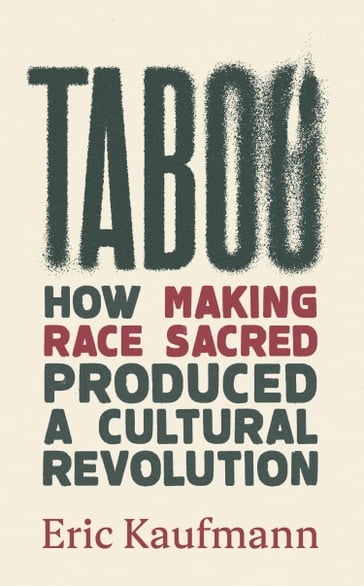
Earlier this year, Eric Kaufmann, a Canadian professor of political science, left Birkbeck College in the University of London where he had taught for twenty years. He was also head of the political science department there, and already had a number of deeply researched books behind him. But neither long service, departmental prominence, nor publishing success offered much of a defence against three separate attempts to cancel him. Indeed, his 2018 book Whiteshift told against him, since it argued, inter alia, that white majorities should have as much right to protect their identity and culture as minorities, a position now perceived by some as evidence of racism. “Repressing white identity as racist”, he wrote, “and demonising the white past, adds insult to the injury of this group’s demographic decline. This way lies growing populist discontent, or even terrorism.”
During the first part of his career, Kaufmann mostly kept his conservative views to himself, and with good reason. When he revealed them in Whiteshift, he became a marked man and spent several years fending off persistent efforts to strip him of his job and livelihood. His academic colleagues were generally unsupportive, and some of them participated in the campaign against him. So, he left Birkbeck for the University of Buckingham, the first of a small clutch of private universities created since the 1970s with the enthusiastic backing of Prime Minister Margaret Thatcher. Buckingham takes pride in rejecting leftist monoculture in favour of an approach that privileges open debate without the risk of career obliteration.
These days, Kaufmann is — as the Scots saying goes — a “bonnie hater” (or what others might call a “happy warrior”). With his new book, he joins the best of those (disproportionately American) writers, journalists, and politicians alarmed by the activities of ideologically motivated individuals and organisations operating under the vague umbrella term “wokeism”. This inchoate movement, Kaufmann maintains, is deeply destructive of freedom (and of freedom of speech in particular), learning, virtue, public morality, patriotism, and emotional continence. It is, Kaufman recently told the Daily Mail, an “Orwellian threat to the [E]nlightenment — free speech, equal treatment, due process, objective scientific truth. I believe this new woke ideology threatens the foundations of our civilisation.”
Wearying of the years of harassment he received for his views (none of which, he stresses, was ever physical), Kaufmann moved to Buckingham. He wanted to take advantage of the opportunity to establish a Centre for Heterodox Sociology where progressive doctrines could be studied, dissected, and debated, a pursuit he believes would be impossible anywhere else. Buckingham received first prize for free speech in last year’s National Student Survey. It will now be required to live up to that distinction, since Kaufman’s approach — after many years spent avoiding conflict — has become direct and uncompromising. Any determined left-leaning student or scholar would find this an intolerable provocation — a display of prejudice and bigotry meriting expulsion from the scholarly body lest it spread to innocent souls insufficiently prepared to counter it.
The list of progressive doctrines Kaufmann has compiled to define “wokeism” is probably the most comprehensive assembled to date. Much of what concerns him most relates to education. He believes that higher education, in particular, has become a place of inflexible dogmas on race, gender, emotional fragility, and anti-white bias rather than a home of serious study, reflection, and discussion. But he does not believe—as many other critics of contemporary progressivism do—that this is a kind of warmed-over Marxism, in which the fragile student has taken the place of the exploited proletarian. Instead, progressivism’s concern for the outnumbered, the vulnerable, and the frail can be traced back to Christ’s teachings, and especially to his Sermon on the Mount reported in Matthew 5:5: “Blessed are the meek, for they shall inherit the earth.” This injunction is now marshalled into a secular hallowing of blacks (above all), Muslims, women, and LGBT individuals.
Kaufmann calls the upshot of this genealogy “cultural socialism” — a movement that privileges equality, but equality of outcome not merely opportunity. He points to a speech that US president Lyndon Johnson delivered to students at the historically black Howard University in 1965, in which Johnson claimed that “we seek not just equality as a right and a theory, but equality as a fact and equality as a result”. Suddenly, Kaufmann remarks, “the door was open to restricting liberty and equal treatment in the name of achieving ‘equality of result’.” Such a regime, he points out, will inevitably disincentivise effort and excellence. Why forgo pleasure to work hard when the dedicated and indolent alike will all be made equal in the end? It’s worth remarking, however, that socialism does not necessarily provide the low road to unequal equality. Kaufmann quotes the historian Eric Hobsbawm — an unapologetic communist until he died in 2012 — who insisted that privileging one group over another will destroy society by breaking it into mutually hostile communities.


