Quotulatiousness

February 6, 2020

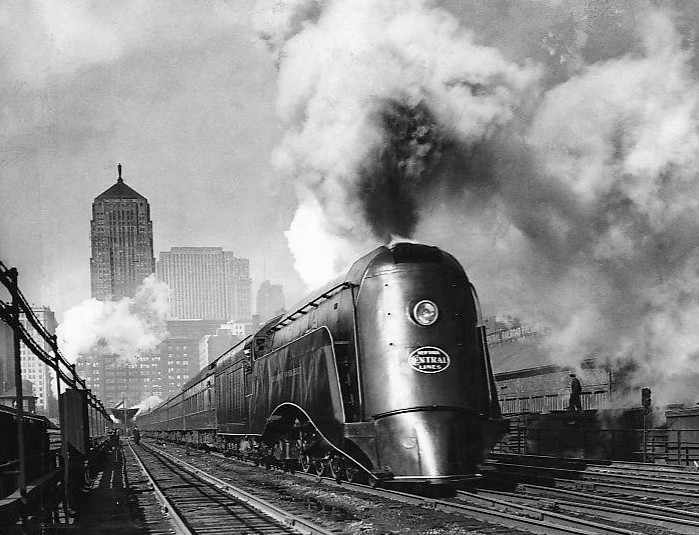
Fallen flag – The Nickel Plate Road

Filed under: Business, History, Railways, USA — Tags: , , , — Nicholas @ 03:00

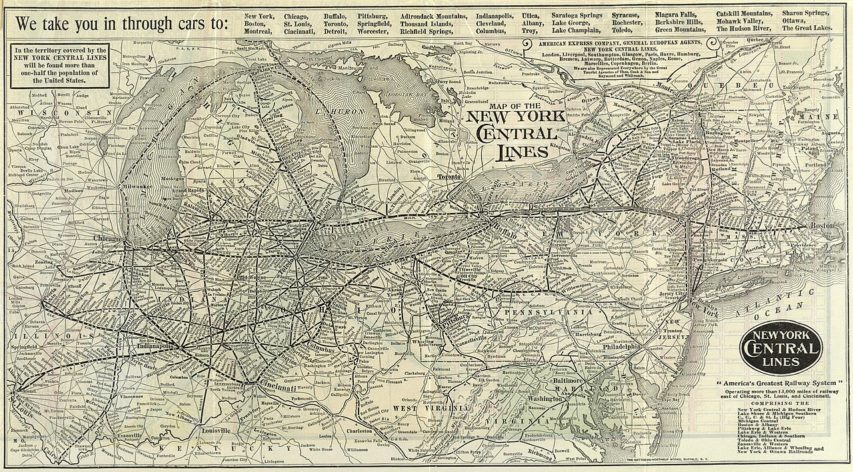
Kevin J. Holland provides a brief look at the history of the New York, Chicago & St. Louis, better known as the “Nickel Plate Road”:

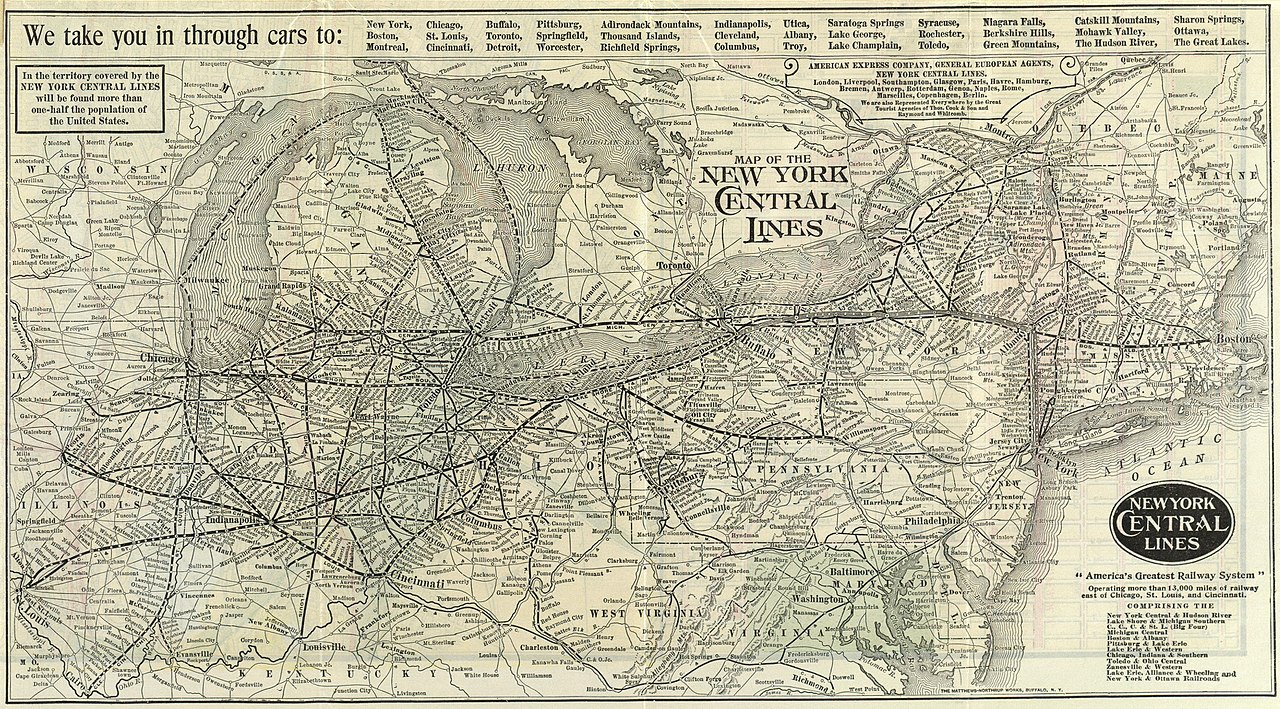
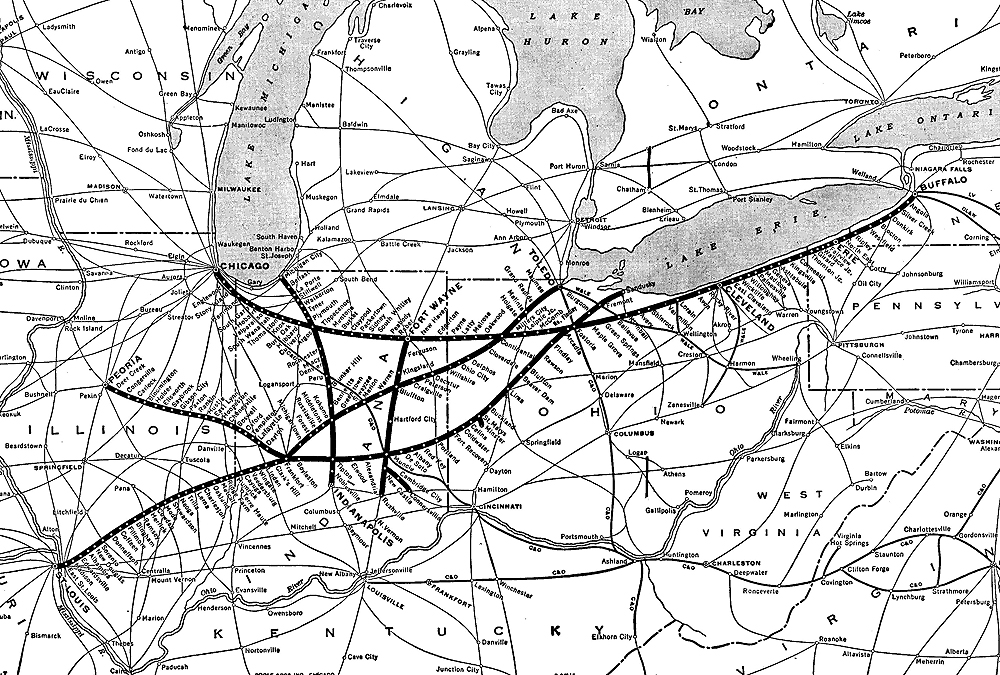
The New York, Chicago & St. Louis opened between Buffalo and Chicago on October 23, 1882, in many spots east of Cleveland just a stone’s throw from rival Lake Shore & Michigan Southern Railway. What would become the Nickel Plate became a Vanderbilt property in January 1883.

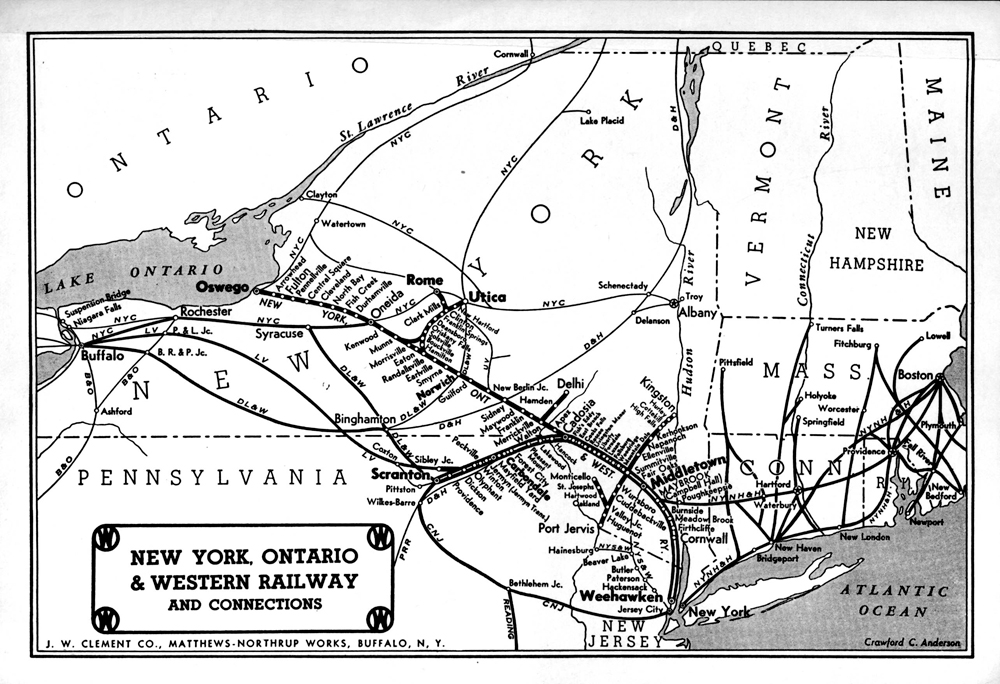
Although eclipsed by the Lake Shore’s plush limiteds, NYC&StL from 1893 fielded three unpretentious, reliable Chicago to Buffalo, N.Y., passenger trains, establishing a long-standing pattern of modest passenger service. In 1897, Delaware, Lackawanna & Western entered the picture, conveying NYC&StL cars from Buffalo to Hoboken, N.J.

“The great … Nickel-plated railroad”
When NYC&StL was being surveyed, Editor F. R. Loomis of Ohio’s Norwalk Chronicle waxed enthusiastically on the railroad coming to town referring to it as “the great New York and St. Louis double-track, nickel-plated railroad.” Use of “Nickel Plate Road” proliferated, in newspapers and by the road itself.

In 1914, LS&MS and Nickel Plate were wards of New York Central. Passage of the Clayton Act that same year was intended to bolster the earlier Sherman Antitrust Act, and left NYC with a dilemma. Enter brothers Oris P. and Mantis J. Van Sweringen, self-made Cleveland real-estate developers who purchased acreage from NYC Vice President Alfred H. Smith. “The Vans” as the brothers were known, approached Smith, by then NYC president, to discuss their plans involving land owned by the Nickel Plate. As the Clayton Act’s divestiture deadline loomed, Smith engineered a sale to the Vans of not only the land they sought, but of the entire Nickel Plate Road. Their Alleghany Corporation holding company eventually in­­cluded control of the Nickel Plate, Chesapeake & Ohio, Pere Marquette, Erie, Wheeling & Lake Erie, Chicago & Eastern Illinois, and Missouri Pacific.

The gaunt NYC&StL was ripe for re-equipping under its new owners. Addressing the Vans’ lack of railroad experience, Smith orchestrated John J. Bernet’s move from an NYC vice-presidency to be Nickel Plate’s president. Neglected physical plant and obsolete motive power received needed attention under Bernet, who reincarnated the road into a lean and aggressive contender.

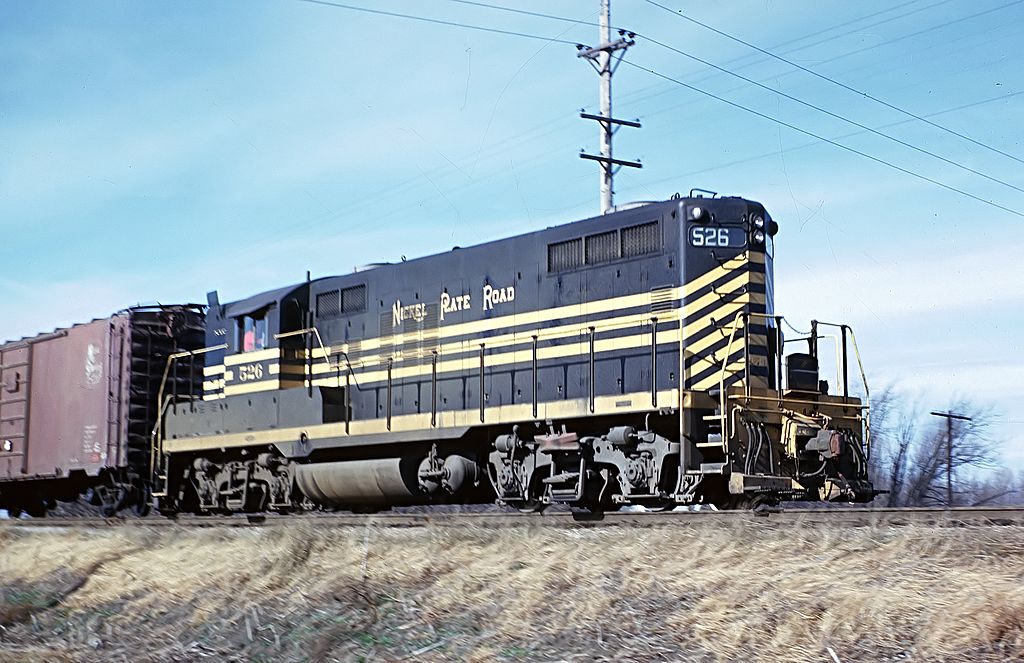
Nickel Plate Road GP9 number 526 switching a way freight at Gibson City, IL on November 24, 1962.
Roger Puta photo from the Mel Finzer Collection via Wikimedia Commons.

January 3, 2020

Fallen flag – the Pennsylvania Railroad

Filed under: Business, History, Railways, USA — Tags: , , , , — Nicholas @ 05:00

The origins and an outline history of the “Standard Railroad of the World” for Classic Trains magazine by George Drury:

The original Pennsylvania Railroad ran from Philadelphia to Pittsburgh. Much of its subsequent expansion was accomplished by leasing or purchasing other railroads.

Construction began in 1847. Two years later the Pennsy made an operating contract with the Harrisburg, Portsmouth, Mountjoy & Lancaster, and by late 1852 rails ran from Philadelphia to Pittsburgh via a connection with the Portage Railroad between Hollidaysburg and Johnstown, Pa. The summit tunnel was opened in 1854, bypassing the inclined planes and creating a continuous railroad from Harrisburg to Pittsburgh.

In 1857 PRR bought the Main Line of Public Works and in 1861 leased the Harrisburg, Portsmouth, Mountjoy & Lancaster, putting the entire Philadelphia to Pittsburgh line under one management.

PRR also acquired interests in two major railroads, the Cumberland Valley and the Northern Central. The Cumberland Valley was opened in 1837 from Harrisburg to Chambersburg, and it was extended by another company in 1841 to Hagerstown, Maryland. The Baltimore & Susquehanna was incorporated in 1828 to build north from Baltimore. Progress was slowed because of the reluctance of Pennsylvania state officials to charter a railroad that would carry commerce to Baltimore. The line reached Harrisburg in 1851 and Sunbury in 1858. By then the railroad companies that formed the route had been consolidated as the Northern Central Railway. Pennsy acquired majority ownership of the Northern Central in 1900.

The Pennsy expanded into northwestern Pennsylvania by acquiring an interest in the Philadelphia & Erie Railroad in 1862 and assisting that road to complete its line from Sunbury to the city of Erie in 1864. The line to Erie was not particularly successful, but from Sunbury to Driftwood it could serve as part of a freight route with easy grades. The rest of that route was the Allegheny Valley Railroad, conceived as a feeder from Pittsburgh to the New York Central and Erie railroads. The Pennsylvania obtained control in 1868, and in 1874 opened a route with easy grades from Harrisburg to Pittsburgh via the valleys of the Susquehanna and Allegheny rivers. PRR leased the Allegheny Valley Railroad in 1900.

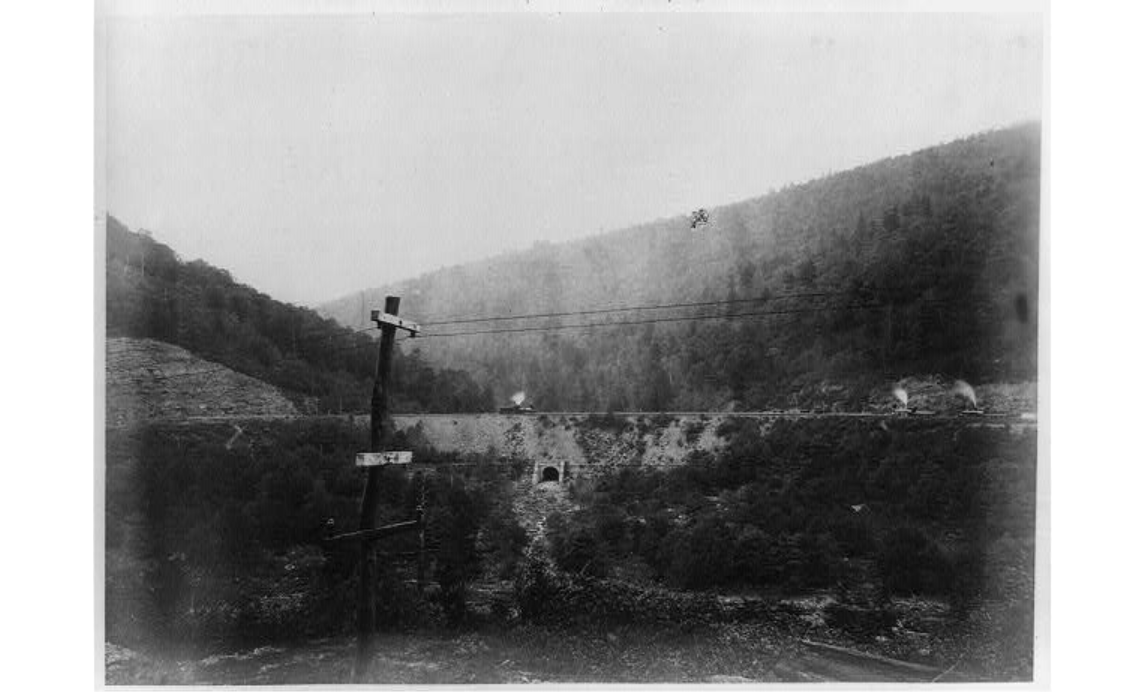
Horse shoe curve near Altoona on the Pennsylvania Railroad, circa 1874.
Photo by W.P. Mange & Co. via the Library of Congress.

But even the mighty can fall, and the PRR fell into difficult times after WW2:

During World War II Pennsy’s freight traffic doubled and passenger traffic quadrupled, much of it on the eastern portion of the system. The electrification was of inestimable value in keeping the traffic moving. After the war Pennsy had the same experiences as many other railroads but seemed slower to react. PRR was slower to dieselize, and when it did so it bought units from every manufacturer.

As freight and passenger traffic moved to the highways, Pennsy found itself with far more fixed plant than the traffic warranted or could support, and it was slow to take up excess trackage or replace double track with Centralized Traffic Control.

PRR was saddled with a heavy passenger business. It had extensive commuter services centered on New York, Philadelphia, and Pittsburgh and lesser ones at Chicago, Washington, Baltimore, and Camden, New Jersey. It had gone through the Depression without going bankrupt.

Pennsylvania and New York Central surprised the railroad industry by announcing merger plans in 1957. The two had long been rivals, and the merger would be one of parallel roads rather than end-to-end. The merger took place on February 1, 1968 — and Penn Central fell apart faster than it went together.

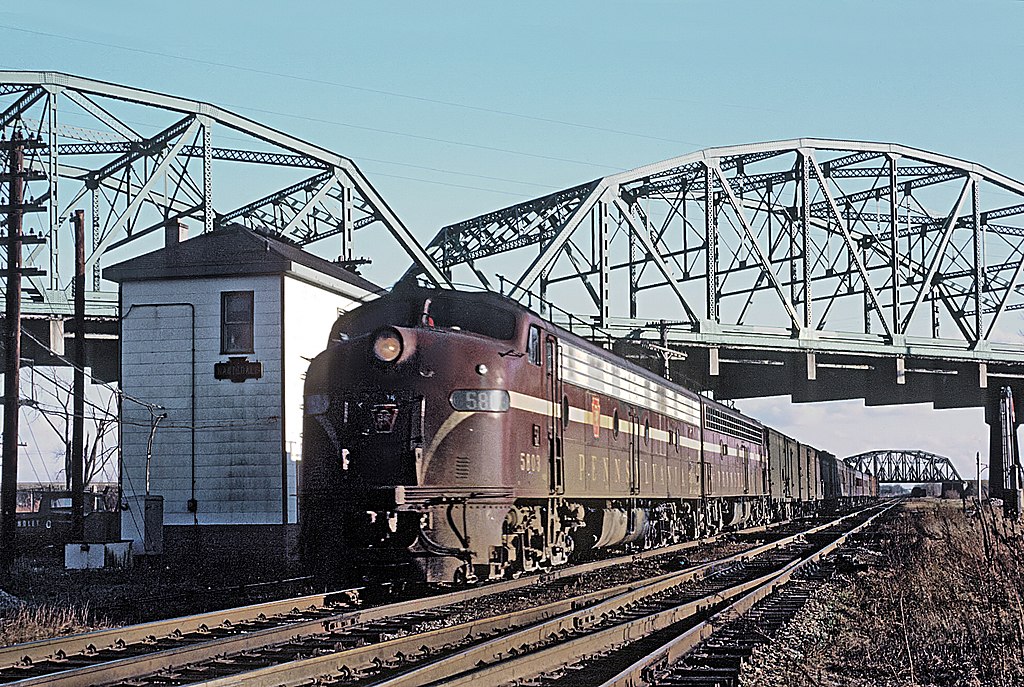
PRR E8A 5803 with Train 72, The Red Bird, passing the Hartsdale, Indiana tower and crossing the NYC and EJ&E on November 26, 1965.
Photo from the Roger Puta collection via Wikimedia Commons.

December 25, 2019

Repost – “Fairytale of New York”

Filed under: Media, USA — Tags: , , , — Nicholas @ 02:00

Time:

“Fairytale of New York,” The Pogues featuring Kirsty MacColl

This song came into being after Elvis Costello bet The Pogues’ lead singer Shane MacGowan that he couldn’t write a decent Christmas duet. The outcome: a call-and-response between a bickering couple that’s just as sweet as it is salty.

December 5, 2019

The New York Central in 1928-1929

Filed under: History, Railways, USA — Tags: , , — Nicholas @ 02:00

Speed Graphic Film and Video
Published 22 Dec 2017

More early sound film from the Fox Movietone News archives in the University of South Carolina’s Moving Image Resource Collection.

It shows New York Central trains in the Hudson River valley in 1928 and 1929. Scenes include:
0:10 K3 Pacifics passing through Peekskill station.
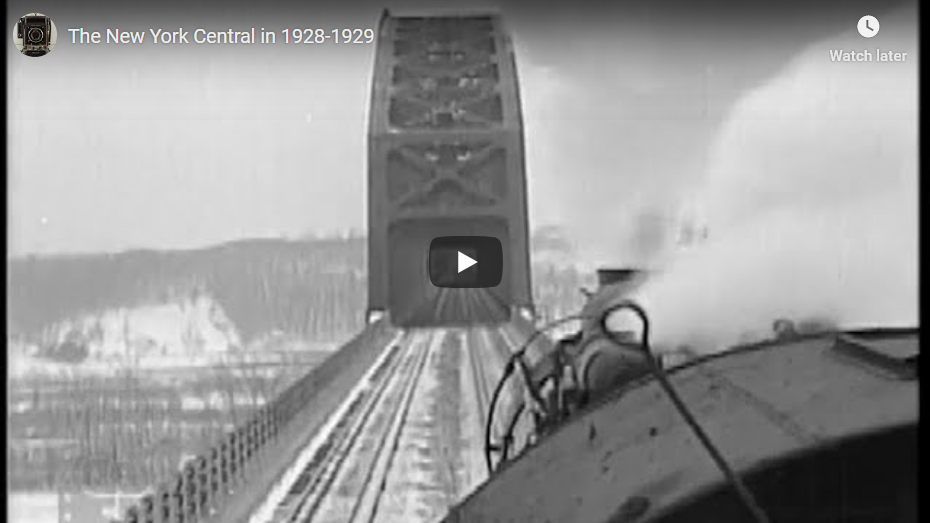
1:10 View from the tender as a fast freight crosses the bridge at Castleton.
2:30 Looking up at the bridge as a train passes over.
2:42 Another ride over the bridge at Castleton, this time seen from the caboose. There is a brief glimpse of NYC 0-6-6-0 No. 1300, the only locomotive with that wheel arrangement on the railroad.
4:54 View from a bluff above the Weehawken yards. (Thanks to Vincent Zablocki for the ID.)
5:30 Street operations on the West Side Line in Manhattan when it still ran at street level. Locomotives seen include No. 595 and dummy No. 1904.
7:33 A look at the drivers as a K3 Pacific passes by the camera.
8:21 Passenger trains on the main line, seen at a distance. These are editing “trims,” so the shot ends just as the train gets near the camera. These were probably taken at Breakneck Mountain.
11:19 Departing passenger train at a grade crossing. Again, this is a “trim,” so the beginning of the shot is missing.

June 19, 2019

Summer Stupidity: NEW YORK (City Review!)

Filed under: Food, Humour, USA — Tags: , , , — Nicholas @ 04:00

Overly Sarcastic Productions
Published on 18 Jun 2019

Welcome to summer break! We’re beta-testing a new kind of video to punctuate our REAL weekly Friday content on lazy summer Tuesdays. Let us know if this brand of fast-talking stupidity is something you’d potentially like to see more of! As always, regular content returns Friday.

PATREON: http://www.Patreon.com/OSP

March 10, 2019

Irish Potato Famine – The American Wake – Extra History – #4

Filed under: Britain, Cancon, Food, History, Religion, USA — Tags: , , , , , — Nicholas @ 06:00

Extra Credits
Published on 9 Mar 2019

Not all of the 214,000 Irish immigrants in 1847 made it safely to their new homes — and of those who did, many faced classism and xenophobia and even bullying from the “Ulster Irish” or “Scots-Irish” folks who had previously established themselves. In New York City specifically, the Five Points neighborhood became an infamous center of conflict — while local Irish-American John Joseph Hughes became instrumental in restoring Irish Catholicism.

Join us on Patreon! http://bit.ly/EHPatreon

February 25, 2019

“Alexandria Ocasio-Cortez [is] doing for America what Jeremy Corbyn has done for Britain”

Filed under: Economics, Media, Politics, USA — Tags: , , , , , , — Nicholas @ 05:00

Alex Noble sings the praises of Alexandria Ocasio-Cortez as she does the heavy lifting to bring awareness of socialism to the American people:

Alexandria Ocasio-Cortez speaking at the Reardon Convention Center in Kansas City, on 20 July 2018.
Photo by Mark Dillman via Wikimedia Commons.

Good old Alexandria Ocasio-Cortez – she’s doing for America what Jeremy Corbyn has done for Britain. Much to the dismay of the secret socialists now entrenched in the Democrat Party, she is stripping away the protective layer of bullshit that socialism normally has to rely upon to keep people from understanding its inherent failings, and is thus laying it bare before the world.

Because she is too ignorant to understand them – she actually believes in socialism, and thinks that if only it is adequately explained to the rest of us, we will love it as she does.

She doesn’t know enough history to know that everyone over the age of forty has seen socialism tried a dozen times in their lifetimes. Her sales pitch is wasted on us – we’ve seen the results before.

So when she told Amazon that their particular brand of crony capitalism was not welcome in New York, she genuinely thought people would admire her.

Instead, even the crony capitalists on the Democrat side of the aisle (i.e those who understand how the game is really played) are very upset with her – she has driven away 25,000 jobs and all the votes economic benefits that would have flowed from them.

All because she thinks Amazon should pay more corporation tax.

February 4, 2019

QotD: Brasilia and reconciling with Jane Jacobs

Filed under: Architecture, History, Quotations, USA — Tags: , , , , , , — Nicholas @ 01:00

Brasilia is interesting only insofar as it was an entire High Modernist planned city. In most places, the Modernists rarely got their hands on entire cities at once. They did build a number of suburbs, neighborhoods, and apartment buildings. There was, however, a disconnect. Most people did not want to buy a High Modernist house or live in a High Modernist neighborhood. Most governments did want to fund High Modernist houses and neighborhoods, because the academics influencing them said it was the modern scientific rational thing to do. So in the end, one of High Modernists’ main contributions to the United States was the projects – ie government-funded public housing for poor people who didn’t get to choose where to live.

I never really “got” Jane Jacobs. I originally interpreted her as arguing that it was great for cities to be noisy and busy and full of crowds, and that we should build neighborhoods that are confusing and hard to get through to force people to interact with each other and prevent them from being able to have privacy, and no one should be allowed to live anywhere quiet or nice. As somebody who (thanks to the public school system, etc) has had my share of being forced to interact with people, and of being placed in situations where it is deliberately difficult to have any privacy or time to myself, I figured Jane Jacobs was just a jerk.

But Scott has kind of made me come around. He rehabilitates her as someone who was responding to the very real excesses of High Modernism. She was the first person who really said “Hey, maybe people like being in cute little neighborhoods”. Her complaint wasn’t really against privacy or order per se as it was against extreme High Modernist perversions of those concepts that people empirically hated. And her background makes this all too understandable – she started out as a journalist covering poor African-Americans who lived in the projects and had some of the same complaints as Brazilians.

Her critique of Le Corbusierism was mostly what you would expect, but Scott extracts some points useful for their contrast with the Modernist points earlier:

First, existing structures are evolved organisms built by people trying to satisfy their social goals. They contain far more wisdom about people’s needs and desires than anybody could formally enumerate. Any attempt at urban planning should try to build on this encoded knowledge, not detract from it.

Second, man does not live by bread alone. People don’t want the right amount of Standardized Food Product, they want social interaction, culture, art, coziness, and a host of other things nobody will ever be able to calculate. Existing structures have already been optimized for these things, and unlesss you’re really sure you understand all of them, you should be reluctant to disturb them.

Third, solutions are local. Americans want different things than Africans or Indians. One proof of this is that New York looks different from Lagos and from Delhi. Even if you are the world’s best American city planner, you should be very concerned that you have no idea what people in Africa need, and you should be very reluctant to design an African city without extensive consultation of people who understand the local environment.

Fourth, even a very smart and well-intentioned person who is on board with points 1-3 will never be able to produce a set of rules. Most of people’s knowledge is implicit, and most rule codes are quickly replaced by informal systems of things that work which are much more effective (the classic example of this is work-to-rule strikes).

Fifth, although well-educated technocrats may understand principles which give them some advantages in their domain, they are hopeless without the on-the-ground experience of the people they are trying to serve, whose years of living in their environment and dealing with it every day have given them a deep practical knowledge which is difficult to codify.

How did Jacobs herself choose where to live? As per her Wikipedia page:

    [Jacobs] took an immediate liking to Manhattan’s Greenwich Village, which did not conform to the city’s grid structure.

Scott Alexander, “Book Review: Seeing Like a State”, Slate Star Codex, 2017-03-16.

January 5, 2019

Leave the Strand Alone! Iconic Bookstore Owner Pleads With NYC: Don’t Landmark My Property

Filed under: Architecture, Books, Bureaucracy, Business, Government, USA — Tags: , , — Nicholas @ 04:00

ReasonTV
Published on 4 Jan 2019

Leave the Strand Alone! Iconic Bookstore Owner Pleads With NYC: Don’t Landmark My Property

More from the article at Reason:

If New York City moves ahead with a proposal to landmark the home of the Strand Book Store, it would be putting a “bureaucratic noose” around the business, says owner Nancy Bass Wyden. “The Strand survived through my dad and grandfather’s very hard work,” Wyden says, and now the city wants to “take a piece of it.”

Opened by her grandfather, Benjamin Bass, in 1927, the Strand is New York City’s last great bookstore — a four-story literary emporium crammed with 18 miles of merchandise stuffed into towering bookcases arranged along narrow passageways. It’s the last survivor of the world-famous Booksellers Row, a commercial district comprised of about 40 secondhand dealers along Fourth Avenue below Union Square.

On December 4, 2018, the New York City Landmarks Preservation Commission held a public hearing on a proposal to designate the building that’s home to the Strand as a historic site. If the structure is landmarked, Wyden would need to get permission from the city before renovating the interior or altering the facade.

“It would be very difficult to be commercially nimble if we’re landmarked,” Wyden tells Reason. “We’d have to get approvals through a whole committee and bureaucracy that do not know how to run a bookstore.”

Wyden’s outrage derives in part from her family’s decades of struggle to keep the business alive.

The Strand survived, she says, because of “my grandfather and my dad’s very hard work and their passion … Both worked most of their lives six days a week” and they “hardly took vacations.”

December 25, 2018

Repost – “Fairytale of New York”

Filed under: Media, USA — Tags: , , , — Nicholas @ 02:00

Time:

“Fairytale of New York,” The Pogues featuring Kirsty MacColl

This song came into being after Elvis Costello bet The Pogues’ lead singer Shane MacGowan that he couldn’t write a decent Christmas duet. The outcome: a call-and-response between a bickering couple that’s just as sweet as it is salty.

October 29, 2018

The $15 Minimum Wage Is Turning Hard Workers Into Black Market Lawbreakers

Filed under: Business, Economics, USA — Tags: , , , , — Nicholas @ 02:00

ReasonTV
Published on 11 Oct 2018

An in-depth look at New York’s car wash industry, and the real world consequences of politicians interfering with a complex industry they don’t understand.

Reason is the planet’s leading source of news, politics, and culture from a libertarian perspective. Go to reason.com for a point of view you won’t get from legacy media and old left-right opinion magazines.

—————-

On March 4, 2015, a group of union leaders, activists, and elected officials were arrested for blocking traffic during a protest in front of a Vegas Auto Spa, a small car wash in Park Slope, Brooklyn. Chanting “No contract, no peace!” and “Si se puede!,” they had come in support of striking workers, who had walked out demanding a union contract after allegedly being subjected to dismal working conditions.

For David Mertz, the New York City director and a vice president at the Retail, Wholesale and Department Store Union (RWDSU), it was an inspirational moment in an ambitious six-year campaign to unionize the city’s car washes industry.

“These workers were willing to stand out there during one of the coldest winters … literally in decades to fight for their rights and for basic human dignity,” says Mertz, who was also arrested that day. “You have the ability to make change by coming together, and when you do that sometimes you find that you’ve got some friends on your side.”

In the past six years, the car wash industry, which employs low-skilled, mostly immigrant workers, has also been the target of lawsuits for alleged underpayment of wages, including a handful of cases spearheaded by the New York State Attorney General’s office. Working conditions in the industry were also cited as a raison d’être in the successful campaign to raise the state minimum wage to $15 per hour, which takes full effect at New York City car washes in January of 2019.

As Reason chronicled in a feature story in our July 2016 issue, the real world impact of the unionization drive, the lawsuits, and the $15 minimum wage has been mainly to push car washes to automate and to close down.

Two years later, there are more unintended consequences. The $15 minimum wage is fostering a growing black market—workers increasingly have no choice but to ply their trade out of illegal vans parked on the street, because the minimum wage has made it illegal for anyone to hire them at the market rate.

The minimum wage is also cartelizing the industry: Businesses that have chosen to automate are benefiting from the $15 wage floor because outlawing cheap labor makes it harder for new competitors to undercut them on price and service.

As a sequel to the 2016 article, this video takes an in-depth look at the real world consequences that result when politicians interfere with a complex industry they don’t understand, enabled by media coverage that rarely questions the overly simplistic tale of exploited workers in need of protection.

Written, shot, edited, and narrated by Jim Epstein.

October 22, 2018

Vikings beat New York Jets, 37-17

Filed under: Football — Tags: , , , — Nicholas @ 05:00

On Sunday afternoon, the Minnesota Vikings visited New Jersey to play the 3-3 Jets and rookie quarterback Sam Darnold. I don’t think Darnold enjoyed his afternoon, racking up stats of 16 of 41 fpr 195 yards and three interceptions. Vikings wide receiver Adam Thielen tied a long-standing NFL record with his seventh 100-yard game to start the season.

The New York Jets lost out on Kirk Cousins in March. On Sunday, they lost to him.

Cousins, who considered the Jets in free agency before signing with the Vikings, led to Minnesota to a 37-17 victory at MetLife Stadium.

On a chilly day, with the wind blowing 16 mph at kickoff, Cousins completed 25 of 41 passes for 241 yards and two touchdowns. He threw touchdowns of 34 yards to Adam Thielen in the first quarter and 34 yards to Aldrick Robinson in the fourth.

Thielen caught nine passes for 110 yards, his seventh straight game of 100 yards receiving or more to start the season. That tied the NFL record set by Charlie Hennigan of the Houston Oilers in 1961.

Vikings running back Latavius Murray had 15 carries for 69 yards and two touchdowns. He scored on runs of 11 yards in the third quarter and 38 yards in the fourth. Murray’s second score gave the Vikings a safe 27-10 lead.

With the win, the Vikings (4-2-1) moved into first place in the NFC North.

(more…)

June 26, 2018

Henry Johnson And The Harlem Hellfighters I WHO DID WHAT IN WW1?

Filed under: France, Germany, History, Military, USA, WW1 — Tags: , , , — Nicholas @ 04:00

The Great War
Published on 25 Jun 2018

The 369th Infantry Regiment from Harlem, New York was an all-black unit that served on the Western Front. But not under American command, but loaned tot he French Army.

May 17, 2018

Tom Wolfe “would spend the rest of his days in a golden cage of a book deal”

Filed under: Books, Media, USA — Tags: , , , — Nicholas @ 03:00

In the National Post Colby Cosh explains why Tom Wolfe was so significant in the literary world almost from his first published work:

… Tom Wolfe was an educated man: unlike any of the macho novelists he was sparring with, he was entitled to adjoin an honest-to-God PhD to his byline. In the end, he could not escape the prejudices imprinted on him in youth. It is a truth universally acknowledged: a prose artist must excrete a novel to demonstrate his true mettle.

Wolfe described it this way himself in a 2008 interview. “Originally, I was only going to write one novel, to prove to myself and any random doubters that I could do it.” “Random doubters” sounds so dismissive and calm until you remember the amount of work Wolfe was proposing to undertake in order to impress them. He continued: “But that novel, The Bonfire of the Vanities, was such an astounding success… I’m afraid I got swept away.”

Wolfe, I suppose, was too well-raised to utter the word “money” in front of an interviewer. (The explicit subject of all his work, his journalism and fiction, is social status: but social status and money do travel together mighty closely.) Bonfire (1987) became one of the publishing events of the epoch, and he would spend the rest of his days in a golden cage of a book deal. The dabbler in the novel had proved too much: he had proved that the novel really is still in a class by itself as a social phenomenon.

More novels in the vein of Bonfire — deeply researched, socially prescient, full of truculent conservative squareness — followed. I myself would not trade The Right Stuff, Wolfe’s 1979 nonfiction book about the Mercury astronauts, for the whole pile, Bonfire included. (And I say this knowing full well that there is some quantum of sheer bull in The Right Stuff.)

Wolfe continued to insist, returning to the interview already mentioned, that “Nonfiction remains the most important literary genre in American literature of the past 60 years.” He still, 20 years on from Bonfire, felt the need to half-apologize for abandoning non-fiction. My instinct is that it was indeed a mistake, but I am only a consumer of Wolfe, looking back at the corpus from without: none of us readers had to meet Wolfe’s dry-cleaning bills.

April 9, 2018

The Triangle Shirtwaist Fire – Horror in Manhattan – Extra History

Filed under: History, USA — Tags: , , , , , — Nicholas @ 04:00

Extra Credits
Published on 7 Apr 2018

A throwaway cigarette landed on a pile of cloth. 146 workers died from the resulting fire. But this tragedy motivated citizens and politicians to take a stand from workers’ rights, creating a far safer world that we still live in over a century later.

« Newer PostsOlder Posts »

Powered by WordPress