
Quotulatiousness

May 16, 2012

Thomas Mulcair: your “go-to guy [for] cockamamie wheels-within-wheels theor[ies]”

Filed under: Cancon, Media, Politics — Tags: , , , , — Nicholas @ 10:24

In Maclean’s, Paul Wells gets in a small dig at Stephen Harper before unloading on Thomas Mulcair:

Before I make a bit more fun of Mulcair, and then try to take some of his arguments seriously, I should first stipulate that the Harper government is fully capable of childish absurdity on the energy/environment front. Indeed I think the confrontation between resource exports and environmental activism is turning into less of a slam-dunk political winner for Harper than he seemed to think in the New Year.

But we see two longstanding Mulcair traits in his remarks. First, a kind of Byzantine certainty. Not just that he knows what’s going on, but inevitably that what’s going on is so complex that only a fellow such as he can grasp its intricacy. Journalists have known for a long time that Mulcair was their go-to guy for some cockamamie wheels-within-wheels theory about his opponents’ motives and actions. It cannot possibly be that Alison Redford, Christy Clark and Brad Wall simply disagree with Mulcair, or even that they don’t care whether he’s right but are playing to different electorates. No, they say what they say because they are in league with Harper against him. Mulcair surely knows Christy Clark’s chief of staff, Ken Boessenkool, helped script Harper’s winning 2006 campaign. If he didn’t know that Brad Wall’s former environment minister, Nancy Heppner, worked in Harper’s PMO for a year after that campaign, he knows it now and will take great satisfaction in tucking it away for future use. See? She’s the go-between. I knew it.

The notion that Alison Redford is Harper’s preferred Alberta premier, or that she scans the skies at night for the light from the Harpsignal, is harder to square with the available data, but whatever. On to the second Mulcair characteristic: the belief that disagreement is synonymous with illegitimate attack against him. You will tell me that’s hardly unique. You’ll be right. Just look at the prime minister. But now we know Mulcair is no more immune from the garden-variety political martyr complex. Wells would write crap like “martyr complex.” He’s from Maclean’s. They hate me.

May 8, 2012

Absurd meme of the month: that European countries have imposed draconian fiscal austerity

Filed under: Economics, Europe, Government, Media — Tags: , , , , — Nicholas @ 11:00

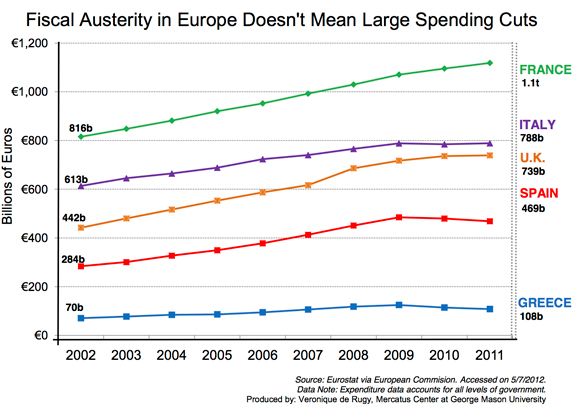
For all the gasping about the impact of fiscal austerity on weakened European economies, it’s hard to detect from the actual numbers:


(Image from the Mercatus Center)

See all those coloured lines dropping precipitously? Me neither.

Veronique de Rugy asks where the “savage” spending cuts can be seen:

Austerity is destroying Europe, we are told. In fact, this “anti-austerity” slogan was a big reason for the victory of newly elected socialist François Hollande to the presidency of France. Interviewed in The Economist a few weeks ago, Hollande’s campaign director said “We are not disciples of savage spending cuts.”

But then, I look at the data and I am asking: What “savage” spending cuts?

Look at [the chart above]. It is based on Eurostat data which you can find here. Following years of large spending increases, Spain, the United Kingdom, France, and Greece — countries widely cited for adopting austerity measures — haven’t significantly reduced spending since 2008. As you can see on this chart:

  • These countries still spend more than pre-recession levels
  • France and the U.K. did not cut spending.
  • In Greece, and Spain, when spending was actually reduced — between 2009–2011 — the cuts have been relatively small compared to what is needed. Also, meaningful structural reforms were seldom implemented.
  • As for Italy, the country reduced spending between 2009 and 2010 but the data shows and uptick in spending 2011. The increase in spending represents more than the previous reduction.

In addition to failing to curb spending, several governments have raised taxes (which has a negative effect on growth in the economy and can — contrary to popular wisdom — actually reduce the total tax collected as people and companies change their habits to minimize the impact of the tax change).

May 6, 2012

The free speech baby with the Citizens United bathwater

Filed under: Government, Law, Liberty, Media, USA — Tags: , , , , , , — Nicholas @ 10:32

George Will on the rather impressive sweep of a new proposal to circumvent the US Supreme Court’s decision in Citizens United:

Now comes Rep. Jim McGovern, D-Mass., with a comparable contribution to another debate, the one concerning government regulation of political speech. Joined by Minority Leader Nancy Pelosi, 26 other Democrats and one Republican, he proposes a constitutional amendment to radically contract First Amendment protections. His purpose is to vastly expand government’s power — i.e., the power of incumbent legislators — to write laws regulating, rationing or even proscribing speech in elections that determine the composition of the legislature and the rest of the government. McGovern’s proposal vindicates those who say most campaign-finance “reforms” are incompatible with the First Amendment.

His “People’s Rights Amendment” declares that the Constitution protects only the rights of “natural persons,” not such persons organized in corporations, and that Congress can impose on corporations whatever restrictions Congress deems “reasonable.” His amendment says it shall not be construed “to limit the people’s rights of freedom of speech, freedom of the press, free exercise of religion, freedom of association and all such other rights of the people, which rights are inalienable.” But the amendment is explicitly designed to deny such rights to natural persons who, exercising their First Amendment right to freedom of association, come together in corporate entities to speak in concert.

McGovern stresses that his amendment decrees that “all corporate entities — for-profit and nonprofit alike” have no constitutional rights. So Congress — and state legislatures and local governments — could regulate to the point of proscription political speech, or any other speech, by the Sierra Club, the National Rifle Association, NARAL Pro-Choice America, or any of the other tens of thousands of nonprofit corporate advocacy groups, including political parties and campaign committees.

Newspapers, magazines, broadcasting entities, online journalism operations — and most religious institutions — are corporate entities. McGovern’s amendment would strip them of all constitutional rights. By doing so, the amendment would empower the government to do much more than proscribe speech. Ilya Somin of George Mason University Law School, writing for the Volokh Conspiracy blog, notes that government, unleashed by McGovern’s amendment, could regulate religious practices at most houses of worship, conduct whatever searches it wants, reasonable or not, of corporate entities, and seize corporate-owned property for whatever it deems public uses — without paying compensation. Yes, McGovern’s scythe would mow down the Fourth and Fifth Amendments, as well as the First.

April 29, 2012

Do you read the daily stock market commentaries? Don’t bother

Filed under: Business, Cancon, Economics, Media — Tags: , , — Nicholas @ 00:04

I don’t mean the ups-and-downs of the market … if you’re invested in the market, it behooves you to pay a bit of attention now and again. No, what I mean are the interpretations of what’s happening in the market and what is or isn’t driving it. Canadian Couch Potato has a good summary:

I remembered the joke this morning when I read the Financial Post’s daily market commentary: “The S&P 500 added more than 2% in the two previous sessions as immediate concerns over rising yields in Spain and Italy ebbed and on bets the Chinese GDP data would surprise on the upside.”

This commentary can sound so knowledgeable and wise. But to suggest that daily market movements can be explained in such simple cause-and-effect terms is laughable. If you want proof, all you need to do is read the commentary every day. You’ll just as often see statements like this: “The S&P 500 shed more than 2% in the two previous sessions despite immediate concerns over…”

It can’t work both ways: either these events affect daily stock prices, or they don’t. Once you accept this, you realize that commentary linking the S&P 500 to surprising Chinese GDP data sounds a lot like the joke about Katarina Witt and Billy Martin.

Here’s my own version of the daily market report: “The S&P 500 added more than 2% during the last two sessions because of an incredibly complex and largely random combination of factors that cannot possibly be distilled into one sentence. Analysts expect gains to continue during the second quarter, but since this already priced into the markets, no one should give a fiddler’s fart what they think. Meanwhile, money managers have released their forecasts for the year, which will be widely read and acted upon, despite the fact that their previous forecasts were dead wrong. Tune in tomorrow for more of the same. In the meantime, stick to your long-term plan.”

H/T to Terence Corcoran for the link.

April 27, 2012

Colby Cosh on the Alberta election results versus the pollsters

Filed under: Cancon, Media, Politics — Tags: , , , , — Nicholas @ 12:42

Most of the national press live and work in either Ottawa or Toronto. Neither location is a good vantage point for figuring out what is happening in the rest of the country:

One point three. Twelve. Fourteen. Seventeen. Eight, seven, seven, six, eight, seven, ten, nine, nine . . . two.

That’s a word picture of the polls taken in the run-up to April 23’s Alberta election, starting with a Leger survey for which interviews took place April 5-8. The numbers represent the Wildrose party’s estimated province-wide lead over the incumbent Progressive Conservatives. No public poll taken by a respectable firm during the campaign had the Wildrose behind the PCs. All pollsters agreed that at least a narrow Wildrose majority government was likely. Reporters in Eastern Canada dutifully filed “Wildrose wins” copy for the April 24 morning papers, believing that the outcome was certain.

And then came the shocking result of the election itself, arriving at the end of the mathematical sequence like some indecipherable symbol from a lost language:

Minus nine point six.

April 26, 2012

The public choice analysis of the “Jeremy Hunt affair”

Filed under: Britain, Government, Media, Politics — Tags: , , , , , — Nicholas @ 08:18

On the Adam Smith Institute blog, “Whig” explains why the Jeremy Hunt affair should be no surprise to anyone, regardless of their party affiliation:

First of all, it is salutary to remember that this is not a party political issue. As evidence to the Leveson Enquiry itself shows, politicians are drawn to newspaper proprietors and editors like flies to the proverbial. The two have a symbiotic relationship with each other, and always have done. Clearly this relationship is the result of a classic public choice style problem — politicians have power but need votes and newspaper editors can deliver votes in exchange for a chance to influence how that power is directed. Of course, this is a very reductive description of the relationship but that is what it boils down to.

Such a relationship is evidently corrupting and open to the exploitation of special interests at the expense of general ones. How should we prevent this? Whilst party politics calls for the minister to fall on his sword, such an action will hardly prevent future occurrences. The general tone of public discourse suggests the introduction of rules, guidelines and procedures on ministers with greater bureaucratic control and less personal control by the minister. In many ways this represents the general trend of constitutional developments over the past 100 years or so. Powers should be vested in ‘disinterested’ civil servants or, better yet, in ‘independent’ Quangos like OFCOM or the Competition Commission, rather than politicians.

The bureaucratic solution, however, is no more acceptable — as any fan of Yes Minister will confirm. Aside from the issues of democratic accountability such developments raise, we should remember that civil servants and bureaucrats are human beings and have a series of vested personal and ideological interests of their own. Bureaucratic rule-making is just as susceptible to corruption as ministerial rule-making. This is especially true in the case of newspapers, which are extremely well-placed to use their influence in order to promote their own interests. Again, the Leveson Enquiry shows us exactly this situation: journalists allegedly entering into corrupt relationships with police officers.

Rupert Murdoch: the secret ruler of Britain

Filed under: Britain, Law, Media, Politics — Tags: , , , — Nicholas @ 08:09

At least, it’s quite clear that most of the chattering classes consider Murdoch to be the arch-manipulator/secret ruler of British life. Brendan O’Neill disagrees:

So there he was, the secret ruler of modern Britain, the dark, rotting heart of the British state, the man who has wielded his ‘extraordinary power’ in order to ‘manipulate officialdom’ and extend his influence over ‘politics, the media and the police’. I hope you weren’t fooled by Rupert Murdoch’s diminutive stature or his octogenarian demeanour as he appeared before the Leveson Inquiry yesterday, or his denials about using his ‘political power to get favourable treatment’. Because this small, old newspaper owner is, in fact, the mastermind of a ‘shadowy influence-mart’ who has exercised a ‘malign influence on our politics for the past 30 years’. And now, thanks to Lord Leveson, we finally have an opportunity to ‘banish’ this ‘tyrant’ from our shores and a ‘glorious opportunity for meaningful reform’.

At least, that’s what the Leveson cheerleading squad, the media and celebrity groupies of this inquiry into press ethics, would have us believe. These people are rapidly taking leave of their senses. Their depiction of Rupert Murdoch as the dastardly puppeteer of the British political sphere has crossed the line from rational commentary into David Icke territory, sounding increasingly like a conspiracy theory about secret rulers of the world. And their claim that Murdoch singlehandedly ruined British politics — that he is, in the words of one commentator, the architect of modern Britain’s ‘heartlessness, coarseness and spite’ — speaks to their inability to get to grips with the true causes of political crisis today. Yesterday’s shenanigans made it pretty clear that Murdoch-bashing has become a cheap substitute for grown-up debate.

It is of course true that Murdoch is very influential, as you would expect of a man who, in Britain alone, owns both the newspaper of record (The Times) and the bestselling tabloid (the Sun). But not only do the Murdoch-maulers overestimate how influential he is; more importantly they misunderstand the origins and nature of his influence in modern Britain. It is not that Murdoch set out to create a ‘shadow state’ that could ‘intimidate parliament’, as madly claimed by Labour MP Tom Watson. Rather, it was the increasing alienation of parliament and politicians from the public which boosted Murdoch’s political fortunes, making him the go-to man for ministers and MPs desperate to make a connection with us. In other words, Murdoch didn’t destroy British politics in his scrabble for greater influence — it was the already existing death of British politics, its loss of meaning and purchase, which, by default, made Murdoch influential.

April 21, 2012

Lazy reporting, ignorance, and an agenda to advance: Breivik and computer gaming

Filed under: Gaming, Media — Tags: , , , — Nicholas @ 00:05

John Walker points out how many headline writers and reporters seem to be gleefully eager to pin Breivik’s horrific crimes on computer games:

It’s pretty relevant to note much of what the killer said in his opening statements, in which he described secret societies, battles for purity, global conspiracy, and refused to recognise the jurisdiction of the courts. Very few press outlets took his comments at face value nor reported them as fact, strangely enough, but rather pointed out that he was either mad, or trying to appear mad. Now he has told the courts that he played World Of Warcraft for apparently 16 hours a day for a year, and saw Modern Warfare 2 as a police-shooting simulator, and not only is the press at large taking it as fact, but most are twisting Breivik’s words to their own interests. Something has gone very wrong when the horror of his actions is being used to fuel irrelevant agenda.

Yesterday Britain’s Daily Telegraph spoke to Oslo University professor of sociology, Thomas Hylland Eriksen, who believes that one factor that “hasn’t sufficiently been taken into account” was Breivik’s so-called “fascination” with World Of Warcraft. Because Breivik likes order and doesn’t like chaos, erm, something something, it’s gaming’s fault.

[. . .]

Then comes Modern Warfare. This he told the courts he played between November 2010 and February 2011, and described it as “a simple war simulator”. He explained that it was helpful for learning about “aiming systems”, and then described in some detail how he had used the game to practice killing policemen.

So, well, an immediate thought. That’s not what Modern Warfare is, or lets you do. The scripted corridors, nor the multiplayer, offer no useful practice for any such actions, and don’t allow you to simulate practising killing policemen in the manner Breivik describes. There is of course the infamous No Russian airport level, in which you play as an undercover agent with terrorists, and are able to shoot (or not shoot) civilians and policemen, but I think it’s unreasonable to suggest that it offers what Breivik claims. Of course there are many other shooters out that that would let you create your own specific scenarios, attempt to rehearse escaping from armed forces, and so on. But Breivik, in keeping with much else of his rhetoric, doesn’t make much sense here. It is very unfortunate that while a sceptical press has been enjoying picking over his comments about being a member of the Knights Templar, and disproving them, they see no need to question his remarks on using Call Of Duty as a simulator for combating armed police in real life. Instead here it’s assumed he’s being honest and clear-headed. It’s also important to note that Breivik’s memoir makes it clear that he only played MW2 after he had entirely planned the attacks, and it was in no way influential on his decision to kill anyone.

April 18, 2012

A guerilla war is fought in two primary theatres: in the field and in the media

Filed under: History, Media, Military, Politics, USA — Tags: , , , , , — Nicholas @ 08:57

A survey of US experiences in guerilla fighting over the years at Strategy Page:

After a decade of fighting Islamic terrorists the U.S. Department of Defense finally realized, at the most senior levels, that the nature of, and progress in this war was being poorly presented to the national leadership and the public. Actually, from the very beginning, there was a reluctance to reveal the masses of data collected and how it was analyzed. Partly this was to prevent the enemy from realizing how much information on terrorist operations it possessed. But another reason was the fact that such a large mass of data could be interpreted many different ways, some of them unfavorable to the United States. Thus there was no “body count” or any other type of measure released by the Department of Defense. Internally, there were various metrics (measurements) presented to senior military and political leadership. The big problem was the use of aggregation (combining a lot of data together that should not have been combined). That was a problem that slowly became obvious over the last decade.

It’s now recognized that the wars in Iraq and Afghanistan (and elsewhere, like Yemen, Somalia, North Africa and so on) were all somewhat different and that context for each of them was crucial if you were going to analyze them. For example; al Qaeda is more of an idea than a centralized organization. Thus the al Qaeda found in each country, or part of a country, usually has different means and motivations. The war in Iraq was actually several separate wars going on at the same time, and occasionally interacting with other “wars” nearby. Same thing in Afghanistan and places like Somalia. Measuring progress is more accurate if you show the unique trends in all the different wars. Some of them ended early, some escalated and some are still in progress while others evolve into new kinds of conflicts. In other words, the military should use contextual assessment in reporting what is going on with guerilla conflict (or “irregular warfare” in general.)

[. . .]

When the United States first got involved with Vietnam in the late 1950s, there was good reason to believe American assistance would lead to the defeat of the communist guerilla movement in South Vietnam. That was because the communists had not been doing so well with their guerilla wars. In the previous two decades, there had been twelve communist insurgencies, and 75 percent of them had been defeated. These included Greek Civil War (1944-1949), Spanish Republican Insurgency (1944-1952), Iranian Communist Uprising (1945-1946), Philippine Huk War (1946-1954), Madagascan Nationalist Revolt (1947-1949), Korean Partisan War (1948-1953), Sarawak/Sabah “Confrontation” (1960-1966), Malayan Emergency (1948-1960), Kenyan Mau-Mau Rebellion (1952-1955). The communists won in the Cuban Revolution (1956-1958), the First Indochina War (1945-1954) and the Chinese Civil War (1945-1949). The communists went on to lose the guerilla phase of the Second Indochina War (1959-1970). Guerillas make great copy for journalists. You know, the little guy, fighting against impossible odds. What we tend to forget (and the record is quite clear, and easily available), is that these insurgent movements almost always get stamped out. That does not make good copy, and the dismal details of those defeats rarely make it into the mass media, or the popular consciousness.

April 8, 2012

The chronicle of the declining “old media” empires

Filed under: Liberty, Media, Technology — Tags: , , , , — Nicholas @ 10:32

Matt Welch explains why, even though more reporting is being done now than ever before in human history, the “old media” portrays the situation in the same way the dinosaurs might view the end of their era:

Imagine for a moment that the hurly-burly history of American retail was chronicled not by reporters and academics but by life-long employees of A&P, a largely forgotten supermarket chain that enjoyed a 75 percent market share as recently as the 1950s. How do you suppose an A&P Organization Man might portray the rise of discount super-retailer Wal-Mart, or organic foods-popularizer Whole Foods, let alone such newfangled Internet ventures as Peapod.com? Life looks a hell of a lot different from the perspective of a dinosaur slowly leaking power than it does to a fickle consumer happily gobbling up innovation wherever it shoots up.

That is largely where we find ourselves in the journalism conversation of 2012, with a dreary roll call of depressive statistics invariably from the behemoth’s point of view: newspaper job losses, ad-spending cutbacks, shuttered bureaus, plummeting stock prices, major-media bankruptcies. Never has there been more journalism produced or consumed, never has it been easier to find or create or curate news items, and yet this moment is being portrayed by self-interested insiders as a tale of decline and despair.

It is no insult to the hard work and good faith of either newspaper reporters or media-beat writers (and I’ve been both) to acknowledge that their conflict of interest in this story far exceeds that of, say, academic researchers who occasionally take corporate money, or politicians who pocket campaign donations from entities they help regulate, to name two perennial targets of newspaper editorial boards. We should not expect anything like impartial analysis from people whose very livelihoods—and those of their close friends—are directly threatened by their subject matter.

This goes a long way toward explaining a persistent media-criticism dissonance that has been puzzling observers since at least the mid-1990s: Successful, established journalism insiders tend to be the most dour about the future of the craft, while marginalized and even unpaid aspirants are almost giddy about what might come next. More kids than ever go to journalism school; more commencement speeches than ever warn graduates that, sadly, there’s no more gold in them thar hills. Consumers are having palpable fun finding, sharing, packaging, supplementing, and dreaming up pieces of editorial content; newsroom veterans are consistently among the most depressed of all modern professionals.

March 28, 2012

Science and journalism, two flavours that have uneven results when mixed together

Filed under: Environment, Health, Media, Science — Tags: , , , — Nicholas @ 08:54

James Randerson on the intersection between science and popular journalism:

Just to be clear, we are talking here about standard news stories based on a single journal paper — the science hack’s bread and butter. For me, the answer is straightforward. Of course a good science/health/environment journalist should read the paper if possible. It is the record of what the scientists actually did and what the peer reviewers have allowed them to claim (peer review is very far from perfect but it is at least some check on researchers boosting their conclusions).

Without seeing the paper you are at the mercy of press-release hype from overenthusiastic press officers or, worse, from the researchers themselves. Of course science journalists won’t have the expertise to spot some flaws, but they can get a sense of whether the methodology is robust — particularly for health-related papers.

In any case, very often the press release does not include all the information you will need for a story, and the paper can contain some hidden gems. Frequently the press release misses the real story.

The tricky question is whether you go ahead and write the story if you can’t get hold of the paper. I think a blanket ban would be going too far. Sometimes, it is not possible to get hold of the research paper in the time available.

I’m not scientifically trained, so the odd time when I post something with a link to a recent scientific paper, you can be pretty sure that I’ve only read the summary — but I’m not being paid to present my readers with scientific information. I’d expect professional science journalists to at least do a bit more due diligence than I expect bloggers to do…

March 26, 2012

Stephen Gordon: financial headlines you’ll never see

Filed under: Cancon, Economics, Media — Tags: , , , — Nicholas @ 08:00

In the Globe & Mail Economy Lab column, Stephen Gordon points out the monotonous message we get from our financial news sources every time a foreign company buys a Canadian firm:

Here is a headline that will never, ever run over a foreign takeover story: “Foreign buyers taken to cleaners by savvy Canadian investors.”

The reason you will never see that sort of a headline is that all stories in which foreigners buy Canadian-owned assets are based on the assumption that foreign investors are — yet again! — snapping up Canadian-owned assets on the cheap, and why oh why won’t Ottawa intervene and put a stop to it? The notion that Canadian investors are fully capable of assessing the value of their holdings and that they might earn a tidy profit in selling them never seems to make an appearance in these accounts.

Debating “granny tax” and generational warfare

Filed under: Britain, Economics, Government, Health, Media — Tags: , , , — Nicholas @ 07:38

In the Guardian, Patrick Collinson looks at the media’s response to the British government’s recent “granny tax” moves:

In case you missed every newspaper front page (the Telegraph went for “Granny tax hits 5m pensioners”, the Daily Mail said “Osborne picks the pockets of pensioners”, but Metro won with “Gran theft auto”), at issue is the decision to freeze and then scrap the higher personal allowances for people over 65.

But let’s first ask why people in retirement are awarded better income tax breaks than those who are working? There was a fascinating analysis in the Financial Times last weekend of the economically “jinxed generation” — and they’re not pensioners. It found that today’s adults in their 20s will be the first generation who won’t be better off than their parents. What’s more, the disposable income of people in their 60s is now higher than people in their 20s, for the first time ever. We’ve created a society where the non-working retired earn more than working people — and that’s before adding up the largely unearned wealth tied up in the houses of those in their 60s.

It wasn’t like this when the welfare state started. Before the second world war, retirement was for most people short and miserable. It was entirely right that as a rich society we found a way to improve the lot of the elderly with better state pensions and free healthcare. Along the way, we added better personal allowances, fuel payments, free bus passes, free TV licences, free prescriptions and so on.

March 24, 2012

Rex Murphy on Islamophobia

Filed under: Media, Religion — Tags: , , , — Nicholas @ 09:50

He’s against coining new “-phobia” memes:

It is far too late to protest what I see as the false coinage of “phobia” words — not that I will let that stop me.

We have (from some time back) francophobia; somewhat more recently, homophobia; and, most volatile and recent of them all, Islamophobia. All of these, in one form or other, are founded on a loose analogy with the genuine phobias — arachnophobia, agoraphobia or hydrophobia, for example, which speak to a morbid and irrational dread of — in the case of these terms — spiders, open spaces and water. But the new phobia words are more terms of art, than clinical descriptions.

Islamophobia is meant to be a blanket term that refers to unthinking hostility to Islam and Muslims. There is no doubt that such prejudice exists. But there is no doubt, too, that cries of “Islamophobia” are issued to suffocate argument, to deflect or deter analysis of some behaviour that is factually related to Islam. There is no doubt either that some Muslims have acted as terrorists, either singly, or in association with various Islamist groups. To point this out is not a phobia, but a simple respect for reality.

[. . .]

Bin Laden’s declared purpose, his “war” on the West, and his overt linkage of his cause with a fundamentalist version of Islam, are the primary drivers of our non-phobic — which is to say, very rational — fear of, and hostility to, manifestations of Islamic fanaticism. When post-9/11 successor attacks took place, taking off from Bin Laden’s example or direction — such as in Madrid, London or Bali — it was not Islamophobia when some immediately assumed these were al Qaeda, or Islamist-inspired. It was just a natural first response, the acknowledgement of a pattern. In most cases, that first response proved correct. In fewer cases, such as Norway, it was not.

We should be clear on such matters. The too-energetic effort to fall outside the shadow of prejudice has served to distort the response of investigators. Looking for everybody else except the most “likely” suspects first, wastes time and resources. In France, for instance, the yearning for the villain to be a “far-right neo-Nazi” clouded the initial response of police. Blindness as a form of social or ethnic courtesy is never good policy.

March 15, 2012

Abusing the homeless … by giving them money to perform tasks

Filed under: Media, Politics, Technology, USA — Tags: , , , — Nicholas @ 09:13

Chris Selley skewers the bien-pensant journalists who got so upset that some homeless people were given an opportunity to earn money:

Now, you might think homeless people, development directors at homeless shelters and anti-homelessness activists would know a thing or two about what homeless people need and want, and you would be correct. You might therefore think this was a good-news story, and you would be wrong. BBH took heavy fire from keyboard warriors who think the program was just ghastly.

Here in Canada, Maclean’s technology correspondent Jesse Brown, perhaps testing out a new hyperbole app, led the pack. He called it a “disgusting marketing ploy,” an “epic milestone in the history of bad taste,” “grotesque” and “degrading — literally.” Yes, literally.

“Yes, [the employee] keeps the money. No, that doesn’t make it okay,” he sniffed, presumably enjoying easy access to many multiples of $50 as he typed.

[. . .]

There ought to be an official term for this phenomenon, wherein well-meaning, bien-pensant carer/sharers freak out on behalf of a group of (homeless, poor, oppressed, disaster-afflicted) people, only to be told by those people to shut their goddamn pie holes. We saw it after the 2010 earthquake in Haiti, when people criticized Royal Caribbean cruise lines for continuing to sail to its private beaches in the country, where it employs locals and, for a time, donated the proceeds of its visits to relief efforts. Such bad taste!

« Newer PostsOlder Posts »

Powered by WordPress

