Quotulatiousness

April 8, 2012

The chronicle of the declining “old media” empires

Filed under: Liberty, Media, Technology — Tags: , , , , — Nicholas @ 10:32

Matt Welch explains why, even though more reporting is being done now than ever before in human history, the “old media” portrays the situation in the same way the dinosaurs might view the end of their era:

Imagine for a moment that the hurly-burly history of American retail was chronicled not by reporters and academics but by life-long employees of A&P, a largely forgotten supermarket chain that enjoyed a 75 percent market share as recently as the 1950s. How do you suppose an A&P Organization Man might portray the rise of discount super-retailer Wal-Mart, or organic foods-popularizer Whole Foods, let alone such newfangled Internet ventures as Peapod.com? Life looks a hell of a lot different from the perspective of a dinosaur slowly leaking power than it does to a fickle consumer happily gobbling up innovation wherever it shoots up.

That is largely where we find ourselves in the journalism conversation of 2012, with a dreary roll call of depressive statistics invariably from the behemoth’s point of view: newspaper job losses, ad-spending cutbacks, shuttered bureaus, plummeting stock prices, major-media bankruptcies. Never has there been more journalism produced or consumed, never has it been easier to find or create or curate news items, and yet this moment is being portrayed by self-interested insiders as a tale of decline and despair.

It is no insult to the hard work and good faith of either newspaper reporters or media-beat writers (and I’ve been both) to acknowledge that their conflict of interest in this story far exceeds that of, say, academic researchers who occasionally take corporate money, or politicians who pocket campaign donations from entities they help regulate, to name two perennial targets of newspaper editorial boards. We should not expect anything like impartial analysis from people whose very livelihoods—and those of their close friends—are directly threatened by their subject matter.

This goes a long way toward explaining a persistent media-criticism dissonance that has been puzzling observers since at least the mid-1990s: Successful, established journalism insiders tend to be the most dour about the future of the craft, while marginalized and even unpaid aspirants are almost giddy about what might come next. More kids than ever go to journalism school; more commencement speeches than ever warn graduates that, sadly, there’s no more gold in them thar hills. Consumers are having palpable fun finding, sharing, packaging, supplementing, and dreaming up pieces of editorial content; newsroom veterans are consistently among the most depressed of all modern professionals.

March 28, 2012

Science and journalism, two flavours that have uneven results when mixed together

Filed under: Environment, Health, Media, Science — Tags: , , , — Nicholas @ 08:54

James Randerson on the intersection between science and popular journalism:

Just to be clear, we are talking here about standard news stories based on a single journal paper — the science hack’s bread and butter. For me, the answer is straightforward. Of course a good science/health/environment journalist should read the paper if possible. It is the record of what the scientists actually did and what the peer reviewers have allowed them to claim (peer review is very far from perfect but it is at least some check on researchers boosting their conclusions).

Without seeing the paper you are at the mercy of press-release hype from overenthusiastic press officers or, worse, from the researchers themselves. Of course science journalists won’t have the expertise to spot some flaws, but they can get a sense of whether the methodology is robust — particularly for health-related papers.

In any case, very often the press release does not include all the information you will need for a story, and the paper can contain some hidden gems. Frequently the press release misses the real story.

The tricky question is whether you go ahead and write the story if you can’t get hold of the paper. I think a blanket ban would be going too far. Sometimes, it is not possible to get hold of the research paper in the time available.

I’m not scientifically trained, so the odd time when I post something with a link to a recent scientific paper, you can be pretty sure that I’ve only read the summary — but I’m not being paid to present my readers with scientific information. I’d expect professional science journalists to at least do a bit more due diligence than I expect bloggers to do…

March 26, 2012

Stephen Gordon: financial headlines you’ll never see

Filed under: Cancon, Economics, Media — Tags: , , , — Nicholas @ 08:00

In the Globe & Mail Economy Lab column, Stephen Gordon points out the monotonous message we get from our financial news sources every time a foreign company buys a Canadian firm:

Here is a headline that will never, ever run over a foreign takeover story: “Foreign buyers taken to cleaners by savvy Canadian investors.”

The reason you will never see that sort of a headline is that all stories in which foreigners buy Canadian-owned assets are based on the assumption that foreign investors are — yet again! — snapping up Canadian-owned assets on the cheap, and why oh why won’t Ottawa intervene and put a stop to it? The notion that Canadian investors are fully capable of assessing the value of their holdings and that they might earn a tidy profit in selling them never seems to make an appearance in these accounts.

Debating “granny tax” and generational warfare

Filed under: Britain, Economics, Government, Health, Media — Tags: , , , — Nicholas @ 07:38

In the Guardian, Patrick Collinson looks at the media’s response to the British government’s recent “granny tax” moves:

In case you missed every newspaper front page (the Telegraph went for “Granny tax hits 5m pensioners”, the Daily Mail said “Osborne picks the pockets of pensioners”, but Metro won with “Gran theft auto”), at issue is the decision to freeze and then scrap the higher personal allowances for people over 65.

But let’s first ask why people in retirement are awarded better income tax breaks than those who are working? There was a fascinating analysis in the Financial Times last weekend of the economically “jinxed generation” — and they’re not pensioners. It found that today’s adults in their 20s will be the first generation who won’t be better off than their parents. What’s more, the disposable income of people in their 60s is now higher than people in their 20s, for the first time ever. We’ve created a society where the non-working retired earn more than working people — and that’s before adding up the largely unearned wealth tied up in the houses of those in their 60s.

It wasn’t like this when the welfare state started. Before the second world war, retirement was for most people short and miserable. It was entirely right that as a rich society we found a way to improve the lot of the elderly with better state pensions and free healthcare. Along the way, we added better personal allowances, fuel payments, free bus passes, free TV licences, free prescriptions and so on.

March 24, 2012

Rex Murphy on Islamophobia

Filed under: Media, Religion — Tags: , , , — Nicholas @ 09:50

He’s against coining new “-phobia” memes:

It is far too late to protest what I see as the false coinage of “phobia” words — not that I will let that stop me.

We have (from some time back) francophobia; somewhat more recently, homophobia; and, most volatile and recent of them all, Islamophobia. All of these, in one form or other, are founded on a loose analogy with the genuine phobias — arachnophobia, agoraphobia or hydrophobia, for example, which speak to a morbid and irrational dread of — in the case of these terms — spiders, open spaces and water. But the new phobia words are more terms of art, than clinical descriptions.

Islamophobia is meant to be a blanket term that refers to unthinking hostility to Islam and Muslims. There is no doubt that such prejudice exists. But there is no doubt, too, that cries of “Islamophobia” are issued to suffocate argument, to deflect or deter analysis of some behaviour that is factually related to Islam. There is no doubt either that some Muslims have acted as terrorists, either singly, or in association with various Islamist groups. To point this out is not a phobia, but a simple respect for reality.

[. . .]

Bin Laden’s declared purpose, his “war” on the West, and his overt linkage of his cause with a fundamentalist version of Islam, are the primary drivers of our non-phobic — which is to say, very rational — fear of, and hostility to, manifestations of Islamic fanaticism. When post-9/11 successor attacks took place, taking off from Bin Laden’s example or direction — such as in Madrid, London or Bali — it was not Islamophobia when some immediately assumed these were al Qaeda, or Islamist-inspired. It was just a natural first response, the acknowledgement of a pattern. In most cases, that first response proved correct. In fewer cases, such as Norway, it was not.

We should be clear on such matters. The too-energetic effort to fall outside the shadow of prejudice has served to distort the response of investigators. Looking for everybody else except the most “likely” suspects first, wastes time and resources. In France, for instance, the yearning for the villain to be a “far-right neo-Nazi” clouded the initial response of police. Blindness as a form of social or ethnic courtesy is never good policy.

March 15, 2012

Abusing the homeless … by giving them money to perform tasks

Filed under: Media, Politics, Technology, USA — Tags: , , , — Nicholas @ 09:13

Chris Selley skewers the bien-pensant journalists who got so upset that some homeless people were given an opportunity to earn money:

Now, you might think homeless people, development directors at homeless shelters and anti-homelessness activists would know a thing or two about what homeless people need and want, and you would be correct. You might therefore think this was a good-news story, and you would be wrong. BBH took heavy fire from keyboard warriors who think the program was just ghastly.

Here in Canada, Maclean’s technology correspondent Jesse Brown, perhaps testing out a new hyperbole app, led the pack. He called it a “disgusting marketing ploy,” an “epic milestone in the history of bad taste,” “grotesque” and “degrading — literally.” Yes, literally.

“Yes, [the employee] keeps the money. No, that doesn’t make it okay,” he sniffed, presumably enjoying easy access to many multiples of $50 as he typed.

[. . .]

There ought to be an official term for this phenomenon, wherein well-meaning, bien-pensant carer/sharers freak out on behalf of a group of (homeless, poor, oppressed, disaster-afflicted) people, only to be told by those people to shut their goddamn pie holes. We saw it after the 2010 earthquake in Haiti, when people criticized Royal Caribbean cruise lines for continuing to sail to its private beaches in the country, where it employs locals and, for a time, donated the proceeds of its visits to relief efforts. Such bad taste!

March 14, 2012

The red meat of medical churnalism

Filed under: Food, Health, Media, Science — Tags: , , — Nicholas @ 11:38

Rob Lyons on the latest red meat scare from the medical press, who “churn out scary-sounding studies about steak and bacon faster than McDonald’s produces Big Macs”.

It’s official, it seems: red meat — particularly processed red meat — will be the death of you. ‘Small quantities of processed meat such as bacon, sausages or salami can increase the likelihood of dying early by a fifth, researchers from Harvard School of Medicine found. Eating steak increases the risk of early death by 12 per cent’, declared the Daily Telegraph yesterday. BBC1 Breakfast’s resident GP, Dr Rosemary Leonard, told millions of viewers the link was ‘very, very clear’.

[. . .]

The topline results were that, after adjustment for major lifestyle and dietary risk factors, there was a 13 per cent increase in the risk of death for each portion of red meat eaten per day and a 20 per cent increase in mortality for each portion of processed meat consumed per day. This is not the first study to suggest that eating meat is bad for you. But that might simply mean that this study shares many of the same problems that all the other studies have had.

However, before we get to the problems, here’s some brighter news. At the end of the study, the members of the two groups studied had, on average, reached the grand old age of 75. How many had died along the way? Less than 20 per cent. Those who started the study were four times more likely than not to reach 75. So, whatever your eating habits when it comes to eating red meat or processed meat, the most important lesson is that most people live a long time these days. ‘Early death’ is very much a relative concept.

The authors claim that 9.3 per cent of deaths in men and 7.6 per cent of deaths in women could be avoided by eating little or no red meat. To put that into some back-of-an-envelope statistical perspective: multiplying that 9.3 per cent by the 20 per cent who actually died shows that about 1.8 per cent of red-meat eaters would die by the time they were 75 because of their meat-eating habit. Even if that claim were absolutely accurate (and even the authors call it an estimate), would you really give up your favourite foods for decades on the slim possibility of an extra year or two of old age?

March 13, 2012

El Neil on Limbaugh’s “show of weakness”

Filed under: Liberty, Media, Politics — Tags: , , , , , , , — Nicholas @ 10:01

L. Neil Smith weighs in on the Rush Limbaugh “apology” to Sandra Fluke and the media feeding frenzy it perpetuated:

Please understand that I am not a conservative of any kind. As a more or less lifelong libertarian, and a proud, battle-scarred (and, I like to think, highly decorated) veteran of America’s 1960s Sexual Revolution (which actually began in the 1920s), I’m very much in favor of individuals finding joy, and generally doing whatever they desire with their own lives. Love (or whatever floats your boat) is such a rare commodity that they ought to revel in it whenever they can. What I am vehemently opposed to, however, is making other people pay for it.

But then, despite the basic truth behind what he’d said about her, Limbaugh decided — far more likely it was decided for him — to apologize.

John Wayne became famous, among other things, for declaring, in several of his movies, “Never apologize. It’s a sign of weakness.” Mark Harmon has said it, too, in the role of Leroy Jethro Gibbs of NCIS. And there’s a basic, Darwinistic truth in what they’ve both said, as illustrated by what happened next to the Formerly Fat Flumpus.

When his ideological enemies began screaming about what Limbaugh had said, if he’d told them to stick it where the sun don’t shine and break it off, their screaming would have subsided and finished with a whimper.

But the minute he apologized, the minute he rolled over on his back, sticking his paws in the air and exposing his belly, they fell on him like wolves. With the ladies and gentlemen of the evening who constitute our news media cheering them along, public figures called for removing him from the air the way they had Don Imus — and Imus, true to the sad, broken figure of Winston Smith he had become, joined in.

“Do it to Limbaugh!”

Meanwhile animals and barbarians of all kinds showered Limbaugh with death threats and other worst-wishes, and the Internet writhed like a pit of snakes with vile, anonymous accusations of every kind against him. Clearly free speech in this country is supposed to be reserved to the creatures who call themselves “progressives” because they’ve dirtied the word “liberal” to the point it can’t be used any more.

March 6, 2012

Nick Gillespie: Short memories and shorter tempers

Filed under: Humour, Media, Politics, USA — Tags: , , , — Nicholas @ 12:34

A very funny trip down a memory lane not quite in the same dimension as we currently occupy:

With Super Tuesday upon us like a plague of 24-hour locusts that threaten not just the GOP but the very fabric of the nation itself (a wool and Lycra blend explicitly forbidden in Leviticus, btw) which is being stripped more bare than the bride by her bachelors even or the dessert bar near closing time at a Golden Corral buffet, it’s as good a time as any to wonder:

Was it just four years ago that The New York Times was running stories about the deleterious effects of a long, drawn-out, bruising fight for the Democratic presidential nod?

[. . .]

Good god, how does the nation ever survive the primary process? Isn’t it a scientific fact that nobody has ever won the presidency after having gone through a difficult nominating race? Obama was forced to visit all 57 states (by his count) multiple times until he kept fainting on stage from exhaustion like that guy from the Black Crowes who used to be famous.

After all, hasn’t a poll just scientifically proved that the GOP is hurting its “brand” (you know: Depends-wearing, anti-government crackers who only leave their houses on the Medicare-purchased personalized motor scooters to cruise to the mailbox to pick up their Social Security checks and oil-company dividend checks) by not immediately appointing the candidate most likely to get smoked by Obama in November?

The only subgroup of Americans who have weaker memories than high school seniors (99 percent of whom contend that the War of 1812 was fought between the Crips and the Bloods over the last Cabbage Patch doll between 1983-1986) are political journalists, many of whom, you may recall, took Donald Trump and Herman Cain seriously.

March 1, 2012

The plight of Britain under austerity

Filed under: Britain, Economics, Government, Media — Tags: , , , , , — Nicholas @ 10:03

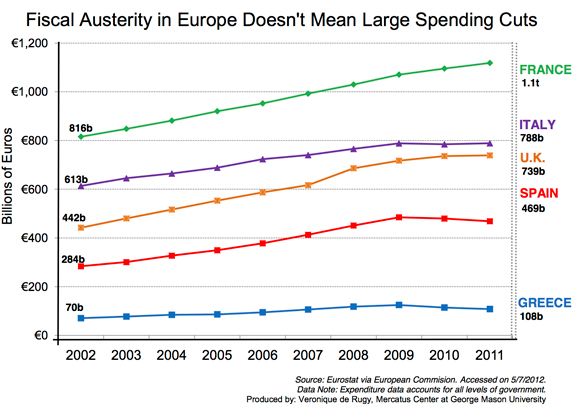
Vuk Vukovic wonders why the notion that the British government has imposed austerity still has any traction in the media:

The UK had the one of the strongest fiscal stimuli (relative to the size of its economy) in the world as a response to the crisis, during the premiership of Gordon Brown. The result was making the situation much worse with a rising public debt and the third highest budget deficit in the world behind only Greece and Egypt in 2011, and behind Greece and Iceland in 2010. This comparison is striking since these countries were doing much worse than the UK at the time and were countries with highly unstable economies – Iceland before the restructuring, Greece whenever, and Egypt after a year-long revolution which saw the downfall of a dictator and an inability to consolidate ever since.

So the argument of Keynesians is that this wasn’t enough, and that Britain is crippled with austerity. The media is supporting the former view as well. Britain is running the hardest austerity policy in Europe and this is resulting in terrible growth performance and the inability to start up the recovery. However, Britain is far from austerity. Yes, some painful cuts have been made, tuitions were rising, unions were hit, wages in the public sector are stagnant, a lot of public sector workers have been laid off, but what does the government do with this saved up money? It “invests” in credit easing, housing subsidies, the youth contract and infrastructural projects. On the other hand, it’s guiding private sector investment and centrally planning credit, it announces an increase of the minimum wage, abolishing of the default retirement age, more regulation after claiming to remove regulation, the 50p tax rate and so on. None of these policies are policies aimed at growth. They are all part of a Keynesian response to the crisis.

After all, if one would just observe the spending data for the UK, it is still increasing, both relatively (as percent of GDP) and absolutely.

“You keep using that word. I do not think it means what you think it means.” To call a situation where government’s share of GDP is rising as “austerity” requires a brand new definition for the word.

February 27, 2012

David Friedman: The boy who cried wolf

Filed under: Media, Science — Tags: , , , , , , — Nicholas @ 09:15

Although it mentions the global warming debate, it’s really more about being skeptical in general:

A number of political commenters have compared the current Republican contestants unfavorably with Barry Goldwater. The current crop, we are told, are religious nutcases, or possibly pretending to be. Goldwater, on the other hand, was an intelligent and reasonable man, even if not on the right side of every issue.

I have been reading my parents’ autobiography, and recently got to the Goldwater campaign. Their description fits my memory. What we were being told then — by people almost none of whom could have done a competent job of explaining Goldwater’s positions or the arguments for them — was that he was a dangerous madman. There was even a piece by some large number of psychiatrists, none of whom had ever examined the candidate, explaining how crazy he was. And the TV ad with the little girl, the countdown, and the mushroom cloud.

[. . .]

I am not competent to judge the climate science behind global warming, but I am suspicious of orthodoxies pushed relentlessly in the popular media, orthodoxies that claim that everyone competent agrees on an urgent problem which requires drastic action immediately if not sooner. I remember when we were being assured that it was simply a scientific fact that overpopulation was the cause of poverty and a near term threat to our own well being, if not survival. Also when we were assured that the only way to get the poor countries of the world up to our level was central planning, if possible supported by generous foreign aid.

When I see news headlines about global warming having shrunk horses to the size of cats, along with a picture comparing a cat sized dog to a modern Morgan — you have to read down a bit to discover that the ancestral horses shrank to the size of cats from the size of dogs, from 12 pounds to 8 1/2 pounds, and spent tens of thousands of years doing it — I suspect that what I am seeing is driven at least as much by what people want other people to believe as by the evidence for believing it.

February 24, 2012

Argentina, like China, publishes unreliable economic statistics

Filed under: Americas, Economics, Government, Media — Tags: , , — Nicholas @ 11:27

The Economist has finally decided to stop using “official” economic statistics from Argentina:

Imagine a world without statistics. Governments would fumble in the dark, investors would waste money and electorates would struggle to hold their political leaders to account. This is why The Economist publishes more than 1,000 figures each week, on matters such as output, prices and jobs, from a host of countries. We cannot be sure that all these figures are trustworthy. Statistical offices vary in their technical sophistication and ability to resist political pressure. China’s numbers, for example, can be dodgy; Greece underreported its deficit, with disastrous consequences. But on the whole government statisticians arrive at their figures in good faith.

There is one glaring exception. Since 2007 Argentina’s government has published inflation figures that almost nobody believes. These show prices as having risen by between 5% and 11% a year. Independent economists, provincial statistical offices and surveys of inflation expectations have all put the rate at more than double the official number. The government has often granted unions pay rises of that order.

What seems to have started as a desire to avoid bad headlines in a country with a history of hyperinflation has led to the debasement of INDEC, once one of Latin America’s best statistical offices. Its premises are now plastered with posters supporting the president, Cristina Fernández de Kirchner. Independent-minded staff were replaced by self-described “Cristinistas”. In an extraordinary abuse of power by a democratic government, independent economists have been forced to stop publishing their own estimates of inflation by fines and threats of prosecution. Misreported prices have cheated holders of inflation-linked bonds out of billions of dollars.

February 18, 2012

Even hardcore pro-Tory cheerleaders hate the new Internet bill

Filed under: Cancon, Government, Liberty, Media, Technology — Tags: , , , , — Nicholas @ 12:27

The Sun chain of newspapers is without a doubt the most pro-Conservative media voice in Canada. When even they are calling Bill C-30 “seriously flawed”, you’ve got to hope that the government will give up:

The legislation, Bill C-30, tabled this week as the Protecting Children from Internet Predators Act, had virtually no safeguards to protect law-abiding Canadians, including the media, from being spied upon by police, bureaucrats, CSIS — even the competition bureau.

Until Prime Minister Stephen Harper punted the bill straight to committee for a badly-needed overhaul, his government appeared unconcerned about its own inconsistency.

Earlier this week, for example, the long-gun registry was finally put down, killed by the Harper majority for one reason and one reason alone.

It was rightly deemed to be an intrusion into the privacy of law-abiding Canadians.

This leaves Bill C-30 indefensible in its present form.

Requiring telecommunications providers to hand over personal information — without a warrant — to law-enforcement agencies opens the door to incredible abuses, and not just by Big Brother.

“This is going to be like the Fort Knox of information that the hackers and the real bad guys will want to go after,” said Ann Cavoukian, Ontario’s privacy commissioner.

The bill also includes a lovely little gag order provision that prevents your ISP from telling you when your information has been turned over to “inspectors” under the bill (and that doesn’t limit itself to the police: anyone could be appointed as an inspector by the ministry).

February 10, 2012

Lorne Gunter: Toronto Star imagines oil just “bubbles up out of the ground and we Westerners just run out with buckets to collect it?”

Filed under: Cancon, Economics, Media — Tags: , , , , , — Nicholas @ 10:30

Lorne Gunter in the National Post:

As I read the Toronto Star’s editorial about Statistics Canada’s recently released 2011 census population data, it was hard for me not to imagine a plump, aging diva reclining on a brocade-covered chaise wailing, “I’m still beautiful! Really, I am.”

Entitled, “Census shows a fading Ontario? Don’t count on it,” the editorial makes the argument that it is “too simplistic” to claim “Ontario’s day is over.”

No one is making the case that Ontario can be dismissed as an afterthought. That is a concern without a cause.

[. . .]

But before anyone jumps to the conclusion that I, an Albertan, am pleased by Ontario’s decline, I’ll add that any trend that bodes ill for Ontario, eventually bodes ill for the country as a whole.

Canada needs a strong, prosperous, confident heartland. The West may be the new engine of the national economy, but that doesn’t mean the country can afford to have the old engine — Ontario — be idle.

The Star insults the West’s ingenuity and determination when it scoffs that “it’s relatively easy to grow based on resource extraction. Ontario does not have the luxury of sitting on gas and oil fields, so the task here is much harder.” Really? Have the paper’s editorial writers ever tried to find, extract, transport and refine oil and natural gas? Do they imagine the stuff bubbles up out of the ground and we Westerners just run out with buckets to collect it?

February 9, 2012

Paul Wells: Harper’s trip to China is going well

Filed under: Cancon, China, Economics, Media — Tags: , , , — Nicholas @ 11:22

In his Maclean’s column, Paul “Inkless” Wells talks about the state of play in prime minister Stephen Harper’s visit to China:

The old-timers in the press gallery know how to defuse an announcement like this. We dust a toolkit from the early Chrétien days off. A Canadian prime minister shows up in a fancy Beijing ballroom with a bunch of business executives wielding Montblanc pens. A big number is being tossed around — say, “$3 billion.” But if we subtract the deals that would have happened anyway, and then subtract the deals that aren’t really deals — then we can wear that number down to some innocuous nub.

But while individual elements of Stephen Harper’s signing ceremony Thursday night in a fancy Beijing ballroom may not pan out, at some point the weight of evidence starts to suggest something real is going on. The evidence at hand comes, not just from Canadian sources, but from Chinese.

The first source of the morning was the semi-official English-language China Daily, which reserves real excitement for vice-premier Xi Jingping’s upcoming trip to the United States but which has been respectful, and a little more than that, toward Stephen Harper all week.

Later in the day came Harper’s bilateral meeting with Hu Jintao. Here, no trace of scolding for time spent posturing in the early years of Harper’s term as prime minister. Now, Hu said, “Mr. Prime Minister, you put a lot of value on Canada’s relationship with China and are strongly committed to promoting the practical cooperation between our two countries. I appreciate your efforts.” Translation: You’re out of the doghouse. Come here, ya big lug.

Update: David Akin contrasts the glowing reviews Harper is getting in the Chinese press this time with his 2009 visit:

I’ve travelled to a lot of spots around the world covering Prime Minister Stephen Harper’s international travels and I cannot recall him ever generating the kind of positive press he’s getting in this morning’s China Daily, the English-language state-run daily newspaper here.

A picture of Harper chatting with Chinese chess players during a visit Wednesday to the Temple of Heaven is the front-page top-of-the-fold main art here with a generally positive article about the two countries improving trade relationship. Inside, there’s two other pieces involving Canada and Harper.

[. . .]

Read between the lines here and China’s government is approvingly showing Canada’s prime minister to be a decent, pious individual deserving of China’s friendship and support.

That’s a sharp contrast to the China Daily‘s coverage of Harper’s 2009 visit. There was front-page coverage then too — of how Premier Wen dressed down Harper for letting the China-Canada relationship languish. The narrative in 2009 was that the Canadian prime minister was a wayward supplicant coming to China to seek forgiveness for his sins. Not this time: He is being profiled in the press as the leader “of a strong delegation of five ministers and 40 business leaders” who, along with Wen, witnessd “the signing of nine deals.” The reader of the China Daily on this Harper visit is meant to be impressed.

« Newer PostsOlder Posts »

Powered by WordPress