Quotulatiousness

November 24, 2010

End of an era

Filed under: Britain, Military — Tags: , , , — Nicholas @ 18:49

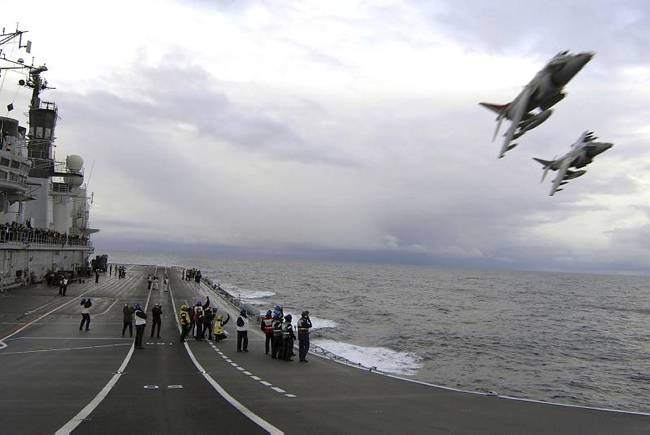
The last Harrier takes off from HMS Ark Royal earlier today:

Lt. Cdr. James Blackmore was the last Harrier pilot to launch from HMS Ark Royal, noting that “this is truly a memorable day.” But as it is never a good idea to tell your bosses they are a bunch of idiots, he also adds that “we accept the decision to decommission both the Harrier and HMS Ark Royal; however, of course the final launch will be emotional.”

More information at Aviation Week.

RN’s Type 45 destroyer has even more trouble

Filed under: Britain, France, Military — Tags: , — Nicholas @ 12:54

Remember the Royal Navy’s latest destroyer, the Type 45? It’s the one without effective main armament. As if that wasn’t bad enough, the lead ship of the class, HMS Daring, broke down at sea recently:

The Royal Navy’s new Type 45 destroyers continue to suffer from technical mishaps, with first ship of the class HMS Daring arriving a week late in Portsmouth on Saturday following emergency propulsion repairs in Canada. The £1.1bn+ ship had previously broken down in mid-Atlantic.

The News of Portsmouth reported on the breakdown and the destroyer’s delayed return to its home port, noting that a similar propulsion problem had occurred just four months previously during an outing in the Solent for families of the ship’s company.

[. . .]

The Type 45s’ hulls and some of their kit — for instance the fire-control radar — are made in Britain but much of the colossal expense of the ships has gone on equipment from the US, Italy and France. Particularly well-known are their French-made Aster air-defence missiles, which have been delayed for several years following repeated failures in test-firings caused by a manufacturing fault.

The UK Public Accounts Committee went so far to describe the missile-system, named “Sea Viper” in British service, as “disgraceful” in 2009 … and that was before the most recent test failure. However the flaws in the Aster missiles are now reportedly rectified and successful firings have since taken place. The UK Ministry of Defence expects to declare its first Sea Viper system operational next year: until then, the Type 45 destroyers will continue to be almost unarmed, able to employ only basic guns and cannon.*

[. . .]

*Apart from Sea Viper, the only armament possessed by a Type 45 is a single 4.5-inch “Kryten” gun turret, primarily useful for bombarding targets ashore (within a few miles of deep water) and two light 30mm cannon for close-in work against pirate dhows or the like.

Sea Viper will not enhance the destroyers’ abilities against other ships or land targets when it becomes operational as it has no surface-to-surface mode. It is said to be superior to any other system against missiles and aircraft, perhaps even offering an effective defence against widely-feared shipkiller missiles of Russian manufacture which approach their target at supersonic speeds. However Aster/Sea Viper has never been tested against a supersonic target and there are no plans to do so, which means that any battle plan based on such a capability would be a gutsy call indeed.

As you can tell, Lewis Page isn’t a fan of the Type 45 destroyers . . .

China’s first aircraft carrier approaching completion?

Filed under: China, Military — Tags: , — Nicholas @ 08:08

In their growth from a small coastal protection flotilla to a blue water navy, the next milestone for China’s navy will be the completion of the Shi Lang:

Work is picking up on what appears to be China’s first aircraft carrier, the Shi Lang. For eight years now, China has been tinkering with a half finished Russian aircraft carrier. Two years ago, this ex-Russian aircraft carrier, Varyag, was renamed the Shi Lang (after the Chinese general who took possession of Taiwan in 1681, the first time China ever paid any attention to the island) and given the pennant number 83.

Until last year, progress was slow. But there has been a lot of work lately. Early in 2009, China moved the Shi Lang into dry dock, where work is now obviously underway to install engines and other heavy equipment. A year ago, the radar mast was completed, and now there is a Chinese radar system being installed. Officially, the Chinese say nothing. But the dockyard workers keep at it, and it’s possible to take photos from a distance. It appears that the Shi Lang is a year or so from going to sea.

November 12, 2010

Another call to keep the Harrier in operation

Filed under: Britain, Economics, Military — Tags: , , , , — Nicholas @ 08:33

The Economist sums up the arguments in favour of retaining the Harrier over the RAF’s preferred Tornado:

Francis Tusa of Defence Analysis, a newsletter, reckons that retiring the much more maintenance-heavy Tornados instead of the Harriers would have saved £4 billion-5 billion, while keeping Ark Royal going would cost only about £120m a year. He adds that getting out of the strike-carrier business for ten years means that critical skills will be lost. Others, including the letter’s authors, fear that the “carrier gap” will mean Britain loses the ability to carry out autonomous expeditionary missions. Among other things, that would, they say, leave the Falkland Islands (and their valuable oilfields) vulnerable to attack.

What appears to have changed the new (and inexperienced) National Security Council’s mind at the last moment was the air force’s claim that the Tornado was more effective than the Harrier in Afghanistan. It is odd that this was regarded as a clinching argument, as there are more than enough jets in Afghanistan. It is true that in terms of range, payload, speed and its ability to hit moving targets, the Tornado wins. On the other hand, the Harrier can operate from makeshift landing sites, is more flexible and reliable and could easily be equipped with the advanced Brimstone anti-tank missiles carried by the Tornado. And for five months of the year in Afghanistan, when the weather is hot, the Tornado can only take off with a similar weapons load to the Harrier.

The RAF’s enthusiasm for the Tornado is understandable. It does not have to share it with the navy (the Harrier is operated by a Joint Strike Wing) and it needs a lot more people to operate it (saving air-force jobs). Mr Tusa suggests a sensible compromise that would still save billions of pounds: get rid of half the Tornados, keeping 60 until they are not needed in Afghanistan; retain 20 Harriers for carrier duty until their replacements arrive in 2020; and accelerate the deployment of the strike version of the Typhoon. Time for a rethink.

November 11, 2010

In memorium

Filed under: Britain, History, Military, WW1, WW2 — Tags: , , — Nicholas @ 08:03

A simple recognition of some of our family members who served in the First and Second World Wars:

The Great War

  • Private William Penman, Scots Guards, died 1915 at Le Touret, age 25
    (Elizabeth’s great uncle)
  • Private David Buller, Highland Light Infantry, died 1915 at Loos, age 35
    (Elizabeth’s great grandfather)
  • Private Walter Porteous, Northumberland Fusiliers, died 1917 at Passchendaele, age 18
    (my great uncle)
  • Corporal John Mulholland, Royal Tank Corps, died 1918 at Harbonnieres, age 24
    (Elizabeth’s great uncle)

The Second World War

  • Flying Officer Richard Porteous, RAF, survived the defeat in Malaya and lived through the war
    (my uncle)
  • Able Seaman John Penman, RN, served in the Defensively Equipped Merchant fleet on the Murmansk Run (and other convoy routes), lived through the war
    (Elizabeth’s father)
  • Private Archie Black (commissioned after the war and retired as a Major), Gordon Highlanders, captured at Singapore (aged 15) and survived a Japanese POW camp
    (Elizabeth’s uncle)

In Flanders fields the poppies blow
Between the crosses row on row,
That mark our place; and in the sky
The larks, still bravely singing, fly
Scarce heard amid the guns below.

We are the Dead. Short days ago
We lived, felt dawn, saw sunset glow,
Loved and were loved, and now we lie
In Flanders fields.

Take up our quarrel with the foe:
To you from failing hands we throw
The torch; be yours to hold it high.
If ye break faith with us who die
We shall not sleep, though poppies grow
In Flanders fields.

Lieutenant Colonel John McCrae, MD (1872-1918)

November 10, 2010

Retired RN admirals warn of risks of scrapping Ark Royal and Harriers

Filed under: Britain, Military — Tags: , , , , , — Nicholas @ 09:08

As I mentioned a few weeks ago, the British government announced that they were giving up on being a country with a navy and just wanted a medium-sized coast guard retiring HMS Ark Royal and eliminating the Harrier VTOL aircraft from service. Even if the current Admiralty staff were willing to go along with this, some retired admirals point out that it’s a risky decision:

A group of former Royal Navy chiefs urged the government today to reverse its decision to scrap the aircraft carrier Ark Royal and the fleet of Harrier jets, which they described as “the most dangerous of the defence cuts” announced by the coalition.

In a letter to the Times, the former commanders said the cuts would leave the oil-rich Falkland Islands open to a fresh Argentinian attack “from which British prestige … might never recover”.

The signatories, who include former navy chief Lord West and admiral of the fleet Sir Julian Oswald also said they believed David Cameron had been badly advised before agreeing to the measures, which they said “practically invited” Argentina to attempt to inflict a national humiliation on the British on the scale of the loss of Singapore in 1942.

Of course, the administration of the Falkland Islands knows that any hint of agreement with the dissident admirals is likely to be punished by the government and is rushing to distance itself from any taint:

But a spokesman for the Falklands government said it was not concerned that defence cuts would leave the islands vulnerable to attack. “The Falkland Islands government is satisfied and grateful for the levels of defence on the islands which are suitable to maintain an effective deterrent,” a spokesman said.

Update: Lewis Page thoroughly agrees with Julian Thompson’s letter to the Times:

     Harrier could still use Kandahar runway if half of it were blocked by Taleban action; can use any make-shift landing site; has a response time of less than 10 minutes, as against 30 [for the Tornado]; performs better in hot weather; requires fewer ground crew; and has better availability.

     Harrier can deliver close air support of ground forces anywhere from the existing carriers … [it] has nearly twice as many airframes provided with precision-guided ground attack capability [as Tornado]; will not require a further £1.4 billion to re-engine in 2014; and can remain in service until 2023 without significant investment.

     The existing Tornado force will cost, over 10 years, seven times as much to keep in service as Harrier …

     The decision to axe the entire Harrier force is strategically and financially perverse.

The letter is signed by former Royal Marine major-general Julian Thompson, who should be the best-known of the signatories. Thompson commanded the UK’s Commando brigade, mostly made up of Marines (reinforced for the occasion by troops from the Parachute Regiment) during the Falklands campaign, when it acted as the primary unit in the victorious land fighting.

November 9, 2010

Submarines, and the things they run into, literally

Filed under: Britain, Military — Tags: , — Nicholas @ 12:49

It’s always a subject of uninformed joking, but submarines can and do have collisions with all sorts of things. HMS Astute is the most recent case of this, fortunately with only minor damage and no reported casualties. Strategy Page puts this and other incidents into perspective:

British media and politicians made much of the recent grounding of their new nuclear submarine HMS Astute. On October 22nd, the sub got snagged on a sand bank off Scotland for ten hours. This was during sea trials, and after it was freed, Astute collided with one of the tugs, causing more damage. Members of Parliament demanded to know, among other things, how often this sort of thing happened. They were told there had been seventeen collisions since 1988. One in that year, two in 1989, one in 1990, one in 1991, two in 1996, one in 1997, two in 2000, one in 2002, one in 2003, one in 2008 and two in 2009 and two, so far, this year. This made it clear that such collisions are not as rare as most people think.

This has to do with how the media deals with these events. For example, five years ago a U.S. SSN (nuclear attack sub) collided with an underwater mountain. The sub survived, but its sonar dome was smashed in, and one sailor died. This was big news, but most collisions are minor, and don’t make it to the media. The navies involved like to keep it that way, if only to keep secret where, and when, their submarines operate. Most of the American collisions involve snagging fishing nets of large fishing vessels, or other lines (towing, anchor) hanging from surface ships. There were also lots of bumping into piers or buoys. Bumping into other ships or subs was also common. Most of the time, damage was minor, making it easier to keep such incidents quiet.

After all, submarines don’t have windshields or portholes you can look out to see obstructions . . .

October 19, 2010

UK defence cuts announced

Filed under: Britain, Economics, Military — Tags: , , , , , , , — Nicholas @ 12:57

As I blogged yesterday, quoting a Guardian article, the British government will be cutting their armed forces substantially:

I want to be clear there is no cut whatsoever in the support for our forces in Afghanistan.

The funding for our operations in Afghanistan comes not from the budget of the Ministry of Defence but instead from the Treasury Special Reserve.

So the changes to the Ministry of Defence that result from today’s Review will not affect this funding.

That will help the morale of the troops on the ground in Afghanistan, but the army overall is still being reduced.

Our ground forces will continue to have a vital operational role so we will retain a large well-equipped Army, numbering around 95,500 by 2015 that is 7,000 less than today.

We will continue to be one of very few countries able to deploy a self-sustaining properly equipped Brigade-sized force anywhere around the world and sustain it indefinitely if needs be.

And we will be able to put 30,000 into the field for a major, one off operation.

In terms of the return from Germany half our personnel should be back by 2015 and the remainder by 2020.

And tanks and heavy artillery numbers will be reduced by around 40%.

The garrison in Germany is a relic of the Cold War, and it’s amazing that they’ll still be there until 2020.

We will complete the production of six Type 45 destroyers one of the most effective multi-role destroyers in the world.

But we will also start a new programme to develop less expensive, more flexible, modern frigates.

Total naval manpower will reduce to around 30,000 by 2015.

And by 2020 the total number of frigates and destroyers will reduce from 23 to 19 but the fleet as a whole will be better able to take on today’s tasks from tackling drug trafficking and piracy to counter-terrorism.

Those are the same Type 45’s that haven’t actually had effective main armament, according to The Register.

We have decided to retire the Harrier which has served this country so well for 40 years.

The Harrier is a remarkably flexible aircraft but the military advice is that we should sustain the Tornado fleet as that aircraft is more capable and better able to sustain operations in Afghanistan.

RAF manpower will also reduce to around 33,000 by 2015.

Inevitably this will mean changes in the way in which some RAF bases are used but some are likely to be required by the Army as forces return from Germany.

The retirement of the Harrier is a simultaneous victory for the RAF against their two most dangerous enemies: the army and the Fleet Air Arm. The Harrier was the one aircraft that could provide both naval and ground support, and was therefore considered readily dispensible by the fighter jocks in the Royal Air Force.

We will build both carriers, but hold one in extended readiness.

We will fit the “cats and traps” — the catapults and arrestor gear to the operational carrier.

This will allow our allies to operate from our operational carrier and allow us to buy the carrier version of the Joint Strike Fighter which is more capable, less expensive, has a longer range and carries more weapons.

We will also aim to bring the planes and carriers in at the same time.

That is probably finis for carrier operations in the Royal Navy: but expect both of these ships to show up again in the fleet of India within 5-10 years.

. . . we will retain and renew the ultimate insurance policy — our independent nuclear deterrent, which guards this country round the clock every day of the year.

[. . .]

…extend the life of the Vanguard class so that the first replacement submarine is not required until 2028;
…reduce the number of operational launch tubes on those new submarines from 12 to eight…
…reduce the number of warheads on our submarine at sea from 48 to 40…..
…and reduce our stockpile of operational warheads from less than 160 to fewer than 120.

October 18, 2010

Royal Navy’s Ark Royal to be decommissioned

Filed under: Britain, Military — Tags: , , , — Nicholas @ 17:23

The Royal Navy is losing its carrier HMS Ark Royal effective immediately, according to The Guardian:

The prime minister will underline the scale of the cuts to Britain’s annual £37bn defence budget tomorrow when he announces that Britain will be without a carrier strike capability for a decade. HMS Ark Royal will be decommissioned immediately and its Harrier jump jets will be withdrawn from service.

The Royal Navy will have to wait 10 years until as many as 50 new Joint Striker Aircraft can be launched using the catapult and trap system — “cat and trap” — from the new Prince of Wales aircraft carrier. This system, which will allow French and US planes to fly from Britain’s new aircraft carrier, will cost about an extra £500m.

In reality, this means that the Royal Navy will probably never have a strike carrier capability again. The next government will have lots of reasons to further reduce the RN’s Fleet Air Arm, and the will to reverse these cuts can’t be found on the opposition benches. The Royal Navy will now move toward being a pure coastal defence force.

The cost of only 50 F-35B aircraft will sink the carrier fleet more effectively than torpedoes. They were already going to be ultra-expensive with the original planned order of more than twice as many. Ordering so few guarantees that they’ll be even more expensive per plane. Whether the current government survives a full term in office or is defeated in the house, the next government will have even less political reason to buy these planes.

The Prince of Wales will be the second of the new aircraft carriers to be built at a cost of £5.2bn. The first aircraft carrier — the Queen Elizabeth — will be in service for just three years, between 2016-19, as a helicopter carrier. It will then be mothballed, a process known as “extended readiness”, and possibly sold off.

Cameron told the cabinet today that the decision to abandon a carrier strike capability for 10 years — and to put the Queen Elizabeth aircraft carrier into service for just three years — was one of the most difficult decisions he has made. “The prime minister told the cabinet that this was one of the hardest things he has had to grapple with,” one source said. “But this decision was taken collectively.”

It’s not mentioned in the article, but I assume that the reconfiguration of Queen Elizabeth as a helicopter carrier also means that the RN will be losing the relatively new HMS Ocean as well as the Ark. I guess the “frigate captain” branch of the service won the battle for funding.

Argentina’s opportunity to liberate “les Malvinas” coming up shortly . . .

Update, 19 October: The Prime Minister’s speech to the House of Commons confirms most of what The Guardian reported yesterday. The planned F-35B purchase will be switched to F-35C, one carrier to be completed then mothballed, the other to go into active service, and the Harriers to be retired from service. Trident fleet to be replaced, but five years later than planned, and both tubes per boat and number of boats to be reduced. The Army loses 7,000 troops, and 40% of their tanks and heavy artillery. On the plus side, the British will no longer be maintaining a garrison in Germany after 2015. The RAF will be reduced to 33,000 by 2015.

October 11, 2010

F-35B to learn Royal Navy landing trick

Filed under: Military, Technology — Tags: , , , — Nicholas @ 11:32

The carrier version of the F-35 Joint Strike Fighter may be about to learn another trick developed for the Sea Harrier, Shipboard Rolling Vertical Landing (SRVL):

According to the US announcement, made last week and flagged up first by Flightglobal.com, Lockheed will be partnered with the UK side of BAE Systems plc for the task of ensuring that the F-35B can get down on a ship at sea using SRVL. BAE is already involved in development of the jet, and in fact the lead test pilot for the F-35B, Graham Tomlinson, is a BAE employee.

The idea of SRVL is that the F-35B will not set down vertically supported solely by thrust from its lift fan and downward-swivelled jetpipe. Rather it will come down still moving forward slowly, supplementing the vertical thrust with lift from its wings. The forward speed would still be slow enough that there would be no need for arrester wires and a tail hook.

This should allow an F-35B to set down on a carrier deck while carrying a larger amount of fuel and weapons than would normally be possible. The Royal Navy is well-known to be anxious about this issue as it led to the early departure of the late, great Sea Harrier fighter.

October 8, 2010

Does SDSR stand for Slashing Damage to Strategic Resources?

Filed under: Britain, Military, Politics — Tags: , , , — Nicholas @ 13:22

Well, no, it stands for Strategic Defence and Security Review, which is what the British government is conducting right now. Lewis Page (who is a former naval officer, BTW) is still hoping that the Admirals can manage to save the core components of the Royal Navy from the budget cutters:

The Telegraph reports on the matter today, quoting unnamed insider sources at the heart of the ongoing Strategic Defence and Security Review (SDSR, the new government’s name for the savage cuts that will be necessary to sort out the UK defence budget crisis).

According to the paper’s informants, the navy has proposed cutting its fleet of “escort” warships (submarine-hunting frigates and air-defence destroyers) from the current 23 down to 12 — a couple more than we here on the Reg naval desk suggested under We Want Two. We didn’t think that the navy could preserve its vital amphibious-landing capability without cutting the tremendously costly — and largely useless — escort fleet a little further. It seems that we were on the money, as reportedly the two-carrier, 12-escort plan calls for “all amphibious craft” to be dispensed with.

If the paper’s sources are correct, some version of the escort-slashing, carrier-saving plan will go ahead. Reportedly the ministers of the National Security Council, meeting yesterday, “stopped short of a formal decision”, but “insiders now believe both ships will be built”.

Getting the two carriers through the first skirmish in the budget battle is a good start, but the ships are cheap compared to the proposed aircraft to equip them. The F-35B supersonic VTOL/STOL aircraft will cost a lot more than the ships they’ll be based on.

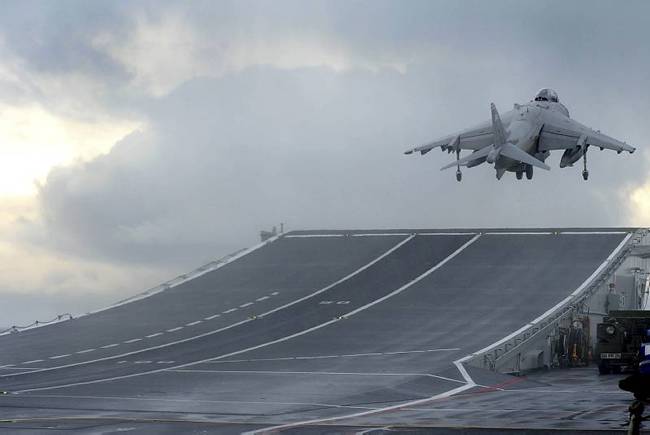
Although it makes for a fairly cheap carrier, the F-35Bs would be horrifyingly expensive, particularly if bought in time to equip the ships as they are completed. Not only is the F-35B the world’s first ever supersonic stealth jumpjet, it is currently suffering severe delays in flight testing: for quite some few years, until the production line gets into gear and economies of scale kick in, it will be very pricey to buy. It will also be comparatively expensive to own and operate, as perhaps the most or second-most complicated jet in the world today. Worse still, the need to carry a lift fan, swivelling exhaust nozzle and multiple lids and doors to cover these things when not in use means that the F-35B jumpjet will not be as good a combat plane as the F-35A and F-35C versions (runway and catapult respectively).

If we dare to assume that the hulls will be built, then a quick budget fix would be to omit the F-35B and install catapults on the carriers to allow them to use cheaper tail-hook aircraft (the F-18 or perhaps the F-35C). That’ll chop a few billion off the total cost of the package, and the only fly in the ointment is that the carriers are gas-turbine, not steam or nuclear-powered. That means depending on the not-yet-in-service electromagnetic catapult designed for the USS Gerald Ford, the next big American carrier.

The US Navy is committed to the electromagnetic catapult working, or they’ll have to pay a lot of money to re-engineer the Ford to use older technology and accept a multi-year delay in commissioning the ship. The US Navy could buy the entire Royal Navy out of petty cash, so it’s not a huge risk to depend on them getting the bugs worked out of the new mechanism in time.

The Telegraph thinks that the plan will be to convert HMS Prince of Wales, the second carrier, to an amphibious assault ship. Page thinks this is a bad idea on multiple counts:

The Telegraph‘s sources think that this is on the cards, saying that “ministers have discussed reconfiguring the first new carrier as a helicopter platform that would also carry Royal Marine commandos. The carrier would then ultimately replace the existing helicopter ship, HMS Ocean“.

This is a foolish plan, however. HMS Ocean is new: she doesn’t need replacing. Furthermore, having only one proper carrier is much, much worse than having two, almost as bad as having none: an enemy need only wait until the sole proper carrier is in a planned refit before becoming aggressive, happy in the knowledge that the UK can’t even rattle its sabre effectively in response. (One of the main ways that the USA resolves or responds to tense situations around the world day to day or week to week is to move its carriers about.)

In effect, the amphib downgrade plan sacrifices a hugely important and powerful carrier — gives up the critical one-carrier-always-up capability — and throws away the perfectly good HMS Ocean, which was actually quite cheap to have anyway (she cost less than a typical escort and her crew is no larger). The only upside here is that one or two more frigates or destroyers are preserved, a largely meaningless gain: the more so as there would now be fewer capital ships actually requiring escorts.

The problem with any kind of military spending is that you’re trying to make provision for the unforeseen future contingency. The last time the British government was on the verge of scrapping the aircraft carriers, Argentina kindly kicked up a ruckus that required military action — which would not have been possible without the carriers.

This time around, there’s no likely trouble spot to flare up and force the government to reconsider (unless we can prod Argentina to do us a favour again . . .)

October 6, 2010

British forces facing imminent cuts

Filed under: Britain, Economics, Military — Tags: , , , , , — Nicholas @ 12:15

Lewis Page makes what I think is the correct call for the British government’s National Security Council to keep the Royal Navy’s carrier program and gut the RAF deep bomber fleet and the army’s heavy combat arm:

Thus it is a good bet that the first of the two new carriers for the Royal Navy will go ahead. The second may be downgraded to serve as an amphibious-warfare ship full of troops and helicopters rather than combat aircraft, or it might be cancelled altogether — which means British shipbuilding would be kept alive by bringing forward plans for a new generation of navy frigates.

The RAF and even the Army will be offering up massive cuts of their own — it is expected that the entire Tornado deep-bomber fleet will be retired years early, and the current Cold War style armoured-warfare juggernaut of tanks, mobile artillery and infantry fighting vehicles is set for a major trim back — so there is only one way that the government can preserve a two-carrier navy.

A navy with pretensions to independent action requires aircraft carriers. Plural. A single carrier isn’t enough, and places too much of your naval “capital” in a single hull. Two is the minimum (and three would be even better): you can, with care, always have at least one carrier fully worked-up and ready to deploy.

Even if the RN gets both carriers through the NSC flensing mill, they still face other cuts:

That one way is to finally cut the Royal Navy’s force of frigates and destroyers — collectively known as “escorts”, as their primary role is to protect and defend major warships — down to numbers suitable for actually escorting our biggest ships. For the past many decades, for reasons of history and jobs for the boys, the RN has actually maintained far more escorts than it needs to escort major units such as carriers and amphibious task groups.

Realistically, a combat carrier can actually protect herself using aircraft far more effectively than her escorts can: but it is reasonable to say that sending a carrier out to a major war alone, when just one bomb or missile or torpedo could eliminate Britain’s reach into a given theatre — perhaps cutting off air cover, supplies, even the chance of evacuation for our troops ashore — is a gutsy call.

Reducing the number of frigates and destroyers would make a lot of sense (except if you’ve “spent your whole life in an effort to be a frigate captain”). A bigger-ticket item than the carriers themselves is the required aircraft to equip the ships. Current plans are for the role to be given to the ultra-expensive F-35B. Politics aside, it would make brilliant economic and military sense to replace those techno-wonders with slightly less capable F-18s:

Really we need a maximum total escort fleet of say 10, as compared to the Navy’s current lineup of 23. Savings just in running costs over the next decade would add up to at least £11bn. Then we can save at least another billion-odd in acquisition costs by not buying the last two Type 45s and their dubious missile systems. All this is far and away more than enough to ensure that the second carrier is built, and to give the two ships catapult launch. This in turn would permit the purchase of much cheaper and more powerful aircraft for them, easing the problems caused for the MoD budget by the rising costs and delays facing the F-35B supersonic stealth jumpjet (currently grounded following the discovery of technical snags during flight testing).

And why would I, a former ground-pounder, be so enthusiastic about aircraft carriers? Because the British experience has been that the RN has been there for the army when needed:

It hasn’t been often that British troops have needed fighter cover since World War II, but when they’ve needed it they’ve really, really needed it. Just ask the Welsh Guards, chopped to pieces by Argentine jets at Bluff Cove. When there has actually been any fighter cover for British troops in combat since World War II, it has come from the navy, not the RAF. Every time a British fighter has shot down an enemy aircraft since 1945, it took off from a ship to do so. Even back during WWII, lack of carrier air killed a lot of sailors and soldiers — and the presence of it saved many more.

October 5, 2010

Let me read that again

Filed under: Britain, France, Military — Tags: , — Nicholas @ 13:01

The Royal Navy has had some of their new Type 45 destroyers in service for a while, but they’ve only just gotten around to arming them?

The Royal Navy’s new £1bn+ Type 45 destroyers, which have been in service for several years (the first is already on her second captain), have finally achieved a successful firing of their primary armament.

The Ministry of Defence (MoD) announced yesterday that HMS Dauntless, second of the class, has made the first firing from a Type 45 of the French-made Aster missiles with which the ships are armed. All previous trial shoots were carried out using a test barge at French facilities in the Mediterranean.

Well, at least they’re getting closer to being armed and equipped as they were originally supposed to be:

Each of the six Type 45s will now cost the taxpayer £1.1bn and counting. At the moment the only weapons they can use operationally are their basic 4.5-inch “Kryten” gun turrets and light 30mm autocannon, principally useful for bombarding undefended foreshore targets or shooting up pirate dhows and the like. This is armament barely above the gunboat level.

The big attraction to the (very expensive) PAAMS/Sea Viper missile system is its claimed ability to shoot down the latest generation of Russian supersonic anti-ship missiles . . . oh, and that it wasn’t the cheaper (and proven) American AEGIS system.

As it is, we will pay at least double and get none of these things. Our Type 45s will have no serious ability to strike targets ashore, and we will continue to have no capabilities against ballistic missiles. Most glaringly of all, the Type 45 will have no weapon other than its guns with which to fight enemy ships — Sea Viper has no surface-to-surface mode.

You might feel that preservation of British high-tech jobs in some way justifies such horrific overspending for such lamentable amounts of capability, but in fact the relatively few Brit workers concerned have now mostly been fired anyway.

We can’t poke too much fun at the Royal Navy over the jobs issue: most major purchases for the Canadian Forces are driven more by “spin-offs” and regional employment concerns than either cost or military efficacy.

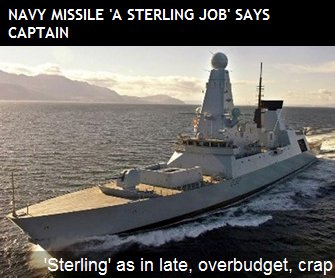
I did like The Register‘s cheeky graphic:

September 27, 2010

EMALS back on track in time to save British carrier fleet?

Filed under: Britain, Military, Technology — Tags: , , , , , — Nicholas @ 08:54

As discussed earlier, the Royal Navy has been watching the US Navy’s ongoing EMALS project carefully, as it might provide a major cost-saving for the new carriers HMS Queen Elizabeth and HMS Prince of Wales. Recent testing shows the program appears to be back on track:

The US Navy’s plan to fit its next aircraft carrier with electromagnetic mass-driver catapults instead of steam launchers is reportedly on track, with shore trials using test weights a success. The progress of the Electromagnetic Aircraft Launch System (EMALS), the first of its kind, is of interest to the Royal Navy as it could offer a way to massively cut the money spent on the Service’s two new carriers — or, more accurately, to cut the money spent on their aeroplanes.

A statement issued last week by the US Naval Air Systems Command (NAVAIR) says that the EMALS test installation at Lakehurst, New Jersey is going through its planned programme without difficulty.

[. . .]

CVN 78, aka USS Gerald R Ford, is the next US Navy supercarrier, now under construction. It’s very important to the USN that EMALS works, as it is acknowledged that it’s now too late to change the Ford’s design and fit her with steam catapults like all other US (and French) carriers. If for some reason EMALS isn’t a success, the US will have bought the biggest and most expensive helicopter carrier ever.

Though the steam catapult is actually a British invention, Blighty’s present pocket-size carriers don’t have any catapults at all. Thus they can only launch helicopters and short-takeoff Harrier jumpjets.

The problem for Britain’s decision makers is that the current carrier design limits them to the ultra-expensive F-35B, which will be roughly twice the price of the ships themselves to provide sufficient aircraft to make the carriers fully operational. Being able to swap out the deluxe F-35B for cheap-as-dirt F-18E’s may be enough to save both carriers from the ongoing cost-slashing by the ministry.

September 16, 2010

Army, RN, RAF, and Trident replacement: pick any three

Filed under: Britain, Military, Politics — Tags: , , , , , — Nicholas @ 10:03

The British coalition government has declared that they will retain the nuclear option (that is, buy replacements for their current Trident submarines), but still seem to think that you can take £20bn from the Defence budget (in addition to the 10-20% savings you’re already demanding be made) and still have three viable services. Perhaps it’s a strange form of new math:

The £20bn replacement of the UK’s Trident nuclear deterrent could be put off until after 2015, according to reports.

The BBC said ministers were considering delaying the planned 2014 date in an effort to reduce short-term costs and head off a pre-general election political row.

The Ministry of Defence (MoD) said no decisions had yet been taken on the future of the submarine-based missile system, which is currently the subject of a value-for-money review.

It has been formally excluded from the ongoing strategic defence and security review (SDSR) but the Treasury has made clear the under-pressure MoD budget will have to pay for it. An influential committee of MPs yesterday warned that that decision would have very significant consequences for future defence spending.

Just as the coalition took office, it was mentioned that the previous Labour government had committed to spend £37bn on various new weapon systems, but had not actually provided the funding to make those purchases. Add a Trident replacement bill on top of that and there is no way to successfully pay the bills out of the current military budget.

There are always economies that can be made in military spending: it’s not unreasonable to assume that savings of 10% can be found in any military force. 20% is pushing the envelope too much unless a scaling-back of commitment is also part of the reduction. 20% cuts, no reduction in tasks, and the Trident replacements (even if you reduce the fleet from four to three) can’t be done.

Update: Lewis Page thinks the Trident replacement is essential:

Proper new Trident, with submarine-launched ballistic nukes, is the right call for the UK. Its cost is tiny compared to UK government spending — just half of a single year’s Department for Work and Pensions budget would buy new Trident boats, arm them, crew them and cover their running costs for decades.

Compared to the MoD’s much smaller budget the costs look bigger, but they are still small — and ICBM submarines represent far and away the best value for money in the MoD. For perhaps £20bn to £30bn in acquisition costs you get an unstoppable, unfindable nuclear hammer capable of shattering a nation in an afternoon. When one reflects that we have spent the same money to get the Eurofighter — a wildly expensive and now rather oldfashioned pure air-to-air platform — new Trident looks like a steal.

One major reason that the Eurofighter is such poor value for money, of course, has been repeated delay so as to achieve short-term savings in the past. This is also true of nearly every other procurement project in the MoD: cumulatively, past politicians failing to grasp nettles are now costing us billions every year. It has to stop, and stop now — as a taxpayer, quite frankly I don’t see why I should pay still more billions down the road just to keep Mr Cameron in Downing Street and Mr Clegg in the Cabinet today.

« Newer PostsOlder Posts »

Powered by WordPress