Quotulatiousness

August 20, 2012

The US Navy’s still-experimental Littoral Combat Ship

Filed under: Military, Technology, USA — Tags: , , — Nicholas @ 08:29

New ship designs are highly complex and often take years to debug. The US Navy’s Littoral Combat Ship (LCS) program surprised most observers by settling on two different designs and splitting the intended order quantity between the two design firms. One of each design is in service now, the more traditional USS Freedom (LCS-1), and the trimaran-hull USS Independence (LCS-2). Each has had its own set of teething problems:

The LCS has long been a good source of bad news and potentially explosive revelations. In the last year the LCS design has been found to have structural and other flaws. The first LCS, the monohull USS Freedom, has suffered four major problems since it entered service four years ago. The latest one is a leak in a propeller shaft seal, which caused some minor flooding. Despite this Freedom was able to get back to port under its own power. Last year cracks in the hull as long as 17 cm (6.5 inches) were discovered, and the water-jet propulsion system broke down as well. Two years ago one of the gas turbine engines broke down.

The most serious problem is in the USS Independence, a radical trimaran design. It seems that a “dissimilar metals” situation arose when salt water, the aluminum hull, and some other metals got into close proximity with each other and extensive corrosion resulted. Aluminum hulls tend to corrode more than steel, but the problem became so bad with the USS Independence that, 18 months after entering service, it was sent into dry dock for corrosion repairs and design changes to eliminate the problem.

Cracks, corrosion, and equipment breakdowns are common in new warship designs especially designs that are radically different (like the broad trimaran shape of the USS Independence). Usually, these problems can be fixed but there’s always the risk that the new design will be seriously flawed, requiring extensive rework and a halt in building more ships of that class. So far, the U.S. Navy has not wavered in the face of potential design and construction flaws.

This is all part of the expected years of uncertainty and experimentation as this radical new combat ship design seeks to find out what works, to what degree, and what doesn’t. There is some nervousness about all this. The U.S. Navy has not introduced a radical new design for nearly a century. The last such new design was the aircraft carrier, which required two decades of experimentation and a major war to nail down what worked. Even the nuclear submarines of the late 1950s and early 60s were evolutionary compared to what the LCS is trying to do.


USS Freedom at sea. Click for full-sized image at Wikipedia


USS Independence at pier side. Click for full-sized image at Wikipedia.
August 18, 2012

Warships are not like books or DVDs

Filed under: Britain, Bureaucracy, Economics, Military — Tags: , — Nicholas @ 00:23

“Sir Humphrey” explains why adding another two Type 45 destroyers to the Royal Navy’s current construction plans won’t fly, even though it would be popular with many key constituencies: “it would win votes, it would keep supporters of the Navy happy, and the RN would be delighted”.

From the outset, let’s be extremely clear. This article is not saying that the UK could not build two more Type 45s – if the will is there, and the budget exists to do so, then anything is possible. As will be seen though, the challenge is trying to do so in a manner which makes rational sense.

[. . .]

In terms of support and manning, providing two additional Type 45s would raise a significant cost and manpower burden on the fleet. The RN has scaled itself to provide spares for six hulls. An additional two hulls means increasing spares by 33% above the existing fleet, which in turn would mean extra funding for parts, supplies, maintenance and munitions. Even basic issues like Sea Viper war shots, helicopter fleets, ammunition for 4.5” guns and the like would need to be increased. The funding for this is not in place at present. It’s not that the RN can’t find this funding, but that it will cost more to fund it than previously expected — this money has to be found from commensurate savings elsewhere.

[. . .]

The final point is perhaps the best reason why it would be near impossible to achieve this. There is simply no room in the construction yards to build two additional Type 45s. As was seen in the award of the MARS tanker project to Korea, the current UK shipbuilding industry is operating at peak capacity – the CVF programme is in pure tonnage terms providing the equivalent of 20 Type 45 destroyers worth of construction. The yards are full with CVF work now, and in a few years’ time will be ramping up to construct Type 26. To inject two additional Type 45s now would throw that programme into disarray as the yards struggle to work out how they can actually build the vessels. It’s not just a case of laying some steel down and a new ship popping up. T45s are built across multiple yards in parts, so it would need all the component yards to work together to fit it into their programme. They’d also need to work out how to take on the extra staff, who would then need to be made redundant later on as the workflow dropped off again. One of the key successes of the terms of business agreement is that the shipyards can plan for an agreed level of work. Adding ships in to this actually throws the plan into confusion as the yards have to resource to a higher level than before, incurring additional costs, and probably delaying both CVF and T26.

It is not impossible to build extra ships. That much is clear — if the willpower is there, then it can be done. But the days of shipyards existing in a short term environment, dependent on the next RN order, whatever it may be, are all but gone. The issue is the preservation of key skills, such as ship design and also high end manufacture of critical components, and doing so in a manner which makes the industry sustainable for the long term, and not the ‘boom and bust’ approach of the last century.

Regular readers of the blog may remember that the Type 45 destroyer design in particular came in for a hammering from other sources.

August 17, 2012

The plight of Russian submariners

Filed under: History, Military, Russia — Tags: , , , , — Nicholas @ 08:36

An update from Strategy Page on how far the Russian nuclear submarine threat has diminished from its peak during the cold war:

Three years ago two Akulas were detected (by the U.S. Navy) off the east coast of the United States, in international waters. Russia admitted two of its Akula class boats were out there. This was the first time Russian subs had been off the North American coast in over a decade. This spotlights something the Russian admirals would rather not dwell on. The Russian Navy has not only shrunk since the end of the Cold War in 1991, but it has also become much less active. In the previous three years, only ten of their nuclear subs had gone to sea, on a combat patrol, each year. Most of the boats going to sea were SSNs, the minority were SSBNs (ballistic missile boats). There were often short range training missions, which often lasted a few days, or just a few hours.

The true measure of a fleet’s combat ability is the number of “combat patrols” or “deployments” in makes in a year and how long they are. In the U.S. Navy, most of these last from 2-6 months. Currently U.S. nuclear subs have carry out ten times as many patrols as their Russian counterparts. Russia is trying to catch up, but has a long way to go.

Russia has only 14 SSNs (nuclear attack subs) in service and eight of them are 7,000 ton, Akulas. These began building in the late 1980s and are roughly comparable to the American Los Angeles class. All of the earlier Russian SSNs are trash, and most have been decommissioned. There are also eight SSGN (nuclear subs carrying cruise missiles) and 20 diesel electric boats. There is a new class of SSGNs under construction, but progress has been slow.

[. . .]

The peak year for Russian nuclear sub patrols was 1984, when there were 230. That number rapidly declined until, in 2002, there were none. Since the late 1990s, the Russian navy has been hustling to try and reverse this decline. But the navy budget, despite recent increases, is not large enough to build new ships to replace the current Cold War era fleet that is falling apart. The rapid decline of Russia’s nuclear submarine fleet needed international help to safely decommission over a hundred obsolete, worn out, defective or broken down nuclear subs. This effort has been going on for over a decade, and was driven by the Russian threat to just sink their older nuclear subs in the Arctic Ocean. That might work with conventional ships, but there was an international uproar over what would happen with all those nuclear reactors sitting on the ocean floor forever. Russia generously offered to accept donations to fund a dismantling program that included safe disposal of the nuclear reactors.

August 15, 2012

India’s next aircraft carrier delayed (again)

Filed under: India, Military, Russia — Tags: , — Nicholas @ 09:02

The Indian navy will have to carry on with an ancient aircraft carrier for a few more years because the INS Vikrant is being further delayed:

India announced that its first locally designed and built aircraft carrier, INS Vikrant will be at least three years late. This was not unexpected. The latest delay was caused, in large part, because the Indian firm hired to build a complex portion of the engine, the gearbox, proved incapable of the task and a foreign company had to be brought in.

There have been many other problems. While construction began three years ago, it was soon delayed because Russia was late in supplying the high-grade steel needed for the hull. Last December 30, the Vikrant was floated out its dry dock. Vikrant was not supposed to leave dry dock yet but the dock was needed for another project. Construction will go on, with pipes, conduits, and other fittings installed. Later this year, Vikrant will return to another dry dock to have its engines and other major equipment installed, although some of that equipment will be late because of problems with suppliers.

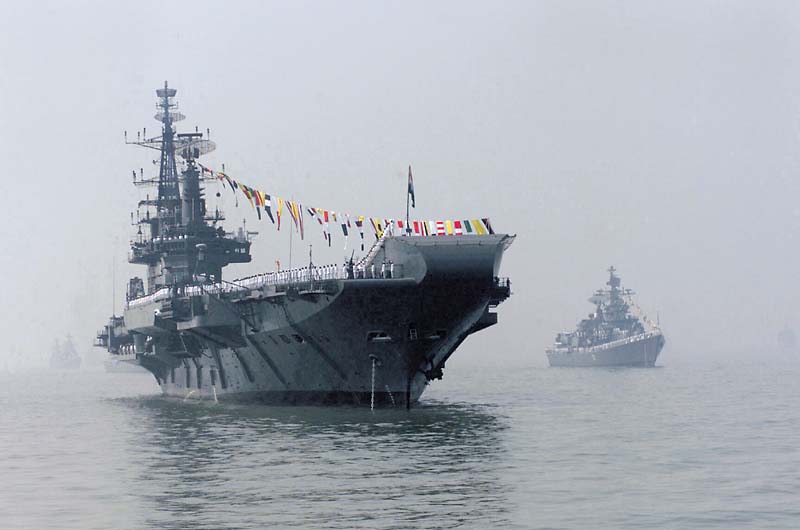
While waiting for the Vikrant to be ready, India will have to extend the service life of the already aged INS Viraat, which began life as HMS Hermes in the Royal Navy before being transferred to Indian service in 1987. She is the oldest aircraft carrier in active service in any navy.

Image from Wikipedia.

August 6, 2012

Admiral Fisher: an excitable sort of man

Filed under: Britain, Germany, History, Humour, WW1 — Tags: , , , — Nicholas @ 10:41

Admiral “Jackie” Fisher was a major historical figure in the Royal Navy, advocate of the modern dreadnought battleship and a tad high-strung (“…and on one occasion, the king asked him to stop shaking his fist in his face”). His relationship with Winston Churchill at the Admiralty must have been something to observe, as two of the most influential men in London worked together (for a while). After leaving the Admiralty for the last time, he still kept in touch with Churchill. Here is an example of his communication style:

This is believed to be the first documented use of the now familiar “OMG”.

H/T to Shaun Usher.

August 2, 2012

US military faces recruiting nightmare

Filed under: Health, Military, USA — Tags: , , , , — Nicholas @ 09:17

Strategy Page outlines the most recent major problem the US military is facing: the bloat of potential recruits (not in numbers, but in individual mass). While the number of new recruits needed is declining, the pool of potential recruits to draw from has been declining even faster:

The problem is that Americans have, in the last two decades, become very fat and out-of-shape. There are 32 million male Americans of prime military age (17-24). But because of bad lifestyle choices, only 13 percent of them (4.2 million) are physically eligible for service. Each year, the armed forces have to recruit 150,000 new troops. The military is allowed to waive some physical or mental standards, and this means that only about 20 percent of those 32 million potential recruits qualify. Each year, recruiters have to convince about two percent of those eligible that they should join up. It’s a tough job, made worse by a generation that eats too much, exercises too little and doesn’t pay enough attention in school. You not only have to be physically fit enough to join, you also have to be smart enough and have no criminal record.

The enormous growth in computer entertainment, and subsequent massive reduction in exercise teenage boys get is the major reason for the body fat percentage crisis. As a result, one of the biggest problems American military recruiters have is unfit young Americans trying to enlist. Some 57 percent of potential recruits are not eligible because they do not score high enough on the aptitude test the military uses to see if people have enough education and mental skills to handle military life. Many of those who score too low do so because they did not do well at school. A lot of these folks have high IQs, but low motivation. Most of the remainder are not eligible for physical reasons. But get this; the most common physical disqualifier is being overweight. Nearly a third of the people of military age are considered obese. Many of these big folks are eager to join, and are told how much weight they have to lose before they can enlist. Few return light enough to sign up.

Computer gaming and other forms of indoor entertainment certainly bear some of the blame for the obesity problem, but other issues should also be included: helicopter parents who don’t dare let their kids go outside to play without full-time parental supervision, schools that have reduced or eliminated physical education for budget or liability reasons, and the huge increase in availability of low-priced, high-calorie fast foods.

July 29, 2012

US Navy’s surge to the Persian Gulf

Filed under: Middle East, Military, USA — Tags: , , — Nicholas @ 12:36

Strategy Page has the details:

The U.S. is sending another carrier task force to the Persian Gulf, and the ships are heading out four months early and will stay at sea for eight months instead of four. There are already two carrier task forces in the Gulf area, and for a short while there will be three when the third task force arrives in five months.

This is what the U.S. Navy describes as “surge capability” (getting the maximum number of ships to a war or hot sport in the shortest possible time). It’s a new policy, getting a workout here because of rising tensions in the Persian Gulf.

It all began eight years ago, after a massive surge for the invasion of Iraq. This caused several problems, one of them being a dip in morale. So the navy decided it had to keep ships at sea less often. That’s because the ships need more time in port for maintenance, and the more you keep the ships at sea (especially for more than four months at a time), the more sailors decide to leave the navy.

For the 2003 Iraq campaign the navy sent 72 percent of the combat fleet (221 of 306 warships, including seven of twelve carriers, 75 percent of the amphibious ships and 33 of 54 attack submarines). There were 600 navy (and marine) warplanes involved, and over 100,000 sailors and marines. But this was done in the midst of the navy’s usual (for several decades) routine of six month cruises followed by six months in port. The navy got so many ships and aircraft into the Iraqi campaign by skipping scheduled maintenance, keeping sailors at sea for very long periods and basically improvising. This meant that when the Iraq operation was over, the navy had more than half its ships out of action for months as maintenance for ships and rest for crews was caught up on.

July 27, 2012

US admiral calls for more “trucks” and fewer “limousines”

Filed under: Military, Technology, USA — Tags: , , , , — Nicholas @ 09:06

The Economist reports on a recent article in the US Naval Institute’s Proceedings by Admiral Jonathan Greenert, chief of naval operations:

The “luxury-car” platforms designed in the last days of the cold war (and which still dominate much military procurement) have not adapted well to changes in security and technology, he says. Such platforms must always carry the sophisticated equipment to defeat a sophisticated foe. Yet much of this may be irrelevant to the navy’s typical missions in the past 20 years: counter-terrorism, anti-piracy, mine-clearing, maritime patrolling and carrier operations in support of counter-insurgency campaigns in Iraq and Afghanistan.

Given the cost of building new platforms and the need to keep them in service for 30 to 50 years or even longer, Admiral Greenert wants them to be more like “trucks”: with plenty of space and power to accommodate different payloads. Some of the Pentagon’s oldest platforms have turned out to be much better trucks than their successors.

Because of its sheer size, its reserve electrical power and its small number of integral systems, at least compared with newer aircraft-carriers, the 50-year-old USS Enterprise has proved more adaptable than modern, densely packed designs. Unlike them, it has the space, storage and power-generating capacity to carry new aircraft types and new systems.

The same is true of the stalwart B-52 bomber. It first flew 60 years ago. It is now expected to stay in service until 2045. Conceived as a strategic bomber after the second world war, it has been recast many times. It is now proving to be a cost-effective platform for the latest precision-guided “stand-off” weapons (meaning those fired from afar). It is also more dependable than any of its more advanced successors.

Another advantage of high-tech payloads over platforms stems from Moore’s law: the doubling of computer-chip speed every two years or less. This embarrasses military planners. Even their latest and fabulously expensive equipment often lacks the processing power of cheap consumer gadgets. It takes at least 15 years to bring a new ship or aircraft from design to completion. That can be eight or more cycles of Moore’s law.

July 26, 2012

Wreck of WWII U-boat may be 100km up the Churchill River

Filed under: Cancon, Germany, History, Military, WW2 — Tags: , , — Nicholas @ 09:57

CBC News on the possible discovery of remains of a German WW2 submarine in Labrador:

The German government says it is possible, but added that it would be “sensational and unusual,” that a submarine could have ended up so far inland.

“We do know that German U-boats did operate in that region,” said Georg Juergens, the deputy head of mission for the German Embassy in Ottawa.

He notes that a Second World War-era, battery-operated weather station was found decades after being left in Labrador by a U-boat. It is now on display at the Canadian War Museum in Ottawa.

“We must brace ourselves for surprises,” Juergens told CBC News, while stressing that the submarine has yet to be positively identified.

More than a dozen U-boats may still be unaccounted for, he said.

If the mystery find is proven to be a submarine wreck, the German government does not favour bringing it to the surface.

“That would be against our tradition and our naval customs,” Juergens said. “This site then would be declared a war grave at sea.”

He said Canadian policy dovetails with German policy on such matters.

According to Juergens, the Newfoundland and Labrador government is now involved in efforts to authenticate the possible wreck.

July 23, 2012

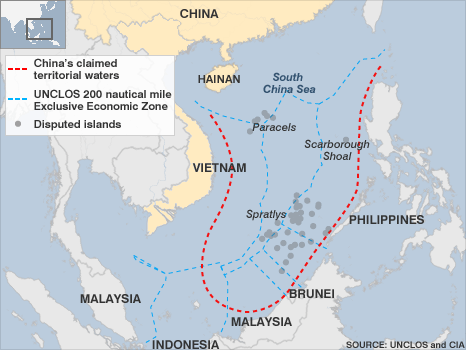
China’s latest ploy in the South China Sea

Filed under: China, Military, Pacific — Tags: , , , — Nicholas @ 12:29

To cement Chinese claims to the vast majority of the South China Sea, a garrison is being established in the Paracel Islands:

China’s powerful Central Military Commission has approved the formal establishment of a military garrison for the disputed South China Sea, state media said, in a move which could further boost tensions in already fractious region.

The Sansha garrison would be responsible for “national defence mobilisation … guarding the city and supporting local emergency rescue and disaster relief” and “carrying out military missions”, the Xinhua news agency said on Sunday.

China has a substantial military presence in the South China Sea and the move is a further assertion of its sovereignty claims after it last month upped the administrative status of the seas to the level of a city, which it calls Sansha.

Sansha city is based on what is known in English as Woody Island, part of the Paracel Islands also claimed by Vietnam and Taiwan.

July 22, 2012

HMCS Victoria torpedoes and sinks US Navy ship!

Filed under: Cancon, Military, Pacific, USA — Tags: , , — Nicholas @ 11:09

The word “decommissioned” should appear in that headline. Details here: http://www.liveleak.com/view?i=c51_1342677437

July 9, 2012

The F-35 is “unaffordable and simply unacceptable”

Filed under: Military, Technology, USA — Tags: , , , , — Nicholas @ 12:46

Winslow Wheeler on the near-doubling of the F-35 price (so far):

On June 14 — Flag Day, of all days — the Government Accountability Office released a new oversight report on the F-35: Joint Strike Fighter: DOD Actions Needed to Further Enhance Restructuring and Address Affordability Risks. As usual, it contained some important information on growing costs and other problems. Also as usual, the press covered the new report, albeit a bit sparsely.

Fresh bad news on the F-35 has apparently become so routine that the fundamental problems in the program are plowed right over. One gets the impression, especially from GAO’s own title to its report, that we should expect the bad news, make some minor adjustments, and then move on. But a deeper dive into the report offers more profound, and disturbing, bottom line.

Notorious for burying its more important findings in the body of a report — I know; I worked there for nearly a decade — GAO understates its own results on acquisition cost growth in its one-page summary, which — sadly — is probably what most read to get what they think is the bottom line.

[. . .]

Set in 2001, the total acquisition cost of the F-35 was to be $233.0 billion. Compare that to the current estimate of $395.7 billion: cost growth has been $162.7 billion, or 70%: a lot more than what GAO stated in its summary.

However, the original $233 billion was supposed to buy 2,866 aircraft, not the 2,457 currently planned: making it $162 billion, or 70%, more for 409, or 14%, fewer aircraft. Adjusting for the shrinkage in the fleet, I calculate the cost growth for a fleet of 2,457 aircraft to be $190.8 billion, or 93%.

The cost of the program has almost doubled over the original baseline; it is not an increase of 42%.

July 6, 2012

US Navy re-thinks their Pacific strategy options

Filed under: China, Military, Pacific, USA — Tags: , , , — Nicholas @ 08:07

Strategy Page discusses the historical uses of the submarine in the Pacific and why things would not be the same in the case of a Chinese war:

The U.S. Navy is rethinking how it will use its submarines in a future Pacific War. The problem is that a campaign against Chinese shipping is unlikely, in part because of what actually happened during the last great anti-shipping campaign, which occurred during World War II (1939-45). After the war, the U.S. analyzed its operations against Japanese shipping and found that submarines were important, but not the only weapon effective against shipping. Some 8.9 million tons of Japanese shipping was sunk or so seriously damaged (disabled) at the end of the war. Submarines accounted for 54.7 percent of this. But 16.3 percent was attributable to carrier-based aircraft, 14.5 percent to land- based planes and 9.3 percent to mines (most dropped by B-29s). Less than one percent was due to surface gunfire, and the balance of 4 percent was caused by accidents.

[. . .]

Meanwhile, the U.S. has adopted a new approach to any potential war with China. The U.S. Department of Defense has been told that, for the foreseeable future, there will be no more large-scale land campaigns. The air force, navy, and marines responded with a plan (AirSea Battle) that has been in the work for years. The new strategy is designed to cope with the rising power of China in the Pacific. AirSea Battle involves tighter planning and coordination of navy, marine, and navy forces, plus the development of some new weapons and tactics and cooperation with allies.

[. . .]

AirSea battle concentrates on military operations. But these will be heavily influenced by economic factors. For example, during World War II the United States was a largely self-sufficient “continental power.” We exported much (more than any other nation on the planet), but did not have to import much. That has changed. Now the U.S. has to import a lot of its oil, special raw materials (like “rare earths” from China) and a lot of manufactured goods. The U.S. is now like much of the rest of the world, China included. If there were a maritime blockade of China, the U.S. and many other Chinese trading partners would suffer severe economic disruptions. There would be massive unemployment for all concerned and that would happen despite energetic efforts by everyone to find alternative sources to goods no longer available because of the disruption of the China trade.

[. . .]

Meanwhile, the nuclear submarine community has done the math and found that their greatest contribution these days is not attacking enemy warships, but land bombardment with cruise missiles and intelligence collecting. Since the first nuclear subs showed up in the 1950s, only one, a British boat, has used a torpedo to sink a hostile warship. But hundreds of cruise missiles have been launched at land targets and uncounted (because they are highly classified) intelligence missions have been, and continue to be, carried out. All that is the recent past for subs, and is likely to be the future as well. World War II in the Pacific is not likely to be rerun. The U.S. Navy still expects its subs to go after enemy warships, and its surface and air forces to battle enemy subs. But a major war on shipping is much less likely.

July 4, 2012

Canada’s new Cyclone helicopters — already 4 years late — may not arrive for another 5 years

Filed under: Cancon, Military, Technology — Tags: , , , — Nicholas @ 10:32

Greg Weston reports for CBC News:

Canada’s long-promised fleet of new Sikorsky naval helicopters, already four years late and $300 million over budget, likely won’t be delivered and ready for combat for up to another five years, informed industry sources tell CBC News.

Last month, Connecticut-based Sikorsky missed its latest contract deadline to finish delivering 28 sleek, state-of-the-art Cyclone maritime helicopters to replace Canada’s aged fleet of increasingly unreliable Sea Kings, now nearing 50 years old.

In fact, delivery of the new choppers hasn’t even started.

[. . .]

As of last month, Sikorsky had only provided a couple of prototypes that have no military mission systems, and aren’t certified to fly over water or at night.

The two helicopters apparently spend most of their time on the tarmac at Shearwater Heliport at CFB Halifax as “training aids” for ground mechanics.

The machines are so incomplete the Canadian government refuses to accept them as an official delivery of anything in the contract.

What is it about helicopters in particular that makes it so difficult and so expensive for the Canadian government to acquire? Here’s the sad chronology:

  • In 1963, the CH-124 Sea King helicopter (a variant of the US Navy S-61 model) entered service with the Royal Canadian Navy.
  • In 1983, the Trudeau government started a process to replace the Sea Kings. That process never got far enough for a replacement helicopter to be ordered.
  • In 1985, the Mulroney government started a new process to find a replacement for the Sea Kings.
  • In 1992, the Mulroney government placed an order for 50 EH-101 Cormorant helicopters (for both naval and search-and-rescue operations).
  • In 1993, the Campbell government reduced the order from 50 to 43, theoretically saving $1.4B.
  • In 1993, the new Chrétien government cancelled the “Cadillac” helicopters as being far too expensive and started a new process to identify the right helicopters to buy. The government had to pay nearly $500 million in cancellation penalties.
  • In 1998, having split the plan into separate orders for naval and SAR helicopters, the government ended up buying 15 Cormorant SAR helicopters anyway — and the per-unit prices had risen in the intervening time.
  • In 2004, the Martin government placed an order with Sikorsky for 28 CH-148 Cyclone helicopters to be delivered starting in 2008 (after very carefully arranging the specifications to exclude the Cormorant from the competition).
  • Now, in 2012, we may still have another five years to wait for the delivery of the Cyclones.

Update: In the National Post, Kelly McParland tries to draw some useful conclusions from the longest-running Canadian comedy act:

If there is a solution to this farce it’s not easily identified. Canada desperately needs the helicopters and it is far too late to return once again to the drawing board. The blame is so widespread that politicians barely bother to bestir themselves to try: if Jean Chretien’s government hadn’t maliciously cancelled Brian Mulroney’s original 1992 purchase, a full decade might have been cut from the script, but there is no guarantee other mishaps wouldn’t have occurred. Ottawa’s only option now is to hound Connecticut-based Sikorsky relentlessly and mercilessly, recover every cent possible for its repeated failure to live up to its promises, and accept nothing less than full compliance with its contracted responsibilities.

The greater lesson lies in the nether world that surrounds military procurement. It’s a world where no promise can be accepted as reliable, no cost guarantee assumed to be binding, no contract treated as worth the paper it’s written on. The federal Conservatives should think long and hard on the Sea King saga as they push ever deeper into their own purchase of new fighter jets, whether the F-35 or otherwise. Prime Minister Stephen Harper would be well-advised to abandon his usual aggressive approach and tread warily. The uncertain costs, the shifting due dates, the obdurate insistence of the military mandarins on having their way, the determined stonewalling of the politicians : it has all the identifying markings of a Sea King re-make.

Update the second: On Facebook, Damian Brooks suggests that Kelly McParland is only able to see the humour because he hasn’t been close enough to the situation: “I’d be curious to know if McParland’s ever flown in one of our Sea Kings, with tranny fluid dripping down the fuselage, practicing autorotations ad nauseum (literally). I suspect not. If he had, I have a feeling he’d find the situation much more disgraceful and much less funny.” He also posted a link to this:

July 1, 2012

The Royal Navy’s successful privatization effort

Filed under: Britain, Business, Economics, Military — Tags: , , — Nicholas @ 00:04

Even the most dogmatic libertarian would be hard-pressed to defend the notion of privatizing the fighting navy, but the rest of the navy (training, support, maintenance, etc.) can in some instances be privatized not only without impacting military efficiency, but actually boosting it:

The Royal Maritime Auxiliary Service (RMAS) was privatised and taken over by Serco back in the 1990s and run for profit. To this day, Serco Denholm are responsible for the provision of all manner of auxiliary services, ranging from tugs and tender transfers, through to torpedo recovery craft, exercise minelayers and range target vessels.

All in all, there are easily over 100 vessels which can be found primarily in naval bases, but also in other establishments such as the Kyle of Lochalsh, around the UK. This fleet of vessels is an important reason to be positive for two reasons. Firstly, many navies rely on their own personnel to man and operate these vessels. When they need replacing, these costs are funded from naval budgets, and not from a wider contract fund. Similarly, the manpower needed to operate them comes from the Navy, and not from the private sector, meaning more sailors are needed to do this sort of job, and not go to sea on a ‘proper’ military vessel. By contracting out the service, the RN is able to focus its resources and manpower on proper military vessels, and not have to worry about finding funds to replace elderly tugs, at a time when it wants to bring frigates into service. It is not remotely glamorous, but it is an essential part of operating a Navy, and one that is often forgotten.

Also forgotten is just how new this fleet is — there has been a huge amount of investment in the port services fleet in recent years, with literally dozens of craft (Humphrey read something saying over 80 new vessels were being ordered) being built and entering service. The RN has managed to acquire the services of one of the most modern and effective port support vessels fleets in the world. This would not have happened if the RN were still looking after the RMAS — instead, by privatising it, the funding instead has brought new ships and better capabilities into service, at a reduced cost to the taxpayer. This matters because without it, the RN would be reliant on ever older ships, or finding scarce equipment programme funds to pay for them. (For those interested in the ships in service now, try this link — http://www.rfanostalgia.org/gallery3/index.php/RMAS)

« Newer PostsOlder Posts »

Powered by WordPress