Quotulatiousness

July 27, 2010

Photography is legal in Britain . . . unless they catch you at it

Filed under: Britain, Bureaucracy, Law — Tags: , , , — Nicholas @ 12:22

The continuing story of police harassment of peaceful photographers has still not come to a middle:

The Metropolitan Police Force cannot be guaranteed to abide by the law when it comes to allowing the public their right to take photographs.

That was the startling admission made last week by Met Police Commissioner John Stephenson under sharp questioning from Liberal Democrat London Assembly Member Dee Doocey during a Police Authority Meeting on 22 July in City Hall. Video footage of the exchange is available on the Metropolitan Police Authority site, with relevant footage from around the 68 minute mark.

[. . .]

He admitted that he was aware of a recent disturbing incident that took place in Romford, which according to Doocey represented “eight minutes of two of your officers intimidating somebody”.

She continued: “At one stage they say that they don’t need a law to stop them photographing, but much more worrying, they don’t need a law to take them away. It’s not a question in my view of . . . It’s so serious that it don’t think it should be somebody giving them words of advice and I don’t also agree with you that it is a question of officers using their discretion.

“This was very black and white: Two of your officers who, despite the fact that I know you have given them guidelines because I have a copy of it, who totally disregarded them and were either so completely ignorant of the law, or decided to ignore the law — they were just going to say they knew the law better than the person they were talking to — they were very seriously intimidating. I find it quite worrying that I don’t think you are taking this quite as seriously as I think you should be.”

In short, the powers-that-be have grudgingly acknowledged that photographers do indeed have the right to take photos unmolested by PC Plod, but admitted that it’s still not actually been properly communicated to Plod and the other coppers on the beat.

We asked the Met for official comment as to why, despite the numerous efforts made by Assistant Commissioner John Yates and other serving officers to get the message about photography across, such incidents kept occurring. They suggested that these incidents were a very small part of the whole story of London policing, that to expect zero incidents was unrealistic, and that when such incidents occurred, they tended to be blown up out of all proportion by the press.

An alternative explanation, suggested to us by current and recently serving police officers with whom we have spoken, is that such incidents represent a far more disturbing aspect of police culture. They suggest that a small minority of officers see the law as being “what they say it is”, and these officers are quite prepared to take their chances, on the basis that the number of times they will be caught out by being recorded is likely to be few and far between.

It’s almost as if the police are sublimating their frustrations with the out-of-control but politically favoured members of certain religious groups and instead victimizing members of the public who don’t have political favour.
June 18, 2010

Royal charter granted

Filed under: Britain, History, Technology — Tags: , , — Nicholas @ 13:01

The most recent recipients of a royal charter are the Worshipful Company of Information Technologists:

The Worshipful Company of Information Technologists received its Royal Charter yesterday — its mark of approval from the Queen.

The Livery Companies were originally proto-trade unions or professional standards bodies, depending which you look at it, based in the City of London. The first, the Worshipful Company of Mercers, got its Royal Charter in 1394 but was in existence for an unknown time before that. Although some retain a regulatory role — assay marks to show the purity of gold and silver are still overseen by the Company of Goldsmiths — most are now social and charitable bodies.

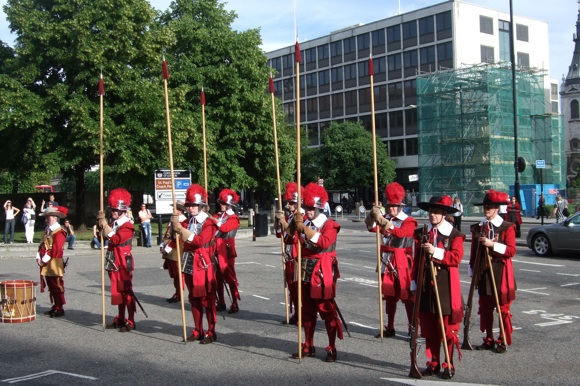
Yesterday’s ceremony was part of Evensong at London’s most beautiful building, St Paul’s Cathedral. The actual Royal Charter — a large vellum certificate — was blessed before freemen and livery men walked to Mansion House escorted by a ceremonial guard of Pikemen and Musketeers for a banquet with the Lord Mayor.

I was hoping that the recipients were the chaps with the morion helmets and the back-and-breastplates:

May 19, 2010

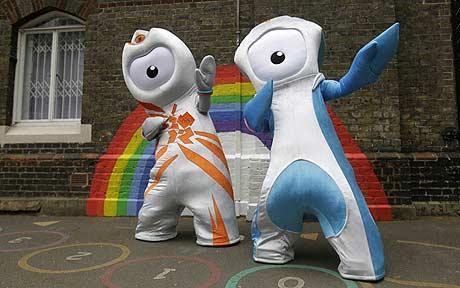
The 2012 Olympic organizers want to give your children nightmares

Filed under: Britain, Media, Sports — Tags: , , — Nicholas @ 15:05

At least, that’s the only explanation that seems to make sense:

January 22, 2010

London in the 1960s

Filed under: Britain, History — Tags: , , — Nicholas @ 12:26

I’m not from London, but the England I grew up in looked very similar to the typical street scenes here (except I grew up in Middlesbrough, so imagine looking at these scenes through a dark gray filter): Wasleso’s London 1960s slideshow.

November 30, 2009

2012 Olympic logo not just ugly, but also cartoon porn

Filed under: Britain, Law, Sports — Tags: , , , — Nicholas @ 12:41

One of the least aesthetic Olympic logos ever devised may also be deemed pornographic:

Government zeal in pursuing anyone suspected of harbouring paedophilic tendencies may shortly rebound — with unintended consequences for the 2012 Olympic logo.

Earlier this month, the Coroners & Justice Bill 2009 received the Royal Assent. This Act was another of those portmanteau pieces of legislation for which the current government is famous, mixing up new regulations on the holding of inquests, driving offences, provocation in murder cases and, crucially, a new law making it a criminal offence to be found in possession of an indecent cartoon image of a child.

The horror facing the unpopular Olympics logo is that this is a strict liability offence. If an image is indecent, or held to be so by a jury, it is no good the Olympic Committee claiming that it was not intended as such.

Regular readers will be aware of the controversy that surrounded the current logo since the day it was launched. Critics were not impressed by the £400,000 that had allegedly been shelled out to creative consultancy Wolff Olins to come up with the design. However, it was the logo’s perceived suggestiveness — with many sniggering that it appeared to show Lisa Simpson performing an act of fellatio — that excited internet controversy.

You’ll not that I was careful not to show the offending logo, both for fear of prosecution and because it’s hideous:

[Perry de Havilland]: What does it look like to you? To me it is obvious: a collapsing structure of some sort, perhaps a building at the moment of demolition. The sense of downwards motion towards the bottom of the page is palpable.

Breathtaking. I mean what truly magnificent symbolism. The entire Olympic endeavour has been a massive looting spree with already grotesque cost over-runs (and it is only 2007), so surely something that conjures up images of collapse and disaster is really on the money . . . and speaking of money, at £400,000 (just under $800,000 USD) for the logo, it perfectly sums up the whole ‘Olympic Experience’ for London taxpayers. [. . .]

[James Lileks]: Seriously, what is the matter with people who come up with this? And what is the matter with the people who approved it? Ads that showed the logos have reportedly caused seizures among British epileptics, but I think this thing would make a fossilized femur bone suffer convulsive muscle spasms. If you can’t tell, it’s the year of the London games — 2012. I think it’s also meant to imply a human form — say, a discus thrower, or a runner bursting from the blocks. Whatever it is, it’s an aesthetic catastrophe, and would seem to indicate there’s no one around in the London Games who had the nerve to bark “rubbish, that; try again, and give me a proper logo with some bloody numbers.” I think there’s a point at which people lose the ability to pretend they have any sort of aesthetic criteria, and embrace whatever’s loud and ugly simply because loud and ugly is the style of the times. There’s always a fair amount of coin to be had for dissing the traditionalists, of course; I imagine that if someone submitted a logo with a flag or a bulldog they would have suffered a gentle sneer: still pining for the empire, eh, Smithson. Well, Kipling’s dead. Yes he is. Dig him up, you’ll find Posh Spice’s heel stuck in his heart, the coffin stuffed with I Heart Diana memorial teddy bears.

October 16, 2009

Friday links of possible interest

Filed under: Britain, Football, Health, Humour, Religion, Technology — Tags: , , , , , , — Nicholas @ 12:25
« Newer Posts

Powered by WordPress