Quotulatiousness

September 23, 2011

The cliché-meister strikes again

Filed under: Books, Economics, Environment, Media, Politics — Tags: , , — Nicholas @ 13:04

Andrew Ferguson reviews the book That Used To Be Us by Thomas L. Friedman and Michael Mandelbaum. He didn’t find it a pleasant read:

Mr. Friedman can turn a phrase into cliché faster than any Madison Avenue jingle writer. He announces that “America declared war on math and physics.” Three paragraphs later, we learn that we’re “waging war on math and physics.” Three sentences later: “We went to war against math and physics.” And onto the next page: “We need a systemic response to both our math and physics challenges, not a war on both.” Three sentences later: We must “reverse the damage we have done by making war on both math and physics,” because, we learn two sentences later, soon the war on terror “won’t seem nearly as important as the wars we waged against physics and math.” He must think we’re idiots.

The slovenliness of our language, George Orwell wrote, makes it easier to have foolish thoughts, and while Mr. Friedman’s language has been tidied up a bit, the thinking remains what it has always been. The authors call themselves “frustrated optimists.” Their frustration is owing to the depredations of the last decade, which they call (Mr. Mandelbaum nods) the Terrible Twos. But self-contradiction is also part of the Friedman brand. In many other passages, the authors specifically trace the American slide to the end of the Cold War — though still elsewhere they remark that the 1990s were “positive for America.” It doesn’t help their argument, such as it is, that the evidence of decline they cite — crumbling infrastructure, a failing public-education system — predates both 2001 and 1989 by a long stretch. Our potholes and schools have been favorites of declinists for generations.

If the authors’ frustration is unoriginal and ill-defined, their optimism is terrifying. America will rebound — we will become the us that we used to be again, you might say and Mr. Friedman does — when we regain our ability to do “big things” through “collective action.” Collective action is a phrase that means “the federal government.” Among the big things that we will do are rework American industry, through regulation and taxation, to drastically cut carbon emissions. Another one of our big things is a big increase in the gasoline tax. We will also impose on us a new big carbon tax. We will use revenues to create a “clean energy” industry with millions of “green jobs” like the ones that were eliminated earlier this month at Solyndra. Readers will wonder, like the early environmentalist Tonto, “What do you mean ‘we,’ kemo sabe?”

H/T to Jon, my former virtual landlord, for the link.

September 22, 2011

We need to borrow another word from German

Filed under: Germany, Randomness — Tags: — Nicholas @ 12:29

The English language is adept at picking up bits of vocabulary from other languages — it’s one of the greatest strengths of English. I’ve just read of a word in German that I have needed for decades:

Schadenfreude captures a much more complex psychological concept, and therefore lacks a single-word counterpart in the English dictionary (Schadenfreude itself is a combination of the German words Schaden and Freude; meaning damage and joy respectively).

Nonetheless, Schadenfreude is such a basic human experience, that it is only natural that — if you don’t develop your own word for it — you would certainly want to adopt somebody else’s word for it into your vocabulary.

Another word that seems similarly essential to describing a particular feeling that most humans experience at some time or another, but which — unlike Schadenfreude — has somehow evaded incorporation into the English language, appears in the verb “Fremdschämen“:

Fremdschämen describes embarrassment which is experienced in response to someone else’s actions, but it is markedly different from simply being embarrassed for someone else. In particular it is different from being embarrassed because of how another person’s actions reflect on us or because of how another person’s actions make us look in the eyes of others.

Instead, Fremdscham (the noun) describes the almost-horror you feel when you notice that somebody is oblivious to how embarrassing they truly are. Fremdscham occurs when someone who should feel embarrassed for themselves simply is not, and you start feeling embarrassment in their place. It is at the heart of beloved “mockumentaries” such as The Office, Modern Family, or Ricky Gervais’ Extras. It is also what makes the auditions for American Idol, Britain’s got Talent and Deutschland Sucht den Superstar so discomfortingly entertaining…

I can now use the correct word to express how almost-physically-painful I feel when I see someone else get embarrassed or humiliated. Fremdschämen. I must remember that.

September 19, 2011

Why are kids using the word “gay” to mean “lame”?

Filed under: Britain, Media — Tags: , , , , , — Nicholas @ 09:23

Brendan O’Neill isn’t going to get letters of love and support for his current column in the Telegraph:

One thing that causes great consternation amongst schoolteachers, commentators and gay-rights activists is that young people use the word gay to mean “rubbish”. Last week it was reported that thousands of schoolchildren, some as young as four, have been reported to their local authorities for using racist or homophobic language, including using “gay” as a stand-in for “naff”. One boy was reprimanded for saying in class: “This work’s gay.” This follows other gay-as-rubbish controversies, including a tsunami of newspaper outrage when, in 2006, BBC Radio 1 presenter Chris Moyles described a mobile phone ringtone as “gay”, and even more outrage when the BBC inquiry into his remark ruled that the word gay is “often now used to mean ‘lame’ or ‘rubbish’. This is widespread current usage… among young people.”

But is it really such a mystery as to why the word gay has come to mean rubbish? It seems obvious to me. It is because gay culture is quite knowingly and resolutely lame. I don’t mean culture that happens to be produced by homosexuals, which includes some of the greatest art in history. No, I mean the stuff that passes for mainstream “gay culture”, foisted upon us by gay TV producers, filmmakers and magazine publishers, which is almost always shallow and camp and kitsch. That is, crap. If young people associate “gay” with “rubbish”, then they’re more perceptive than we give them credit for — they have twigged that, sadly, what is these days packaged up us as “gay culture” is almost always patronising pap.

September 17, 2011

Decoding book review language

Filed under: Books, Humour, Media — Tags: , , — Nicholas @ 11:17

Have you ever bought a book on the recommendation of a book review, then found it didn’t match up to your expectations? Here is a useful guide to what the reviewer is actually saying:

“absorbing”: “makes a great coaster” @DonLinn Don Linn, publishing consultant

“accessible”: “not too many big words” @MarkKohut Mark Kohut, writer and consultant

“acclaimed”: “poorly selling” @BloomsburyPress Peter Ginna, publisher, Bloomsbury Press

“breakout book”: “Hail Mary pass” @BookFlack Larry Hughes, associate director of publicity, the Free Press at Simon & Schuster

“brilliantly defies categorization”: “even the author has no clue what he’s turned in” @james_meader James Meader, publicity director of Picador USA

“captures the times we live in”: “captures the times we were living in two years ago” @mathitak Mark Athitakis, critic

“classroom-friendly”: “kids won’t read it unless they have to” @LindaWonder, Linda White, book promoter at Wonder Communications

August 31, 2011

Despite media reports, Australia didn’t “screw up” torpedo purchase

Filed under: Australia, France, Italy, Media, Military — Tags: , , — Nicholas @ 08:58

Strategy Page expresses a bit of contempt for the Fairfax media reporters who mangled a story to get a juicy headline or six:

Another good example of mass media screwing up a story on the military recently appeared in Australia. Fairfax, the largest media group in Australia ran a late August story asserting that the Australian Navy had mishandled the acquisition of new anti-submarine torpedo from France, and had to hire translators to turn the French and Italian user and technical manuals into English. The Defense Ministry quickly responded and pointed out that the Fairfax reporters had misunderstood the situation. The contract to purchase the torpedoes stipulated that all documents be in English. This is standard for such purchases, and has been for a long time. The Fairfax reporters should have known that. The Defense Ministry was hiring translators to handle additional data, not covered by the MU90 purchase, on some of the 200 test launches of the torpedo. This would save the Australian Navy a lot of money as some of their own test launches could be skipped, if the French and Italian tests covered the same situations. But the documents on most of those tests were in the language of the navy conducting them (French or Italian.) The reports were classified, but the two navies were willing to share them, although it was understood that Australia would have to handle translations. This has been standard practice for decades, but the Fairfax reporters didn’t dig that deep. This sort of facile military reporting has become increasingly common. It goes beyond calling all warships (except carriers and subs) “battleships” (a class of ship that went out of wide use half a century ago) or calling self-propelled artillery (or even infantry fighting vehicles) “tanks” simply because they all have turrets (but very different uses). The bad reporting extends to many other basic items of equipment, training, leadership, tactics and casualties.

The argument from the press is probably that the public doesn’t know — and doesn’t care about — the differences between warship classes or armoured vehicles anyway, so they don’t “waste their time” by being accurate.

August 10, 2011

English in India

Filed under: History, India — Tags: — Nicholas @ 08:55

An interesting post at The Economist‘s Johnson blog looks at the evolution of “Hinglish”:

Once the British left India, Anglo-Indian died a natural death. In its place came a chutnified Indian English that mixes American and British versions of the language with vernacular words and syntax and direct translations of phrases.

A glimpse of the breadth of influences in contemporary Indian English can be found at the delightfully-named Samosapedia. A cross between Hobson-Jobson and Urban Dictionary, the website modestly describes itself as “the definitive guide to South Asian lingo” and invites users to “catalog and celebrate the rich, diverse and ever-evolving landscape of this region’s shared vernacular”. Over 2,500 words and phrases have been added since Samosapedia was launched at the end of June.

Samosapedia is a lot of fun. It is also fascinating. Many phrases it lists are common across India: A “chaddi buddy” (lit: underwear friend) is someone you’ve known since childhood; “kabab mein haddi” (lit: a bone in the kebab) is a third wheel with better imagery; an “enthu cutlet” (lit: an enthusiastic mincemeat croquette) is an overly earnest soul. But then there are those that come from regions, sub-cultures and even neighbourhoods. “Talking-shalking” highlights the Punjabi fondness for rhyme. “Sandra from Bandra” is a stereotype from a predominantly Catholic suburb of Mumbai. “Send it” refers to smoking pot.

The entries at Samosapedia also offer an insight into how Indian culture is changing. “Traditional with modern outlook”, often found in matrimonial ads, encapsulates the evolving nature of arrange marriage—or “love-cum-arranged marriage”—where the prospective bride and groom have far greater say in their partners than earlier generations did. “Behenji-turned-mod” is a condescending term for a traditional woman transitioning from fusty and oily-haired to a more urban, socially acceptable version of herself. It is telling that these undoubtedly modern but widely-used phrases exist in Hinglish, a portmanteau of Hindi and English.

Lots of links in the original post to various entries in Samosapedia.

August 1, 2011

Vocabulary test

Filed under: Randomness — Tags: , — Nicholas @ 12:22

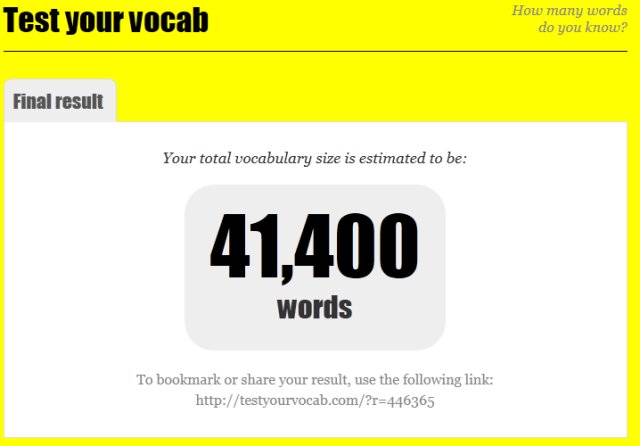
Another one of those “test yourself” websites: Test Your Vocabulary. I did fine on most of the test, but a few of the words in the right column are ones I’ve never encountered:

H/T to James M. Bryant for the link.

Update: On the same list, John Lennard points out this possibly cautionary note: “It is interesting, but without knowing how they’re performing their calculations I’m kinda suspicious. [. . .] Shakespeare’s total recorded active vocabulary (all words used in all his printed works) is 29,066.”

June 2, 2011

When menu translators go feral: “Timid and rapidly grown prostitutes”

Filed under: Food, Humour — Tags: — Nicholas @ 12:16

Victor Mair finds the menu items lost something, but gained humour, in the translation:

The basic Bèn School Method seems to be to look each content word up in a bilingual dictionary, and to pick the most amusing and least grammatical option among the alternatives on offer. The word order of the translation seems to be a semi-random compromise among the various languages involved.

H/T to Tom Vinson for the link.

Pity the poor, over-used em-dash

Filed under: Media, Randomness — Tags: , , , , — Nicholas @ 09:39

Noreen Malone — who admits to being an em-dash abuser herself — makes an appeal for everyone to just leave the em-dash alone!

According to the Associated Press StylebookSlate‘s bible for all things punctuation- and grammar-related — there are two main prose uses— the abrupt change and the series within a phrase — for the em dash. The guide does not explicitly say that writers can use the dash in lieu of properly crafting sentences, or instead of a comma or a parenthetical or a colon — and yet in practical usage, we do. A lot — or so I have observed lately. America’s finest prose — in blogs, magazines, newspapers, or novels — is littered with so many dashes among the dots it’s as if the language is signaling distress in Morse code.

What’s the matter with an em dash or two, you ask? — or so I like to imagine. What’s not to like about a sentence that explores in full all the punctuational options — sometimes a dash, sometimes an ellipsis, sometimes a nice semicolon at just the right moment — in order to seem more complex and syntactically interesting, to reach its full potential? Doesn’t a dash — if done right — let the writer maintain an elegant, sinewy flow to her sentences?

Nope — or that’s my take, anyway. Now, I’m the first to admit — before you Google and shame me with a thousand examples in the comments — that I’m no saint when it comes to the em dash. I never met a sentence I didn’t want to make just a bit longer — and so the dash is my embarrassing best friend. When the New York Times‘ associate managing editor for standards — Philip B. Corbett, for the record — wrote a blog post scolding Times writers for overusing the dash (as many as five dashes snuck their way into a single 3.5-paragraph story on A1, to his horror), an old friend from my college newspaper emailed it to me. “Reminded me of our battles over long dashes,” he wrote — and, to tell the truth, I wasn’t on the anti-dash side back then. But as I’ve read and written more in the ensuing years, my reliance on the dash has come to feel like a pack-a-day cigarette habit — I know it makes me look and sound and feel terrible — and so I’m trying to quit.

Bloggers (some of us, anyway) tend to use the em-dash a bit too frequently, and that’s one of the downsides to being one-person shows — there’s no kindly editor to strike through the excess punctuation with a red pen.

May 28, 2011

Etymology of the word “buxom”

Filed under: History, Law, Randomness — Tags: — Nicholas @ 12:22

In a report on a lawyer’s attempt to become an internet laughing stock, there’s a brief digression into the word “buxom”:

To get back to “buxom” — I was surprised to learn that, according to the OED, this word originally had nothing specifically to do with women. It meant something like “obedient,” “pliant,” or “submissive,” but in reference to God, the Pope, or legal authority — e.g., c.1175 “Beo buhsome toward gode”; c.1523 “I shall be buxome and obeydient to iustice”; c. 1581 “The Consuls should sweare faythfully to become … buxome to the Pope.” (That last one especially I think is good evidence that the word didn’t mean what it means now.) The word also had the sense of “gracious,” “courteous,” or “kindly,” again without regard to gender.

By the 16th century, though, it was evolving into something like “lively” or “full of health,” still not exclusively as to women, but by the 19th century it looks like the dominant meaning had become “plump and comely … chiefly [to describe] women.” Given the word’s history of meaning “submissive” or “compliant,” though, this transition seems to make the word a lot more creepy and sexist than I had thought. I sweare faythfully not to use it anymore.

April 26, 2011

CBC headline: “Layton open to constitutional talks with Quebec”

Filed under: Cancon, Government, Politics — Tags: , , , , , — Nicholas @ 13:32

Oh, crikey. Because that’s exactly what we need to do to continue our recovery from the recession — re-open the constitutional debate all over again:

NDP Leader Jack Layton is willing to reopen talks on the Canadian Constitution in an effort to get Quebec to sign the document once there was a “reasonable chance of success.”

Layton was asked about the issue of constitutional talks on Tuesday in Montreal, where he is trying to capitalize on an apparent sharp increase in support for the NDP in recent public opinion polls.

The NDP leader, however, said he does not think the federal government should enter into constitutional negotiations with the provinces until “there is some reasonable chance of success.”

“It’s not a question of appeasing anybody. We have an historic problem. We have a quarter of our population who have never signed the Constitution. That can’t go on forever,” Layton said.

April 8, 2011

Swearing in soccer? Gasp! Shock! Horror!

Filed under: Britain, Media, Soccer — Tags: , — Nicholas @ 08:52

Duleep Allirajah wonders how the Football Association has managed to avoid hearing what soccer players say on the pitch until now:

Rooney swore? So f***ing what

Those fretting over the footballer’s anglo-saxon turn of phrase have clearly never been to a match before.

Wayne Rooney’s angry outburst was curious. What did it mean? Who was he addressing? In appearing to pick a fight with a TV camera, it immediately struck me as an homage to Robert De Niro’s famous ‘You talking to me?’ scene in Taxi Driver. But maybe I’m reading too much into it.

In a statement issued by his club, the player said: ‘Emotions were running high, and on reflection my heat-of-the-moment reaction was inappropriate. It was not aimed at anyone in particular.’ Maybe he was railing against his inner demons. Maybe there is no deeper meaning. Maybe it was a release of pent-up frustration after months of domestic strife and poor goal-scoring form.

But enough of my speculative interpretation, it’s the Football Association’s response that we should really be bothered about. The FA has banned Rooney for two matches for using ‘offensive, insulting and/or abusive language’. You don’t need to be a lipreader to work out that footballers swear quite a lot; every Saturday you’ll find them effing and blinding like proverbial troopers. But while disciplinary action for abusing match officials is nothing new, a ban for swearing per se is quite unprecedented.

February 6, 2011

“Mad Max” throws away the Quebec vote

Filed under: Cancon, Liberty, Politics — Tags: , , , — Nicholas @ 12:26

At least, that’s the way most in the media are likely to interpret his position on Bill 101:

Some people say I am not a “real Quebecer” and are accusing me of “attacking Quebec” simply because I want to be more popular in the rest of Canada. They seem unable to conceive that it’s possible to have a different position than theirs on the basis of fundamental principles.

My position is this: Yes, it’s important that Quebec remain a predominantly French-language society. And ideally, everyone in Quebec should be able to speak French. But we should not try to reach this goal by restricting people’s rights and freedom of choice.

French will survive if Quebecers cherish it and want to preserve it; it will flourish if Quebec becomes a freer, more dynamic and prosperous society; it will thrive if we make it an attractive language that newcomers want to learn and use. Not by imposing it and by preventing people from making their own decisions in matters that concern their personal lives.

Mad Max for PM!

Update, 9 February: According to an anonymous Conservative, Maxime Bernier is “mostly harmless”.

February 2, 2011

The Register: Let’s replace the discredited term “scientist” with “boffin”

Filed under: Media, Science — Tags: , — Nicholas @ 08:28

The Register, reacting to the decision by the Advertising Standards Authority to allow homeopaths and herbalists to be described as “scientists”, offers an alternative term:

We here at the Reg would like to offer as a new gold standard our use of the term “boffin” to replace the now officially discredited term “scientist” — which was already in our view unacceptably loosely applied, including as it did researchers in such fields as sports science, psychology etc.

A boffin, on these pages at least, will be a researcher whose work is based on hard sums and/or hard facts such as fossils, atomsmasher collisions etc. Statistics, especially ones gleaned by surveying students or counting up patents granted etc, will generally not count. Persons who work with the latter sorts of material will normally be known as eggheads, trick-cyclists, economists etc as appropriate.

And even though the word “scientist” now officially means nothing, we still aren’t going to apply it to homeopathic smellies experts.

January 22, 2011

How Big Government fans cast their arguments

Filed under: Government, Liberty, Politics — Tags: , , — Nicholas @ 12:01

L.A. Liberty rounds up the rhetorical conventions of Big Government sympathizers:

With discussions of “rhetoric” in the air, I thought it timely to propose what I have observed — from online discussions, family get-togethers, and everything in between — as the archetypal rhetorical conventions of big government sympathizers (i.e. the left, generally, though not exclusively):

* deflections (altering or averting the basis of the discussion to a different but seemingly related topic),
* assertions of pathos (appeals to one’s emotions, usually in the form of a sad hypothetical or a specific personal account, intended to either pity a concession or portray the opposition as a monster; this could also take the form of fear mongering),
* assertions of ethos (attempts to find hypocrisy in the opposition’s position, either by alleging that a different position held by the opposition is counter to their opposition’s current position, or by simply alleging “You would sing a different tune if it were you [or other person you care about] who needed [said government program]”)
* ad hominem attacks (related to pathos, such an attack charges either the opposition or another person who shares the opposition’s position in order to render an argument invalid, this often takes the form of accusations of racism, sexism, or some other form of bigotry),
* straw men (absurd conclusions, ostensibly based on the opposition’s argument, created in order to be refuted)
and perhaps most common of all…
* non-sequiturs (similar to straw men, these are failures in logic that assume incorrect conclusions; often a form of reducto ad absurdum based on incomplete or incorrect data)

These conventions can be explained by what is arguably the greatest weakness of big government sympathizers: a lack of reasoned thought and creativity that is the result of their inability to look beyond the status quo. In other words, because government does it, they have a hard time envisioning how it could be done without government.

« Newer PostsOlder Posts »

Powered by WordPress