Quotulatiousness

August 1, 2011

Vocabulary test

Filed under: Randomness — Tags: , — Nicholas @ 12:22

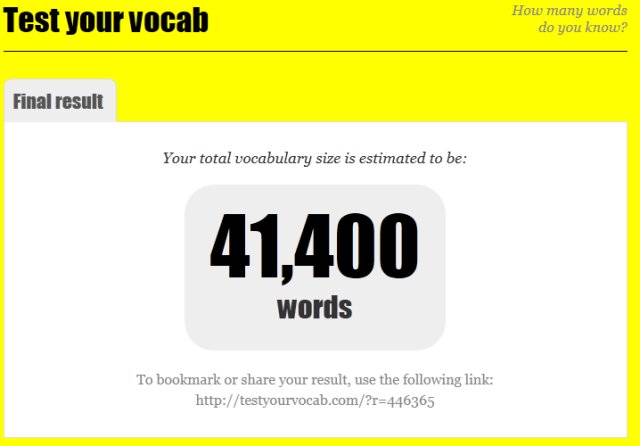
Another one of those “test yourself” websites: Test Your Vocabulary. I did fine on most of the test, but a few of the words in the right column are ones I’ve never encountered:

H/T to James M. Bryant for the link.

Update: On the same list, John Lennard points out this possibly cautionary note: “It is interesting, but without knowing how they’re performing their calculations I’m kinda suspicious. [. . .] Shakespeare’s total recorded active vocabulary (all words used in all his printed works) is 29,066.”

June 2, 2011

When menu translators go feral: “Timid and rapidly grown prostitutes”

Filed under: Food, Humour — Tags: — Nicholas @ 12:16

Victor Mair finds the menu items lost something, but gained humour, in the translation:

The basic Bèn School Method seems to be to look each content word up in a bilingual dictionary, and to pick the most amusing and least grammatical option among the alternatives on offer. The word order of the translation seems to be a semi-random compromise among the various languages involved.

H/T to Tom Vinson for the link.

Pity the poor, over-used em-dash

Filed under: Media, Randomness — Tags: , , , , — Nicholas @ 09:39

Noreen Malone — who admits to being an em-dash abuser herself — makes an appeal for everyone to just leave the em-dash alone!

According to the Associated Press StylebookSlate‘s bible for all things punctuation- and grammar-related — there are two main prose uses— the abrupt change and the series within a phrase — for the em dash. The guide does not explicitly say that writers can use the dash in lieu of properly crafting sentences, or instead of a comma or a parenthetical or a colon — and yet in practical usage, we do. A lot — or so I have observed lately. America’s finest prose — in blogs, magazines, newspapers, or novels — is littered with so many dashes among the dots it’s as if the language is signaling distress in Morse code.

What’s the matter with an em dash or two, you ask? — or so I like to imagine. What’s not to like about a sentence that explores in full all the punctuational options — sometimes a dash, sometimes an ellipsis, sometimes a nice semicolon at just the right moment — in order to seem more complex and syntactically interesting, to reach its full potential? Doesn’t a dash — if done right — let the writer maintain an elegant, sinewy flow to her sentences?

Nope — or that’s my take, anyway. Now, I’m the first to admit — before you Google and shame me with a thousand examples in the comments — that I’m no saint when it comes to the em dash. I never met a sentence I didn’t want to make just a bit longer — and so the dash is my embarrassing best friend. When the New York Times‘ associate managing editor for standards — Philip B. Corbett, for the record — wrote a blog post scolding Times writers for overusing the dash (as many as five dashes snuck their way into a single 3.5-paragraph story on A1, to his horror), an old friend from my college newspaper emailed it to me. “Reminded me of our battles over long dashes,” he wrote — and, to tell the truth, I wasn’t on the anti-dash side back then. But as I’ve read and written more in the ensuing years, my reliance on the dash has come to feel like a pack-a-day cigarette habit — I know it makes me look and sound and feel terrible — and so I’m trying to quit.

Bloggers (some of us, anyway) tend to use the em-dash a bit too frequently, and that’s one of the downsides to being one-person shows — there’s no kindly editor to strike through the excess punctuation with a red pen.

May 28, 2011

Etymology of the word “buxom”

Filed under: History, Law, Randomness — Tags: — Nicholas @ 12:22

In a report on a lawyer’s attempt to become an internet laughing stock, there’s a brief digression into the word “buxom”:

To get back to “buxom” — I was surprised to learn that, according to the OED, this word originally had nothing specifically to do with women. It meant something like “obedient,” “pliant,” or “submissive,” but in reference to God, the Pope, or legal authority — e.g., c.1175 “Beo buhsome toward gode”; c.1523 “I shall be buxome and obeydient to iustice”; c. 1581 “The Consuls should sweare faythfully to become … buxome to the Pope.” (That last one especially I think is good evidence that the word didn’t mean what it means now.) The word also had the sense of “gracious,” “courteous,” or “kindly,” again without regard to gender.

By the 16th century, though, it was evolving into something like “lively” or “full of health,” still not exclusively as to women, but by the 19th century it looks like the dominant meaning had become “plump and comely … chiefly [to describe] women.” Given the word’s history of meaning “submissive” or “compliant,” though, this transition seems to make the word a lot more creepy and sexist than I had thought. I sweare faythfully not to use it anymore.

April 26, 2011

CBC headline: “Layton open to constitutional talks with Quebec”

Filed under: Cancon, Government, Politics — Tags: , , , , , — Nicholas @ 13:32

Oh, crikey. Because that’s exactly what we need to do to continue our recovery from the recession — re-open the constitutional debate all over again:

NDP Leader Jack Layton is willing to reopen talks on the Canadian Constitution in an effort to get Quebec to sign the document once there was a “reasonable chance of success.”

Layton was asked about the issue of constitutional talks on Tuesday in Montreal, where he is trying to capitalize on an apparent sharp increase in support for the NDP in recent public opinion polls.

The NDP leader, however, said he does not think the federal government should enter into constitutional negotiations with the provinces until “there is some reasonable chance of success.”

“It’s not a question of appeasing anybody. We have an historic problem. We have a quarter of our population who have never signed the Constitution. That can’t go on forever,” Layton said.

April 8, 2011

Swearing in soccer? Gasp! Shock! Horror!

Filed under: Britain, Media, Soccer — Tags: , — Nicholas @ 08:52

Duleep Allirajah wonders how the Football Association has managed to avoid hearing what soccer players say on the pitch until now:

Rooney swore? So f***ing what

Those fretting over the footballer’s anglo-saxon turn of phrase have clearly never been to a match before.

Wayne Rooney’s angry outburst was curious. What did it mean? Who was he addressing? In appearing to pick a fight with a TV camera, it immediately struck me as an homage to Robert De Niro’s famous ‘You talking to me?’ scene in Taxi Driver. But maybe I’m reading too much into it.

In a statement issued by his club, the player said: ‘Emotions were running high, and on reflection my heat-of-the-moment reaction was inappropriate. It was not aimed at anyone in particular.’ Maybe he was railing against his inner demons. Maybe there is no deeper meaning. Maybe it was a release of pent-up frustration after months of domestic strife and poor goal-scoring form.

But enough of my speculative interpretation, it’s the Football Association’s response that we should really be bothered about. The FA has banned Rooney for two matches for using ‘offensive, insulting and/or abusive language’. You don’t need to be a lipreader to work out that footballers swear quite a lot; every Saturday you’ll find them effing and blinding like proverbial troopers. But while disciplinary action for abusing match officials is nothing new, a ban for swearing per se is quite unprecedented.

February 6, 2011

“Mad Max” throws away the Quebec vote

Filed under: Cancon, Liberty, Politics — Tags: , , , — Nicholas @ 12:26

At least, that’s the way most in the media are likely to interpret his position on Bill 101:

Some people say I am not a “real Quebecer” and are accusing me of “attacking Quebec” simply because I want to be more popular in the rest of Canada. They seem unable to conceive that it’s possible to have a different position than theirs on the basis of fundamental principles.

My position is this: Yes, it’s important that Quebec remain a predominantly French-language society. And ideally, everyone in Quebec should be able to speak French. But we should not try to reach this goal by restricting people’s rights and freedom of choice.

French will survive if Quebecers cherish it and want to preserve it; it will flourish if Quebec becomes a freer, more dynamic and prosperous society; it will thrive if we make it an attractive language that newcomers want to learn and use. Not by imposing it and by preventing people from making their own decisions in matters that concern their personal lives.

Mad Max for PM!

Update, 9 February: According to an anonymous Conservative, Maxime Bernier is “mostly harmless”.

February 2, 2011

The Register: Let’s replace the discredited term “scientist” with “boffin”

Filed under: Media, Science — Tags: , — Nicholas @ 08:28

The Register, reacting to the decision by the Advertising Standards Authority to allow homeopaths and herbalists to be described as “scientists”, offers an alternative term:

We here at the Reg would like to offer as a new gold standard our use of the term “boffin” to replace the now officially discredited term “scientist” — which was already in our view unacceptably loosely applied, including as it did researchers in such fields as sports science, psychology etc.

A boffin, on these pages at least, will be a researcher whose work is based on hard sums and/or hard facts such as fossils, atomsmasher collisions etc. Statistics, especially ones gleaned by surveying students or counting up patents granted etc, will generally not count. Persons who work with the latter sorts of material will normally be known as eggheads, trick-cyclists, economists etc as appropriate.

And even though the word “scientist” now officially means nothing, we still aren’t going to apply it to homeopathic smellies experts.

January 22, 2011

How Big Government fans cast their arguments

Filed under: Government, Liberty, Politics — Tags: , , — Nicholas @ 12:01

L.A. Liberty rounds up the rhetorical conventions of Big Government sympathizers:

With discussions of “rhetoric” in the air, I thought it timely to propose what I have observed — from online discussions, family get-togethers, and everything in between — as the archetypal rhetorical conventions of big government sympathizers (i.e. the left, generally, though not exclusively):

* deflections (altering or averting the basis of the discussion to a different but seemingly related topic),
* assertions of pathos (appeals to one’s emotions, usually in the form of a sad hypothetical or a specific personal account, intended to either pity a concession or portray the opposition as a monster; this could also take the form of fear mongering),
* assertions of ethos (attempts to find hypocrisy in the opposition’s position, either by alleging that a different position held by the opposition is counter to their opposition’s current position, or by simply alleging “You would sing a different tune if it were you [or other person you care about] who needed [said government program]”)
* ad hominem attacks (related to pathos, such an attack charges either the opposition or another person who shares the opposition’s position in order to render an argument invalid, this often takes the form of accusations of racism, sexism, or some other form of bigotry),
* straw men (absurd conclusions, ostensibly based on the opposition’s argument, created in order to be refuted)
and perhaps most common of all…
* non-sequiturs (similar to straw men, these are failures in logic that assume incorrect conclusions; often a form of reducto ad absurdum based on incomplete or incorrect data)

These conventions can be explained by what is arguably the greatest weakness of big government sympathizers: a lack of reasoned thought and creativity that is the result of their inability to look beyond the status quo. In other words, because government does it, they have a hard time envisioning how it could be done without government.

January 19, 2011

Hollywood gets exposed to “the nihilism of the British way”

Filed under: Britain, Humour, USA — Tags: , — Nicholas @ 16:55

Did you watch the Golden Globes awards the other night? I didn’t, but I rather enjoyed watching Ricky Gervais do his introduction (courtesy of YouTube and literally hundreds of contributors). It may be one of the larger gaps between image and reality . . . the way Americans think Brits talk and how they slag one another off:

Anyone from anywhere can be cruel, anyone from anywhere can be witty, but there is something particularly British about cruel wit. John Lennon, with his withering remarks about Ringo Starr (“Not even the best drummer in The Beatles”) and the avant-garde (“French for bullshit”), had it. Writers past (Evelyn Waugh) and present (AA Gill) have it. George Osborne, the chancellor of the exchequer, has it, and gets into political scrapes when he flaunts it.

The anything-goes approach applies as much to everyday conversation as it does to comedy, where the subject of British irreverence has been analysed to death (and where America has plenty of acid-tongued geniuses itself). It feels natural to those of us who grew up with it, but British banter — the playfully barbed conversational style adopted by groups of friends in bars, offices and even classrooms up and down the country — can baffle and perturb foreigners. It is especially jarring when set against the popular image of Britain as a more decorous and civil place than most. Even tamer badinage in this country can, to a foreign ear, sound like enmity. The moment the ice is truly broken between two newly acquainted Britons is when one teases the other about something. Reginald D Hunter, an American comedian who does most of his work over here, says Britain is the only country where people will introduce you to a friend by saying “This is my mate Barry, he’s a bit of a twat.”

America is a land of Regency etiquette in comparison. So much so that it pays any Briton to be a bit more mindful of what he says and how he says it when enjoying the company of Americans (with the exception of fervently Anglophile Americans who, judging by friends of mine who fit that description, are caustic conversationalists). The rules are just different. For example, the c-word, which in Britain has lost much of its toxicity, remains a no-no.

December 4, 2010

Insults in other languages that don’t translate well

Filed under: Humour — Tags: — Nicholas @ 11:30

A fascinating thread on AskReddit asks “What are your favourite culturally untranslatable phrases?”

Language warning, so I’ve put it below the fold.

(more…)

October 30, 2010

Shakespeare in the original pronunciation

Filed under: Britain, History, Media — Tags: , , — Nicholas @ 10:18

It doesn’t sound much like your traditional Shakespeare production does it?

Like an archeologist reconstructing the fossilized skeleton of an ancient species, a University of Kansas theatre professor has pieced together the bones of a form of English that has never been heard in North America in modern times — the original pronunciation of Shakespeare.

Thanks to the work of Paul Meier, audiences can get a sense of what it might have been like to eavesdrop on opening night of “Hamlet” or “Romeo and Juliet” at the Globe Theater in London or to listen in on a shipboard conversation on the Mayflower as it approaches the shores of the New World.

“What did English sound like back then?” Meier said. “Was it posh or down to earth? Was it anything like today’s British or American English? Would we understand it?”

H/T to A Blog About History for the link.

October 22, 2010

Stephen Fry on language

Filed under: Education, Humour, Quotations — Tags: , — Nicholas @ 08:50

October 21, 2010

QotD: Linguistic voids and what they say about that culture

Filed under: Liberty, Quotations, Randomness — Tags: , , — Nicholas @ 16:45

I thought a bit more about how languages differ on how they assign words to concepts and how this affects the thought processes of people who think in those languages. For example, imagine if some language had only one word that meant both “buy” and “steal”, and you had to express the notion of free markets to them. Yet equally absurd examples abound in English that, despite its huge vocabulary, still uses one word “love” to express how newlyweds love each other, a parent loves a child, a Southerner loves good barbeque and a liberal loves Che Guevara, even though all four are utterly different things. Equally oddly, the verb “play” is used for poker, hopscotch, trumpet and Hamlet: maybe this somehow makes sense for native speakers, but in Finnish all four are different words. Another gap in English that I find ever stranger the more I think about it is how you have to say “extended family” since English does not have a separate word for this hugely important concept (at least I have never heard of it). Such gaps reveal a lot about the speakers who develop the language; for example, recall how the Chinese have one word “crisatunity” to mean both crisis and opportunity, Russians have no word for “freedom” and the French lack the word for an “entrepreneur”.

Ilkka, “A word for everything and everything in a word”, The Fourth Checkraise, 2010-10-21

September 27, 2010

QotD: Explorers and translation

Filed under: Humour, Quotations, Randomness — Tags: , — Nicholas @ 16:55

When the first explorers from the warm lands around the Circle Sea travelled into the chilly hinterland they filled in the blank spaces on their maps by grabbing the nearest native, pointing at some distant landmark, speaking very clearly in a loud voice, and writing down whatever the bemused man told them. Thus were immortalised in generations of atlases such geographical oddities as Just A Mountain, I Don’t Know, What? and, of course, Your Finger You Fool.

Terry Pratchett, The Light Fantastic, 1986

« Newer PostsOlder Posts »

Powered by WordPress


