
I said: “It irritated me; it must have been worse for you. Then there are saddles,” I went on — I wished to get this lesson home to him. “Can you think of any saddle ever advertised that you have not tried?”
He said: “It has been an idea of mine that the right saddle is to be found.”
I said: “You give up that idea; this is an imperfect world of joy and sorrow mingled. There may be a better land where bicycle saddles are made out of rainbow, stuffed with cloud; in this world the simplest thing is to get used to something hard. There was that saddle you bought in Birmingham; it was divided in the middle, and looked like a pair of kidneys.”
He said: “You mean that one constructed on anatomical principles.”
“Very likely,” I replied. “The box you bought it in had a picture on the cover, representing a sitting skeleton — or rather that part of a skeleton which does sit.”
He said: “It was quite correct; it showed you the true position of the—”
I said: “We will not go into details; the picture always seemed to me indelicate.”
He said: “Medically speaking, it was right.”
“Possibly,” I said, “for a man who rode in nothing but his bones. I only know that I tried it myself, and that to a man who wore flesh it was agony. Every time you went over a stone or a rut it nipped you; it was like riding on an irritable lobster. You rode that for a month.”
“I thought it only right to give it a fair trial,” he answered.
I said: “You gave your family a fair trial also; if you will allow me the use of slang. Your wife told me that never in the whole course of your married life had she known you so bad tempered, so un-Christian like, as you were that month. Then you remember that other saddle, the one with the spring under it.”
He said: “You mean ‘the Spiral.’”
I said: “I mean the one that jerked you up and down like a Jack-in-the-box; sometimes you came down again in the right place, and sometimes you didn’t. I am not referring to these matters merely to recall painful memories, but I want to impress you with the folly of trying experiments at your time of life.”
Jerome K. Jerome, Three Men on the Bummel, 1914.
February 15, 2015
QotD: Bicycle saddles
February 13, 2015
The Thiel Fellowship’s first “class”
Beth McMurtrie talks to the first group of former university students who dropped out to take advantage of the alternative offered by billionaire Peter Thiel:
In the five years since the billionaire investor Peter Thiel announced his eponymous fellowship, the project has assumed outsize social significance, as Mr. Gu discovered. Mr. Thiel’s outspoken nature and his view that the value of college is oversold have earned him both enemies and accolades.
For some, Mr. Thiel is a dangerous man, seeking to undermine a system that has proved the surest path to economic success for millions of Americans. For others, his ideas represent the future of American education, in which brilliant minds are freed from the convention of college and are encouraged to educate themselves on their own terms.
For Mr. Gu and other members of that first class of fellows, their experiences have been neither as dire nor as dramatically successful as observers on both sides predicted. While many fellows say they appreciate what college gave them, they also didn’t feel they needed a credential to pursue their dreams. And while they agree that dropping out isn’t the right choice for many students, they hope they’re proof that there’s not just one path to success.
Indeed, while higher-education experts debate his philosophy, they agree that Mr. Thiel has succeeded in getting more Americans to ask what college provides that the working world cannot.
Jake Schwartz, who heads General Assembly, a company that offers business — and web-development courses as an alternative to formal degree programs, agrees with Mr. Thiel that there is an almost “religious” dedication to higher education.
“I mean religious in a sense in that we don’t necessarily ask why, we just presume it’s important and deserves all the resources we can throw at it,” he says. “It’s probably a healthy thing to ask why and ask which are the benefits to society and which aren’t. That requires alternatives, counterfactuals.”
February 11, 2015
QotD: Driverless cars and their critics
Google this week unveiled the latest iteration of its driverless-car experiment, a prototype vehicle with no steering wheel or brake pedal. Reactions came in three main modes: terror, in the case of traditional automobile manufacturers; gee-whiz enthusiasm among nerds such as yours truly; and, most important, withering criticism from assorted design and automotive critics, who denounced the vehicles’ 1998-iMac-on-wheels aesthetic as too cute by a (driverless) mile, an Edsel as reimagined by Jony Ive. Every wonder that comes (in this case literally) down the pike is met with a measure of scorn by various aficionados and sundry mavens, who are annoying but who also are, regardless of whether they intend or realize it, champions of civilization. The iterative, evolutionary process of product design and refinement is the main engine of progress in material standards of living on this planet, and every condescending, self-righteous snob who pronounces every innovation not quite good enough is making humanity better off.
The Google driverless car may turn out to be the iPod of the automotive world, or it may fail. It may be the case that another firm (though I would not bet on General Motors) will produce a better version; it is more likely that, as with traditional cars, dozens of firms will offer scores of competing products, each serving a different need or taste. It may be the case that the most economically consequential application of the technology is moving cargo rather than people. Or maybe people won’t like them; you never can tell. What is important is that the evolutionary process be allowed to play out with a minimum of political interference.
Kevin D. Williamson, “Race On, for Driverless Cars: On the beauty of putting the consumer in the driver’s seat”, National Review, 2014-06-01.
February 2, 2015
The Burger Wars of the 21st century
The old burger wars were between McDonald’s and its similar-but-slightly-different competitors like Burger King and Wendy’s. Peter Suderman says the new burger wars won’t follow the same pattern. The new battle will be more like plucky bands of humans hunting down woolly mammoths, as the smaller-but-nimbler chains start to encroach on the big chains’ traditional territories:
Hamburger fans, rejoice: Better burgers are winning the fast-food wars.
On Wednesday, McDonald’s — the biggest and most successful brand in fast food — announced that its current CEO, Don Thompson, would be stepping down. The departure comes on the heels of a lackluster earnings report and a steep drop in overall sales as competition from new entrants has increased.
This morning, shares of Shake Shack, a rapidly growing burger chain that grew out of a hot dog stand in Manhattan, shot up in price during the company’s first day of public trading. The restaurant chain has just 63 locations, but it’s now worth an estimated $1.6 billion.
The problems facing McDonald’s are obvious: Because it is so well known and so dominant, it has a hard time changing in response to market demand. Its success gives it access to tremendous resources, but its all-things-to-everyone approach, and the inevitable bloat that tends to accrue at any successful legacy business, leaves it vulnerable to new players that can do fewer things better — like, for example, Shake Shack.
It’s hard to imagine the fast food market without McDonald’s, but it was a very different world then. Here’s Mark Knopfler’s tribute-of-sorts to Ray Kroc, who turned the McDonald’s brand into one of the world’s most well-known and profitable companies:
i’m going to san bernardino ring-a-ding-ding
milkshake mixers that’s my thing, now
these guys bought a heap of my stuff
and i gotta see a good thing sure enough, now
or my name’s not kroc that’s kroc with a ‘k’
like ‘crocodile’ but not spelled that way, yeah
it’s dog eat dog
rat eat rat
kroc-style
boom, like that
the folks line up all down the street
and i’m seeing this girl devour her meat, now
and then i get it, wham as clear as day
my pulse begins to hammer and i hear a voice say:
these boys have got this down
oughtta be a one of these in every town
these boys have got the touch
it’s clean as a whistle and it don’t cost much
wham, bam you don’t wait long
shake, fries patty, you’re gone
and how about that friendly name?
heck, every little thing oughtta stay the same
or my name’s not kroc that’s kroc with a ‘k’
like ‘crocodile’ but not spelled that way, now
it’s dog eat dog
rat eat rat
kroc-style
boom, like that
you gentlemen ought to expand
you’re going to need a helping hand, now
so, gentlemen well, what about me?
we’ll make a little business history, now
or my name’s not kroc call me ray
like ‘crocodile’ but not spelled that way, now
it’s dog eat dog
rat eat rat
kroc-style
boom, like that
well we build it up and i buy ’em out
but, man they made me grind it out, now
they open up a new place flipping meat
so i do, too right across the street
i got the name i need the town
they sell up in the end and it all shuts down
sometimes you gotta be an s.o.b.
you wanna make a dream reality
competition? send ’em south
if they’re gonna drown put a hose in their mouth
do not pass ‘go’ go straight to hell
i smell that meat hook smell
or my name’s not kroc that’s kroc with a ‘k’
like ‘crocodile’ but not spelled that way, now
it’s dog eat dog
rat eat rat
kroc-style
boom, like that
January 29, 2015
Browning’s solution to the handgun problem
Last week, Tam saluted John Moses Browning on the occasion of his birthday, and celebrated the problem he solved:
So, the problem with a self-loading pistol is keeping the action closed until the bullet has left the muzzle and pressure in the chamber has dropped low enough that the brass case will be ejected neatly, as opposed to being transformed into a spray of shrapnel in the shooter’s face.
Early autopistols relied on complex mechanical setups, like the well-known Borchardt/Luger mechanism derived from Maxim’s toggle joint, to provide mechanical disadvantage against which the recoil had to work.
It would not shock me to learn that the two main parts of that toggle required more separate machining steps than an entire modern pistol slide. Further, the entire works were exposed to the great outdoors. Friend Marko once jokingly called it “The perfect handgun for a gunfight in a computer clean room.”
So, what are our choices to hold the breech closed for that crucial fraction of a second? Well, there’s spring pressure, but you can only add so much of that before the action can’t be worked by human hands. You can also add weight to the breechblock.

January 12, 2015
Virginia Postrel on “the power of seemingly trivial inventions to utterly transform our notion of ‘normal’ life”
In The Weekly Standard, Virginia Postrel reviews Packaged Pleasures by Gary S. Cross and Robert N. Proctor:
Toward the end of the nineteenth century, a host of often ignored technologies transformed human sensual experience, changing how we eat, drink, see, hear, and feel in ways we still benefit (and suffer) from today. Modern people learned how to capture and intensify sensuality, to preserve it, and to make it portable, durable, and accessible across great reaches of social class and physical space.
Eating canned peaches in the winter, buying a chocolate bar at the corner newsstand, hearing an opera in your living room, and immortalizing baby’s first steps in a snapshot all marked a radical shift in human experience. Replacing scarcity with abundance and capturing the previously ephemeral — these mundane pleasures defied nature as surely as did horseless carriages.
It’s a keen insight and a valuable reminder of the power of seemingly trivial inventions to utterly transform our notion of “normal” life. Cross and Proctor carry their theme through chapters on cigarettes, mass-market sweets (candy, soda, ice cream), recorded sound, photographs and movies, and amusement parks. The somewhat eccentric selection reflects the authors’ scholarly backgrounds. In his previous work, Cross, a historian at Penn State, has focused primarily on childhood and leisure, which presumably explains the amusement parks. Proctor, a historian of science at Stanford, has written extensively on tobacco and cancer, including in his Golden Holocaust: Origins of the Cigarette Catastrophe and the Case for Abolition (2012).
The authors are at their best when showing how incremental improvements cumulate to create dramatic technological and cultural changes. They start with the packaging itself. “Industrial containerization,” they write, “made it possible to distribute foods throughout the globe; think only of what it would be like to live in a world without tin cans, cardboard cartons, and bottled drinks.” The “tubularization” represented by cylinders such as cigarettes, tin cans, and soda bottles (not to mention lipsticks and bullet shells) transformed manufacturing and marketing as well as distribution, giving producers easily fillable containers that could be labeled, branded, and advertised.
Historians unduly slight packaging technologies, the authors suggest, because “tubing the natural world” developed so gradually. Although the metal can dates back to 1810, it took nearly a century of refinements in stamping, folding, and soldering to achieve the design that changed the world: the “sanitary can,” which used crimped double seams and no interior solder to create an airtight seal. This was the design, Cross and Proctor write, that “allowed a wide range of tinned food to reach urban populations, especially as rival processors introduced ever-cheaper and more attractive foodstuffs festooned with colorful labels and catchy brand names.”
January 8, 2015
Copyright is to culture what salt is to snails
Mike Masnick included a fascinating chart in this story:
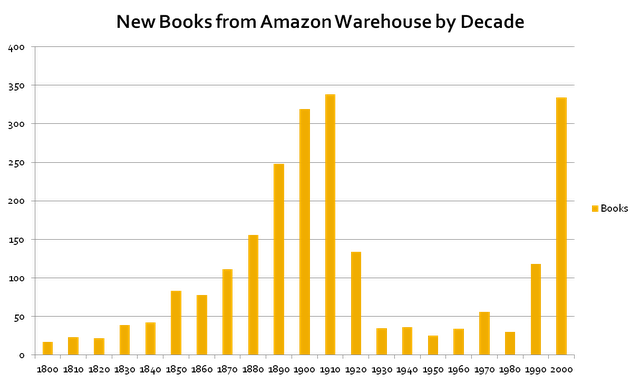
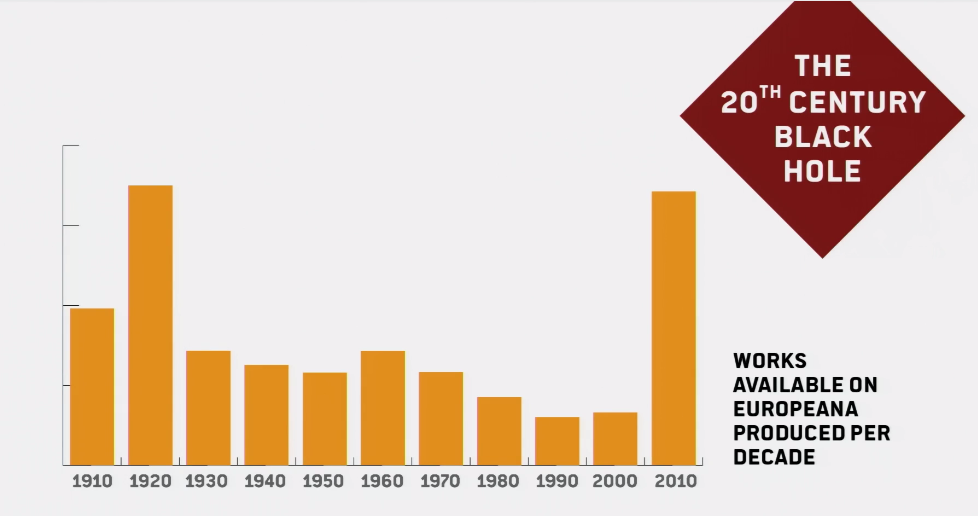
What it shows is that while new books are available for sale, they quickly go out of print and are basically not available — until you get down to 1923, at which point the works are in the public domain. Think of all those works that are no longer available to buy in that major gap in the middle. Heald has since updated that research to show how serious a problem this is — and demonstrating how the arguments against letting these works into the public domain make no sense. He demolishes the arguments made by some that a public domain will be either “under” or “over” exploited (yes, both arguments are made), as neither makes much sense.
It appears that copyright is doing similar damage in Europe. At the latest Chaos Communications Congress in Germany, Julia Reda, the European Parliament member from the Pirate Party gave a talk on the state of copyright law today (you can see the video here and included a similar graphic concerning books available in Europe:
January 4, 2015
“Google self-driving cars are timid”
The Oatmeal got a chance to ride in one of Google’s self-driving cars, and learned six things from his experience:
2. Google self-driving cars are timid.
The car we rode in did not strike me as dangerous. It struck me as cautious. It drove slowly and deliberately, and I got the impression that it’s more likely to annoy other drivers than to harm them. Google can adjust the level of aggression in the software, and the self-driving prototypes currently tooling around Mountain View are throttled to act like nervous student drivers.
In the early versions they tested on closed courses, the vehicles were programmed to be highly aggressive. Apparently during these aggression tests, which involved obstacle courses full of traffic cones and inflatable crash-test objects, there were a lot of screeching brakes and roaring engines and terrified interns. Although impractical on the open road, part of me wishes I could have experienced that version as well.

December 30, 2014
The humble pallet … and a shipping revolution
It’s very easy to let your eye skip over the humble pallet, yet it represents a huge improvement in how products get from the factory to you:
The magic of these pallets is the magic of abstraction. Take any object you like, pile it onto a pallet, and it becomes, simply, a “unit load” — standardized, cubical, and ideally suited to being scooped up by the tines of a forklift. This allows your Cheerios and your oysters to be whisked through the supply chain with great efficiency; the gains are so impressive, in fact, that many experts consider the pallet to be the most important materials-handling innovation of the twentieth century. Studies have estimated that pallets consume 12 to 15 percent of all lumber produced in the US, more than any other industry except home construction.
Some pallets also carry an aesthetic charge. It’s mostly about geometry: parallel lines and negative space, slats and air. There is also the appeal of the raw, unpainted wood, the cheapest stuff you can buy from a lumber mill — “bark and better,” it’s called. These facts have not escaped the notice of artists, architects, designers, or DIY enthusiasts. In 2003, the conceptual artist Stuart Keeler presented stacks of pallets in a gallery show, calling them “the elegant serving-platters of industry”; more recently, Thomas Hirschhorn featured a giant pallet construction as part of his Gramsci Monument. Etsy currently features dozens of items made from pallets, from window planters and chaise lounges to more idiosyncratic artifacts, such as a decorative teal crucifix mounted on a pallet. If shipping containers had their cultural moment a decade ago, pallets are having theirs now.
Since World War II, most of America’s pallet needs have been met by several thousand small and mid-sized businesses. These form the nucleus of not just an industry, but a sprawling, anarchic ecosystem — a world, really, complete with its own customs, language, and legends, with a political class, with its own media. This world is known as “whitewood.” There are approximately forty thousand citizens of whitewood, ranging from pallet pickers (who salvage pallets from the trash) to pallet recyclers (who repair broken pallets and make them whole) to pallet manufacturers, pallet consultants, pallet academics, pallet thieves, and pallet association presidents. Whitewood includes people who crisscross the country selling pallet repair machinery, preaching the gospel of tools such as the Rogers Un-Nailer.
Not all pallets belong to the world of whitewood. The most important other category — and whitewood’s chief antagonist — is the blue pallet. These blues are not just a different color; they are also built differently, and play by different rules, and for the past twenty-five years, the conflict between blue and white has been the central theme in the political economy of American pallets. The person most identified with this conflict is a soft-spoken, middle-aged man from Kansas named Bob Moore. Currently embroiled in a legal battle over a pallet deal gone bad, Moore is a singular figure in the industry and a magnet for controversy. When not in federal court, he can sometimes be found piloting a Mooney Acclaim Type S airplane, which he prefers, when possible, to flying commercial. The Mooney is a good place to concentrate, one imagines. And it is important to concentrate when plotting the future of pallets.
December 20, 2014
QotD: When it’s steam engine time
Ridcully poked at his pipe with a pipe cleaner and said, “Ye-es, that is a conundrum. Surely the steam engine cannot happen before it’s steam-engine time? If you saw a pig, you would, I think, say to yourself, well, here’s a pig, so it must be time for pigs. You wouldn’t question its right to be there would you?”
“Certainly not,” said Lu-Tze. “In any case, pork gives me the wind something dreadful. What we know is that the universe is never-ending story that, happily, writes itself continuously. The trouble with my brethren in Oi Dong is that they are fixated on the belief that the universe can be totally understood, in every particular jot and tittle.”
Ridcully burst out laughing. “Oh, my word! You know, my wonderful associate Mister Ponder Stibbins appears to have fallen into the same misapprehension. It seems that even the very wise have neglected to take notice of one rather important goddess … Pippina, the lady with the Apple of Discord. She knows that the universe, while it requires rules and stability, also needs just a tincture of chaos, the unexpected, the surprising. Otherwise it would be a mechanism — a wonderful mechanism, ticking away the centuries, but with nothing different happening. And so we may assume that the loss of balance will be allowed this time and the beneficent lady will decree that this mechanism might yield wonderful things, given a chance.”
“For my part, I would like to give it a chance,” said Lu-Tze. “Serendipity is no stranger to me. I know the monks have been carefully shepherding the world, but I rather think they don’t realize that the sheep sometimes have better ideas. Uncertainty is always uncertain, but the difficulty with people who rely on systems is that they begin to believe that nearly everything is in some way a system and therefore, sooner or later, they become bureaucrats.”
Terry Pratchett, Raising Steam, 2013.
December 16, 2014
Anton Howes on what caused the industrial revolution
In the first post at his new blog, Anton Howes lays out one of the biggest questions about the 19th century:
What caused the Industrial Revolution?
By the term “Industrial Revolution”, the broadly accepted meaning is of (1) innovation-led, (2) sustained and (3) replicable economic growth.
Each of those adjectives are the source of some of the other important questions in the social sciences. Here are some brief summaries of the issues at hand, which I’ll maybe expand upon separately.
(1) Innovation-led
Innovation-led growth distinguishes itself hugely from what we might call ‘Ricardian’ or ‘Malthusian’ economic growth (it’s usually called ‘Smithian’, but that’s a topic for another time). Capital accumulation, population growth, conquest, and education, can all result in initial surges of economic growth. But this is soon brought to a standstill by the brutal reality of diminishing marginal returns, depreciation, and food shortages.
[…]
(2) Sustained
Innovation existed before the Industrial Revolution. Of course it did – you need look no further than the invention of agriculture, writing, bronze, crop rotations, horse collars, windmills, gunpowder, printing presses, paper, and bills of exchange to know that innovations have occurred throughout history before the IR.
The difference is that these were few and far between. Some of them, often grouped together, resulted in Golden Ages, or “Efflorescences” as Jack Goldstone likes to call them. The 1st Century early Roman Empire; the 8th Century Arab World; 12th Century Sung Dynasty China; the 15th Century northern Italian city-states; and 17th Century Dutch Republic are all good examples.
[…]
(3) Replicable
Perhaps most importantly, this miracle quickly spread. First to Belgium, across the Atlantic to the new-born USA, and then to the Dutch Republic still winding down from its own Golden Age, France, Northern Italy, and the multitude of German principalities.
In the last Century it spread to Japan, South Korea, Singapore, Hong Kong, China, Vietnam and Eastern European countries escaping the shadow of Communism.
In this Century it appears to finally be taking root in various African countries. Kenya, Tanzania and Rwanda in particular seem to be leading the way.
The more recent recipients of the IR are experiencing an unprecedented rate of growth, which in itself provides a further miracle in economic history. Britain’s sustained growth only initially manifested itself at less than 1% per year. It took about 100 years for Britain’s first doubling in GDP to occur.
More recent recipients can expect to grow at 7-10% every year, and sometimes even higher. To put that in perspective, growth at 7% per year would result in a doubling of the size of the economy in only 10 years. 10% a year in only 7 years.
December 10, 2014
QotD: Quality, innovation, and progress
Measured by practically any physical metric, from the quality of the food we eat to the health care we receive to the cars we drive and the houses we live in, Americans are not only wildly rich, but radically richer than we were 30 years ago, to say nothing of 50 or 75 years ago. And so is much of the rest of the world. That such progress is largely invisible to us is part of the genius of capitalism — and it is intricately bound up with why, under the system based on selfishness, avarice, and greed, we do such a remarkably good job taking care of one another, while systems based on sharing and common property turn into miserable, hungry prison camps.
We treat the physical results of capitalism as though they were an inevitability. In 1955, no captain of industry, prince, or potentate could buy a car as good as a Toyota Camry, to say nothing of a 2014 Mustang, the quintessential American Everyman’s car. But who notices the marvel that is a Toyota Camry? In the 1980s, no chairman of the board, president, or prime minister could buy a computer as good as the cheapest one for sale today at Best Buy. In the 1950s, American millionaires did not have access to the quality and variety of food consumed by Americans of relatively modest means today, and the average middle-class household spent a much larger share of its income buying far inferior groceries. Between 1973 and 2008, the average size of an American house increased by more than 50 percent, even as the average number of people living in it declined. Things like swimming pools and air conditioning went from being extravagances for tycoons and movie stars to being common or near-universal. In his heyday, Howard Hughes didn’t have as good a television as you do, and the children of millionaires for generations died from diseases that for your children are at most an inconvenience. As the first 199,746 or so years of human history show, there is no force of nature ensuring that radical material progress happens as it has for the past 250 years. Technological progress does not drive capitalism; capitalism drives technological progress — and most other kinds of progress, too.
Kevin D. Williamson, “Welcome to the Paradise of the Real: How to refute progressive fantasies — or, a red-pill economics”, National Review, 2014-04-24
December 7, 2014
Another (mechanical) step closer to true battlefield armoured suits
In Popular Mechanics, Erik Schechter talks about the most recent DARPA work on power-assisted suits for soldiers in the field:
The Army doesn’t have an Iron Man suit. Yet. But the Defense Advanced Research Projects Agency (DARPA) Warrior Web program is a step closer to developing a soft, low-powered exosuit that will augment the physical capabilities of soldiers. Worn under the uniform, the proposed suit will allow troops to carry 100-plus pounds of equipment without risking the joint and back injuries that typically accumulate in the field.
The Warrior Web program, which is also supported by the U.S. Army Research Laboratory (ARL), just wrapped up its first phase in which it tested exosuit components in the lab and the outdoors, says Mike LaFiandra, Dismounted Warrior Branch chief at ARL’s Human Research Engineering Directorate. In their next step, engineers will test how various pieces developed by different program participants perform when integrated into one suit. Basically, DARPA is “looking for performers to pair up and say, ‘We’re going to pair up this ankle with this knee’ and come up with a system that they bring here to evaluate,” LaFiandra says. That will take 18 to 24 months.
That first phase involved nine prototypes. By Phase II, the program was down to six, including entries from the Harvard University’s Wyss Institute, Ekso Bionics (now a subsidiary of Google), and Arizona State University’s Human Machine Integration Laboratory.
November 25, 2014
When was it exactly that “progress stopped”?
Scott Alexander wrote this back in July. I think it’s still relevant as a useful perspective-enhancer:
The year 1969 comes up to you and asks what sort of marvels you’ve got all the way in 2014.
You explain that cameras, which 1969 knows as bulky boxes full of film that takes several days to get developed in dark rooms, are now instant affairs of point-click-send-to-friend that are also much higher quality. Also they can take video.
Music used to be big expensive records, and now you can fit 3,000 songs on an iPod and get them all for free if you know how to pirate or scrape the audio off of YouTube.
Television not only has gone HDTV and plasma-screen, but your choices have gone from “whatever’s on now” and “whatever is in theaters” all the way to “nearly every show or movie that has ever been filmed, whenever you want it”.
Computers have gone from structures filling entire rooms with a few Kb memory and a punchcard-based interface, to small enough to carry in one hand with a few Tb memory and a touchscreen-based interface. And they now have peripherals like printers, mice, scanners, and flash drives.
Lasers have gone from only working in special cryogenic chambers to working at room temperature to fitting in your pocket to being ubiquitious in things as basic as supermarket checkout counters.
Telephones have gone from rotary-dial wire-connected phones that still sometimes connected to switchboards, to cell phones that fit in a pocket. But even better is bypassing them entirely and making video calls with anyone anywhere in the world for free.
Robots now vacuum houses, mow lawns, clean office buildings, perform surgery, participate in disaster relief efforts, and drive cars better than humans. Occasionally if you are a bad person a robot will swoop down out of the sky and kill you.
For better or worse, video games now exist.
Medicine has gained CAT scans, PET scans, MRIs, lithotripsy, liposuction, laser surgery, robot surgery, and telesurgery. Vaccines for pneumonia, meningitis, hepatitis, HPV, and chickenpox. Ceftriaxone, furosemide, clozapine, risperidone, fluoxetine, ondansetron, omeprazole, naloxone, suboxone, mefloquine, – and for that matter Viagra. Artificial hearts, artificial livers, artificial cochleae, and artificial legs so good that their users can compete in the Olympics. People with artificial eyes can only identify vague shapes at best, but they’re getting better every year.
World population has tripled, in large part due to new agricultural advantages. Catastrophic disasters have become much rarer, in large part due to architectural advances and satellites that can watch the weather from space.
We have a box which you can type something into and it will tell you everything anyone has ever written relevant to your query.
We have a place where you can log into from anywhere in the world and get access to approximately all human knowledge, from the scores of every game in the 1956 Roller Hockey World Cup to 85 different side effects of an obsolete antipsychotic medication. It is all searchable instantaneously. Its main problem is that people try to add so much information to it that its (volunteer) staff are constantly busy deleting information that might be extraneous.
We have the ability to translate nearly major human language to any other major human language instantaneously at no cost with relatively high accuracy.
We have navigation technology that over fifty years has gone from “map and compass” to “you can say the name of your destination and a small box will tell you step by step which way you should be going”.
We have the aforementioned camera, TV, music, videophone, video games, search engine, encyclopedia, universal translator, and navigation system all bundled together into a small black rectangle that fits in your pockets, responds to your spoken natural-language commands, and costs so little that Ethiopian subsistence farmers routinely use them to sell their cows.
But, you tell 1969, we have something more astonishing still. Something even more unimaginable.
“We have,” you say, “people who believe technology has stalled over the past forty-five years.”
1969’s head explodes.
November 10, 2014
A critical view of the Zumwalt class of destroyers
James R. Holmes makes the case that the latest class of US Navy destroyers are already obsolete:

BATH, Maine (Oct. 28, 2013) The Zumwalt-class guided-missile destroyer DDG 1000 is floated out of dry dock at the General Dynamics Bath Iron Works shipyard. The ship, the first of three Zumwalt-class destroyers, will provide independent forward presence and deterrence, support special operations forces and operate as part of joint and combined expeditionary forces. The lead ship and class are named in honor of former Chief of Naval Operations Adm. Elmo R. “Bud” Zumwalt Jr., who served as chief of naval operations from 1970-1974. (U.S. Navy photo courtesy of General Dynamics/Released)
Hie thee hence, sea fighters, to peruse Information Dissemination‘s take on the U.S. Navy’s Zumwalt-class destroyer. Pseudo-pseudonymous pundit “Lazarus” gives a nifty profile of the newfangled vessel. That’s worth your time in itself. Though not in so many words, moreover, he depicts the attention-grabbing DDG-1000 stories of recent weeks and months as a red herring. Sure, Zumwalt features a “tumblehome” hull that makes the ship look like the second coming of USS Monitor. (This is not a compliment.) The hull tapers where it should flare and flares where it should taper. Zounds!
Yet more than cosmetics occasions commentary. Some navy-watchers voice concern about tumblehome hulls’ seakeeping ability in rough waters. Others question their ability to remain buoyant and stable after suffering mishaps or battle damage. That’s a worry in a “minimum manned” ship that relies on automated damage control. (The very idea of automated firefighting and flooding control, and sparsely populated fire parties, sits poorly with this former fire marshal.) In any event, time will tell whether the naval architects got it right.
Even if problems do come to light, Zumwalt would be far from the first fighting ship to undergo modifications to remedy problems baked into her design. The flattop USS Midway, for example, underwent repeated change over her long life — including to correct such maladies. Plus ça change.
Zumwalt‘s secondary armament has made headlines as well. The navy recently opted to substitute lesser-caliber 30-mm guns for the 57-mm guns originally envisioned to empower the ship to duel small boats and light surface combatants. The smaller mount evidently meets performance parameters for close-in engagements that its bigger counterpart misses. This too is a controversy that, in all likelihood, will be settled once sea trials put the ship through her paces. Tempest, meet teapot.


