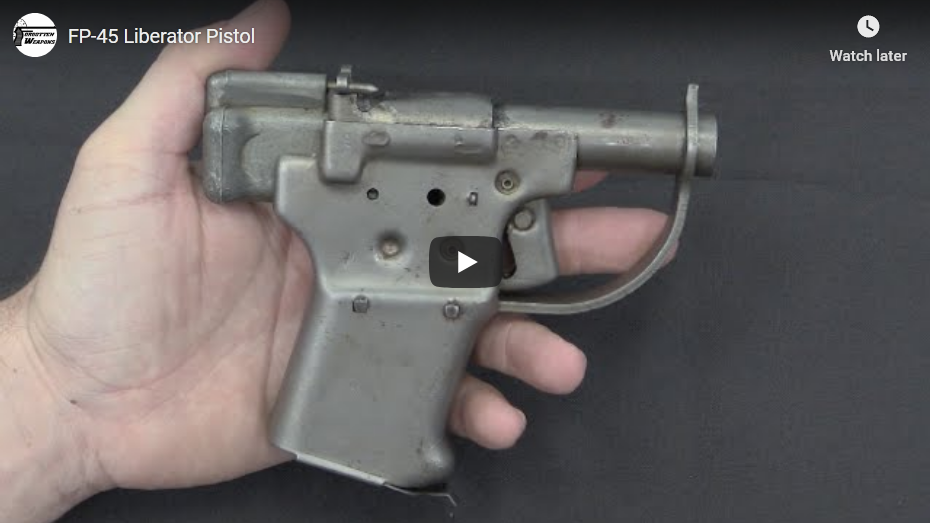
The Liberator is one of those interesting artifacts of WWII; an extremely simple single-shot .45 caliber pistol made by the boxcar-load (a million, specifically) with the intention of being dropped en masse across Europe to promote civilian sabotage against German occupation forces. They were manufactured by the Guide Lamp division of GM in record time – just 10-11 weeks for a literal million-gun production run. However, as they were being manufactured, shipped, and put into storage the motivation behind the project largely evaporated. British SOE ultimately decided not to distribute any in France, and only distributed a small number to partisans in Greece.
In the US, the Army stockpile of Liberators was transferred to the OSS, and a fair number were actually distributed in India, China, and the Philippine Islands – although they did not ultimately have any measurable impact on the war effort.
Roller locking is a system that is not used in many guns and often confused with roller-delayed blowback — which is understandable, given the similarities between the systems. Roller locking was first developed as a modification of the German G43 rifle, and it is really a sub-type of flapper locking mechanism. It was most significantly used in the MG42, and also in the Czech vz.52 pistol. In essence, it uses rollers in place of flaps to lock the bolt and barrel securely together during firing, and depends on an external system (short recoil, in the case of the MG42 and vz.52) to unlock before it can cycle.
Contact:
Forgotten Weapons
6281 N. Oracle #36270
Tucson, AZ 85740
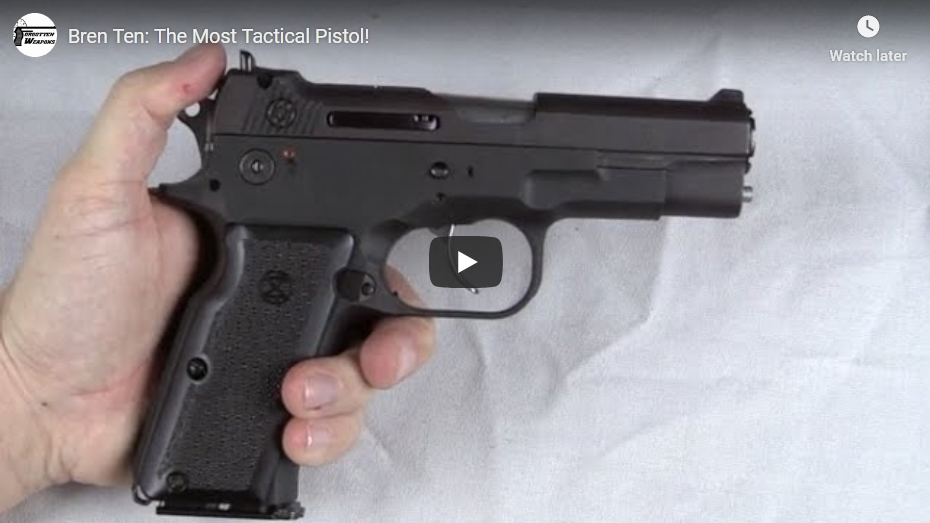
The Bren Ten is an interesting story of handgun development and business failure. The gun was first developed by Dornaus & Dixon, with the consulting help of the iconic Col. Jeff Cooper. It was intended to be a handgun to improve upon the venerable 1911 in every way.
To satisfy the adherents to the theory of large-caliber handgun cartridges, the gun was designed around a new 10mm cartridge designed by Norma. This cartridge would propel a 200 grain bullet at 1200 fps from a 5 inch barrel, making it the most powerful service handgun cartridge in production. It would use a 10-round magazine, and also be convertible to .45ACP.
The gun itself was based on the excellent Czech CZ-75 (made at Brno, which is where the “Bren” portion of the pistol’s name came from). It had full length slide rails, a DA/SA trigger that could be carried cocked and locked, and nice big sights.
Unfortunately, a combination of production quality problems, inadequate magazine design, preorders, and other issues led to the company quickly falling into tough financial straits. The guns were only manufactured for about 2 years before bankruptcy ended production. Some had been shipped without magazines, and Bren Ten magazines remain a sought-after commodity today.
Comments Off on Bren Ten: The Most Tactical Pistol!
This is Lot 1953 in the upcoming RIA December Premier auction.
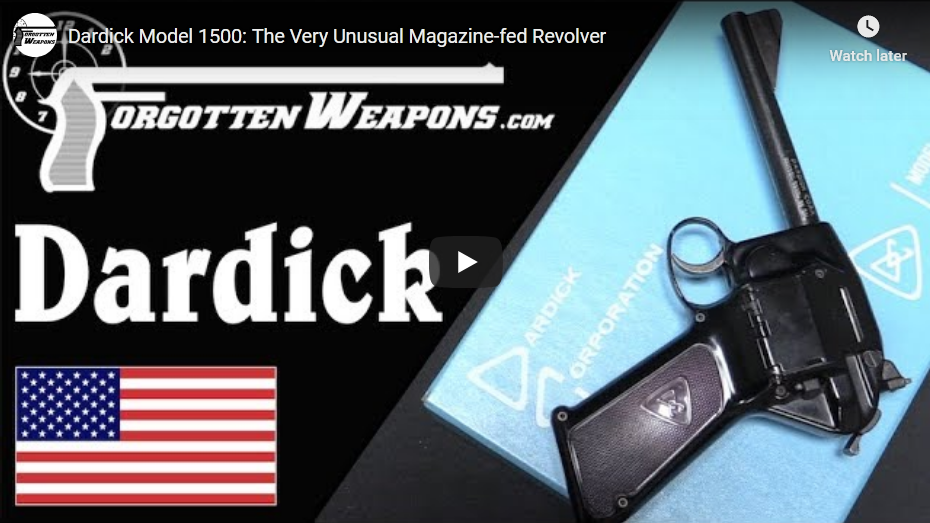
The Dardick 1500 was a magazine-fed revolver designed by David Dardick in the 1950s. His patent was granted in 1958, and somewhere between 40 and 100 of the guns were made in 1959, before the company went out of business in 1960. The concept was based around a triangular cartridge (a “tround”) and a 3-chambered, open-sided cylinder. This wasn’t really of direct benefit to a handgun, but instead was ideal for a high rate of fire machine gun, where the system did not need to pull rounds forward or backward to chamber and eject them. In lieu of military machine gun contract, Dardick applied the idea to a sidearm.
The Model 1500 held 15 rounds, inside a blind magazine in the grip. It was chambered for a .38 caliber cartridge basically the same as .38 Special ballistically. A compact Model 1100 was also made in a small numbers, with a shorter grip and correspondingly reduced magazine capacity (11 trounds). A carbine barrel/stock adapter was also made. The guns were a complete commercial failure, with low production and lots of functional problems. Today, of course, they are highly collectible because of that scarcity and their sheer mechanical weirdness.
Contact:
Forgotten Weapons
6281 N. Oracle #36270
Tucson, AZ 85704
I’ve always had an interest in the Dardick, from their appearance in some of L. Neil Smith’s science fiction novels. I linked to an earlier article of his, and commented:
As Neil pointed out in one of his books, the Dardick was the answer to a bad crime writer’s prayers: it was literally an automatic revolver. (For those following along at home, an “automatic” has a magazine holding the bullets which are fed into the chamber to be fired by the action of the weapon: fire a bullet, the action cycles, clearing the expended cartridge and pushing a new one into place, cocking the weapon to fire again. A “revolver” holds bullets in the cylinder, rotating the cylinder when the gun is fired to put a new bullet in line with the barrel to be fired. The Dardick is the only example I know of that combines both in one gun.)
Comments Off on Dardick Model 1500: The Very Unusual Magazine-fed Revolver
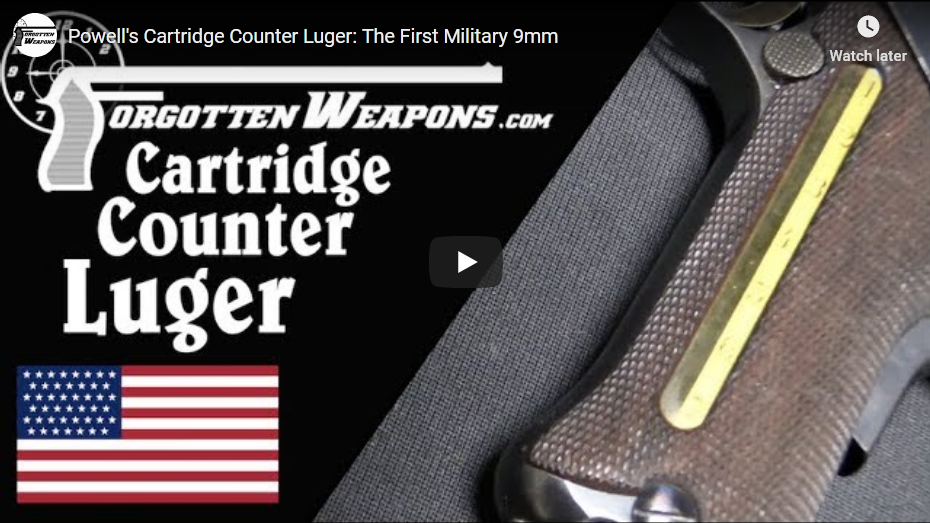
The US first tested the Luger in 1901, and it seemed potentially good enough that the government spent $15,000 to buy 1,000 of the pistols (in 7.65mm Luger; the only cartridge available at the time) for field trials. The trials resulted in a variety of complaints, but particular among them was a dislike for the small caliber. In response, Georg Luger necked the 7.65mm round up to 9mm, and the US would be the first to trial the new model. After presenting 3 samples in 1903, Luger made a deal to swap 50 of the American 7.65mm pistols for 50 new 9mm ones. The US also specified that new guns had to be fitted with a cartridge counter grip system designed by one Graham Powell. The resulting guns (s/n 22401-22450) were delivered in April of 1904.
American testing did not find the 9mm much more satisfactory than the old 7.65mm, however. At the same time, the Thompson-La Garde tests of terminal ballistics were concluding that a new service pistol should be no less than .45 caliber. Luger would make one last effort to interest the US in 9mm with a duplex load in 1906, but this would also fail. Instead, he would redesign the Luger for .45 ACP and enter that in the US 1907 pistol trials.
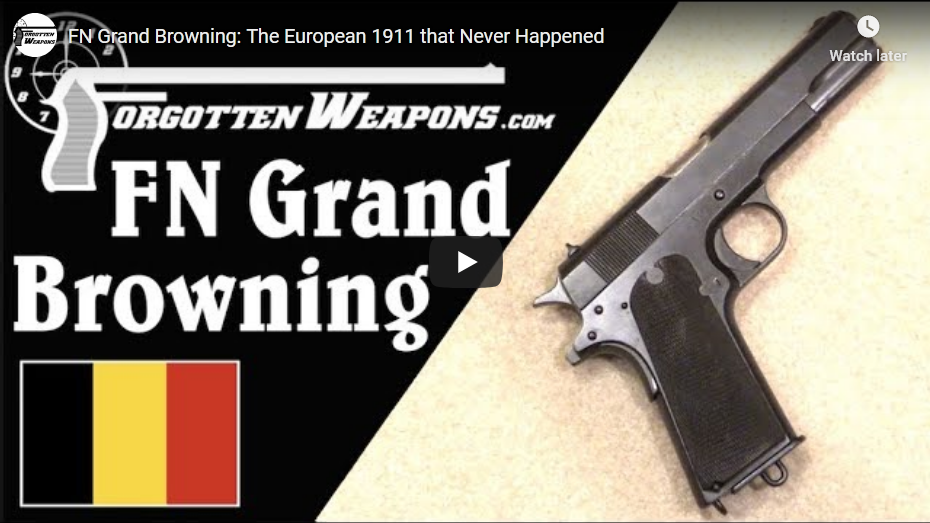
When John Browning licensed his handgun patents, the North American rights were granted to Colt, and the Western European rights to FN in Belgium. Browning provided the patents and patent model guns to the companies, and they were then free to interpret the design however they thought best. In the case of the shrouded-hammer blowback system, the Colt interpretation (the Pocket Hammerless) was a civilian concealed pistol in .32ACP, while the FN interpretation (Model 1903) was a substantially larger gun in 9×20 Browning Long intended for military service.
The locked-breech patent was the same. Colt developed it into the Model 1911 adopted by the US military, and FN built a slightly smaller version in 9.65x23mm intended for European military service. However, while the Colt pistol became tremendously popular, FN’s development was disrupted by World War One, and never completed in its aftermath. Only a couple dozen examples of the Grand Browning, as it was called, were made before the war, and just a few survive today. We will never know how European militaries would have responded to a Browning locked-breech pistol at the time…
Contact:
Forgotten Weapons
6281 N. Oracle #36270
Tucson, AZ 85704
Comments Off on FN Grand Browning: The European 1911 that Never Happened
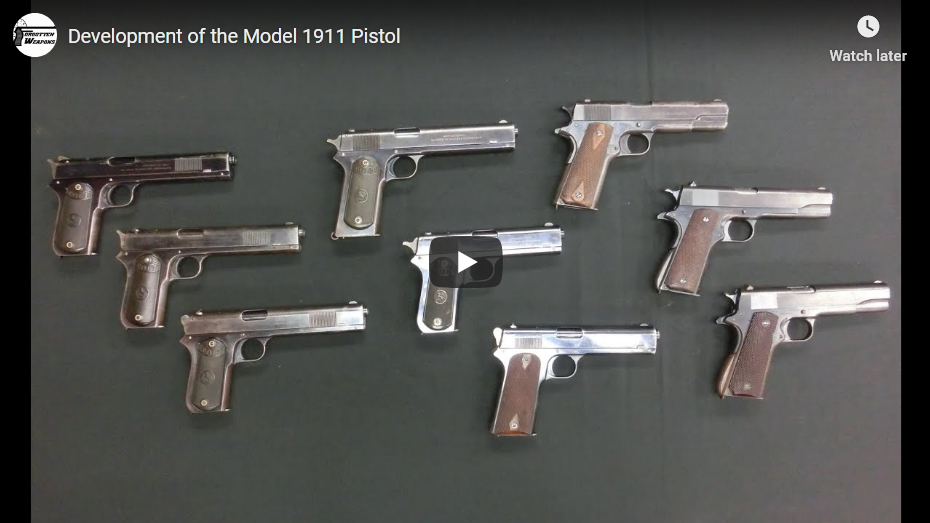
When I was looking through the catalog for this upcoming Rock Island auction, I noticed that there were a lot of early-type Colt automatic pistols listed. I looked a bit closer, and noticed that there was, in fact, one of almost every major developmental variety. Well, that sounded like a recipe for a big overview video! So here I present the developmental history of the 1911.
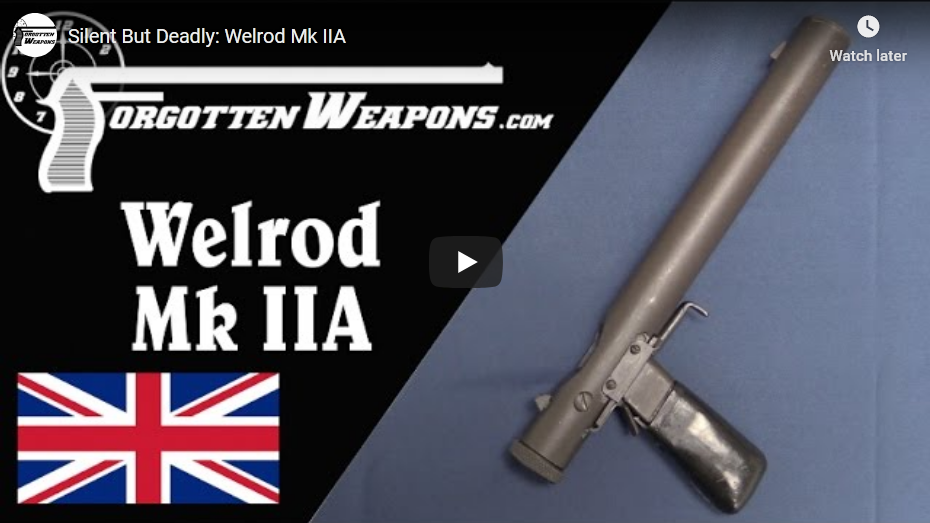
The Welrod is a nearly completely silent bolt action pistol designed by SOE Section 9 for covert operation and assassination use during WW2. Chambered for the .32ACP cartridge (which is subsonic to begin with), the Welrod uses a ventilated barrel and large-volume suppressor with several solid rubber wipes to bring its firing report down to the minimum possible level. This noise reduction only lasts for about a dozen shots, after which time the rubber wipes have more or less bore-sized permanent holes in them, reducing the suppressor’s effectiveness to pretty much on par with other typical designs.
The Welrod is a manually operated pistol, to avoid action noise. It feeds from a Colt 1903 Pocket Hammerless magazine, which also serves as its grip. A grip safety is the only safety device, and it fires using a striker mechanism. The Welrod was first introduced in 1943, with a larger 9x19mm version added later in the war. They appear to have been manufactured by BSA, with a total of about 14,000 made. Welrods were in service as recently as Desert Storm, and are most likely still in use for those times when a very efficient silent pistol is necessary.
Thanks to the Institute of Military Technology for allowing me to have access to this very cool pistol and bring it to you! Check them out at:
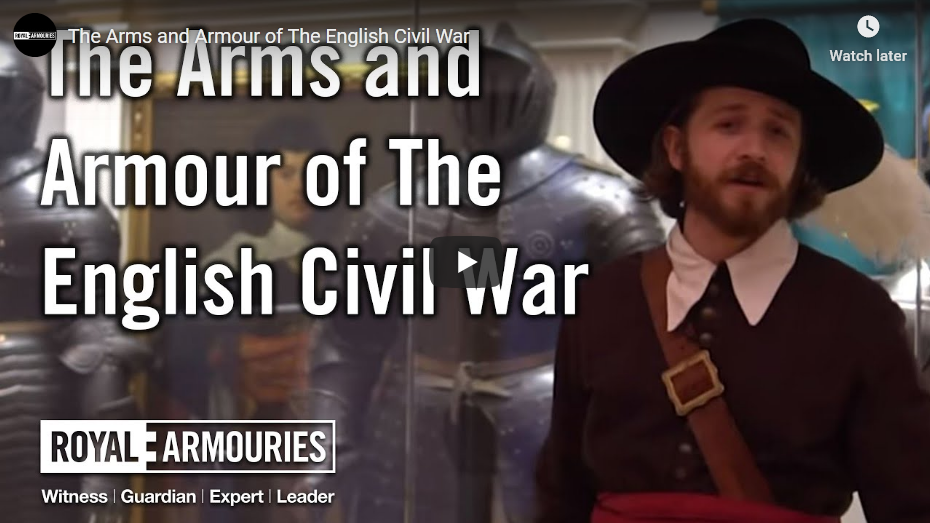
The Royal Armouries’ English Civil War collection boasts an array of infantry and cavalry arms and armour from the 1640s. Delve into this turbulent historical period with a look at some cavalry arms and armour.
The Royal Armouries is the United Kingdom’s national collection of arms and armour. On this channel, discover what goes on behind the scenes at the museum and to see our collection come to life. From combat demonstrations to jousting coverage to behind the scenes tours with our curators, we’ve got it covered.
Have a question about arms and armour? Feel free to leave us a comment and we’ll do our best to answer it.
Comments Off on The Arms and Armour of The English Civil War
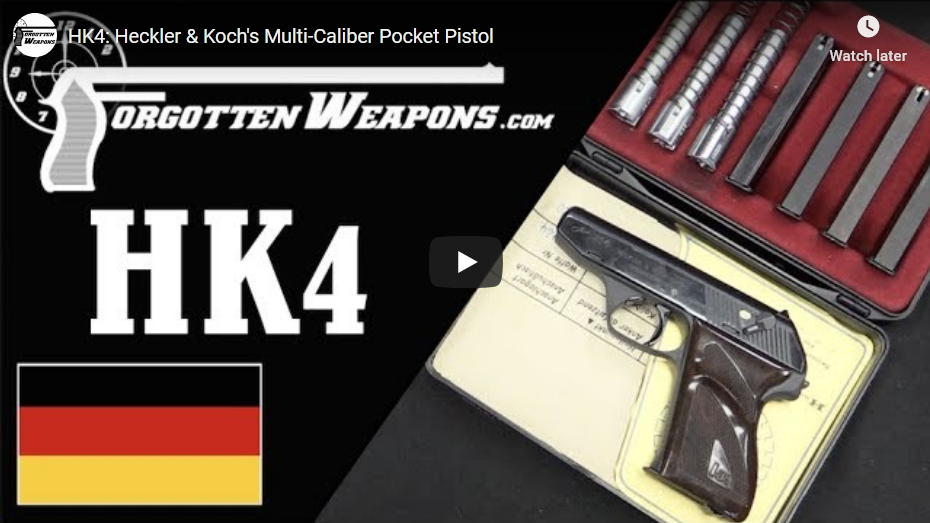
The H&K Model 4 was named for the fact that it was offered in four different calibers – .22LR, .25 ACP, .32 ACP, and .380 ACP. The gun came with a complete set of spare barrels and magazines to allow conversion between all of them, and interesting feature not offered by any other pistols like it at the time. The design was by Alex Seidel, one of the founding engineers of H&K. He had familiarity with the Mauser HSc from his time working at Mauser, and it was the rough basis fo the HK4.
The changes between centerfire calibers required nothing more than swapping barrels (and recoil springs, which were pinned to the barrels) and magazines. Differing spring strength for each caliber were enough to make the gun both safe and reliable in the different chamberings. To convert to .22LR rimfire, it was also necessary to unscrew the removable breech face and flip it around. The breech face had two firing pin holes (one centerfire and one rimfire), and the firing pin could pivot enough to use either one. When the breech face was removed, the firing pin could be positioned for whichever setting was desired.
The HK4 was interesting and reasonably successful, but never able to really compete with guns like the Walther PP and PPK. During a 16-year production run from 1968 until 1984 a total of 38,200 were made, including 12,400 for the German customs police.
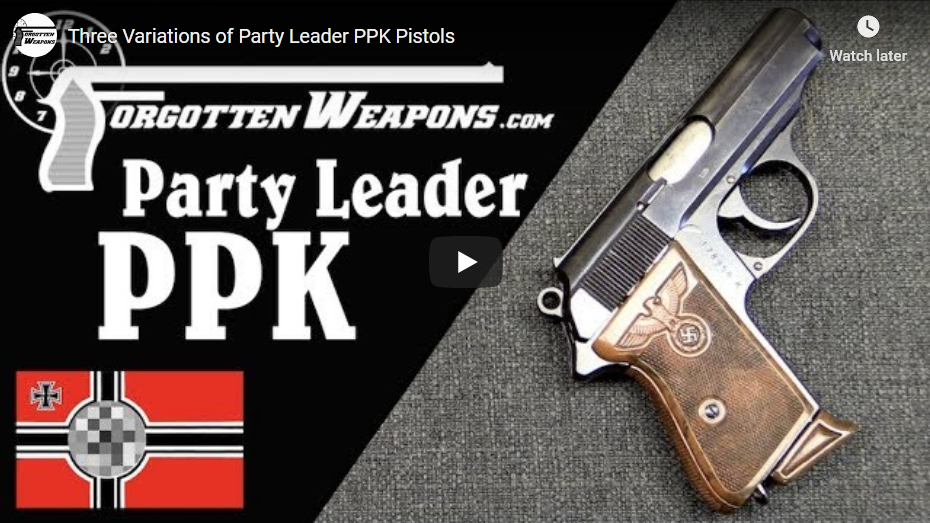
Today, courtesy of Tom from Legacy Collectibles, we are taking a look at “party leader” PPK pistols. There are three different versions of these, and we will look at all of them in sequence. They are highly valued in the collecting community, and also extremely easy to fake, making authentication quite difficult. I will give you as much information as I can to assist in this, and Tom is happy to help (free of charge) as well.
To see more about Legacy, check out their YouTube channel:
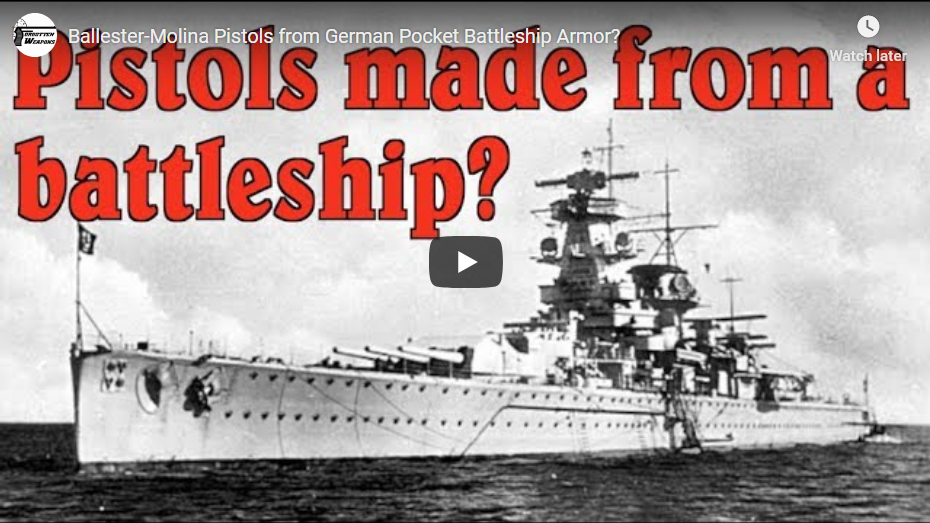
There is an old gun shop tale that Argentine Ballester-Molina pistols were made form the salvaged armor plate of the pocket battleship Admiral Graf Spee. The Graf Spee was scuttled in the Rio de la Plata estuary in December 1939, only a few miles from the HAFDASA factory in Buenos Aires, and Argentina did not have the domestic steel reserves to make enough pistols…
See Michael Parker’s full article on this, including the exact results of his metallurgical analysis, here:
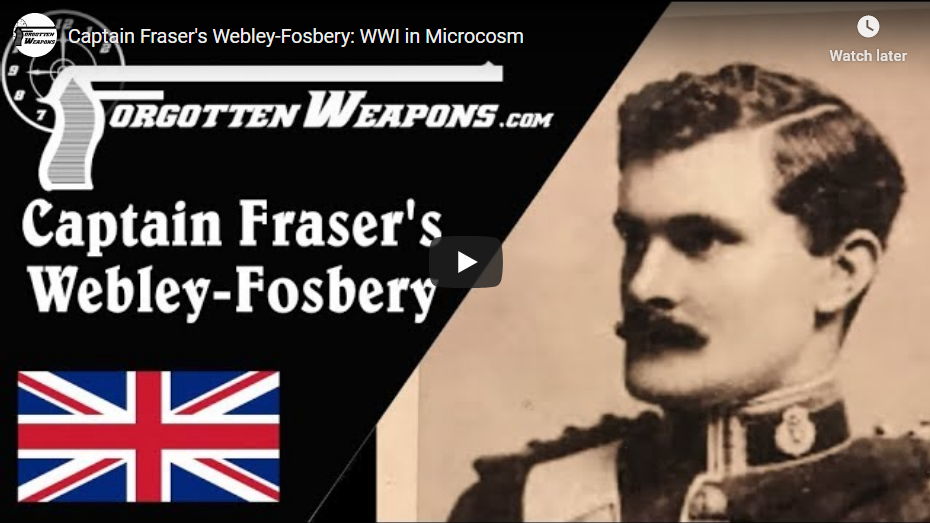
Captain Percy Fraser, DSO was born on January 22, 1879 and died in Ypres on the night of February 23, 1915 while attempting to aid men wounded outside their trench. His unit of the Queen’s Own Cameron Highlanders would suffer horrendous casualties at Ypres, and today we will look at his Webley-Fosbery automatic revolver and his service in the British Army.
Thanks to Mike Carrick of Arms Heritage magazine for sharing Captain Fraser’s story and revolver. See his regular column here: https://armsheritagemagazine.com
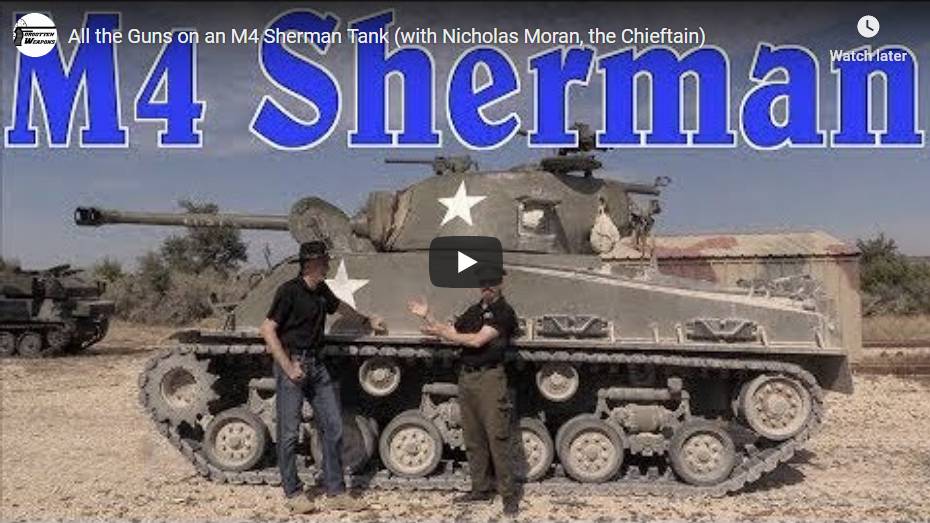
Today Nicholas Moran (the Chieftain) and I are at DriveTanks.com courtesy of Wargaming.net, to show you around a World War Two Sherman tank and all its various armaments. We will discuss and shoot the bow machine gun, coaxial machine gun, commander’s hatch machine gun, antiaircraft .50 cal M2 machine gun, 76mm high velocity main gun, and the crew’s small arms, an M3 Grease Gun and a 1911 pistol.
If you enjoy this video, check out World of Tanks – and maybe they will send Nicholas and I back again to do the same thing for a different tank!
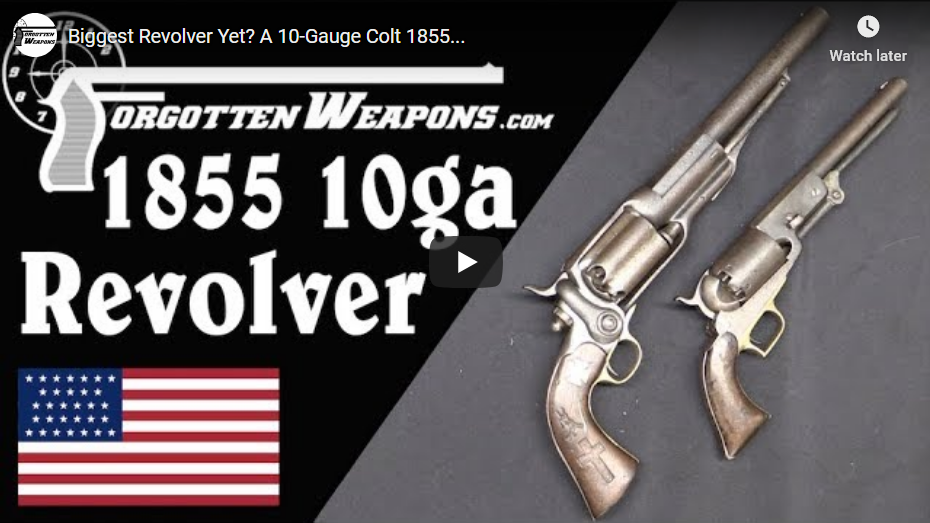
This ludicrously huge handgun is actually a 10-gauge Colt 1855 Revolving Shotgun with a cut-down barrel and a newly made grip frame. The backstop and trigger guard of the shotgun were handily reshaped into a grip frame, and the finished product actually looks nicely proportional — until you try to actually pick it up, of course. The grip is filled with brass inlay, about a third of which are missing (possibly from the recoil of actually firing?). Despite the rather poor finish condition, the gun cycles smoothly, and appears to be fully functional. Just the thing for someone who wants to make the Colt Walker look puny!
Contact:
Forgotten Weapons
6281 N. Oracle #36270
Tucson, AZ 85704
Comments Off on Biggest Revolver Yet? A 10-Gauge Colt 1855…