Forgotten Weapons
Published 8 Jan 2018The Winchester G30R is the final iteration of David Marshall Williams’ work on a full power .30 caliber military rifle. The project began with a design by Ed Browning (John Browning’s half brother) using a tilting bolt and annular gas piston, manufactured for US military trials by Colt. It moved to the Winchester company, which assigned Williams to the project when Browning died in 1939. Williams first replaced the annular gas piston with his gas tappet system, creating the G30M rifle. This performed poorly in trials, and the next iteration was the replacement of the tilting bolt with a Garand-type rotating bolt, creating the Winchester M2 rifle.
The US military was not interested in the M2 in .30-06, but thought the concept could be ideal for the Light Rifle trials then underway, and Winchester scaled it down to .30 carbine, and won the Light Rifle trials with it. That weapon would go on to become the M1 Carbine. Once it was in mass production, Winchester returned to the M2 design and improved it into this G30R. It was tested by the Marine Corps, but not adopted. The Canadian military also expressed an interest, but the US government opted to not allow any exports, and so Canada never tested it.
The US Army was quite satisfied with the M1 Garand, but suggested that this rifle might be made into a replacement for the BAR if it were redesigned a bit for greater sustained fire capacity. Winchester did so, creating the Winchester Automatic Rifle (WAR), which was on track for adoption until World War Two ended and immediate arms development became a much less important priority for the military.
Thanks to the Institute of Military Technology for allowing me to have access to this rifle so I can bring it to you! Check out the IMT at:
August 11, 2022
“Carbine” Williams’ Battle Rifle: The Winchester G30R
August 8, 2022
FN-DA1: The BAR for NATO
Forgotten Weapons
Published 13 Apr 2022After World War Two, FN put the BAR back into production. This was initially the FN-D version with a quick-change barrel, but with NATO’s adoption of the 7.62mm cartridge, there was a demand for the BAR in that chambering. The Belgian Army adopted this new round, and plenty of other nations did as well. This prompted FN to release a new version of the FN-D for it, designated the FN-DA1.
In addition to the new chambering, the DA1 also had these three changes:
– Larger bipod feet and a wider bipod stance
– A rear aperture sight instead of an open notch
– A more protected barrel release latchThe FN-DA1 would remain in production until 1967, when it was finally discontinued.
(more…)
August 7, 2022
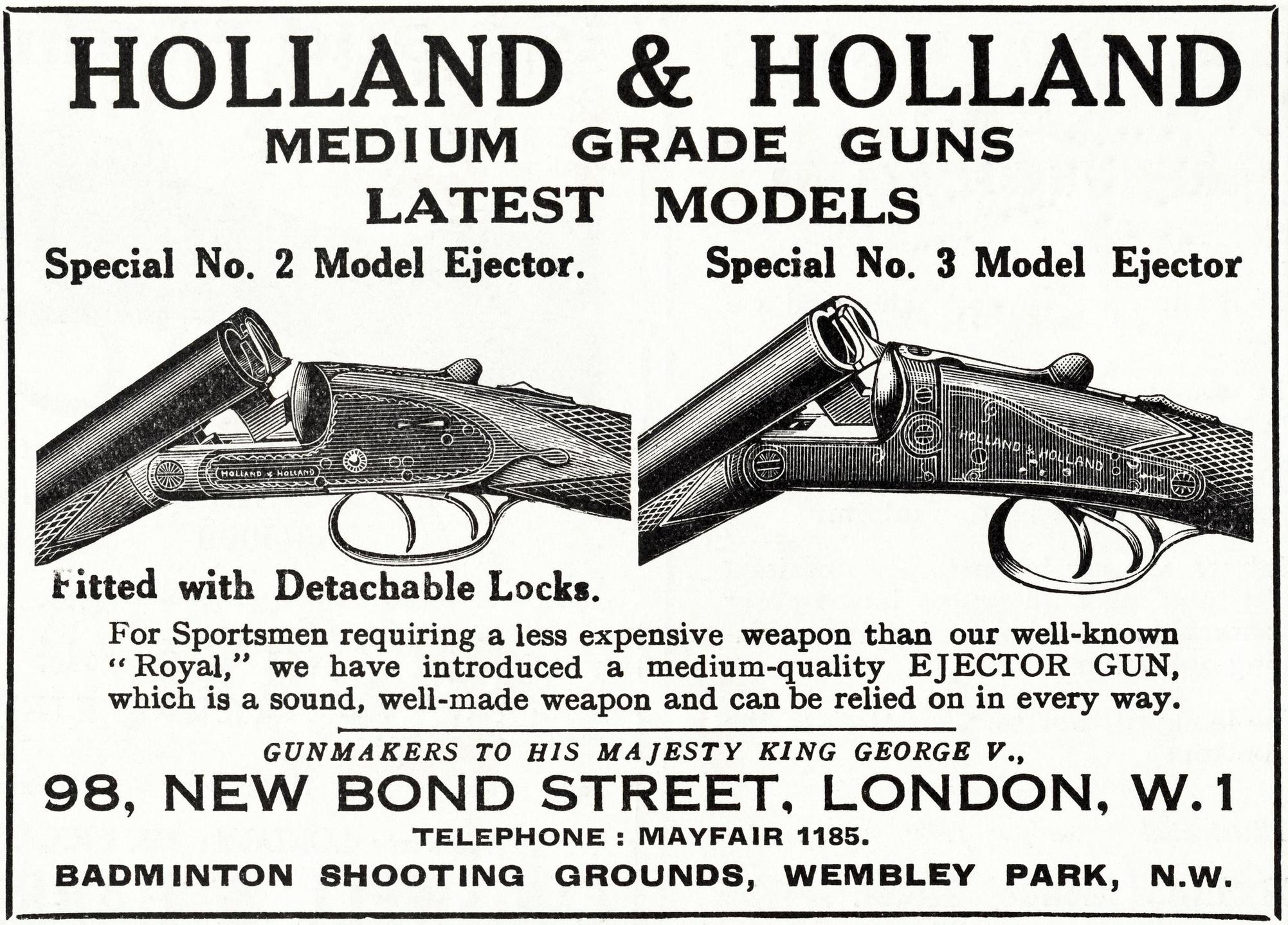
Legendary British gunmaker Holland & Holland, now a Beretta subsidiary
In The Critic, Patrick Galbraith talks to the current head of the Beretta company, which took over Britain’s Holland & Holland:
On the steps up to the blue door a man in a faded red tracksuit leans on one of the stone pillars in the Monday morning sun. All down Jermyn Street windows have been thrown open and flags above shop doors hang still in the heat.
I knock three times then push a bottle of Sudafed up my nose, squeeze twice, and lick at the bitter liquid as it runs over my lip. I was 20 before I ever experienced hay fever. I was fishing somewhere I shouldn’t have been when it first hit. I’ve not enjoyed June much since.
When I get up there, Franco Gussalli Beretta is sitting in the middle of the room in a puddle of sunlight: blue suit, thick grey hair, and a trio of arrows on his big silver belt buckle, the logo of a business established by his ancestor in Lombardy almost 500 years ago.
The earliest documented order was from the Venetian Republic for 185 barrels: “296 ducats made payable to Bartolomeo Beretta”. Fifteen generations later, Franco oversees the production of 1,500 guns a day, from grenade launchers to the ubiquitous “Silver Pigeon”, probably the most popular shotgun in the world.
The current generation are aggressively acquisitive. In recent years they’ve bought a German optics firm, a Finnish rifle manufacturer, and an American company that makes replicas of the sort of weapons that won the West — my own cowboy costume has been too small for some time.
Then, last February, Beretta made their boldest move yet by buying Holland & Holland, the finest gunmaker in London. Franco is a likeable man: he speaks at twice the volume he needs to and he laughs more loudly still. He loves cars and art and boats, and he admits that the day there’s a Beretta running the business who isn’t passionate about guns will be the day it all goes bang. What Holland & Holland needs, he reckons, is innovation.
British gunmakers have been stuck in the late nineteenth century for over a hundred years now and it might just be that Franco has the coglioni to make it new. We talk for half an hour and then as I’m standing to go, Carlo walks in — nonchalant at 25, a black t-shirt, dark sunglasses and jeans. Bartolomeo’s 16 times great-grandson. Franco gestures towards him and asks if I have any questions for the boy. Carlo talks to me briefly about NFTs but then tells me the real struggle is going to be a political one. He wants to make the world understand that hunting can be part of conservation. “And do you hunt?” I ask, thinking we might swap rabbit recipes. He shakes his head and tells me that as crazy as it sounds he doesn’t get out very much: “In Italy, young people don’t hunt so much anymore.”
August 5, 2022
FN MAG: Best of the Western GPMGs
Forgotten Weapons
Published 6 Apr 2022
(more…)
August 2, 2022
M34: The Berthier Converted to the 7.5mm Rimless Cartridge
Forgotten Weapons
Published 3 Aug 2017http://www.patreon.com/ForgottenWeapons
With the end of World War One, it was finally possible for the French military to replace the 8mm Lebel cartridge with a modern rimless cartridge, and they wasted no time in doing so. By 1924 a new round had been adopted, and along with it a new modern light machine gun. Next, the arsenals would start working on converting 8mm rifles to the new cartridge. The first candidate was the Lebel, and in 1927 a conversion was approved and a batch of a few hundred made — but this was a more expensive and time-consuming process than anyone wanted. After some brief trials, it was decided to work on adapting the Berthier instead, and in 1934 a conversion designed from St Etienne was approved as the 1907/15-M34.
This new design used a new 22.5″ barrel (570mm), a Mauser style internal 5-round double stack magazine, and new sights. The receivers and trigger parts were retained from the rifles being converted, along with the nosecaps and barrel bands, but not much else. Still, these conversions were put into production alongside the manufacture of new MAS-36 bolt action rifles. By the time of the German invasion about 63,000 M34 Berthiers had been converted, and were issued to frontline troops. They would fight in the Battle of France, and would also be used by German occupation forces as the Gewehr 241(f).
(more…)
July 30, 2022
PTRD 41: The Simple Soviet Antitank Rifle of WWII
Forgotten Weapons
Published 25 May 2018http://www.patreon.com/ForgottenWeapons
Cool Forgotten Weapons merch! http://shop.bbtv.com/collections/forg…
The Soviet Union had originally eschewed the use of large numbers of antitank rifles, anticipating that any potential combat use of them would be largely against tanks impervious to AT rifle cartridges. However, when German forces came flooding across the border in 1941, the Soviet Union found themselves being attacked by quite large numbers of tanks which were in fact vulnerable to an antitank rifle cartridge. Stalin ordered an immediate development and production of such a weapon, and the designers responded with concepts. Simonov produced the PTRS-41, a semiautomatic 14.5mm weapon that was sophisticated, expensive, and effective. Degtyarev produced the PTRD-41, a single shot 14.5mm weapon which was simple, cheap, and also effective. Both used the same cartridge, which fires a 980gr armor piercing projectile at a remarkable 3320 fps.
Both the Simonov and Degtyarev rifles were ordered into production, with the PTRD-41 being available and fielded within a month because of its very simple nature. By the end of the war some 185,000 of these rifles had been made, and even after the new German tanks became impervious to them, they remained effective weapons for use on light armored vehicles, field guns, machine gun nests, pillboxes, and other hardened targets.
The PTRD-41 is a mechanically interesting and unusual weapon in that despite being only a single shot system, it is recoil operated. When fired, the entire barrel assembly recoils rearward, absorbing some of the immense recoil energy and also opening the bolt and ejecting the spent case. The shooter then need only drop a new cartridge into the action and close the bolt to be ready for a subsequent shot.
(more…)
QotD: The advent of horses and firearms on the North American plains
The domesticated horse is not native to the Americas. There is perhaps no more important fact when trying to understand how the horse-borne nomadic cultures of the Eurasian Steppe relate to those of the Great Plains. The first domesticated horses arrived in the Americans with European explorer/conquerors and the settler-colonists that followed them. Eventually enough of those horses escaped to create a self-reproducing wild (technically feral, since they were once domesticated) horse population, the mustangs, but they are not indigenous and mustangs were never really the primary source of new horses the way that wild horses on the Steppe were (before someone goes full nerd in the comments, yes I am aware that there were some early equines in the Americas at very early dates, but they were extinct before there was any chance for them to be domesticated).
Horses arrived in the Great Plains from the south via the Spanish and moving through Native American peoples west of the Rocky Mountains by both trade and eventually raiding in the early 1700s. Notably firearms also began moving into the region in the same period, but from the opposite direction, coming from British and French traders to the North and West (the Spanish had regulations against trading firearms to Native Americans, making them unavailable as a source). Both were thus initially expensive trade goods which could only be obtained from outside and then percolated unevenly through the territory; unlike firearms, which remained wholly external in their supply, horses were bred on the plains, but raiding and trade were still essential sources of supply for most peoples on the plains. We’ll get to this more when we talk about warfare (where we’ll get into the four different military systems created by this diffusion), but being in a position where one’s neighbors had either the horse or the gun and your tribe did not was an extreme military disadvantage and it’s clear that the “falling out” period whereby these two military innovations distributed over the area was very disruptive.
But unlike guns, which seem to have had massive military impacts but only minimal subsistence impacts (a bow being just as good for hunting bison as a musket, generally), the arrival of the horse had massive subsistence impacts because it made hunting wildly more effective. But the key thing to remember here is: the horse was introduced to the Great Plains no earlier than 1700, horse availability expanded only slowly over the area, but by 1877 (with the end of the Black Hills War), true Native American independence on the Great Plains was functionally over. Consequently, unlike the Steppe, where we have a fairly “set” system that had already been refined for centuries, all we see of the Plains Native American horse-based subsistence system is rapid change. There was no finally reached stable end state, as far as I can tell.
Though there is considerable variation and also severe limits to the evidence, it seems that prior to the arrival of the horse, most Native peoples around the Great Plains practiced two major subsistence systems: nomadic hunter-gathering on foot (distinct from what will follow in that it places much more emphasis on the gathering part) on the one hand and a mixed subsistence system of small-scale farming mixed seasonally with plains hunting seems to have been the main options pre-horse, based on the degree to which the local area permitted farming in this way (for more on those, note Isenberg, op. cit., 31-40). Secoy (op. cit.) notes that while there is some evidence that the Plains Apache may have shifted through both systems, being hunter-gatherers prior to the arrival of horses, by the time the evidence lets us see clearly (which is shortly post-horse) they are subsisting by shifting annually between sedentary agricultural racheirias (from the Spring to about August) and hunting bison on the plains during the fall. Isenberg notes the Native Americans of the Missouri river combining corn agriculture with cooperative bison hunting in the off-season (in that case, in the summer). Meanwhile, the Comanches and Kiowas seem to have mostly subsisted on pedestrian bison hunting along with gathering fruit and nuts, with relatively little agriculture, prior to going fully nomadic once they acquired horses. Bison hunting on foot required a lot of cooperation (so a group) and it seems clear that it was not enough to support a group on its own and had to be supplemented somehow, at least before the arrival of the horse. Some mix of either bison+gathering or bison+horticulture was required.
Isenberg argues (op. cit.), that at this point the clear advantage was to what he terms the “villagers” – that is the farmer-hunters who lived in villages, rather than the nomadic hunter-gathers. These horticulturists were more numerous and seem quite clearly to have had the better land and living conditions. Essentially the hunter-gatherers stuck on marginal land were mostly hunter-gatherers because they were stuck on marginal land, which created a reinforcing cycle of being stuck on marginal land (the group is weak due to small group size because the land is marginal and because the group is weak, it is only able to hold on to marginal lands). That system was stable without outside disruption. The horse changed everything.
A skilled Native American hunter on a horse, armed with a bow, could hunt bison wildly more effectively than on foot. They could be found more rapidly, followed at speed and shot in relative safety. It is striking that while pedestrian bison hunting was clearly a team effort, a hunter on a horse could potentially hunt effectively alone or in much smaller groups. In turn, that massively increased effectiveness in hunting allowed the Native Americans of the region, once they got enough horses, to go “full nomad” and build a subsistence system focused entirely on hunting bison, supplemented by trading the hides and other products of the bison with the (increasingly sedentary and agrarian) peoples around the edges of the Plains. Many of the common visual markers of Plains Native Americans – the tipi, the travois, the short bow for use from horseback – had existed before among the hunter-gathering peoples, but now spread wore widely as tribes took to horse nomadism and hunting bison full time. At the same time, Isenberg (op. cit. 50-52) has some fascinating paragraphs on all sorts of little material culture changes in terms of clothing, home-wares, tools and so on that changed to accommodate this new lifestyle. The speed of the shift is quite frankly stunning.
We’ll come back to this later, but I also want to note here that this also radically changed the military balance between the nomads and the sedentary peoples. The greater effectiveness of bison hunting meant that the horse nomads could maintain larger group sizes (than as hunter-gatherers, although eventually they also came to outnumber their sedentary neighbors, though smallpox – which struck the latter harder than the former – had something to do with that too), while possession of the horse itself was a huge military advantage. Thus by 1830 or so, the Ute and Comanche pushed the Apache off of much of their northern territory, while the Shoshone, some of the earliest adopters of the horse, expanded rapidly north and east over the Northern Plains, driving all before them (Secoy, op. cit., 30-31, 33). Other tribes were compelled to buy, raise or steal horses and adopt the same lifestyle to compete effectively. It was a big deal, we’ll talk about specifics later.
Bret Devereaux, “That Dothraki Horde, Part II: Subsistence on the Hoof”, A Collection of Unmitigated Pedantry, 2020-12-11.
July 27, 2022
Italy’s Worst Machine Gun: The Breda Modello 30
Forgotten Weapons
Published 28 Jul 2017http://www.patreon.com/ForgottenWeapons
Cool Forgotten Weapons merchandise! http://shop.bbtv.com/collections/forg…
The Breda Model 30 was the standard Italian light machine gun of World War II, and is a serious contender for “worst machine gun ever”. Yes, given the choice we would prefer to have a Chauchat (which really wasn’t as bad as people today generally think).
The Breda 30 suffered from all manner of problems. To begin with, it was far more complicated than necessary. The amount of machining needed to build one is mind boggling compared to contemporary guns like the ZB26/Bren or BAR. And for all that work, it just didn’t work well in combat conditions.
Mechanically, the Breda used a short recoil action with a rotating bolt. The recoil action meant that the barrel moved with each shot, so the sights were mounted on the receiver to keep them fixed. This seems like a good idea, but it meant that the sights would need to be re-zeroed each time the barrel was changed. To compound this, the gun fired from a closed bolt which made it more susceptible to overheating and it was recommended to change barrels every 200 rounds or so. An oiling mechanism was built in to lightly oil each cartridge on feeding. This allowed the gun to extract without ripping rims off the cases, but was a disaster waiting to happen on the battlefield. In places like North Africa, the oil acted as a magnet for sand and dust, leading to quick jamming if the gun were not kept scrupulously clean.
The next huge judgment error on Breda’s part was the magazine. The thought behind it was that magazine feed lips are easily damaged in the field, and they can be protected by building them into the gun receiver rather than in each cheap disposable box magazine (the Johnson LMG and Madsen LMG recognized this issue as well). However, Breda’s solution was to make the 20-round magazine a permanent part of the gun. The magazine was attached to the receiver by a hinge pin, and was reloaded by special 20-round stripper clips. This meant that reloading took significantly longer than changing magazines, and any damage to the one attached magazine would render the gun inoperable. As if anything else were needed, the magazine was made with a big opening on top to allow the gunner to see how many rounds remained – and to let more of that North African sand into the action.
Most of the Breda Model 30s were made in 6.5 Carcano, but a small number were made in 7.35 Carcano when that cartridge was adopted. The rate of fire was about 500 rounds per minute, which was a bit slower than most other machineguns of the day.
(more…)
July 24, 2022
Stoner 63A Automatic Rifle – The Original Modular Weapon
Forgotten Weapons
Published 17 Mar 2018The Stoner 63 was a remarkably advanced and clever modular firearm designed by Eugene Stoner (along with Bob Fremont and Jim Sullivan) after he left Armalite. This was tested by DARPA and the US Marine Corps in 1963, and showed significant potential — enough that the US Navy SEALs adopted it and kept it in service into the 1980s. It was a fantastic balance of weight and controllability, offering a belt-fed 5.56mm platform at less than half the weight of the M60. The other fundamental characteristic of the Stoner 63 was modularity. It was built around a single universal receiver component which could be configured into a multitude of different configurations, from carbine to medium machine gun. Today we have one of the rarer configurations, an Automatic Rifle type. In addition, today’s rifle is actually a Stoner 63A, the improved version introduced in 1966 to resolve some of the problems that had been found in the original.
Ultimately, the Stoner system was able to achieve its remarkably light weight by sacrificing durability. The weapon was engineered extremely well and was not a danger to itself (like, for example, the FG-42), but it was prone to damage when mishandled by the average grunt. This would limit its application to elite units like the SEALs, who were willing to devote the necessary care to the maintenance and operation of the guns in exchange for the excellent handling characteristics it offered.
(more…)
July 17, 2022
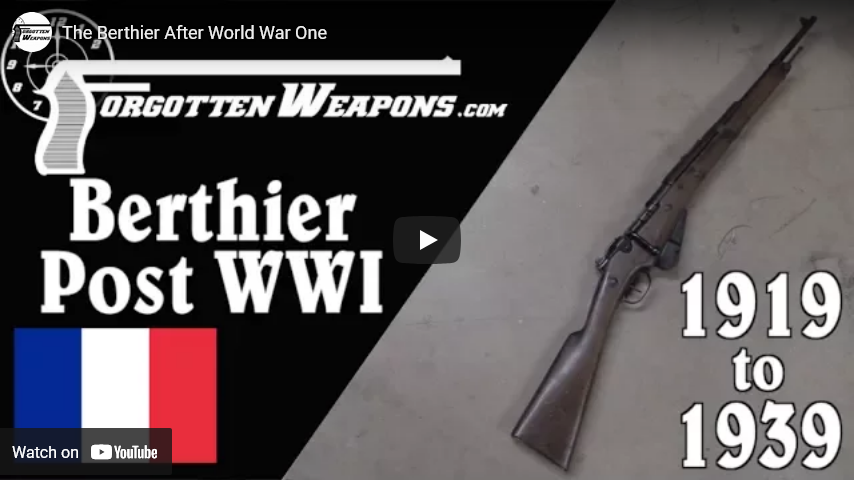
The Berthier After World War One
Forgotten Weapons
Published 31 Jul 2017http://www.patreon.com/ForgottenWeapons
In the aftermath of World War One, France would face the need to replace virtually all of its small arms, because nearly everything it had been using was either a wartime stopgap (like the Ruby, Chauchat, and Berthier 07/15) or had been obsolete before the war began (like the Lebel and Mle 1892 revolver). The first focus of the rearming was a new light machine gun, which would be adopted in the form of the Chatellerault M24/29. Plans were made to develop a semiautomatic infantry rifle and bolt action support troops’ rifle (both in the new 7.5mm rimless cartridge), but these would not prove to be as quickly realized. As a result, the Berthier Mle 1916 carbines would remain in major frontline service right up to the outbreak of World War Two.
During the twenty years between the wars, the Berthiers would see a series of changes and upgrades including:
– Sling bars replacing swivels
– Revised handguard profile
– Raised sights
– Removal of the clearing rods
– Adoption of the 1932N cartridge and associated rechambering
– New metal finishesProduction of new carbines in fact continued all the way until 1939, with at least 160,000 made in 1919 and later. Many of the alterations made during this postwar period are evident on examples found today, and there is a collecting premium on guns that do not exhibit these peacetime modifications. So, let’s have a look, shall we?
If you enjoy Forgotten Weapons, check out its sister channel, InRangeTV! http://www.youtube.com/InRangeTVShow
July 13, 2022
m/26 Suomi: Aimo Lahti’s First Production Design
Forgotten Weapons
Published 23 Mar 2022
(more…)
July 10, 2022
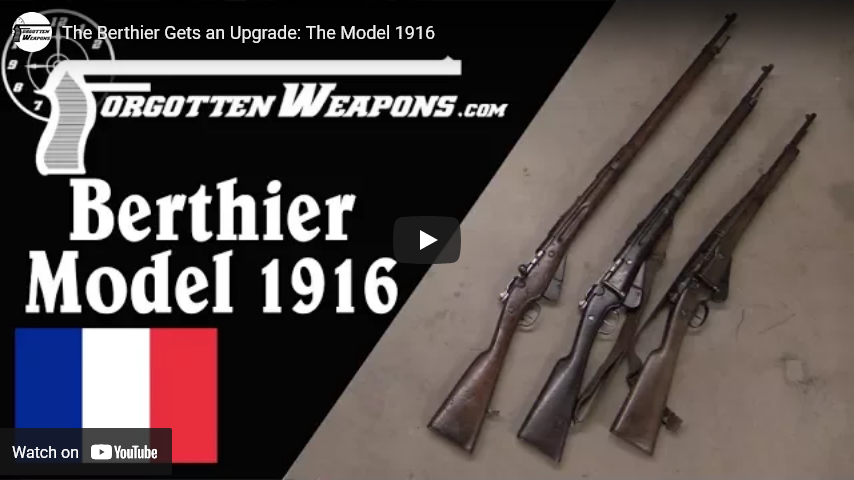
The Berthier Gets an Upgrade: The Model 1916
Forgotten Weapons
Published 26 Jul 2017http://www.patreon.com/ForgottenWeapons
The “Modifié 1916″ update to the Berthier system of rifles and carbines marked a major improvement in the gun’s combat effectiveness — really the first substantial overhaul to the design since it was developed in 1890. The two main elements of the upgrade were the addition of an upper handguard and an extension of the magazine from 3 rounds to 5, to match the capacity of the Mauser rifles used by Germany. In addition, several other improvements were made at the same time, including a redesign of the sights to favor quick target acquisition over long range precision and the addition of luminous radium elements to the sights. The upgrade package originally also included a dust cover over the bolt, but this was dropped for reasons I have not been able to determine.
This upgrade package was formally adopted in late 1916, and would go into production in 1917. However, it took a substantial time for the weapons to filter down to the front lines, and only a small number of M16 carbines and a very small number of M16 long rifles actually saw combat service before the Armistice. The M16 pattern (particularly the carbines) would form the standard armament for the French military right up to World War II, however, with Berthier carbine production continuing until 1939.
If you enjoy Forgotten Weapons, check out its sister channel, InRangeTV! http://www.youtube.com/InRangeTVShow
July 7, 2022
M38 Carcano Carbine: Brilliant or Rubbish?
Forgotten Weapons
Published 1 Aug 2017http://www.patreon.com/ForgottenWeapons
Cool Forgotten Weapons merchandise! http://shop.bbtv.com/collections/forg…
Carcano vs K98k Match video: https://www.youtube.com/watch?v=FAyxL…
I would like to propose that the M38 Carcano short rifle was, despite the poor reputation of the Carcano series of rifles, one of the best thought-out bolt action weapons of World War 2. Why, you ask? Well, let’s consider …
Only a few nations actually recognized the short ranges at which combat actually took place. Germany was one, as seen with its 8x33mm cartridge development, and Italy was another. The sights on the M38 series of carbines were made as simple fixed notches, with no adjustments to be knocked out of place unintentionally. With a 200 meter zero (or 150 meters, with the Finnish replacement front sight), the weapon needed no adjustment to make hits out to 300 meters, which is as far as anyone could realistically engage a target.
The M38 is a light and handy weapon compared to its contemporaries — 8.1 pounds and 40.2 inches (3.7kg and 1.02m) — and it fired a significantly lighter cartridge as well. The 7.35x51mm round used a 128gr (8.3g) bullet at 2400-2500 fps (735-755 m/s) depending on barrel length. This produced noticeably less recoil than rounds like the .30-06 or 8mm Mauser, which made it easier for troops to shoot effectively. The Carcano also had a 6-round capacity and fed with Mannlicher type clips, which are potentially faster to load than Mauser-type stripper clips.
Today we will discuss the M38 and these features (along with its predecessor, the M91 rifle) as they appear on paper. At the same time, over on InRangeTV, today we have the first stage of a 2-Gun Action Challenge Match in which I am shooting this M38 Carcano against Karl, who is using a Mauser K98k – so we will see how the theory works out in the field!
If you enjoy Forgotten Weapons, check out its sister channel, InRangeTV! http://www.youtube.com/InRangeTVShow

July 3, 2022
Model 1907/15 Berthier: The WW1 Standard Infantry Rifle
Forgotten Weapons
Published 24 Jul 2017http://www.patreon.com/ForgottenWeapons
When World War One broke out in 1914, France mobilized millions of men into military service — and it became abundantly clear that a lot of new rifles would need to be manufactured. The 1886 Lebel was no longer in production and was a slow rifle to make in any case — but the 1907 Colonial Berthier was being produced already, and was a more efficient design as well. By late 1914, plans were underway to drastically increase Berthier rifle production.
A few changes were made to the 1907 pattern, mainly changing the front end to accept the standard 1886 Lebel bayonet (“Rosalie”). After the first 80,000 had been made, the bolt handle was also changed from the bent carbine style to a heavier duty straight type. With these changes made, the Modele 07/15 was ready for mass adoption by the infantry, where it would serve side by side with the Lebel.
The primary manufacturer of 07/15 rifles was the St. Etienne arsenal, which build between 1.0 and 1.2 million of them by the spring of 1917. The Chatellerault arsenal produced another 436,000, and the Delauney Belleville automobile factory retooled its workshops to make rifles, producing another 170,000 of them. The Remington company in the US also took a contract to make 250,000 Berthier rifles, but was unable to meet the terms of the contract. Remington had taken on more wartime production work than it could handle, and failed to meet French quality and scheduling requirements. In August of 1916 that contract was cancelled, with just 9,440 rifles sent to France for use. The remaining 5,000-10,000 that had been made by Remington were sold on the commercial market in the US.
By 1916, it was clear that the 3-round capacity of the Berthier was a very real disadvantage (both tactically and psychologically) to the German Mauser rifles, and an upgrade program was put underway. This would ultimately become the 1916 pattern and would go into production in 1917.
If you enjoy Forgotten Weapons, check out its sister channel, InRangeTV! http://www.youtube.com/InRangeTVShow

June 29, 2022
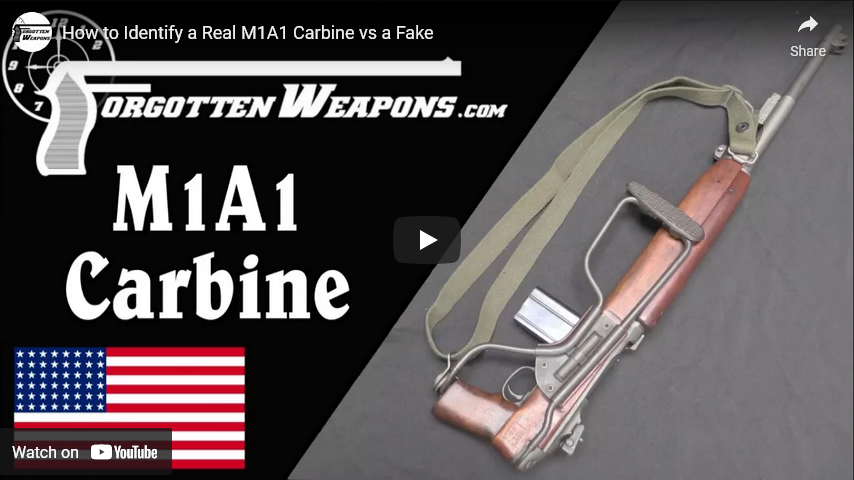
How to Identify a Real M1A1 Carbine vs a Fake
Forgotten Weapons
Published 10 Feb 2018Looking for a light and compact weapon to equip its new Airborne units, the US military adopted the M1A1 Carbine in May of 1942. This was mechanically identical to the existing M1 Carbine but with a wire-frame side-folding stock in place of the standard wooden stock. This allowed the M1A1 to fit into a very handy leg bag for paratroops.
Deliveries began in October 1942, with all of the guns being manufactured by the Inland company. A total of 140,591 were made in two batches (71,000 between October 1942 and October 1943 and another 69,000 between April and December 1944). This is a very small fraction of the more than 6 million M1 Carbines made during the war, and the M1A1 has become quite notable and desirable for its association with elite Airborne units. As a result, reproduction and fake stocks abound, and are quite difficult to tell from original ones.
Today we are going to look at some of the specific features that can help you authenticate an M1A1 stock.
http://www.patreon.com/ForgottenWeapons
Cool Forgotten Weapons merch! http://shop.bbtv.com/collections/forg…
If you enjoy Forgotten Weapons, check out its sister channel, InRangeTV! http://www.youtube.com/InRangeTVShow
Contact:
Forgotten Weapons
6281 N Oracle #36270
Tucson, AZ 85704