Quotulatiousness

October 22, 2021

L-34 Sampo: Aimo Lahti’s Rejected Masterpiece

Filed under: Europe, History, Military, Weapons — Tags: , , , , , — Nicholas @ 02:00

Forgotten Weapons
Published 30 Jun 2021

http://www.patreon.com/ForgottenWeapons

https://www.floatplane.com/channel/Fo…

Cool Forgotten Weapons merch! http://shop.forgottenweapons.com

Finland’s standard light machine gun going into the Winter War was the LS-26, a gun which did not succeed in field use. It was complex and cumbersome, and Finnish troops quickly replaced it with captured Russian DP-27 LMGs. Part of the problem of the LS-26 was its recoil-operated design. Finnish military authorities specified a recoil-operated mechanism for their LMG in light of the success of the recoil-operated heavy Maxim guns in Finnish service. Gas operation was quickly recognized as a superior system for light machine guns, but too late to stop adoption of the LS-26.

In the early 1930s, Aimo Lahti did design a gas-operated LMG, heavily influenced by the Czech ZB-26 system. A handful of prototypes were made by VKT, looking for both Finnish military acceptance and international sales. The gun was made in several calibers, most notably 7.62x54R for Finland and 7.92x57mm Mauser for export. However, bureaucratic issues prevented its consideration by the Finnish Army, and the timing was too late for exports. The L-34 was significantly lighter and simpler than the LS-26, and it was performed quite well in Finnish trials — which did not happen until the 1950s. By that time, the Finnish military was looking for an intermediate-caliber belt-fed gun, and the L-34 was not suitable regardless of its performance.

Many thanks to Sako for providing me access to film this L-34 from their reference collection!

Contact:
Forgotten Weapons
6281 N. Oracle 36270
Tucson, AZ 85740

October 19, 2021

Semiauto FAMAS F1 Rifle

Filed under: France, History, Military, Weapons — Tags: , , , , , — Nicholas @ 02:00

Forgotten Weapons
Published 9 Aug 2016

http://www.patreon.com/ForgottenWeapons

The French FAMAS was one of the first bullpup rifles to be adopted and built in large numbers by a military power. It was adopted by France in 1978 at right about the same time as the Steyr AUG was being adopted by the Austrian military. Bullpup rifles offered a short overall length without sacrificing barrel length, an advantage that seemed quite valuable for troops who were to spend significant amounts of time in vehicles, where space is at a premium. In French service, the FAMAS was also made the formal replacement for both the MAS-49/56 rifle and the MAT-49 submachine gun, thanks to its compact nature.

The FAMAS is interesting mechanically, as it is one of very few production delayed-blowback rifle designs (the other common one being the CETME/HK series). The FAMAS uses a lever-delaying system, which allows a very simple bolt and action mechanism. The F1 model (adopted by the French Army and still in use today, making up the bulk of FAMAS production) has a 1:12″ twist to its rifling, effectively limiting it to 55 grain projectiles — and it also requires steel-cased ammunition to run reliably. The G2 variant (adopted in 1995 by the French Navy) changed to a 1:9″ twist, introduced a full-hand trigger guard, and also uses NATO standard AR15 magazines instead of the proprietary 25-round magazine of the F1.

In the late 1980s a small number of semiauto FAMAS rifles were made by St Etienne and imported into the US by Century. Most people say 100-125 rifles, although serial number suggest this may have actually been 225-250 rifles. Regardless, they are quite scarce and expensive today.

October 16, 2021

W.A.R. – the Winchester Automatic Rifle

Filed under: History, Military, USA, Weapons, WW2 — Tags: , , — Nicholas @ 02:00

Forgotten Weapons
Published 1 Aug 2016

http://www.patreon.com/ForgottenWeapons

With the failure of the G30M and G30R to lead to any military orders (American or otherwise), the Winchester company took the advice of the Ordnance Department to scale the design up to an automatic rifle. The BAR had a number of known shortcomings in WWII, and the military was interested in replacing it. The Winchester Automatic Rifle (WAR) offered the same basic set of features with a lighter weight and lower cost.

The WAR used a 2-lug rotating bolt like the Garand’s, in combination with a Williams short stroke gas tappet action. Chambered for the standard .30-06 cartridge and using 20-round magazines, the WAR could be used as a semiautomatic rifle or in full automatic with a rate of fire of approximately 600 rpm (slightly more or less depending on whether a muzzle device was used).

The WAR passed initial Ordnance inspection with flying colors, and a contract for 10 was placed, for more extensive testing. It passed these tests well, but they took place in the summer of 1945. By the time a major contract was a real possibility, World War II had ended, and the budget for new arms development was slashed. Had the war continued, the WAR likely would have begun to replace the BAR in US military service.

October 5, 2021

How Does It Work: Clips! (Not Magazines)

Filed under: History, Military, Weapons — Tags: , — Nicholas @ 02:00

Forgotten Weapons
Published 16 Jun 2021

http://www.patreon.com/ForgottenWeapons

https://www.floatplane.com/channel/Fo…

Cool Forgotten Weapons merch! http://shop.forgottenweapons.com

Today we are looking at clips and how they work. There are two different types; Mannlicher-style and Mauser-style.

Mannlicher clips were introduced circa 1885, and are also known as en bloc or packet loading clips. They include a set of feed lips, and are inserted completely into a gun. Once the last round is chambered (or fired, in some cases) the empty clip is ejected from the action.

Mauser clips were introduced in 1889, and are also called stripper or charger clips. On these, the clip acts only as a guide to load the cartridges into a separate magazine, either a fixed internal magazine or a detachable box magazine.

Contact:
Forgotten Weapons
6281 N. Oracle 36270
Tucson, AZ 85740

October 2, 2021

How Does It Work: Toggle Actions

Filed under: History, Weapons — Tags: , , , — Nicholas @ 02:00

Forgotten Weapons
Published 3 Jun 2021

http://www.patreon.com/ForgottenWeapons

https://www.floatplane.com/channel/Fo…

Cool Forgotten Weapons merch! http://shop.forgottenweapons.com

Toggle actions are a relatively exotic locking system that are relatively common and well-known because the system was used in a pair of particularly successful early guns: the Luger and Maxim/Vickers. There have also been toggle-action shotguns, military rifles, sporting rifles, and submachine guns, but the system went out of favor by the 1930s (except in the mind of one Adolf Furrer).

Most toggle-action designs use the toggle as a locked breech system, unlocked by a secondary operating system (usually short recoil). However, toggle system can also be the basis for delayed blowback actions, as in the Pedersen rifle.

For a full playlist of toggle-action firearms, check here:
https://www.youtube.com/playlist?list…

Contact:
Forgotten Weapons
6281 N. Oracle 36270
Tucson, AZ 85740

September 28, 2021

Webley 1913 Semiauto Pistol: Shooting

Filed under: Britain, History, Military, Weapons, WW1 — Tags: , , — Nicholas @ 02:00

Forgotten Weapons
Published 26 May 2017

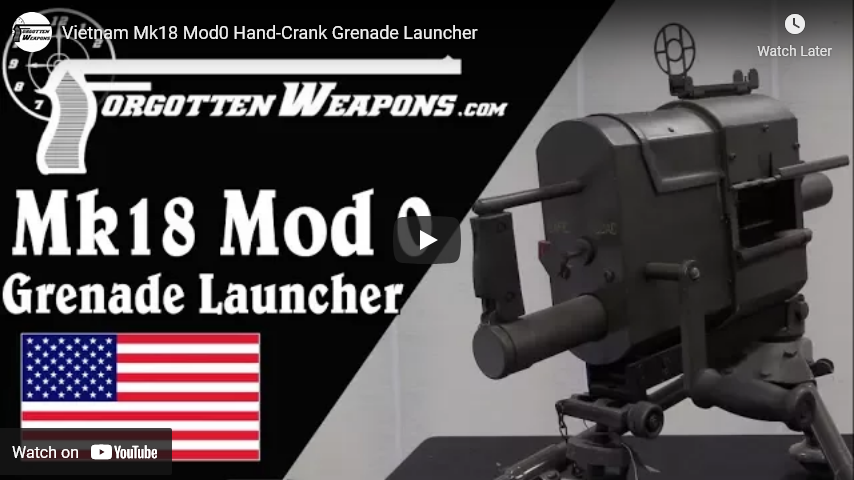
Following up on yesterday’s history and disassembly of the Webley 1913, today I am taking one of them out to the range. Courtesy of Mike Carrick from Arms Heritage magazine, I am shooting original WWI British .455 SL ammunition. We don’t have a lot of it to work with here, but we will try out some magazine fire as well as some single loading, since the magazine cutoff was one of the relatively unique features of the 1913 Webley.

Overall, from this admittedly limited firing experience, I think the Webley is a rather underrated pistol, probably because of its short service live and unavailable ammunition. Despite its awkward appearance, it handles and points pretty well, and has felt recoil not unlike the Colt 1911, despite having a more powerful cartridge.

Cool Forgotten Weapons merchandise! http://shop.bbtv.com/collections/forg…
http://www.patreon.com/ForgottenWeapons

If you enjoy Forgotten Weapons, check out its sister channel, InRangeTV! http://www.youtube.com/InRangeTVShow

September 25, 2021

Webley 1913 Semiauto Pistol: History and Disassembly

Filed under: Britain, History, Military, Weapons, WW1 — Tags: , , , , — Nicholas @ 02:00

Forgotten Weapons
Published 25 May 2017

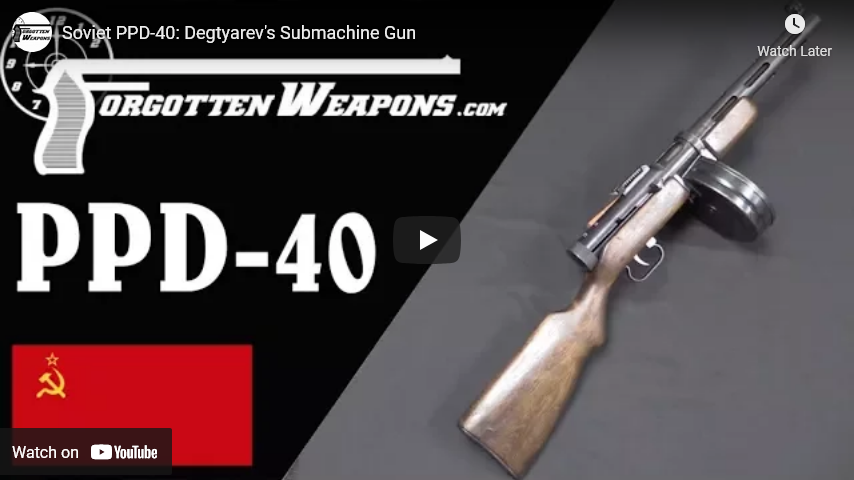
William Whiting and the Webley company had high hopes for their self-loading pistols being adopted by the British military — but they never got the success they were hoping for.

After the poor performance of the Webley 1904 (https://www.youtube.com/watch?v=-hT38…) at trials, William Whiting decided to make sure his next attempt would be fully developed before he put it in the hands of the military. He did very well at that too, as the gun which would become the Model 1913 Webley did very well from its very first military tests. The Royal Navy was, in fact, quite enthusiastic about it, although the Army was not. The Navy would ultimately adopt the gun and purchase about 8,000 of them during World War One, while the Army acquired just a couple hundred and preferred to stick to its revolvers.

Thanks to Mike Carrick of Arms Heritage magazine for loaning me these pistols to bring to you!

Cool Forgotten Weapons merchandise! http://shop.bbtv.com/collections/forg…
http://www.patreon.com/ForgottenWeapons

If you enjoy Forgotten Weapons, check out its sister channel, InRangeTV! http://www.youtube.com/InRangeTVShow

September 22, 2021

Ishapore SMLE MkI** India Pattern

Filed under: Britain, History, India, Military, Weapons, WW1 — Tags: , , , — Nicholas @ 02:00

Forgotten Weapons
Published 6 Feb 2017

While many people are familiar with the Ishapore 2A1 rifles chambered in 7.62mm NATO (largely thanks to their importation and sale in the US in large numbers), production of Indian Enfield rifles actually dates back to 1905, when the Ishapore arsenal was opened. The first rifles produced there were a batch of 3,000 MkI Enfield rifles in 1908/9. These were of course early pattern SMLEs, with features like split charger bridges, volley sights, and magazine cutoffs. Production quickly changed to the No1 Mk III pattern of rifle, which had been formally adopted in Britain in 1907.

During World War One, the need for arms led to those first early rifles being rebuilt in the MkIII configuration, but they retain their original markings, showing their origin. Today we have one of those first 3,000 to look at.

http://www.patreon.com/ForgottenWeapons

Cool Forgotten Weapons merch! http://shop.bbtv.com/collections/forg…
If you enjoy Forgotten Weapons, check out its sister channel, InRangeTV! http://www.youtube.com/InRangeTVShow

September 19, 2021

Chassepot: Best of the Needle Rifles

Filed under: France, History, Military, Weapons — Tags: , , , — Nicholas @ 02:00

Forgotten Weapons
Published 3 May 2019

The Model 1866 Chassepot was France’s first military cartridge-firing rifle. It used a self-contained paper cartridge on the same basic principle as the Prussian 1841 Dreyse rifle, but was a substantial improvement on that system. The Chassepot fired an 11mm bullet at about 1350 fps (410 m/s), which was substantially higher velocity than the Dreyse. It was more accurate and had a substantially longer effective range. The French would produce about 1.5 million Chassepot rifles, most of them before the Franco-Prussian War.

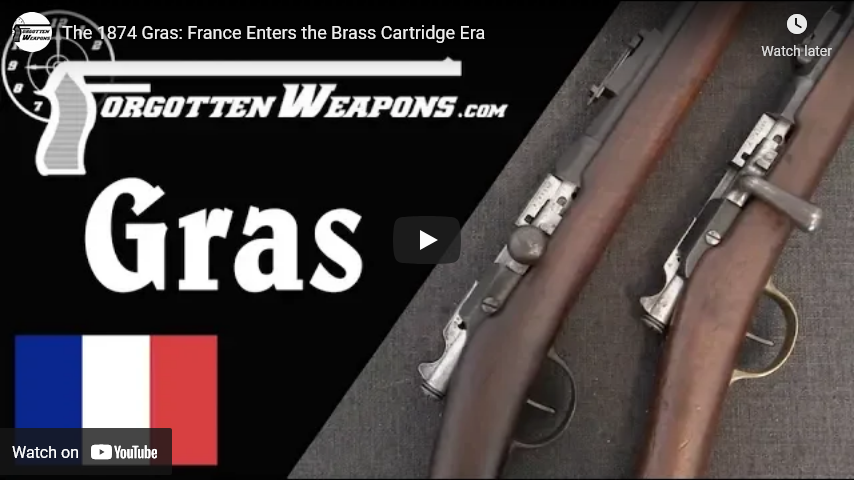
Despite the quality of the Chassepot rifle, that war would go tremendously badly for the French, with hundreds of thousands of men and arms captured by the Prussians and the new German state being declared in the palace of Versailles. In the aftermath, many German cavalry units would adopt Chassepots for their own use, until the Gewehr 71 was available in carbine form. The French would resume Chassepot production briefly after the war, but would soon transition to a new rifle, the metallic cartridge firing Gras.

http://www.patreon.com/ForgottenWeapons

Cool Forgotten Weapons merch! http://shop.bbtv.com/collections/forg…
Contact:
Forgotten Weapons
PO Box 87647
Tucson, AZ 85754

September 14, 2021

Sturmgewehr MP-44 Part II: History & Implementation

Filed under: Germany, History, Military, Weapons, WW2 — Tags: , , , , — Nicholas @ 02:00

Forgotten Weapons
Published 27 Sep 2016

Cool Forgotten Weapons Merch! http://shop.bbtv.com/collections/forg…
The Sturmgewehr was the result of a German intermediate cartridge development program that began in the mid-1930s. It was sidelined for a period as the focus of German Ordnance shifted to full-power rifles in 8x57mm with telescopic sights, but as the German fighting in Russia became more desperate, many Ordnance officers realized that the greater firepower offered by the Sturmgewehr concept was one of the few options that might be able to allow depleted German units to effectively hold ground against Russian attacks.

To this end, the guns were issued primarily in the East, with whole companies being equipped in order to focus a maximum amount of firepower, rather than spreading the new rifles piecemeal across all units. Ultimately, of course, this was insufficient to prevent the growing Soviet advance — but for the individual German soldier, an MP-43/44/StG-44 would have been a much more comforting weapon than a Kar98k Mauser!

http://www.patreon.com/ForgottenWeapons

September 11, 2021

Sturmgewehr MP-44 Part I: Mechanics

Filed under: Germany, History, Military, Weapons, WW2 — Tags: , , , — Nicholas @ 02:00

Forgotten Weapons
Published 27 Sep 2016

The MP-43 (which is mechanically identical to the MP-44 and StG-44; the differences are the subject for another video later) is a tilting bolt rifle with a long stroke gas piston. It was manufactured primarily from complex sheet steel stampings, as a way to minimize the amount of high-quality and thus difficult to acquire steels needed for its construction. The rifle is heavy by today’s standards, but remarkably ergonomic (except for the metal handguard, when heats up quickly). Its sights come right up to the eye when shouldering the rifle, and it disassembles quickly and easily.

It really is one of the best small arms developed during World War II.

http://www.patreon.com/ForgottenWeapons

September 7, 2021

How William Fairbairn Created the Modern SWAT Team in Warlord Era Shanghai

Forgotten Weapons
Published 1 Jun 2021

William E. Fairbairn is best known for his work with Eric Sykes and their “Commando” knife design during World War Two. However, Fairbairn spent some 33 years in the Shanghai Municipal Police, working his way up from a beat constable to Assistant Commissioner. There he was responsible for the SMPD adopting truly forward-thinking fighting methods, and he essentially invented the modern SWAT team (the “Reserve Unit”, which Fairbairn led for 10 years). He combined expertise in formal marksmanship, instinctive practical shooting, and hand-to-hand combat schools (including jiu-jitsu and judo) into a comprehensive training program like no other on earth at the time.

Book references:
The World’s First SWAT Team, by Leroy Thompson:
https://amzn.to/2TrYiNv

Gentleman & Warrior, by Peter Robins:
https://amzn.to/3vuODn9

http://www.patreon.com/ForgottenWeapons

https://www.floatplane.com/channel/Fo…

Cool Forgotten Weapons merch! http://shop.forgottenweapons.com

Contact:
Forgotten Weapons
6281 N. Oracle 36270
Tucson, AZ 85740

September 4, 2021

The Mauser Train: High Adventure in the Last Days of WWII

Filed under: Europe, Germany, History, Military, Railways, Weapons, WW2 — Tags: , , , , , — Nicholas @ 02:00

Forgotten Weapons
Published 18 May 2021

http://www.patreon.com/ForgottenWeapons

https://www.floatplane.com/channel/Fo…

Cool Forgotten Weapons merch! http://shop.forgottenweapons.com

Only days ahead of the French Army in April 1945, Ott-Helmuth von Lossnitzer and about 250 Mauser engineers and technicians fled Oberndorf with the core of Mauser’s new projects. They had the drawings, components, and gages for guns like the new StG-45 assault rifle, MK214 aircraft cannon, and Volkspistol and they were headed for an impregnable series of tunnels in the Austrian Alps to carry on the war. In a story that is absolutely worthy of film adaptation they scrounged a series of locomotives, dodged P47 Thunderbolt attacks, and went careening through the Alps with about 2 dozen boxcars of the most important prototype guns in the German arsenal.

Of course, the idea of continued resistance was a complete fantasy. When it did finally arrive in Ötztal, the Mauser refugees found all the tunnels already occupied by other groups with the very same idea. So they basically made camp and waited for American forces to arrive. The train was found by a British-American CIOS (Combined Intelligence Objective Subcommittee) party, the engineers were all questioned, and the train contents packed up for shipment to the UK and US. Ott-Helmuth von Lossnitzer himself emigrated to the US as part of Operation Paperclip, where he worked for Springfield Arsenal for many years until retiring in 1968 and then living in Wisconsin until his passing in 1989.

For anyone interested in this story, I highly recommend Lossnitzer’s oral recollections compiled into book form by Leslie Field and Bas Martens – ISBN 9789081737807. It is out of print now, but you may be able to find it on the secondary market.

Much more accessible is the reprinting of the original CIOS report on Mauser published by Peter Dallhammer (whom you may recall from his Textbook of Pistol Technology and Design). This is a 360-page treasure trove of details on Mauser’s ongoing R&D in 1945, and it is available on Amazon:
https://amzn.to/2RrnNgT

Contact:
Forgotten Weapons
6281 N. Oracle 36270
Tucson, AZ 85740

September 1, 2021

1893 Lee-Metford Trials Carbine (One of Only 100 Made)

Filed under: Britain, History, Military, Weapons — Tags: , , , — Nicholas @ 02:00

Forgotten Weapons
Published 17 May 2021

http://www.patreon.com/ForgottenWeapons

https://www.floatplane.com/channel/Fo…

Cool Forgotten Weapons merch! http://shop.forgottenweapons.com

Once Lee-Metford rifle production was in place, the British began working on a carbine version of the same action for their cavalry. In 1893 a trial run of 100 carbines were made, and today we are looking at serial number 32 of that batch. These carbines are different in several ways from the ultimately adopted pattern. They had exposed muzzles like the Martini carbines, instead of the heavy snub-nose muzzle that would be adopted (similar to the muzzle of most early Mauser carbines). These trials carbines also had no safety, no sling attachments, and no barrel band. The did have the bent bolt handle of the final pattern (albeit not flattened down) and the short 6-round magazine.

Contact:
Forgotten Weapons
6281 N. Oracle 36270
Tucson, AZ 85740

August 29, 2021

MP-28: Hugo Schmeisser Improves the MP18

Filed under: Germany, History, Military, Weapons — Tags: , , , — Nicholas @ 02:00

Forgotten Weapons
Published 22 Aug 2017

The MP28,II was Hugo Schmeisser’s improved take on the original World War One MP18,I design. It used a simple box magazine in place of the Luger drum magazines, and this magazine would form the basis for a long series of military SMG magazines. It was a double-stack, single feed design because Schmeisser thought this would prevent some malfunctions that were possible with double-feed magazines (and because Mauser probably had a patent on the double feed box magazine at the time). This magazine would be used in conversions of MP18 guns, and would also be the model for the MP-38/40 and subsequent British Sten gun magazines.

The MP28 also introduced a semiautomatic selector switch, where the MP18 had been a fully automatic-only design. It is the presence of this selector button over the trigger, along with a tangent sight instead of a simple flip-up notch that can be used to distinguish between an updated MP18 and an MP28.

While the MP28 was not formally adopted by the German military, it was used by police and SS units, as well as being adopted or copied by a wide selection of other nations, including Portugal, Spain, China, Japan, and Ethiopia.

http://www.patreon.com/ForgottenWeapons​

Cool Forgotten Weapons merch! http://shop.bbtv.com/collections/forg…​

If you enjoy Forgotten Weapons, check out its sister channel, InRangeTV! http://www.youtube.com/InRangeTVShow

« Newer PostsOlder Posts »

Powered by WordPress