Quotulatiousness

December 14, 2021

Chatellerault M24/29: France’s New Wave of Post-WWI Small Arms

Filed under: France, History, Military, Weapons, WW2 — Tags: , , , , , — Nicholas @ 02:00

Forgotten Weapons
Published 26 Aug 2017

France fought the Great War with an array of weapons which were all sub-par in one way or another — the Lebel rifle was obsolescent by 1914, the Berthier was a cavalry carbine forced into rifle service, the Chauchat was an emergency wartime design optimized for production volume instead of quality, and the handguns were a mixture of old revolvers and desperate imports from Spain. Once the war finally ended, the French military would move to replace the whole lot with new and modern arms.

This would begin by finally replacing the 8mm Lebel cartridge with a non-tapered, rimless cartridge — something that would be well suited to use in magazines and repeating arms. Simultaneously, a new light machine gun would be found, as this was deemed to most important improvement to be made. The cartridge was adopted in 1924 as the 7.5x58mm, but it would soon be realized that there was a critical problem with that round. The French military had a large supply of German arms taken as war reparations, and the new 7.5mm cartridge looked very similar to the 8x57mm Mauser cartridge. Worse, the Mauser round would chamber and fire in the new French chambers, causing serious damage to guns when the 8mm bullet was squeezed down to 7.5mm. To fix this issue, the French cut their cartridge down by 4mm, resulting in the 1929 adoption of the 7.5x54mm round — the chamber of which would no longer fit a German 8mm round.

As for the machine gun, the first choice was to simply adopt the Browning BAR — but France insisted on obtaining the technical data package and producing the guns in France, and they could not come to an agreement with Colt over the price of such a license. So, the French held trials of other guns, looking at virtually everything then available. In the aftermath of the trials, it was decided that the Chatellerault arsenal could design its own weapon using the best features of the other existing guns. The arsenal rather quickly produced prototypes, and they were adopted in 1924 (and then updated to use the shorter version of the 7.5mm cartridge in 1929).

The Chatellerault M24/29 is a quite good weapon, especially considering how early it was designed. It uses a tilting bolt and a top-mounted 25 round magazine. It has two triggers, the front one firing in semiautomatic and the rear one in fully automatic. The wooden front handguard allows for fire from the hip or shoulder if desired, and a set of thorough dust covers keep the gun free from ingress of mud or dirt. About 188,000 would be manufactured, and it would stay in service for many decades.

http://www.patreon.com/ForgottenWeapons

Cool Forgotten Weapons merch! http://shop.bbtv.com/collections/forg…

If you enjoy Forgotten Weapons, check out its sister channel, InRangeTV! http://www.youtube.com/InRangeTVShow

December 11, 2021

Suppressed OSS M3 Grease Gun and Bushmaster Booby Trap Trigger

Filed under: History, Military, USA, Weapons, WW2 — Tags: , , , , — Nicholas @ 02:00

Forgotten Weapons
Published 9 May 2017

Today, we have a chance to take a look at a suppressed M3 “Grease Gun”, as purchased and issued by the Office of Strategic Services (the OSS; predecessor to the CIA). Thanks to its readily removable barrel, the M3 (and M3A1) submachine gun was an easy gun to adapt to use with a suppressor (or as it was called at the time, a silencer). During World War 2, such a unit was developed for clandestine use by OSS and British SOE agents in occupied Europe, and they would see use for many decades in all manner of conflicts.

The suppressor itself is quite different than modern designs, being a two-part device using tight wire mesh instead of baffles. The barrel itself is heavily perforated, and extends only through the large diameter section of the suppressor. Around it is wrapped a large roll of wire mesh, which acts as an expansion chamber to slow down the exit of gas from the muzzle. The smaller front section of the unit is filled with small discs of the same wire mesh, similar to wipes but made of mesh.

Allegedly, the suppressor was effective enough to reduce the noise of the gunshots below the level of the action cycling, which is all that one can reasonable want from a suppressor. This particular example has an excellent provenance, having been provided by OSS to a European resistance fighter for a specific mission right at the end of WW2.

In addition, we also have a piece of the OSS sneaky tricks catalog to see. Specifically, a “Bushmaster” remote trigger mechanism to allow the M3 (silenced or otherwise) to be made into an autonomous booby trap in conjunction with a time delay, tripwire, or other triggering device.

Many thanks to the anonymous collector who let me take a look at this piece and bring you a video on it!

Cool Forgotten Weapons merchandise! http://shop.bbtv.com/collections/forg…

http://www.patreon.com/ForgottenWeapons

If you enjoy Forgotten Weapons, check out its sister channel, InRangeTV! http://www.youtube.com/InRangeTVShow

December 8, 2021

SA80 History: The Pre-Production XL85 and XL86

Filed under: Britain, History, Military, Weapons — Tags: , , , , , , — Nicholas @ 02:00

Forgotten Weapons
Published 17 May 2017

Armament Research Services (ARES) is a specialist technical intelligence consultancy, offering expertise and analysis to a range of government and non-government entities in the arms and munitions field. For detailed photos of the guns in this video, don’t miss the ARES companion blog post:

http://armamentresearch.com/british-e…

The SA80 saga continues today with the final pre-production versions of the L85A1 and L86A1, although at this point they still both carry XL designations, as they were not yet formally adopted weapons. In these weapons we can see a couple last distinctive mechanical changes, but perhaps more importantly by this time the worker morale at RSAF Enfield was thoroughly in the tank. It had become well known that the factory complex was going to be taken public or sold outright, and it was widely expected that Enfield would be shut down as a result. A new facility would be built in Nottingham, but none of the rank and file staff expected to transfer. They would be laid off, and they knew it. Not surprisingly, quality control suffered as a result.

As for the guns themselves, the first distinctive visible improvement was in the magazine well. In the XL70 weapons, the bottom half of the magazine well had been simple welded onto the bottom of the lower receiver, in order to retain the easy stamping of that element. On these guns, that have been replaced by a separate box which encompassed the magazine and was spot welded into the lower receiver. This change in construction method allow the magazine well to be much more precisely located in the receiver, and then fixed in place without the risk of warping the thin sheet metal of the lower receiver – while still retaining the simple stamping of that lower.

The other visible change was to the Light Support Weapon, and it consisted of a long “girder” support added below the barrel. This was intended to mount the bipod onto, in the hopes of resolving the long-running problem of split groups in the LSW. This was a problem in which the first round of a burst would hit substantially low and left relative to the rest of the burst. While the LSW was a quite accurate weapon in semiautomatic mode, this split group problem was a substantial detriment to its effectiveness as a proper support weapon.

http://www.patreon.com/ForgottenWeapons

Cool Forgotten Weapons merch! http://shop.bbtv.com/collections/forg…

If you enjoy Forgotten Weapons, check out its sister channel, InRangeTV! http://www.youtube.com/InRangeTVShow

December 5, 2021

MAS 44: The French Adopt a Semiauto Rifle

Filed under: France, History, Military, Weapons — Tags: , — Nicholas @ 02:00

Forgotten Weapons
Published 17 May 2019

The French Army had been planning a semiauto infantry rifle since 1921, but indecisiveness and bureaucracy delayed its development. A major trial was held in 1931, and elements of two experimental rifles were chosen to be combined into what would eventually become the MAS 1944. It was put through field trials in late 1939, and passed with flying colors — but too late to get into production before the 1940 armistice with Germany. The project was hidden from the Germans at St. Etienne, and would be revived upon the factory’s liberation in the fall of 1944. By late 1945, rifles were coming off the production line.

The MAS 44 was a direct gas impingement operating system with a tilting bolt, and was a remarkably rugged, dependable, and simple rifle. It was initially adopted by the French Navy, and only 6200 were made before a number of improvements were made and a new model was designated; the MAS 1949. When those 6200 rifles were ultimately surplussed in the 1980s, the vast majority of the surviving examples came to the United States, where their scarcity is not well appreciated.

http://www.patreon.com/ForgottenWeapons

Cool Forgotten Weapons merch! http://shop.bbtv.com/collections/forg…

Contact:
Forgotten Weapons
PO Box 87647
Tucson, AZ 85754

December 2, 2021

XM-148: Colt’s Vietnam Grenade Launcher

Filed under: Asia, History, Military, USA, Weapons — Tags: , , , — Nicholas @ 02:00

Forgotten Weapons
Published 11 Dec 2019

http://www.patreon.com/ForgottenWeapons

Cool Forgotten Weapons merch! http://shop.bbtv.com/collections/forg…

While the Special Purpose Infantry Weapon (SPIW) program failed to produce any successful rifles, it did become clear that the area-effect aspect of its requirements did have merit. This was spun off as its own program to develop a 40mm under-barrel grenade launcher for the M16 rifle. Of the initial entrants, (Philco/Ford, AAI, and Colt), Colt’s CGL-4 was the most promising. It was moved quickly through development and 10,500 were ordered in January 1966 as the XM-148. Field reports quickly turned sour, though, and in May of 1967 the XM-148 was ordered out of combat use, to be replaced with the M79 grenade launcher. The idea was sound, but the execution needed improvement — which would come in the form of the M203 launcher instead.

Many thanks to Movie Armaments Group in Toronto for the opportunity to showcase this grenade launcher for you! Check them out on Instagram to see many of the guns in their extensive collection:

https://instagram.com/moviearmamentsg…

http://www.moviearms.com

Contact:
Forgotten Weapons
6281 N. Oracle #36270
Tucson, AZ 85704

November 28, 2021

SA80 History: XL70 Series Final Prototypes (Individual Weapon and LSW)

Filed under: Britain, History, Military, Weapons — Tags: , , , , — Nicholas @ 02:00

Forgotten Weapons
Published 13 May 2017

Armament Research Services (ARES) is a specialist technical intelligence consultancy, offering expertise and analysis to a range of government and non-government entities in the arms and munitions field. For detailed photos of the guns in this video, don’t miss the ARES companion blog post:

http://armamentresearch.com/british-e…

By 1980, the scheduled deadline for adopting the L85 and L86 was rapidly approaching, and the weapons should have been in the last stages of fine-tuning before production began. This was not the case, however — testing was still uncovering critical problems in the guns.

The goal for these weapons was 8000 MRBF (Mean Rounds Between Failure) for the LSW and 2500 MRBF for the IW. As real testing began, the numbers were actually 100-300 MRBF. In many cases, the guns could not run three magazines in a row without a malfunction, and this was literally an order of magnitude below the requirements. But what truly led to the massive problems with the L85/86 was that RSAF Enfield did not fix these problems. Instead, they moved the goalposts. With so many problems, it was decided to only count malfunctions that occurred in the endurance testing (ie, when the guns were not put under any environmental stress at all) and to only count “critical” malfunctions in the tally. A “critical” failure was one which could not be resolved by the shooter, such as a split barrel. Simple feed or ejection failures were not counted, nor were malfunctions that required gun disassembly to correct. Even under this new paradigm, MRBF over 3000 could not be achieved.

In addition, the LSW was showing a problem that would become endemic; split groups. The weapon shot very good groups in semiautomatic, but in full auto fire it would produce two discreet groups. The first shot in each burst would land about 6 minutes of angle low and right compared to the remaining rounds in the group. This would be the subject of significant work, and was never fully rectified.

http://www.patreon.com/ForgottenWeapons

Cool Forgotten Weapons merch! http://shop.bbtv.com/collections/forg…

If you enjoy Forgotten Weapons, check out its sister channel, InRangeTV! http://www.youtube.com/InRangeTVShow

November 25, 2021

Why The Most Expensive US Martial Pistol Exploded A Lot

Filed under: History, Military, Technology, USA, Weapons — Tags: , , , , , — Nicholas @ 02:00

Forgotten Weapons
Published 12 Aug 2021

http://www.patreon.com/ForgottenWeapons

https://www.floatplane.com/channel/Fo…

Cool Forgotten Weapons merch! http://shop.forgottenweapons.com

The Colt Model 1847 Walker is one of the most valuable of all US military handguns in the collecting community, with examples sometimes breaking seven figures. However, the Walker was in many ways a remarkable failure as a service sidearm, mostly because it tended to explode. By today’s standards, it exploded quite a lot.

Why?

Basically, a combination of several factors:

– The Walker was made of wrought iron, and not always the best quality wrought iron. Cylinders had internal flaws that became weak points and failed upon firing.
– The Walker had a huge powder capacity in its chambers, between 50 and 60 grains depending on the projectile used. This was basically rifle size, and it left the cylinder design with a very small margin of safety.
– Powder composition and grain size was less standardized in the 1840s than it is today, making overpressure loads more likely than today.
– The Walker was designed for a conical “Pickett” bullet that was tricky to load correctly (point forward). Loading it backward could increase the powder volume in a chamber.

Of nearly 400 Walkers issued for the Mexican-American War, only 191 were returned after a year’s service, and only 82 of those were serviceable. Some of those missing guns were lost and stolen, but a substantial number — generally accepted to be 20%-30% — suffered burst barrels, burst cylinders, and broken cylinder arbors. Whoops!

Contact:
Forgotten Weapons
6281 N. Oracle 36270
Tucson, AZ 85740

November 21, 2021

SA80 History: XL60 Series in 4.85mm

Filed under: Britain, History, Military, Weapons — Tags: , , , , , , — Nicholas @ 02:00

Forgotten Weapons
Published 10 May 2017

Armament Research Services (ARES) is a specialist technical intelligence consultancy, offering expertise and analysis to a range of government and non-government entities in the arms and munitions field. For detailed photos of the guns in this video, don’t miss the ARES companion blog post:

http://armamentresearch.com/british-e…

Once the basic configuration of the new British rifle was determined, the next step was to build a series of prototypes. The design that took form was basically a bullpup copy of the Armalite AR-18. The design team at Enfield were mostly senior draftsmen, with virtually no firearms experience among them. To make things worse, most of the design team was regularly rotated onto other projects, preventing them from developing any project experience on the rifle.

Several prototype batches were made (typically of a dozen guns each, both IWs and LSWs), all in the unique British 4.85x49mm cartridge, with a variety of different feature sets. Through the different patterns, configurations would change on the safety (push button vs lever) fire selector (push button vs lever), and magazine catch (straight-in side lever vs rock-in side lever vs rock-in rear paddle). At this time, plans still existed to make both left- and right-handed versions of the final gun, so prototypes of both were manufactured.

Because cost-cutting measures had not yet been forced on the project, these XL-60 series guns were generally reliable, at least in normal conditions. They are quite comfortable to fire, with a cartridge very similar to the 5.56mm NATO in practical terms. There is nothing particularly wrong with that cartridge, but it would be dropped when it lost NATO trials to the Belgian SS109 … but we will address that in the next episode of the SA80 history.

http://www.patreon.com/ForgottenWeapons

Cool Forgotten Weapons merch! http://shop.bbtv.com/collections/forg…

If you enjoy Forgotten Weapons, check out its sister channel, InRangeTV! http://www.youtube.com/InRangeTVShow

November 18, 2021

All the Guns on a T-62 Tank (with Nicholas Moran, the Chieftain)

Forgotten Weapons
Published 5 Aug 2021

Try out World of Tanks with a special bonus tank using this link!

https://tanks.ly/3dqGoBL

Today Nicholas Moran (the Chieftain) and I are at Battlefield Vegas courtesy of Wargaming.net, to show you around a Soviet T-62 and all its various armaments. This particular T-62 was built in 1971 or 1972 and initially sold to Syria. It saw combat in the Valley of Tears in 1973, but survived as was eventually transferred to Lebanese ownership. From there is was captured by Israel and eventually imported into the United States via the UK. The T-62 was the last of the “simple” WW2-style Soviet tanks, and equipped with an extremely effective 115mm smoothbore main gun. In addition to that cannon, we will discuss and shoot the coaxial PKT machine gun and the loader’s antiaircraft DShKM heavy machine gun.

If you enjoy this video, check out World of Tanks – and maybe they will send Nicholas and I back again to do the same thing yet again on a third tank!

For videos on the detail of tanks like this one, check out The Chieftain:
https://www.youtube.com/user/WorldOfT…
https://www.youtube.com/channel/UCp4j…

0:00:00 – Introduction
0:06:02 – Coaxial PKT
0:13:12 – Antiaircraft DShKM
0:20:25 – 115mm Main Gun
0:28:43 – Firing the main gun

Contact:
Forgotten Weapons
6281 N. Oracle 36270
Tucson, AZ 85740
November 14, 2021

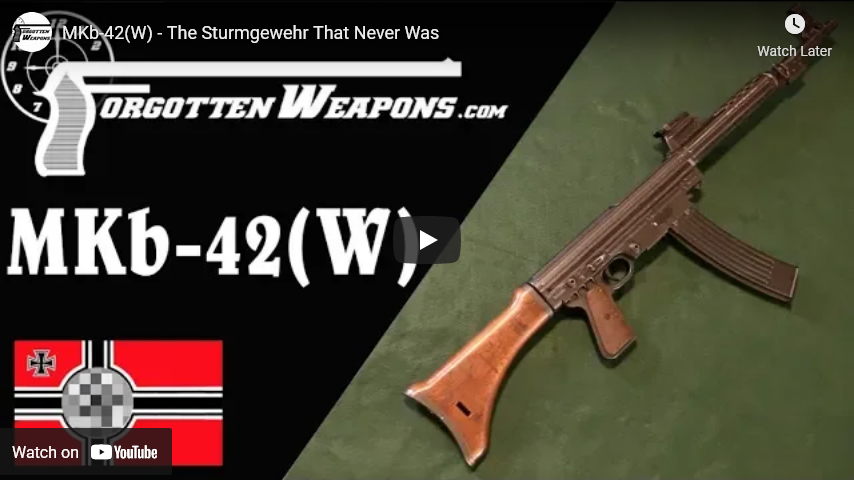
“Jungle Carbine” – the Lee Enfield No5 MkI Rifle

Filed under: Britain, History, Military, Weapons, WW2 — Tags: , , — Nicholas @ 02:00

Forgotten Weapons
Published 4 Aug 2021

http://www.patreon.com/ForgottenWeapons

https://www.floatplane.com/channel/Fo…

Cool Forgotten Weapons merch! http://shop.forgottenweapons.com

Today I am concluding our series on the standard-issue Lee Enfield system with the No5 MkI — the “jungle carbine”. Developed in 1943 as a shorter and handier pattern of rifle than the No4, the carbine went into production in 1944 and saw use during World War Two. It featured a number of lightening cuts, as well as a shortened barrel, conical flash hider, side-mounted sling, 800-yard sights, and rubber buttpad. Unfortunately, the No5 was beset by a problem of “wandering zero”. A significant number of the rifles failed to properly hold zero when they were widely issued. The problem was never fully resolved, but appears to have been the result of receiver flex due to the lightening cuts. Efforts to fix it were essentially abandoned, as it was recognized that a new self-loading rifle was going to be adopted soon, and it would be a waste of time and money to continue development of the Lee Enfield by that point.

Contact:
Forgotten Weapons
6281 N. Oracle 36270
Tucson, AZ 85740

November 9, 2021

Bayonet Development for the Lee Enfield No4 Rifle

Forgotten Weapons
Published 22 Jul 2021

http://www.patreon.com/ForgottenWeapons

https://www.floatplane.com/channel/Fo…

Cool Forgotten Weapons merch! http://shop.forgottenweapons.com

Having wrapped up our series on the major development of the Lee Enfield rifle in British service, I figured it would be a nice addendum to talk about the bayonets developed for the No4 rifle. These went through a substantial evolution, and are an interesting field for collectors all by themselves.

During World War One, the British used the Pattern 1907 bayonet, a long blade type essentially copied from the Japanese Type 30. By the 1920s, this was being reconsidered – the long blades were expensive, fragile, and perhaps not really necessary. When the No1 Mk VI rifle was put into trials, it was given a new bayonet style. This was inspired by the Swiss cyclists’ bayonet, with a cruciform spike instead of a true blade. It was only 8 inches long; this was determined to be long enough for virtually all use cases and being short minimized weight and bulk.

As World War Two progressed, the spike bayonet was simplified several times. Before the initial production of the first standard model (No4 MkI) was completed, the cruciform pattens had already been abandoned for a much simpler (and faster and cheaper) round body spike with a screwdriver-like point at the end. This was in turn simplified by separating the socket and spike into two parts for easier production, and then further simplified by casting the socket instead of forging it. After the war, the spike was replaced by a short blade-type socket bayonet (the No9), although this was rather short-lived because of the adoption of the SLR (FN FAL).

Contact:
Forgotten Weapons
6281 N. Oracle 36270
Tucson, AZ 85740

November 6, 2021

No4 MkII: The Lee Enfield’s Final Standard Upgrade

Filed under: Britain, History, Military, Weapons — Tags: , , , — Nicholas @ 02:00

Forgotten Weapons
Published 21 Jul 2021

http://www.patreon.com/ForgottenWeapons

https://www.floatplane.com/channel/Fo…

Cool Forgotten Weapons merch! http://shop.forgottenweapons.com

The final standard pattern of the venerable Lee Enfield as a standard-issue service rifle was the No4 MkII, introduced after the end of World War Two. The new pattern was adopted to resolve problems that had come about because of wartime simplifications to the rifle. Specifically, the use of kiln-dried wood for stocks. On the original No4 design, the trigger was pinned to the trigger guard, which was in turn connected to the front handguard. The sear was pinned to the receiver. If the handguard swelled, shrank, or warped (which was much more likely on the quickly kiln-dried stocks used during the war, compared to the naturally dried pre-war wood), the trigger/sear interaction could be impacted.

To solve this, the receiver was changed slightly to include a boss for attaching the trigger. This kept both the trigger and sear pinned to the (metal) receiver, and stock shifting was no longer a problem. In addition, a change was also made to remove the boss originally intended for mounting the magazine cutoff lever, so that No4 rifles would be made using No5 receiver forgings (this change did not result in a new rifle designation).

Many existing rifles were refitted to the new standard, with upgraded MkI rifles becoming Mk I/2 and upgraded MkI* rifles becoming MkI/3.

Contact:
Forgotten Weapons
6281 N. Oracle 36270
Tucson, AZ 85740

November 1, 2021

Britain’s Last Ditch: Wartime Changes to No4 Lee Enfield

Filed under: Britain, Cancon, History, Military, USA, Weapons, WW2 — Tags: , , , — Nicholas @ 02:00

Forgotten Weapons
Published 14 Jul 2021

http://www.patreon.com/ForgottenWeapons

https://www.floatplane.com/channel/Fo…

Cool Forgotten Weapons merch! http://shop.forgottenweapons.com

When we think of “last-ditch” rifles, we normally think of 1945 and the very end of World War Two. For the British, however, the lowest ebb of the war was in 1941 and 42, and it is during that period that the Lee Enfield was at its crudest. British ordnance instituted a number of simplifications to maximize weapons production. In particular:

– Walnut replaced with kiln-dried birch and beech for furniture
– Two-groove barrels replacing five-groove ones
– A vastly simplified 2-position flip sight in place of the original fine micrometer style
– Simplified bolt release, designated the No4 MkI* (which was only produced in the US and Canada)
– Aluminum buttplates
– Much reduced standards of fit and finish, leading to really ugly machine marks and haphazard markings.

Most of these changes would be walked back later in the war as Britain’s footing became more solid, but they make a very interesting period of changes for the collector to study.

Contact:
Forgotten Weapons
6281 N. Oracle 36270
Tucson, AZ 85740

October 29, 2021

A New Enfield for a New War: The No4 MkI

Filed under: Britain, History, Military, Weapons, WW2 — Tags: , , , — Nicholas @ 02:00

Forgotten Weapons
Published 7 Jul 2021

http://www.patreon.com/ForgottenWeapons

https://www.floatplane.com/channel/Fo…

Cool Forgotten Weapons merch! http://shop.forgottenweapons.com

The stalwart No1 MkIII “Smelly” served the United Kingdom well during the First World War, but by the 1920s it was growing obsolescent. The war had revealed a number of shortcomings of the design, and in the interwar years the British developed a replacement. The main issues that the new rifle would address were:

– Better mechanical accuracy, through use of a heavier barrel
– Better practical accuracy, through use of a micrometer-adjustable aperture sight
– A more practical short spike bayonet
– More efficient manufacturability

After a brief dalliance with the No1 MkV rifle in the early 1920s, the No1 MkVI was developed, which was fundamentally the new No4 rifle, just without the name. In the early 1930s a run of about 2500 No4 MkI rifles was produced, and they would go through field trials for the next several years until being formally adopted in 1939. Production actually began in the summer of 1941 at Maltby, Fazakerley, and BSA.

Contact:
Forgotten Weapons
6281 N. Oracle 36270
Tucson, AZ 85740

October 25, 2021

P90: FN’s Bullpup PDW

Filed under: Europe, History, Military, Weapons — Tags: , , , , , , , — Nicholas @ 02:00

Forgotten Weapons
Published 2 Jul 2021

http://www.patreon.com/ForgottenWeapons

https://www.floatplane.com/channel/Fo…

Cool Forgotten Weapons merch! http://shop.forgottenweapons.com

FN began developing the P90 in the late 1980s, actually preceding the NATO requirement that it would eventually compete for. The idea of the P90 was to develop a weapon for secondary troops to replace 9mm pistols and SMGs. There was an anticipated threat of Russian paratroops wearing armor that could defeat 9mm ball. The P90 was intended to be a light and handy weapon that was easily controllable without a tremendous about of training, and could defeat that sort of body armor.

The result was the 5.7x28mm cartridge, firing a 31 grain armor-piercing bullet at 2350 fps. This was combined with a simple blowback action and a Hall-style 50-round magazine in a fully ambidextrous, bullpup layout. The gun was introduced onto the market in 1990, and has been widely purchased by security and special operations organizations. In its original intended role for support troops, it has only been adopted by Belgium.

Contact:
Forgotten Weapons
6281 N. Oracle 36270
Tucson, AZ 85740
« Newer PostsOlder Posts »

Powered by WordPress