Forgotten Weapons
Published 3 Aug 2016http://www.patreon.com/ForgottenWeapons
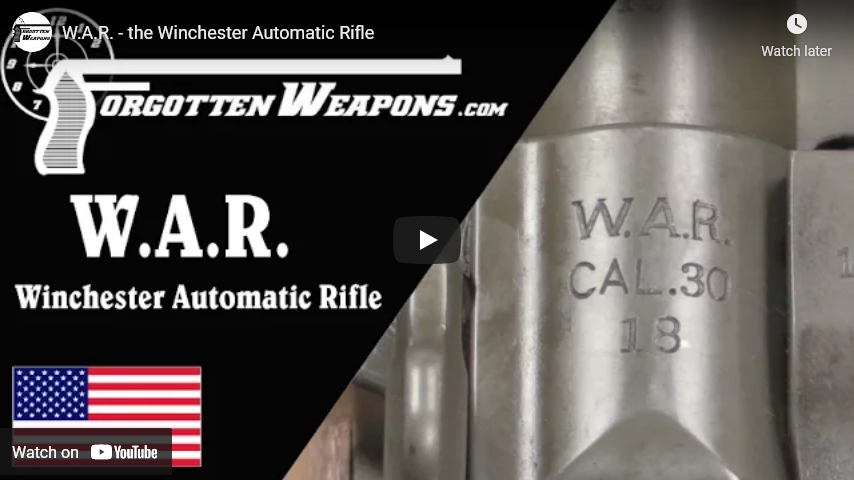
David Marshall Williams was hired by the Winchester company in 1939, and would have a hand in a number of major projects during his 10-year stint with the company, although best known for the M1 Carbine. The Carbine was an offshoot of the Winchester G30 and G30M rifles, which would also evolve into the G30R and Winchester Automatic Rifle. Another offshoot using this same basic mechanism was this undesignated .50 BMG semiautomatic antitank rifle developed by Winchester during World War II.
This rifle, like its developmental precursors, uses a two-lug, Garand type rotating bolt and a Williams gas tappet short stroke action. It has a 10-round detachable box magazine.
Although I have not found a testing report, the gun was apparently tested by the Canadian military and performed quite well. It was never purchased or put into serial production, however, most likely because as an antitank rifle the .50 BMG cartridge was not effective by the end of World War II.
August 26, 2021
Winchester WWII 50 AT rifle
August 22, 2021
Mounties’ First Revolver: the NWMP Adams MkIII
Forgotten Weapons
Published 3 May 2021http://www.patreon.com/ForgottenWeapons
https://www.floatplane.com/channel/Fo…
Cool Forgotten Weapons merch! http://shop.forgottenweapons.com
The first handguns issued by the North West Mounted Police (which would later become the modern RCMP) were 330 Adams revolvers, requisitioned by the new police service in March 1874, and shipped over from England. Upon their receipt in July of that year, the Mounties were dismayed to find thoroughly worn out Adams Mk I 5-shot conversions from old percussion revolvers. These were found totally unfit for frontier service, and an appeal was sent back to England for something better.
A replacement shipment arrived in October 1875, and this time they received 326 much better Adams MkIII revolvers (330 were shipped, but 4 were stolen in transit). The MkIII pattern was a purpose-made .450 Adams cartridge revolver, holding six shots with a double action trigger and solid frame. These served very well, and the NWMP ordered more in 1880 — for which they instead received Enfield revolvers, which had replaced the Adams in British military service by that time.
The 326 Adams MkIII revolvers issued by the NWMP were marked by a local gunsmith upon their arrival. The right side of the frames are marked “C M.P.” (presumably Canada Mounted Police) and given a police inventory number just below the barrel (in addition to the serial number above the trigger). These issue numbers were defaced when the guns were sold out of service.
Contact:
Forgotten Weapons
6281 N. Oracle Box 36270
Tucson, AZ 85740
August 19, 2021
Hill SMG/Pistol: Inspiration for the FN P90
Forgotten Weapons
Published 28 Apr 2021http://www.patreon.com/ForgottenWeapons
https://www.floatplane.com/channel/Fo…
Cool Forgotten Weapons merch! http://shop.forgottenweapons.com
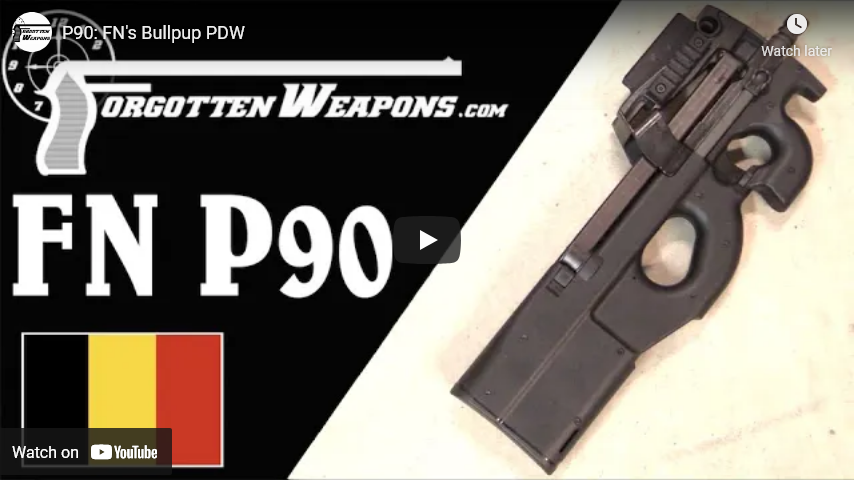
John L. Hill was a World War One fighter pilot [in the short-lived Canadian Air Force] who went into the oil and gas industry, and enjoyed tinkering with guns in his free time. In 1949 he got an idea for a new style of magazine and feed system, which he developed and patented in the early 1950s. Hill’s intention was to create a submachine gun for the military or police that held its magazine flat atop the action, instead of sticking out of the gun where it would get in the way. To do this, Hill designed the system that would be later used in the FN P90, with ammunition held perpendicular to the barrel, and a turret mechanism in the action to turn the cartridges 90 degrees for feeding in the chamber.
Hill built seven or eight fully automatic prototypes, which were examined by the US Army and the FBI. One was tested at Aberdeen Proving Grounds in 1953, and we still have some of the photos from that examination (that particular gun was built using an MP40 barrel, interestingly). Hill’s guns varied in pretty much all details, including different barrel lengths, stock configurations, and magazines. Some used single-stack and some double-stack magazines, but all were a simple blowback action.
At some point in the late 50s or early 60s, Hill sold his patent rights to a pair of Texas businessmen who built 90 or 100 more examples (mostly semiautomatic) under the name H&B Enterprises. They took one to FN in Belgium, who found it interesting but did not opt to license or produce it. Ultimately, nobody was interested enough to put the gun into production, and only a small number of the H&B guns survive today. The original Hill prototypes were donated to the Lone Star Flight Museum in Texas in 1993, although it is not clear where they are today.
When FN began to design the P90 in the early 1980s, Hill’s concept made a return. It is not known exactly how much direct link there was between the Hill prototype and the P90 concept, but the eventual patents filed on the P90 do reference Hill’s patents (among others). The P90 remains the only production firearm to use this clever rotary feeding system.
Hill’s patents:
https://patents.google.com/patent/US2…
https://patents.google.com/patent/US2…For more documents, see the Forgotten Weapons page on this design:
https://www.forgottenweapons.com/hill…Contact:
Forgotten Weapons
6281 N. Oracle 36270
Tucson, AZ 85740

August 15, 2021
Denel NTW 20: A Multi-Caliber Anti-Materiel Rifle
Forgotten Weapons
Published 7 Sep 2018http://www.patreon.com/ForgottenWeapons
Cool Forgotten Weapons merch! http://shop.bbtv.com/collections/forg…
Created by noted South African gun designer Tony Neophytou, the NTW-20 is a bolt action anti-materiel rifle made in 20x82mm, 20x110mm, and 14.5x115mm. The weapon began as idea to use the large quantities of surplus 14.5mm ammunition available at the time, and a recognition that the 14.5mm Soviet cartridge was an excellent anti-armor round, with a really remarkably high muzzle velocity. To widen the rifle’s capabilities, it was decided to incorporate an easily interchangeable barrel, and also chamber it for the 20x82mm round used in the Inkunzi PAW individual weapon and Inkunzi Strike machine gun. The 20x82mm is low velocity compared to traditional 20mm cartridges, carrying the same explosive or incendiary payload but without the punishing recoil of what was originally an aircraft cannon cartridge.
Both of these cartridges are fed from a 3-round box magazine on the left side of the action. A single-shot version in the longer 20x110mm cartridge was also developed by request of a military client, but this cartridge is too long to fit the magazine. A version in .50 BMG was considered, but decided against on the basis of the 14.5mm being just as available and substantially more effective.
The gun is liberally sprinkled with clever engineering and design features — things like using the recoil-absorbing travel of the action to recock the hammer, and the use of both 20mm and 14.5mm cartridge cases as levers for unlocking the barrel. The optic was custom made for the rifle, an 8x56mm long eye relief scope to prevent any chance of the scope bell injuring the shooter during recoil. The trigger mechanism uses only a single spring, and is easily removed from the action. The bolt handle itself is on a pivot pin, and provides the primary extraction leverage to ensure easy cycling with the high-pressure 14.5mm cartridge.
From a military perspective, the NTW-20 is easily broken apart into barrel and action loads, and can be transported more easily than any comparable weapon by a two-man team. The use of a recoil buffer in the action and an effective muzzle brake makes it a remarkably pleasant 20mm rifle to fire. Of all the anti-material rifles I have fired (Lahti L39, Solothurn S18-1000, Mauser T-Gewehr), the NTW-20 was by far the most comfortable to shoot. It was also the only one in which I jumped at the chance to fire more rounds once the filming needs were met. It certainly has a kick, but not at all a painful one.
Many thanks to Denel Land Systems for allowing me to try out this very cool rifle!
If you enjoy Forgotten Weapons, check out its sister channel, InRangeTV! http://www.youtube.com/InRangeTVShow
August 12, 2021
FN CAL: Short-Lived Predecessor to the FNC
Forgotten Weapons
Published 4 Jan 2019http://www.patreon.com/ForgottenWeapons
Cool Forgotten Weapons merch! http://shop.bbtv.com/collections/forg…
The CAL (Carabine Automatique Leger; Light Automatic Carbine) was FN’s first attempt to produce a 5.56mm rifle as a counterpart to the 7.62mm FAL. While light and handy, the CAL was a relatively complex and expensive design, and failed to garner many sales. About 12,000 were made in total before FN pulled the gun in favor of the FN FNC, which would prove to be much more successful.
Contact:
Forgotten Weapons
PO Box 87647
Tucson, AZ 85754
August 8, 2021
Australia’s FAL-Based L2A1 Heavy Automatic Rifle
Forgotten Weapons
Published 21 Apr 2021http://www.patreon.com/ForgottenWeapons
https://www.floatplane.com/channel/Fo…
Cool Forgotten Weapons merch! http://shop.forgottenweapons.com
Many the nations that adopted the FAL (or L1A1, in Commonwealth terminology) opted to also use a heavy-barreled variant of the same rifle as a light support weapon. In the Commonwealth, this was designated L2A1 and it was used by Canada, Australia, and New Zealand. The Australian model was build at Lithgow and supplied to the Australian and New Zealand forces, as well as being exported to a variety of other nations including Ghana, India, Singapore, Malaysia, Papua New Guinea, and others (total Lithgow production was 9,557). It has a 21″ heavy barrel and a distinct folding bipod with wooden panels that act as handguard when the bipod is folded up. Doctrinally, the L2A1 was intended to be used in semiauto most of the time, with the bipod and heavy barrel allowing greater sustained semiauto fire than a standard rifle.
A 30-round magazine was developed and issued, but abandoned before long. It was found to be insufficiently reliable, interfered with prone shooting, and contributed to overheating of the guns. Interestingly, Australia also opted to not have an automatic bolt hold open functionality in their FAL type rifles. The control can be used manually, but the rifle does not lock open when empty. This was presumably done in favor of keeping the action closed and clean at the expense of slower reloading (the same compromise was made on the G3 family of rifles).
This particular example is a registered transferrable machine gun made on a Lithgow receiver imported by Onyx in 1985 with other Lithgow-produced parts, including a 1960 bolt, 1961 carrier, and 1961 lower receiver from an L1A1 originally exported to Malaysia.
Contact:
Forgotten Weapons
6281 N. Oracle 36270
Tucson, AZ 85740
August 5, 2021
Gordon Ingram’s Westarm .308 Battle Rifle
Forgotten Weapons
Published 2 Apr 2021http://www.patreon.com/ForgottenWeapons
https://www.floatplane.com/channel/Fo…
Cool Forgotten Weapons merch! http://shop.bbtv.com/collections/forg…
In the late 1970s and early 80s, Gordon Ingram came close to producing a military rifle in one of the most convoluted international arrangements I’ve yet heard of. Prototypes were made in Italy using British raw castings, to be tested in Somalia as part of a project to build a rifle factory there with Dominican Republic expertise from the San Cristobal armory. Somalia actually ordered a large quantity of rifles in 7.62x39mm, but Ingram prototyped the design in .223 and .308 as well.
Mechanically, the rifle was essentially a scaled-up M1 Carbine with a long stroke gas piston instead of a gas tappet. The production guns were select-fire, but the handful or prototypes brought into the US were semi-automatic only, to meet import requirements. In .308, the rifle used FAL magazines, while the .223 ones used AR magazines and the 7.62x39mm ones AK magazines.
Unfortunately for Ingram (but predictably), the project fell apart as the result of financial corruption among the many interested parties. The Somali government ended up paying out something like $5 million US and all they got for it were 10 unreliable prototype rifles.
Contact:
Forgotten Weapons
6281 N. Oracle 36270
Tucson, AZ 85740

August 2, 2021
Who is Colt? A History of the Colt Patent Firearms Manufacturing Company
Forgotten Weapons
Published 23 Feb 2017Today we will take a look at the history of the Colt company, from Sam Colt’s first efforts in Paterson (and before) to the West Hartford remnants that survive today. If you enjoy this type of history, please let me know in the comments!
http://www.patreon.com/ForgottenWeapons
Cool Forgotten Weapons merch! http://shop.bbtv.com/collections/forg…
If you enjoy Forgotten Weapons, check out its sister channel, InRangeTV! http://www.youtube.com/InRangeTVShow
Gun display racking provided by Matrix Armory: http://www.matrixarmory.com
July 29, 2021
MAT 49: Iconic SMG of Algeria and Indochina
Forgotten Weapons
Published 16 Jan 2018http://www.patreon.com/ForgottenWeapons
Cool Forgotten Weapons merchandise! http://shop.bbtv.com/collections/forg…
The MAT-49 was developed by France after World War Two to satisfy the need for a more modern submachine gun to replace the MAS-38. The military had come around to standardizing on the 9x19mm cartridge for its pistols and subguns, and the 7.65mm MAS-38 was not feasible to convert. All three state arsenals and the Hotchkiss company submitted designs, and the Tulle arsenal won out with a gun that borrows substantially from the American M3 “Grease Gun”.
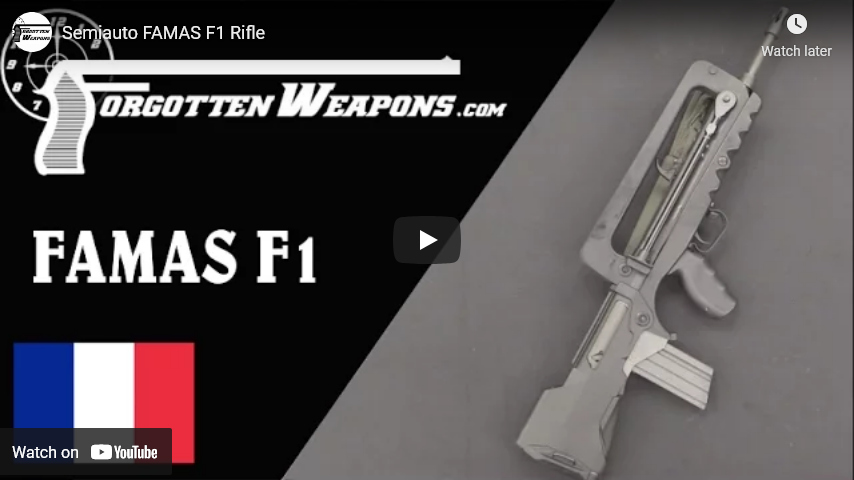
About 700,000 MAT-49s were produced between 1949 and 1979, when it (along with the MAS 49/56 rifle) was replaced by the FAMAS bullpup rifle. During that time it saw substantial combat in France’s colonial wars, notable Algeria and Indochina. Despite being a relatively heavy weapon, it came to be well liked by all who used it for its durability and reliability.
Many thanks to the anonymous collector who let me take a look at this piece and bring you a video on it!
If you enjoy Forgotten Weapons, check out its sister channel, InRangeTV! http://www.youtube.com/InRangeTVShow
July 25, 2021
Russian Type 2 AK: Introducing the Milled Receiver
Forgotten Weapons
Published 8 Jul 2018http://www.patreon.com/ForgottenWeapons
Cool Forgotten Weapons merch! http://shop.bbtv.com/collections/forg…
Updated to fix errors in nomenclature and production dates.
With recognition of the production problems of the original Type 1 AK, an alternative was needed. Russian engineer Valeriy Kharkov led a team of engineers who designed a replacement drop-forged and machined receiver for the AK. This new receiver was not a technical challenge for Izhevsk to produce, and it added durability and potentially accuracy to the weapon, at the cost of an additional pound (half kilo) of weight and more manufacturing time/expense.
The Type 2 AK is distinctive for its rear socket used to attach the buttstock, which was done to simplify the receiver profile and to allow the same receiver to be used for both fixed and underfolding stocks. The Type 2 receiver also has a weight reduction scalloped cut on the right side which is parallel to the top surface of the receiver (on the later Type 3, this cut would be made parallel to the bottom of the receiver instead) as well as a few other smaller features.
While the Type 2 receiver solved the immediate problem for Kalashnikov’s team, it would only be in production for a short time. Introduced in 1951, production ceased in 1957, being replaced by an improved iteration of milled receiver, the Type 3, in 1955. The Type 3 would remain in production until the stamped receiver was finally perfected as the AKM in 1959, and the Type 3 would be produced by a significant number of nations outside the Soviet Union.
Today, the second pattern AK is an very rare weapon, and I am grateful to the private collector who allowed me to video this one for you!
If you enjoy Forgotten Weapons, check out its sister channel, InRangeTV! http://www.youtube.com/InRangeTVShow
Contact:
Forgotten Weapons
6281 N Oracle #36270
Tucson, AZ 85704
July 22, 2021
Type 1 Russian AK: The First Production Stamped AK (Updated)
Forgotten Weapons
Published 8 Jul 2018http://www.patreon.com/ForgottenWeapons
Cool Forgotten Weapons merch! http://shop.bbtv.com/collections/forg…
Updated to fix errors of nomenclature and production dates.
The AK was formally adopted in 1947, and went into production in 1948. In this very first form, it used a stamped receiver with front and rear trunnions riveted in place. Unfortunately, while the hand-fitted preproduction guns were quite excellent, the manufacturing processes and quality control left a lot to be desired. The stamped receiver was relatively thin (especially compared to previous stamped Russian small arms like the PPS-43), and was very susceptible to warping during heat treating and other parts of the manufacturing process. The guns that met QC requirements were every bit as good as expected, but the high number of rejects nullified much of the point of having those stamped parts in the first place.
For this reason, Type 1 AK production ended in 1951, and a milled receiver was developed to allow rifles to continue being made while the engineering and production team worked to improve the receiver design and the manufacturing processes around it.
It should be noted that the “AK-47” was the final prototype version of the gun, and the Type 1 was designated simply “AK” in official Soviet documentation.
Today, the first pattern AK47 is an extremely rare weapon, and I am grateful to the private collector who allowed me to video this one for you!
If you enjoy Forgotten Weapons, check out its sister channel, InRangeTV! http://www.youtube.com/InRangeTVShow
Contact:
Forgotten Weapons
6281 N Oracle #36270
Tucson, AZ 85704
July 19, 2021
Luxembourg FN49 Semiauto Sniper Rifle
Forgotten Weapons
Published 30 Jan 2019http://www.patreon.com/ForgottenWeapons
Cool Forgotten Weapons merch! http://shop.bbtv.com/collections/forg…
After World War Two, Luxembourg was one of the nations which opted to purchase new FN-49 rifles. It bought a total of 6,203 of them for the military — an initial purchase of 4,000 semiauto SAFN rifles and a followup purchase of 2,000 AFN select-fire rifles and 203 semiauto rifles fitted with Belgian OIP telescopic sights. The scope mounts were commercial Echo mounts, designed and manufactured by an American engineer named Herkner, in Boise Idaho.
When Luxembourg replaced its FN49 rifles with the newer FN FAL type, the snipers were either scrapped or sold as surplus, but the scopes were kept and reused on FALs. However, the Luxembourg rifles used the same pattern OIP scopes as the Belgian military, and these are often found mounted to surviving Luxembourg rifles.
Contact:
Forgotten Weapons
PO Box 87647
Tucson, AZ 85754
July 16, 2021
Rhodesian FAL – with Larry Vickers
Forgotten Weapons
Published 1 Jul 2018http://www.patreon.com/ForgottenWeapons
Cool Forgotten Weapons merch! http://shop.bbtv.com/collections/forg…
The iconic weapon of the Rhodesian Bush War is the FN-FAL, painted in a distinctive “baby poop” yellow and green pattern. Because Rhodesia was under international embargo, its options for obtaining weapons were limited. Some domestic production was undertaken, but one large source was neighboring South Africa. Both South African production FALs and also Belgian-made South African contract FALs were provided. This rifle is one of the latter, with the South African crest and proof marks defaced for some theoretical deniability should it be scrutinized.
Larry Vickers will talk us through this FAL, pointing out the different elements that are distinctly Rhodesian, as well as the unique Halbeck Device — and detachable muzzle brake.
Thanks to Larry for sharing this rifle with us!
If you enjoy Forgotten Weapons, check out its sister channel, InRangeTV! http://www.youtube.com/InRangeTVShow
Contact:
Forgotten Weapons
6281 N Oracle #36270
Tucson, AZ 85704
July 12, 2021
Shooting the Ishapore MkIII Vickers-Berthier LMG
Forgotten Weapons
Published 20 Sep 2017http://www.patreon.com/ForgottenWeapons
Cool Forgotten Weapons merch! http://shop.bbtv.com/collections/forg…
The Vickers-Berthier MkIII was adopted by the Indian army in 1933, and served through World War Two and into the 1970s (at least). It is chambered for the standard .303 British cartridge, fires from an open bolt, and uses top-mounted 30-round magazines. I didn’t know exactly what to expect when I had the chance to fire this one — and it turned out the be an excellent experience.
The rate of fire on the Vickers-Berthier is relatively low, and I found it to be an exceptionally stable and controllable gun to fire from its bipod. I don’t know if it’s the unusual muzzle brake design or other factors as well, but the sight picture remains stable and clear in a way that few other LMGs have matched in my experience.
Thanks to Marstar for letting me examine and shoot their Vickers-Berthier!
If you enjoy Forgotten Weapons, check out its sister channel, InRangeTV! http://www.youtube.com/InRangeTVShow
July 11, 2021
History and Disassembly of the Vickers-Berthier MkIII LMG
Forgotten Weapons
Published 19 Sep 2017http://www.patreon.com/ForgottenWeapons
Cool Forgotten Weapons merch! http://shop.bbtv.com/collections/forg…
The Vickers-Berthier was initially designed by Andre Berthier in France prior to World War One. It went through a number of substantial design changes before the war, and was actually ordered in quantity by the United States right at the end of WWI — but the order was cancelled with the armistice. In the 1920s, Berthier sold the design to the Vickers company in England, which wanted a light machine gun to market alongside its Vickers heavy machine gun.
When the British military decided to replace its Lewis and Hotchkiss light machine guns, the Vickers-Berthier was one of the leading contenders, although in the endurance trials it was edged out by the Czech ZB-33, which would ultimately be adopted as the Bren. However, the Indian Army opted to take the Vickers-Berthier, and it was put into production at the Ishapore Rifle Factory and saw substantial use in World War Two.
Mechanically, the Vickers-Berthier is a tilting bolt design with a long stroke gas piston. It has a thorough set of covers over the magazine well and ejection port, and a relatively slow rate of fire. The barrel is quick-changeable, and it feeds from top-mounted 30-round magazines, with an aperture type rear sight being offset to the left side of the gun to clear the magazine.
Thanks to Marstar for letting me examine and shoot their Vickers-Berthier!
If you enjoy Forgotten Weapons, check out its sister channel, InRangeTV! http://www.youtube.com/InRangeTVShow