
World War Two
Published 7 Aug, 2025September 1931: Berlin descends into chaos as Nazis unleash a violent pogrom on Jewish New Year — while the police stand by. The scandal of the Kurfürstendamm riot rocks Germany, but the month’s headlines don’t stop there: Hitler’s niece is found dead under mysterious circumstances, France’s leaders visit Berlin to a frosty reception, and Japanese troops invade Manchuria. Extremists surge at the polls as democracy teeters — can the Republic survive?
(more…)
August 8, 2025
Germany’s Darkest Night Yet? – Rise of Hitler 21 – September 1931
Comments Off on Germany’s Darkest Night Yet? – Rise of Hitler 21 – September 1931
August 3, 2025
20th century advertising alchemy rediscovered
Much sound and fury has been devoted to the ritual denunciations of American Eagle and their new ad campaign featuring blatant Nazi ideology and imagery, er, I mean Sydney Sweeney:

Whenever I endure a sentence which trespasses into a jibe about whiteness or men or some other illusory bugbear, I stop reading and launch the laptop through the window. This week, I’ve cleaned out eBay. As one delivery driver lugs a fresh laptop to my front door, another scoops up the last to fall from the sky.
Those all-too-common laments about skin colour or genitalia are the scarlet letter imprinted on the chest of the thoughtless bore. It’s a mind virus without antidote. Screeching “whiteness!” upon snapping one’s shoelace betrays sound psychological health.
Take Sydney Sweeney, an American actress blessed with a merciless, unfair genetic inheritance. This week, Sydney broke the internet. Her crime? She’s rather attractive. Worse yet, Sydney flaunts her icy, Scandinavian beauty.
In an advert for American Eagle, the dewy, lissom blonde squeezes her gymnastic body into a pair of denim jeans. Smouldering before the camera, Sydney flutters her “great genes”.
Those great genes sashay around a classic Mustang — 400 horses of unapologetic masculine energy. Sydney pats her hypnotic behind. She fires up that climate-melting engine. The infernal marriage of masculine-feminine consummates as she roars off into the distance.
Advertisers know what they did. Diana, Roman goddess and huntress of men. Her chariot, the male appendage made steel and exploding gasoline. A combination to light our monkey brains on fire. The symbolism hijacks our amygdala: buy these jeans, and she’s yours. Or, for the other sex, buy these and manipulate them.
I’m sorry to be so blunt, reader. Those claims, as primitive as they may appear, are the animating spirit of advertising. Back in the 1920s, Freud’s nephew, Edward Bernays, transplanted Uncle Siggy’s theories into the advertising business. Out went staid adverts praising a product’s utility. In went adverts selling visions of your unconscious, insatiable self. Bernays transformed the public relations and advertising worlds. He sold products that stirred the galloping herds of the subconscious mind.
Take cigarettes. Before Bernays, smoking was a decidedly male pursuit. Tobacco giants, keen to double their potential customer pool, turned to him. Bernays transformed smoking from a vulgar, unladylike pastime into a symbol of freedom and female empowerment. Men buy Patek Phillipe watches for the same reason. As Dave Chappelle put it: “If a man could fuck a woman in a cardboard box, he wouldn’t buy a house”.
In just a few moments, Sweeney’s serpentine hips lulled advertising away from overt wokeness to its subliminal witchcraft. It worked. American Eagle’s stock surged fifteen percent.
For research, I studied the ad twenty-seven times. Your humble narrator bought thirty-seven pairs of jeans and then signed over his entire inheritance to Ms Sweeney.
The reaction on the identitarian left authored five additional chapters to the upcoming edition of the Diagnostic and Statistical Manual of Mental Disorders.
By teasing the words “genes” and “jeans”, Sweeney called for the annexation of Poland and the Sudetenland. MSNBC excelled itself, even birthing a new pidgin English indecipherable to 97 percent of native speakers:
“Sydney Sweeney’s ad shows an unbridled cultural shift towards whiteness”.
Well, that’s one way to think about it.
Comments Off on 20th century advertising alchemy rediscovered
August 1, 2025
When Stalin and Hitler Teamed Up – Prussia 1931 – Rise of Hitler 20, August 1931
World War Two
Published 31 Jul 2025August 1931: Prussia becomes the battleground as a bizarre alliance of Nazis, Communists (under Stalin’s orders), right-wing elites, and President Hindenburg tries to topple Germany’s last major democracy. With foreign meddling, political violence, and backroom deals, the fate of the Weimar Republic hangs by a thread. Against all odds, the democratic coalition prevails — at least for now. But with chaos spreading and the world watching, can democracy survive the next assault?
(more…)
Comments Off on When Stalin and Hitler Teamed Up – Prussia 1931 – Rise of Hitler 20, August 1931
July 11, 2025
Why Didn’t France and Britain Stop Germany’s Secret Rearmament? – Out of the Bullpen 001
World War Two
Published 10 Jul 2025In this special “Out of the Bullpen” episode, we answer your burning questions about Weimar Germany’s most turbulent years. From clandestine military pacts with the Soviets to the creative ways Germany sidestepped Versailles, we dig into aspects which shaped a republic on the brink.
(more…)
Comments Off on Why Didn’t France and Britain Stop Germany’s Secret Rearmament? – Out of the Bullpen 001
June 27, 2025
Germany’s Constitution, Erotica, and a Pastor’s Dignity – Rise of Hitler 19, July 1931
World War Two
Published 26 Jun 2025A rogue preacher breaks into the Reichstag and steals silverware, banned erotica, and the 1848 German Constitution. As Germany’s banks collapse and panic spreads, the press is captivated by the strange tale of Walter Wohlgemuth: pastor, thief, and accidental symbol of a republic in crisis.
(more…)
Comments Off on Germany’s Constitution, Erotica, and a Pastor’s Dignity – Rise of Hitler 19, July 1931
June 25, 2025
H.G. Wells’ Things To Come: Through The Eyes of its Time
Feral Historian
Published 10 Jan 2025H.G. Wells’ Things To Come played much differently in 1936 than it does today. So much so that it offers us an insight into the politics of the period if we can step back from our post-WWII understanding and look at it on its own terms.
Link to the Coupland essay.
http://digamoo.free.fr/coupland2000.pdf00:00 Intro
02:08 Revolution Envy
05:15 The Gulf of Time
06:32 Wells and the BUF
08:02 Empire and Establishment
12:11 The World State
15:18 To Understand the Past …
Comments Off on H.G. Wells’ Things To Come: Through The Eyes of its Time
June 9, 2025
QotD: “Defending” democracy with totalitarian methods
One of the peculiar phenomena of our time is the renegade Liberal. Over and above the familiar Marxist claim that “bourgeois liberty” is an illusion, there is now a widespread tendency to argue that one can defend democracy only by totalitarian methods. If one loves democracy, the argument runs, one must crush its enemies by no matter what means. And who are its enemies? It always appears that they are not only those who attack it openly and consciously, but those who “objectively” endanger it by spreading mistaken doctrines. In other words, defending democracy involves destroying all independence of thought. This argument was used, for instance, to justify the Russian purges. The most ardent Russophile hardly believed that all of the victims were guilty of all the things they were accused of: but by holding heretical opinions they “objectively” harmed the regime, and therefore it was quite right not only to massacre them but to discredit them by false accusations. The same argument was used to justify the quite conscious lying that went on in the leftwing press about the Trotskyists and other Republican minorities in the Spanish civil war. And it was used again as a reason for yelping against habeas corpus when Mosley was released in 1943.
These people don’t see that if you encourage totalitarian methods, the time may come when they will be used against you instead of for you. Make a habit of imprisoning Fascists without trial, and perhaps the process won’t stop at Fascists. Soon after the suppressed Daily Worker had been reinstated, I was lecturing to a working men’s college in South London. The audience were working‐class and lower‐middle‐class intellectuals — the same sort of audience that one used to meet at Left Book Club branches. The lecture had touched on the freedom of the press, and at the end, to my astonishment, several questioners stood up and asked me: Did I not think that the lifting of the ban on the Daily Worker was a great mistake? When asked why, they said that it was a paper of doubtful loyalty and ought not to he tolerated in war time. I found myself defending the Daily Worker, which has gone out of its way to libel me more than once. But where had these people learned this essentially totalitarian outlook? Pretty certainly they had learned it from the Communists themselves!
Tolerance and decency are deeply rooted in England, but they are not indestructible, and they have to be kept alive partly by conscious effort. The result of preaching totalitarian doctrines is to weaken the instinct by means of which free peoples know what is or is not dangerous. The case of Mosley illustrates this. In 1940, it was perfectly right to intern Mosley, whether or not he had committed any technical crime. We were fighting for our lives and could not allow a possible Quisling to go free. To keep him shut up, without trial, in 1943 was an outrage. The general failure to see this was a bad symptom, though it is true that the agitation against Mosley’s release was partly factitious and partly a rationalization of other discontents. But how much of the present slide to ward Fascist ways of thought is traceable to the “anti‐Fascism” of the past ten years, and the unscrupulousness it has entailed?
George Orwell, “The Freedom of the Press“, 1945 (written as the introduction to Animal Farm, but not published in Orwell’s lifetime).
Comments Off on QotD: “Defending” democracy with totalitarian methods
June 8, 2025
The Canadian Retribution at Normandy | History Traveler Episode 196
The History Underground
Published 16 Feb 2022Throughout the Battle of Normandy, the Canadians of the 3rd Infantry Division and the Germans of the 12th SS Panzer Division found themselves locked in a battle of attrition that would mark some of the most vicious fighting of the entire campaign. After suffering a blow at Buron and Authie (as seen in the last episode) the fight shifted over to a place that has now become legendary in Canadian military history: Bretteville-l’Orgueilleuse. In this episode, we’re joined by Paul Woodadge of @WW2TV to show a small part of one of the most epic fights in the battle to take Normandy.
(more…)
Comments Off on The Canadian Retribution at Normandy | History Traveler Episode 196
June 7, 2025
The US President Saves Germany – Rise of Hitler 18 – June 1931
World War Two
Published 5 Jun 2025In June 1931, Germany teeters on the edge of collapse — facing riots, unemployment, and a banking crisis. Amidst chaos and international pressure, US President Herbert Hoover offers a dramatic moratorium on war debts, giving Germany a critical lifeline. Can this American intervention stabilize the Weimar Republic, or is disaster still on the horizon? Explore how global politics, economic turmoil, and desperate diplomacy shape a nation’s fate.
(more…)
Comments Off on The US President Saves Germany – Rise of Hitler 18 – June 1931
The 12th SS Massacre of the Canadians in Normandy | History Traveler Episode 195
The History Underground
Published 9 Feb 2022In the days after D-Day, the Canadians of the 3rd Infantry Division found themselves up against the German 12th SS Panzer Division as they were making their way south through Normandy. Tragically, some of these men would find themselves as the victims of one the battle’s worst atrocities at a place called Abbey Ardenne. In this episode, we’re joining Paul Woodadge of @WW2TV as we retrace the final steps of these men as they made their way to a tragic fate at the hands of Kurt Meyer and a division of the most fanatical fighters that Germany threw into the Battle of Normandy.
(more…)
Comments Off on The 12th SS Massacre of the Canadians in Normandy | History Traveler Episode 195
May 23, 2025
Did Germany Just Choose a King? – Rise of Hitler 17, May 1931
World War Two
Published 22 May 2025May 1931: 150,000 Stahlhelm men parade through Breslau before Crown Prince Wilhelm and other imperial relics, reviving monarchist hopes. Hitler hails his SA and calls for eastern expansion. But it’s economic collapse that dominates — Austria’s top bank nears default, threatening Germany’s own system. As Berlin pushes for a reparations pause and clings to its customs union with Vienna, France stands firm. And in Oldenburg, the Nazis take their first Landtag.
(more…)
Comments Off on Did Germany Just Choose a King? – Rise of Hitler 17, May 1931
May 21, 2025
The Butt Report – Nadir of the RAF – The Bomber War Episode 3
HardThrasher
Published 15 Dec 2023As the powers that be on YT have decided that this video is Evil and naughty they’ve removed the ads — which, like, is great from your point of view but a bit shite from mine. So if you wanted to it’d be awesome if you’d consider either hitting the Super Thanks button or consider becoming a super cool kid and joining my Pateron.
If you’d like to email me send a message to lordhardthrasher@gmail.com
In this episode, the Butt Report, what happened next and the arrival of Bomber Harris. Despite this being more than 50 minutes, I’ve skipped some detail e.g. The Singleton Report which basically said “eh – bit difficult this bombing thing” nor Tizard’s rubbishing of Cherwell’s Memorandum, nor really the detail of the Cherwell Memorandum. You’ll live. However if you want more on the subject then I recommend the Official History of Bomber Command to get more into the civil service fire fights.
(more…)
Comments Off on The Butt Report – Nadir of the RAF – The Bomber War Episode 3
May 9, 2025
Nazi vs. Nazi – The Rebellion Within – Rise of Hitler 16, April 1931
World War Two
Published 8 May 2025April 1931 plunges Hitler’s Nazis into crisis as SA leader Walter Stennes leads a dramatic internal revolt, challenging Hitler’s oath to legality. Meanwhile the Nazis loose their only ministerial post and President Hindenburg’s emergency decree intensifies clashes with communists, leading to mass arrests during banned protests.
(more…)
Comments Off on Nazi vs. Nazi – The Rebellion Within – Rise of Hitler 16, April 1931
May 8, 2025
Aftermath
I’ve read a few books on what happened in Europe after the surrender of Nazi Germany in May of 1945, but there is always more to learn about a continent-wide struggle to recover from a disaster of the magnitude of World War Two:
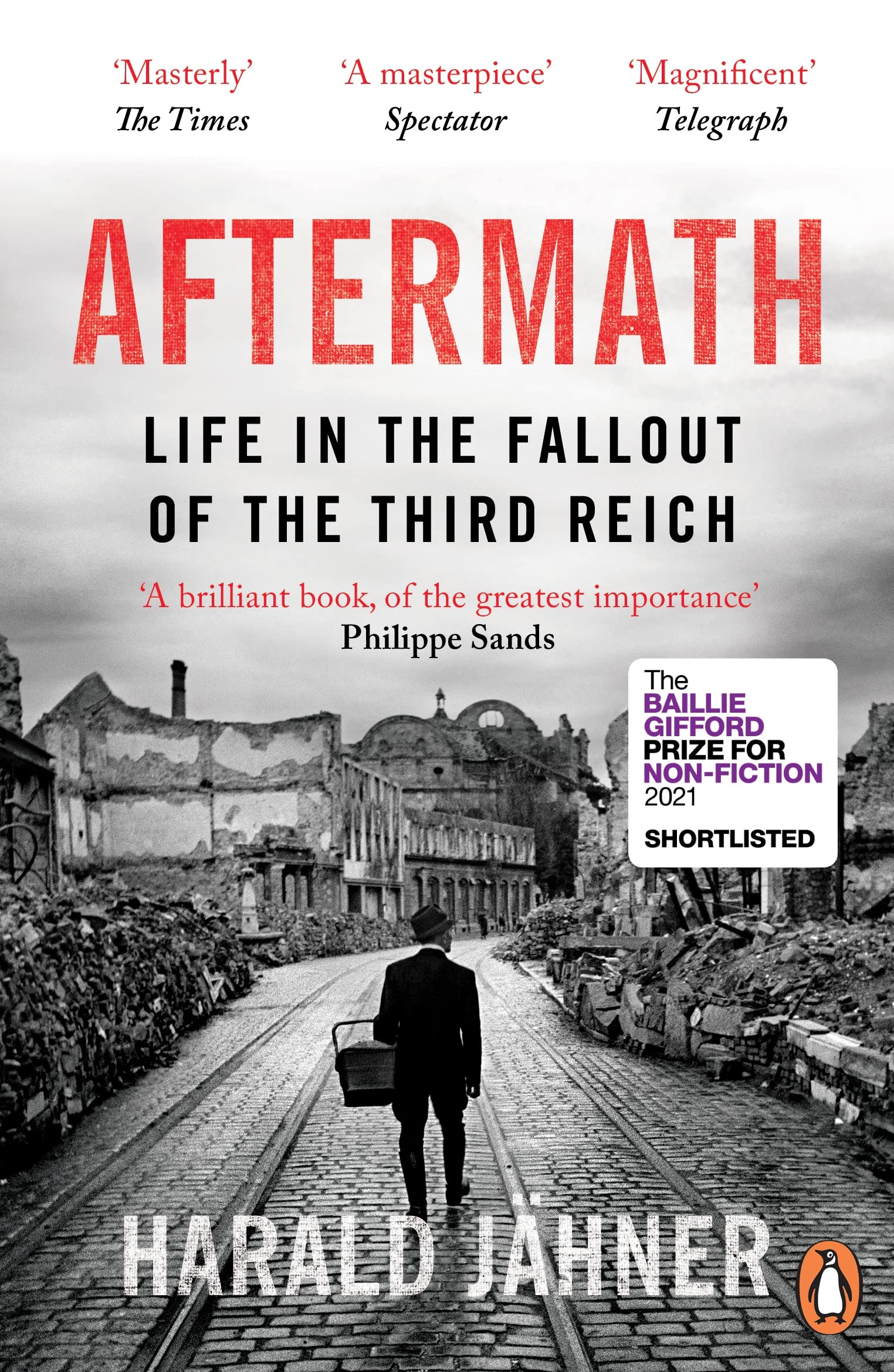
On a train journey earlier this year between Cologne and Berlin, I began to read Harald Jähner’s Aftermath, a fascinating account of the years when Germany emerged from the destruction and shame of the Third Reich.
The war ended 80 years ago today, and in the defeated nation the scenes were primeval and apocalyptic. In Berlin, journalist Ruth Andreas-Friedrich, along with a doctor, actor and musical conductor, discovered a white ox wandering through the streets and, after finding a Russian soldier to shoot it, found themselves suddenly surrounded by a ravenous mob. She recalled: “Suddenly, as if the underworld had been spying on them, a noisy crowd gathered around the dead ox. They crept from a hundred basements. Women, men, children. Were they lured by the smell of blood? Within minutes they were scrambling for meat.” The bourgeois of Middle Europe reduced to an animal state.
Germany was a pile of rubble; the ruins in the Reich‘s capital amounted to 55 million cubic metres, enough for a wall 30 metres wide and 5 metres high stretching all the way to Cologne. In West Berlin, for the next 22 years, up to 800 lorries a day unloaded so much rubble on the former Factory of Armaments Technology that it became known as Teufelsberg, or Devil’s Mountain. The last “rubble brigade” in Dresden only finished work in 1977.
Although Nazi party members were made to clear rubble as a punishment, the Germans hardly needed encouragement; on 23 April, the war not yet over, the municipal building of Mannheim had already declared WE ARE REBUILDING.
The communal process of clearing away seemed to serve a psychological function for a hungry, defeated people, and was encouraged by the new authorities — all the “heroic cinematic rhetoric” employed by the UFA film company of the Nazi regime now used to get the country clearing up. There was even a cinema genre called Trümmerfilm, rubble films, one — And The Heavens Above Us — ending with the Lord’s Prayer being recited among the ruins of Germany.
German POWs, “dispirited, disciplined and dutiful to the point of submissiveness”, made life easy for occupying soldiers while their former victims were far more troublesome. (Russian POWs in France caused such anarchy that they called in a Soviet liaison officer who selected ten at random and shot them, bringing the mob under control.) This led to a bizarre alliance between Allied and German law enforcement working hand-in-hand from the early days of the occupation, with joint raids and weapons searches on displaced persons from Poland and the Soviet Union, which the Poles and Russians “of course saw as an intolerable provocation”.
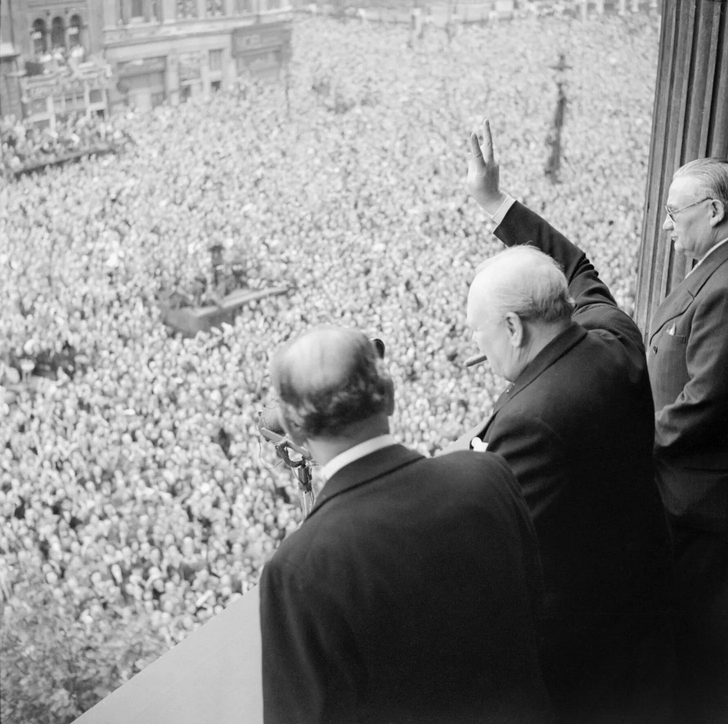
London cheered on May 8, 1945. In Berlin they searched for food and cleared rubble
In a strange irony, there was now a large-scale migration of Jews from Poland to Germany, fleeing fresh persecution despite the horror they had endured. Even here in a camp system under Allied control, there were anti-Semitic attacks from other survivors, so that Jews were eventually separated altogether following the conclusions of the Harrison Report. The Americans, in a likely first in European history, now made Jews an explicitly privileged group, with superior camp conditions.
The Polish Jews set up their own camp in the Munich district of Bogenhausen where locals were confused and disorientated by the new arrivals. These eastern Jews actually looked like the alien caricatures Nazi propaganda had bombarded them with, dressed in oriental clothes from the shtetl, totally unlike the assimilated German Jews they had grown up with. One local complained that “the Jews from the old days were really, how can I put it, very intelligent, polite and unusually friendly and elegant people. And of course the ones who turned up after the war included all sorts.” The Jews “from the old days” were “the good Jews”, he lamented.
Holocaust guilt was in the distant future for most, and newly re-established newspapers weren’t remotely shy about publishing anti-Semitic content. One printed a resident’s complaint about Polish Jews that “these were not people who had been persecuted” but “the sputum, the yeast and the scum of elements who were never deported but, to avoid regular work, came here from the eastern states, in many cases completely illegally, and are now spreading themselves raggedly about the place.”
Comments Off on Aftermath
May 4, 2025
The Clean German Myth, Doomed B-17 Pilots, and Japan’s Rapid Victories – Out of the Foxholes Live
World War Two
Published 3 May, 20205Indy and Sparty tackle some more of your interesting questions in another live Out of the Foxholes. Today they look at loss rates of B-17 crews, the myth of the clean Wehrmacht, and ask why the West was apparently so unprepared for Japan’s attack.
(more…)
Comments Off on The Clean German Myth, Doomed B-17 Pilots, and Japan’s Rapid Victories – Out of the Foxholes Live


