An ad in the Nashville Craigslist:
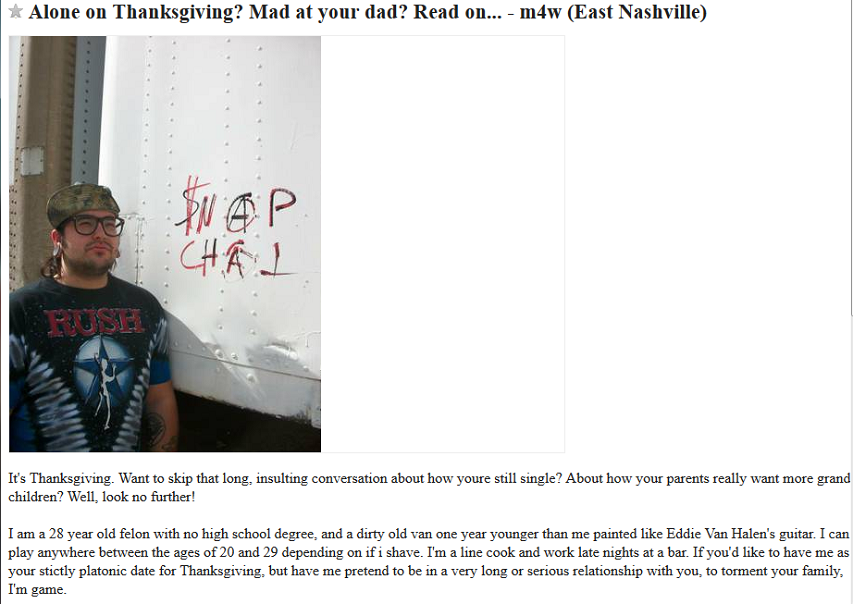
It may not be a huge market, but there’s definitely a demand for these kind of services, especially at Thanksgiving, Christmas, and family birthday parties.
H/T to Marina Stover for the link.

An ad in the Nashville Craigslist:
It may not be a huge market, but there’s definitely a demand for these kind of services, especially at Thanksgiving, Christmas, and family birthday parties.
H/T to Marina Stover for the link.
In The Federalist, Rachel Lu says that Neanderthals were better at parenting than modern humans:
Is it just me, or has the world gone completely crazy when it comes to childrearing?
You know what I’m talking about. Once upon a time, people expected to get married in early adulthood and have kids at reasonable intervals. Parents stayed married and paid the bills, while kids played in front yards and freely opened sidewalk lemonade stands. Children fit naturally into the rhythm of American life.
Nowadays, we treat children like a deathly plague, unless of course you’ve decided you want one. Then they become a luxury good worth tens or even hundreds of thousands. Once acquired, they must be treated like prize poodles, feted and protected at every turn.
The traditional family model has largely been put through the shredder, much to the detriment of children. We try to make up for this by hovering over our kids every second, and sending the police after parents who still think it’s fine to take their grandparents’ more laid-back, “let the kids play” approach.
In other words, our ideas about family are a huge, hairy mess. It’s strange we would have so much trouble figuring out a thing that’s been done since Neanderthal times. Then again, maybe that’s the real problem. Unlike Neanderthals, we’re obsessed with figuring out how to do this. We’ve fought tooth and nail to free ourselves from the natural implications of our biology and, as a reward, we now have to plan every detail of family formation. There’s no taking comfort in “the done thing” anymore. Parenthood today is all about doing it right.
It’s a perfect illustration of a major drawback of the modern egalitarian marriage: coordination failure. In a traditional household, paper towel acquisition was within the wifesphere. She monitored the stocks, arranged for any necessary purchases and put them away within a storage scheme of her own devising. No one had to discuss the distribution of responsibilities or quarrel about their execution. But egalitarian marriages split things up along the idiosyncratic preferences of each couple. That creates three problems that every couple must deal with: Negotiations, Overlaps and Gaps.
Let me make one thing clear: I am not writing a brief against egalitarian marriage. I am in one. Both of us work, often quite long hours. Both of us assume some household duties: I oversee the plant life (ineptly), buy groceries, cook, vacuum and clean out the roof gutters as necessary; my husband, who is much neater than I am, is in charge of storage, dishwashing, home electronics and the termination of any pests larger than an ant. Nor am I a Self-Hating Egalitarian; I think this is a splendid arrangement. But like everything else in life, it has drawbacks, and this one is worth noting.
[…]
Take the kitchen. I am in charge of kitchen equipment, cooking and organization. But my husband is in charge of dishwashing and storage. The result: We have a carefully thought-out scheme of What Goes Where that is completely intuitive — to me. He doesn’t know where the measuring spoons go, and half the time, I can’t find them.
We could fix this by carefully mapping out a scheme that both of us find intuitive. Unfortunately, we don’t have six weeks and a crack team of high-level diplomats to devote to the negotiations. Peter could also simply ask me where every single item goes every single time he does the dishes, but our yard is small and our basement is on a concrete slab, and I can’t figure out where I’d put the grave. So what if I haven’t seen my sifter in three months? It seems a small price to pay.
Megan McArdle, “How to Stop Money From Killing Your Marriage”, Bloomberg View, 2014-09-12.
Last year, the Scottish government introduced legislative proposals to nominate state guardians for all Scottish children, to be called “named persons” and to exercise rather Orwellian powers over the child and the child’s parents. The legislation is now in force, and Stuart Waiton explains why it’s such an intrusive step:
The children’s minister, Aileen Campbell, has been dismissive of those people who have criticised the act as state snooping, or, as many Christian groups have put it, an ‘attack on the family’. For Campbell, the new powers and duties being given to the state guardians are simply another service to help families in trouble and further ensure that children are protected in society. Indeed, Aileen Campbell at times appears to be nonplussed by her critics, incapable of seeing why her caring approach is not instantly celebrated. The claims of state snoops undermining the family, she argues, are simply ‘misunderstandings’ and ‘misrepresentations’ of the new law. When someone raised the point that this act undermined the role of parents in child-rearing, Campbell, somewhat comically, replied, ‘we recognise that parents also have a role’.
However, given the increasing ways in which all children are being categorised as ‘vulnerable’, the way in which all professionals are being educated to put child safety at the top of their agenda, and at time in which ‘early intervention’ is promoted as the only rational approach to solving social problems, there is a serious risk that the relationship between the ‘named person’ and parents will become one predicated on suspicion. Given that the red line for when it is appropriate to intervene in a child’s life is also being downgraded, from the child being seen as at serious risk of harm to mere concerns about their ‘wellbeing’, the potential for unnecessary and potentially destructive state intrusion into family life with this law is significant.
[…] There is also a great danger here that by incorporating every single child in the child-safety rubric, the few children who need state intervention in their lives will get lost in this vast system and not get the support they need. As one concerned parent has noted, when you are looking for a needle in a haystack, why make the haystack bigger?
 Elizabeth and I got married in Toronto on this date in 1983. It was a bit of a race to get to the courthouse on time — my so-called best man decided that he had to go back to Mississauga “for a shower” that morning, and was quite late getting back into Toronto. Trying to get a cab to hurry in downtown Toronto traffic was a waste of effort, so I very nearly missed my own wedding. Elizabeth was not pleased with me holding up the show (even though I could rightfully claim it wasn’t my fault). The rest of the day is rather a blur to me now.
 We had the reception that evening at a lovely house in the Playter Estates (during which my father tried to pick a fight with Elizabeth’s uncle), and then set off for our very brief honeymoon in Niagara-on-the-Lake the next day. We could only afford two nights at the Prince of Wales hotel, and because we got married on Saturday, we were in NOTL for Sunday and Monday nights. Back in 1983, Ontario still had fairly restrictive Sunday closing laws, so there was very little to do — almost everything was closed. (And that was probably for the best, as we had almost no money to spend anyway…)
 One of the few businesses we found open in the area was the original Chateau des Charmes estate winery (not the huge, imposing facility of today: a small industrial-looking building a few kilometres away), where the only person on duty was Mme Andrée Bosc who gave us an exhaustive tasting experience and showed us around the winery. Neither of us were experienced wine drinkers, so this was wonderful for both of us. I’d love to say that we started our wine cellar that day, but that would only be partially true: we bought about a dozen bottles of various Chateau des Charmes wines, but we couldn’t afford to restock after those had been opened. We visited the winery every year on our anniversary for about a decade, until we got out of the habit of going back to NOTL (which was around the time our son was born).
After our brief honeymoon, we both had to go back to our jobs. Very shortly after that, my employer (the almost-unknown-to-Google Mr Gameway’s Ark) went bankrupt, which was financially bad timing for us, having just spent most of our tiny cash hoard on our honeymoon.
Everyone knows the old myth about a spike in wife-beating after major sporting events (most frequently referenced is the Superbowl, but the same factoid is trotted out about every “big game”). Barbara Kay reveals the awkward truth that nearly half of all spousal abuse is by female partners:
One of first-wave feminism’s great achievements in the 1970s was to end the denial surrounding wife abuse in even the “best” homes. Resources for abused women proliferated. Traditional social, judicial and political attitudes toward violence against women were cleansed and reconstructed along feminist-designed lines.
But then a funny thing happened. The closet from which abuse victims were emerging had, everyone assumed, been filled with women. But honest researchers were surprised by the results of their own objective inquiries. They were all finding, independently, that intimate partner violence (IPV) is mostly bidirectional.
But by then the IPV domain was awash in heavily politicized stakeholders. Even peer-reviewed community-based studies providing politically incorrect conclusions were cut off at the pass, their researchers’ names passed over for task force appointments and the writing of training manuals for the judiciary. Neither were internal whistle-blowers suffered gladly. Erin Pizzey, who opened the first refuge for battered women in England in 1971, was “disappeared” from the feminist movement when she revealed what she learned in her own shelter: She committed a heresy by asking women about their own violence, and they told her.
[. . .]
(While the CDC survey does not reference Canadian data, our IPV statistics vary significantly from the U.S.’s in certain respects. “Minor” wife assault rates as measured on the commonly employed Conflict Tactics Scale are identical, but “severe violence” rates in Canada fall as the violence ratchets up. For “kicking” and “hitting,” Canadian rates were 80% of the American rate; for “beat up,” they were 25%; and for “threatened with or used a gun/knife,” they were only 17%.)
By now there is no excuse for the failure of governments at all levels to follow through on — or at least acknowledge — the settled science of bilateral violence. Yet just last week the Justice Institute of British Columbia issued a lengthy report on “Domestic Violence Prevention and Reduction,” and sure enough, it defines domestic violence as “intimate partner violence against women,” recommending only that government work “to bridge gaps in the services and systems designed to protect women and children.”
One area where the majority of abusers are female is child abuse: women are much more likely to batter their children than men.



Powered by WordPress